
Anatomy of a Perfect Muay Thai Roundhouse Kick: A StepbyStep Guide


Welcome to Martial Arts Mastery, your gateway to the captivating world of combat disciplines! Ever wondered what truly separates a good Muay Thai roundhouse kick from a devastating one? Our in-depth exploration of Muay Thai roundhouse kick anatomy unveils the secrets behind this iconic technique, revealing the biomechanical precision and subtle adjustments that can elevate your striking power. Prepare to dissect the movement, unlock its potential, and discover the path to mastering this fundamental Muay Thai weapon... Dive in to learn more!
- Mastering the Muay Thai Roundhouse: A Comprehensive Breakdown
- Step 1: The Stance and Setup for a Powerful Muay Thai Kick
- Step 2: The Pivot and Hip Rotation: Generating Power
- Step 3: Chambering the Leg: Preparing for Impact
- Step 4: Extending the Kick: Delivering Devastating Force
- Step 5: The Follow-Through and Recovery: Maintaining Balance
- Step 6: Power Generation Techniques for Muay Thai Kicks
- Step 7: Common Mistakes and How to Fix Them in Your Roundhouse
- Step 8: Roundhouse Kick Variations in Muay Thai
- Step 9: Integrating the Roundhouse Kick into Muay Thai Combinations
- Conclusion: Perfecting Your Muay Thai Roundhouse Kick
-
Frequently Asked Questions
- What are the key muscle groups engaged during a Muay Thai roundhouse kick?
- How important is proper hip rotation in executing a powerful Muay Thai roundhouse kick?
- What is the optimal distance to maintain from an opponent when throwing a Muay Thai roundhouse kick?
- How can I improve the speed and flexibility required for a successful Muay Thai roundhouse kick?
- What are some common mistakes to avoid when practicing the Muay Thai roundhouse kick?
- Final Reflection: Mastering the Art of the Roundhouse
- Master the Kick: Unleash Your Muay Thai Potential Now!
Mastering the Muay Thai Roundhouse: A Comprehensive Breakdown
The Muay Thai roundhouse kick is arguably the most powerful weapon in the art of eight limbs. Unlike kicks in some other martial arts that use the instep, the Muay Thai variation connects with the shinbone, delivering immense force capable of breaking bones or knocking out opponents. Understanding the intricate anatomy of this strike is crucial for developing power, speed, and precision. This guide dissects the technique from the ground up, exploring the foundational elements, the mechanics of power generation, and advanced applications.
Developing a formidable Muay Thai roundhouse kick requires dedication and attention to detail. It's not just about brute strength; it's a complex sequence involving coordination, balance, and explosive hip rotation. By breaking down the kick into manageable steps, practitioners can identify weaknesses in their technique and work towards achieving that devastating power synonymous with elite Muay Thai kicking. This anatomical approach allows for a deeper understanding of how each part of the body contributes to the final impact.
Step 1: The Stance and Setup for a Powerful Muay Thai Kick
Proper Muay Thai Stance for Roundhouse Kicks
The foundation of any effective strike in Muay Thai is the stance. For throwing a powerful roundhouse kick, the traditional fighting stance provides the necessary balance and mobility. Typically, the lead foot points slightly inward, and the rear foot is angled outward, roughly shoulder-width apart. The weight is distributed evenly or slightly more on the back leg, allowing for quick pivots and weight transfers. This stance keeps the hips slightly angled away from the opponent, which is advantageous for initiating the hip rotation needed for the Muay Thai roundhouse kick anatomy.
Maintaining a relaxed yet alert posture is key. The knees should be slightly bent, providing a stable base and allowing for explosive movement. The hands are held high, protecting the head and face, while the elbows are tucked in to guard the ribs. This defensive posture is maintained even as the kick is initiated, a critical element often overlooked. Proper stance minimizes telegraphing and sets up the body mechanics required to generate maximum force in the subsequent steps of the roundhouse kick execution.
Weight Distribution for Optimal Kick Power
Weight distribution is paramount for generating power in a Muay Thai roundhouse kick. Before initiating the kick, a subtle shift of weight occurs. If kicking with the rear leg, the majority of the weight momentarily shifts to the lead leg. This allows the rear leg to become light and mobile, free to swing with maximum velocity. Conversely, if throwing a lead leg roundhouse, the weight shifts predominantly to the rear leg. This dynamic weight transfer is a core component of the anatomy of a Muay Thai kick's power generation.
This shift isn't just about balance; it's about loading the base leg to act as an anchor and pivot point. Imagine the lead leg (for a rear kick) as the central axis around which the body rotates. The stability provided by the weighted lead leg allows the hips to rotate explosively, pulling the rear leg through with tremendous force. For instance, a fighter weighing 70kg might shift 80-90% of their weight onto the supporting leg just before the pivot, demonstrating the significant load transfer involved in perfecting the Muay Thai roundhouse kick.
The Initial Pivot: Setting the Foundation
The initial pivot of the supporting foot is the first active movement in the roundhouse kick sequence and is foundational to its power. As the weight shifts to the supporting leg, the heel of that foot lifts off the ground, and the foot pivots outwards, typically 90 degrees or more, depending on the target angle. This pivot aligns the hips and shoulders optimally for rotation and prevents injury to the knee of the supporting leg. A common error is not pivoting enough, which restricts hip movement and reduces power.
This outward pivot serves multiple functions. Firstly, it clears the path for the kicking leg to travel through the target area without obstruction from the supporting leg. Secondly, and most importantly, it pre-loads the core and hips for the explosive rotation that follows. A well-executed pivot allows the fighter to generate rotational kinetic energy from the ground up, channeling it through the core and into the kicking leg. Fighters often practice this pivot extensively, sometimes just drilling the footwork without throwing the kick, recognizing its critical role in the overall Muay Thai roundhouse kick anatomy.
Step 2: The Pivot and Hip Rotation: Generating Power
The Importance of a Strong Pivot in the Roundhouse Kick
The pivot of the supporting foot is not a static position but a dynamic movement that continues throughout the kick. As the kicking leg swings, the supporting foot continues to rotate, allowing the hips to turn over fully. This strong, continuous pivot is essential for transferring the ground reaction force up through the body and into the strike. Without a committed pivot, the hips cannot rotate optimally, severely limiting the power generated, often by as much as 30-40% compared to a full hip turn.
Consider the analogy of throwing a baseball or swinging a bat; the power comes from rotating the body around a central axis, anchored by the feet. In the anatomy of a Muay Thai roundhouse kick, the supporting foot's pivot is that anchor point. Elite Nak Muay like Buakaw Banchamek are known for their incredibly deep pivots, often turning their supporting foot almost 180 degrees, allowing their hips to rotate completely and deliver maximum force with their shin. This level of pivot requires ankle and hip flexibility, developed through years of dedicated training.
Maximizing Hip Rotation for Kick Velocity
Hip rotation is the engine of the Muay Thai roundhouse kick. As the supporting foot pivots, the hips rotate violently, pulling the kicking leg through like a whip. The goal is to rotate the hips as far as possible, driving the non-kicking shoulder towards the target while the kicking-side hip drives forward. This rotational force accelerates the leg, resulting in a high-velocity impact with the shin. A common cue is to imagine trying to point your kicking-side hip at the target before impact.
Effective hip rotation involves engaging the core muscles powerfully. The obliques and abdominal muscles contract forcefully to drive the rotation. The non-kicking arm also plays a role, swinging down and across the body to help counter-balance and increase rotational momentum. The speed and completeness of this hip turn directly correlate to the power of the Muay Thai roundhouse kick. Studies have shown that maximum hip angular velocity occurs just before impact, highlighting its importance in the strike's anatomy.
Pivot and Hip Rotation Drills: Tire Drills and Medicine Ball Throws
Developing a powerful pivot and explosive hip rotation requires specific training. Tire drills are a classic Muay Thai exercise where fighters repeatedly kick a large truck tire suspended from a chain. Kicking the heavy, resistant tire forces the fighter to engage their hips and core fully to move it, building strength and muscle memory for the necessary rotation. Performing hundreds of kicks on the tire builds endurance and power in the hip flexors, glutes, and core.
Medicine ball throws are another excellent drill. Standing in a fighting stance, fighters hold a medicine ball and perform the hip rotation motion as if throwing a kick, but instead of kicking, they throw the ball explosively towards a wall or partner. This drill isolates and strengthens the rotational muscles of the core and hips, directly translating to increased power in the Muay Thai roundhouse kick. Using balls weighing 5-10kg for multiple sets of 10-15 repetitions can significantly improve rotational strength and speed.
Step 3: Chambering the Leg: Preparing for Impact
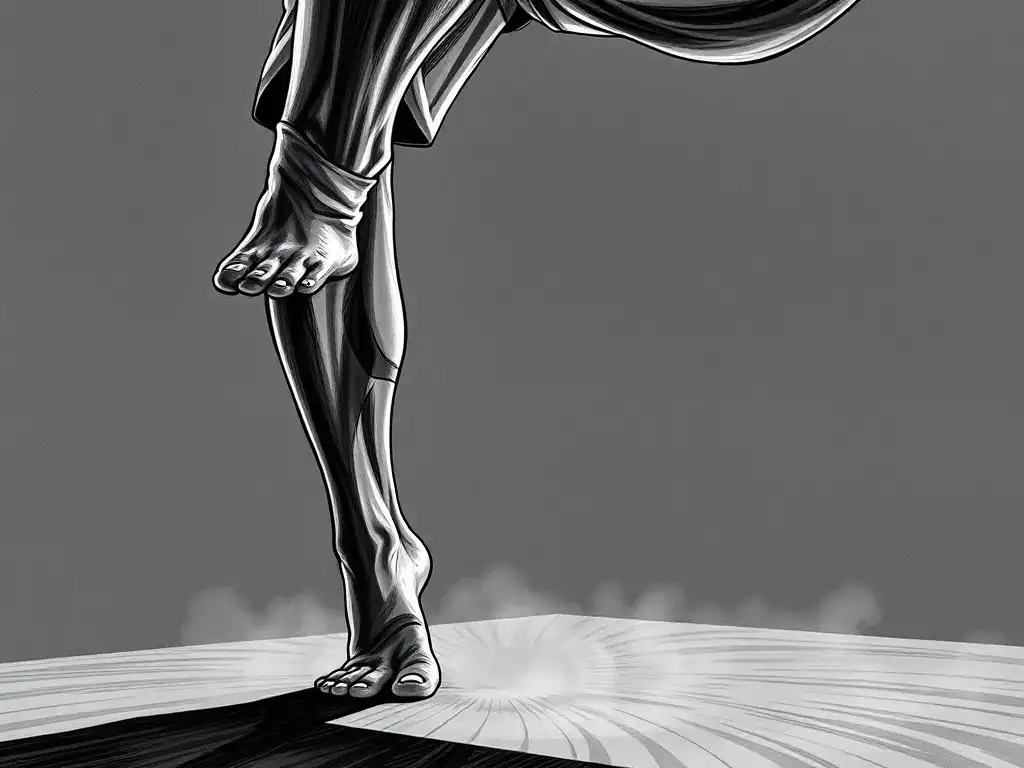
Understanding the Leg Chamber in Muay Thai Roundhouse Kicks
While some martial arts kicks feature a pronounced chamber where the knee is brought high towards the chest before extension, the Muay Thai roundhouse kick's chamber is different. It's less about holding a chambered position and more about the direct, powerful swing of the leg. As the pivot and hip rotation begin, the kicking leg lifts off the ground, and the knee bends naturally as the leg is pulled through by the rotating hips. The knee points generally towards the target area, but the motion is continuous rather than a distinct stop-and-hold chamber.
This 'dynamic chamber' allows for a more fluid and faster execution of the kick. The leg travels in a slight arc, often described as a 'baseball bat swing' or a 'golf swing', where the leg is accelerating throughout the motion. The bending of the knee during the initial lift allows the leg to clear the ground and positions the shin for the optimal angle of impact. Understanding this specific anatomy of the Muay Thai kick's lead-up is crucial for efficient technique.
Knee Position and Angle for Maximum Force
The position and angle of the knee during the swing are critical for delivering maximum force with the shin. As the leg swings, the knee should point towards the intended target. For a low kick targeting the thigh, the knee might point slightly downwards. For a body kick targeting the ribs or arm, the knee points more horizontally. The angle of the shin relative to the target at impact is also dictated by the knee's trajectory. The ideal is for the shin to be relatively perpendicular to the target surface at the moment of connection, maximizing the force transfer.
Maintaining the correct knee angle ensures that the hardest part of the shin makes contact. The tibia bone, particularly the lower half, is incredibly dense and strong due to conditioning. By driving the knee through the target line and extending the leg just before impact, the fighter ensures that this powerful weapon is utilized effectively. Incorrect knee angle can lead to impact with the foot or ankle, significantly reducing power and increasing the risk of injury, demonstrating a key aspect of the Muay Thai roundhouse kick anatomy.
Keeping the Guard Up During the Chamber
A common mistake, especially for beginners, is dropping the guard during the kick's chambering phase. As the kicking leg swings up, there's a natural tendency to drop the hands for balance or to add momentum. However, this leaves the head and body exposed to counter-attacks, particularly punches or head kicks. Maintaining a high guard is paramount throughout the entire sequence of the Muay Thai roundhouse kick.
The non-kicking arm, while potentially used for counter-balance, should not drop below chest level and should remain positioned to protect the face. The kicking-side arm is often tucked in or held high to protect that side of the head. Training drills often involve holding focus mitts or pads near the head while practicing kicks to reinforce the habit of keeping the guard up. This defensive consideration is an integral, albeit often overlooked, part of the Muay Thai roundhouse kick anatomy and execution.
Step 4: Extending the Kick: Delivering Devastating Force
Extending the Leg with Precision and Power
The extension of the leg is the final, explosive phase of the Muay Thai roundhouse kick before impact. As the hips complete their rotation and the leg is pulled through, the knee slightly extends, straightening the leg just enough to ensure contact is made with the shin. This extension isn't a full straightening like a front kick, but rather a forceful 'snap' or 'whip' motion generated by the momentum of the leg and the final push from the hips and core. The power is derived from the speed and mass of the leg accelerated by the body's rotation.
Precision is as important as power. The fighter must time the extension correctly to ensure the shin connects with the intended target zone at the peak of the kick's velocity. This requires excellent timing and distance management. Missing the target or hitting with the wrong part of the leg drastically reduces the effectiveness of the strike and can lead to loss of balance or injury. The controlled, powerful extension is a hallmark of a well-trained Muay Thai roundhouse kick.
Connecting with the Shin: Ideal Impact Zone
The defining characteristic of the Muay Thai roundhouse kick is contact with the shinbone. The ideal impact zone is typically the lower half of the tibia, approximately 4-6 inches above the ankle bone. This part of the shin is conditioned through repeated impact (often against heavy bags, pads, and even sparring partners' shins) to become incredibly hard and less sensitive. Hitting with the foot or ankle is less powerful, more likely to cause injury to the kicker, and can be easily checked by the opponent.
Training focuses heavily on ensuring shin contact. Practicing on padded surfaces, heavy bags, and specialized kick pads helps fighters develop the muscle memory and accuracy needed to consistently land with the shin. The sound of a well-executed shin kick connecting with a heavy bag is distinct – a dull, heavy thud that signifies significant force transfer. This focus on shin conditioning and impact point is central to the anatomy and application of the Muay Thai roundhouse kick.
Target Selection: Ribs, Arms, and Thighs
The Muay Thai roundhouse kick is versatile and can target various areas of the opponent's body, each with a different strategic goal. Low kicks target the opponent's thighs (quadriceps and hamstrings) to impair their mobility, balance, and power over time. Repeated low kicks can significantly damage leg muscles, making it difficult for the opponent to stand, pivot, or generate power for their own strikes. Fighters like Ernesto Hoost were masters of the devastating low kick, often finishing opponents by targeting their legs.
Body kicks target the ribs or the opponent's guarding arms. Kicking the ribs can cause immense pain, break ribs, or knock the wind out of an opponent. Kicking the arms, particularly when the opponent is blocking, can break their guard, damage their forearms (making it painful to block further strikes), and score points. High kicks targeting the head are often set up by lower strikes and aim for a knockout. Understanding the anatomy of these targets and how the Muay Thai roundhouse kick affects them is key to strategic striking.
Step 5: The Follow-Through and Recovery: Maintaining Balance
Importance of Follow-Through in the Muay Thai Kick
Follow-through is a crucial element of the Muay Thai roundhouse kick, contributing both to power and recovery. Unlike some kicks that snap back immediately, the Muay Thai kick is often delivered with such force and momentum that the leg continues past the point of impact, sometimes even wrapping slightly around the target. This follow-through ensures that the maximum velocity and force are delivered through the target, rather than just at it. It's part of the whip-like action.
A strong follow-through also aids in maintaining balance and setting up the return to the fighting stance. The rotational momentum generated during the kick continues, helping the fighter complete the turn and face their opponent again quickly. Stopping the kick abruptly after impact can disrupt balance and leave the fighter vulnerable. The natural arc of the leg continues, often ending with the kicking foot landing behind the supporting foot, completing the rotation. This smooth continuation is integral to the anatomy of a powerful Muay Thai kick.
Returning to Stance Safely and Efficiently
After the follow-through, the fighter must quickly and efficiently return to their stable fighting stance. This recovery phase is critical for defense and setting up subsequent techniques. As the kicking leg completes its arc, the body's rotation brings the fighter back to face the opponent. The kicking foot typically lands behind the original position of the supporting foot, which has completed its pivot and may have moved slightly.
The return to stance should be fluid and controlled. The hands remain high to protect the head, and the body maintains its defensive posture. A clumsy recovery can leave the fighter off-balance and open to counter-attacks. Drill work often focuses on the complete sequence: stance, setup, kick, follow-through, and immediate return to guard. Practicing on a slippery floor or uneven surface can highlight weaknesses in balance during the recovery phase, helping refine the Muay Thai roundhouse kick anatomy beyond just the impact.
Avoiding Common Mistakes in the Roundhouse Recovery
Several common mistakes occur during the recovery of a roundhouse kick. One is dropping the hands, as mentioned earlier. Another is landing with the kicking foot too far out of position, making it difficult to regain balance or move effectively. Over-rotating and turning completely away from the opponent is also a significant error, leaving the back exposed. The supporting foot's pivot needs to be complete but controlled to prevent this over-rotation.
Another mistake is leaning back excessively during or after the kick, which compromises balance and reduces potential power. The torso should remain relatively upright, supported by a strong core. Correcting these issues involves slow-motion practice, drilling the recovery phase specifically, and getting feedback from a trainer. Understanding the kinetic chain involved in the recovery is as vital as understanding the power generation phase when dissecting the anatomy of a perfect Muay Thai roundhouse kick.
Step 6: Power Generation Techniques for Muay Thai Kicks
Core Engagement for Increased Kick Power
The core muscles are the powerhouse connecting the lower body's ground force to the upper body's rotation and the leg's swing. Engaging the core forcefully throughout the roundhouse kick is non-negotiable for maximizing power. The abdominal muscles, obliques, and lower back muscles contract to stabilize the torso, transfer rotational energy from the hips, and provide the final 'snap' to the kick. Think of the core as the transmission system for the power generated by the legs and hips.
Exercises like planks, medicine ball twists, and hanging leg raises are excellent for strengthening the core muscles essential for a powerful Muay Thai roundhouse kick. A strong core prevents energy leakage during the rotation and ensures that the force generated by the lower body is efficiently channeled into the strike. Without adequate core strength, much of the potential power from the hip rotation is lost, resulting in a less impactful kick. Developing a strong core is a fundamental part of refining the anatomy of your Muay Thai kick.
Breathing Techniques to Enhance Power Output
Proper breathing might seem minor, but it plays a role in power generation and endurance. Exhaling sharply through the mouth or nose at the moment of impact helps to engage the core muscles more effectively and can provide a slight boost in power. This sharp exhale is often accompanied by a 'HUP!' sound in training. It also helps to release tension, allowing for faster, more fluid movement.
Holding your breath during the kick restricts movement and can make you tense, reducing speed and power. Conversely, breathing too passively means you aren't leveraging the core engagement that a sharp exhale provides. Coordinating the breath with the strike is a subtle but important detail in refining the Muay Thai roundhouse kick anatomy for maximum effectiveness. Consistent practice helps make this coordinated breathing automatic.
Strength and Conditioning: Squats, Deadlifts, and Plyometrics
While technique is paramount, underlying physical strength and explosiveness are crucial for maximizing the power of a Muay Thai roundhouse kick. Compound exercises like squats and deadlifts build overall lower body and core strength, which provide the foundation for generating force from the ground. Strong legs and hips are essential for the pivot and hip rotation. A fighter weighing 75kg might aim to squat 1.5-2 times their body weight to build sufficient leg strength for powerful kicks.
Plyometric exercises, such as jump squats, box jumps, and bounds, improve explosive power. They train the muscles to generate maximum force in minimal time, which is exactly what is needed for the rapid hip rotation and leg acceleration of the kick. Incorporating 2-3 sessions of strength and conditioning per week, focusing on these types of exercises, can significantly enhance the power output of your Muay Thai roundhouse kick, complementing technical drilling by building the necessary physical attributes.
Step 7: Common Mistakes and How to Fix Them in Your Roundhouse
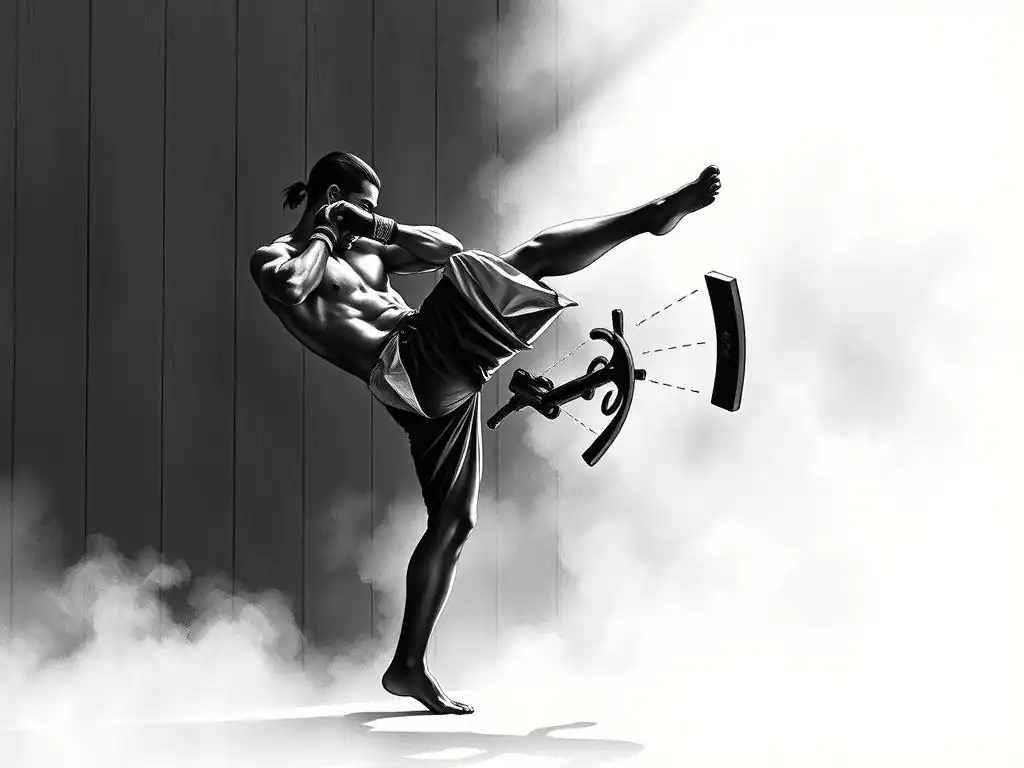
Identifying Common Roundhouse Kick Errors
Many practitioners encounter similar hurdles when learning the Muay Thai roundhouse kick. Common errors include not pivoting the supporting foot enough, failing to rotate the hips fully, dropping the guard, hitting with the foot instead of the shin, and poor balance during or after the kick. These errors compromise power, speed, and defense. For instance, a common issue is the 'slapping' kick, where the leg swings without proper hip rotation, resulting in a weak strike that makes a slapping sound rather than a solid thud.
Identifying these mistakes requires careful observation, often through video analysis or feedback from an experienced trainer. Recognizing where the anatomy of your Muay Thai roundhouse kick is breaking down is the first step to fixing it. Is it the initial pivot? The hip turn? The point of impact? Pinpointing the specific flaw allows for targeted corrective drills. For example, if the issue is insufficient hip rotation, drills focusing purely on the pivot and hip turn without kicking can be beneficial.
Addressing Balance Issues in Muay Thai Kicks
Balance is fundamental to executing a powerful and safe roundhouse kick. Issues with balance often stem from an unstable supporting leg, improper weight distribution, or lack of core strength. If the supporting leg is not firmly rooted and pivoted correctly, the entire body's balance is compromised during the kick. Standing on one leg drills, yoga poses like Warrior III, and exercises that strengthen the ankle and knee stabilizers can help improve balance.
Practicing the kick slowly, breaking it down into components, can also help identify where balance is lost. For example, practicing the pivot and leg chamber while holding onto a wall or rope can isolate the movement and allow the fighter to focus on balance without the full momentum of the kick. Consistently working on core strength also significantly improves overall stability during the dynamic movement of the Muay Thai roundhouse kick.
Fixing Telegraphing and Improving Kick Speed
Telegraphing occurs when a fighter gives away their intention to kick before executing the strike, often through subtle movements like a deep breath, a shift in posture, or dropping a hand. This allows the opponent to anticipate and block or counter. Fixing telegraphing involves minimizing unnecessary movements before the kick. The setup should be subtle and integrated with other techniques or feints.
Improving kick speed comes from refining technique, increasing explosive strength, and practicing speed drills. Technique refinement ensures the most efficient path for the leg, minimizing wasted motion. Explosive strength training (plyometrics) increases how quickly force can be generated. Speed drills involve throwing rapid-fire kicks, sometimes focusing on quantity over power initially, to build fast-twitch muscle memory. For example, throwing 10 kicks as fast as possible on a focus mitt or heavy bag, resting, and repeating, can significantly improve kick speed, making your Muay Thai roundhouse kick much harder to block.
Step 8: Roundhouse Kick Variations in Muay Thai
The Diagonal Roundhouse Kick
While the most common roundhouse kick travels on a horizontal or slightly upward plane, the diagonal roundhouse kick travels on a downward angle, often targeting the opponent's collarbone or shoulder. This kick is less common but can be very effective, especially against opponents who are accustomed to blocking horizontal kicks. The mechanics are similar to the standard roundhouse, but the angle of the hip drive and leg trajectory is adjusted downwards.
This variation can be used to break down an opponent's guard or cause pain in the shoulder joint, limiting their ability to punch or block effectively. It requires precise timing and distance, as the target area is smaller and higher than typical body or leg kicks. Mastering the standard Muay Thai roundhouse kick anatomy is a prerequisite before effectively utilizing this diagonal variation.
The Question Mark Kick (Sao)
The Question Mark Kick, or 'Sao' in Thai, is a deceptive variation that starts like a low or middle kick but curves upwards at the last moment to target the head. It gets its name from the trajectory, which resembles a question mark shape. The initial movement draws the opponent's guard downwards or sideways to block a perceived lower kick, creating an opening for the leg to curve up and over their guard to strike the head.
This kick requires significant hip flexibility and control to execute the deceptive curve. It's a high-level technique used by experienced fighters to surprise opponents. The anatomy of this Muay Thai kick involves a subtle shift in hip rotation and a flexible knee joint to redirect the leg's path late in the trajectory. It's a testament to the adaptability and depth of the Muay Thai kicking arsenal.
Adapting the Roundhouse: Shorter and Taller Opponents
Effective use of the roundhouse kick also involves adapting the technique based on the opponent's height and stance. Against a shorter opponent, the kick might need to be thrown on a slightly downward angle even when targeting the body, or the fighter might need to step in closer. The pivot might need to be less extreme. Against a taller opponent, the fighter might need to step further offline or use a more upward trajectory for body or head kicks.
Distance management becomes even more critical when facing opponents of different heights. Using feints and footwork to close or create distance before throwing the kick is essential. A fighter might use a teep (push kick) to create space against a shorter, swarming opponent before following up with a roundhouse, or step deep into the pocket against a taller fighter to land a close-range body kick. Understanding these adaptations is part of mastering the Muay Thai roundhouse kick anatomy in practical application.
Step 9: Integrating the Roundhouse Kick into Muay Thai Combinations
Combining the Roundhouse with Punches and Elbows
In a real fight, the roundhouse kick is rarely thrown in isolation. It is most effective when integrated into combinations with other strikes. Punches are often used to set up kicks. For example, a jab-cross combination can distract the opponent's guard high, creating an opening for a low or body kick. Conversely, a kick can set up punches or elbows; landing a solid body kick might cause the opponent to drop their guard, leaving them open for follow-up punches or elbows in the clinch.
Example combination: Jab (distraction), Cross (distraction/setup), Rear Roundhouse Kick (power strike). Another common combination is Left Body Kick (forces reaction), Right Elbow (as they recover). The rapid transition between striking with the hands and the legs is a hallmark of Muay Thai and requires seamless coordination, integrating the anatomy of the Muay Thai kick with the mechanics of punching and elbowing.
Setting up the Roundhouse with Feints and Footwork
Feints and strategic footwork are essential for landing roundhouse kicks effectively. A feinted punch or teep can draw a reaction from the opponent, creating an opening for the kick. For example, a feinted low kick might cause the opponent to check, leaving them momentarily off-balance and vulnerable to a body kick. Footwork is used to manage distance, create angles, and cut off the opponent's movement.
Circling away from the opponent's power side, stepping offline to find an open angle, or using small adjustments to get into optimal range are all critical footwork elements. A fighter might use a small step-drag movement to close distance while masking the intention to kick. Mastering the anatomy of the Muay Thai roundhouse kick includes understanding how movement and deception contribute to landing the strike cleanly.
Roundhouse Combinations: Jab-Cross-Low Kick and Teep-Roundhouse
Several classic Muay Thai combinations heavily feature the roundhouse kick.
- Jab-Cross-Rear Low Kick: A fundamental combination used to damage the opponent's lead leg. The punches occupy the upper body while the kick targets the lower.
- Teep-Rear Roundhouse: The teep creates space and pushes the opponent back, disrupting their balance and posture, making them an easier target for the follow-up roundhouse kick to the body or leg.
- Left Body Kick-Right Roundhouse (Switch Kick): This combination uses the lead leg kick (often a switch kick for power) to draw a block, then immediately follows with the rear leg roundhouse to the same or a different target, often catching the opponent before they can reset their guard.
These combinations highlight how the Muay Thai roundhouse kick functions not just as a standalone technique but as part of a larger offensive strategy. Practicing these sequences repeatedly builds the fluidity and timing needed to execute them effectively in sparring and competition, showcasing the complete anatomy of how this strike is used in action.
Conclusion: Perfecting Your Muay Thai Roundhouse Kick
Consistent Practice and Refinement
Perfecting the Muay Thai roundhouse kick is a journey that requires thousands of repetitions and continuous refinement. Hitting the heavy bag, working with trainers holding pads, and sparring are all essential components of this process. It's not enough to simply go through the motions; each repetition should be performed with focus, attention to detail, and the intention to execute the anatomy of the Muay Thai roundhouse kick correctly.
Regularly reviewing your technique, perhaps through video recording, can help identify subtle flaws that you might not feel during execution. Breaking down the kick into its constituent parts – stance, pivot, hip rotation, chamber, extension, follow-through, and recovery – and drilling each part individually can help strengthen weaker links in the kinetic chain. Consistency in training, even short, focused sessions, is more effective than infrequent, long sessions.
Seeking Guidance from Experienced Muay Thai Trainers
While self-study and practice are valuable, the guidance of experienced Muay Thai trainers is invaluable for mastering the roundhouse kick. A good trainer can identify flaws in your Muay Thai roundhouse kick anatomy that you might not see yourself, provide specific corrective drills, and offer personalized feedback based on your body mechanics and level of experience. They can also safely guide you through conditioning exercises like shin conditioning and tire drills.
Learning from someone who has spent years practicing and teaching the art provides insights and nuances that are difficult to acquire alone. They can demonstrate the correct technique, explain the 'why' behind each step, and help you integrate the kick effectively into your overall fighting style. Investing in quality coaching is one of the best ways to accelerate your progress in perfecting this signature strike.
Mastering the Art of the Eight Limbs
The Muay Thai roundhouse kick is a powerful technique, but it is only one part of the art of eight limbs. True mastery involves integrating the roundhouse kick seamlessly with punches, elbows, knees, and the clinch. Understanding when and how to use the roundhouse kick in conjunction with these other weapons makes you a more versatile and dangerous fighter.
By diligently studying and practicing the anatomy of the Muay Thai roundhouse kick, you build a strong foundation for your striking game. Continue to explore the variations, combinations, and strategic applications of this devastating strike, always seeking to refine your technique and understand how it fits within the broader context of Muay Thai. With dedication and intelligent training, you can develop a roundhouse kick that is both powerful and precise, a true testament to the effectiveness of this ancient martial art.
Frequently Asked Questions
What are the key muscle groups engaged during a Muay Thai roundhouse kick?
The Muay Thai roundhouse kick heavily relies on the core, hips, and legs. Specifically, the obliques, glutes, hamstrings, and quadriceps are crucial for power and stability.
How important is proper hip rotation in executing a powerful Muay Thai roundhouse kick?
Hip rotation is absolutely fundamental for generating power. It's the driving force behind the kick, transferring energy from the ground upwards and into the target with maximum impact.
What is the optimal distance to maintain from an opponent when throwing a Muay Thai roundhouse kick?
The ideal distance is a medium range where you can fully extend your leg without overextending or being too close. This allows for full power generation and minimizes the risk of being countered.
How can I improve the speed and flexibility required for a successful Muay Thai roundhouse kick?
Consistent stretching and flexibility training are essential. Drills focusing on speed and technique, like shadow kicking and bag work, will also improve execution and velocity.
What are some common mistakes to avoid when practicing the Muay Thai roundhouse kick?
Avoid telegraphing the kick, dropping your hands, or failing to pivot properly. Maintaining balance and a strong guard are crucial for both offense and defense.
Final Reflection: Mastering the Art of the Roundhouse
The journey through the anatomy of a perfect Muay Thai roundhouse kick, as detailed in this guide, transcends mere technique; it represents a deeper understanding of power, precision, and the art of combat. While the steps outlined provide a framework, the true mastery lies in the continuous refinement and adaptation of these principles to one's own unique physical capabilities and fighting style.
The impact of the Muay Thai roundhouse kick extends far beyond the ring. It's a symbol of discipline, dedication, and the relentless pursuit of self-improvement. The art of fighting is simply the art of expressing oneself.
- Bruce Lee. This quote resonates deeply, reminding us that the roundhouse, like any martial art technique, is a vehicle for expressing our inner strength and resilience. Its influence can be seen in countless martial arts disciplines and continues to inspire athletes and enthusiasts worldwide.
Now, take a moment to reflect on your own journey. How can you apply the principles of balance, rotation, and precision, not just in the execution of a Muay Thai roundhouse kick, but in all aspects of your life? Embrace the challenge, cultivate your discipline, and strive for perfection in every movement. The power to transform yourself, both physically and mentally, lies within you.
Master the Kick: Unleash Your Muay Thai Potential Now!
Thank you for exploring the intricacies of the Muay Thai roundhouse kick with us! You've unlocked valuable insights into technique and power generation. Now, it's time to put that knowledge into action and truly elevate your game.
- Step into the ring: Dedicate 15 minutes today to practice the hip rotation drills we discussed.: Feel the power building from the ground up! This is your primary focus.
- Film yourself performing the kick and compare it to the examples provided. What subtle adjustments can you make?
- Share your progress and biggest takeaway with a training partner or on social media using #MartialArtsMasteryKick – let's inspire each other!
Ready to unleash your best roundhouse kick yet?