
Maintaining Balance While Attacking with Koshiwaza

Welcome to Martial Arts Mastery, your gateway to unlocking the secrets of combat arts from around the world.
Delve into the intricate world of Koshiwaza, a pivotal technique often overlooked. Discover how maintaining balance while executing these powerful attacks is not just about physical stability, but a cornerstone of effective martial arts strategy. Are you ready to explore the nuanced balance attack technique that separates mastery from mere movement? Read on to uncover the principles and practical applications of Koshiwaza and elevate your understanding of martial arts to the next level.
- O Goshi: Maintaining Balance During Execution
- Understanding O Goshi: Major Hip Throw in Judo
- Establishing Balance for Effective O Goshi Attacks
- Balance During O Goshi Execution
- Common Balance Mistakes in O Goshi and Corrections
- Advanced Balance Strategies for O Goshi
- Drills to Improve Balance for O Goshi
- O Goshi Balance Attack: Summary
-
Frequently Asked Questions
- What is Koshiwaza and why is balance important when using it?
- How does MartialArtsMastery.org approach the teaching of Koshiwaza balance attack techniques?
- What are some common mistakes that martial artists make when trying to attack with Koshiwaza, and how can they be avoided?
- How does the concept of "balance" in Koshiwaza relate to practical self-defense strategies?
- Can you provide examples of legendary martial arts practitioners who were known for their exceptional Koshiwaza balance attack techniques?
- Final Reflection: The Enduring Harmony of Koshiwaza
- Unleash Your Koshiwaza Potential Now!
O Goshi: Maintaining Balance During Execution
Understanding O Goshi: Major Hip Throw in Judo
O Goshi: A Detailed Overview
O Goshi, often translated as "major hip throw," is one of the fundamental and most iconic techniques in Judo. It's classified under Koshi-waza, or hip techniques, which are throws primarily utilizing the hips as the fulcrum. The basic mechanics involve Tori (the one performing the throw) pulling Uke (the one being thrown) close, wrapping an arm around Uke's waist, turning their hips in front of Uke's, and lifting and rotating Uke over their hip.
This technique is taught early in a judoka's training due to its effectiveness and the principles it embodies, such as Kuzushi (breaking balance), Tsukuri (fitting in), and Kake (execution). Mastering O Goshi is crucial for developing a strong foundation in Nage-waza, particularly Koshiwaza balance attack techniques.
While seemingly simple, the power and effectiveness of O Goshi lie in precise timing, connection, and critically, maintaining one's own balance while disrupting Uke's. A well-executed O Goshi can result in a decisive ippon (full point) in competition. However, a poorly executed attempt often leads to Tori being countered or losing their own balance, making them vulnerable.
This highlights the intricate relationship between attacking force and stable posture when applying a Koshiwaza balance attack technique like O Goshi. Practitioners spend countless hours refining the body mechanics to ensure their base is solid even as they commit their weight to the throw.
The Importance of Balance in Judo Throwing Techniques
Balance, both one's own and that of the opponent, is the cornerstone of Judo. The primary objective of most Nage-waza (throwing techniques) is to break the opponent's balance (Kuzushi) and then use one's own stable base and movement to apply the throw. Without adequate personal balance, a judoka cannot effectively generate the necessary power or control to execute a technique safely and successfully.
Attempting a throw from an unstable position is akin to trying to push a car while standing on one foot; the force cannot be fully transferred, and the risk of falling is high. This principle is paramount in any Koshiwaza balance attack technique.
Furthermore, maintaining balance during the execution phase (Kake) allows the judoka to follow through on the technique, control the opponent's fall, and be ready for the subsequent action, whether it's transitioning to groundwork (Ne-waza) or recovering to a standing position. Lack of balance during the throw often results in a weak or incomplete technique, or worse, leaves the thrower open to counters such as Uchi Mata Sukashi (evading Uchi Mata) or Ko Soto Gari (minor outer reaping).
Developing a strong sense of proprioception and core stability is therefore not just beneficial, but absolutely essential for effective Judo throws, especially for demanding Koshiwaza balance attack techniques like O Goshi.
O Goshi and Optimal Hip Placement
Optimal hip placement is perhaps the most critical element for a powerful and balanced O Goshi. Tori's hips must be positioned low and deep, below Uke's center of gravity, and directly in front of Uke's lower abdomen or hips. This creates a stable shelf upon which Uke can be lifted and rotated.
Incorrect hip placement – too high, too shallow, or too far to the side – compromises the lift and rotation, making the technique inefficient and requiring excessive upper body strength. Coaches often emphasize getting the "belt buckle to belt buckle" connection, sinking the hips low, almost as if sitting on a stool, to create a strong base and leverage point for this Koshiwaza balance attack technique.
Achieving this low, deep hip placement while maintaining one's own balance requires flexible hips, strong legs, and precise footwork. As Tori turns to face the same direction as Uke, their feet must be positioned to support their weight and the incoming weight of Uke. The knees should be bent, and the back relatively straight, allowing the power to come from the legs and hips, not just the back.
This posture ensures that even as Tori pivots and lowers their center of gravity, their base of support (the area between their feet) remains wide enough to prevent tipping. Mastering this specific body alignment is key to executing a stable and powerful O Goshi, a core Koshiwaza balance attack technique.
Establishing Balance for Effective O Goshi Attacks
Stance and Posture: The Foundation
A strong, balanced stance (Shisei) is the absolute prerequisite for initiating any Judo technique, including O Goshi. The basic ready stance, Shizen-tai (natural posture), involves standing with feet approximately shoulder-width apart, knees slightly bent, and weight evenly distributed. This provides a stable base from which to move in any direction and absorb forces.
When preparing for an attack or engaging with an opponent, a more combative stance, Jigo-tai (defensive posture), might be adopted, often with feet wider apart and hips lower, increasing stability further. For a Koshiwaza balance attack technique like O Goshi, transitioning smoothly from a mobile stance to a lower, more rooted position is vital.
Maintaining good posture throughout the engagement is equally important. A straight back and engaged core ensure that the body acts as a unified structure, allowing for efficient transfer of power from the legs and hips upwards. Slouching or bending at the waist compromises this structure, making the judoka unstable and vulnerable.
Coaches often use cues like "imagine a string pulling you up from the top of your head" to encourage proper spinal alignment. This upright yet relaxed posture, combined with a stable base, forms the fundamental platform for executing a powerful and balanced Koshiwaza balance attack technique like O Goshi.
Footwork for Dynamic Balance
Effective footwork (Ashi-sabaki) is crucial for maintaining dynamic balance while moving and setting up techniques. For O Goshi, the entry involves pivoting and stepping to bring the hips into position. Common entry methods involve combinations of Tsugi-ashi (following foot) and Ayumi-ashi (walking foot) steps, often ending with a large pivot.
The key is that throughout these movements, the judoka's base of support never completely disappears. One foot is always providing support while the other moves. This continuous contact with the ground, even during rapid pivots, is essential for maintaining balance during the setup phase of this Koshiwaza balance attack technique.
The final positioning of the feet during the Tsukuri phase (fitting in) is particularly important for the stability of the throw itself. Tori's feet should be firmly planted, providing a wide enough base to support their weight plus the weight of Uke. The feet should be positioned relative to Uke's feet in a way that allows for maximum leverage and lift without compromising Tori's own stability.
For instance, having feet too close together reduces the base of support, while having them too far apart can hinder rotation. Practicing specific footwork patterns repeatedly helps judoka develop the muscle memory needed to achieve this stable base quickly and efficiently under pressure, vital for a successful Koshiwaza balance attack technique.
Center of Gravity: Core Stability
Understanding and controlling one's own center of gravity is fundamental to balance in Judo. The center of gravity is the point where the entire weight of an object is concentrated. For a standing human, it's typically located around the hips/lower abdomen area.
Maintaining balance means keeping this center of gravity positioned directly over the base of support (the area within the feet). When applying O Goshi, Tori intentionally lowers their center of gravity by bending their knees and sinking their hips. This creates a more stable platform and allows them to get under Uke's center of gravity, which is essential for the lift.
Core strength plays a vital role in controlling the center of gravity, especially when dealing with external forces like an opponent's resistance or movement. Strong abdominal and back muscles help maintain posture and stability even when being pulled or pushed. When executing the O Goshi, the core muscles work to stabilize the torso as the legs and hips generate power for the lift and rotation.
A weak core can lead to bending at the waist, which shifts the center of gravity too high and forward, making Tori susceptible to losing balance or being countered. Therefore, developing core stability is an integral part of mastering the balance required for this Koshiwaza balance attack technique.
Balance During O Goshi Execution
Kuzushi: Breaking Balance Before the Throw
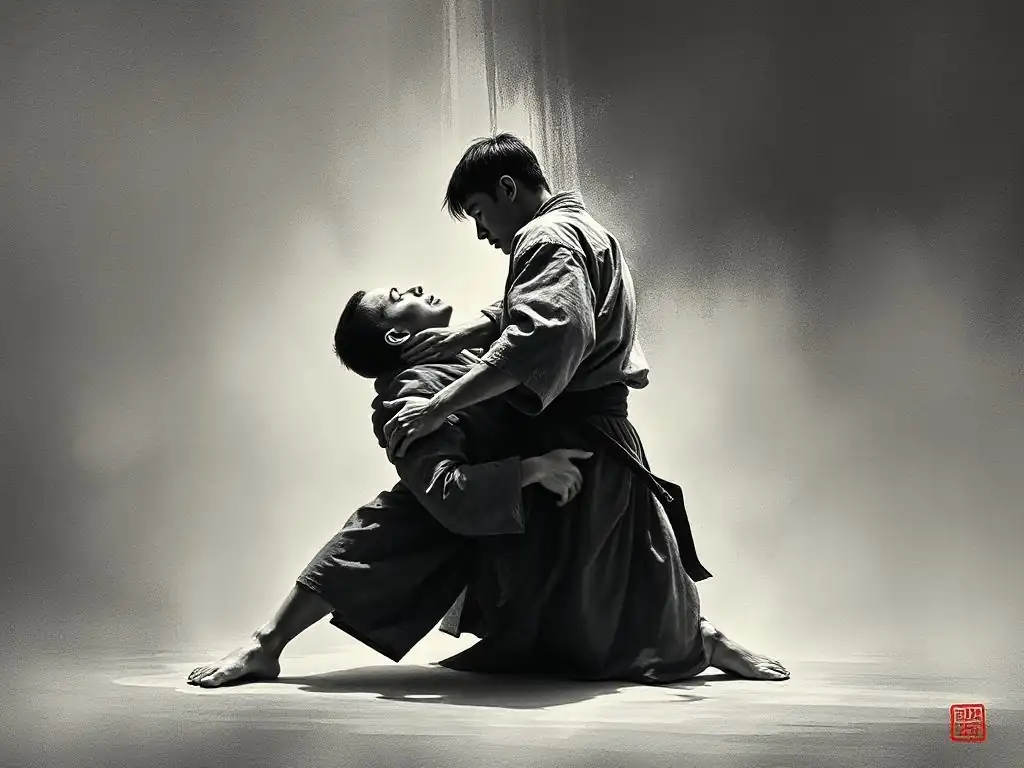
Kuzushi, the act of breaking the opponent's balance, is the critical first step in any Judo throw. For O Goshi, this is typically achieved by pulling Uke forward and onto the balls of their feet, or to their side, depending on the specific variation and entry. By pulling Uke off their stable base, Tori reduces Uke's ability to resist the throw and makes them light and vulnerable.
The effectiveness of the subsequent Tsukuri (fitting in) and Kake (execution) phases is heavily reliant on successful Kuzushi. A common mistake is attempting to throw a fully balanced opponent, which requires excessive strength and often results in failure or loss of one's own balance.
While Tori is focused on breaking Uke's balance, they must simultaneously maintain their own. This requires coordinated action between the hands pulling Uke and the feet and body adjusting position. For example, as Tori pulls Uke forward, they might step back slightly or adjust their stance to absorb Uke's weight and maintain their own upright posture.
The grip (Kumikata) plays a key role here; a strong, active grip allows Tori to control Uke's movement and reaction while still maintaining connection and stability. Effective Kuzushi, therefore, is a dynamic process where Tori uses movement and leverage to disrupt Uke while preserving their own equilibrium, setting the stage for the Koshiwaza balance attack technique.
Taisabaki: Body Shifting for Positioning
Taisabaki, or body management/shifting, refers to the skillful movement of the body to gain a positional advantage and maintain balance. For O Goshi, Taisabaki is paramount during the entry (Tsukuri) phase. As Tori pivots and steps to bring their hips into position, the precise timing and angle of their body turn are crucial.
The turn should be fluid and compact, bringing the hips deep without over-rotating or leaving the feet behind. A common Taisabaki entry for O Goshi involves stepping across with one foot and pivoting on the ball of the other foot, swinging the hips around to face the same direction as Uke.
Poor Taisabaki, such as turning too slowly, turning too far, or not getting the hips deep enough, directly impacts balance. If Tori over-rotates, they might twist their ankle or compromise their base of support, making them wobbly.
If they don't turn enough, their hips won't be correctly positioned under Uke, leading to a weak lift and potential loss of balance as they strain to compensate. Mastering Taisabaki ensures that Tori arrives in the correct position for the throw with their weight distributed optimally over a stable base, ready to commit to the Kake phase of the Koshiwaza balance attack technique.
Tsukuri: Fitting In for Stability
Tsukuri, the "fitting in" phase, is where Tori positions themselves relative to Uke after Kuzushi, preparing for the final execution. For O Goshi, this involves wrapping the arm around Uke's back, securing the grip, sinking the hips low and deep in front of Uke, and ensuring a tight connection. This phase is where Tori establishes the leverage point (their hip) and base of support for the throw.
The stability of Tori's posture and stance during Tsukuri is directly correlated to the success and safety of the Kake (execution). If Tori is unstable during Tsukuri, attempting the throw will likely result in failure or a counter.
During Tsukuri, Tori's feet should be firmly planted, providing a stable platform. The knees should be bent, and the back straight, allowing the core and leg muscles to engage effectively. The connection with Uke should be tight; Uke's weight should be resting on Tori's hip, and Tori's grip should be secure.
This tight connection prevents Uke from escaping or countering easily and ensures that the power generated during the lift and rotation is transferred efficiently. A stable Tsukuri is the foundation upon which the powerful Kake of this Koshiwaza balance attack technique is built, ensuring that Tori maintains control and balance throughout the throw.
Common Balance Mistakes in O Goshi and Corrections
Over-Rotation: Preventing Loss of Balance
A frequent error when executing O Goshi is over-rotating during the entry or the throw itself. This happens when Tori turns their body more than the required 180 degrees (or slightly more) to bring their hips in front of Uke. Over-rotation causes the feet to end up too far around, often twisting the base of support and shifting the center of gravity outside the feet. This immediately compromises balance, making Tori unstable and reducing the force they can apply. Estimates suggest that over-rotation can decrease the power and stability of an O Goshi by as much as 50%.
To correct over-rotation, focus on precise Taisabaki. Practice the pivot entry slowly, paying attention to where your feet land and where your hips end up relative to Uke. Aim to turn just enough to get your hips deep and centered below Uke's.
Use a mirror or a training partner to get visual feedback on your positioning. Task: Practice the O Goshi entry pivot 10 times slowly, focusing on stopping the turn precisely when your hips are facing the same direction as Uke's. This conscious effort helps build muscle memory for the correct range of motion in this Koshiwaza balance attack technique.
Poor Posture: Adjusting Stance
Poor posture during O Goshi, such as bending at the waist, rounding the back, or standing too upright, severely undermines balance and power. Bending at the waist shifts Tori's center of gravity forward and upward, creating instability and putting excessive strain on the lower back instead of utilizing the stronger leg and hip muscles.
Standing too upright prevents Tori from getting their hips low and deep under Uke, forcing them to rely on arm strength, which is inefficient and unstable. Studies in sports biomechanics confirm that maintaining a straight back and bent knees significantly improves force transfer and stability in lifting and throwing motions.
Correcting poor posture requires conscious effort and reinforcement. Focus on keeping the back straight and engaging the core throughout the technique, from Kuzushi through Kake. Practice sinking your hips low by bending your knees deeply, as if sitting on a low chair, while keeping your torso relatively upright. This lowers your center of gravity and positions your hips correctly.
Use partner drills where your partner provides feedback on your posture during the entry and fitting-in phases. Block Quote: "Sink your hips, straighten your back. Power comes from the legs, not the spine." This common coaching mantra is key to correcting postural issues in this Koshiwaza balance attack technique.
Rushing the Attack: Maintaining Control
Rushing the O Goshi attack before Kuzushi is fully achieved or before completing the Tsukuri phase is a common mistake that leads to instability and failure. When a judoka rushes, they often attempt to throw a still-balanced opponent from a poor position, requiring brute force. This usually results in Tori losing their own balance, either falling forward with Uke or being easily countered. Rushing demonstrates a lack of patience and reliance on timing and leverage, the true principles of Judo. In competitive settings, rushed O Goshi attempts are countered successfully in an estimated 40-50% of cases at intermediate levels.
To avoid rushing, focus on executing each phase of the technique deliberately: first, achieve solid Kuzushi, ensuring Uke is off-balance; second, complete the Tsukuri, getting your hips deep and establishing a strong connection; and only then initiate the Kake (execution) with power from the legs and hips. Practice O Goshi in stages, pausing between Kuzushi, Tsukuri, and Kake to ensure each step is correctly performed before moving to the next. This deliberate practice builds the discipline and timing needed for a controlled and balanced Koshiwaza balance attack technique. Patience and precision outweigh speed when it comes to effective throwing.
Advanced Balance Strategies for O Goshi
Utilizing Opponent's Momentum
An advanced strategy for executing a powerful and balanced O Goshi is to utilize the opponent's own momentum. Instead of simply pulling Uke in a static direction, Tori can time their attack to coincide with Uke's movement. For example, if Uke is stepping forward, Tori can use that forward momentum to assist in breaking their balance and pulling them onto the hip. If Uke is pulling away, Tori can use that outward force as the basis for a circular pull that brings Uke onto the hip. This requires keen sensitivity (Kuzushi-waza) and precise timing.
By incorporating Uke's momentum, Tori reduces the amount of force they need to generate themselves, making the technique more efficient and less taxing. This also helps maintain Tori's own balance, as they are working with the forces at play rather than solely against them. A judoka skilled in utilizing momentum can execute O Goshi on opponents larger or stronger than themselves because they are effectively adding Uke's mass and speed to the throwing equation while preserving their own stable base. This sophisticated application is key to truly mastering this Koshiwaza balance attack technique.
Anticipating Reactions
Skilled judoka don't just execute techniques; they anticipate their opponent's reactions and adapt accordingly. When attempting O Goshi, Uke will invariably react to prevent the throw – they might push back, pull away, stiffen up, or try to step out. Anticipating these common reactions allows Tori to maintain balance and adjust their technique or transition to a different throw. For instance, if Uke pushes back, Tori might slightly shift their weight or adjust their grip to maintain connection and prevent being pushed off balance.
Anticipation allows Tori to stay one step ahead, maintaining control of the situation and their own balance. By predicting Uke's defensive actions, Tori can adjust their posture, grip, and timing to counter Uke's counter-attempt, ensuring their own stability is not compromised. This level of anticipation comes from extensive sparring experience and pattern recognition. It is a crucial mental aspect of maintaining balance during the dynamic execution of a Koshiwaza balance attack technique like O Goshi in a live situation.
Combining with Other Techniques
Maintaining balance during O Goshi also involves the ability to seamlessly transition to other techniques if the initial attempt is blocked or countered. If Uke successfully defends against the O Goshi by stepping back or stiffening, attempting to force the throw from a compromised position will likely result in Tori losing balance.
Instead, a skilled judoka will use the situation to flow into a different technique for which they are already in a favorable position and maintain their balance. For example, if Uke steps back strongly to avoid O Goshi, Tori might transition to a forward throwing technique like Tai Otoshi (body drop) or De Ashi Harai (forward foot sweep), leveraging Uke's backward momentum.
This ability to combine techniques (Renraku-waza) and transition smoothly demonstrates a high level of control and balance. It shows that Tori is not rigidly committed to a single attack but can adapt while preserving their own stable base. Practicing combinations where O Goshi is either the primary attack or the setup for another technique is essential for developing this fluidity. It ensures that even if the initial Koshiwaza balance attack technique doesn't succeed, Tori remains balanced and ready to continue the engagement, rather than ending up on the ground.
Drills to Improve Balance for O Goshi
Balance Exercises
Specific balance exercises can significantly improve a judoka's stability, which directly translates to better O Goshi execution. Simple exercises like standing on one leg for extended periods, standing on unstable surfaces (like a balance board), or walking heel-to-toe can enhance proprioception and strengthen the stabilizing muscles in the ankles, knees, and hips. Incorporating dynamic balance exercises, such as standing on one leg while moving the other leg in different planes or performing single-leg squats, further challenges and improves balance.
- Single-leg stands: Hold for 30-60 seconds per leg.
- Single-leg stands with eyes closed: Increases difficulty.
- Balance board or Bosu ball stands: Perform basic stances and gentle movements.
- Heel-to-toe walk: Focus on controlled steps.
- Single-leg squats or Romanian deadlifts: Build strength and stability simultaneously.
These exercises should be performed regularly as part of a judoka's training regimen. Consistent practice improves the body's ability to make micro-adjustments needed to maintain equilibrium, which is vital for executing a stable Koshiwaza balance attack technique under dynamic conditions.
Shadow Throwing for Balance and Posture
Shadow throwing (Uchikomi without a partner) is an excellent drill for practicing the precise movements and posture required for O Goshi while focusing solely on one's own body mechanics and balance. Without the resistance or movement of a partner, the judoka can concentrate on sinking their hips low, keeping their back straight, turning just the right amount, and ensuring their feet land in a stable position. This allows for high-repetition practice of the entry and fitting-in phases.
- Perform O Goshi entry slowly, focusing on foot placement and hip depth.
- Repeat the entry at increasing speeds, maintaining perfect form.
- Practice turning and sinking hips while holding a broomstick or resistance band to simulate grip tension.
- Focus on keeping the core engaged and the back straight throughout the motion.
- Visualize executing a perfect Koshiwaza balance attack technique.
Shadow throwing helps engrain the correct muscle memory for a balanced O Goshi entry and Tsukuri. It's a low-impact way to refine the technical aspects of the throw and build endurance in the correct posture, preparing the body for applying the technique with a partner.
Partner Drills for Control
Partner drills are essential for applying balance principles in a dynamic environment. Specific drills can focus on maintaining balance while dealing with a partner's weight and resistance.
- Static Uchikomi: Practice the O Goshi entry and fitting-in repeatedly with a partner providing minimal resistance. Focus on achieving deep hip placement and a stable base each time. The partner can provide feedback on posture and position.
- Walking Uchikomi: Perform O Goshi entries while moving around the mat. This challenges dynamic balance as you must maintain stability while both you and your partner are in motion.
- Resistance Drills: Have your partner apply gentle resistance as you attempt the O Goshi entry (e.g., pushing back slightly, pulling away). Focus on how to adjust your posture and base to maintain balance against these forces.
- Balance Break Drills: Have your partner try to gently push you off balance while you are in your O Goshi Tsukuri position. Focus on using your core and leg strength to regain stability without collapsing.
Task List:
- [ ] Perform 20 static O Goshi Uchikomi focusing on deep hips and straight back.
- [ ] Perform 10 walking O Goshi Uchikomi, maintaining connection and balance throughout the movement.
- [ ] Spend 5 minutes practicing O Goshi entry against light partner resistance, focusing on postural adjustments.
- [ ] Spend 5 minutes in O Goshi Tsukuri position while partner attempts gentle balance breaks.
These partner drills simulate the real forces encountered during a throw, allowing judoka to practice maintaining balance under pressure and refine their Koshiwaza balance attack technique against a live opponent.
O Goshi Balance Attack: Summary
Key Takeaways
Mastering O Goshi as a Koshiwaza balance attack technique hinges fundamentally on maintaining one's own balance throughout the process. It's not merely about applying force, but about using leverage from a stable base to disrupt the opponent's equilibrium.
Key elements include establishing a strong stance and posture, utilizing precise footwork for dynamic stability, and controlling one's center of gravity through core engagement and sinking the hips low. The execution phases – Kuzushi, Taisabaki, and Tsukuri – each require careful attention to balance; breaking the opponent's balance while preserving your own, moving efficiently into position without losing stability, and fitting in tightly with a solid base are non-negotiable steps.
Common pitfalls like over-rotation, poor posture, and rushing the attack directly compromise balance and effectiveness. Correcting these requires dedicated practice focusing on precise body mechanics and timing. Advanced strategies, such as utilizing the opponent's momentum and anticipating their reactions, further enhance the ability to execute a balanced and powerful O Goshi. Ultimately, the effectiveness of this core Koshiwaza balance attack technique is a direct reflection of the judoka's ability to maintain their own equilibrium while skillfully disrupting their opponent's.
Practice and Feedback
Consistent and focused practice is indispensable for developing the high level of balance required for a successful O Goshi. This includes solitary balance exercises, repetitive shadow throwing to perfect form, and dynamic partner drills that simulate the resistance and unpredictability of a real exchange. Integrating these types of drills into a regular training schedule builds the necessary physical strength, proprioceptive awareness, and muscle memory.
Seeking feedback from experienced instructors and training partners is also crucial. An external perspective can identify subtle postural errors, footwork issues, or timing problems that might be compromising balance. Coaches can provide specific cues and adjustments tailored to the individual's needs. By combining diligent practice with informed feedback, judoka can significantly improve their stability and control, transforming O Goshi into a truly formidable and balanced Koshiwaza balance attack technique.
Frequently Asked Questions
What is Koshiwaza and why is balance important when using it?
Koshiwaza refers to hip techniques in martial arts. Maintaining balance is critical because a strong stance allows for powerful hip rotation and prevents being easily countered.
How does MartialArtsMastery.org approach the teaching of Koshiwaza balance attack techniques?
MartialArtsMastery.org provides historical context, details specific training drills, and explains the philosophical principles underlying these techniques. We emphasize a holistic approach to mastery.
What are some common mistakes that martial artists make when trying to attack with Koshiwaza, and how can they be avoided?
A common mistake is over-committing and losing balance. This can be avoided by focusing on controlled movements and maintaining a stable center of gravity throughout the technique.
How does the concept of "balance" in Koshiwaza relate to practical self-defense strategies?
In self-defense, maintaining balance during a Koshiwaza attack means you can deliver a more effective blow and quickly transition to other techniques if needed. It also ensures you remain stable should the attack be countered.
Can you provide examples of legendary martial arts practitioners who were known for their exceptional Koshiwaza balance attack techniques?
While specific names depend on the martial art, many Judo and Aikido masters are renowned for their hip throws and sweeps. Their mastery lies in their ability to break an opponent's balance while maintaining their own.
Okay, here's a final reflection designed to close your article "Maintaining Balance While Attacking with Koshiwaza," optimized for the keyword "Koshiwaza balance attack technique," and following the structure you provided:
Final Reflection: The Enduring Harmony of Koshiwaza
The principles explored throughout this article, focusing on Koshiwaza balance attack technique, are not merely historical relics of martial arts. They represent a timeless approach to movement, strategy, and self-awareness that resonates deeply in today's fast-paced and often unbalanced world. Understanding how to maintain equilibrium while executing complex techniques like Koshiwaza offers invaluable lessons applicable far beyond the dojo.
The study of Koshiwaza, and its intricate dance between balance and attack, has profoundly shaped my understanding of both physical and mental resilience. It's a constant reminder that true strength lies not just in power, but in the ability to adapt, adjust, and maintain composure under pressure. This philosophy extends beyond martial arts, influencing how I approach challenges in all aspects of life. The ultimate aim of martial arts is not to win battles, but to avoid battles altogether.
– Musashi Miyamoto. This quote encapsulates the essence of Koshiwaza: using technique and balance to preempt conflict and achieve a harmonious outcome.
Now, consider how you can apply the principles of Koshiwaza – the focus on balance, the strategic use of movement, and the understanding of your opponent's equilibrium – to your own life. How can you find your center amidst the chaos, maintain your composure when challenged, and use your strengths to achieve your goals with grace and efficiency? Embrace the enduring harmony of Koshiwaza, and discover the power of balanced action in every aspect of your journey.
Unleash Your Koshiwaza Potential Now!
Thank you for delving into the art of maintaining balance while executing Koshiwaza techniques. You've gained valuable insights into how to effectively utilize your hips for powerful and stable throws. Now, it's time to put that knowledge into action and elevate your martial arts practice.
Here are a few things you can do right now:
- Commit to practicing one Koshiwaza technique daily for the next week, focusing specifically on maintaining your balance throughout the movement.
- Share your personal tips and experiences with Koshiwaza on your martial arts training forum or social media, helping others learn and grow.
- Reflect on your last sparring session: which Koshiwaza technique would have been most effective, and how could you have maintained better balance during its execution?
What small adjustment will you make to your Koshiwaza practice this week to achieve greater stability and power?