
Common Punching Mistakes in Taekwondo and How to Correct Them

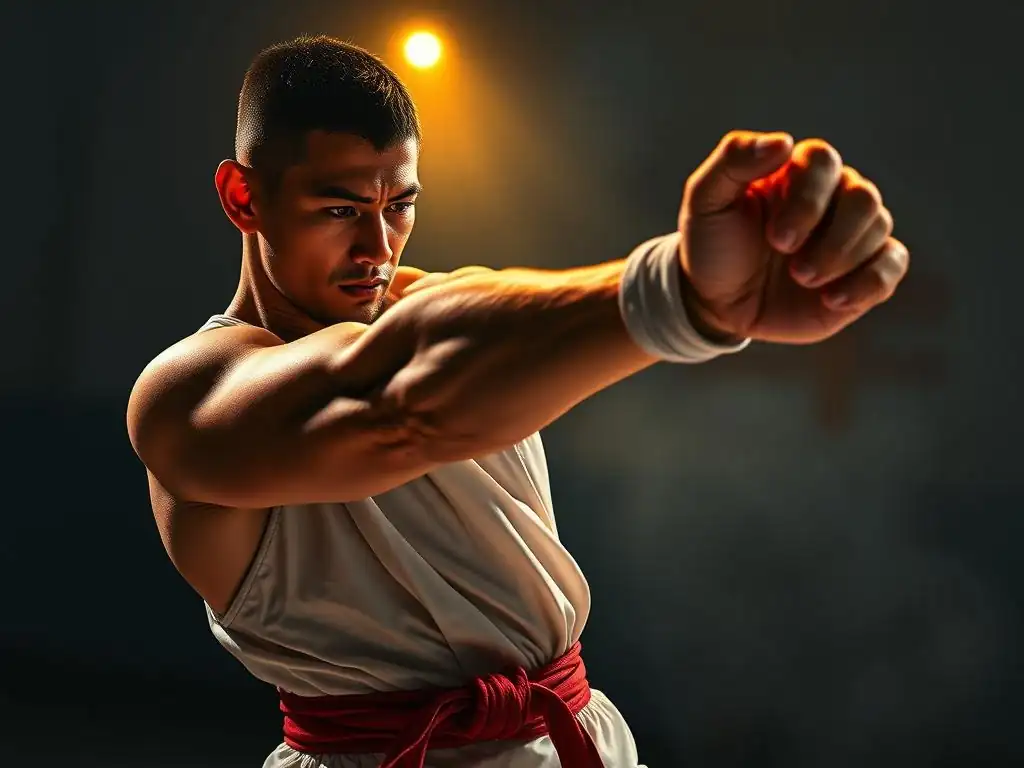
Welcome to Martial Arts Mastery, your gateway to understanding the intricate world of combat. Ever wonder if you're truly maximizing the power in your Taekwondo punches? This article dives deep into common punching mistakes in Taekwondo and offers practical corrections to elevate your technique. Uncover the secrets to a more effective and powerful strike, and discover how to refine your form from the ground up. Keep reading to unlock your full potential!
- Introduction to Taekwondo Punching Technique
- Mistake 1: Incorrect Stance and Balance for Taekwondo Punches
- Mistake 2: Improper Fist Formation in Taekwondo
- Mistake 3: Lack of Hip Rotation in Taekwondo Punching
- Mistake 4: Telegraphing Punches in Taekwondo
- Mistake 5: Incorrect Target Focus During Taekwondo Punches
- Mistake 6: Neglecting Follow-Through in Taekwondo Punching
- Mistake 7: Bending the Wrist on Impact in Taekwondo
- Summary: Mastering Taekwondo Punching Techniques
-
Frequently Asked Questions
- What are some common mistakes beginners make when practicing Taekwondo punches?
- How important is the correct stance for effective Taekwondo punching?
- What are some drills to improve punching power in Taekwondo?
- How does hip rotation contribute to the power of a Taekwondo punch?
- What are the self-defense implications of mastering correct Taekwondo punching technique?
- Final Reflection: Mastering the Art of the Strike
- Unleash Your Inner Power: Master the Perfect Punch!
Introduction to Taekwondo Punching Technique
The Importance of Proper Punching Form in Taekwondo
Mastering proper punching form is not merely about aesthetics; it is fundamental to generating power, ensuring speed, and preventing injury in Taekwondo. The efficiency of your strikes directly correlates with how well your body mechanics align. Even a slight deviation, such as a bent wrist upon impact or hitting with the wrong knuckles, can significantly reduce the force transmitted to the target – potentially by more than half – and expose the hand to sprains, fractures, or dislocations. Correct form is the bedrock upon which all effective Taekwondo punching technique correction is built.
Beyond raw power and safety, precise form conserves energy and allows for quicker recovery. A punch thrown with poor alignment requires more effort from smaller, weaker muscles and leaves the practitioner off-balance or slow to retract. By refining your Taekwondo punching technique, you develop strikes that are not only impactful but also sustainable over multiple exchanges, integrating seamlessly into combinations and defensive movements, thereby enhancing overall performance in sparring or self-defense situations.
Common Punching Errors Affecting Power and Accuracy
Many practitioners, especially beginners, fall prey to common pitfalls that undermine their Taekwondo punching technique. These errors often stem from a lack of understanding of the kinetic chain or simply ingrained bad habits. Issues like a weak stance, improper fist formation, failing to engage the core and hips, or telegraphing intentions are widespread. These mistakes collectively diminish the force behind a punch, make it predictable, and reduce the likelihood of hitting the intended target with full effect.
Such fundamental errors can render even a seemingly powerful individual's punches relatively ineffective against a skilled opponent who can read the movements and absorb or evade the strike. Recognizing these common problems is the first crucial step in any Taekwondo punching technique correction process. Addressing these foundational issues systematically is far more beneficial than simply trying to punch harder, as true power comes from efficient technique, not just muscular force.
Mistake 1: Incorrect Stance and Balance for Taekwondo Punches
Problem: Weak Base and Instability During Punch Delivery
A stable stance is the foundation of any powerful strike, including punches in Taekwondo. Errors here often involve feet being too close together, too wide, improperly angled, or weight being distributed incorrectly (e.g., locked knees, leaning too far forward or backward). When your base is unstable, the force generated from the ground cannot efficiently travel up through your legs, core, and into your punch. This disconnect in the kinetic chain means your strike relies predominantly on upper body strength, which is inherently limited compared to the power potential of the entire body working in concert.
Instability during punch delivery also leaves you vulnerable. If your weight is off-center or your stance is narrow, the act of punching itself can cause you to lose balance, making it difficult to recover quickly or defend against a counter-attack. A weak base can reduce the potential force of your punch by 30-40% compared to a strike launched from a solid, rooted position. Addressing stance issues is paramount in effective Taekwondo punching technique correction.
Taekwondo Punch Correction: Strengthening Your Stance and Maintaining Balance
Correcting your stance begins with understanding the specific requirements of the Taekwondo stances used for hand techniques, such as the walking stance (Ap Seogi) or fighting stance (Gyeorugi Seogi). Ensure your feet are positioned at the appropriate width and length for the stance, with knees slightly bent and relaxed, never locked. Your weight should be distributed according to the stance's requirements, typically slightly favoring the front leg in a fighting stance or more evenly in a walking stance, allowing you to root firmly into the ground.
Maintaining balance is an active process, not just a static posture. It involves engaging your core muscles to stabilize your trunk and being mindful of your weight distribution as you move and strike. Practice holding your stances for extended periods, focusing on feeling rooted and balanced. Incorporate gentle pushes from a partner to test and improve your stability. Consistent attention to your base is a core element of Taekwondo punching technique correction.
Drill: Practicing Weight Transfer for Enhanced Punching Power
- Assume a Taekwondo walking stance (Ap Seogi).
- Place your fists in a guard position.
- Slowly shift your weight from the back leg to the front leg, feeling the transfer of energy.
- As your weight settles onto the front leg, simulate throwing a punch with the front hand, focusing on how the weight transfer supports the movement.
- Repeat, shifting weight back and forth, coordinating the movement with simulated punches from alternating hands.
- Progress to doing this drill faster, eventually incorporating a full punch at the end of the weight transfer.
Mistake 2: Improper Fist Formation in Taekwondo
Problem: Risk of Injury and Reduced Impact Force
One of the most critical errors in punching is forming the fist incorrectly. Common mistakes include leaving the thumb inside the fingers (guaranteeing a broken thumb upon impact), not tucking the fingers tightly, or failing to align the wrist and forearm. A loose or improperly formed fist is a recipe for injury; even hitting a padded target with significant force can cause sprains, fractures (like a "boxer's fracture" of the metacarpals), or severe bruising. The hand is a complex structure, and improper force distribution can easily damage its delicate bones and ligaments.
Beyond injury risk, a poor fist formation drastically reduces the effectiveness of the punch. The force generated by your body is dissipated through the unstable structure of the hand rather than being concentrated onto the target. A loose fist might deliver only a fraction of the potential impact force, perhaps absorbing 50% or more of the energy internally. Correcting fist formation is non-negotiable for both safety and power in Taekwondo punching technique correction.
Taekwondo Punch Correction: Achieving a Tight and Correct Fist
Forming a proper Taekwondo fist ensures that the hand becomes a solid, safe tool for striking. The key is to create a compact, stable structure that aligns with the forearm. The process involves curling the fingers tightly into the palm, starting with the fingertips touching the base of the fingers. Then, the thumb is securely wrapped around the outside of the curled fingers, specifically resting across the middle knuckles of the index and middle fingers.
This formation creates a solid striking surface primarily with the two largest knuckles (index and middle). When combined with a straight wrist, this alignment allows the force of the punch to travel directly through the bones of the forearm and hand into the target, maximizing penetration and minimizing the risk of the wrist bending or fingers collapsing. Mastering this simple yet vital technique is fundamental to effective Taekwondo punching technique correction.
Technique: Step-by-Step Guide to Forming a Proper Taekwondo Fist
- Extend your hand flat.
- Curl your fingertips down towards the base of your palm.
- Continue curling your fingers tightly into your palm.
- Fold your thumb over the outside of your curled fingers, resting it firmly across the middle knuckles.
- Ensure your wrist is straight and aligned with your forearm.
- Practice tensing the fist slightly to feel the solidity, but avoid excessive tension that could slow down your strike.
Mistake 3: Lack of Hip Rotation in Taekwondo Punching
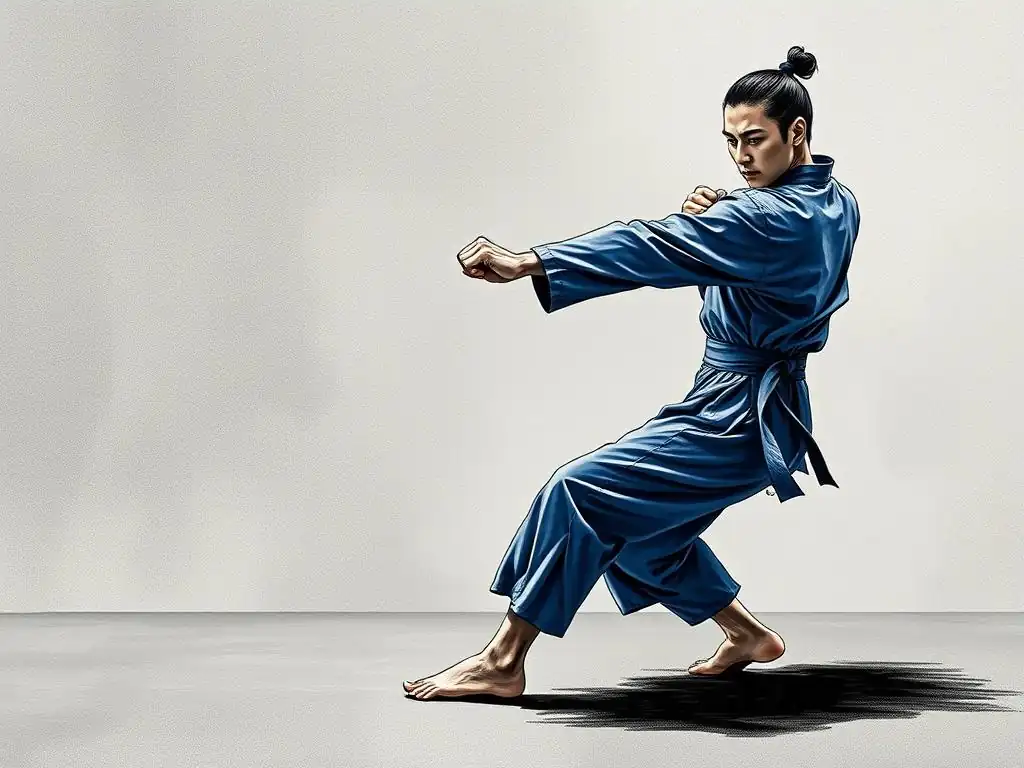
Problem: Limited Power Generation from the Core
Many beginners punch primarily using just their arm and shoulder muscles. This is a fundamental error that severely limits power. True punching power in Taekwondo, as in most striking arts, originates from the ground and is amplified by the core and hips through a rotational movement.
Failing to rotate the hips and torso disconnects the powerful lower body and core from the strike, leaving the punch relatively weak and 'armless'. An arm-only punch might generate only a few hundred pounds of force, whereas a punch incorporating proper hip rotation can potentially double or triple that, depending on the individual and specific technique.
Punches thrown without hip rotation lack the characteristic 'snap' and driving force needed for penetration. They are easier for an opponent to absorb or deflect. Moreover, relying solely on shoulder and arm strength leads to quicker fatigue in those muscles, making it harder to maintain offensive pressure. Integrating hip rotation is a critical component of any comprehensive Taekwondo punching technique correction effort.
Taekwondo Punch Correction: Engaging Hip Rotation for Maximum Force
Generating power through hip rotation involves coordinating the movement of the lower body with the extension of the arm. As you throw a punch, particularly a straight punch (Jireugi), the hip on the side of the punching arm rotates forward. This rotation is typically initiated by pivoting slightly on the ball of the foot opposite the punching hand, allowing the hips and torso to turn. The energy from this rotation is then transferred up through the core and shoulder, adding significant momentum and force to the punch.
This movement should be fluid and simultaneous with the arm extension, not a separate action. Think of your core as the engine driving the punch. Practice throwing punches slowly at first, focusing purely on feeling the hip rotation and its effect on the punch's power. Gradually increase speed, ensuring the coordinated rotation remains integral to the movement. Mastering this kinetic chain is vital for powerful Taekwondo punching technique.
Exercise: Developing Core Strength for Powerful Taekwondo Punches
- Medicine Ball Twists: Sit on the floor with knees bent, feet flat or slightly elevated. Hold a medicine ball. Twist your torso from side to side, touching the ball to the floor beside you. This builds rotational core strength.
- Plank with Hip Dips: Hold a standard forearm plank. Slowly dip your hips towards the floor on one side, then return to center and dip to the other side. This strengthens the oblique muscles essential for rotation and stability.
- Standing Torso Twists: Stand with feet shoulder-width apart, holding a light weight or resistance band. Keep hips relatively stable and twist your torso side to side. Focus on controlled movement and engaging the core.
Mistake 4: Telegraphing Punches in Taekwondo
Problem: Predictable Movements Allowing for Easy Defense
Telegraphing occurs when a practitioner makes unnecessary preparatory movements before throwing a punch, effectively signaling their intention to the opponent. This could involve drawing the hand back excessively, dipping a shoulder, tensing visibly, or even a subtle shift in gaze. These small tells, often subconscious, give the opponent precious milliseconds – potentially 100-200ms or more – to react, evade, block, or counter. In the rapid exchanges of Taekwondo sparring, this small window is often the difference between a scoring hit and a missed opportunity.
Examples include winding up the arm like preparing to throw a baseball, taking a deep breath just before striking, or tensing the neck and shoulders noticeably. Such predictable movements make the punch easy to read, negating any potential speed or power advantages. Eliminating telegraphing is a sophisticated aspect of Taekwondo punching technique correction that significantly improves effectiveness in dynamic situations.
Taekwondo Punch Correction: Concealing Your Intentions and Speeding Up Delivery
Correcting telegraphing involves training yourself to launch strikes directly from your relaxed guard position with minimal preliminary movement. The power should be generated through speed, core engagement, and technique, not a wind-up. Practice starting your punches straight from the position where your hand rests during your guard, focusing on an explosive, direct line to the target.
Developing relaxation is also key; tense muscles are slower and often give visual cues. Learn to keep your body relaxed until the moment of impact, where tension is channeled into the strike. Drills focusing on rapid, straight-line movements from guard, without any backward pull or dipping, are essential. The goal is to make your punches appear suddenly, giving the opponent minimal time to react and making your Taekwondo punching technique less predictable and more effective.
Drill: Practicing Rapid Punches with Minimal Telegraphing
- Stand in your fighting stance with hands in a relaxed guard.
- Have a partner hold a focus mitt or target directly in front of you at punch height.
- Practice launching straight punches (e.g., a straight punch or 'jab') as quickly and directly as possible from your guard position to the mitt.
- Focus on starting the movement forward immediately, without drawing the hand back first or dipping the shoulder.
- Your partner can watch for any preparatory movements and provide feedback. Aim for speed and directness over raw power in this drill.
Mistake 5: Incorrect Target Focus During Taekwondo Punches
Problem: Reduced Accuracy and Weakened Impact
Proper target focus is more than just looking at the opponent; it involves locking onto the specific point on the target you intend to hit with your knuckles. A common mistake is having wandering eyes, looking generally at the opponent's body, or hitting 'at' the target rather than 'through' it. This lack of precise visual focus can lead to punches that miss the intended mark, land with a glancing blow, or hit a less effective area. Without locking onto the target, your body's mechanics may not align optimally to deliver maximum force to that precise spot.
Reduced accuracy means wasted energy and missed opportunities to score or incapacitate. A glancing blow delivers significantly less energy than a direct hit – potentially reducing impact force by half or more depending on the angle. Moreover, hitting a strong point like an elbow or forehead unintentionally due to poor focus can cause injury to your own hand. Developing sharp target focus is a crucial, often overlooked, element of effective Taekwondo punching technique correction.
Taekwondo Punch Correction: Maintaining Focus on the Target
Correcting target focus involves training your eyes and mind to lock onto the specific point you intend to strike before initiating the punch and maintaining that focus throughout the strike. This is not merely passive looking but an active, intentful gaze. Whether aiming for the solar plexus, the chin, or a specific point on a training pad, visualize your knuckles hitting that exact spot.
This sharp visual focus helps align your body mechanics, ensuring that the force generated from your stance and core is directed precisely to the intended point of impact. Practice hitting stationary targets like a heavy bag or focus mitts, consciously choosing a specific spot (e.g., the logo, a piece of tape) and focusing your eyes on it before and during the strike. Integrating this mental discipline enhances both the accuracy and the penetrating power of your Taekwondo punching technique.
Technique: Visualizing the Target for Precise Punch Placement
- Before throwing a punch, identify a very specific, small point on your target (e.g., a seam on a heavy bag, a dot on a focus mitt, or a specific area on an opponent's body like the sternum).
- Focus your eyes intently on that single point.
- As you initiate your punch, maintain your visual lock on that point.
- Imagine your fist traveling through that point, not just to it.
- Practice this visualization technique during solo drills and partner work to make it an automatic part of your Taekwondo punching technique.
Mistake 6: Neglecting Follow-Through in Taekwondo Punching
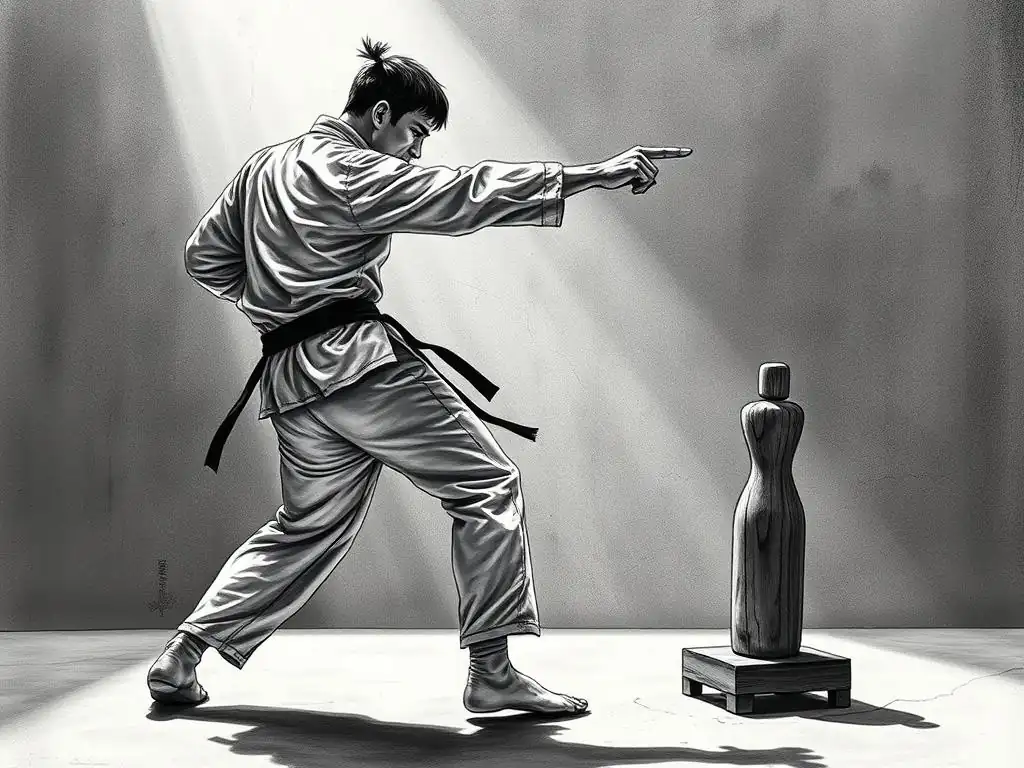
Problem: Reduced Power and Potential for Recovery
Follow-through in punching refers to the brief extension of the arm past the point of impact, followed by a rapid retraction. A common mistake is stopping the punch abruptly at the target. While this might feel fast, it reduces the amount of force transferred into the target and leaves the arm extended for a fraction of a second longer than necessary. The difference in force transfer can be significant; a punch with good follow-through has more 'pushing' power than one that stops short, potentially delivering 20-30% more effective force through the target.
Stopping short also hinders the speed of your recovery. The arm remains momentarily 'stuck' or slow to return to the guard position, leaving you open to counter-attacks or delaying your next technique. Effective Taekwondo punching technique correction requires not only delivering force but also being immediately ready for the next action, whether it's defense or another strike.
Taekwondo Punch Correction: Extending the Punch Fully Through the Target
Correcting this involves consciously extending your punch slightly beyond the perceived surface of the target. Imagine your fist is a projectile meant to travel through the target to a point a few inches behind it. This ensures full extension of the arm and maximizes the transfer of kinetic energy into the target mass. However, this extension should be brief and controlled.
Equally important is the subsequent rapid retraction. Immediately after the moment of impact and brief follow-through, the punching hand must snap back to the guard position as quickly as possible. This 'snap-back' is crucial for defense and readiness. Practice drills that emphasize both the full extension through the target and the explosive return to guard. This complete movement cycle is vital for refined Taekwondo punching technique.
Drill: Practicing Full Extension and Retraction of Taekwondo Punches
- Use a heavy bag or a sturdy focus mitt held by a partner.
- Throw straight punches, focusing on driving the fist through the target rather than just hitting the surface.
- Pay attention to the feeling of full arm extension.
- Immediately after the moment of impact and brief follow-through, powerfully snap your hand back to your guard position.
- Practice this repeatedly, focusing on the speed and efficiency of both the extension and the retraction phases of the Taekwondo punching technique.
Mistake 7: Bending the Wrist on Impact in Taekwondo
Problem: Injury and Power Loss
Bending the wrist backward (hyperextension) or sideways upon impact is perhaps the most dangerous punching mistake. The wrist joint is not designed to withstand the immense forces generated by a full-body punch when it is not properly aligned. Impacting a target with a bent wrist places severe strain on the ligaments, tendons, and small bones of the wrist and hand, leading to sprains, dislocations, or fractures, including severe injuries requiring surgery. A bent wrist can absorb 70% or more of the potential impact force internally rather than transferring it to the target.
Beyond the critical injury risk, a bent wrist acts as a "kink" in the kinetic chain, preventing the efficient transfer of force from your body to the target. The power you generated is dissipated at the weak, unstable wrist joint instead of being delivered effectively. This significantly reduces the penetrating force of the punch. Correcting this wrist alignment is non-negotiable for safe and powerful Taekwondo punching technique.
Taekwondo Punch Correction: Keeping a Straight Wrist for Maximum Impact
Maintaining a straight wrist upon impact means ensuring that the knuckles, wrist, and forearm are aligned in a single, stable line, acting like a solid rod. The wrist should be locked straight, but not rigidly stiff, as excessive tension can also be detrimental. This alignment ensures that the force of the punch travels directly through the strong bones of the forearm and into the target via the knuckles, minimizing stress on the wrist joint.
Achieving a straight wrist requires proper fist formation (as discussed earlier) and developing strength and stability in the wrist joint itself. Practice hitting soft targets initially, focusing purely on maintaining that straight alignment. Strengthen your wrist flexors and extensors through targeted exercises. Consistent practice with proper form will build the muscle memory needed to keep your wrist straight and strong at the critical moment of impact, a fundamental aspect of safe and effective Taekwondo punching technique correction.
Technique: Strengthening Wrist Stability for Taekwondo Punching
- Wrist Curls: Using light dumbbells, perform wrist curls (palm up) and reverse wrist curls (palm down) to strengthen the muscles controlling wrist flexion and extension.
- Knuckle Push-ups: If comfortable and safe, practice push-ups on your knuckles (on a soft surface initially). This helps reinforce the straight wrist alignment and builds strength in that position.
- Isometric Holds: Extend your arm as if punching and hold the position, focusing on keeping the wrist perfectly straight and aligned with the forearm. You can gently push against a wall or partner's hand for resistance.
Summary: Mastering Taekwondo Punching Techniques
Key Takeaways for Punching Technique Correction in Taekwondo
Improving your Taekwondo punching technique is a journey that requires diligent attention to detail. We've highlighted several crucial areas for Taekwondo punching technique correction: establishing a strong, balanced stance; forming a correct and tight fist; effectively engaging hip rotation for power; eliminating telegraphing movements; maintaining precise target focus; ensuring adequate follow-through; and, critically, keeping the wrist straight upon impact to prevent injury and maximize force. Each of these elements plays a vital role in transforming a basic hand movement into a powerful, accurate, and safe Taekwondo punch.
Remember that mastering Taekwondo punching technique is an ongoing process. It requires consistent practice, self-awareness, and often, feedback from a qualified instructor. By systematically addressing these common mistakes through focused drills and conscious effort, you will see significant improvements in the speed, power, accuracy, and safety of your hand strikes, ultimately enhancing your overall Taekwondo skill set and your effectiveness in practical applications.
Further Resources for Improving Your Taekwondo Hand Strikes
To continue refining your Taekwondo punching technique, seek guidance from experienced instructors who can provide personalized feedback and correct your form in real-time. They can spot subtle errors you might not notice yourself. Supplement your regular training by reviewing instructional materials, such as detailed technique guides or videos that demonstrate proper biomechanics and common error corrections.
Utilize training equipment designed to help improve striking. Focus mitts are excellent for practicing speed, accuracy, and combinations with a partner. Heavy bags allow you to practice generating power and developing follow-through. Consider using tools like wrist rollers or grip strengtheners to build the necessary wrist and forearm stability for powerful, safe punches. Consistent, informed practice using these resources is key to successful Taekwondo punching technique correction.
Frequently Asked Questions
What are some common mistakes beginners make when practicing Taekwondo punches?
Beginners often exhibit a lack of proper stance, resulting in instability. They also frequently fail to fully extend their punches, diminishing power. Finally, forgetting to rotate the hips is a common error, hindering the transfer of body weight.
How important is the correct stance for effective Taekwondo punching?
A solid stance is crucial because it provides the foundation for power and balance. Without a stable base, the force generated by the punch is significantly reduced, and the practitioner becomes vulnerable to counterattacks.
What are some drills to improve punching power in Taekwondo?
Practicing repetitive punching drills with a focus on hip rotation and proper form is essential. Using resistance bands can also help build the muscles used in punching. Target practice with a punching bag or focus mitts refines accuracy and power.
How does hip rotation contribute to the power of a Taekwondo punch?
Hip rotation allows you to transfer the power from your core to your punch. It engages your entire body, turning a simple arm movement into a full-body strike, maximizing force.
What are the self-defense implications of mastering correct Taekwondo punching technique?
Mastering punching technique translates directly to effective self-defense. A powerful and accurate punch can quickly neutralize a threat. The speed and precision developed through training are invaluable in real-world situations.
Final Reflection: Mastering the Art of the Strike
The journey to martial arts mastery is paved with dedication and meticulous attention to detail, and nowhere is this more evident than in the fundamental act of punching. Understanding and correcting common punching mistakes in Taekwondo is not merely about improving technique; it's about unlocking the full potential of one's power and precision. The principles discussed throughout this article resonate far beyond the dojang, offering valuable lessons in self-discipline and the pursuit of excellence in any endeavor.
The impact of proper Taekwondo punching technique extends beyond physical prowess. It fosters confidence, improves focus, and cultivates a deeper understanding of body mechanics. This journey of refinement, of constantly striving for improvement, is a microcosm of life itself. The journey of a thousand miles begins with a single step,
as Lao Tzu wisely stated. Each corrected punch is a step forward, not just in Taekwondo, but in the ongoing pursuit of self-improvement.
Now, consider how you can apply these principles of meticulous correction and unwavering dedication to your own life. Just as a Taekwondo practitioner strives for the perfect punch, you too can identify areas where refinement and focused effort can unlock your potential. Embrace the challenge, seek guidance, and never stop striving for excellence in all that you do. The power to transform lies within you; unleash it.
Unleash Your Inner Power: Master the Perfect Punch!
Thank you for taking the time to explore the art of the Taekwondo punch! Now that you've gained valuable insights into common mistakes and how to correct them, it's time to put that knowledge into action and elevate your training.
Here's how you can continue your journey:
- Commit to dedicating just 15 minutes each day this week to practicing the punching drills outlined in this article. Feel the difference!
- Share this article with a training partner or fellow Taekwondo enthusiast. Help them refine their technique too!
- Surprise yourself and film your next practice session, then carefully compare it with the techniques demonstrated. What unexpected improvements – or areas for growth – do you notice?
Ready to transform your punch and become a more powerful martial artist?