
Jumping Front Kick (Twieo Ap Chagi): Mastering the Basics of Aerial Attacks


Welcome to Martial Arts Mastery, your ultimate resource for unlocking the secrets of combat traditions worldwide. Ever wondered how to elevate your striking game? This article delves into the foundational principles behind a breathtakingly effective technique. Discover the jumping front kick technique basics and prepare to add a dynamic and powerful weapon to your arsenal. But this is just the beginning. Explore further and uncover the rich history, diverse styles, and practical applications that define the world of martial arts.
- Introduction to the Twieo Ap Chagi: The Jumping Front Kick in Taekwondo
- Breaking Down the Jumping Front Kick Technique Basics
- Mastering the Jumping Front Kick: A Step-by-Step Guide
- Common Mistakes and How to Correct Them in Your Jumping Front Kick
- Training Drills and Exercises to Improve Your Jumping Front Kick Technique
- Advanced Techniques and Variations of the Jumping Front Kick
- The Jumping Front Kick in Taekwondo Sparring and Competition
- Safety Considerations and Injury Prevention for Aerial Kicks
- Conclusion: Elevating Your Taekwondo Game with the Jumping Front Kick
-
Frequently Asked Questions
- What is the primary purpose of the Jumping Front Kick (Twieo Ap Chagi) in martial arts?
- What are the key elements to consider when learning the Jumping Front Kick technique?
- How does the Jumping Front Kick differ from a standard front kick?
- What are some common mistakes beginners make when practicing the Jumping Front Kick, and how can they be avoided?
- Can the Jumping Front Kick be used effectively for self-defense, and if so, in what situations?
- Final Reflection: Embracing the Aerial Ascent
- Elevate Your Game: Unleash the Twieo Ap Chagi Within!
Introduction to the Twieo Ap Chagi: The Jumping Front Kick in Taekwondo
What is the Jumping Front Kick (Twieo Ap Chagi)? A Fundamental Aerial Attack
The Twieo Ap Chagi, commonly known as the jumping front kick, is a dynamic aerial technique in Taekwondo. It involves launching the body into the air and executing a front kick (Ap Chagi) while airborne. This technique leverages forward momentum and vertical lift to deliver a powerful strike, typically aimed at an opponent's torso or head. Mastering the jumping front kick technique basics requires significant coordination, strength, flexibility, and timing, building upon the foundation of the standard standing front kick.
Unlike a simple hop, the Twieo Ap Chagi utilizes a run-up or a preceding step to generate the necessary horizontal velocity that translates into height and distance. The kick itself is delivered with the ball of the foot or the heel, driving straight into the target.
Due to its complexity and the energy required, it is often employed as a surprise attack or to cover distance rapidly in sparring. Successfully landing this kick can score significant points in competition, such as the 2 points awarded for a body kick or 3-4 points for a head kick in World Taekwondo (WT) rulesets, depending on the specific competition format and valid contact.
Why Master the Twieo Ap Chagi? Benefits for Taekwondo Practitioners
Mastering the jumping front kick technique basics offers several key advantages for a Taekwondo practitioner. Firstly, it significantly increases reach and allows strikes from a greater distance than standing kicks, enabling practitioners to engage opponents who are attempting to maintain separation. This extended reach can be crucial in competitive sparring, allowing for surprise attacks or the ability to score before an opponent can close the distance.
Secondly, the Twieo Ap Chagi generates considerable power due to the combined momentum of the body's forward and upward movement. When executed correctly, the force delivered can be substantial, capable of disrupting an opponent's balance or even leading to a knockout in appropriate contexts (though safety gear in sparring mitigates this in competition). Furthermore, incorporating aerial techniques like the jumping front kick adds an element of unpredictability to a practitioner's repertoire, making them a more challenging opponent to read and defend against, forcing adversaries to adjust their defensive strategies and footwork.
Twieo Ap Chagi within Taekwondo's Fundamental Kicks
While considered an advanced application, the Twieo Ap Chagi is fundamentally built upon the Ap Chagi, the basic standing front kick. The Ap Chagi, a linear kick driving straight forward, is one of the first kicks taught in Taekwondo and forms the core of many other techniques. The jumping front kick essentially adds a plyometric component and forward translation to this fundamental movement pattern.
Understanding and perfecting the standing front kick is non-negotiable before attempting the jumping version. A solid Ap Chagi ensures proper hip extension, knee snap, and foot alignment, all of which are critical for an effective Twieo Ap Chagi. Many Taekwondo schools introduce the standing front kick early, often within the first few belts (e.g., white to yellow belt), while the jumping front kick is typically introduced much later, often at blue belt or higher, reflecting the advanced coordination and control required to safely and effectively execute the jumping front kick technique basics.
Breaking Down the Jumping Front Kick Technique Basics
Stance and Preparation for the Jumping Front Kick
The preparation for a jumping front kick typically begins from a sparring stance, such as a fighting stance (Gyeorugi Sogi), or involves a brief preparatory step. A common approach is to start from a relatively balanced position, perhaps slightly sideways, with the lead leg forward. The initial stance should allow for a quick, explosive push-off. While there isn't one single "correct" stance, the practitioner must be stable yet ready to generate forward momentum.
The preparatory phase involves deciding on the target and initiating the run-up or step. This run-up is usually short, perhaps 1-3 steps, designed to build horizontal speed. The last step is critical; it acts as the launchpad. The foot from this final step plants firmly, and the driving leg (often the rear leg if kicking with the front, or vice versa) pushes powerfully off the ground. The arms are also used dynamically during this phase, swinging to aid balance and contribute to the upward momentum, similar to how arm swing assists in a vertical jump.
The Critical Step: Generating Momentum for the Jump
Generating adequate momentum is arguably the most critical aspect of the jumping front kick technique basics. It's not just about running fast, but about efficiently converting horizontal speed into vertical lift and forward trajectory. The final step before the jump is pivotal. The foot should land slightly ahead of the body's center of gravity, creating a slight forward lean, and then the leg acts as a spring, pushing off the ground with maximum force.
This push-off involves the powerful extension of the ankle, knee, and hip of the driving leg. Simultaneously, the non-kicking leg (the one that will perform the kick) is typically brought up sharply towards the chest, tucking the knee high. This knee tuck helps generate lift and prepares the leg for the subsequent extension. The arm swing, synchronized with the leg drive, further propels the body upwards and forwards. Achieving optimal height, often aiming to clear obstacles or reach higher targets, relies heavily on the power and timing of this explosive push-off from the ground.
Executing the Kick: Proper Leg Extension and Target Focus
Once airborne, the focus shifts to executing the kick with precision and power. The tucked non-kicking leg is extended straight forward, driving the heel or the ball of the foot towards the intended target. The extension should be rapid and full, snapping the leg out from the hip and knee. The body's core must remain tight to transfer the momentum effectively and maintain balance in the air.
Target focus is paramount. The practitioner's eyes should be locked onto the target throughout the jump and kick. The hip of the kicking leg should rotate slightly forward to add power and ensure proper alignment, typically aiming to strike with the sole or ball of the foot flat against the target for maximum impact and safety (though the heel is also used). The kicking leg fully extends, and the impact occurs at the peak of the jump or slightly after, ensuring the full force of the body's momentum is delivered.
Landing Safely: Maintaining Balance and Control
The landing phase is as important as the jump itself for safety and readiness for subsequent action. After delivering the kick, the kicking leg is immediately retracted, and the body prepares to absorb the impact of landing. The feet should ideally land simultaneously or very close together, distributing the force evenly. The knees and hips should bend upon landing, acting as shock absorbers to protect the joints, particularly the knees and ankles.
Maintaining balance upon landing is crucial. Landing off-balance leaves a practitioner vulnerable to counter-attacks. The arms, which were used for momentum during the jump, can be used again to help stabilize the body upon landing. The goal is to land in a controlled fighting stance, ready to defend, attack again, or move away. Practicing landing techniques from progressively higher jumps or low boxes can help build the necessary strength and proprioception required for safe landings after executing jumping front kick technique basics.
Mastering the Jumping Front Kick: A Step-by-Step Guide
Step 1: Building a Solid Foundation with the Standing Front Kick (Ap Chagi)
Before attempting any aerial techniques, a practitioner must first achieve proficiency in the basic standing front kick, the Ap Chagi. This involves practicing the chambering of the knee high towards the chest, extending the leg straight with power and proper foot alignment (ball of the foot or heel), and retracting the leg quickly to return to a balanced stance. Repetition is key; aim for hundreds, if not thousands, of standing front kicks on both legs to develop muscle memory, flexibility in the hip flexors and hamstrings, and power generation from the core and supporting leg.
Focus on the mechanics: ensure the supporting foot pivots slightly for hip rotation, the knee fully extends, and the foot makes contact correctly. Practice kicking stationary targets like a heavy bag or focus mitts held by a partner. A beginner might generate around 50-100 Newtons of force with a standing kick, while an advanced practitioner can exceed 1000 Newtons. Building this foundational power and precision is essential before adding the complexity of a jump to the jumping front kick technique basics.
Step 2: Incorporating a Run-Up for Increased Power
Once the standing front kick is solid, the next step is to introduce the run-up. Start with a very short run-up, perhaps just one or two steps. The purpose is not speed but generating forward momentum that can be converted upwards. Practice running forward and then driving powerfully off the last step. The non-kicking leg should still chamber high, even without the full jump initially.
Focus on the transition from horizontal movement to vertical drive. The final step should be strong and directed slightly downwards-forwards to propel the body upwards-forwards. Practice this step and drive repeatedly without kicking, just focusing on getting height and forward distance. A short, explosive run-up of 2-3 steps can typically increase jump height by 20-30% compared to jumping from a standstill, significantly impacting the effectiveness of the jumping front kick.
Step 3: The Jump: Achieving Height and Distance
Now, integrate the jump with the run-up. After the powerful push-off from the final step, focus on lifting the body as high as possible while simultaneously moving forward. The tucked knee of the kicking leg assists in generating lift. Arm swing is crucial here; swing the arms upwards forcefully as you jump.
Practice jumping and tucking the knee without kicking initially. Focus purely on maximizing height and forward trajectory from your run-up. Aim to jump over low obstacles or reach a marked height on a wall. Consistent practice can help practitioners gain significant height; many experienced competitors can achieve a jump height sufficient to kick a target at head level (typically 1.8m or higher) from a distance of 2-3 meters after a short run-up. This step is about mastering the aerial trajectory component of the jumping front kick technique basics.
Step 4: Perfecting the Kick Mid-Air: Alignment and Precision
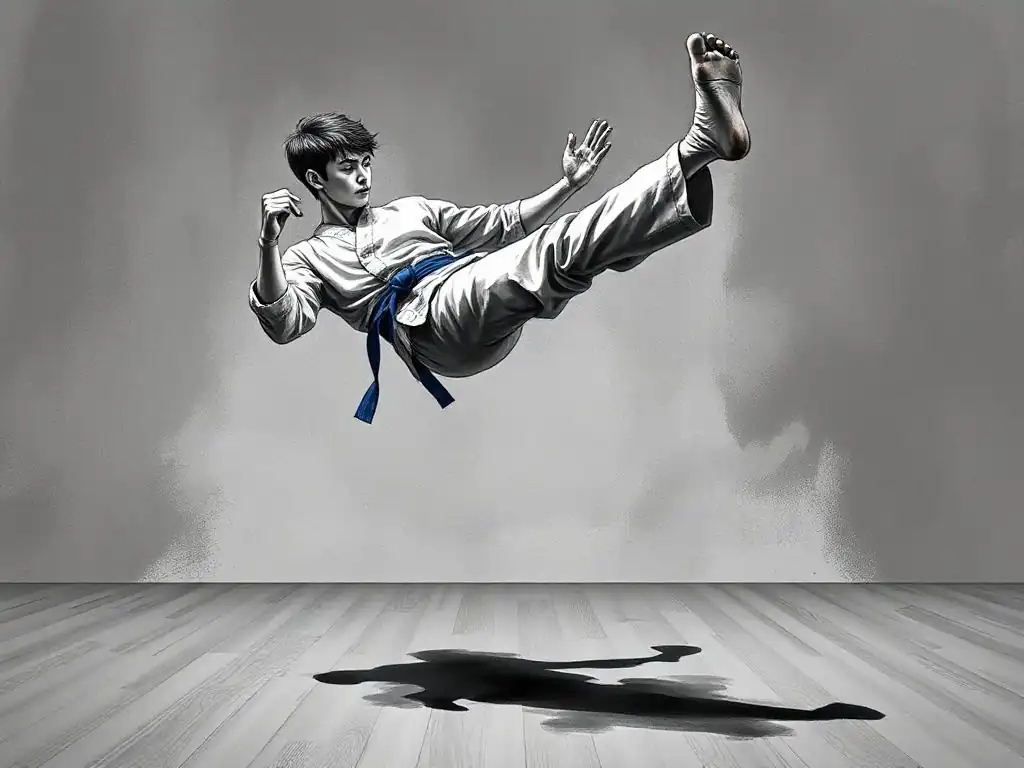
With the jump mechanics improving, add the kick back in while airborne. Timing is critical: the kick should be executed at or near the peak of the jump. The tucked knee extends rapidly, driving the foot towards the target. Maintain core tension and use your arms for balance.
Practice kicking stationary targets held at varying heights. Focus on striking with the correct part of the foot and ensuring the leg is fully extended. Record yourself if possible to check alignment and timing. A common drill is to jump and kick a paddle or focus mitt held by a partner, aiming for the 'pop' sound that indicates good impact. Perfecting mid-air technique ensures the power generated by the jump is effectively transferred into the strike, making the jumping front kick a truly formidable technique.
Step 5: Controlled Landing and Follow-Through
The final step in mastering the basics of the jumping front kick technique is the controlled landing. After the kick, immediately retract the leg. Prepare to absorb the impact by bending the knees and hips upon landing. Practice landing softly and maintaining balance, ideally returning to a ready stance.
Perform drills focusing solely on the landing: jump from a small height (e.g., a step or low box) and practice landing with bent knees and regaining balance quickly. Incorporate this landing practice into your full jumping front kick repetitions. A good landing minimizes the risk of injury and allows you to immediately follow up or defend. Landing off-balance can cost vital seconds in a sparring match, potentially allowing an opponent to score.
Common Mistakes and How to Correct Them in Your Jumping Front Kick
Incorrect Stance and Balance Issues
A common mistake in the jumping front kick technique basics is starting from an unstable or incorrect stance, or failing to execute a proper preparatory step/run-up. This leads to insufficient momentum, poor balance during the jump, and a weak kick. For instance, a practitioner might start too square to the target or take steps that are too long or too short, disrupting the rhythm needed for an explosive push-off.
Correction involves returning to basics: practice the initial stance and the run-up sequence slowly. Focus on taking consistent steps and ensuring the final push-off step is powerful and correctly angled. Drills focusing on balance from a single leg stance, like holding a chambered position for several seconds, can also help build the stability needed for the airborne phase. Using visual cues, such as markers on the floor for your steps, can help standardize your approach and correct inconsistencies in your run-up mechanics.
Insufficient Jump Height and Distance
Many practitioners struggle to gain enough height or cover sufficient distance with their jumping front kick. This is often due to a weak push-off from the ground or poor utilization of arm swing and knee tuck. Without adequate height and distance, the kick becomes predictable, lacks power, and may not reach the intended target, especially higher ones like the head.
To correct this, incorporate plyometric training into your regimen. Exercises like box jumps, squat jumps, and bounding drills specifically target the explosive power needed for the jump. Focus on driving hard off the ground with the supporting leg and simultaneously bringing the non-kicking knee up high. Practice jumping and reaching for an overhead target without kicking to isolate and improve the vertical lift component of the jumping front kick technique basics. Consistent practice of these explosive movements can significantly improve jump metrics, potentially increasing vertical jump height by 10-15cm over several months.
Poor Leg Extension and Impact Point
Another frequent error is failing to fully extend the kicking leg or striking with the wrong part of the foot (e.g., the instep instead of the ball or heel). This reduces the power of the kick, makes it less effective, and can increase the risk of injury to the foot or ankle. Poor hip rotation or core engagement can also contribute to a weak or improperly aimed kick.
Correction requires dedicated practice of the kick mechanics in isolation. Practice standing front kicks with a focus on full extension and correct foot position. Use a target like a kicking shield or heavy bag and listen for a solid impact sound, which indicates proper force transfer. Drills involving kicking resistance bands can help build strength and snap in the extension. Ensure your hips are rotating slightly forward as you kick to add power and align the body correctly for the strike, a key element in the jumping front kick technique basics.
Lack of Coordination and Timing
Successfully executing a jumping front kick requires precise coordination between the run-up, jump, kick, and landing. Mistakes in timing – kicking too early or too late in the jump, or mistiming the run-up – result in a clumsy, ineffective technique. For example, kicking too early can cause you to lose height, while kicking too late might mean you are already descending, reducing power and increasing landing impact.
Improve coordination through repetition and breaking down the technique into smaller parts before combining them. Practice the run-up and jump rhythm separately until it feels natural. Then, add the chamber and extension, focusing on timing the kick with the peak of your jump. Partner drills where a target is presented at a specific height and distance can help refine timing in a more dynamic context. Slow-motion practice, gradually increasing speed, can also help the body synchronize the complex sequence of movements involved in the jumping front kick technique basics.
Training Drills and Exercises to Improve Your Jumping Front Kick Technique
Plyometric Exercises for Explosive Power
Plyometric exercises are crucial for developing the explosive power needed for the jump in the jumping front kick. These exercises train muscles to exert maximum force in short intervals. Examples include squat jumps, where you explode upwards from a squat position; box jumps, jumping onto a stable elevated surface; and bounding, exaggerated running strides focusing on height and distance.
Performing 3-5 sets of 8-12 repetitions of these exercises, 2-3 times per week, can significantly improve the power generated during the push-off phase of the jumping front kick technique basics. For example, consistent box jump training can increase vertical jump height by an average of 10-15% over a few months. Ensure proper warm-up before plyometrics and focus on controlled landings to prevent injury.
Flexibility Training for Optimal Leg Extension
Flexibility is vital for achieving full leg extension and preventing muscle strains during the kick. Tight hamstrings, hip flexors, or quadriceps can limit the height and reach of the kick and compromise the speed of the leg extension. Static and dynamic stretching should be part of every training session.
Focus on stretches targeting the hamstrings (e.g., forward bends, leg swings), hip flexors (e.g., lunges, kneeling hip flexor stretches), and quadriceps (e.g., standing quad stretches). Aim for 30-60 seconds per stretch during static stretching after training. Dynamic stretches, like leg swings (forward-backward and side-to-side), should be performed during the warm-up. Increased flexibility, such as gaining an extra 5-10 degrees of hip extension, can translate directly into a higher and more powerful jumping front kick.
Balance and Coordination Drills for Stability
Maintaining balance throughout the airborne phase and during landing is critical for an effective and safe jumping front kick. Drills that challenge balance and coordination are essential. Single-leg balance exercises, such as standing on one leg with the other chambered high, can build ankle and core stability.
Practicing the kick in place on one leg, holding the chamber and extension for a few seconds, helps improve body control. Coordination drills like ladder drills or cone drills improve footwork and the ability to transition quickly between movements, which is beneficial for the run-up and landing. Incorporating exercises that require simultaneous upper and lower body control, such as throwing a light weight while balancing on one leg, can further enhance the complex coordination required for the jumping front kick technique basics.
Partner Drills for Timing and Accuracy
Partner drills provide a dynamic environment to practice the jumping front kick technique basics against a moving or responsive target. A partner can hold focus mitts or a kicking shield, presenting targets at different heights and distances. This helps practitioners work on timing their jump and kick relative to the target's position.
Drills can involve the partner moving forward or backward, requiring the practitioner to adjust their run-up and jump trajectory. Kicking a target held by a partner also provides immediate feedback on impact force and accuracy. For instance, a partner holding a target at head height can help a practitioner gauge if their jump is sufficient, while moving the target slightly can train the practitioner to adjust their kick mid-air. Consistent partner practice is invaluable for translating isolated technique practice into practical application.
Advanced Techniques and Variations of the Jumping Front Kick
Twieo Ap Chagi in Combination with Other Kicks
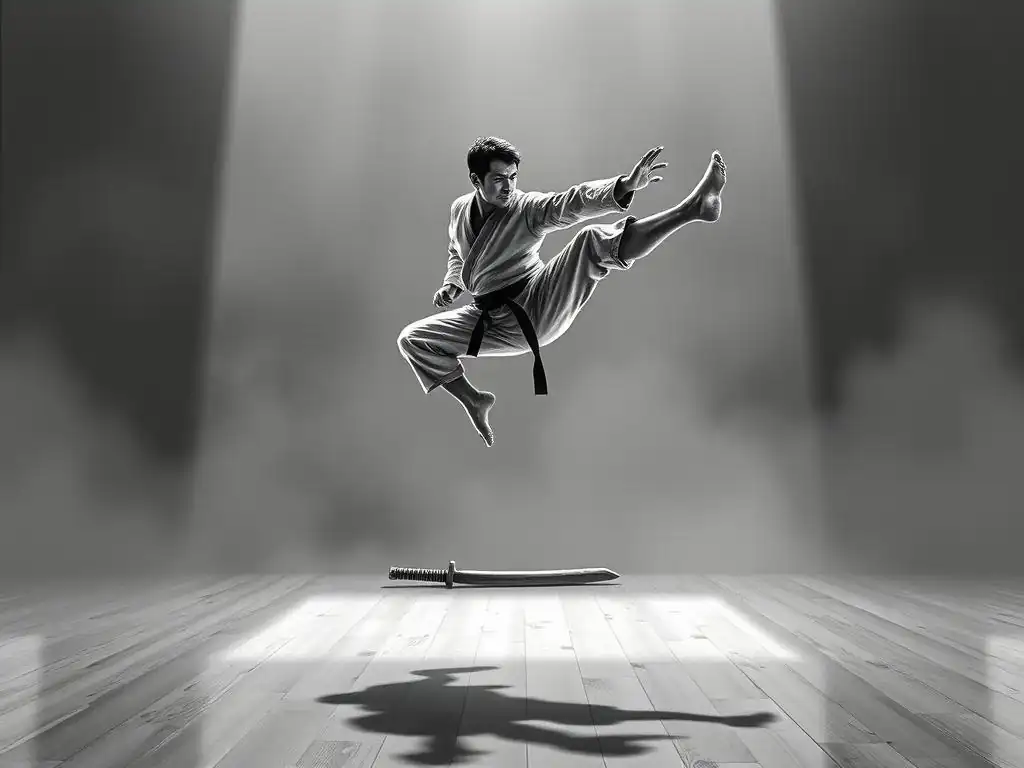
Once proficient in the basic jumping front kick, practitioners can integrate it into combinations. A common variation is the double jumping front kick, where two front kicks are delivered in quick succession while airborne. Another approach is to combine the Twieo Ap Chagi with a different kick upon landing, such as following up with a roundhouse kick or a side kick.
Combining the jumping front kick with other techniques requires advanced timing, balance, and stamina. For example, a practitioner might use the jumping front kick to break an opponent's guard or create distance, then immediately follow up with a rapid ground-based kick as they land. Practicing these combinations in sequence, first slowly and then at speed, helps build the necessary flow and efficiency. A successful jumping front kick combination can overwhelm an opponent's defense, leading to increased scoring opportunities.
Target Variations: Head, Chest, and Abdomen
While the fundamental jumping front kick technique basics apply, adjusting the target requires subtle modifications in technique and trajectory. Kicking to the chest or abdomen is often easier to achieve height for, but requires precise aiming to hit the scoring area (the trunk protector in WT sparring). Kicking to the head requires significantly more height and precision and carries higher risk but offers greater potential reward (3 or 4 points vs. 2).
Practicing kicking targets held at specific heights corresponding to the opponent's head, chest, and abdomen is crucial. Adjust the angle of the jump and the timing of the kick to optimize for each target area. For a head kick, the jump must be higher, and the kick might be delivered slightly later in the jump's arc. For a body kick, the trajectory might be flatter. Training with partners who wear full sparring gear allows for realistic practice of targeting different body areas.
Adding Spins and Turns for Increased Complexity
Advanced practitioners can incorporate spins or turns into their jumping front kick for added power and unpredictability. Techniques like the 180 or 360-degree jumping front kick involve rotating the body during the jump before delivering the kick. This adds rotational momentum to the strike, potentially increasing power, but also significantly increases the difficulty and risk.
These variations require exceptional aerial control, balance, and spatial awareness. They are typically only attempted after years of dedicated training and mastery of simpler aerial techniques. While visually impressive and potentially high-scoring (e.g., a spinning head kick can score 4 points in WT competition), the margin for error is very small. Practice should begin with spinning jumps without kicking, gradually adding the kick once the spinning and landing are controlled.
The Jumping Front Kick in Taekwondo Sparring and Competition
Utilizing the Twieo Ap Chagi Effectively in Combat
In Taekwondo sparring, the jumping front kick can be a highly effective, albeit risky, tool. It is often used to close distance quickly against a retreating opponent or as a counter-attack when an opponent commits to their own technique. Its speed and reach can surprise an opponent who is not expecting an aerial attack.
Effective utilization requires timing and tactical awareness. It's rarely a technique to be thrown randomly. Practitioners often set it up with feints or footwork to create an opening. For example, a feigned low kick followed by a sudden jumping front kick to the head can be very effective. While successful execution can score valuable points (2 for body, 3-4 for head in WT), a failed attempt leaves the practitioner vulnerable upon landing, potentially allowing the opponent to counter-attack and score.
Reading Your Opponent and Identifying Opportunities
Successfully landing a jumping front kick in competition heavily relies on reading your opponent. Look for patterns in their movement, stance, and reactions. An opponent who consistently retreats when pressure is applied might be susceptible to a jumping front kick used to close distance. An opponent who drops their guard when attacking might present an opening for a counter jumping front kick.
Observing their defensive habits is also key. Do they primarily block with their arms or rely on evasive footwork? An opponent who mostly uses footwork might be vulnerable if their retreat path is cut off by a well-timed jumping front kick. Identifying these opportunities requires experience and sharp observation during the match. Elite competitors spend countless hours analyzing opponents to find the precise moments when a high-risk, high-reward technique like the jumping front kick is most likely to succeed.
Countering and Defending Against the Jumping Front Kick
Defending against a jumping front kick requires quick reflexes and proper positioning. The primary defense is often evasion through rapid backward or lateral movement to get out of the kick's range. Blocking is also possible, typically using forearms or shins, but carries a higher risk of injury due to the power of the kick.
Timing is critical for defense. Recognizing the opponent's run-up or preparatory movement signals that an aerial attack might be coming. Training reaction drills specifically for aerial kicks helps improve defensive speed. Countering often involves attacking immediately as the opponent lands, before they have fully regained balance. A rapid push kick or side kick as they descend can disrupt their landing and create a scoring opportunity for the defender.
Safety Considerations and Injury Prevention for Aerial Kicks
Warm-up and Stretching Exercises
Proper warm-up and stretching are non-negotiable before practicing the jumping front kick technique basics or any aerial kicks. A thorough warm-up increases blood flow to the muscles, improving elasticity and reducing the risk of strains or tears. This should include light cardio (e.g., jogging, jumping jacks) for 5-10 minutes, followed by dynamic stretching.
Dynamic stretches, such as leg swings, hip circles, and torso twists, prepare the joints and muscles for the dynamic movements involved in jumping and kicking. Static stretching, focusing on hamstrings, hip flexors, quadriceps, and calves, should be performed after the training session to improve overall flexibility and range of motion, which is crucial for both performance and injury prevention. Neglecting warm-up significantly increases the risk of muscle pulls or ligament sprains.
Proper Landing Techniques to Minimize Impact
Incorrect landing is a major cause of injury when practicing jumping front kicks. Landing stiff-legged or off-balance places excessive stress on the knees, ankles, and hips, potentially leading to sprains, twists, or even fractures over time. Always aim to land softly, bending the knees and hips to absorb the impact.
Practice landing techniques separately from the full kick initially. Jump from a low height (e.g., 30-50cm) and focus purely on landing with controlled flexion of the lower body joints. Strengthen the muscles around the knees and ankles through exercises like calf raises, squats, and lunges. Developing strong supporting muscles helps stabilize the joints and absorb the forces generated upon landing, which can be several times the practitioner's body weight.
Gradual Progression and Avoiding Overexertion
Mastering the jumping front kick technique basics is a gradual process. Attempting too much too soon can lead to frustration and injury. Start by perfecting the standing kick, then gradually add the run-up, jump, and kick components separately before combining them. Begin with low jumps and gradually increase height and distance as your strength and coordination improve.
Avoid excessive repetitions, especially when first learning or practicing for height and power. Overexertion can lead to muscle fatigue, increasing the likelihood of sloppy technique and injury. Listen to your body and take rest days. A structured training plan that incorporates progressive overload, allowing the body to adapt gradually to the demands of aerial techniques, is essential for long-term development and safety in practicing the jumping front kick.
Conclusion: Elevating Your Taekwondo Game with the Jumping Front Kick
The Importance of Consistent Practice and Refinement
Mastering the jumping front kick technique basics, like any advanced Taekwondo technique, requires unwavering dedication and consistent practice. It is not a kick learned in a single session or week. It demands repeated drilling of each component – the stance, run-up, jump, kick, and landing – and then practicing the technique as a whole. Refinement comes from paying attention to detail, seeking feedback from instructors, and continuously working on improving power, height, speed, and precision.
Even experienced practitioners continue to refine their jumping front kick. Slight adjustments in timing, angle, or body position can significantly impact its effectiveness in a dynamic sparring environment. Dedicating specific portions of training sessions to aerial techniques, perhaps 15-20 minutes several times a week, is crucial for developing the necessary muscle memory and coordination. The journey to mastery is ongoing, built on a foundation of consistent effort and meticulous refinement.
Furthering Your Knowledge of Taekwondo Kicks and Techniques
The jumping front kick is just one example of the dynamic aerial techniques available in Taekwondo. Exploring and understanding other kicks, both standing and jumping, will further enhance a practitioner's overall skill set. Techniques like the jumping roundhouse kick (Twieo Dollyeo Chagi), jumping side kick (Twieo Yeop Chagi), or even more complex spinning aerial kicks build upon similar fundamental principles of momentum, balance, and airborne execution.
Continuing to learn about the history, philosophy, and application of various Taekwondo techniques provides a deeper appreciation for the art. Understanding the strategic uses of different kicks in sparring, the physics behind generating power, and the historical evolution of techniques enriches the training experience. By continuously expanding their knowledge beyond the jumping front kick technique basics, practitioners can become more well-rounded martial artists, capable of adapting to diverse situations and opponents.
Frequently Asked Questions
What is the primary purpose of the Jumping Front Kick (Twieo Ap Chagi) in martial arts?
The Twieo Ap Chagi, or Jumping Front Kick, is primarily used for closing distance quickly and delivering a powerful, unexpected strike to an opponent's midsection or head. It allows for attacks from unpredictable angles.
What are the key elements to consider when learning the Jumping Front Kick technique?
Key elements include proper footwork for generating power, precise targeting to maximize impact, and maintaining balance throughout the jump and kick. These elements are crucial for effective execution.
How does the Jumping Front Kick differ from a standard front kick?
Unlike a standard front kick, the Jumping Front Kick involves a vertical leap that adds momentum and reach. This aerial component allows for greater power and the ability to overcome obstacles or opponents.
What are some common mistakes beginners make when practicing the Jumping Front Kick, and how can they be avoided?
Common mistakes include poor balance upon landing, insufficient jump height, and incorrect targeting. These can be avoided through focused practice, drills, and paying careful attention to form.
Can the Jumping Front Kick be used effectively for self-defense, and if so, in what situations?
Yes, the Jumping Front Kick can be effective in self-defense, particularly when needing to quickly close distance or surprise an attacker. However, it requires proper training and awareness of the surrounding environment.
Final Reflection: Embracing the Aerial Ascent
The journey of mastering the jumping front kick, or Twieo Ap Chagi, transcends mere physical technique; it embodies a commitment to overcoming limitations and achieving aerial grace. Today, in a world demanding adaptability and innovation, the principles of balance, precision, and explosive power inherent in this martial art form resonate deeply, offering a potent metaphor for navigating life's challenges with confidence and agility.
This exploration has not only illuminated the mechanics of the kick but also underscored its profound impact on personal growth. The discipline required to perfect each stage, from the initial stance to the final extension, mirrors the dedication needed to achieve any meaningful goal. The journey of a thousand miles begins with a single step
- Lao Tzu. This ancient wisdom rings true; each practice session, each adjustment, each near-miss, contributes to a holistic understanding of self and potential.
Now, as you close this article, consider how the principles of the jumping front kick can inform your own pursuits. Embrace the challenge, cultivate your balance, and harness your inner power. Let the pursuit of mastery, whether in martial arts or in life, propel you towards new heights of achievement and self-discovery. The sky, quite literally, is the limit.
Elevate Your Game: Unleash the Twieo Ap Chagi Within!
Thank you for exploring the fundamentals of the Jumping Front Kick with us! You've now unlocked the foundational knowledge to add this dynamic technique to your martial arts arsenal. Ready to take your training to the next level?
Here are a few actions you can take now:
- Master the technique: Dedicate your next training session entirely to practicing the drills and variations outlined in the article. Aim for fluidity and precision.
- Share this knowledge: Inspire a friend or training partner by demonstrating and teaching them the basics of the Twieo Ap Chagi.
- Analyze professional fighters: Watch videos of high-level martial artists utilizing the jumping front kick in competition. What subtle adjustments can you identify and incorporate into your own practice?
What creative drills will you design to perfect your Twieo Ap Chagi and truly make it your own?