
Roman Gladius: The Short Sword That Conquered an Empire Design & Combat Evolution

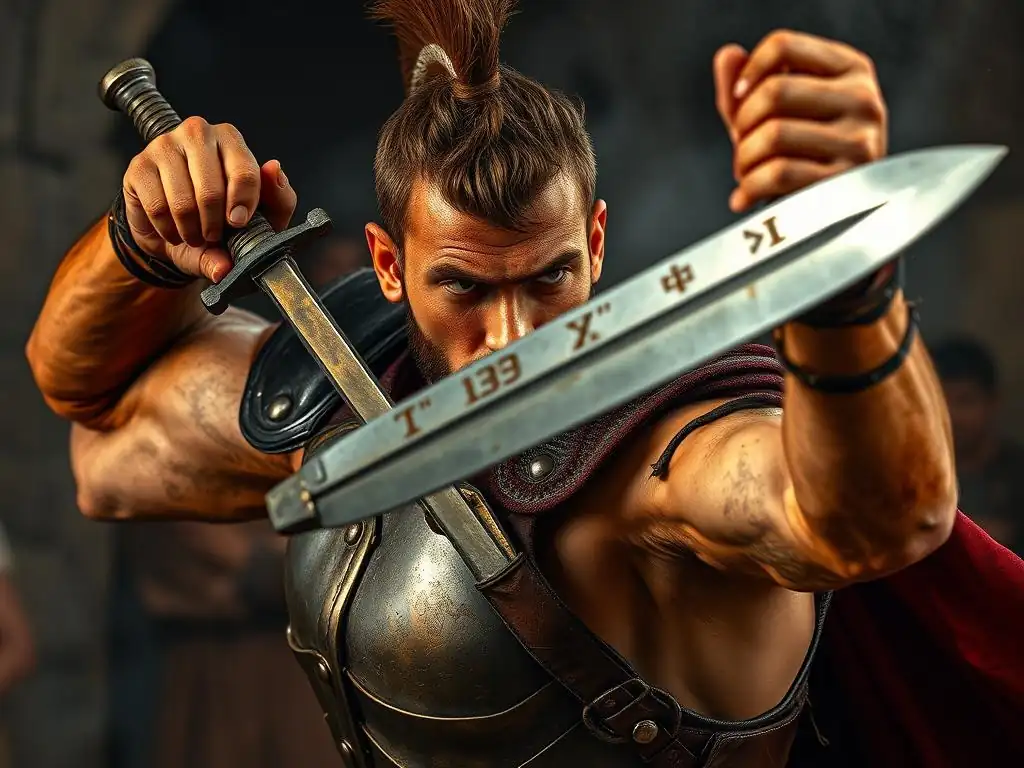
Welcome to Martial Arts Mastery, your portal to the world's fighting traditions! Prepare to delve into the intricacies of combat, philosophy, and the warriors who shaped history. Ever wondered how a single weapon could dominate the ancient world? Join us as we unsheathe the secrets behind the Roman gladius, exploring the design and combat evolution of this iconic short sword and its pivotal role in conquering empires. Discover the techniques, strategies, and legacy that cemented its place in martial arts history... and perhaps even inspire your own training.
The Thrust as the Primary Attack: Gladius Combat Doctrine
Roman military doctrine heavily emphasized the thrust as the primary attack method when employing the gladius. This was not arbitrary but a calculated approach rooted in efficiency and lethality. A thrust, targeting vital areas like the abdomen, groin, or throat, required less force to penetrate the relatively common segmentata or mail armor of the time compared to a sweeping cut.
Furthermore, a thrust delivered with a sharp, pointed gladius blade created a smaller, often more immediately incapacitating wound than a cut, which could be long and bleeding but not instantly fatal. Historical accounts, such as those found in ancient Roman military manuals, consistently highlight the superiority of the thrust, advising legionaries to focus their training on this precise and economical movement.
The tactical advantage of thrusting was particularly evident in the tight formations the Roman army favored. In the densely packed ranks of a legionary cohort or within the protection of a scutum wall, there was limited space for wide, powerful cuts. The short reach and balance of the gladius were perfectly suited for rapid, repeated thrusts from behind the large shield.
A legionary could deliver multiple thrusts in the time it took an opponent wielding a longer, cutting sword to recover from a single swing. This doctrine contributed significantly to the effectiveness of Roman gladius sword fighting techniques, turning the legionaries into highly efficient killing machines in close quarters, maximizing the damage output within their tactical formations.
Gladius Stance and Footwork: Mastering Roman Movement
Mastering Roman gladius sword fighting techniques involved adopting a specific stance and employing disciplined footwork, always in conjunction with the scutum shield. The typical fighting stance involved standing relatively low, with knees slightly bent, the body angled to present a smaller target, and the dominant foot slightly forward or square, depending on the situation. The large scutum was held forward, covering the majority of the body from shoulder to ankle, providing a mobile wall of defense.
The gladius was typically held low behind the shield, ready to dart out for a quick thrust, minimizing the sword's exposure until the moment of attack. This stance prioritized defense and the ability to launch sudden, unexpected attacks from behind cover.
Footwork in Roman gladius combat was primarily functional and economical. It focused on maintaining balance, adjusting distance, and leveraging the shield. Movements were generally short and controlled: stepping forward to close distance and attack, stepping back to evade or create space, and sidestepping to adjust position relative to the opponent or comrades in the formation.
Unlike more dynamic, open-field sword styles, Roman footwork was often constrained by the need to maintain formation integrity. Within the tight ranks, movement was minimal, focused on shuffling steps to keep the shield wall solid. Even in duels or skirmishes, the footwork remained practical, designed to facilitate the effective use of the scutum-gladius combination rather than elaborate maneuvers.
Close-Quarters Combat with the Gladius: Tactics and Maneuvers
The gladius truly excelled in the chaotic, close-quarters environment of ancient battlefields and the gladiatorial arena. Its short length, typically around 60-70 cm for the blade, made it exceptionally maneuverable in tight spaces where longer swords were cumbersome. Roman gladius sword fighting techniques in close quarters revolved around using the scutum to control the opponent – blocking attacks, pushing, or even using the shield's boss (the central metal dome) as a blunt weapon.
Once the opponent was momentarily disrupted or their guard was down, the gladius would flash out from behind the shield for a swift, powerful thrust to a vulnerable spot. This combination of impenetrable defense and sudden, lethal offense was the hallmark of Roman gladius combat.
Beyond the primary thrust, close-quarters tactics included using the gladius for quick, upward thrusts under the opponent's guard or shield, targeting the groin or lower abdomen. While cuts were secondary, they were not entirely absent; short, sharp cuts to limbs or the face could be used to injure, distract, or create openings for a decisive thrust. In the packed conditions of the battle line, legionaries relied on instinct and rigorous training, delivering repeated, short-range attacks.
For example, historical approximations suggest a trained legionary could deliver several thrusts per second at extremely close range. This focus on rapid, close-in attacks, facilitated by the gladius's design and the protective scutum, allowed Roman soldiers to overwhelm opponents in hand-to-hand fighting, turning the melee into a grinding, lethal process that favored the disciplined Roman style.
- The Thrust as the Primary Attack: Gladius Combat Doctrine
- Gladius Stance and Footwork: Mastering Roman Movement
- Close-Quarters Combat with the Gladius: Tactics and Maneuvers
- How did the gladius contribute to Roman military success?
- What were some key Roman gladius sword fighting techniques?
- How did the design of the gladius evolve over time?
- What made the gladius different from other swords of its time?
- Where can I learn more about Roman gladius sword fighting techniques?
Frequently Asked Questions
How did the gladius contribute to Roman military success?
The gladius, being a relatively short and versatile sword, allowed Roman soldiers to fight effectively in close formations like the testudo. Its design facilitated both thrusting and slashing attacks, crucial for defeating various enemy types. This adaptability and effectiveness played a significant role.
What were some key Roman gladius sword fighting techniques?
Roman gladiators and soldiers favored a thrusting attack with the gladius due to its potential for inflicting quick, fatal wounds. Other techniques included short, powerful slashes targeting vulnerable areas, and using the shield for defense and offense. Footwork and positioning were also essential.
How did the design of the gladius evolve over time?
The gladius underwent several design changes, starting with the Gladius Hispaniensis (Spanish sword) adopted from Iberian mercenaries. Later versions, like the Mainz and Pompeii types, featured refined blade shapes and lengths to optimize combat effectiveness. These adaptations reflected changing combat needs.
What made the gladius different from other swords of its time?
The gladius' shorter blade length distinguished it from longer swords used by some of Rome's adversaries, such as the Gauls. This compact size made it ideal for close-quarters combat and for fighting in tight formations. Its thrust-oriented design was also a key differentiator.
Where can I learn more about Roman gladius sword fighting techniques?
MartialArtsMastery.org offers articles and resources on various martial arts, including information on historical combat methods. Further research into Roman military manuals and archaeological findings can provide additional insights. You may also find historical reenactment groups that practice these techniques.
Final Reflection: The Enduring Legacy of the Gladius
The preceding exploration of the Roman gladius, its design evolution, and its pivotal role in shaping Roman military dominance underscores a fundamental truth: weaponry is not merely about metal and edge, but about strategy, adaptation, and the human spirit that wields it. The gladius, more than just a short sword, became a symbol of Roman power, a tool that, when combined with discipline and innovative tactics, carved out an empire that continues to fascinate and influence us today.
The impact of the gladius extends far beyond the battlefield. Its influence can be seen in modern military training, historical reenactments, and even popular culture. The gladius reminds us that even seemingly simple tools, when optimized and integrated into a larger system, can achieve extraordinary results. Fortune favors the bold.
This ancient proverb perfectly encapsulates the Roman spirit, a spirit embodied in the gladius and the legionaries who wielded it with unwavering courage and skill.
Now, consider the lessons learned from the Roman gladius and its impact on history. How can you apply the principles of adaptation, strategic thinking, and disciplined execution in your own life? Embrace the spirit of innovation and the pursuit of excellence, and like the Roman legionary, strive to master your own "gladius" – whatever tools and skills you possess – to achieve your goals and leave your own lasting mark on the world.
Unleash Your Inner Legionary!
Thank you for exploring the legacy of the gladius with us. You've now glimpsed the power and ingenuity behind this iconic weapon. Ready to connect with history and martial mastery?
Here’s how you can delve deeper:
- Craft Your Own Gladius-Inspired Workout: Design a fitness routine incorporating movements that mimic gladius combat drills. Focus on core strength, agility, and precision strikes. This is your chance to feel the power of the legion!
- Research lesser-known variations of the gladius and share your findings on martial arts forums. Expand the conversation beyond the well-trodden path.
- Visit a local museum with Roman artifacts and try to sketch your interpretation of the gladius and its place in history.
What new insights about combat and strategy did the gladius inspire in you?