
Mushin & Fudoshin: Zen Concepts for Unwavering Resilience and Composure in Martial Arts


Welcome to Martial Arts Mastery, where we delve into the heart and soul of combat traditions worldwide. Are you ready to unlock the secrets to unshakeable resilience? Today, we explore the profound connection between Zen and martial arts, focusing on "Zen martial arts resilience training" and how concepts like Mushin and Fudoshin can transform your practice. Discover how to cultivate unwavering composure and mental fortitude, pushing beyond physical limits to achieve true mastery. Let's begin!
- Mental Fortitude in Aikido: Mushin and Fudoshin for Unwavering Resilience
- Introduction to Mushin and Fudoshin in Aikido Philosophy
- Mushin: The Mind Without Obstruction for Fluid Movement
- Fudoshin: The Immovable Mind for Grounded Stability
- Comparing and Contrasting Mushin and Fudoshin in Aikido
- Practical Applications of Mushin and Fudoshin in Aikido Training
- Overcoming Challenges in Developing Mushin and Fudoshin
- Conclusion: Mastering Mental Resilience Through Aikido Principles
-
Frequently Asked Questions
- What are Mushin and Fudoshin in the context of Zen martial arts?
- How does Mushin contribute to resilience during martial arts training and combat?
- How can Fudoshin help a martial artist maintain composure when facing adversity?
- What are some practical exercises to cultivate Mushin in martial arts training?
- How does the historical and philosophical context of Zen Buddhism inform the practice of Mushin and Fudoshin in martial arts?
- Final Reflection: Embracing the Unwavering Mind
- Embrace Inner Peace: Begin Your Journey to Unshakable Resilience!
Mental Fortitude in Aikido: Mushin and Fudoshin for Unwavering Resilience
Introduction to Mushin and Fudoshin in Aikido Philosophy
Understanding the Role of Mental Discipline in Aikido
Aikido, often translated as "the way of harmonious energy," is not merely a collection of physical techniques but a profound path of self-discovery and development. At its core lies a deep emphasis on mental discipline, recognizing that true mastery extends far beyond physical prowess.
This mental training is crucial for developing the unwavering resilience necessary to navigate conflict, both on the mat and in life. Zen principles, such as Mushin and Fudoshin, are integral to this aspect of Aikido practice, providing a framework for achieving mental fortitude and composure under pressure, which is a cornerstone of effective Zen martial arts resilience training.
The founder, Morihei Ueshiba (O-Sensei), stressed the importance of cultivating a calm and centered mind, capable of responding instinctively and effectively to any situation. He believed that physical techniques were merely expressions of inner harmony and mental clarity. Without a disciplined mind, techniques become rigid and ineffective. This focus on inner development is what distinguishes Aikido and highlights its unique approach to martial arts resilience training, emphasizing mental preparedness as much as physical skill.
The Importance of Maintaining Center in Aikido Practice
Maintaining one's physical and mental center is a fundamental concept in Aikido, directly linked to the development of Mushin and Fudoshin. The physical center, often referred to as the hara (located in the lower abdomen), is considered the source of ki (vital energy) and stability. A strong physical center allows for powerful, grounded movements and forms the basis for maintaining balance when attacked. This physical grounding is inextricably linked to mental centering.
A centered mind is calm, focused, and present. It is not easily disturbed by external forces or internal distractions like fear or doubt. In Aikido practice, learning to maintain this mental center while being physically challenged – through throws, pins, and attacks – is essential. This simultaneous development of physical and mental stability is a core component of Zen martial arts resilience training, enabling practitioners to remain composed and effective even in chaotic situations.
Mushin: The Mind Without Obstruction for Fluid Movement
Defining Mushin: Emptying the Mind to React Naturally
Mushin (無心), a term originating from Zen Buddhism, translates literally as "no mind" or "mind without mind." In the context of martial arts, it refers to a state of mental clarity and spontaneity where the mind is free from conscious thought, judgment, fear, or anticipation. It is a state achieved through rigorous and repetitive training, where techniques become internalized to the point of unconscious execution. When in a state of Mushin, the practitioner reacts instinctively and appropriately to an opponent's actions without the delay caused by deliberate thinking.
This state is not one of emptiness or unconsciousness, but rather one of heightened awareness and responsiveness. The mind is present and open, capable of perceiving and reacting instantly. Think of a complex musical improvisation; the musician isn't consciously thinking of each note but is reacting to the music as it unfolds, drawing upon years of practice. Similarly, in Aikido, Mushin allows the practitioner to move fluidly and adaptively, responding to uke's (attacker's) energy and intention without mental hesitation, showcasing the pinnacle of Zen martial arts resilience training in action.
Achieving Mushin: Techniques for Cultivating Spontaneity
Cultivating Mushin is a gradual process that requires consistent and dedicated practice. It involves training the body and mind to respond instinctively, bypassing the analytical mind. Two key practices in Aikido that aid in developing Mushin are Kokyu-ho breathing exercises and Ki-no-nagare practice. These methods help quiet the internal dialogue and foster a state of relaxed alertness, crucial for achieving "no mind."
Another vital aspect is the sheer volume of technical repetition. Practicing foundational techniques like ikkyo or shiho-nage thousands of times, often performing 100-200 repetitions of a single technique in a focused training session, helps engrain the movements. This deep physical conditioning allows the body to react automatically under pressure, freeing the mind from the need to consciously direct each movement.
Kokyu-ho Breathing for Mushin Development
Kokyu-ho (呼吸法), or breath power exercises, are fundamental in Aikido for developing internal energy and promoting a calm, centered mind. These exercises often involve coordinating movement with deep, deliberate breathing, focusing on extending the exhale and maintaining a connection to the hara. For example, a common Kokyu-ho drill involves sitting in seiza (kneeling posture) and extending the arms forward, coordinating the outward breath with the movement, held for perhaps 5-10 seconds.
Consistent practice of Kokyu-ho helps to regulate the nervous system, reduce stress, and quiet mental chatter. By focusing on the physical sensation of breath and movement, the practitioner learns to anchor their awareness in the present moment, a necessary prerequisite for entering the state of Mushin. This focus on breath control is a direct link to Zen meditation practices and reinforces the connection between Aikido and Zen martial arts resilience training.
Ki-no-nagare Practice for Unobstructed Flow
Ki-no-nagare (気の流れ), meaning "flow of ki," is an advanced training method in Aikido where techniques are performed continuously and fluidly, with minimal pauses between movements and transitions. Instead of executing discrete techniques, the practitioner learns to blend seamlessly with uke's energy, allowing the technique to unfold naturally. This requires a high degree of sensitivity and adaptability.
In Ki-no-nagare drills, the interaction between nage (thrower) and uke is dynamic and continuous. Uke might maintain a constant attack or flow into the next movement after being thrown. This forces nage to react instantaneously and without hesitation, relying on ingrained reflexes and intuitive understanding rather than conscious planning. Practicing in this free-flowing manner, perhaps for several minutes consecutively without stopping, actively cultivates the spontaneous responsiveness characteristic of Mushin.
The Benefits of Mushin in Aikido Techniques
Achieving moments of Mushin during practice significantly enhances the effectiveness of Aikido techniques. When the mind is free from internal obstacles, the body can move with greater efficiency, power, and adaptability. This state allows the practitioner to perceive and react to subtle cues that might otherwise be missed, leading to more precise timing and effortless execution of techniques.
- Benefits of Mushin:
    - Enhanced perception and sensitivity.
    - Improved reaction time.
    - Greater adaptability to changing situations.
    - Reduced physical tension.
    - More fluid and powerful technique execution.
This mental state is particularly valuable in unpredictable situations, such as randori (multiple-person attack practice), where the practitioner must respond to simultaneous and varied inputs. Mushin enables a practitioner to handle multiple attackers by reacting instantly to the most immediate threat while remaining aware of others, a testament to the effectiveness of Zen martial arts resilience training under pressure.
Enhanced Sensitivity to Uke's Intentions
One of the most significant benefits of Mushin is a heightened sensitivity to uke's energy, balance, and intentions. When the analytical mind is quiet, the practitioner can perceive subtle shifts in uke's weight distribution, muscle tension, or even breath. This allows nage to anticipate or blend with uke's movement before the technique is fully committed, often leading to effortless throws or pins.
This sensitivity is not about predicting the future but about being fully present and receptive to the information available in the immediate moment of contact. A practitioner in a state of Mushin might feel uke's intention to shift their weight before the shift occurs, allowing them to initiate a technique like kokyu-nage (breath throw) with perfect timing, utilizing uke's own energy against them. This level of intuitive responsiveness is a direct outcome of cultivating a "mind without mind."
Improved Timing and Adaptability
Mushin directly impacts timing and adaptability, critical elements for effective Aikido. In a dynamic interaction, timing is everything; being slightly too early or too late can render a technique ineffective. When the mind is free from hesitation and overthinking, the practitioner can respond with optimal timing, blending with uke's attack at the precise moment their energy is exposed or vulnerable.
Furthermore, Mushin fosters adaptability. If a planned technique isn't working or uke reacts unexpectedly, the practitioner in a state of Mushin can instantly shift to a different technique or variation without mental friction. This fluid adaptability, moving from one response to another without conscious deliberation, allows the practitioner to maintain control and effectiveness throughout a dynamic exchange, showcasing robust Zen martial arts resilience training in action.
Fudoshin: The Immovable Mind for Grounded Stability
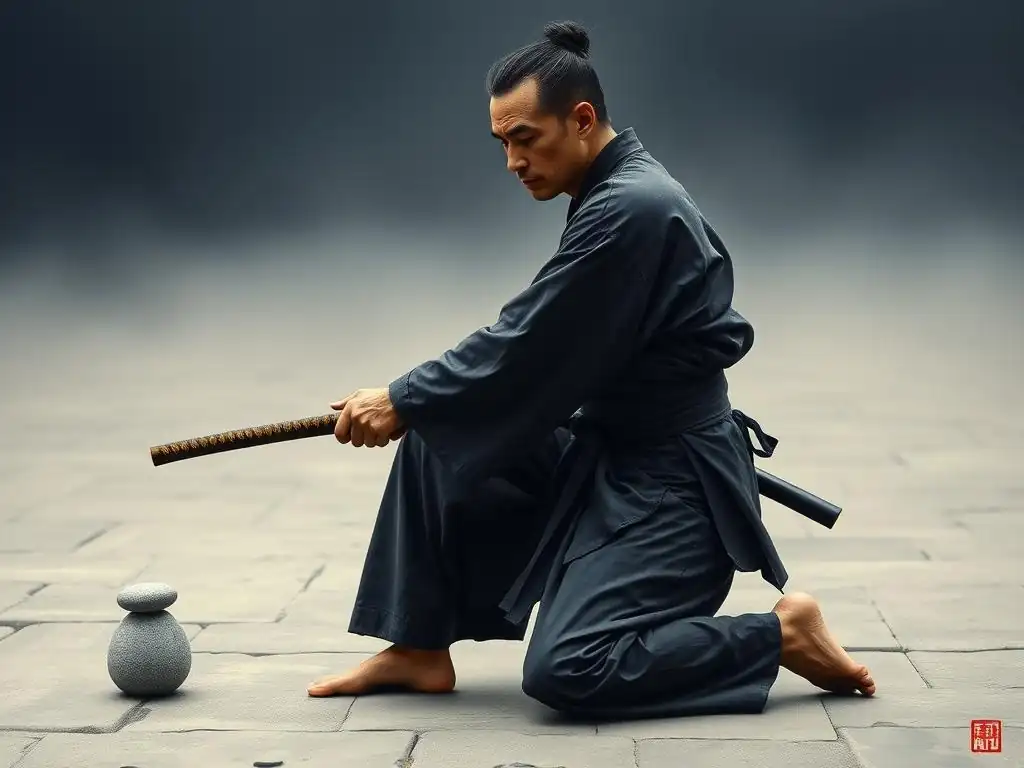
Defining Fudoshin: Cultivating an Unshakeable Center
Fudoshin (不動心), meaning "immovable mind" or "unmoving heart," is another crucial Zen concept applied in martial arts. While Mushin is about fluidity and spontaneity, Fudoshin is about mental stability, composure, and resolve. It refers to a state where the mind is calm, determined, and not easily disturbed by fear, doubt, surprise, or external pressure. It is the mental equivalent of having an unshakeable physical base.
Fudoshin is not about being rigid or stubborn, but about possessing inner strength and conviction that allows one to remain centered and decisive regardless of the circumstances. It is the ability to face adversity with courage and maintain composure in the face of danger. This mental fortitude is essential for effective self-defense and is a cornerstone of developing resilience through martial arts training.
Developing Fudoshin: Building Mental and Physical Stability
Developing Fudoshin involves cultivating both physical stability and mental resilience. The physical practice of maintaining a strong center and grounded posture reinforces the mental state of being unshakeable. Conversely, a calm and determined mind helps the body remain stable under pressure. This symbiotic relationship is central to Aikido practice.
Practices that build physical endurance, balance, and the ability to withstand pressure contribute to Fudoshin. This includes rigorous stance training, resisting attempts to break balance, and safely performing ukemi (breakfalls) from various techniques. Facing physical challenges repeatedly in a controlled environment builds confidence and reduces the fear response, strengthening the "immovable mind." This deliberate cultivation of mental and physical toughness is a key aspect of Zen martial arts resilience training.
Centering Exercises for Strengthening Fudoshin
Centering exercises are vital for developing both physical and mental Fudoshin. These drills focus on maintaining a strong connection to the ground and one's hara, resisting attempts by a partner to push, pull, or unbalance. A simple exercise might involve two partners standing facing each other, hands connected, with one partner attempting to break the other's balance using only gentle, constant pressure for a minute or two.
More advanced exercises involve multiple partners applying pressure from different directions simultaneously. The goal is not to resist with brute force but to sink one's weight, relax the upper body, and maintain a stable, rooted posture. This physical practice directly translates to mental stability; learning to remain calm and grounded under physical stress builds the mental resilience needed to face psychological pressure without becoming flustered, a core tenet of Zen martial arts resilience training.
Ukemi (Breakfalling) as a Fudoshin Practice
Ukemi (受身), the art of receiving techniques and falling safely, is often seen purely as a physical skill to prevent injury. However, it is also a profound practice for developing Fudoshin. Learning to relax and fall safely, even from dynamic throws, requires overcoming the natural fear of falling and impact. Initially, students may hesitate or tense up, leading to awkward or unsafe falls.
Through consistent ukemi practice, performing perhaps dozens of falls in a single class, students learn to trust their training, relax into the movement, and accept the throw. This process builds courage, reduces fear, and develops a willingness to enter uncomfortable or unpredictable situations while maintaining composure. The ability to "receive" a technique with a calm mind and body is a direct manifestation of Fudoshin, demonstrating mental resilience in the face of physical challenge.
The Role of Fudoshin in Maintaining Balance and Structure
Fudoshin plays a critical role in maintaining balance and structural integrity during Aikido techniques. A practitioner with Fudoshin is less likely to be easily thrown off balance ( kuzushi) or have their posture compromised. This allows them to effectively receive an attack, blend with it, and execute a technique without losing their own stability or control.
This inner steadfastness ensures that even when subjected to significant force or disruption, the practitioner's core remains stable, providing a solid foundation for movement and technique application. It's the difference between being a rigid tree that can snap in the wind and a deeply rooted tree that sways but remains firmly anchored.
Resisting Attempts to Break Balance (Kuzushi)
Kuzushi (崩し) is the art of breaking an opponent's balance. A skilled Aikido practitioner is adept at both applying kuzushi and resisting it. Fudoshin is essential for the latter. When uke attempts to break nage's balance, a practitioner with Fudoshin uses their calm mind and grounded posture to absorb or redirect the force without becoming destabilized.
This resistance is not just physical; it's mental. Fear or surprise can cause a practitioner to tense up or react impulsively, making them easier to unbalance. Fudoshin allows the practitioner to remain calm, assess the pressure, and respond appropriately, often by sinking their weight or subtly adjusting their posture, thus maintaining their center against forces designed to disrupt it. This ability to withstand disruption is a core element of Zen martial arts resilience training.
Maintaining a Strong Stance (Hanmi)
Maintaining a strong, stable stance, such as hanmi (half-facing stance), is fundamental in Aikido. Fudoshin underpins the ability to maintain this stance effectively under pressure. A strong stance is not merely about physical positioning but about embodying a sense of groundedness and readiness.
When attacked, a practitioner with Fudoshin maintains their hanmi with a relaxed yet alert posture, allowing them to receive the attack and move from a stable base. They don't collapse or become rigid. This steadfastness in posture, born from an unshakeable mind, provides the necessary stability to execute techniques powerfully and safely, even when dealing with a larger or stronger opponent.
Comparing and Contrasting Mushin and Fudoshin in Aikido
Distinguishing Key Differences: Adaptability vs. Stability
While both Mushin and Fudoshin are crucial Zen concepts in Aikido, they represent slightly different aspects of mental fortitude. Mushin emphasizes adaptability, spontaneity, and the ability to react instantaneously without conscious thought. It's the state of flow, allowing for fluid, unobstructed movement and response. It's about having a mind that is like clear water, capable of taking any shape or reflecting any image without distortion.
Fudoshin, on the other hand, emphasizes stability, composure, and unwavering resolve. It's about having a mind that is grounded and not easily moved by external circumstances or internal fears. It's the mental equivalent of a solid mountain – unshakeable and steadfast. While Mushin is about the mind's ability to change and flow, Fudoshin is about its ability to remain centered and stable.
Complementary Nature: How They Enhance Each Other in Practice
Despite their distinct qualities, Mushin and Fudoshin are deeply complementary and mutually reinforcing in Aikido practice. One cannot truly exist at a high level without the other. Mushin provides the flexibility and responsiveness needed to blend with an attack, while Fudoshin provides the stable base and mental composure needed to receive the attack without being overwhelmed.
Imagine facing a powerful attack: Fudoshin allows you to remain calm and centered, not flinching or becoming rigid. From this stable base, Mushin allows your body to react spontaneously and flow with the incoming energy, executing a technique without conscious deliberation. Without Fudoshin, Mushin might lead to uncontrolled, unstable reactions. Without Mushin, Fudoshin might lead to rigid, ineffective resistance. Together, they create a state of dynamic stability and responsive composure, forming the bedrock of advanced Zen martial arts resilience training.
Integrating Mushin and Fudoshin into Aikido Training
Integrating Mushin and Fudoshin is not achieved by training them separately but by recognizing their presence and cultivating them simultaneously through all aspects of Aikido practice. Every technique, every fall, every interaction with a partner is an opportunity to practice both. Drills that challenge balance and composure build Fudoshin, while free-flowing practice and high-repetition drills foster Mushin.
Instructors often guide students to be "calm yet alert," "rooted yet fluid," encouraging the simultaneous development of these two states. By consciously bringing awareness to one's mental state during rigorous physical training, practitioners learn to embody both the unmoving mountain and the flowing stream, building profound Zen martial arts resilience training from the inside out.
Practical Applications of Mushin and Fudoshin in Aikido Training

Drills and Exercises to Cultivate Mental Fortitude
Specific drills and exercises are designed to challenge the practitioner's mental state and encourage the development of Mushin and Fudoshin. These often involve elements of unpredictability, pressure, or continuous movement, forcing the practitioner to move beyond conscious thought and rely on ingrained responses and inner stability.
| Drill Type | Primary Focus | Description | Cultivates |
|---|---|---|---|
| Kokyu-ho | Breath/Center | Coordinated breathing and movement, often static. | Fudoshin (Calm) |
| Aiki Taiso | Movement/Flow | Dynamic warm-ups emphasizing connection and relaxation. | Mushin (Flow) |
| Morote-dori Kokyu-nage | Stability/Connection | Partner holds wrists, Nage performs breath throw using center/connection. | Fudoshin (Root) |
| Jiyu Waza | Adaptability | Free practice with multiple attacks, requiring continuous response. | Mushin (Spontaneity) |
Consistent engagement with these types of drills, often dedicating specific portions of a class (e.g., 15-20 minutes) to intense free practice or centering exercises, is key to internalizing the principles of Mushin and Fudoshin.
Randori (Free Practice) for Applying Mushin Principles
Randori (乱取り), or free practice, is one of the most effective methods for developing and testing Mushin. In randori, one practitioner ( nage) faces multiple attackers ( uke) simultaneously. The attacks are often varied and unpredictable, coming from different directions and speeds. This chaotic environment prevents nage from planning their responses consciously.
To survive and execute techniques effectively in randori, the practitioner must enter a state of Mushin. They cannot afford the delay of thinking; they must react instantly to the most immediate threat while maintaining awareness of others. Successful randori, even if only lasting for 1-2 minutes against 3-4 determined attackers, demonstrates the ability to function under pressure with a "mind without mind," reacting spontaneously and effectively, a true test of Zen martial arts resilience training.
Suwariwaza (Kneeling Techniques) for Developing Fudoshin
Suwariwaza (座り技), techniques performed from a kneeling position, are particularly challenging and highly effective for developing Fudoshin. Working from the knees significantly reduces mobility and requires a deep connection to the ground and a strong, stable center. Attacks in suwariwaza often involve pulling, pushing, and pinning attempts designed to break the practitioner's very limited balance.
Maintaining composure and stability while being attacked in suwariwaza forces the practitioner to rely heavily on their hara and mental resolve. Techniques like ikkyo or shiho-nage from kneeling require immense physical and mental grounding. Successfully executing even a single suwariwaza technique against a resisting partner demonstrates a high degree of Fudoshin, as the practitioner must maintain an unshakeable mind and center despite being in a vulnerable position.
Real-Life Examples of Mushin and Fudoshin in Action
While perfect Mushin and Fudoshin are ideals that few, if any, achieve completely, glimpses of these states can be observed in highly skilled practitioners. These examples serve as inspiration and demonstration of the potential for Zen martial arts resilience training.
The purpose of Aikido is not to defeat others, but to defeat the base and evil in oneself. This is the mission of Aikido.
- Morihei Ueshiba
This quote by O-Sensei highlights that the true battle is internal, against one's own fear, ego, and doubt – the very obstacles that Mushin and Fudoshin help overcome.
Morihei Ueshiba's Demonstrations of Aiki
Stories and historical accounts of Morihei Ueshiba, the founder of Aikido, often describe abilities that seem almost supernatural, such as being able to sense and evade an attack before it materialized or being unthrowable by multiple strong men. While some accounts may be embellished, they often point to a profound mastery of Aiki principles, which are deeply intertwined with Mushin and Fudoshin.
His ability to seemingly neutralize attacks with minimal physical effort can be attributed in part to a state akin to Mushin, where he could perceive and blend with an attacker's energy instantaneously. His legendary stability and rootedness, even under extreme pressure, were manifestations of Fudoshin. These abilities were not magic but the result of decades of intense spiritual and physical practice, leading to an extraordinary level of Zen martial arts resilience training and mastery.
Contemporary Aikido Instructors and Their Approach
Contemporary Aikido instructors, while perhaps not possessing the legendary abilities of the founder, often embody and teach the principles of Mushin and Fudoshin. Watching a high-level instructor handle multiple attackers in randori provides a practical demonstration. They move fluidly, react instinctively, and maintain a calm center despite the chaos.
Many instructors emphasize the importance of breath, posture, and mental state during class, constantly reminding students to relax, sink their weight, and stay present. They share anecdotes of students overcoming fear during testing or handling stressful situations outside the dojo using the composure and resilience developed through consistent Aikido practice, illustrating the real-world impact of Zen martial arts resilience training.
Overcoming Challenges in Developing Mushin and Fudoshin
Common Obstacles: Fear, Hesitation, and Mental Chatter
Developing Mushin and Fudoshin is a challenging journey, fraught with common obstacles. Fear is perhaps the most significant barrier – fear of getting hurt, fear of failure, or fear of looking foolish. This fear leads to tension, rigidity, and hesitation, preventing the spontaneous flow of Mushin and undermining the calm resolve of Fudoshin.
Mental chatter – the constant stream of thoughts, judgments, and self-criticism – is another major impediment. This internal dialogue distracts the mind, prevents it from being fully present, and hinders the development of Mushin. Hesitation, often a result of fear and overthinking, breaks the connection and timing necessary for effective techniques and contradicts the immediate responsiveness of Mushin. These mental blocks must be acknowledged and actively addressed during practice.
Strategies for Addressing Mental Blocks and Cultivating Patience
Addressing these mental blocks requires a multi-faceted approach centered on self-awareness, consistent practice, and a shift in mindset.
- Mindfulness: Paying attention to your thoughts and physical sensations during practice without judgment. Noticing fear or tension is the first step to releasing it.
- Breathing: Utilizing Kokyu-ho and conscious breathing during stressful drills to calm the nervous system and anchor the mind in the present.
- Focus on Process: Shifting focus from the outcome (performing a perfect technique) to the process (maintaining posture, staying relaxed, blending with energy).
- Gradual Progression: Facing challenges incrementally. Starting with slower, less intense practice before moving to more dynamic drills like randori.
Cultivating Mushin and Fudoshin requires immense patience. Progress is often slow and non-linear. There will be days when the mind feels cluttered or fear is overwhelming. Recognizing this as a natural part of the process and continuing to practice with dedication is crucial for long-term development of Zen martial arts resilience training.
The Importance of Consistent Practice and Humility
Consistent, dedicated practice is the single most important factor in developing Mushin and Fudoshin. These states are not achieved through intellectual understanding but through deep physical and mental conditioning over time. Regular attendance (e.g., training 2-3 times per week) and focused effort in every class are necessary to engrain the principles into the body and mind.
Humility is also essential. Approaching practice with humility means acknowledging one's limitations, being open to instruction, and learning from mistakes. Ego and pride can create mental rigidity, hindering the development of both Mushin and Fudoshin. A humble student is more receptive to the subtle lessons of Aikido and more likely to persevere through the frustrations of training, fostering true Zen martial arts resilience training.
Conclusion: Mastering Mental Resilience Through Aikido Principles
The Enduring Relevance of Mushin and Fudoshin in Aikido
Mushin and Fudoshin are not outdated philosophical concepts; they are living principles vital to the effective practice and understanding of Aikido today. They represent the deep connection between the physical and mental aspects of martial arts and offer a powerful framework for developing inner strength and composure. In a world often characterized by unpredictability and stress, the ability to cultivate a "mind without mind" and an "immovable mind" is more relevant than ever.
These concepts elevate Aikido beyond mere self-defense techniques, making it a path for holistic personal development. By striving to embody Mushin and Fudoshin, practitioners learn to face challenges with clarity, adaptability, and unwavering resolve, skills that are invaluable both on and off the mat. They are the heart of Zen martial arts resilience training within Aikido.
Continuing Your Journey Towards Mental Mastery in Aikido
The journey towards mastering Mushin and Fudoshin is lifelong. There is no final destination, only continuous practice and refinement. Every training session offers new opportunities to observe your mental state, challenge your limitations, and deepen your understanding of these principles. Embrace the process, be patient with yourself, and remain committed to consistent training.
Focus on developing self-awareness during practice, paying attention to moments of tension, hesitation, or mental clarity. Discuss these concepts with your instructor and senior students; their insights can provide valuable guidance. By actively engaging with the mental and philosophical aspects of Aikido, you continue to build the profound Zen martial arts resilience training that is its hallmark.
Resources for Further Study of Aikido and Mental Discipline
To deepen your understanding of Mushin, Fudoshin, and the mental discipline inherent in Aikido, explore resources that delve into the philosophical underpinnings of the art.
- Books on Aikido philosophy and the teachings of Morihei Ueshiba.
- Texts on Zen Buddhism and its application in martial arts.
- Instructional materials (videos, articles) that explicitly discuss the mental aspects of techniques.
- Engaging in discussions with experienced practitioners and instructors.
Exploring these resources can provide context and deeper insight into how concepts like Mushin and Fudoshin contribute to mental toughness and resilience, enriching your understanding and practice of Zen martial arts resilience training.
Frequently Asked Questions
What are Mushin and Fudoshin in the context of Zen martial arts?
Mushin translates to "no-mind" or "mind like water," emphasizing a state of responsiveness without conscious thought. Fudoshin means "immovable mind" or "unshakable heart," representing mental and emotional stability.
How does Mushin contribute to resilience during martial arts training and combat?
Mushin allows practitioners to react instinctively and fluidly to changing situations, preventing hesitation and overthinking which can lead to openings or mistakes. This allows them to be more adaptable and resilient under pressure.
How can Fudoshin help a martial artist maintain composure when facing adversity?
Fudoshin provides mental fortitude to withstand fear, doubt, or pain. It enables practitioners to remain calm and focused even when facing difficult opponents or challenging circumstances.
What are some practical exercises to cultivate Mushin in martial arts training?
Exercises like zazen (seated meditation) and repetition drills can help clear the mind and develop automatic responses. Focusing on the present moment and letting go of expectations are also crucial.
How does the historical and philosophical context of Zen Buddhism inform the practice of Mushin and Fudoshin in martial arts?
Zen Buddhism emphasizes mindfulness and detachment. These principles contribute to the development of Mushin and Fudoshin by encouraging practitioners to act without ego and remain present in the moment, fostering resilience and composure.
Final Reflection: Embracing the Unwavering Mind
The principles of Mushin and Fudoshin, once confined to the dojo, resonate deeply in our modern world, where constant change and relentless pressure demand unwavering resilience. These Zen concepts, far from being relics of the past, offer a powerful framework for navigating the complexities of life with composure and grace, extending far beyond the realm of martial arts.
The journey towards cultivating Mushin and Fudoshin is a lifelong pursuit, a continuous refinement of the mind and spirit. This pursuit, I believe, is not just about achieving peak performance, but about fostering a deeper understanding of ourselves and our capacity for inner peace. The mind is like water. When it's turbulent, it's difficult to see. When it's calm, everything becomes clear.
- Prasad Mahes. This quote encapsulates the essence of these Zen principles, highlighting the importance of mental clarity in the face of adversity.
As you reflect on the principles of Mushin and Fudoshin, consider how you can integrate them into your daily life. Embrace the present moment, cultivate a stillness within, and allow your actions to flow naturally from a place of inner peace. By doing so, you can unlock your own potential for unwavering resilience and composure, not just in martial arts, but in every aspect of your life.
Embrace Inner Peace: Begin Your Journey to Unshakable Resilience!
Thank you for exploring the profound concepts of Mushin and Fudoshin with us. Now that you understand their power, it's time to integrate these principles into your life, both on and off the mat. Here's how you can start:
- Commit to daily mindfulness practice to cultivate a "no-mind" state and improve your reaction time under pressure.
- Share this article with fellow martial artists and spark a conversation about incorporating mental resilience into training.
- Explore unconventional training methods like blindfolded drills or sparring with deliberate distractions to hone your focus and composure.
How will you apply Mushin and Fudoshin to become a more resilient and composed martial artist today?