
In and Out: Mastering Range Control with Strategic Boxing Footwork


Welcome to Martial Arts Mastery, your ultimate resource for delving into the rich world of combat disciplines!
Unlock the secrets to victory by exploring the nuanced dance of distance. Today, we're stepping into the ring to dissect strategic boxing footwork range control. Are you ready to discover how precise movement can dictate the flow of a fight and transform you into an untouchable force? Dive in and let's master the art of in-and-out footwork!
- Understanding Range Control in Boxing: The Foundation of Strategic Footwork
- The Core Principles of Strategic Boxing Footwork for Range
- Techniques for Controlling the Distance in Boxing
- Advanced Footwork Strategies for Boxing Range Control
- Drills to Improve Your Strategic Boxing Footwork and Range Control
- Common Mistakes in Boxing Footwork and How to Avoid Them
- Integrating Strategic Footwork Range Control into Your Boxing Game
- The Benefits of Mastering Strategic Boxing Footwork for Range Control
- Conclusion: Elevating Your Boxing with Strategic Footwork
-
Frequently Asked Questions
- How important is footwork in achieving strategic range control in boxing?
- What are some key footwork techniques for controlling range in boxing?
- How does understanding an opponent's footwork help with range control?
- How can I improve my footwork for better range control in boxing?
- What role does mental strategy play in utilizing footwork for range control?
- Final Reflection: Dancing on the Edge of Distance
- Unlock Your Ring Dominance: Step into Action Now!
Understanding Range Control in Boxing: The Foundation of Strategic Footwork
Defining Boxing Range: Long, Mid, and Inside
In the dynamic world of boxing, understanding and controlling the distance between you and your opponent is paramount. This concept, known as range control, is fundamentally linked to effective strategic boxing footwork. Boxing ranges are typically categorized into three primary zones: long range, mid-range, and inside range. Long range is where neither boxer can land a punch without taking a significant step forward; it's often the domain of jabs and movement. Mid-range is the most common fighting distance, allowing for combinations involving hooks and straight punches. Inside range is close quarters, characterized by infighting, uppercuts, and short hooks.
Mastering these ranges isn't just about where you stand, but how you get there and how you leave. Strategic boxing footwork allows a boxer to dictate the range, moving seamlessly between these zones to land punches effectively while minimizing the opponent's opportunities. For instance, a boxer might use quick steps back to establish long range after landing a combination in mid-range, denying the opponent a chance to counter.
Conversely, a skilled infighter uses precise footwork to close the distance rapidly and initiate exchanges in the tight inside range. The ability to transition between these distances is a hallmark of advanced strategic boxing footwork range control.
The Importance of Distance Management in Boxing Strategy
Distance management is a cornerstone of boxing strategy, directly impacting both offensive and defensive effectiveness. A boxer who can consistently control the distance can dictate the pace of the fight, choose when and where to engage, and exploit their own physical attributes while neutralizing their opponent's. For a taller fighter with a long reach, maintaining long range with strategic boxing footwork allows them to utilize their jab and straight punches effectively, keeping a shorter opponent at bay.
Conversely, a shorter fighter needs superior footwork to bridge the distance safely and fight on the inside, where their power punches might be more effective. Consider the strategic advantage gained by a boxer who can consistently stay just outside the opponent's punching range, forcing them to overextend, and then quickly step in to land a counter. This precise control of distance, facilitated by strategic boxing footwork, is not merely tactical; it is a fundamental strategic imperative that can determine the outcome of a bout, influencing everything from punch selection to energy conservation.
How Strategic Footwork Enables Range Dominance
Strategic boxing footwork is the engine that drives range dominance. It's the mechanism by which a boxer moves into, out of, and around an opponent's effective punching range. Simple linear movement (forward and backward) is essential, but lateral movement, pivots, and angles are equally critical for establishing and maintaining control. For example, side-stepping allows a boxer to avoid a direct attack while simultaneously creating a new angle for their own offense or establishing a safer distance.
Effective strategic boxing footwork range control isn't just reactive; it's proactive. It involves anticipating the opponent's movements and positioning oneself advantageously. A boxer might use a series of small, controlled steps to subtly shift their position, drawing the opponent into a trap or creating an opening. This constant, intelligent adjustment of position through footwork allows a boxer to consistently fight at their preferred range, maximizing their strengths and minimizing their weaknesses, thereby achieving true range dominance.
The Core Principles of Strategic Boxing Footwork for Range
Balance and Stance: The Cornerstone of Effective Footwork
At the heart of effective strategic boxing footwork lies a solid foundation of balance and stance. A proper boxing stance provides stability, allowing for quick, explosive movements in any direction without losing equilibrium. The feet should be shoulder-width apart, with the lead foot slightly forward and the weight distributed evenly, or slightly more on the back foot for power generation, or slightly more on the lead foot for forward movement and defense. Maintaining this balanced stance is crucial because any loss of balance compromises a boxer's ability to move efficiently, defend effectively, or generate power.
Furthermore, maintaining a consistent, balanced stance throughout movement is key to strategic boxing footwork range control. Whether stepping forward, backward, or laterally, the relationship between the feet should remain relatively constant, avoiding bringing the feet too close together (which causes instability) or too far apart (which limits mobility). This constant attention to balance ensures that every step, slide, or pivot is executed from a stable base, allowing the boxer to transition smoothly between offense and defense and maintain optimal distance.
Movement Drills: Developing Agility and Coordination
Developing agility and coordination is fundamental to executing strategic boxing footwork for range control. This isn't just about being fast; it's about being able to move precisely and efficiently. Drills such as skipping rope are invaluable, improving rhythm, timing, and calf endurance, all critical for light, quick steps. Ladder drills enhance foot speed and coordination, teaching the feet to move in specific patterns rapidly. Cone drills focus on changing direction quickly while maintaining balance.
These movement drills, practiced consistently, build the muscle memory and neurological pathways necessary for complex strategic boxing footwork. For instance, practicing the "in and out" movement repeatedly helps develop the coordination needed to step forward to attack and immediately step back out of range. Similarly, practicing lateral shuffles improves the ability to circle an opponent effectively. Dedicating 15-20 minutes per training session specifically to these types of footwork drills can dramatically improve a boxer's agility and coordination, directly enhancing their strategic boxing footwork range control.
Understanding Angles: Creating Openings and Defenses
Understanding and utilizing angles is an advanced principle within strategic boxing footwork range control. Moving off the center line is not just about avoiding punches; it's about creating advantageous positions relative to the opponent. By stepping to the side (creating an angle), a boxer can move outside the opponent's lead hand or foot, limiting their offensive options and simultaneously opening up new lines of attack for themselves, such as a hook around the opponent's guard.
This manipulation of angles through footwork is a powerful tool for range control. A boxer might use a small step to the side to pivot, effectively changing the engagement angle and forcing the opponent to reset their feet, losing a moment of offensive opportunity. Creating angles also aids in defense; by moving off the line of attack, the boxer makes themselves a harder target. Mastering the ability to consistently create and exploit angles using strategic boxing footwork is essential for controlling the fight's geography and dominating the range.
Techniques for Controlling the Distance in Boxing
The Jab as a Range Finder and Controller
The jab is often called the most important punch in boxing, and its role as a range finder and controller is central to strategic boxing footwork range control. The jab is typically the longest punch, used not only to score points or set up power shots but also to gauge the distance to the opponent. By extending the lead arm with a jab, a boxer can feel how close they are to the target and determine if they are within effective punching range for other techniques.
Beyond just finding the range, the jab is a powerful tool for controlling it. A consistent, snapping jab can keep an opponent at a preferred distance, preventing them from closing the gap. It can also be used to disrupt an opponent's rhythm or force them to move, allowing the jabbing boxer to adjust their own position using strategic boxing footwork. Throwing multiple jabs while stepping back, for example, can effectively increase the distance and break an opponent's forward pressure. Conversely, stepping forward with a jab helps close the distance safely to initiate an attack.
In and Out Movement: Closing and Opening the Distance
The "in and out" movement is a fundamental technique in strategic boxing footwork range control, specifically designed for rapidly changing the distance to the opponent. This involves taking a quick step or two forward to enter punching range (the "in" part), often to land a punch or combination, and then immediately taking a quick step or two backward to exit range (the "out" part), avoiding the opponent's counter-attack. This movement pattern allows a boxer to attack without lingering in the danger zone.
Effective execution of the in and out movement requires coordination between the feet and the upper body, maintaining balance throughout. It's not just about linear motion; often, the "out" step might involve a slight angle to further evade a potential counter. This technique is vital for boxers who prefer to fight from the outside or mid-range, allowing them to dart in, score, and retreat before the opponent can respond effectively. Practicing this strategic boxing footwork pattern is crucial for mastering offensive entries and defensive exits.
Lateral Movement: Circling and Avoiding Traps
Lateral movement, or moving side-to-side, is another critical component of strategic boxing footwork range control. Circling an opponent allows a boxer to avoid staying on the center line, making them a moving target and harder to hit. It also helps in controlling the ring space, potentially cutting off an opponent or preventing oneself from being trapped in a corner. Moving laterally can also create angles, as discussed earlier, opening up offensive opportunities.
Using lateral movement effectively requires keeping the feet relatively close to the ground, shuffling rather than stepping high, to maintain balance and readiness. It's often used defensively to evade an attack or offensively to set up a punch from an unexpected angle. For instance, a boxer might feint a step forward and then shuffle laterally to the side, avoiding the opponent's anticipated counter and gaining a positional advantage. This constant, fluid lateral motion is a key element of sophisticated strategic boxing footwork range control.
Advanced Footwork Strategies for Boxing Range Control
Pivoting: Changing Angles and Gaining Advantage
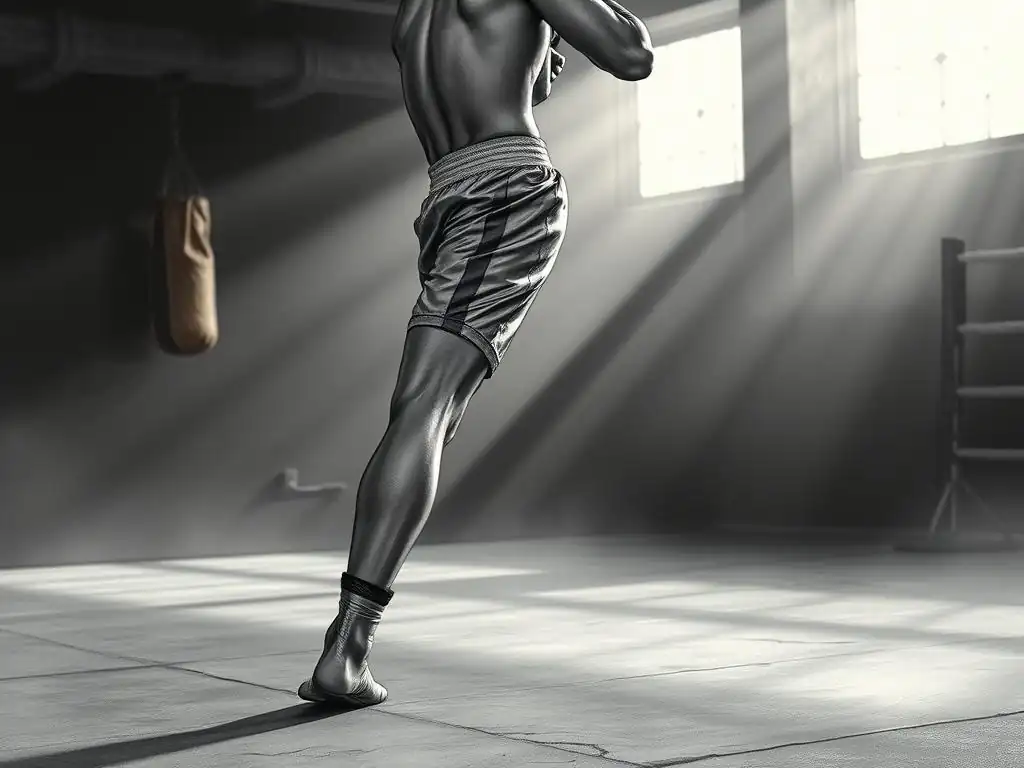
Pivoting is an advanced strategic boxing footwork technique that allows a boxer to rapidly change direction and angle relative to their opponent. It involves rotating the body on the ball of one foot (usually the lead foot for an outside pivot or the back foot for an inside pivot), while the other foot steps around. A common application is the lead-foot pivot, where the boxer pivots on the lead foot, swinging their back leg around to the side or even behind the opponent, effectively circling them.
Mastering pivots is crucial for strategic boxing footwork range control because it allows a boxer to escape danger, create new angles for attack, or reposition themselves to cut off the ring. For example, if an opponent is pressuring forward, a quick pivot can take the boxer off the line of attack and place them to the side of the opponent, disrupting their momentum and potentially opening them up for a counter. This ability to instantly shift position through a pivot is a high-level skill in managing distance and gaining tactical advantage.
Slipping and Weaving: Evading Punches While Maintaining Position
Slipping and weaving are defensive movements that are intrinsically linked to strategic boxing footwork, particularly concerning maintaining effective range. Slipping involves moving the head slightly to the side to allow a punch to pass by, while weaving involves bending at the knees and waist to duck under punches, often in a bobbing motion. While primarily defensive, these techniques are not just about avoiding hits; they are about doing so while staying within or immediately re-entering offensive range.
Effective slipping and weaving require precise timing and coordination with subtle foot adjustments. For instance, a slip might be accompanied by a small step or pivot to further enhance evasion and prepare for a counter. Weaving often involves slight forward or lateral movements of the feet to maintain balance and position. These techniques allow a boxer to evade incoming fire without having to step completely out of range, enabling immediate counter-attacks. This ability to defend and transition instantly to offense using integrated upper body movement and strategic boxing footwork is a hallmark of high-level range control.
Footwork Combinations: Linking Movement with Punches
The most effective strategic boxing footwork range control involves seamlessly linking movement with punches. Individual footwork techniques like stepping, sliding, pivoting, and lateral movement are rarely performed in isolation during a fight. Instead, they are combined and integrated with offensive and defensive actions. This means throwing punches while moving, or using movement to set up punches, or using movement to retreat after punching.
Examples of footwork combinations include stepping forward with a jab-straight combination, stepping back with a jab to create distance, shuffling laterally to land a hook, or pivoting after landing a combination to avoid a counter. A complex example might be: Step Forward (Lead Foot) + Jab -> Slide Back (Both Feet) -> Lateral Shuffle (Lead) + Hook. The ability to fluidly combine these movements and punches is what allows a boxer to constantly adjust range, create openings, and maintain defensive posture. Developing these footwork combinations through dedicated practice is essential for sophisticated strategic boxing footwork range control.
Drills to Improve Your Strategic Boxing Footwork and Range Control
Shadow Boxing Drills for Footwork Development
Shadow boxing is one of the most fundamental and effective drills for improving strategic boxing footwork range control. Practiced alone, it allows a boxer to visualize an opponent and move around them, practicing entries and exits, lateral movement, angles, and pivots without the pressure of a real opponent. Focus during shadow boxing should be placed squarely on the feet: stepping correctly, maintaining balance, and moving with purpose.
- [ ] Practice stepping in and out repeatedly, visualizing landing a punch as you step in and evading a counter as you step out.
- [ ] Circle the imaginary opponent, focusing on maintaining a consistent distance and smooth lateral movement.
- [ ] Practice pivots, changing angles after throwing combinations.
- [ ] Incorporate defensive movements like slipping and weaving, linking them with subtle footwork adjustments.
- [ ] Visualize specific scenarios, such as being pressured or needing to cut off the ring, and use footwork to execute the appropriate strategy.
Partner Drills: Practicing In and Out Movement with Resistance
Partner drills add a layer of realism and reaction to footwork training, specifically enhancing strategic boxing footwork range control. One simple drill involves partners facing each other, with one partner acting as a moving target or providing light resistance. The other partner practices stepping in to touch the target (simulating landing a punch) and then immediately stepping back out of range.
Another effective partner drill is "mirroring," where one partner moves their feet, and the other tries to mirror their movements precisely, maintaining a specific distance (e.g., arm's length). This helps develop reactive footwork and the ability to maintain range relative to a dynamic opponent. Using focus mitts with a partner allows for practicing stepping in to punch the mitts and then immediately using footwork to move to a safe distance or angle. These drills provide crucial feedback on timing, distance, and balance.
Sparring: Applying Footwork Strategies in Live Combat
Sparring is the ultimate test and application ground for strategic boxing footwork range control. It's where all the practiced drills and techniques come together against a live, unpredictable opponent. While sparring, a boxer must actively think about managing the distance, using their footwork to get in range to attack, get out of range to defend, create angles, and control the ring.
During sparring, focus should be placed on executing the planned footwork strategies rather than just trading punches. Pay attention to how your opponent reacts to your movements and adjust your strategic boxing footwork accordingly. Did stepping in draw a counter? Did circling create an opening? Analyzing your footwork during and after sparring, perhaps with a coach, is vital for identifying weaknesses and refining your strategic boxing footwork range control in a realistic combat scenario.
Common Mistakes in Boxing Footwork and How to Avoid Them
Overextending and Losing Balance
One of the most common and detrimental mistakes in strategic boxing footwork is overextending. This happens when a boxer takes steps that are too large, either when moving forward to attack or backward to retreat. Overextension leads to a loss of balance, making the boxer vulnerable to counter-attacks and slow to recover or move again. Imagine taking a giant lunge forward to land a punch; if the punch is missed or blocked, the boxer is caught off-balance and exposed.
To avoid overextending, focus on taking smaller, controlled steps. Think of shuffling or sliding rather than large strides. The goal is to move the feet just enough to cover the necessary distance while keeping the base stable. Practicing drills like the step-slide, where one foot moves and the other quickly follows, helps develop this controlled movement. Maintaining proper weight distribution throughout the movement is also key to avoiding falling off balance and preserving effective strategic boxing footwork range control.
Telegraphing Movements: Giving Away Your Intentions
Telegraphing refers to giving away your intended movement or punch through subtle, unconscious physical cues. In the context of strategic boxing footwork range control, this might involve taking a noticeable preparatory step before moving, shifting weight excessively before stepping in, or looking down at the feet. These tells allow the opponent to anticipate your move and react accordingly, negating the strategic advantage of your footwork.
Avoiding telegraphing requires conscious effort and attention to detail during training. Practice moving without unnecessary preliminary actions. Keep your upper body relaxed and your gaze steady. Focus on initiating movement from a stable base with minimal wasted motion. Filming yourself shadow boxing or drilling can help identify telegraphing habits you might not be aware of. Minimizing telegraphing ensures that your strategic boxing footwork remains deceptive and effective in controlling range.
Neglecting Footwork: Focusing Solely on Punches
A mistake often seen, particularly in less experienced boxers, is neglecting footwork in favor of focusing solely on throwing punches. They may stand flat-footed, relying only on upper body movement or power, and fail to use their feet to manage distance, create angles, or defend effectively. This leads to being a stationary target, easily hit, and struggling to land clean punches against a mobile opponent.
To avoid neglecting footwork, make it an intentional and integral part of every training session. View footwork not just as a way to move, but as fundamental to both offense and defense. Consciously link every punch or combination with a specific footwork action – stepping in, stepping back, pivoting, or circling. During sparring, set goals related to footwork, such as "I will focus on maintaining outside range with my jab and footwork this round." Integrating strategic boxing footwork range control into every aspect of training is essential for becoming a complete boxer.
Integrating Strategic Footwork Range Control into Your Boxing Game
Developing a Personalized Footwork Style
Just as boxers develop personalized styles of punching and defense, they also develop unique footwork styles. While fundamental principles remain constant, how a boxer applies strategic boxing footwork range control will vary based on their physical attributes (height, reach, speed), strengths (power, speed, endurance), and preferred fighting style (out-fighter, in-fighter, counter-puncher). A tall, rangy boxer might emphasize linear and lateral movement to maintain distance, while a shorter, powerful boxer might focus on explosive steps to close the gap and pivots to create inside angles.
Developing your personalized footwork style involves experimenting with different techniques during training and sparring to see what works best for you. Analyze your body type and tendencies. Are you naturally quick on your feet? Do you have strong legs for explosive pushes? Do you prefer to circle left or right? By understanding your own physical and mental strengths, you can tailor your strategic boxing footwork range control to maximize your effectiveness in the ring.
Adapting Your Footwork to Different Opponents
A crucial aspect of strategic boxing footwork range control is the ability to adapt your movement to the opponent's style. Every opponent presents a different challenge regarding range and movement. A high-pressure fighter who constantly moves forward requires footwork that can create space and angles to counter or evade. A defensive counter-puncher who likes to fight off the back foot might require more aggressive forward movement and techniques to cut off the ring.
Scouting opponents (if possible) or observing them in the early rounds is key. Notice their preferred range, their tendencies to move forward or backward, their lateral movement habits, and their reactions to pressure or movement. Based on this assessment, adjust your strategic boxing footwork. If they struggle against lateral movement, circle more. If they are vulnerable when pressured, use explosive steps to close the distance. The ability to adapt your strategic boxing footwork range control on the fly is a sign of a truly skilled boxer.
The Mental Aspect of Footwork: Staying Focused and Disciplined
Beyond the physical execution, strategic boxing footwork range control has a significant mental component. It requires constant awareness, focus, and discipline. A boxer must continuously observe their opponent's position and movements, anticipate their intentions, and make split-second decisions about where and how to move. This mental processing happens simultaneously with throwing and defending against punches.
Staying focused means not becoming so fixated on landing punches that you neglect your position and distance. It requires discipline to stick to a game plan that utilizes strategic boxing footwork, even when tired or under pressure. Visualizing successful footwork scenarios during training and maintaining a calm, analytical mindset during a fight are essential for executing effective strategic boxing footwork range control under duress. The mental game is just as important as the physical one.
The Benefits of Mastering Strategic Boxing Footwork for Range Control
Improved Defense and Evasion
Mastering strategic boxing footwork range control dramatically improves a boxer's defense and evasion. By consistently maintaining optimal distance, a boxer can avoid being within range of the opponent's most dangerous punches. Effective footwork allows for rapid retreats, lateral movements, and pivots that take the boxer off the line of attack, making them a much harder target to hit cleanly.
Consider the difference between standing flat-footed and trying to block punches versus using quick steps back or to the side to make the opponent miss entirely. The latter is significantly more energy-efficient and safer. Strategic boxing footwork enables a boxer to evade punches not just by blocking or parrying, but by not being there in the first place. This superior defense is a direct result of proficient strategic boxing footwork range control.
Enhanced Offensive Opportunities
While footwork is crucial for defense, it is equally vital for creating and enhancing offensive opportunities. Strategic boxing footwork allows a boxer to move into range quickly and safely to land their own punches. It helps create angles that open up the opponent's guard or leave them vulnerable. Movement can also set up traps, drawing an opponent into a specific area where a counter-attack is waiting.
For instance, using an in-and-out movement allows a boxer to enter range, land a quick combination, and exit before the opponent can react. Pivoting can put a boxer in a position to land a powerful hook or uppercut around the opponent's guard. By controlling the distance and position through strategic boxing footwork, a boxer can dictate the terms of engagement, ensuring they are in the best possible position to land their punches effectively.
Increased Stamina and Efficiency
Effective strategic boxing footwork range control contributes significantly to increased stamina and efficiency over the course of a fight. By using movement intelligently to avoid punches, a boxer conserves energy that would otherwise be spent absorbing blows or engaging in unnecessary close-range exchanges. Smart footwork also minimizes wasted movement; every step has a purpose, whether it's to close distance, create space, or change angle.
Compare a boxer who constantly has to move their head violently or absorb body shots because they are flat-footed to one who uses subtle footwork to stay just outside range. The latter will expend far less energy defensively. Furthermore, efficient movement allows a boxer to deliver punches from a balanced base, maximizing power and minimizing strain. This conservation of energy through superior strategic boxing footwork allows a boxer to maintain a high level of performance throughout all rounds, often giving them a crucial advantage in later stages of a bout.
Conclusion: Elevating Your Boxing with Strategic Footwork
Mastering strategic boxing footwork range control is not merely an accessory skill; it is a fundamental pillar upon which high-level boxing performance is built. From defining and managing the critical ranges of long, mid, and inside, to employing core principles like balance, agility, and angles, footwork is the invisible engine of effectiveness in the ring. Techniques like the jab as a range finder, the in-and-out movement, and lateral steps are essential tools in a boxer's arsenal for controlling the fight's geography.
Advanced strategies such as pivoting, integrating slipping and weaving with footwork, and seamlessly combining movement with punches elevate a boxer's ability to dominate distance. Dedicated drills, from shadow boxing to partner work and sparring, are necessary to hone these skills. Avoiding common pitfalls like overextension, telegraphing, and neglecting footwork altogether is crucial for continuous improvement.
By developing a personalized footwork style, adapting to opponents, and maintaining mental focus, boxers can unlock the profound benefits of superior strategic boxing footwork range control: enhanced defense, increased offensive opportunities, and greater stamina and efficiency. Ultimately, a boxer's feet are just as important as their fists in the pursuit of victory.
Frequently Asked Questions
How important is footwork in achieving strategic range control in boxing?
Footwork is absolutely critical for range control. It allows you to close the distance for attacks or maintain a safe distance to avoid being hit. Proper footwork facilitates both offensive and defensive maneuvers.
What are some key footwork techniques for controlling range in boxing?
Essential techniques include the jab step, pivot, and lateral movement. These movements allow you to dictate the engagement distance and maintain optimal positioning relative to your opponent.
How does understanding an opponent's footwork help with range control?
Observing an opponent's footwork patterns reveals their tendencies and weaknesses. This understanding allows you to anticipate their movements and exploit openings, effectively controlling the range.
How can I improve my footwork for better range control in boxing?
Consistent practice of footwork drills, such as shadow boxing and agility ladder exercises, is essential. Focus on balance, speed, and coordination to enhance your ability to control range effectively.
What role does mental strategy play in utilizing footwork for range control?
Mental strategy is crucial for planning your movements and anticipating your opponent's actions. Knowing when to close the gap or create distance requires strategic thinking and awareness of the fight's dynamics.
Final Reflection: Dancing on the Edge of Distance
The principles of strategic boxing footwork and range control, as explored throughout this article, are not merely historical relics of the sweet science; they are living, breathing tactics that continue to define the highest levels of combat sports today. Understanding and mastering these techniques is the difference between being a reactive target and a proactive orchestrator of the fight, dictating the pace and controlling the narrative within the ring.
The art of range control, underpinned by strategic footwork, has profoundly shaped the evolution of boxing, influencing not only fighting styles but also the very perception of the sport. It's a dance of calculated aggression and evasive grace, a constant negotiation of space and opportunity. Boxing is like jazz. The better it is, the less people appreciate it.
- George Foreman. This quote encapsulates the subtlety and sophistication of footwork, often overlooked but undeniably crucial to a boxer's success.
Now, consider how these principles extend beyond the squared circle. Reflect on the importance of strategic positioning, calculated movement, and controlled distance in your own life, whether in professional negotiations, personal relationships, or even simply navigating daily challenges. Embrace the discipline and awareness required to master your own "range," and you'll find yourself more effectively controlling the narrative of your own life, stepping into a future where you dictate the terms of engagement.
Unlock Your Ring Dominance: Step into Action Now!
Thank you for exploring the art of range control in boxing with us. We hope you’ve gained valuable insights into mastering footwork for strategic advantage. Now, it’s time to put that knowledge into practice!
Here are some actionable steps you can take today:
- Commit to 15 minutes of dedicated footwork drills, focusing specifically on the in-and-out movements described in the article. Feel the rhythm, visualize your opponent, and build that muscle memory.
- Share your biggest takeaway from this article with a fellow boxing enthusiast or training partner – sparking a valuable discussion can solidify your understanding and theirs.
- Record yourself performing a simple in-and-out footwork sequence. Analyze the video for areas of improvement and make adjustments.
What subtle change in your footwork immediately improved your range control in your last sparring session?