
AshiSabaki: The Crucial Footwork That Powers Your Kendo Stances and Strikes

Welcome to Martial Arts Mastery!
Delve into the rich tapestry of martial arts knowledge, where history, technique, and philosophy converge. Ever wondered about the secrets behind lightning-fast Kendo movements? This exploration begins with Ashi Sabaki, the crucial footwork that forms the very foundation of powerful strikes and unwavering stances. Uncover the intricacies of this essential skill and unlock a deeper understanding of Kendo's artful precision. Ready to take your first step?
- Understanding Ashi Sabaki: The Foundation of Kendo Movement
- Mastering Basic Ashi Sabaki Techniques in Kendo
- Advanced Ashi Sabaki Drills and Applications in Kendo
- The Role of Ashi Sabaki in Kendo Strategy and Tactics
- Training Tips and Drills for Improving Your Kendo Footwork (Ashi Sabaki)
- The Historical Significance of Ashi Sabaki in Kendo
- Frequently Asked Questions
- Final Reflection: Mastering Movement, Mastering Kendo
- Master Kendo: Elevate Your Footwork, Amplify Your Power!
Understanding Ashi Sabaki: The Foundation of Kendo Movement
What is Ashi Sabaki in Kendo? Defining the Core Footwork
Ashi Sabaki, often translated simply as "footwork," is the absolute cornerstone of effective movement in Kendo. It's not just about shuffling feet; it's a precise system of shifting body weight, maintaining balance, and generating power through coordinated leg and hip action. This specialized Kendo footwork allows practitioners to cover distance rapidly, change direction instantly, and position themselves optimally for both attack and defense. Without proficient Ashi Sabaki, even the most powerful strikes will lack speed, accuracy, and follow-through.
The primary goal of Ashi Sabaki is to enable dynamic, fluid motion while maintaining a stable and grounded posture. Unlike walking or running, Kendo Ashi Sabaki emphasizes keeping the feet close to the floor, minimizing vertical oscillation, and ensuring that the center of gravity remains low and controlled. This grounded movement is essential for generating explosive power for strikes and for absorbing impact or reacting quickly to an opponent's actions. Mastery of Ashi Sabaki Kendo footwork is a lifelong pursuit, foundational from the very first lesson to advanced competitive play.
The Importance of Proper Kendo Footwork for Effective Technique
Proper Ashi Sabaki is inextricably linked to every other element of Kendo technique, from basic stances (Kamae) to complex combination strikes. It dictates how quickly you can close distance to strike (Maai), how effectively you can evade an incoming attack, and how much power you can channel into your Shinai (bamboo sword). In fact, many instructors emphasize that poor footwork is the most common limiting factor for Kendo practitioners, hindering their ability to execute techniques with sufficient speed or strength.
Consider the basic Men strike: without correct Ashi Sabaki, the forward motion will be sluggish, the body weight will not be properly behind the strike, and the necessary driving force will be absent. Similarly, maintaining a strong, stable Chudan-no-Kamae relies heavily on the subtle pressure and positioning facilitated by Ashi Sabaki, allowing for instantaneous shifts into offensive or defensive actions. Developing this core Kendo footwork is therefore paramount, as it provides the mobile platform upon which all other skills are built and executed effectively in the dynamic environment of Kendo.
Mastering Basic Ashi Sabaki Techniques in Kendo
Okuri-Ashi: The Fundamental Sliding Step in Kendo Footwork
Okuri-Ashi, often called the "sending foot" step, is the most fundamental and frequently used type of Ashi Sabaki in Kendo. It involves moving forward or backward by sliding the lead foot first, followed immediately by the rear foot catching up to maintain the correct stance width. The key is that the feet never cross and the distance between them remains relatively constant, typically around shoulder width, preserving the stable triangle formed by the feet and the center of gravity. This sliding motion keeps the body low, balanced, and ready to explode into action or shift direction.
This essential Kendo footwork technique allows for quick, smooth adjustments of distance and positioning. When moving forward, the left (rear) foot pushes off, sending the right (lead) foot forward, and then the left foot slides to follow. When moving backward, the right (lead) foot pulls back, and the left (rear) foot slides to follow. The motion should be continuous and fluid, not a series of discrete steps. Mastering Okuri-Ashi is crucial for maintaining Maai (combative distance) and setting up opportunities for strikes, making it the bedrock of all Kendo Ashi Sabaki.
Okuri-Ashi: Step-by-Step Breakdown for Beginners
- Start in Kamae: Assume your chosen stance, typically Chudan-no-Kamae, with your feet roughly shoulder-width apart, lead foot slightly forward, and knees slightly bent. Ensure your weight is balanced.
- Initiate Forward Movement: To move forward, subtly shift weight onto the rear (left) foot. Push off the ball of the rear foot, allowing the lead (right) foot to slide forward smoothly.
- Follow with the Rear Foot: Immediately after the lead foot moves, slide the rear (left) foot forward to return to the starting distance between the feet. The motion should be continuous, almost like one foot 'sending' the other.
- Initiate Backward Movement: To move backward, subtly shift weight onto the lead (right) foot. Pull the lead foot backward, allowing it to slide smoothly.
- Follow with the Rear Foot: Immediately after the lead foot moves, slide the rear (left) foot backward to return to the starting distance between the feet. Again, the motion is continuous.
- Maintain Stance and Balance: Throughout the movement, keep your body low, your back straight, and your eyes focused. Avoid bouncing or letting your feet leave the floor excessively.
Common Mistakes in Okuri-Ashi and How to Correct Them
One of the most frequent errors in Okuri-Ashi Ashi Sabaki is allowing the feet to cross or become too close together. This destroys the stable base, compromises balance, and makes it difficult to generate power or react quickly. To correct this, practice drills focusing on maintaining the correct distance between the feet, perhaps using tape lines on the floor as a visual guide, and consciously focusing on pushing off the rear foot (forwards) or pulling with the lead foot (backwards) while the other foot follows.
Another common mistake is lifting the feet too high off the ground, resulting in a 'bouncing' motion instead of a smooth slide. This wastes energy, slows down movement, and makes you vulnerable. The correction involves consciously keeping the soles of the feet close to the floor, almost brushing it. Practicing in socks or on a slippery surface can help beginners feel the correct sliding sensation. Additionally, failing to use the hips and core to drive the movement, relying only on the legs, is detrimental; focus on coordinating the entire body's movement with this fundamental Kendo footwork.
Hiraki-Ashi: The Pivoting and Turning Footwork for Kendo
Hiraki-Ashi involves pivoting or moving diagonally, allowing a Kendo practitioner to change direction, evade attacks, or move around an opponent. This Kendo Ashi Sabaki technique is crucial for lateral movement and creating angles. It typically involves stepping out with one foot (usually the lead foot) and then pivoting on the ball of the other foot while bringing it to the new position. This allows for a rapid change of orientation while maintaining balance and the ability to launch a strike or defend.
Unlike the linear movement of Okuri-Ashi, Hiraki-Ashi enables circular or angular movement, essential for tactical positioning. It's used to step offline from an opponent's attack, circle to find an opening, or adjust position without retreating directly backward. Mastering Hiraki-Ashi requires coordination between stepping, pivoting, and maintaining core stability. It's a vital component of defensive Ashi Sabaki and opens up opportunities for counter-attacks.
Hiraki-Ashi: Mastering the Angle and Balance
Mastering Hiraki-Ashi is about precise control of angle and maintaining a stable center of gravity during the pivot. The key is to step out with the lead foot to the desired angle (e.g., 45 degrees off the line of attack) while simultaneously beginning the pivot on the ball of the rear foot. As the body turns, the rear foot slides or steps to join the lead foot, re-establishing the stable Kamae. The angle of the initial step dictates the degree of the turn, and practicing various angles (from slight adjustments to near-90-degree turns) is crucial.
Balance is maintained by keeping the body weight centered and the knees bent throughout the movement. Avoid straightening the legs during the pivot, as this raises the center of gravity and makes you unstable. Focus on rotating the hips and torso along with the feet. A common drill involves practicing Hiraki-Ashi around a central point or marker, ensuring smooth, controlled pivots without jerky movements or losing posture. This type of Ashi Sabaki Kendo footwork requires dedicated practice to become fluid and instinctive.
Utilizing Hiraki-Ashi for Offensive and Defensive Maneuvers
Hiraki-Ashi is incredibly versatile in Kendo strategy. Defensively, it's essential for Tai-sabaki, body evasion. By stepping offline with Hiraki-Ashi as an opponent attacks, you can avoid the strike entirely while simultaneously creating an angle for a counter-attack, such as a Do or Kote strike. For example, a slight Hiraki-Ashi to the left can evade a Men strike and set up a return Kote.
Offensively, Hiraki-Ashi can be used to circle an opponent, disrupt their posture, or create an opening. By subtly shifting position with this Kendo footwork, you can force your opponent to adjust their Kamae, potentially creating a momentary weakness. It can also be combined with feints to draw a reaction before moving in for a strike from an unexpected angle. Effective use of Hiraki-Ashi adds a layer of tactical depth to a practitioner's Ashi Sabaki repertoire.
Tsugi-Ashi: The Following Step for Maintaining Distance
Tsugi-Ashi is a type of Kendo footwork used to quickly shorten the distance to an opponent while preparing for a strike. It involves bringing the rear foot forward slightly before launching the lead foot into a forward Okuri-Ashi or strike. The rear foot 'closes the gap' slightly, shortening the distance between the feet, which primes the legs for a more explosive forward push with the lead foot. It's a subtle movement, distinct from Okuri-Ashi because the feet temporarily become closer than the standard Kamae width.
This Ashi Sabaki technique is often used when the Maai is just slightly too far for a single, powerful Okuri-Ashi strike. By bringing the rear foot up a few inches, the practitioner effectively loads their weight onto the balls of both feet, ready for an immediate, powerful forward burst. It allows for a deceptive burst of speed and helps maintain forward pressure on the opponent. While it temporarily compromises the stable base of Kamae, it's executed so quickly that the vulnerability is minimal if timed correctly.
Tsugi-Ashi: Closing the Gap and Maintaining Pressure
The primary function of Tsugi-Ashi Ashi Sabaki is to efficiently close a small gap to enter striking distance. Imagine you are just outside range for a Men strike. A full Okuri-Ashi might be too slow or predictable. Tsugi-Ashi allows you to subtly adjust your position forward, placing you perfectly for an immediate, powerful strike. It's about gaining that crucial few inches without signaling your intention too overtly.
Beyond just closing distance for a strike, Tsugi-Ashi helps maintain forward pressure. By constantly threatening to enter striking range, even with small adjustments, you keep your opponent on the defensive and limit their options. This constant forward energy, fueled by effective Tsugi-Ashi Kendo footwork, is a key element of a strong offensive strategy in Kendo, preventing the opponent from settling into their own rhythm or launching their attack.
Integrating Tsugi-Ashi with Other Footwork Drills
Tsugi-Ashi is rarely used in isolation; it's typically a preparatory movement immediately followed by a strike initiated by Okuri-Ashi or a powerful drive. Training drills often combine Tsugi-Ashi with subsequent actions. For instance, a common drill is "Tsugi-Ashi into Men": practice bringing the rear foot up slightly, followed immediately by a powerful forward Okuri-Ashi combined with a Men strike.
Integrating Tsugi-Ashi with defensive Ashi Sabaki is also possible. For example, you might use a subtle Tsugi-Ashi to draw a reaction from your opponent, only to immediately execute a Hiraki-Ashi to evade their resulting attack and counter. Practicing transitions between these different Kendo footwork techniques is crucial for developing fluid and adaptable movement in sparring (Keiko).
Advanced Ashi Sabaki Drills and Applications in Kendo
Combining Okuri-Ashi, Hiraki-Ashi, and Tsugi-Ashi for Fluid Movement
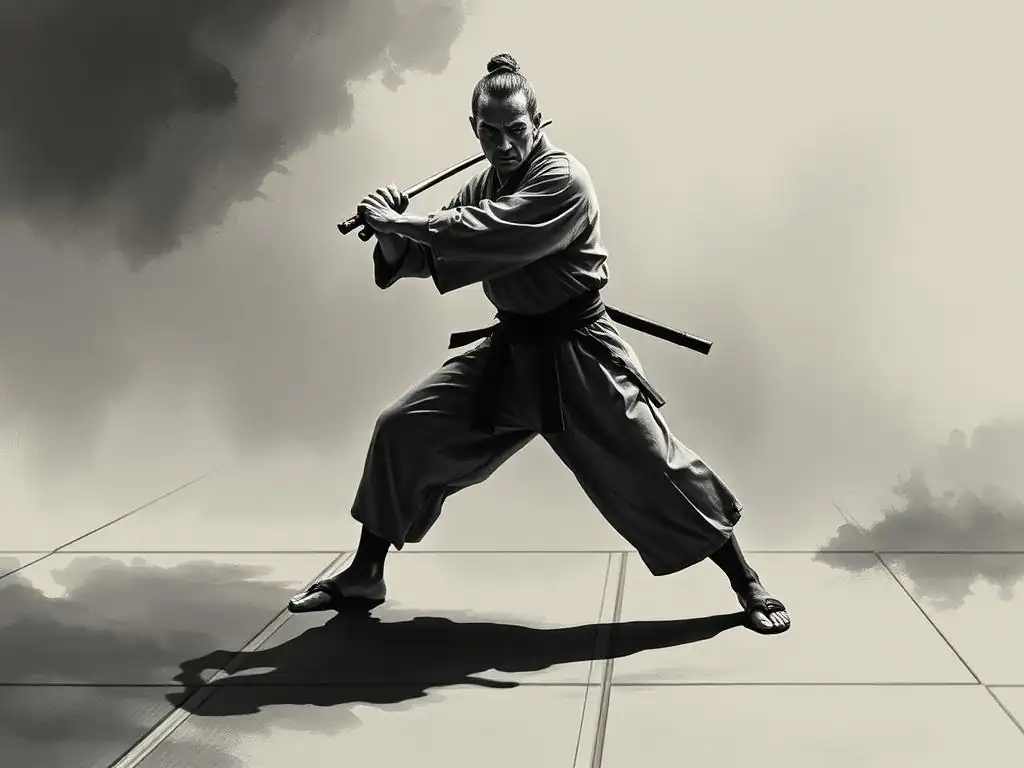
True mastery of Ashi Sabaki Kendo footwork lies in the seamless combination and transition between Okuri-Ashi, Hiraki-Ashi, and Tsugi-Ashi. Advanced practitioners don't think of these as distinct steps but as components of a fluid movement system. Drills focus on transitioning rapidly from linear movement (Okuri-Ashi) to angular evasion (Hiraki-Ashi), or using a preparatory step (Tsugi-Ashi) to set up an explosive attack, perhaps followed by a defensive Okuri-Ashi backward.
Consider a scenario: you advance with Okuri-Ashi, your opponent threatens a strike, you use Hiraki-Ashi to evade, and then immediately use Tsugi-Ashi followed by a powerful Okuri-Ashi to counter-attack. This requires instantaneous recognition of the situation and the ability to execute the appropriate Ashi Sabaki combination without hesitation. Advanced Ashi Sabaki training involves reacting to signals (visual cues, partner movements) rather than just performing pre-set patterns, building instinctive, responsive Kendo footwork.
Ashi Sabaki in Relation to Kendo Stances (Kamae)
Ashi Sabaki and Kamae are two sides of the same coin in Kendo; one cannot be truly effective without the other. Ashi Sabaki is the dynamic aspect of Kamae, allowing the practitioner to move while maintaining the structural integrity and readiness of their stance. The subtle pressures and shifts in weight within the feet during Ashi Sabaki are what enable a strong, stable Kamae that is also mobile and ready to act.
Maintaining proper Kamae throughout movement is a key indicator of good Ashi Sabaki. The distance between the feet, the angle of the feet, the bend in the knees, and the alignment of the body should ideally remain consistent during Okuri-Ashi and recover instantly after a Hiraki-Ashi or Tsugi-Ashi. Poor Ashi Sabaki often manifests as a breakdown in Kamae – feet too wide or too narrow, body straightening up, or loss of balance.
The Impact of Ashi Sabaki on Proper Kendo Kamae
Proper Ashi Sabaki directly supports and enhances the effectiveness of Kendo stances. For instance, in Chudan-no-Kamae, the slight forward pressure on the lead foot and the readiness of the rear foot to push are products of good Okuri-Ashi mechanics, even when standing still. When moving, this Kendo footwork ensures that the hips remain properly aligned, the shoulders stay relaxed, and the core remains engaged – all vital components of a strong, ready Kamae.
Conversely, a weak Kamae will hinder effective Ashi Sabaki. If the knees are locked, or the weight is shifted too far back, the practitioner cannot execute a powerful forward push with Okuri-Ashi or a quick pivot with Hiraki-Ashi. The two elements are mutually reinforcing: strong Ashi Sabaki maintains and improves Kamae, and a solid Kamae provides the stable base needed for dynamic Ashi Sabaki.
Adapting Ashi Sabaki to Different Kendo Stances
While Chudan-no-Kamae is the most common stance, Kendo also utilizes Jodan-no-Kamae (overhead stance) and Gedan-no-Kamae (low stance), among others. Ashi Sabaki principles remain the same, but their application adapts slightly to the specific balance requirements of each stance. In Jodan, for example, the weight distribution is often more forward, requiring particularly strong rear-leg drive for explosive Okuri-Ashi and careful balance during Hiraki-Ashi due to the raised Shinai.
Gedan-no-Kamae, while appearing defensive, still requires agile Ashi Sabaki for rapid transitions to attack or evasion. The lower posture might slightly alter the mechanics of the push-off or pivot compared to Chudan. Practitioners must train their Ashi Sabaki specifically within the context of each Kamae they utilize, understanding how the different arm and body positions influence the optimal Kendo footwork for stability and mobility.
Applying Ashi Sabaki in Kendo Strikes and Attacks
The ultimate purpose of Ashi Sabaki in Kendo is to enable effective strikes (Datotsu). Every Men, Kote, Do, or Tsuki strike relies heavily on the preceding and accompanying footwork. The power, speed, and accuracy of a strike are not solely generated by the arms but are amplified significantly by the coordinated drive and body weight transfer facilitated by proper Ashi Sabaki.
Think of the strike as the culmination of the Ashi Sabaki. The forward motion of Okuri-Ashi or the preparatory movement of Tsugi-Ashi builds momentum and aligns the body, allowing the power generated from the legs and hips to be channeled through the core and into the Shinai at the point of impact. Without this kinetic chain starting from the feet, strikes become weak, arm-driven motions lacking the necessary force to be valid points (Yuko-Datotsu).
Generating Power and Speed Through Effective Kendo Footwork
Effective Ashi Sabaki is the engine of power and speed in Kendo strikes. The explosive push-off from the rear foot during a forward Okuri-Ashi, coordinated with the downward cutting motion, channels the body's mass forward, multiplying the force applied to the Shinai. This forward drive, often referred to as 'Tai-atari' (body collision) when executing a vigorous strike, is only possible with powerful and precise Kendo footwork.
Speed in striking also comes from the efficiency of Ashi Sabaki. A smooth, rapid Okuri-Ashi allows you to cover distance quickly and launch the strike before your opponent can react. Tsugi-Ashi provides that extra burst to bridge a small gap almost instantaneously. The ability to transition quickly from movement to strike, without hesitation or loss of balance, is a direct result of well-honed Ashi Sabaki.
Ashi Sabaki and its effect in the accuracy of Men, Kote, Do, and Tsuki Strikes
Beyond power and speed, Ashi Sabaki profoundly impacts strike accuracy. Proper Kendo footwork ensures that the body is stable and aligned at the moment of impact, allowing for precise targeting of the Men (head), Kote (wrist), Do (body), or Tsuki (throat). If the Ashi Sabaki is shaky, the body will be unstable, leading to glancing blows or missing the target entirely.
For example, hitting the small target of the Kote requires not only precise handwork but also Ashi Sabaki that brings the body into the correct range and angle without over-committing or losing balance. A successful Tsuki strike, perhaps the most difficult due to its small target and inherent risk, demands impeccable forward drive and body control facilitated by expert Ashi Sabaki to ensure the tip of the Shinai lands cleanly on the throat protector. Each target requires subtle variations in timing and angle delivered by the footwork.
The Role of Ashi Sabaki in Kendo Strategy and Tactics
Using Ashi Sabaki for Offensive Maneuvers and Initiative
Ashi Sabaki is not just about physical movement; it's a primary tool for Kendo strategy and tactics. Offensively, skillful Ashi Sabaki allows a practitioner to seize and maintain the initiative (Seme). Constant, controlled forward pressure using Okuri-Ashi and subtle Tsugi-Ashi can disrupt an opponent's rhythm and create openings. It forces them to react to your movement, rather than the other way around.
Feinting with Ashi Sabaki is also a common tactic. A quick Tsugi-Ashi might draw a defensive reaction, or a strong forward Okuri-Ashi followed by a sudden stop can bait an opponent into attacking prematurely. The ability to control Maai (distance) through precise Ashi Sabaki is fundamental to setting up attacks, ensuring you are in optimal range when you decide to strike.
Defensive Ashi Sabaki: Evading Attacks and Maintaining Distance
Defensively, Ashi Sabaki is crucial for avoiding incoming strikes and controlling the engagement distance. Rapid backward Okuri-Ashi is used to retreat from an attack or maintain a safe Maai. Hiraki-Ashi is employed for Tai-sabaki, stepping offline to evade a direct strike while potentially setting up a counter.
The ability to quickly change direction or distance using Ashi Sabaki allows a practitioner to survive attacks and create opportunities for defensive counters. It's not just passive evasion; defensive Kendo footwork aims to neutralize the opponent's attack while positioning oneself advantageously for the immediate follow-up.
Reading Your Opponent's Footwork: Anticipating Movements
An advanced tactical skill in Kendo is the ability to "read" your opponent's Ashi Sabaki. Subtle shifts in their weight, the tension in their feet, or the initiation of a Tsugi-Ashi can signal their impending intentions – whether they are preparing to attack, trying to draw you in, or looking to evade.
By observing their Kendo footwork, you can anticipate their likely movements and adjust your own Ashi Sabaki accordingly. For example, noticing the slight rear foot movement of a Tsugi-Ashi might signal an imminent forward attack, prompting you to prepare for a defensive Hiraki-Ashi or a preemptive strike (Debana-waza). Reading Ashi Sabaki is a critical part of the mental game in Kendo.
Training Tips and Drills for Improving Your Kendo Footwork (Ashi Sabaki)
Solo Drills for Developing Ashi Sabaki Proficiency
Consistent solo practice is fundamental to developing strong Ashi Sabaki Kendo footwork. Simple drills like performing continuous Okuri-Ashi forward and backward across the dojo floor help build endurance and muscle memory. Practicing Okuri-Ashi with increasing speed and length of movement is also vital.
- Continuous Okuri-Ashi (forward and backward)
- Okuri-Ashi sprints (short, explosive bursts)
- Hiraki-Ashi pivots (practicing turns at various angles)
- Tsugi-Ashi followed by explosive forward drive
- Combinations (e.g., two Okuri-Ashi forward, one Hiraki-Ashi left, one Okuri-Ashi backward)
Using markers on the floor to practice hitting specific distances or angles with Ashi Sabaki can provide helpful structure. Focus on maintaining low posture, smooth sliding motion, and consistent foot spacing during all solo drills.
Partner Drills for Practicing Footwork and Coordination
Training with a partner allows for practicing reactive Ashi Sabaki. Partner drills can involve one person dictating movement (e.g., "forward," "back," "left," "right") while the other responds with the appropriate Kendo footwork (Okuri-Ashi, Hiraki-Ashi).
- Follow the leader (one partner moves, the other mirrors their Ashi Sabaki)
- Distance keeping (partners maintain a set distance while moving forward/backward)
- Reaction drills (partner signals a target or direction, practitioner uses Ashi Sabaki to move and simulate a strike)
- Maai control drills (partners practice adjusting distance using Ashi Sabaki, trying to find and control the optimal striking range)
These drills add the element of external stimulus, helping practitioners apply their Ashi Sabaki in a more dynamic, Kendo-like context.
Incorporating Footwork into Kendo Kata and Sparring (Keiko)
Ultimately, Ashi Sabaki must be seamlessly integrated into Kendo techniques. Kendo Kata (pre-arranged forms) provide an excellent way to practice linking Ashi Sabaki with strikes and posture changes in a structured environment. Each Kata sequence requires specific, precise Kendo footwork that must be executed correctly for the technique to be valid.
During Keiko (sparring), conscious application of Ashi Sabaki is paramount. Actively focus on using Okuri-Ashi to advance, Hiraki-Ashi to evade, and Tsugi-Ashi to set up attacks. Don't just move randomly; move with intent, using your Ashi Sabaki to control distance, create opportunities, and respond effectively to your opponent. Regular practice in Keiko under the guidance of an instructor is where Ashi Sabaki truly comes to life.
The Historical Significance of Ashi Sabaki in Kendo
The Evolution of Kendo Footwork Techniques
The Ashi Sabaki techniques practiced in modern Kendo have evolved over centuries from the battlefield footwork of ancient samurai. Early forms of swordsmanship required footwork that facilitated powerful cuts while wearing heavy armor, often emphasizing stability and grounded movement. As combat moved from the battlefield to dueling grounds and eventually to formalized practice, the footwork adapted.
The development of the Shinai and Bogu (protective armor) in the Edo period allowed for safer, more vigorous practice, which in turn influenced the speed and dynamism of Ashi Sabaki. Techniques like the powerful, driving Okuri-Ashi became central as practitioners focused on delivering decisive blows with full body commitment. While the core principles of balance and efficient movement remained, the specific methods of Kendo footwork refined over time to suit the evolving nature of the practice and the tools used.
Ashi Sabaki and its relationship with other Japanese martial arts footwork.
Ashi Sabaki in Kendo shares fundamental principles with footwork found in many other Japanese martial arts (Budo). Arts like Iaido (sword drawing), Jodo (stick fighting), and Aikido also emphasize grounded movement, maintaining a stable center, and coordinating body weight with motion. The basic concept of sliding steps (Suri-ashi or similar terms) and pivoting movements (Hiraki-ashi or Tai-sabaki) can be found across many disciplines.
However, the specific application and emphasis of Ashi Sabaki differ based on the art's focus. Kendo's competitive focus on rapid, decisive strikes with the Shinai gives its Ashi Sabaki a unique emphasis on explosive forward drive (Okuri-ashi) and dynamic distance management. While the root principles of efficient, balanced movement are shared, the dynamic, forward-charging nature of Kendo Ashi Sabaki is distinctly tailored to the art's objective of striking specific targets in a fencing-like engagement.
Frequently Asked Questions
What is Ashi Sabaki in Kendo?
Ashi Sabaki in Kendo refers to the footwork used to maintain proper distance and balance during matches. It's crucial for both offensive and defensive maneuvers, allowing for quick attacks and effective evasion.
Why is Ashi Sabaki considered so important in Kendo?
Ashi Sabaki is fundamental because it directly impacts your ability to strike effectively and defend yourself. Without proper footwork, your stance and balance will be compromised, making you vulnerable.
What are some of the basic types of Ashi Sabaki footwork?
Common Ashi Sabaki techniques include Okuri-ashi (sliding step), Tsugi-ashi (following step), and Hiraki-ashi (opening step). Each technique allows you to maintain a stable stance while moving and striking.
How does mastering Ashi Sabaki improve your Kendo performance?
Mastering Ashi Sabaki leads to greater speed and precision in your movements. It also helps you maintain seme, applying constant pressure on your opponent and creating openings for attacks.
What resources does MartialArtsMastery.org offer for learning Ashi Sabaki?
MartialArtsMastery.org provides training tips, historical overviews, and practical self-defense strategies related to Ashi Sabaki. You can find articles and potentially video demonstrations focusing on this key footwork technique.
Final Reflection: Mastering Movement, Mastering Kendo
The essence of Kendo, as this article has explored, lies not just in the swing of the shinai, but in the subtle dance of Ashi Sabaki, the crucial footwork that underpins every stance and strike. Its relevance today is undeniable; in a world often prioritizing brute force, Ashi Sabaki reminds us that true power comes from precision, balance, and a deep understanding of movement.
The journey to mastering Ashi Sabaki is a journey of self-discovery, a constant refinement of technique that mirrors the broader pursuit of self-improvement. It's a discipline that transcends the dojo, fostering patience, focus, and an appreciation for the interconnectedness of mind and body. As the legendary Miyamoto Musashi wisely stated: Perception is strong and sight weak. In strategy it is important to see distant things as if they were close and to take a distanced view of close things.
So, as you step off the dojo floor and back into the world, consider how the principles of Ashi Sabaki – balance, precision, and mindful movement – can be applied to your own life. Embrace the challenge of constant refinement, and remember that true mastery lies not just in the destination, but in the journey itself. Let the spirit of Ashi Sabaki guide your steps, both on and off the mat.
Master Kendo: Elevate Your Footwork, Amplify Your Power!
Thank you for exploring the art of Ashi Sabaki with us. We hope this has deepened your understanding of how crucial footwork is to achieving mastery in Kendo. Now, it's time to translate this knowledge into action!
- Commit to 15 minutes of focused Ashi Sabaki practice daily to internalize these techniques and build muscle memory. This is your foundation for explosive strikes.
- Record yourself practicing, focusing specifically on foot placement. Review the video critically, comparing your form to examples of high-level Kendo practitioners. You'll spot areas for refinement you might otherwise miss.
- Share your journey! Connect with fellow Kendo enthusiasts online or in your dojo, sharing tips, challenges, and progress. Collaborative learning accelerates improvement.
What specific Ashi Sabaki drill will you integrate into your next practice session to level up your footwork?