
Krav Maga Ground & Pound Defense: Shield, Survive, and Create Escape Routes


Welcome to Martial Arts Mastery!
Delve into the world of combat and self-defense. Ever wondered how to survive a ground and pound situation? This article explores critical Krav Maga ground escape routes, offering practical strategies to shield yourself, survive the initial onslaught, and ultimately create opportunities to regain your footing. Discover the techniques and tactics that can transform a desperate situation into a chance to escape and counter-attack. Intrigued? Let's begin your journey towards mastery of ground defense.
- Understanding the Threat: Ground and Pound in Self-Defense Scenarios
- Krav Maga Ground Defense Principles: Shielding and Survival
- Krav Maga Ground Escape Routes: Creating Opportunities for Evasion
- Krav Maga Ground and Pound Defense Techniques: A Step-by-Step Guide
- Advanced Krav Maga Ground Evasion Strategies
- Drills and Training Exercises for Ground and Pound Defense
- Mental Fortitude: The Psychological Aspect of Ground Survival
- Krav Maga Ground Escape Routes: Preventing the Takedown
- Integrating Ground Defense into Your Overall Krav Maga Training
-
Frequently Asked Questions
- What is the primary goal of Krav Maga ground and pound defense?
- How does Krav Maga prioritize defense against ground and pound attacks?
- What are some common escape routes taught in Krav Maga ground defense?
- Why are ground escape routes so important in Krav Maga, compared to other martial arts?
- Besides physical techniques, what other elements are crucial for effective Krav Maga ground and pound defense?
- Final Reflection: Embracing Resilience on the Ground
- Unleash Your Inner Defender: Master the Escape!
Understanding the Threat: Ground and Pound in Self-Defense Scenarios
The Brutality of Ground and Pound Attacks
Ground and pound, a common tactic in mixed martial arts and unfortunately, in street altercations, involves an attacker taking a person to the ground, establishing a dominant position (like mount or side control), and then striking them repeatedly with fists or elbows. This type of assault is particularly dangerous because it can lead to rapid, severe trauma, including concussions, facial fractures, and even loss of consciousness, rendering the victim unable to defend themselves or escape.
Unlike standing striking, the ground often limits a defender's mobility and ability to generate power for counter-attacks, while the attacker benefits from gravity and leverage.
The sheer force and frequency of strikes in a ground and pound situation can overwhelm a person's defenses quickly. Studies on fight-related injuries indicate that strikes to the head, common in ground and pound, are a leading cause of serious injury in altercations. For instance, a forceful punch from a standing position can generate hundreds of pounds of force, and while potentially less forceful from a ground position, the repeated impact from a dominant posture significantly increases the cumulative damage and the likelihood of incapacitation within seconds if proper defense isn't immediately established.
Why Ground Defense is Crucial in Krav Maga
While Krav Maga emphasizes staying on your feet to maintain mobility and control the environment, acknowledging the reality of conflict means preparing for the worst-case scenario: being taken to the ground. Ground defense in Krav Maga isn't about engaging in a grappling match; it's about immediate survival and creating opportunities to get back up or escape. The focus is on mitigating damage, controlling distance just enough to survive the initial onslaught, and transitioning back to a standing position as rapidly and safely as possible.
Incorporating ground defense into Krav Maga training directly addresses the vulnerability of being in a non-dominant ground position. Without specific training, a person on their back facing a ground and pound attack is incredibly vulnerable. Krav Maga provides simple, effective, and aggressive techniques designed specifically for survival in this high-stress situation. It's not about learning complex submissions, but mastering fundamental principles like protecting vital areas, using leverage to create space, and explosive movements to stand up, which are critical Krav Maga ground escape routes.
Common Ground and Pound Scenarios in Real-World Conflicts
Ground and pound attacks often occur following a takedown initiated by the attacker, either planned or resulting from a scramble. A typical scenario might involve a larger, stronger individual tackling a smaller person to the ground. Once grounded, the attacker immediately seeks a dominant position like the mount (sitting on the defender's chest or abdomen) or side control (lying perpendicular to the defender). From these positions, the defender's ability to move is significantly restricted, allowing the attacker to deliver repeated strikes to the head and face with relative ease.
Another common scenario involves a fall during a standing altercation, where one party ends up on the ground with the other standing or kneeling over them. The standing or kneeling attacker then initiates strikes downwards. These situations highlight the unpredictable nature of real-world violence; a fight can go to the ground unexpectedly. Krav Maga training addresses these varied entries into a ground situation, focusing on universal principles of protection and escape regardless of how one got there, emphasizing that recognizing potential Krav Maga ground escape routes starts the moment you hit the ground.
Krav Maga Ground Defense Principles: Shielding and Survival
The Importance of Protecting Your Head: Primary Target Awareness
In any ground and pound situation, the absolute priority is protecting the head and face. These areas contain vital structures – the brain, eyes, nose, jaw – that are highly susceptible to damage and incapacitation from strikes. A single forceful blow to the temple or back of the head can end the confrontation negatively for the defender. Krav Maga teaches an immediate, instinctive response to cover and protect the head using the arms, hands, and elbows, creating a protective shield.
This protective shield, often referred to as the "high guard" or simply covering up, involves bringing the hands and forearms tightly around the head, protecting the sides, top, and back. The elbows are tucked in to protect the ribs and sides of the head. While this position doesn't prevent all strikes, it significantly reduces their impact and prevents catastrophic damage to critical areas. It buys precious seconds needed to assess the situation and begin implementing Krav Maga ground escape routes.
Utilizing Frames and Barriers to Defend Against Strikes
Beyond simply covering the head, Krav Maga utilizes "framing" as a key defensive principle on the ground. Framing involves using the bone structure of your arms and legs to create barriers between you and the attacker, preventing them from getting close enough to generate full power in their strikes or establish unbreakable control. For example, using your forearms to push against the attacker's hips or chest from a bottom position creates space.
These frames act as structural supports, leveraging your skeletal strength rather than muscular endurance. A common frame involves placing a forearm across the attacker's neck or jaw while on your back, using the bone to maintain distance. Another involves using both arms to create a wedge between your body and the attacker's, preventing them from achieving a tight mount or side control. Effective framing is essential for surviving the initial assault and is a prerequisite for creating Krav Maga ground escape routes.
Maintaining Awareness and Assessing the Threat Level
Even while defending against strikes, maintaining situational awareness is paramount. Blindly covering up without understanding the attacker's position, posture, and intentions limits your ability to react effectively. Krav Maga emphasizes the importance of trying to see through or around your guard, feeling the attacker's weight distribution, and listening for cues. Is the attacker committed to striking, or are they trying to transition to a submission? Are there multiple attackers? Is there an immediate escape path available?
Assessing the threat level involves recognizing the attacker's size, aggression level, and the environment. Are you near a wall, an obstacle, or an exit? This assessment informs your defensive strategy and helps identify potential Krav Maga ground escape routes. For instance, if the attacker is focused entirely on striking, a sudden explosive movement might create an opening. If they are trying to stabilize their position, framing and hip movement become crucial. Staying calm under pressure, though incredibly difficult, is vital for making these assessments.
Krav Maga Ground Escape Routes: Creating Opportunities for Evasion
Identifying Vulnerabilities: Recognizing Openings for Escape
Creating Krav Maga ground escape routes hinges on recognizing moments of vulnerability in the attacker's position or actions. No dominant position is completely airtight, and attackers often create small openings as they adjust their weight, transition between positions, or commit to strikes. A key vulnerability is often when the attacker posts a hand on the ground for balance, momentarily reducing their pressure on you, or when they lift their weight slightly to deliver a strike.
Another vulnerability arises from the attacker's focus. If they are solely focused on striking your head, their base or lower body might become unstable, presenting an opportunity to disrupt their balance or slip a leg out. Learning to feel these subtle shifts in weight and pressure is crucial. Krav Maga training teaches practitioners to actively look for these windows – a gap between bodies, a limb out of position, a moment of reduced pressure – as potential starting points for Krav Maga ground escape routes.
Bridging and Shrimping: Fundamental Movements for Ground Evasion
Bridging and shrimping (also known as hip escape) are two fundamental movements in ground defense that are essential for creating Krav Maga ground escape routes. A bridge involves lifting your hips explosively off the ground by driving through your feet, while keeping your head and upper back grounded. This movement can momentarily lift the attacker's weight off you or even off-balance them, providing a critical window to maneuver.
Shrimping involves moving your hips out from under an opponent by pushing off the ground with your feet and bridging slightly, then sliding your hips away. This sideways movement creates space between your body and the attacker's, allowing you to insert a knee, recover a guard, or begin to turn away. Mastering the coordinated use of bridging to create initial disruption and shrimping to create distance and angle is foundational for executing effective Krav Maga ground escape routes.
The Tactical Stand-Up: Safely Returning to a Standing Position
The ultimate goal of ground defense in Krav Maga is typically to return safely to a standing position, where you regain mobility and control over the environment. The "tactical stand-up" is a specific method for doing this while minimizing the risk of being taken down again or getting kicked. From a position where you've created some space (often using shrimping or framing), one hand posts on the ground behind you for stability.
You then use your legs and the posting hand to explosively push yourself up, simultaneously bringing one leg forward to create a base. The other hand often remains up to shield the face or push the opponent away. This isn't a slow, deliberate stand; it's a quick, aggressive movement designed to get you back on your feet before the attacker can react effectively. Practicing this transition under pressure is vital for successful Krav Maga ground escape routes.
Krav Maga Ground and Pound Defense Techniques: A Step-by-Step Guide
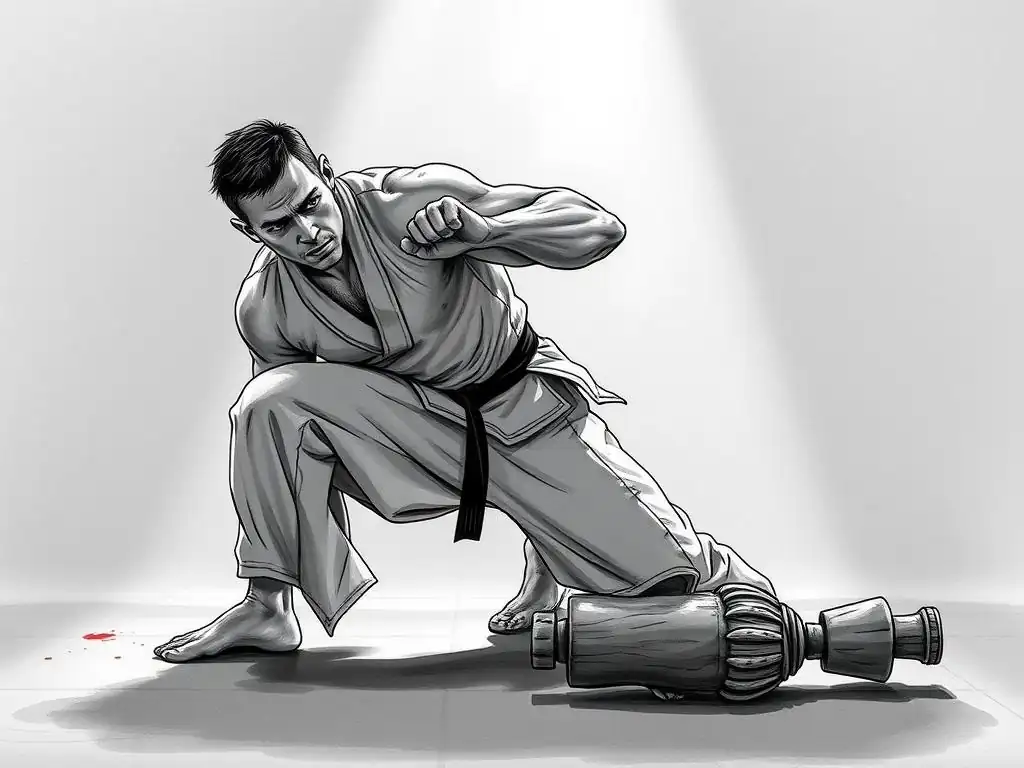
The Basic Shielding Position: Protecting Against Initial Assault
When an attacker initiates ground and pound from a dominant position like the mount, the immediate priority is damage control. The first technique is establishing the basic shielding position. Step 1: Bring your elbows tight to your sides, protecting your ribs and the sides of your head. Step 2: Bring your hands up to cover the sides and top of your head, interlocking your fingers or simply covering with your palms and forearms.
Your forearms should cover your temples and ears. Step 3: Tuck your chin tightly to your chest to protect your jaw and neck. Step 4: Keep your body tight, minimizing any gaps the attacker can exploit.
This position absorbs or deflects incoming strikes, protecting the most vulnerable areas. While uncomfortable, it is crucial for surviving the initial barrage, which might involve 5-10 rapid strikes within just a few seconds. Maintaining this tight shield buys you time to assess the situation and look for opportunities to initiate Krav Maga ground escape routes.
The Elbow Escape: Creating Space and Disrupting the Attack
Once the basic shield is established, the elbow escape is a common technique to start creating space, particularly from side control or a loose mount. Step 1: While maintaining your head shield, use your forearm closest to the attacker's head to create a frame against their neck or jaw. Step 2: Use your other hand to push against their bicep or shoulder on the same side, preventing them from posturing up fully.
Step 3: Use your legs to bridge slightly, creating a small amount of space and shifting their weight. Step 4: As you bridge, simultaneously turn your body slightly towards the attacker and try to slide your elbow (from the framing arm) into the space between your body and theirs, aiming towards their hip or abdomen.
This action disrupts their base and creates a small pocket of space. By continuing to use your frame and elbow, you can prevent them from re-establishing tight control and begin to shrimp your hips away, which is a crucial step in opening up Krav Maga ground escape routes.
The Hip Escape and Granby Roll: Creating Distance and Changing Position
The hip escape (shrimping) is fundamental for creating distance, while the Granby roll can be used to change your position relative to the attacker or even stand up. For the hip escape: Step 1: Turn slightly to one side, pushing off the ground with your feet. Step 2: Bridge your hips slightly.
Step 3: While bridging, push off with your hand on the side you are turning towards and slide your hips away from the attacker. Step 4: Recover your legs, perhaps inserting a knee shield or half guard. Repeat on the other side as needed to create more space.
The Granby roll is a more advanced maneuver, often used when the attacker is pressuring forward or trying to pass your guard. It involves tucking your head and rolling over one shoulder, using momentum to end up facing the opposite direction or even on your knees, creating significant distance and potentially allowing you to stand.
For example, if the attacker is pressuring from your left side, you might tuck your chin, post your right hand, and roll over your left shoulder, aiming to land on your knees or feet facing away from where you started, effectively creating a Krav Maga ground escape route.
Advanced Krav Maga Ground Evasion Strategies
Using the Guard: Controlling Distance and Limiting the Opponent's Attacks
While Krav Maga aims to avoid ground fighting, if escape isn't immediately possible, establishing some form of guard can be a crucial survival strategy. The guard, in this context, isn't for submissions but for control and creating opportunities. From your back, using your legs to control the distance and posture of the attacker is key. A simple "closed guard" involves wrapping your legs around the attacker's waist and locking your ankles, preventing them from posturing up to strike effectively.
From guard, your legs act as a barrier and a tool for disruption. You can push on their hips or chest with your feet (open guard) to maintain distance, or use your legs to pull them closer to break their posture. While in guard, your hands remain active, framing against the neck or pushing on the shoulders to prevent strikes. The guard is a temporary position designed to stall the attack, recover, and actively look for openings that lead to Krav Maga ground escape routes.
The Kimura Trap: Creating Submission Threats for Escape
While Krav Maga avoids complex grappling, understanding basic joint locks can sometimes create a powerful deterrent or an opportunity for escape. The Kimura lock targets the opponent's shoulder. From a defensive posture on your back or side, if the attacker reaches for your head or neck with one arm, you can potentially trap that arm. Step 1: Secure the attacker's wrist with one hand. Step 2: Loop your other arm under their captured arm and grab your own wrist, creating a figure-four grip on their arm. Step 3: Control their posture and twist their captured arm towards their back.
Applying pressure with the Kimura grip can cause pain and threaten a shoulder lock. Crucially, in a self-defense context, the goal isn't necessarily to finish the submission but to use the threat of pain and injury to force the attacker to react, shift their weight, or create a momentary distraction. This reaction can provide the split-second opening needed to execute Krav Maga ground escape routes.
Exploiting the Mount: Creating a Window for Escape
Being in the bottom mount position is highly disadvantageous, but even here, Krav Maga offers escape strategies by exploiting the attacker's need to posture up to strike. A common escape involves the "upa" or bridge and roll. Step 1: Secure one of the attacker's arms (the one on the side you plan to escape towards) by trapping it against their body or your own chest. Step 2: Trap the corresponding leg on that same side by wrapping your leg over it. Step 3: Bridge your hips explosively upwards and towards the side where you've trapped their arm and leg.
This powerful bridge, combined with trapping their limb, aims to roll the attacker off you. If executed correctly, it can reverse the position, putting you on top, or more commonly in Krav Maga, create enough space and disruption to scramble back to your feet. This is a high-risk, high-reward technique, but it's one of the primary Krav Maga ground escape routes taught from this dominant bottom position.
Drills and Training Exercises for Ground and Pound Defense
Partner Drills for Practicing Shielding and Evasion
Effective ground defense requires live practice with a partner applying realistic pressure. A key drill is the "Survival Drill." Partner A lies on their back, while Partner B takes a kneeling mount position. Partner B applies light to moderate pressure and simulates strikes (controlled taps or light punches to padded areas). Partner A's goal is solely to maintain the basic shielding position, focusing on keeping elbows tight, hands covering the head, and chin tucked. This builds the instinctual protective response under stress.
Another crucial drill is the "Bridge and Shrimp Escape Drill." Starting from bottom mount or side control, Partner B applies pressure but does not strike. Partner A focuses on executing bridges to disrupt balance and shrimping movements to create space and recover guard or escape the hips. Varying the pressure applied by Partner B helps Partner A learn to feel weight distribution and identify opportunities for Krav Maga ground escape routes.
[ ] Basic Shielding Drill (Partner applies light pressure/simulated strikes)
[ ] Bridge and Shrimp Escape Drill (Partner applies pressure, no strikes)
[ ] Frame Recovery Drill (Practice using forearms/legs to create space and frames)
[ ] Tactical Stand-Up Drill (Practice standing up quickly from a grounded position)
Sparring Scenarios: Integrating Ground Defense into Live Training
While full ground sparring (like in BJJ) isn't the focus of Krav Maga, incorporating ground survival scenarios into sparring is vital. One approach is "Situational Ground Sparring." Start from a scenario like bottom mount or side control.
The person on top uses light to moderate ground and pound (simulated). The person on the bottom's only goal is survival and creating one of the practiced Krav Maga ground escape routes – getting back to their feet, recovering guard, or creating enough space to disengage. The round ends once the person on the bottom is safely standing or the top person achieves a dominant, controlled position for a set time (e.g., 10-15 seconds).
Another scenario involves starting from a standing position with one person attempting a simple takedown, leading immediately to ground and pound. This forces the defender to react from a dynamic situation, emphasizing the transition from standing defense to immediate ground survival and the execution of Krav Maga ground escape routes under more realistic conditions. Safety gear, such as helmets and mouthguards, is essential for these drills.
Developing a Strong Ground Game: Building Core Strength and Flexibility
While Krav Maga ground defense isn't about complex techniques, it demands physical capability. Developing a strong core is crucial for generating power in bridges and shrimping, and for maintaining a tight defensive structure. Exercises like planks, crunches, and leg raises are beneficial. Flexibility, particularly in the hips and shoulders, improves mobility on the ground, making it easier to shrimp, frame, and execute movements needed for Krav Maga ground escape routes.
Regular stretching routines targeting the hips, hamstrings, and shoulders are recommended. Furthermore, practicing the ground movements themselves – bridging, shrimping, rolling – even without a partner, builds muscle memory and improves body control, which is essential when reacting under the chaotic conditions of a real ground and pound attack. A dedicated 15-20 minute session focusing purely on these foundational movements can significantly improve your ability to create Krav Maga ground escape routes.
Mental Fortitude: The Psychological Aspect of Ground Survival
Maintaining Composure Under Pressure
Being on the ground with someone striking you is an incredibly stressful and terrifying experience. The feeling of being trapped and vulnerable can trigger panic, leading to freezing or ineffective reactions. Developing mental fortitude is as crucial as physical technique in ground survival. Krav Maga training aims to build resilience through controlled exposure to stress. Drills involving simulated strikes and pressure help practitioners become more comfortable operating in uncomfortable positions.
Maintaining composure involves controlled breathing, focusing on the immediate task (protecting the head), and reminding yourself that you have trained for this. It's about managing the fear and adrenaline surge to allow your training to take over. A calm mind is better able to assess the situation, identify vulnerabilities, and initiate the correct Krav Maga ground escape routes.
Visualizing Escape Routes and Developing a Mental Plan
Even before a conflict goes to the ground, having a mental preparedness plan is beneficial. This includes visualizing potential scenarios and how you would react. Specifically for ground defense, mentally rehearsing the steps of shielding, framing, bridging, shrimping, and standing up can make the reactions more automatic under stress. When on the ground, even while defending, try to mentally scan for escape possibilities – is there a direction you can roll towards? Is the attacker leaving a limb exposed?
Developing a simple mental checklist: 1. Protect head. 2. Create space/frame. 3. Disrupt balance (bridge). 4. Move hips (shrimp). 5. Look for stand-up opportunity. This structured thinking, even amidst chaos, helps guide your actions towards creating Krav Maga ground escape routes rather than reacting randomly.
The Importance of Aggressive Defense: Turning the Tables
Krav Maga emphasizes aggressive action, even in defense. On the ground, this doesn't necessarily mean striking back immediately (though opportunities may arise), but defending with aggression and intent. Your frames should be strong, your bridges explosive, and your movements decisive. Passive defense, simply covering up and waiting, is unlikely to work against a determined attacker.
Aggressive defense means constantly working to improve your position, create space, and execute your escape plan. It's about turning the defensive situation into an offensive one, where your movements force the attacker to react, creating the very openings you need for Krav Maga ground escape routes. This mindset shift from "surviving" to "actively escaping" is a core principle.
Krav Maga Ground Escape Routes: Preventing the Takedown
Situational Awareness: Recognizing Potential Takedown Attempts
The best ground defense is often preventing the fight from going to the ground in the first place. Situational awareness is key to recognizing potential takedown attempts before they happen. Look for changes in an attacker's posture – lowering their level, reaching for your legs or waist, or closing distance rapidly in a committed way. Pay attention to the environment – fighting near obstacles or uneven surfaces increases the risk of falling or being taken down.
Verbal cues and body language can also signal an impending physical assault, including a takedown attempt. Maintaining appropriate distance and being prepared to react to sudden movements are critical. Recognizing these precursors allows you to employ standing defenses, preserving your ability to create Krav Maga ground escape routes by staying on your feet.
Sprawling Techniques: Defending Against Takedowns
Sprawling is a primary defense against penetration-style takedowns (like a double or single leg). When an attacker shoots in for your legs, the sprawl involves quickly widening your stance, dropping your hips low, and driving your legs back, landing on the balls of your feet or your knees. This position puts weight on the attacker's back and hips, preventing them from lifting your legs or driving forward effectively.
Simultaneously, your hands should be used to cross-face the attacker, apply pressure to their neck or shoulders, or secure a headlock to break their posture further. A strong sprawl neutralizes the takedown attempt and often leaves the attacker in a vulnerable position on the ground beneath you, completely negating the need for Krav Maga ground escape routes by keeping the fight standing or putting you in a dominant position.
Maintaining a Strong Stance: Minimizing Takedown Opportunities
A stable, balanced standing stance is your first line of defense against takedowns. A common Krav Maga stance involves feet shoulder-width apart, one foot slightly forward, knees bent, and weight balanced. This "ready" stance allows for quick movement in any direction. Avoid being flat-footed, having your feet too close together, or being off-balance, as these make you easy to push over or take down.
Actively using footwork to maintain distance and control the angle also minimizes takedown opportunities. Circling away from an attacker who is trying to close distance for a takedown, or using defensive sidekicks to keep them at bay, are examples of using movement to prevent the fight from going to the ground. A solid standing base and good footwork are foundational to avoiding the scenario where Krav Maga ground escape routes become necessary.
Integrating Ground Defense into Your Overall Krav Maga Training
Combining Striking and Grappling Techniques
Effective self-defense in Krav Maga requires seamless transitions between striking and grappling ranges, including ground defense. Training should integrate these elements. Practice striking combinations that end with a clinch defense, or takedown defense drills that transition immediately into ground survival if the sprawl is unsuccessful. For example, practice defending against a headlock that goes to the ground, immediately transitioning into ground shielding and escape movements.
Similarly, train to transition from the ground back to standing while ready to strike. After executing a tactical stand-up, practice immediately getting into a fighting stance and being prepared to deliver strikes or assess for further threats. This fluid integration ensures that your skills are functional across the dynamic ranges of a real conflict, making your Krav Maga ground escape routes part of a larger, comprehensive defensive system.
Adapting to Different Opponent Styles and Sizes
Real-world attackers come in all shapes, sizes, and levels of aggression. Your Krav Maga ground defense must be adaptable. Training with partners of different sizes helps you understand how pressure and leverage change. A technique that works easily against a smaller partner might require significantly more force or a different angle against a larger one. Practice maintaining your frames and executing escapes against heavier individuals who can apply more crushing pressure.
Similarly, practice against partners who simulate different levels of aggression – some who are purely focused on striking, others who try to control position tightly. This adaptability ensures that your Krav Maga ground escape routes are not limited to a specific type of attacker but can be applied effectively against a variety of threats encountered in real-world scenarios.
Continuous Improvement: Refining Your Ground Game and Escape Routes
Mastering Krav Maga ground escape routes is an ongoing process. Regular practice is essential to maintain proficiency, as ground techniques require specific body mechanics and muscle memory that can degrade without consistent training. Dedicate time in your training schedule specifically to ground defense drills, even if it's just 10-15 minutes per session.
Seek feedback from instructors and training partners to refine your technique. Are your frames strong? Is your bridge explosive enough? Are you identifying escape opportunities effectively? Continuously drilling the fundamental movements – shielding, framing, bridging, shrimping, tactical stand-up – under increasing levels of pressure will build confidence and effectiveness, ensuring that you are prepared to shield, survive, and create Krav Maga ground escape routes if a confrontation goes to the ground.
Frequently Asked Questions
What is the primary goal of Krav Maga ground and pound defense?
The primary goal is to survive the initial assault and create opportunities for escape, not necessarily to engage in prolonged ground fighting.
How does Krav Maga prioritize defense against ground and pound attacks?
Krav Maga emphasizes shielding techniques to protect vulnerable areas, along with movements to disrupt the attacker's balance and create space.
What are some common escape routes taught in Krav Maga ground defense?
Common escape routes involve using bridging and rolling techniques to create distance or get back to a standing position, allowing for further engagement or disengagement.
Why are ground escape routes so important in Krav Maga, compared to other martial arts?
Krav Maga is designed for real-world self-defense scenarios, where prolonged ground fighting is disadvantageous, making rapid escape paramount.
Besides physical techniques, what other elements are crucial for effective Krav Maga ground and pound defense?
Situational awareness is crucial, along with a strong mental fortitude to remain calm and focused under pressure, allowing for effective execution of escape routes.
Final Reflection: Embracing Resilience on the Ground
The techniques and strategies explored in this article, focused on Krav Maga ground escape routes, are not merely about physical defense; they represent a profound commitment to resilience in the face of adversity. In a world that often throws us off balance, both literally and figuratively, the ability to shield, survive, and create escape routes becomes an invaluable skill, extending far beyond the confines of a martial arts mat.
The principles of Krav Maga, particularly its emphasis on practical and adaptable solutions, have deeply influenced how I approach challenges in all aspects of life. Learning to remain calm under pressure, assess threats quickly, and find a path to safety is a skill that transcends physical combat. The best fight is the one you avoid.
This quote, often attributed to various martial arts masters, perfectly encapsulates the spirit of Krav Maga's ground defense: to minimize risk, maximize survival, and regain control of the situation.
Now, I invite you to consider how you can apply these principles of resilience and strategic thinking to your own life. What are the "ground and pound" situations you face daily? How can you develop your own "escape routes" – both physical and mental – to navigate challenges with greater confidence and effectiveness? Embrace the spirit of Krav Maga, and empower yourself to shield, survive, and ultimately, thrive.
Unleash Your Inner Defender: Master the Escape!
Thanks for diving into the world of Krav Maga ground defense! Now that you're armed with these strategies, it's time to put them into practice and solidify your skills. The real strength lies in applying this knowledge effectively.
- Prioritize your safety: Immediately practice the shield and bridge techniques with a trusted training partner to build muscle memory and refine your responses. This is crucial for effective self-defense.
- Explore related martial arts: Research complementary grappling arts like Brazilian Jiu-Jitsu or wrestling to enhance your ground game understanding.
- Spread the knowledge: Share this article with fellow martial artists or anyone interested in learning practical self-defense techniques.
What's the first escape technique you'll drill in your next training session to make it second nature?