
Advanced Kumijo: Complex Paired Staff Interactions in Aikido Forms

Welcome to Martial Arts Mastery, your ultimate resource for unlocking the secrets of martial arts!
Dive into the intricate world of Aikido paired staff techniques, where tradition meets innovation. Are you ready to explore the advanced applications of the kumijo and discover the hidden complexities within these elegant forms? Prepare to delve deeper than ever before into the art of Aikido staff work and unlock a new level of understanding. Let's begin!
- Introduction to Aikido Kumijo and Paired Staff Training
- Deeper Dive into Advanced Kumijo Techniques
- Analyzing Key Aikido Paired Staff Forms (Kumijo)
- Principles of Effective Aikido Paired Staff Practice
- Benefits of Advanced Kumijo Training
- Safety Considerations in Aikido Paired Staff Training
- Conclusion: The Path to Mastery in Aikido Paired Staff Techniques
-
Frequently Asked Questions
- What is Kumijo and how does it relate to Aikido?
- What are "paired staff techniques" in Aikido, and why are they important?
- What are some of the benefits of learning advanced Kumijo techniques?
- How does the study of Kumijo contribute to self-defense strategies in Aikido?
- Where can I learn more about Kumijo and other Aikido training methods?
- Final Reflection: Mastering Harmony Through Aikido Paired Staff Techniques
- Master the Dance: Unleash Your Kumijo Potential!
Introduction to Aikido Kumijo and Paired Staff Training
Understanding the Role of Staff (Jo) in Aikido Training
The jo, a wooden staff typically around 128 cm (or about 50 inches) in length and 2.4 cm (about 1 inch) in diameter, holds a significant place in Aikido training, complementing the empty-hand techniques. Its inclusion stems from the founder Morihei Ueshiba's extensive study of traditional Japanese martial arts, including Jojutsu, which focuses on the use of the short staff.
Training with the jo helps practitioners understand concepts like distance (maai), timing (timing), and centerline control, which are fundamental to Aikido's unarmed movements. The staff serves as an extension of the body, allowing students to explore principles of leverage, momentum, and projection in a tangible way, often highlighting subtle errors in body mechanics that might be less apparent in empty-hand practice.
Beyond simply learning weapon techniques, jo practice in Aikido is a method for deepening the understanding of aiki principles. It teaches how to blend with an opponent's energy, redirect force, and maintain centeredness under pressure, whether facing a staff or an empty-hand attack. The jo acts as a tool to visualize lines of attack and defense, illustrating how Aikido movements can neutralize linear force through circular motion and precise positioning.
For instance, a basic jo thrust requires not just arm strength but coordinated hip and body movement, mirroring the integrated whole-body power generation used in techniques like ikkyo or kokyu-nage. This integration ensures that jo techniques are not isolated skills but are intrinsically linked to the core principles of Aikido.
The Significance of Kumijo (Paired Staff Forms) in Aikido Mastery
Kumijo, or paired staff forms, represent a crucial step in advancing a practitioner's understanding of Aikido principles in a dynamic, interactive context. Unlike solo jo suburi (basic strikes and movements), kumijo involves two practitioners working together, one often initiating an attack (like a thrust or strike) and the other responding with a defense (such as a parry, block, or redirection), followed by a counter-movement.
These pre-arranged sequences, developed by O-Sensei and his students, are not mere demonstrations of technique but living lessons in timing, distance, blending, and mutual coordination. They require both partners to maintain sensitivity to the other's movement and intent, fostering a deeper connection than static solo practice.
The practice of Aikido paired staff techniques is particularly valuable because it introduces the element of a resisting, yet cooperative, partner. This interaction forces practitioners to apply maai (distance) and timing with precision, as a slight misjudgment can lead to the technique failing or becoming ineffective.
Kumijo also emphasizes the concept of musubi (connection or tying together), where the energies of both partners merge momentarily before the technique is executed. By repeatedly practicing these complex interactions, students refine their ability to read an opponent's movements, anticipate their intentions, and apply Aikido principles under realistic, albeit controlled, conditions, ultimately enhancing their empty-hand skills as well.
Deeper Dive into Advanced Kumijo Techniques
Moving Beyond Basic Aikido Paired Staff Techniques
Progressing from foundational jo suburi and simple kumijo exchanges involves embracing more complex sequences and a deeper understanding of the underlying principles. Basic Aikido paired staff techniques often involve direct blocks and simple counters to straightforward attacks like a middle thrust (tsuki) or overhead strike (shomen uchi). Advanced training delves into sequences that incorporate multiple attacks and defenses, changes in direction, entries (irimi) and turning movements (tenkan), and techniques that transition fluidly between different ranges. This requires practitioners to anticipate not just the immediate attack but the potential follow-up movements and strategic positioning of their partner.
Advanced kumijo also introduces variations in rhythm and intensity. While basic forms might be practiced at a steady pace to learn the choreography, advanced practitioners explore executing the same forms with variations in speed, power, and angle, pushing the boundaries of their maai and timing control.
For example, the same sequence might be practiced slowly to feel the connection and flow of energy, then at a faster pace to develop reflexes and timing under pressure. This adaptive practice is crucial for developing the ability to apply Aikido paired staff techniques effectively in a less predictable environment, moving towards a more spontaneous and responsive interaction.
Exploring the Principles Behind Complex Staff Interactions
The effectiveness of complex Aikido paired staff techniques lies not just in memorizing the sequence of movements but in understanding and applying the core Aikido principles they embody. Principles like kokyu ryoku (breath power), irimi (entering), tenkan (turning), and maai (distance) are interwoven throughout advanced kumijo. For instance, a successful entry against a staff attack requires precise irimi timing, stepping into the line of attack at the opportune moment to disrupt the opponent's balance while simultaneously executing a protective movement with one's own staff. This is a direct application of blending with incoming force rather than meeting it head-on.
Furthermore, complex kumijo sequences often highlight the principle of kuzushi (breaking balance). Through subtle shifts in weight, changes in angle, or unexpected changes in rhythm, one partner seeks to momentarily unbalance the other, creating an opening for a technique. The responding partner must maintain their center and stability, often using tai sabaki (body movement) to recenter themselves while simultaneously defending. These interactions teach practitioners how to recognize and exploit moments of vulnerability, and equally importantly, how to maintain their own stability under dynamic pressure, principles directly transferable to empty-hand techniques against a variety of attacks.
Analyzing Key Aikido Paired Staff Forms (Kumijo)
13-Count Kumijo: Detailed Breakdown and Application
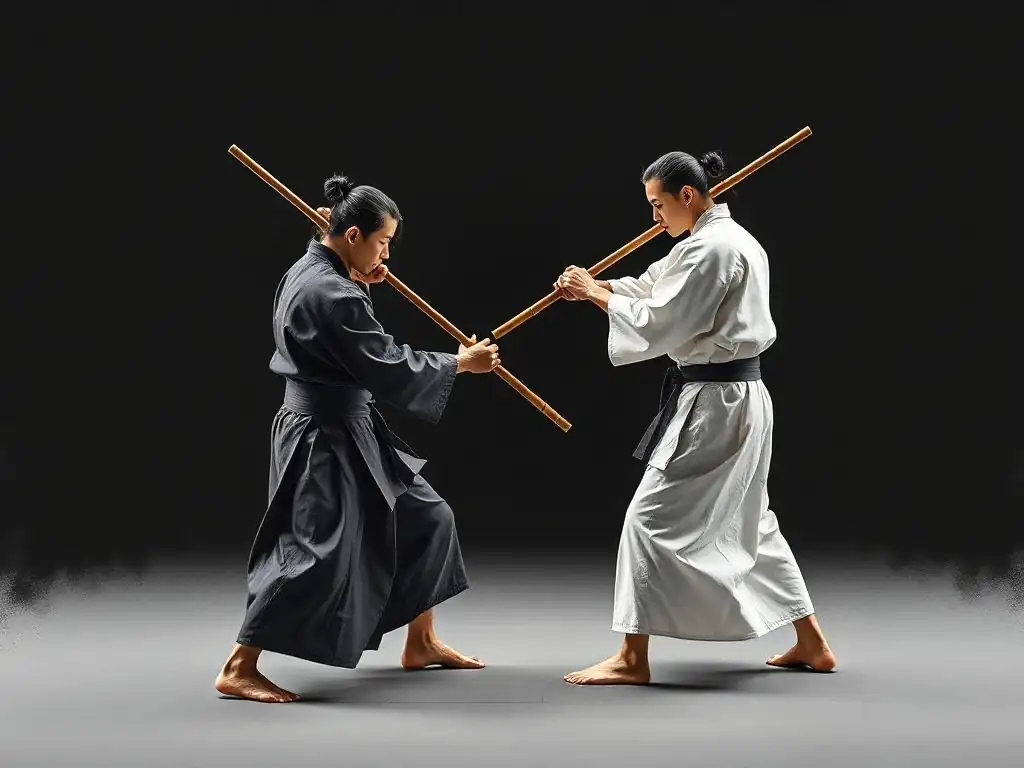
The 13-Count Kumijo is a fundamental paired staff form in many Aikido schools, often serving as an entry point into more complex Aikido paired staff techniques. It is attributed to Morihiro Saito Sensei, a prominent student of O-Sensei, and systematically introduces basic attacks, defenses, and counter-movements. The form involves 13 distinct movements for each partner, executed in sequence.
Practitioner A might initiate with a series of strikes or thrusts, while Practitioner B defends and counters. The roles then typically reverse. This form is designed to build a strong foundation in basic jo handling, footwork, and the crucial concept of coordinating one's movements precisely with a partner.
Stance and Posture in 13-Count Kumijo
Proper stance and posture are paramount in the 13-Count Kumijo, providing stability, mobility, and the ability to generate power efficiently. The basic stance often resembles hanmi (half-body stance), with one foot slightly forward and weight distributed evenly or slightly more on the back foot for readiness. The jo is typically held with one hand near the end and the other further up, ready to shift grip for different techniques.
Maintaining a relaxed yet alert posture, with the spine aligned and shoulders relaxed, is essential. This allows for smooth transitions between movements and ensures that techniques are powered by the whole body, not just the arms. Incorrect posture, such as leaning too far forward or backward, can lead to instability and limit the effectiveness of blocks and strikes.
Understanding the Flow of Movement in 13-Count Kumijo
The flow of movement in the 13-Count Kumijo is characterized by continuous, connected actions rather than a series of disjointed steps. Each movement should transition smoothly into the next, reflecting the principle of nagare (flowing). For example, a block might immediately transition into a counter-strike, or a step might be timed precisely with a partner's movement to create an opening.
The form teaches practitioners to maintain forward momentum and blend with the partner's energy, avoiding static positions after a block or attack. This continuous flow is crucial for maintaining maai and disrupting the partner's ability to regain their balance or initiate a follow-up attack effectively.
Partner Coordination in 13-Count Kumijo
Effective partner coordination is the heart of Kumijo practice, and the 13-Count form is a prime example. Both partners must execute their movements with precise timing and distance relative to each other. This isn't about competition but about mutual learning and refinement. Partner A's attack sets the context for Partner B's defense, and B's counter sets the context for A's subsequent defense.
A slight delay or misjudgment in distance by one partner can disrupt the entire sequence. Practicing the 13-Count Kumijo repeatedly helps develop a non-verbal communication and sensitivity between partners, allowing them to adjust their movements in real-time and execute the form harmoniously. This synchronicity is a tangible expression of musubi in action.
The 31-Count Kumijo is another foundational and widely practiced paired staff form, also often attributed to Morihiro Saito Sensei. As its name suggests, it is significantly longer and more complex than the 13-Count form, incorporating a wider variety of attacks, defenses, and transitions. It includes thrusts, strikes, sweeps, and more intricate footwork patterns, demanding a higher level of coordination and understanding of Aikido principles. Mastering the 31-Count Kumijo is considered a significant milestone in learning Aikido paired staff techniques, as it integrates many elements found in both jo and empty-hand techniques.
Strategic Positioning in 31-Count Kumijo
Strategic positioning, or tsuki (opportunity/gap), is critical throughout the 31-Count Kumijo. The form teaches practitioners how to move to advantageous angles relative to their partner's staff, either entering their line of attack ( irimi) to neutralize it at its source or moving off-line ( tenkan) to evade and counter from a safer position.
For instance, after blocking an overhead strike, the form might dictate a swift entry and pivot (such as a tenkan step) to get behind the partner's line of attack before executing a counter-movement. This constant emphasis on strategic positioning underscores the Aikido principle of using movement to control the engagement rather than relying solely on force-on-force blocking.
Utilizing Aiki Principles in 31-Count Kumijo
The 31-Count Kumijo is a rich repository for applying and understanding aiki principles in a dynamic context. Techniques within the form require the practitioner to blend with the partner's incoming force, redirecting it rather than opposing it directly. For example, a powerful thrust might be met with a subtle parry combined with a simultaneous irimi step, causing the partner's force to carry them past while the defender moves to a position of control.
Kokyu ryoku (breath power) is essential for executing powerful, decisive movements, often synchronized with the exhalation. The form also emphasizes maintaining a strong, grounded center ( hara) throughout the complex transitions, allowing for stable defense and powerful attacks.
Common Mistakes and Corrections in 31-Count Kumijo
Common mistakes in the 31-Count Kumijo often revolve around poor maai (distance), incorrect timing, and a lack of integrated body movement. Practitioners might stand too far away, making techniques ineffective, or too close, hindering their movement and risking being hit. Timing errors, such as blocking too early or too late, disrupt the flow and can leave one vulnerable.
Relying solely on arm strength instead of coordinating the entire body is another frequent issue, leading to weak techniques and fatigue. Corrections typically involve focusing on foundational elements: practicing footwork drills independently, slowing down the form to feel the connection and timing with the partner, and receiving detailed feedback from an instructor on posture and body mechanics. Repetition with mindful attention to these details is key to refining Aikido paired staff techniques within this form.
Jo-dori Kumijo: Detailed Breakdown and Application
Jo-dori Kumijo focuses specifically on techniques for taking the staff from an opponent. These forms simulate scenarios where one practitioner attacks with the jo, and the other, initially unarmed or using their body, seeks to disarm them. This type of kumijo is highly practical and directly links weapon defense to empty-hand Aikido principles.
It involves precise entries, joint locks (like nikyo or sankyo applied to the wrist holding the staff), throws ( nage), and control techniques ( osae) to neutralize the armed threat and gain control of the weapon. Jo-dori practice hones the practitioner's ability to deal with weapon attacks under pressure.
Timing and Distance in Jo-dori Kumijo
Timing ( timing) and distance ( maai) are perhaps even more critical in Jo-dori Kumijo than in other paired staff forms. When facing an armed opponent, a slight misjudgment in entering or evading can have immediate and serious consequences. Techniques often rely on entering just as the opponent commits to their attack, using their momentum against them.
For example, entering inside a sweeping strike requires precise irimi timed with the weapon's trajectory, followed by a quick control or throw. The maai must be constantly managed; being too far away makes disarmament difficult, while being too close without proper control is dangerous. Jo-dori drills train practitioners to instinctively adjust their maai based on the opponent's movement and the specific attack being delivered.
Weapon Control and Manipulation in Jo-dori Kumijo
A central theme of Jo-dori is weapon control and manipulation. This isn't just about grabbing the staff; it's about controlling the opponent's body and balance through their connection to the staff. Techniques often involve applying pressure to the opponent's grip hand or wrist, using Aikido joint locks to force them to release the weapon.
For instance, a technique might involve pinning the staff against the opponent's body while applying nikyo to their wrist, making it impossible for them to maintain their grip. Other techniques might use the staff itself as a lever to break the opponent's balance and execute a throw. Mastering Jo-dori requires understanding how the opponent's connection to the staff provides leverage points for control and disarmament.
Adapting Jo-dori Kumijo to Different Scenarios
While Jo-dori Kumijo is often practiced in structured forms, the true goal is to develop the adaptability to apply these principles in less predictable scenarios. This involves understanding the intent behind the techniques rather than just the choreography.
Practitioners learn to recognize variations in attacks (e.g., different angles of strike, different types of thrusts) and adapt the basic Jo-dori principles – precise irimi entry, control of the weapon-wielding arm, application of joint locks or throws – to the specific situation. Some dojos practice jiyu-kumijo (free practice) with the jo, where partners engage in more spontaneous, less pre-arranged exchanges, allowing them to test their ability to adapt their Aikido paired staff techniques under more dynamic pressure.
Principles of Effective Aikido Paired Staff Practice
Mastering Distance (Maai) in Kumijo
Mastering maai, or combative distance, is fundamental to effective Aikido paired staff practice. It is the ever-changing space between you and your partner that dictates what techniques are possible and safe. In Kumijo, maintaining proper maai allows you to execute your movements fully while staying out of range of your partner's attacks or positioning yourself to effectively block or redirect them.
Too close, and your techniques become cramped and ineffective; too far, and you cannot reach your partner or control their staff. Kumijo training teaches practitioners to constantly adjust their distance through subtle footwork and body movement, reacting to the partner's shifts in maai.
Developing Sensitivity and Awareness in Paired Staff Drills
Developing sensitivity ( aiki) and awareness ( zanshin) is paramount in Aikido paired staff techniques. Sensitivity involves feeling your partner's intent and movement through the connection of the staff or through subtle changes in their posture and breathing. This allows you to anticipate their actions and blend with their energy before their technique fully develops.
Awareness, or zanshin, is the state of relaxed alertness that allows you to remain connected to your partner and the environment throughout the practice, even after a technique is completed. Paired staff drills, especially those involving flowing transitions, are excellent for cultivating this heightened state of sensitivity and awareness, which are crucial for effective empty-hand Aikido as well.
Integrating Body Movement (Tai Sabaki) with Staff Techniques
Effective jo technique in Aikido is not just about moving the staff; it's about integrating the staff's movement with comprehensive body movement ( tai sabaki). Every block, strike, or parry should be supported by coordinated footwork, hip rotation, and body shifting. This ensures that the power comes from the core and legs, providing stability and allowing for fluid transitions.
For example, blocking an overhead strike isn't just an arm movement; it involves stepping off-line ( tenkan) while raising the staff, using the body's rotation to add power to the block and set up the next movement. Kumijo practice highlights when tai sabaki is lacking, as it often results in awkward, weak, or easily countered techniques.
The Importance of Ki Flow in Aikido Staff Work
The concept of ki (life energy or vital force) is central to Aikido, and its flow is essential in staff work. While often seen as philosophical, ki in a practical sense relates to the coordination of mind, body, and breath, leading to relaxed power and effortless movement. In Kumijo, allowing ki to flow means executing techniques with intention and focus, powered by coordinated breath and relaxed muscles, rather than relying on brute force.
When ki flows freely, movements are fluid, powerful, and connected. When blocked by tension or hesitation, techniques feel stiff and weak. Aikido paired staff techniques provide a tangible way to experience and cultivate this internal coordination, as the resistance or cooperation of the partner immediately reveals blockages in ki flow.
Benefits of Advanced Kumijo Training
Enhancing Coordination and Reflexes Through Staff Work
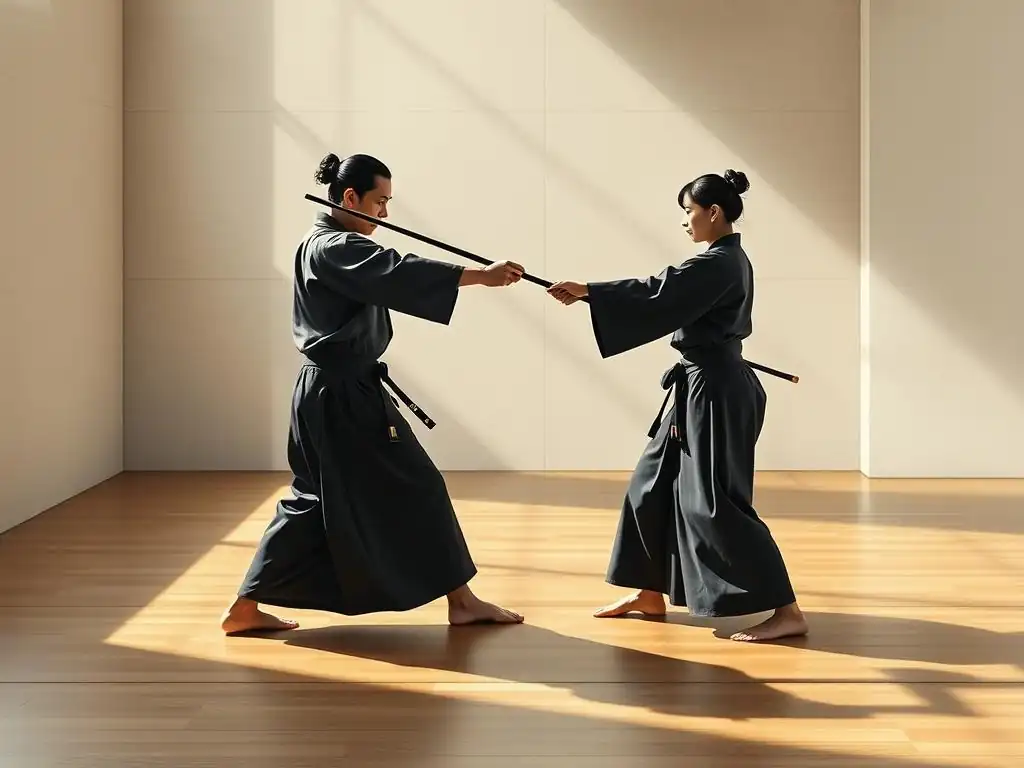
Advanced Kumijo training significantly enhances coordination and reflexes. The dynamic nature of paired staff interactions requires precise timing between visual input (seeing the partner's movement), cognitive processing (deciding on the appropriate response), and physical execution (moving the body and staff). Repeated practice of complex sequences at varying speeds sharpens these反应 (reflexes) and improves overall body-staff coordination. This heightened coordination translates directly to improved performance in empty-hand techniques, where similar rapid adjustments to distance, timing, and angle are necessary.
Improving Understanding of Aikido Principles Through Paired Practice
Practicing Aikido paired staff techniques provides a unique laboratory for understanding Aikido principles. Concepts like maai, timing, irimi, tenkan, and musubi become much more tangible when applied against a partner wielding a staff. The consequences of misapplying a principle are often immediately apparent – a technique fails, or the partner gains an advantage. This immediate feedback loop accelerates learning and deepens the practitioner's intuitive grasp of how these principles function in a dynamic, interactive environment, reinforcing their application in empty-hand techniques.
Developing Confidence in Weapon Handling Skills
Regularly engaging in advanced Kumijo builds confidence in handling the jo and, by extension, other potential weapons or weapon-like objects. While Aikido focuses on empty-hand self-defense, understanding how weapons are used and how to defend against them is crucial. Kumijo practice demystifies the weapon, making the practitioner more comfortable and less intimidated when faced with one. This confidence stems from a practical understanding of weapon dynamics, range, and vulnerabilities gained through countless hours of practicing Aikido paired staff techniques.
Connecting Aikido Empty-Hand Techniques to Staff Applications
Perhaps one of the greatest benefits of Kumijo training is the explicit connection it reveals between staff techniques and empty-hand Aikido. Many jo movements have direct parallels in empty-hand techniques. For example, a jo thrust ( tsuki) uses the same body mechanics as an atemi (strike) or the initial movement of a throw.
A jo block and subsequent entry often mirror the movements used to enter and control an opponent attacking with a punch or grab. By practicing Aikido paired staff techniques, practitioners gain a deeper appreciation for the universality of Aikido principles, seeing how they apply across different contexts, whether armed or unarmed.
Safety Considerations in Aikido Paired Staff Training
Proper Staff Handling and Etiquette
Safety in Kumijo begins with proper staff handling and etiquette. The jo is a tool for learning, not a weapon to be wielded recklessly. Practitioners must learn to control the staff at all times, being mindful of their own movements and their partner's position.
This includes holding the staff securely, avoiding unnecessary swinging, and always being aware of the tip's location. Dojo etiquette typically dictates bowing to the staff and one's partner before and after practice, reinforcing the respect required for training with weapons and acknowledging the trust placed in one another during paired practice. For instance, striking the partner outside of the agreed-upon techniques or failing to control the staff during a technique is a serious breach of etiquette and safety.
Importance of Qualified Instruction
Qualified instruction is non-negotiable for safe and effective Aikido paired staff training. An experienced instructor can demonstrate techniques correctly, explain the underlying principles, and most importantly, supervise practice to ensure that students are maintaining proper maai, controlling their movements, and practicing at an appropriate intensity. They can spot and correct unsafe habits before they lead to injury. Learning Aikido paired staff techniques from unqualified sources or attempting advanced forms without proper foundational training significantly increases the risk of accidents.
Avoiding Injuries During Kumijo Practice
Avoiding injuries during Kumijo practice requires vigilance from both practitioners and the instructor. Key strategies include warming up properly, practicing techniques slowly and deliberately before increasing speed or intensity, maintaining clear communication with one's partner (e.g., signaling if something feels unsafe), and knowing one's own physical limits. Protective gear, such as padded gloves or headgear, may be used in some dojos, especially when practicing more dynamic or free-form drills, although formal Kumijo is often practiced without padding.
The emphasis should always be on control, safety, and mutual learning over speed or force. A typical injury might be a bruised hand from a mistimed block or a strained wrist from an awkward grip, highlighting the need for careful, precise movements.
Conclusion: The Path to Mastery in Aikido Paired Staff Techniques
Integrating Kumijo into Your Aikido Journey
Integrating Kumijo into your overall Aikido journey is not just about adding weapon skills; it's about enriching your understanding and practice of Aikido itself. The principles learned through practicing Aikido paired staff techniques – such as maai, timing, centering, and blending – are universally applicable and will deepen your empty-hand techniques. Regular jo and kumijo practice provides a different perspective on familiar movements and principles, challenging you in new ways and fostering a more complete understanding of Aikido's dynamic potential. It is a vital component for those seeking a comprehensive grasp of O-Sensei's art.
Continual Learning and Refinement in Aikido Staff Work
Mastery in Aikido paired staff techniques, like all aspects of martial arts, is a journey of continual learning and refinement. There is always more to explore, subtler points of connection, timing, and application to discover. Returning to foundational forms like the 13-Count or 31-Count Kumijo even at an advanced level can reveal new insights. Practicing with different partners, under the guidance of various instructors, and exploring variations in rhythm and intensity all contribute to ongoing growth. The path involves persistent, mindful practice, seeking feedback, and always striving to embody the principles of Aiki within the dynamic interaction of Kumijo.
Frequently Asked Questions
What is Kumijo and how does it relate to Aikido?
Kumijo refers to Aikido's staff (jo) techniques. These techniques often involve paired practices, where two practitioners use the jo to develop sensitivity, timing, and coordination. The study of Kumijo enhances Aikido principles.
What are "paired staff techniques" in Aikido, and why are they important?
Paired staff techniques involve two Aikidoka practicing together with the jo. They are important for developing sensitivity to an opponent's movements and understanding the principles of aiki through physical interaction. This involves harmonizing with and redirecting an attacker's force.
What are some of the benefits of learning advanced Kumijo techniques?
Learning advanced Kumijo techniques improves body awareness, enhances spatial awareness, and develops a deeper understanding of Aikido's core principles. It also sharpens reflexes and improves timing and coordination in all aspects of Aikido.
How does the study of Kumijo contribute to self-defense strategies in Aikido?
While Kumijo itself might not be directly applicable in all self-defense situations, it cultivates crucial skills like distance management, timing, and body movement. These skills are transferable to unarmed combat and provide a foundation for effective self-defense.
Where can I learn more about Kumijo and other Aikido training methods?
You can find more information about Kumijo, historical overviews, training tips, and practical self-defense strategies on websites dedicated to martial arts, such as MartialArtsMastery.org. Look for resources that focus on Aikido and specifically staff techniques.
Final Reflection: Mastering Harmony Through Aikido Paired Staff Techniques
The intricate dance of Aikido paired staff techniques extends far beyond mere physical movements; it represents a profound understanding of harmony, balance, and mutual respect. In a world often characterized by conflict and division, the principles embedded within these advanced Kumijo forms offer a powerful reminder of the potential for collaboration and understanding. The ability to anticipate, adapt, and respond to a partner's movements with fluidity and precision is a skill that transcends the dojo, impacting our interactions in all aspects of life.
This exploration of Aikido paired staff techniques has profoundly influenced my own understanding of the art, highlighting the essential interconnectedness between partners and the importance of cultivating a spirit of cooperation. The constant need for adaptation and sensitivity to one's partner mirrors the complexities of human relationships. As Morihei Ueshiba, the founder of Aikido, wisely stated: True victory is victory over oneself.
This sentiment resonates deeply within the practice of Kumijo, where the greatest challenge lies not in overpowering an opponent, but in mastering oneself and achieving a harmonious union.
Now, as you reflect on the principles and techniques discussed, consider how you can apply the lessons of Aikido paired staff techniques to your own life. Embrace the challenge of finding harmony in your interactions, cultivate a spirit of collaboration, and strive for a deeper understanding of yourself and those around you. Let the fluidity and precision of Kumijo inspire you to move through the world with grace, balance, and unwavering respect for all.
Master the Dance: Unleash Your Kumijo Potential!
Thank you for diving deep into the world of advanced Kumijo. We hope this article has sparked a new appreciation for the intricate partner interactions and complex staff work found in Aikido forms. Now, it's time to translate knowledge into action.
Here's how you can further elevate your Kumijo practice:
- Partner up and dedicate your next training session to specifically drilling one of the paired forms discussed. Focus on fluidity and connection with your partner.
- Explore related martial arts forms like Jojutsu or Bojutsu to gain new perspectives on staff movement and combat dynamics.
- Share your insights! What's one unexpected benefit you've found from practicing Kumijo that others might not realize?