
The Philosophy of the Ring: How Boxing Reflects Life's Struggles and Triumphs – A Historical View


Welcome to Martial Arts Mastery, your gateway to the world's diverse fighting traditions!
Delve into the profound connection between combat and character. What if the discipline and resilience forged in the ring could illuminate the challenges we face every day? This article, " The Philosophy of the Ring: How Boxing Reflects Life's Struggles and Triumphs – A Historical View", explores exactly that, revealing how the sweet science mirrors the battles of life itself. Discover the historical roots and the enduring lessons boxing offers – and unlock a deeper understanding of both the sport and yourself. Are you ready to step into the ring of life?
- Boxing: A Metaphor for Life's Battles
- A Historical Journey Through Boxing's Philosophical Underpinnings
- Boxing Legends and Their Philosophical Insights
- The Mental Fortitude Required: Boxing and the Psychology of Success
- Boxing as a Mirror to Society: Reflecting Societal Values and Changes
- The Enduring Appeal: Why Boxing Continues to Resonate with Audiences
-
Frequently Asked Questions
- What are some of the key parallels between boxing and life's struggles, as explored in the article?
- How does the article from MartialArtsMastery.org connect the historical aspects of boxing to modern-day boxing life struggles triumphs?
- Besides physical training, what philosophical elements are discussed in the article regarding Boxing life struggles triumphs?
- Does the article discuss specific examples of boxers who embody the theme of Boxing life struggles triumphs?
- How does MartialArtsMastery.org use the lens of boxing to offer broader self-defense strategies or life lessons relatable to Boxing life struggles triumphs?
- Final Reflection: The Echo of the Bell
- Embrace the Fight: Discover Your Inner Champion!
Boxing: A Metaphor for Life's Battles
Exploring the Parallels Between Boxing and Real-World Challenges
Boxing, often called the "sweet science," serves as a profound metaphor for the human condition. The confined space of the ring, the one-on-one confrontation, and the inherent demand for both physical prowess and mental resilience mirror the challenges individuals face outside the ropes.
Every jab, hook, and uppercut, every defensive maneuver and strategic retreat, can be seen as an action taken in the face of adversity, reflecting the constant negotiation with obstacles that defines life's struggles. The bell signaling the start of a round is akin to a new day or a new challenge, demanding preparedness and courage, while the final bell represents the culmination of effort, a temporary victory, or a hard-fought draw in the ongoing bout of existence.
Consider the fundamental elements of boxing: defense, offense, endurance, and strategy. These aren't confined to the sport; they are critical skills for navigating the complexities of life.
Learning to defend yourself from emotional or professional attacks, knowing when to be assertive (offense), possessing the stamina to persevere through long-term projects or difficult periods (endurance), and developing a plan to achieve goals (strategy) are all skills honed, albeit metaphorically, in the ring of life. The raw, unvarnished nature of boxing, stripping away pretense and forcing confrontation, highlights the core truth that facing challenges head-on is often the only path to overcoming them, demonstrating the direct link between boxing life struggles triumphs.
The Ring as a Crucible: Forging Character Through Adversity
The boxing ring acts as a crucible, a severe test that purifies and strengthens character. Stepping between the ropes requires immense vulnerability and courage, forcing a participant to confront not only an opponent but also their own fears, doubts, and physical limitations.
In this intense environment, weaknesses are exposed, and strengths are tested under pressure. It is through enduring punishing blows, pushing past exhaustion, and finding the will to continue despite pain and setbacks that a boxer's true character is forged, a process that directly parallels how individuals develop resilience and fortitude when facing significant adversity in their own lives.
This process of character development is observable throughout the history of the sport. Fighters who have risen from poverty or difficult circumstances often speak of boxing as their path to discipline, self-respect, and perseverance. The rigorous training schedule, the sacrifices required (such as strict diet and avoiding distractions), and the mental preparation needed for each fight instill a level of discipline that extends far beyond the gym. It is in the crucible of training and competition that the mental toughness necessary to face life's struggles and triumphs is truly built, demonstrating the sport's power to shape individuals.
A Historical Journey Through Boxing's Philosophical Underpinnings
Ancient Roots: Boxing's Early Connection to Stoicism and Resilience
Boxing, or forms very similar to it, have roots stretching back to ancient civilizations. In ancient Greece, pugilism was part of the Olympic Games as early as 688 BC. Participants trained rigorously, their bodies becoming instruments of their will and resilience.
This era coincided with the rise of philosophical schools like Stoicism, which emphasized virtue, reason, and emotional fortitude in the face of hardship. While not explicitly linked, the ideals celebrated in ancient combat sports—endurance, self-control, courage, and the ability to bear pain without complaint—resonate strongly with Stoic principles. Athletes were admired not just for victory but for their ability to withstand punishment and demonstrate unwavering resolve, embodying a practical application of stoic resilience.
The training methods themselves were harsh, focusing on physical conditioning and mental toughness. Boxers would wrap their hands and wrists with leather thongs, sometimes weighted or hardened, preparing for brutal, often lengthy bouts with few rules regarding clinching or hitting a downed opponent.
The focus was on overcoming physical pain and mental exhaustion through sheer willpower, a direct parallel to the Stoic belief that one should focus on what they can control (their reactions, effort, and attitude) rather than external circumstances (the opponent, the outcome). This historical context reveals that the philosophical underpinnings of confronting life's struggles through disciplined effort and resilience were present in boxing from its very beginnings.
The Evolution of Boxing and its Reflective Nature: The Roaring Twenties
The Roaring Twenties in America saw boxing explode in popularity, becoming a major spectator sport and a reflection of the era's dynamic energy and social changes. Figures like Jack Dempsey, known for his aggressive style and "Manassa Mauler" persona, captivated the public imagination.
Boxing matches became grand events, drawing massive crowds; the 1927 "Long Count" fight between Dempsey and Gene Tunney, for example, drew an estimated crowd of over 104,000 people, generating gate receipts exceeding $2.6 million (a staggering sum at the time, equivalent to tens of millions today). This era saw boxing reflect the post-war exuberance, the breaking of old molds, and a fascination with individual power and triumph.
Beyond the spectacle, the sport continued to mirror the struggles and aspirations of the working class and immigrants. Many boxers came from disadvantaged backgrounds, seeing the ring as a potential path to financial success and social mobility. Their stories of rising from poverty through grit and determination resonated deeply with a population grappling with rapid industrialization and social shifts. The dramatic knockouts and comebacks embodied the era's boom-and-bust cycles and the persistent belief in the possibility of overcoming adversity through individual effort, highlighting the boxing life struggles triumphs narrative playing out on a public stage.
The Evolution of Boxing and its Reflective Nature: The Cold War Era
During the Cold War, boxing took on new political and ideological dimensions, becoming a symbolic battleground reflecting global struggles. Matches between boxers from the United States and the Soviet Union or other Eastern Bloc nations were often imbued with nationalist fervor and seen as proxies for the larger ideological conflict. The amateur boxing programs, particularly in the Olympics, became showcases for national strength and athletic superiority, with governments investing heavily in developing fighters. These bouts were watched not just for the sport but for the underlying narrative of competing systems and values.
Furthermore, the Cold War era saw boxing become intertwined with the American Civil Rights Movement. African American boxers, most famously Muhammad Ali, used their platform to challenge racial segregation, inequality, and government policies. Ali's refusal to be inducted into the military in 1967, citing religious and political objections, led to the stripping of his title and a multi-year ban from the sport.
His subsequent legal battle and eventual triumph in the Supreme Court reflected the broader struggles for justice and civil liberties in the United States. Boxing, in this period, was not just a sport but a potent stage reflecting the major social and political struggles and triumphs of the time.
Boxing Legends and Their Philosophical Insights
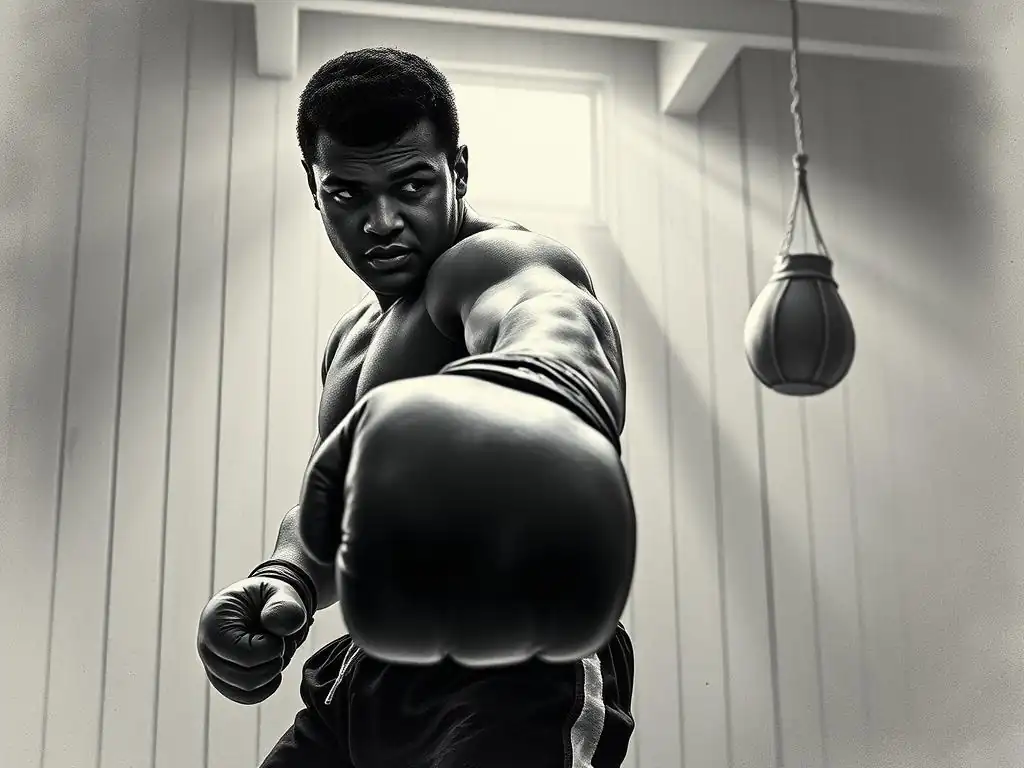
Case Study: Muhammad Ali and the Triumph Over Societal Obstacles
Muhammad Ali's career is a powerful testament to overcoming societal obstacles and a prime example of boxing life struggles triumphs. Born Cassius Clay in segregated Louisville, Kentucky, he faced racial discrimination throughout his early life and career. Despite winning an Olympic gold medal in 1960, he encountered prejudice upon his return to the U.S. As his fame grew, he became increasingly outspoken against racial injustice and the Vietnam War. His conversion to Islam and change of name were controversial, alienating many white fans and media figures who had previously celebrated him.
The defining struggle came in 1967 when he refused military induction based on his religious beliefs. This act of conscience led to his arrest, conviction for draft evasion, the stripping of his heavyweight title, and a ban from boxing during what should have been his prime years (ages 25-29). For over three years, Ali fought a legal battle that went all the way to the Supreme Court, which eventually overturned his conviction in 1971.
His return to boxing and subsequent regaining of the heavyweight title in the "Rumble in the Jungle" in 1974 was a monumental triumph, not just in sports but as a victory for individual conscience and resilience against immense societal and governmental pressure. Ali's journey exemplifies how the principles of standing firm in the face of opposition, a core tenet learned in the ring, can translate to profound victories in the wider world.
Case Study: George Foreman and the Acceptance of Reinvention
George Foreman's career offers a unique perspective on resilience, humility, and the power of reinvention, another vivid illustration of boxing life struggles triumphs. After a dominant early career, including a gold medal at the 1968 Olympics and defeating Joe Frazier for the heavyweight title in 1973, Foreman suffered a devastating loss to Muhammad Ali in 1974. This defeat, coupled with subsequent losses and personal struggles, led him to retire from boxing in 1977 at the age of 28, becoming an ordained minister. For a decade, he focused on his faith and community work, seemingly leaving the sport behind.
However, in 1987, after ten years away, Foreman announced a comeback. This decision was met with skepticism, given his age and time away. Yet, Foreman, having shed the angry persona of his youth and adopted a jovial, self-deprecating public image, embarked on an improbable journey.
He worked his way back up the ranks, finally challenging Michael Moorer for the heavyweight title in 1994. At 45 years old, Foreman knocked out the younger, favored champion in the 10th round, becoming the oldest heavyweight champion in history. His comeback was not just a physical feat but a philosophical statement about the possibility of second acts, the acceptance of past failures, and the enduring power of determination and self-belief, demonstrating that the lessons of perseverance learned in boxing apply at any age and stage of life's journey.
Lessons Learned from the Greats: Applying Boxing's Philosophy to Everyday Life
The careers of boxing greats like Ali and Foreman, among countless others, offer invaluable philosophical lessons applicable to life's struggles. One key lesson is the importance of preparation. Just as a boxer trains relentlessly for a fight, success in life often requires diligent preparation, skill development, and strategic planning. Another lesson is resilience; every boxer faces knockdowns, but the ability to get back up, learn from the experience, and continue fighting is paramount. This translates directly to bouncing back from failures, setbacks, or personal losses in life.
Furthermore, boxing teaches the value of self-belief and mental fortitude. Stepping into the ring requires immense confidence and the ability to manage fear and pressure. Similarly, navigating the challenges of life demands a strong mindset, the ability to silence self-doubt, and the courage to face difficult situations. The discipline required for training—early mornings, strict diets, pushing through pain—instills a work ethic that is crucial for achieving long-term goals in any field. Ultimately, the philosophical insights from these legends boil down to perseverance, adaptability, courage, and the understanding that triumph often comes after significant struggle.
The Mental Fortitude Required: Boxing and the Psychology of Success
Overcoming Fear: Mastering the Inner Game in Boxing and Life
Fear is an intrinsic part of boxing. The fear of being hit, the fear of losing, the fear of disappointing oneself or others – these are powerful psychological barriers that every fighter must confront. Mastering this fear is not about eliminating it entirely but about learning to control it, to function effectively despite its presence. This inner battle is often as demanding as the physical fight itself. Boxers employ various psychological techniques, from visualization and positive self-talk to rigorous physical conditioning that builds confidence, to manage the anxiety that comes with stepping into the ring.
This mastery of fear is directly applicable to life's struggles. Whether facing a job interview, a public speaking engagement, a difficult conversation, or a major life change, fear can be paralyzing. The lessons from boxing teach that courage is not the absence of fear, but action in the face of it.
By adopting a similar mindset – preparing thoroughly, focusing on controllable actions (like effort and technique), and developing mental resilience – individuals can learn to navigate their own fears. The ability to manage internal psychological states is a cornerstone of success, mirroring the boxer's need to master their inner game to perform under pressure.
Discipline and Dedication: The Cornerstones of Boxing and Personal Achievement
Discipline and dedication are non-negotiable requirements in boxing. A fighter's success is built on countless hours in the gym, adhering to strict training regimens, maintaining a disciplined diet, and making personal sacrifices. Skipping training sessions, eating poorly, or lacking focus can have immediate and detrimental consequences in the ring. This unwavering commitment is what allows a boxer to develop the necessary skills, endurance, and mental toughness to compete at a high level.
These same cornerstones are vital for achieving any significant personal or professional goal. Whether pursuing academic excellence, building a career, or mastering a craft, discipline (the ability to do what needs to be done, even when you don't want to) and dedication (consistent, focused effort over time) are essential. The boxer's routine – waking up early, running miles, hitting the heavy bag, sparring rounds – is a powerful analogy for the consistent effort required to overcome life's struggles and achieve triumphs. It underscores the principle that significant accomplishments are rarely accidental; they are the result of sustained, disciplined work.
Resilience in the Face of Adversity: Bouncing Back from Knockdowns
Perhaps the most celebrated aspect of boxing's philosophy is resilience – the ability to absorb punishment, get knocked down, and still find the will to stand back up and continue fighting. A knockdown in boxing is a clear, physical manifestation of failure or a severe setback. How a fighter responds in those critical ten seconds reveals the depth of their resilience. Do they stay down, or do they rise, clear their head, and re-engage? This moment is a powerful metaphor for facing adversity in life.
Life is full of knockdowns – job loss, failed relationships, health crises, financial difficulties. The philosophy of boxing teaches that these setbacks are not necessarily the end; they are tests. The resilient individual, like the resilient boxer, doesn't dwell on the fall but focuses on the act of getting back up.
They learn from the experience, adjust their strategy if necessary, and keep moving forward. Stories of boxers who have overcome multiple knockdowns to win a fight are inspiring precisely because they embody this crucial life lesson: triumph is often preceded by significant struggles, and the ability to bounce back is key.
Boxing as a Mirror to Society: Reflecting Societal Values and Changes
For generations, boxing has served as a potential pathway to social mobility for individuals from disadvantaged backgrounds. In many urban and working-class communities, boxing gyms have been hubs where young people could find structure, discipline, and mentorship, often escaping the negative influences of their environment. The sport offered a tangible opportunity to earn a living, gain recognition, and lift oneself and their families out of poverty through talent and hard work. This was particularly true in the early to mid-20th century, when prize fighting offered some of the highest earning potentials for athletes, albeit alongside significant risks.
Historical figures like Joe Louis, Rocky Marciano, and Jake LaMotta, who came from modest backgrounds, exemplify this trajectory. Louis, the "Brown Bomber," became a national hero during the Depression era, his success offering hope to African Americans facing severe discrimination. Marciano, the son of Italian immigrants, embodied the American dream of rising through hard work. Their stories, and countless others, highlight how boxing reflected the societal value placed on individual effort and provided a rare avenue for advancement when other doors were closed, showcasing the direct link between boxing life struggles triumphs and social progress.
Boxing has also mirrored evolving social norms and attitudes. The sport has seen shifts in rules, safety regulations, and public perception over time, reflecting changing societal views on violence, health, and athlete welfare. The decline of the unregulated bare-knuckle era and the rise of codified rules like the Marquess of Queensberry Rules in the late 19th century reflected a move towards greater order and perceived civility. More recently, increased attention to fighter safety, including medical suspensions, concussion protocols, and weight cutting regulations, reflects growing societal awareness of health risks and a greater emphasis on athlete protection.
Furthermore, the increasing visibility and acceptance of women's boxing in recent decades is a clear reflection of broader societal changes regarding gender equality in sports. While women's boxing faced significant barriers for much of the 20th century, its inclusion in the Olympics in 2012 marked a major turning point. This evolution demonstrates how the sport adapts and changes alongside the society it exists within, showcasing how the struggles for inclusion and recognition in life are mirrored within the boxing world itself, leading to slow but significant triumphs.
Racial Integration Through the Lens of Boxing
Boxing has played a significant, albeit complex, role in the history of racial integration and civil rights. As mentioned with Joe Louis, African American boxers achieved prominence and gained widespread admiration at times when racial segregation was enforced by law and custom. Louis's victory over German Max Schmeling in 1938 was framed as a symbolic battle against Nazism and was celebrated across racial lines in the U.S., momentarily uniting a divided nation. Later, figures like Sugar Ray Robinson and Floyd Patterson continued to break barriers.
However, the path was not smooth. African American fighters often faced discrimination in terms of pay, opportunities, and access to facilities. Jack Johnson, the first black heavyweight champion in the early 20th century, faced intense racial hostility and was actively sought out by white challengers hoping to reclaim the title for the "Great White Hope."
Despite these struggles, the visibility of black champions and their ability to defeat white opponents in a highly public arena challenged deeply ingrained racial prejudices and contributed to shifting perceptions over time. Boxing, therefore, acted as a microcosm of the larger struggles for racial equality and the triumphs won through perseverance and performance.
The Enduring Appeal: Why Boxing Continues to Resonate with Audiences
The Universal Language of Struggle and Triumph
Boxing's enduring appeal lies in its raw, universal depiction of struggle and triumph. The narrative is simple yet profound: two individuals facing off, each seeking to overcome the other through skill, will, and endurance. This resonates because it mirrors fundamental aspects of the human experience – the need to confront challenges, the effort required to succeed, the pain of failure, and the exhilaration of victory. Regardless of cultural background or personal circumstance, most people can relate to the idea of facing a difficult opponent or situation and having to fight through adversity to achieve a goal.
The clear, decisive outcome of a boxing match – a knockout, a decision, a TKO – provides a resolution that is often lacking in the messy complexities of real life. This clarity, combined with the high stakes and the visible display of courage and resilience, makes boxing a compelling drama. It speaks a universal language of effort, sacrifice, and the potential for an underdog to overcome seemingly insurmountable odds, making it a powerful and relatable spectacle of boxing life struggles triumphs.
Boxing's Role in Popular Culture: Inspiring Stories of Perseverance
Boxing has deeply permeated popular culture, serving as a source of countless inspiring stories of perseverance. Literature, film, and television are replete with narratives centered around the boxer's journey – the rise from poverty, the overcoming of personal demons, the improbable comeback. Films like "Rocky," "Raging Bull," "Million Dollar Baby," and "Creed" have captivated audiences worldwide, not just for their action but for their powerful human stories of resilience, determination, and the pursuit of dreams against all odds.
These cultural depictions reinforce the philosophical lessons of boxing. They highlight the grueling training, the moments of doubt, the pain of defeat, and the ultimate triumph that comes from refusing to give up. They emphasize the importance of a supportive corner (mentors, family, friends) and the internal strength required to face challenges alone in the spotlight. By translating the sport's physical and mental battles into compelling narratives, popular culture ensures that the philosophy of boxing life struggles triumphs continues to inspire and resonate with new generations.
The Future of Boxing and its Philosophical Relevance in a Changing World
As the world changes, with new forms of entertainment and athletic competition emerging, boxing faces challenges in maintaining its prominence. However, its core philosophical relevance remains potent. In an increasingly complex and sometimes impersonal world, the fundamental drama of one individual testing their limits against another continues to hold deep meaning. The lessons of discipline, resilience, courage, and the ability to face adversity head-on are timeless and universally applicable.
The future of boxing may involve adaptation – integrating new technologies for training or viewing, evolving rules for safety, or finding new ways to engage audiences. Yet, the essential narrative of the fighter's journey, the physical and mental struggle within the confined space of the ring leading to moments of triumph or noble defeat, will likely continue to resonate. As long as humans face challenges, setbacks, and the need to persevere, the "sweet science" will offer a powerful, albeit sometimes brutal, mirror reflecting the fundamental boxing life struggles triumphs that define the human experience.
Frequently Asked Questions
What are some of the key parallels between boxing and life's struggles, as explored in the article?
The article highlights how boxing reflects life's challenges through themes of adversity, resilience, and the need to adapt to changing circumstances, just as one must in the ring.
How does the article from MartialArtsMastery.org connect the historical aspects of boxing to modern-day boxing life struggles triumphs?
It likely shows how past boxers overcame extreme hardships and achieved significant victories, providing inspiration and context for understanding similar struggles faced by boxers today.
Besides physical training, what philosophical elements are discussed in the article regarding Boxing life struggles triumphs?
The article probably delves into concepts like discipline, mental fortitude, and the importance of self-belief in overcoming both in-ring and out-of-ring obstacles.
Does the article discuss specific examples of boxers who embody the theme of Boxing life struggles triumphs?
Presumably, the article features profiles of legendary boxers who faced significant personal or professional battles and ultimately achieved greatness, demonstrating the core theme.
How does MartialArtsMastery.org use the lens of boxing to offer broader self-defense strategies or life lessons relatable to Boxing life struggles triumphs?
The website likely emphasizes the importance of strategic thinking, self-control under pressure, and the ability to defend oneself both physically and mentally, connecting boxing to real-world scenarios.
Final Reflection: The Echo of the Bell
The echoes of the boxing ring, as we've explored, resonate far beyond the canvas and ropes. The enduring appeal of boxing lies in its raw, unvarnished portrayal of life's struggles and the hard-won triumphs that follow. It's a microcosm of the human experience, where resilience, strategy, and sheer willpower determine the outcome, mirroring the challenges we all face in our own lives.
The philosophy of the ring, with its inherent drama and stark consequences, has profoundly shaped our understanding of perseverance and the pursuit of victory against all odds. The lessons learned from boxing – the importance of discipline, the necessity of adapting to adversity, and the unwavering belief in oneself – are timeless and universally applicable. It isn't the hours you put in, but what you put in the hours.
- Muhammad Ali, encapsulating the dedication and focus required to succeed, both in the ring and in life.
Now, as the final bell rings on this exploration, consider the battles you face, both seen and unseen. Embrace the spirit of the boxer: the unwavering determination, the strategic thinking, and the refusal to be knocked down permanently. Let the philosophy of the ring inspire you to confront your own struggles with courage, to celebrate your triumphs with humility, and to emerge from each round stronger and more resilient than before.
Embrace the Fight: Discover Your Inner Champion!
Thank you for exploring the rich tapestry of boxing and its profound reflections on life. We hope you've gained a new appreciation for the resilience and strategy this sport embodies. Now, it's time to apply those lessons to your own journey.
Here are a few ways to channel your inner warrior:
- Challenge yourself to a new goal. Identify one area of your life where you can push beyond your limits and start training toward success.
- Reflect on your personal "ring." What obstacles are you facing, and how can you apply strategic thinking to overcome them?
- Share this article with someone who needs a boost of motivation and spark a conversation about overcoming adversity.
What's one small "round" you can win today that will bring you closer to your overall victory?