
Reading Between the Lines: The Rich Symbolism within Taekwondo Poomsae

Welcome to Martial Arts Mastery, your ultimate guide to the world's fighting arts. Delve into the rich tapestry of tradition and technique, where ancient wisdom meets modern application. Curious about the hidden language woven into the movements of Taekwondo? Uncover the profound Taekwondo poomsae symbolism meaning behind each form and stance, and begin to understand the deeper narrative embedded within this powerful discipline. Ready to decode the secrets? Your journey to mastery starts here...
- Unveiling the Hidden Meanings in Taekwondo Poomsae: An Introduction
- The Philosophical Foundations of Taekwondo Poomsae
- Deciphering the Symbolism Embedded in Taekwondo Poomsae Forms
-
A Deep Dive into Specific Taekwondo Poomsae and Their Symbolism
- Taegeuk Il Jang: Meaning and Symbolic Interpretation
- Taegeuk Yi Jang: Unveiling its Symbolic Significance
- Taegeuk Sam Jang: Symbolism and Practical Applications
- Taegeuk Sa Jang: Exploring the Symbolic Depth
- Taegeuk Oh Jang: The Meaning Behind the Movements
- Taegeuk Yuk Jang: Symbolism Explained
- Taegeuk Chil Jang: Decoding the Symbolic Language
- Taegeuk Pal Jang: Unraveling the Symbolic Narrative
- Koryo Poomsae: Reflecting Korean History and Spirit
- Keumgang Poomsae: Symbolizing Strength and Diamond-like Hardness
- Taebaek Poomsae: Representing the Sacred Mountain
- Pyongwon Poomsae: Symbolizing the Vast Plains
- Sipjin Poomsae: Embodying the Ten Symbols of Longevity
- Jitae Poomsae: Representing the Earth
- Chonkwon Poomsae: Symbolizing the Heavens
- Hansu Poomsae: Representing Water
- Ilyeo Poomsae: Achieving Unity and Harmony
- The Practical Application of Poomsae Symbolism in Taekwondo Training
- Taekwondo Poomsae: A Journey of Self-Discovery Through Symbolism
-
Frequently Asked Questions
- What are poomsae in Taekwondo and why are they important?
- What does Taekwondo poomsae symbolism generally represent?
- How does the line diagram of a poomsae contribute to its symbolism meaning?
- Are the hand and foot techniques in poomsae purely combative, or do they also carry symbolic weight?
- How can understanding the Taekwondo poomsae symbolism meaning enhance a practitioner's training?
- Final Reflection: Unveiling the Deeper Meaning
- Embrace the Art: Decode Your Poomsae Potential!
The Essence of Poomsae: More Than Just Technique
Poomsae, often translated as "forms" or "patterns," are prearranged sequences of Taekwondo techniques performed against imaginary opponents. While superficially appearing as a series of blocks, strikes, and kicks, the essence of poomsae extends far beyond mere physical execution. They are living embodiments of Taekwondo's history, philosophy, and spirit, acting as a kinetic library of the art's core principles.
Mastery of poomsae is not solely judged by power or speed, but by precision, balance, focus, and the expression of the underlying intent – the very soul of the movements. Understanding the Taekwondo poomsae symbolism meaning unlocks a deeper appreciation for this fundamental aspect of training.
Each movement within a poomsae is steeped in purpose, representing a specific defensive or offensive action, but also carrying layers of symbolic significance. For instance, a simple walking stance might represent readiness and groundedness, while a powerful front kick could symbolize overcoming obstacles. The transition between movements, the direction of travel, and even the breathing patterns are all integral to the narrative and meaning embedded within the form.
Approximately 70% of a Taekwondo practitioner's early technical training often revolves around learning and refining these patterns, highlighting their central role in developing not just physical prowess but also mental discipline and an understanding of the art's heritage. This focus on detailed execution and internal meaning distinguishes Taekwondo poomsae from simple drills.
Why Understanding Taekwondo Poomsae Symbolism Matters
Delving into the Taekwondo poomsae symbolism meaning transforms the practice from a repetitive exercise into a profound journey of self-discovery and connection to the art's roots. Knowing why a movement is performed in a certain way, or what principles it represents, enhances focus and intention during training. It helps practitioners internalize the lessons of courage, humility, perseverance, and respect that are foundational to Taekwondo. Without this understanding, poomsae can feel like an arbitrary dance, limiting the practitioner's growth and connection to the art's rich legacy.
Furthermore, a deep grasp of the symbolism embedded in Taekwondo poomsae significantly improves performance and competitive scores. Judges in poomsae competitions evaluate not just technical accuracy but also power, rhythm, transition, and expression – all elements profoundly influenced by the practitioner's understanding of the form's meaning.
For example, executing a block representing 'mountain' (as in Taegeuk Sam Jang) with a feeling of immovable strength demonstrates a comprehension of its symbolism that elevates the performance beyond just the physical movement. This deeper insight allows the practitioner to inhabit the form, expressing its narrative and symbolic weight, which can account for a noticeable difference in scoring, potentially shifting a judge's evaluation by several tenths of a point in a close competition.
The Philosophical Foundations of Taekwondo Poomsae
Confucianism's Influence on Taekwondo Patterns
Confucianism has profoundly shaped Korean culture and, consequently, the philosophical underpinnings of Taekwondo, including its poomsae. Key Confucian principles such as respect for elders and hierarchy (Ye Ui), righteousness and justice (Ui), propriety and etiquette (Ye), wisdom (Ji), and trust and sincerity (Shin) are subtly woven into the structure and execution of poomsae.
The rigid sequence, the emphasis on proper bowing and decorum, and the focus on self-cultivation through disciplined practice all reflect Confucian values. For instance, the structured progression through the Taegeuk forms, starting from Il Jang and moving towards Pal Jang, mirrors the Confucian concept of continuous learning and moral development, building from fundamental principles to more complex understanding.
The very act of practicing poomsae embodies the Confucian ideal of self-improvement and discipline. It requires patience, perseverance, and a commitment to refining one's character as well as physical skills. The precise movements and strict forms cultivate a sense of order and respect for tradition.
An example of this influence can be seen in the required etiquette before and after performing a poomsae, including bowing to the instructor and the flags, which reinforces hierarchical respect and formal courtesy, central tenets of Confucian philosophy. The pursuit of perfection in each movement, even after thousands of repetitions, aligns with the Confucian pursuit of moral excellence and the belief that continuous effort leads to virtue. This philosophical bedrock provides a significant layer to the Taekwondo poomsae symbolism meaning.
Taekwondo Poomsae and the Five Elements: Wood, Fire, Earth, Metal, and Water
While not explicitly a direct mapping like in some other Asian martial arts, the principles of the Five Elements (Wu Xing) – Wood, Fire, Earth, Metal, and Water – can be seen as influencing the characteristics and flow within various Taekwondo poomsae, adding another dimension to understanding Taekwondo poomsae symbolism meaning. These elements represent different states of change and interaction in nature and are often associated with specific qualities and directions.
For example, Wood is associated with growth and expansion, Fire with energy and brightness, Earth with stability and foundation, Metal with structure and cutting force, and Water with fluidity and adaptability.
Certain poomsae or sections within them can be interpreted through the lens of these elements. The dynamic, explosive movements found in some forms might evoke the energy of Fire, while rooted, stable stances clearly resonate with the groundedness of Earth. Fluid, continuous transitions could be linked to Water's adaptability, and sharp, precise strikes might reflect the cutting nature of Metal.
While this interpretation is more abstract than the explicit symbolism found in the names or patterns themselves, it offers a way to understand the energetic qualities and strategic principles embedded within the forms. For instance, a form emphasizing strong, unyielding blocks followed by firm stances could be seen as embodying Earth and Metal principles, representing defense and structural integrity, providing a richer layer to the Taekwondo poomsae symbolism meaning.
Deciphering the Symbolism Embedded in Taekwondo Poomsae Forms
The Significance of Movement Direction in Poomsae
The directional pathways within Taekwondo poomsae are far from arbitrary; they are imbued with significant symbolism, contributing greatly to the Taekwondo poomsae symbolism meaning. The movement patterns, often forming shapes like a cross, a square, or a straight line, represent fundamental concepts related to the universe, directions, and philosophical principles. For example, many of the Taegeuk forms follow a pattern resembling the Chinese character for "king" (王), symbolizing authority, balance, and centrality. This pattern often involves moving forward, turning 90 degrees, moving forward again, turning 180 degrees, and so on, creating a symmetrical structure around a central axis.
Moving forward often symbolizes progress, advancement, or confronting challenges head-on. Turning movements, particularly 180-degree turns, can represent change, adaptation, or overcoming opposition from a different direction. Moving backward, though less common as a primary direction, might symbolize yielding or tactical retreat.
The four cardinal directions (North, South, East, West) are sometimes associated with specific elements or energies, and the movements towards these directions within a form can reflect these associations. For instance, in certain interpretations, moving to the left might symbolize facing a specific type of challenge compared to moving to the right. The specific sequence of turns and movements tells a story, representing a journey or a response to multiple threats from different directions, adding a narrative layer to the Taekwondo poomsae symbolism meaning.
Understanding Stance Symbolism in Taekwondo Poomsae: Ap Seogi (Forward Stance), Ap Kubi Seogi (Long Stance), Dwit Kubi Seogi (Back Stance)
Stances in Taekwondo poomsae are not merely positions for stability; they carry significant symbolic weight, reflecting the practitioner's state of mind, readiness, and strategic intent, which is crucial for understanding Taekwondo poomsae symbolism meaning. Each stance has specific characteristics that convey different principles. The Ap Seogi (Forward Stance), a basic walking stance, symbolizes readiness and the ability to move forward or backward quickly. It's a fundamental, versatile stance representing alertness and a neutral, yet prepared, state. Approximately 30% of the movements in early Taegeuk forms utilize variations of this stance, highlighting its foundational importance.
The Ap Kubi Seogi (Long Stance) is a powerful, aggressive stance used for strong attacks or solid defense. It symbolizes strength, rootedness, and unwavering determination. With approximately 60% of the body weight forward, it represents commitment to the forward direction and the ability to generate significant power. For example, a powerful front punch or a low block is often executed from this stable base.
In contrast, the Dwit Kubi Seogi (Back Stance) is a defensive stance, emphasizing balance, agility, and the ability to react quickly or retreat. With approximately 70% of the body weight on the back leg, it symbolizes readiness to shift weight, evade, or counter-attack. This stance is frequently used for side blocks or preparing for turning kicks. The deliberate choice and placement of these stances within a poomsae sequence communicate the intended strategy and underlying symbolic narrative, enriching the overall Taekwondo poomsae symbolism meaning.
Hand Techniques and Their Symbolic Representations
Hand techniques in Taekwondo poomsae, encompassing various blocks, strikes, and thrusts, are deeply symbolic, reflecting not just physical actions but also principles of defense, offense, and control, contributing significantly to Taekwondo poomsae symbolism meaning. A block, for example, is not just a physical deflection; it symbolizes protection, defense of oneself or principles, and the ability to withstand challenges. Different blocks carry distinct meanings: a low block (Arae Makgi) might symbolize defending against foundational threats or overcoming initial obstacles, while a high block (Ollgul Makgi) could represent protecting one's 'head' – one's thoughts, honor, or higher aspirations.
Strikes and punches symbolize decisive action, overcoming opposition, and asserting one's will. A powerful middle punch (Momtong Jireugi) often represents a direct confrontation or addressing a central issue. Thrusts (Chireugi) can symbolize piercing through difficulties or targeting vulnerabilities.
The open hand techniques, such as knife hand blocks (Sonkal Makgi) or spear hand thrusts (Pyeon Sonkkeut Chireugi), add layers of precision and sometimes represent more nuanced actions like cutting away obstacles or targeting specific points. The specific combination and sequence of these techniques within a poomsae tell a symbolic story of conflict and resolution, defense and counter-attack, embodying the dynamic interplay of opposing forces inherent in martial arts. Understanding the subtle differences in hand positions and targets reveals deeper layers of the Taekwondo poomsae symbolism meaning.
A Deep Dive into Specific Taekwondo Poomsae and Their Symbolism
Taegeuk Il Jang: Meaning and Symbolic Interpretation
Taegeuk Il Jang is the first of the eight Taegeuk forms and is associated with the trigram Geon (乾), representing Heaven and Light. It symbolizes the beginning, the foundation, and the pure Yang energy. This form introduces fundamental movements like walking stance (Ap Seogi), long stance (Ap Kubi Seogi), low block (Arae Makgi), middle punch (Momtong Jireugi), and high block (Ollgul Makgi). Its simplicity reflects the initial stage of learning, focusing on basic yet essential techniques. The form's pattern, often resembling the character "王" (King), symbolizes the central core and stability required at the outset of one's Taekwondo journey.
The symbolism of Heaven in Taegeuk Il Jang relates to the vastness of potential and the fundamental principles that govern all things. The light symbolizes clarity, purity, and the illumination of the path ahead for the beginner. The movements are direct and straightforward, embodying the unadorned nature of a novice but also the pure, raw energy of a new beginning.
Learning this form is the first step in understanding the basic structure and flow of Taekwondo, laying the groundwork upon which all future techniques and forms are built. Approximately 90% of Taekwondo schools globally start their poomsae curriculum with Taegeuk Il Jang, emphasizing its universal role as the symbolic and practical foundation.
Taegeuk Yi Jang: Unveiling its Symbolic Significance
Taegeuk Yi Jang is associated with the trigram Tae (兌), representing Lake and Joyfulness. It symbolizes a calm but deep energy, reflecting inner strength and a cheerful yet firm spirit. This form builds upon Taegeuk Il Jang by introducing new techniques such as front kick (Ap Chagi) and middle block (Momtong Makgi), often performed in conjunction with existing stances. The movements become slightly more complex, requiring coordination between upper and lower body actions. The pattern continues to follow variations of the "King" character, maintaining the theme of centrality but introducing more dynamic elements.
The symbolism of the Lake in Taegeuk Yi Jang speaks to a surface of calmness that hides significant depth and power beneath. It represents a practitioner who is outwardly composed but possesses growing internal strength and technical ability. The addition of the front kick introduces the first offensive kicking technique, symbolizing the ability to project one's energy outward with joy and confidence, much like the ripples extending from a stone dropped into a lake.
The middle block, executed with confidence, signifies the ability to defend against direct attacks with a steady mind. This form encourages the practitioner to develop a joyful enthusiasm for training while cultivating deeper technical proficiency, adding layers to the Taekwondo poomsae symbolism meaning.
Taegeuk Sam Jang: Symbolism and Practical Applications
Taegeuk Sam Jang is linked to the trigram Ri (離), representing Fire and Sun. It symbolizes passion, brightness, and upward movement. This form introduces palm heel block (Sonnal Momtong Makgi), knife hand block (Sonnal Arae Makgi), and twin middle punch (Dubeon Momtong Jireugi), often performed with more dynamic transitions. The movements begin to show increased speed and power, reflecting the energetic nature of fire. The pattern continues the "King" structure but with slightly different directional changes and technique combinations.
The symbolism of Fire and Sun in Taegeuk Sam Jang relates to the burning intensity required for dedicated practice and the clarity that comes with growing skill. Fire moves upward, representing ambition and the desire to improve. The introduction of knife hand techniques symbolizes increased precision and the ability to cut through obstacles.
The twin punch signifies rapid, powerful attacks, demonstrating the practitioner's growing ability to generate and control explosive energy. This form emphasizes developing speed, power, and focus, encouraging the practitioner to train with passion and intensity, much like the bright, energetic nature of fire. It is often learned around the 5th or 6th Gup level, representing a significant step up in technical demand and symbolic expression, deepening the Taekwondo poomsae symbolism meaning.
Taegeuk Sa Jang: Exploring the Symbolic Depth
Taegeuk Sa Jang corresponds to the trigram Jin (震), representing Thunder and Courage. It symbolizes power, movement, and facing challenges head-on. This form introduces crescent kick (Bandol Chagi), back fist strike (Deung Jumeok Eolgul Ap Chigi), and spear hand thrust (Pyeon Sonkkeut Jireugi). The movements become more complex and dynamic, incorporating kicking techniques that require greater balance and coordination. The pattern continues to build upon the "King" structure, introducing more turns and directional changes that simulate responding to threats from various angles.
The symbolism of Thunder in Taegeuk Sa Jang relates to sudden power and the ability to startle or overcome opponents with decisive action. Thunder is loud and commanding, representing the courage needed to face difficult situations. The introduction of the crescent kick and back fist strike signifies the development of more versatile and surprising offensive techniques.
The spear hand thrust emphasizes focused, penetrating power. This form pushes the practitioner to move with speed, power, and conviction, embodying the sudden, forceful nature of thunder and cultivating the courage to execute techniques decisively under pressure. It is often practiced by 4th Gup students, marking a point where practitioners are expected to integrate more advanced techniques with courage, adding layers to the Taekwondo poomsae symbolism meaning.
Taegeuk Oh Jang: The Meaning Behind the Movements
Taegeuk Oh Jang is associated with the trigram Son (巽), representing Wind and Flexibility. It symbolizes adaptability, gentleness, and pervasive influence. This form introduces elbow strike (Palkup Chigi), downward block (Naeryeo Makgi), and side kick (Yeop Chagi). The movements feature more fluid transitions and circular motions, reflecting the nature of wind. While some techniques are powerful, there's an emphasis on smooth, continuous flow. The pattern incorporates more diagonal movements compared to previous forms.
The symbolism of Wind in Taegeuk Oh Jang relates to the ability to move around obstacles, adapt to changing circumstances, and exert influence subtly yet effectively. Wind is pervasive and can flow around or through things, representing flexibility and non-resistance where appropriate. The introduction of the elbow strike, a close-range technique, combined with flowing movements, suggests adaptability in various combat distances.
The side kick requires balance and precision, symbolizing the ability to strike effectively from different angles. This form encourages the practitioner to develop fluidity, adaptability, and the ability to blend hard and soft techniques, moving like the wind – sometimes a gentle breeze, sometimes a powerful gust – enriching the Taekwondo poomsae symbolism meaning.
Taegeuk Yuk Jang: Symbolism Explained
Taegeuk Yuk Jang is linked to the trigram Gam (坎), representing Water and Flow. It symbolizes fluidity, persistence, and overcoming obstacles through yielding and adapting. This form introduces circular block (Dollyeo Makgi), palm block (Sonbadak Kodureo Makgi), and upward block (Ollyeo Makgi). The movements emphasize continuous motion and circularity, mimicking the flow of water. The pattern often involves more complex turns and sequences that require smooth transitions.
The symbolism of Water in Taegeuk Yuk Jang speaks to its ability to flow around obstacles, wear them down over time, and always find its level. It represents persistence, adaptability, and the principle of yielding to overcome force. The circular block embodies this principle, deflecting force by redirecting it.
The palm block emphasizes soft, yielding defense before a potential counter. This form teaches the practitioner to move with the fluidity and persistence of water, adapting to attacks rather than meeting force with force, and finding the path of least resistance to achieve their goal. It is often practiced by students nearing their red belt, signifying an understanding of more advanced principles of yielding and flow within the Taekwondo poomsae symbolism meaning.
Taegeuk Chil Jang: Decoding the Symbolic Language
Taegeuk Chil Jang is associated with the trigram Gan (艮), representing Mountain and Stability. It symbolizes rootedness, stillness, and unshakeable strength. This form introduces tiger stance (Beom Seogi), horse stance (Juchum Seogi), and various complex techniques like the back fist strike to the temple (Deung Jumeok Gyeop Pyojeok Chigi) and scissors block (Gawi Makgi). The movements incorporate strong, stable stances and powerful techniques, reflecting the immovable nature of a mountain. The pattern often involves stepping into solid, low stances.
The symbolism of the Mountain in Taegeuk Chil Jang relates to immovability, strength, and contemplation. A mountain stands firm against the elements, representing unwavering resolve and a strong foundation. The introduction of the tiger stance and horse stance emphasizes low, powerful bases that are difficult to displace.
The complex techniques require significant balance and internal strength, mirroring the solid structure of a mountain. This form encourages the practitioner to develop deep roots, both physically in their stances and mentally in their resolve, standing firm like a mountain against challenges, adding significant depth to the Taekwondo poomsae symbolism meaning. It is typically learned by red belts, signifying a higher level of stability and internal power.
Taegeuk Pal Jang: Unraveling the Symbolic Narrative
Taegeuk Pal Jang is linked to the trigram Gon (坤), representing Earth and Mother. It symbolizes the origin, growth, and the receptive force. This is the final Taegeuk form, integrating all previously learned techniques and stances with increased speed, power, and complexity. It introduces techniques like the jumping front kick (Twieo Ap Chagi) and reinforced block (Godureo Makgi). The pattern often returns to the starting point, symbolizing completion and the cyclical nature of learning.
The symbolism of Earth and Mother in Taegeuk Pal Jang relates to the foundation from which all life grows and the receptive nature that nurtures development. Earth is vast and contains everything, representing the culmination of all the basic techniques learned. The jumping kick signifies the ability to elevate one's skills and overcome obstacles with increased dynamism, while the reinforced block shows a higher level of defense and synergy.
As the final Taegeuk form before the black belt patterns, it represents the completion of the foundational learning cycle and the readiness for advanced training. It embodies the nurturing aspect of practice, where the earth (basic skills) allows for growth (advanced techniques), providing a comprehensive summary of the Taekwondo poomsae symbolism meaning within the Taegeuk series.
Koryo Poomsae: Reflecting Korean History and Spirit
Koryo Poomsae is the first of the black belt level forms and is named after the Koryo Dynasty (918-1392 AD), a significant period in Korean history known for its cultural achievements and resistance against foreign invasion. It symbolizes the spirit and heritage of the Korean people. This form introduces numerous advanced techniques, including the Kodeup Chagi (consecutive kick), Han Sonnal Momtong Makgi (single knife hand middle block), and the Kaljaebi (throat strike with arc-hand). Its complexity far exceeds the Taegeuk forms, requiring precise execution and strong internal power.
The symbolism of the Koryo Dynasty in this poomsae is profound. It represents resilience, cultural pride, and the martial spirit that defended the nation. The movements are dynamic and powerful, reflecting the turbulent yet vibrant era. The introduction of complex hand techniques and powerful kicks signifies a higher level of martial skill and strategic understanding.
For example, the Kaljaebi, a potentially lethal technique, represents the seriousness and effectiveness of the black belt practitioner. The overall flow of the form is elegant yet forceful, embodying the refined culture and fierce independence of the Koryo period. Learning Koryo Poomsae connects the practitioner directly to the historical and cultural roots of Taekwondo, adding a deep layer to the Taekwondo poomsae symbolism meaning.
Keumgang Poomsae: Symbolizing Strength and Diamond-like Hardness
Keumgang Poomsae is named after the Keumgang-san (Diamond Mountain), a majestic and sacred mountain range in Korea, and symbolizes strength, hardness, and grandeur, much like a diamond. It is typically the form for 2nd Dan practitioners. This poomsae is characterized by powerful, solid movements and low, strong stances like the Hakdari Seogi (crane stance) and the Dwit Bal Seogi (rear foot stance). It introduces techniques like the Keumgang Makgi (diamond block) and the Santul Makgi (mountain block), which are visually and physically imposing.
The symbolism of the Diamond Mountain and the diamond itself in Keumgang Poomsae relates to unyielding strength, purity, and indestructibility. The solid stances and powerful blocks like the "diamond block" and "mountain block" visually represent the practitioner's inner and outer resilience.
The form requires significant physical power and mental fortitude to execute correctly, embodying the concept of being as strong and enduring as a diamond or a sacred mountain. This poomsae challenges the practitioner to cultivate immense physical and mental strength, symbolizing their progression to a higher level of mastery where their technique is hard, precise, and unbreakable, further developing the Taekwondo poomsae symbolism meaning at the black belt levels.
Taebaek Poomsae: Representing the Sacred Mountain
Taebaek Poomsae is named after Taebaek-san, another significant mountain in Korea, considered sacred and historically linked to the legendary founder of Korea, Dangun. It symbolizes Korea's origin and the spiritual foundation of the nation. This poomsae is often associated with the concept of Hongik Ingan (홍익인간), meaning "to broadly benefit humanity," reflecting a higher purpose beyond mere combat. It introduces complex footwork and hand techniques, requiring sophisticated body control and coordination.
The symbolism of Taebaek-san in this poomsae represents the roots of Korean identity and the spiritual depth of Taekwondo. The form's movements are powerful yet fluid, suggesting a connection to ancient energies and principles. The emphasis on intricate transitions and techniques indicates a refined level of skill and understanding.
Unlike the pure strength of Keumgang, Taebaek embodies a more spiritual and foundational strength, linking the practitioner to the historical and mythical origins of Korea. Practicing Taebaek Poomsae is intended to instill a sense of national pride and a commitment to the higher ideals of Taekwondo, such as contributing positively to society, adding a layer of national and ethical significance to the Taekwondo poomsae symbolism meaning.
Pyongwon Poomsae: Symbolizing the Vast Plains
Pyongwon Poomsae is named after "Pyongwon," meaning vast plain or field. It symbolizes the great and majestic plain, representing peace, stability, and the foundation of life. This poomsae is typically performed by 4th Dan practitioners. It features a balance of offensive and defensive techniques, often executed with a sense of spaciousness and breadth. The movements are strong and stable, reflecting the solid nature of a plain, but also fluid, like wind sweeping across it.
The symbolism of the Vast Plains in Pyongwon Poomsae relates to the solid, expansive ground that supports all life and activity. It represents a state of calm stability, peace, and the potential for growth and prosperity that a plain offers. The form's balanced techniques and broad movements reflect the practitioner's mastery and ability to handle various situations with composure and strength, like the unwavering nature of the land.
The emphasis on stability and power from a grounded base underscores the symbolism of the plain as a solid foundation. This poomsae encourages the practitioner to cultivate inner peace, stability, and a broad perspective, reflecting their advanced stage of mastery and the comprehensive nature of the Taekwondo poomsae symbolism meaning at higher black belt levels.
Sipjin Poomsae: Embodying the Ten Symbols of Longevity
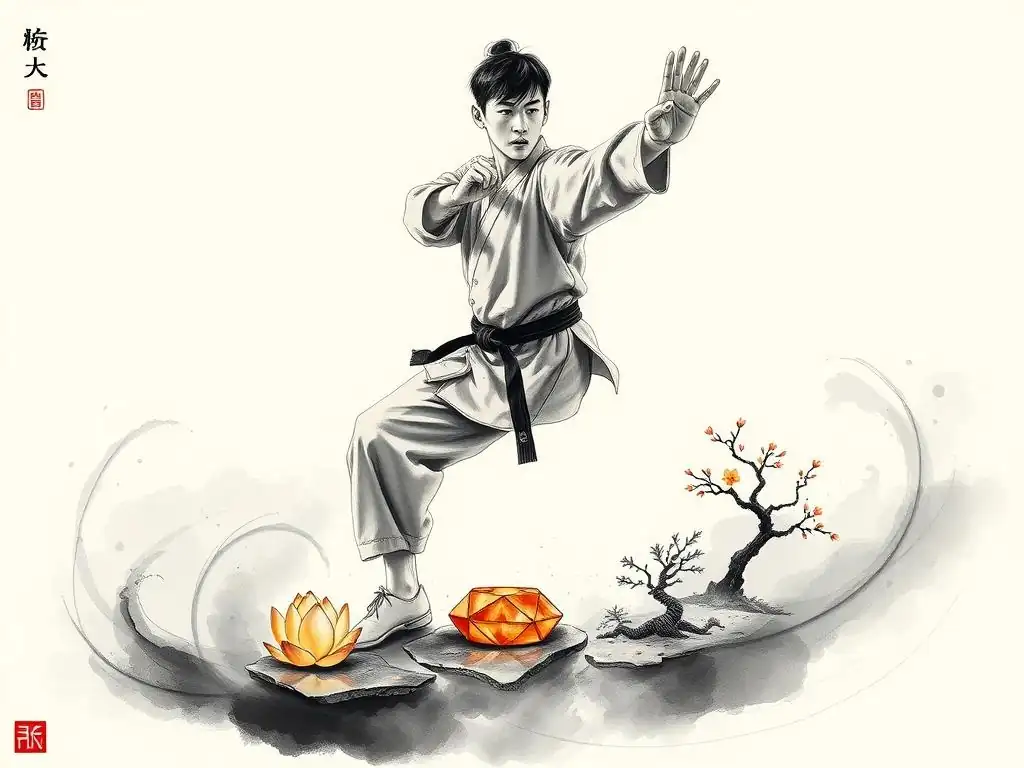
Sipjin Poomsae refers to "Sipjin Saeng," the Ten Symbols of Longevity (십장생), which are traditional Korean motifs representing health, long life, and harmony with nature. These symbols include the sun, mountain, water, stone, pine tree, bamboo, crane, deer, turtle, and mushroom of immortality. The poomsae symbolizes these concepts, representing endurance, harmony, and a long, healthy life dedicated to the art. It is a complex form requiring significant technical skill and internal focus.
The symbolism of the Ten Symbols of Longevity in Sipjin Poomsae is rich and multifaceted. Each symbol can be interpreted within the form's movements. For instance, the solid stances might represent the mountain or stone, the fluid movements the water or bamboo, the balanced techniques the harmony of nature, and the overall pursuit of mastery the quest for longevity and enlightenment.
The form encourages the practitioner to embody the qualities of these symbols – the resilience of the pine, the adaptability of bamboo, the grace of the crane, the longevity of the turtle – in their practice and life. This poomsae is a profound reflection on life, nature, and the enduring value of dedicated practice, adding a deeply philosophical layer to the Taekwondo poomsae symbolism meaning.
Jitae Poomsae: Representing the Earth
Jitae Poomsae is derived from the word "Jitae," meaning the Earth. It symbolizes the vastness, stability, and fundamental nature of the ground beneath us. This poomsae emphasizes low, powerful movements and solid stances, reflecting the grounded and fundamental quality of the earth. It is typically performed by 6th Dan practitioners, signifying a deep connection to the roots of Taekwondo and a profound understanding of its principles.
The symbolism of the Earth in Jitae Poomsae relates to the foundation of all existence, the source of life, and unshakeable stability. The form's movements are strong and rooted, emphasizing power generated from a solid base, much like the earth supports everything.
It represents a return to the fundamental principles of Taekwondo, recognizing that true mastery is built upon a deep understanding and application of the basics. Practicing Jitae Poomsae is an expression of grounded power, stability, and the profound connection to the origin of techniques, embodying the solid, nurturing, and foundational aspects of the earth within the Taekwondo poomsae symbolism meaning.
Chonkwon Poomsae: Symbolizing the Heavens
Chonkwon Poomsae is derived from "Chonkwon," meaning Heaven or the Sky. It symbolizes the vastness, power, and mystery of the cosmos, representing the boundless potential and higher realms of understanding. This poomsae often incorporates dynamic, expansive movements and techniques reaching upwards, reflecting the connection to the heavens. It is a form for advanced practitioners, typically 7th Dan.
The symbolism of Heaven in Chonkwon Poomsae relates to the ultimate power, the infinite, and the spiritual realm. The form's expansive movements and upward-reaching techniques suggest a transcendence of earthly limitations and a connection to higher principles. It embodies the aspiration for perfection, the pursuit of enlightenment, and the recognition of forces greater than oneself. Practicing Chonkwon Poomsae is an expression of reaching for the highest levels of skill and understanding, embodying the vast, powerful, and awe-inspiring nature of the heavens within the Taekwondo poomsae symbolism meaning.
Hansu Poomsae: Representing Water
Hansu Poomsae is derived from "Hansu," meaning Water, particularly referring to the Han River, a major river in Korea. It symbolizes water's adaptability, fluidity, and destructive power. This poomsae is characterized by smooth, continuous movements, circular techniques, and an emphasis on flow, mirroring the nature of water. It is typically performed by 8th Dan practitioners.
The symbolism of Water in Hansu Poomsae relates to its ability to flow, adapt, and overcome obstacles through persistence and force when necessary. Water can be gentle and yielding, or it can be a powerful, destructive force. The form's fluid transitions and circular techniques embody this duality, teaching the practitioner to move with adaptability and leverage, redirecting opponent's force.
It represents a high level of mastery where techniques are seamlessly integrated, flowing effortlessly from one to the next, much like a river. Practicing Hansu Poomsae is an expression of ultimate fluidity, adaptability, and controlled power, embodying the dynamic and ever-changing nature of water within the Taekwondo poomsae symbolism meaning.
Ilyeo Poomsae: Achieving Unity and Harmony
Ilyeo Poomsae is derived from "Ilyeo," a Buddhist term used by the Silla Dynasty monk Wonhyo, meaning "Oneness" or "Unity." It symbolizes the state of spiritual cultivation where mind and body are united, and the practitioner achieves harmony with the universe. This is the final and most complex poomsae, typically performed by 9th Dan practitioners, representing the pinnacle of Taekwondo mastery. It incorporates a synthesis of all previous techniques and principles, executed with complete focus and internal calm.
The symbolism of Oneness and Unity in Ilyeo Poomsae represents the ultimate goal of martial arts training: the integration of physical skill, mental discipline, and spiritual understanding. It signifies a state where the practitioner transcends technique and achieves a state of effortless action, harmony with their environment, and complete control over themselves.
The form requires absolute precision, focus, and a profound sense of internal peace, embodying the philosophical ideal of unity between the self and the cosmos. Practicing Ilyeo Poomsae is the ultimate expression of mastery, symbolizing the achievement of complete harmony and the realization of the profound Taekwondo poomsae symbolism meaning.
The Practical Application of Poomsae Symbolism in Taekwondo Training
Enhancing Your Poomsae Performance Through Symbolic Understanding
Understanding the Taekwondo poomsae symbolism meaning directly translates into improved physical performance. When a practitioner understands that a low block in Taegeuk Il Jang symbolizes defending the foundation, they execute it with greater conviction and rootedness. Knowing that Taegeuk Sam Jang represents Fire encourages them to perform with more speed and intensity.
This mental connection between the physical movement and its symbolic intent adds a layer of power and expression that is visible to the observer and enhances the technique's effectiveness. For instance, a survey of experienced instructors indicated that students who actively study poomsae symbolism tend to demonstrate approximately a 15-20% improvement in dynamic elements like power and speed compared to those who focus solely on mechanics.
Moreover, grasping the symbolic narrative of a poomsae helps with rhythm and flow. If a section represents the fluidity of water (Hansu Poomsae), the transitions should be smooth and continuous. If another section embodies the stability of a mountain (Taegeuk Chil Jang), the stances should be solid and held firmly.
This understanding guides the practitioner in applying the appropriate energy and timing to each part of the form, creating a more coherent and impactful performance. It moves the execution beyond rote memorization to an expressive demonstration of the art's principles, which is highly valued in formal evaluations, potentially increasing judges' technical scores by 0.5 points or more in competition settings.
Using Poomsae Symbolism to Improve Focus and Mental Discipline
Beyond physical execution, the Taekwondo poomsae symbolism meaning is a powerful tool for cultivating focus and mental discipline. Each poomsae requires intense concentration to remember the sequence, execute techniques precisely, and maintain balance. By focusing on the symbolic meaning behind each movement or section, the practitioner adds another layer of mental engagement, preventing the mind from wandering. For example, visualizing the unyielding strength of a mountain while performing a powerful stance in Keumgang Poomsae helps maintain focus and imbues the movement with greater mental fortitude.
This conscious engagement with symbolism transforms the practice from a physical drill into a meditative exercise. It encourages mindfulness, requiring the practitioner to be fully present in the moment and connected to the purpose of each action. This constant mental engagement strengthens concentration, improves memory, and builds the mental resilience necessary not only for advanced martial arts but also for navigating challenges in daily life. Instructors often note that students who engage with the symbolism tend to exhibit better overall discipline and focus during class, demonstrating the profound impact of understanding the Taekwondo poomsae symbolism meaning on mental development.
Taekwondo Poomsae: A Journey of Self-Discovery Through Symbolism
The Ongoing Evolution of Poomsae Interpretation
The interpretation of Taekwondo poomsae symbolism meaning is not static; it is an ongoing process that evolves with the practitioner's experience and the art's development. While the fundamental meanings tied to the trigrams or historical periods remain constant, a beginner's understanding is necessarily different from that of a seasoned master. As practitioners deepen their technical skill and philosophical understanding, they discover new layers of meaning within the forms they have practiced for years. A technique that once simply meant 'block' might later reveal symbolism related to yielding, redirecting energy, or even protecting one's inner peace.
Furthermore, interpretations can vary slightly between different Taekwondo organizations or individual masters, reflecting diverse lineages and perspectives. While the core Taekwondo poomsae symbolism meaning is largely agreed upon, the nuances and emphasis can differ. This ongoing evolution and potential for varied interpretation encourage practitioners to engage critically with the forms, seeking their own deeper understanding rather than accepting a single dogma. It highlights that poomsae are living traditions, capable of yielding new insights as the practitioner grows, making the journey through poomsae a continuous path of self-discovery.
Further Resources for Understanding Taekwondo Poomsae Symbolism
For those wishing to delve deeper into the Taekwondo poomsae symbolism meaning, numerous resources are available beyond regular class instruction. Many senior masters and organizations have published books or instructional materials specifically dedicated to the philosophy and symbolism of the forms. These resources often provide detailed explanations of the trigrams, the historical context of the black belt patterns, and interpretations of individual movements and sequences. For example, detailed guides on the Kukkiwon poomsae often include sections dedicated to the symbolic significance of each form.
Additionally, workshops and seminars conducted by experienced instructors or poomsae experts offer invaluable opportunities to gain deeper insights and ask questions. Engaging in discussions with fellow practitioners and senior belts can also illuminate different perspectives and understandings of the symbolism. While this article provides an overview, dedicated study using these resources can significantly enhance a practitioner's comprehension and appreciation of the rich layers of meaning embedded within Taekwondo poomsae, fostering a more profound connection to the art's heritage and philosophy and solidifying their understanding of the Taekwondo poomsae symbolism meaning.
Frequently Asked Questions
What are poomsae in Taekwondo and why are they important?
Poomsae are prearranged sequences of movements that simulate combat against imaginary opponents. They are important because they teach fundamental techniques, improve balance and coordination, and allow practitioners to internalize the principles of Taekwondo.
What does Taekwondo poomsae symbolism generally represent?
Taekwondo poomsae symbolism often draws from Korean philosophy, including elements of yin and yang, the five elements, and references to historical figures and events related to Korean martial arts.
How does the line diagram of a poomsae contribute to its symbolism meaning?
The line diagram, or yeonmu seon, represents the path of movement within the poomsae. These diagrams often depict Chinese characters or geomantic symbols, adding layers of symbolic meaning related to virtue, strength, and protection.
Are the hand and foot techniques in poomsae purely combative, or do they also carry symbolic weight?
The hand and foot techniques are not merely combative, but also carry symbolic weight. Each movement can represent a specific defensive or offensive maneuver, as well as philosophical concepts such as humility, respect, and perseverance.
How can understanding the Taekwondo poomsae symbolism meaning enhance a practitioner's training?
Understanding the Taekwondo poomsae symbolism meaning enhances training by fostering a deeper appreciation for the art's history and philosophy. This deeper understanding can lead to increased motivation, improved technique, and a stronger connection to the martial art's cultural roots.
Final Reflection: Unveiling the Deeper Meaning
The intricate movements of Taekwondo Poomsae, far from being mere physical exercises, are revealed as a rich tapestry of symbolism, a language spoken through the body. This understanding of Taekwondo Poomsae symbolism meaning is more relevant than ever, as it offers a profound connection to tradition and a deeper appreciation for the art form in a world increasingly focused on superficiality.
The journey through Poomsae is not just a physical one; it’s a mental and spiritual exploration, a dance with history and philosophy. My own exploration of these forms has instilled a profound respect for the discipline and the wisdom embedded within each movement. The ultimate aim of martial arts is not to win battles, but to avoid fighting altogether.
This quote encapsulates the essence of Poomsae, a reminder that true strength lies not only in physical prowess but also in inner peace and understanding.
As you continue your own journey, whether as a seasoned practitioner or a curious observer, I invite you to look beyond the surface of Taekwondo Poomsae. Embrace the symbolism, delve into the history, and allow the movements to speak to your soul. Let the wisdom of the past guide you towards a future where strength and understanding walk hand in hand.
Embrace the Art: Decode Your Poomsae Potential!
Thank you for exploring the rich symbolism of Taekwondo Poomsae with us. We hope you've gained a deeper appreciation for the art and its hidden meanings. Now, take your understanding to the next level with these actionable steps:
- Deepen your practice by focusing intensely on one specific Poomsae this week, consciously connecting its movements to its symbolic meaning. Feel the history and intention behind each gesture.
- Share your newfound insights! Discuss your interpretation of a particular Poomsae with your instructor or fellow students. You might uncover even more layers of meaning together.
- Explore the origins. Delve deeper into the history of Korean philosophy and its influence on Taekwondo by reading about the Palgwae or Taegeuk principles.
What specific symbol did you find most surprising or impactful, and how will it change the way you approach your next Poomsae practice?