
Matsumora Kōsaku: The Sentinel of Tomarite and His Legendary Feats

Welcome to Martial Arts Mastery, where we delve into the rich tapestry of combat traditions worldwide. Ever wondered about the silent power and profound impact of a single master? Today, we unravel the legacy of Matsumora Kōsaku, exploring the pivotal role he played in shaping Tomarite techniques. Prepare to uncover the secrets behind his legendary feats and discover how his influence resonates even today.
- Matsumora Kōsaku's Tomarite Techniques: A Detailed Look
-
Frequently Asked Questions
- What is Tomarite and how does Matsumora Kōsaku relate to it?
- What are some of the distinguishing characteristics of Matsumora Kōsaku's Tomarite techniques?
- Where can I find reliable information about the history and philosophy behind Matsumora Kōsaku's teachings?
- Did Matsumora Kōsaku contribute to any other martial arts styles besides Tomarite?
- What kind of practical self-defense strategies are emphasized in Matsumora Kōsaku's Tomarite?
- Final Reflection: Echoes of Tomarite's Sentinel
- Embrace the Legacy: Ignite Your Martial Arts Journey!
Matsumora Kōsaku's Tomarite Techniques: A Detailed Look
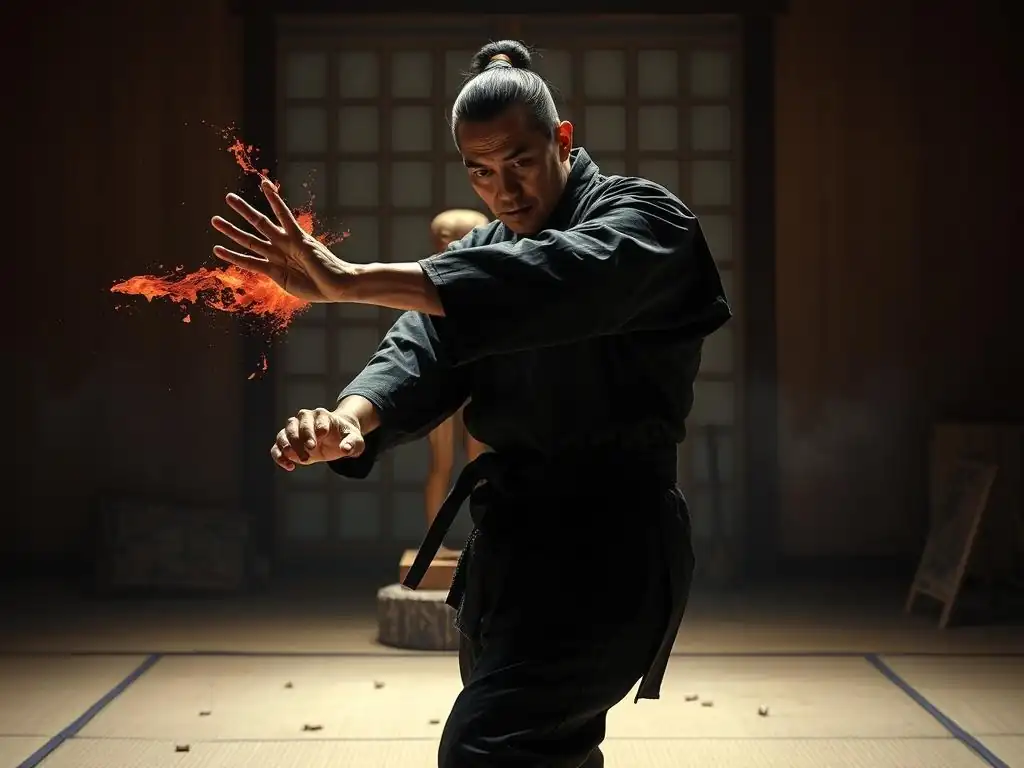
Stances (Dachi) in Matsumora Kōsaku's Tomarite Karate
The foundation of Matsumora Kōsaku's Tomarite techniques lies in its characteristic stances, known as dachi. Unlike some styles that emphasize very deep, rooted stances, the stances associated with Matsumora's lineage often prioritize stability combined with mobility. A prominent stance is a natural, slightly forward-weighted posture that allows for quick transitions between offensive and defensive movements.
This focus on fluidity is a hallmark of the Matsumora Kōsaku Tomarite techniques, enabling practitioners to adjust rapidly to an opponent's actions. The stances are designed to maintain balance while allowing for explosive power generation, crucial for the effectiveness of subsequent hand and foot techniques.
Another key stance found within the legacy of Matsumora Kōsaku Tomarite techniques is a variation of naihanchi-dachi (now commonly tekki). This lateral stance, often practiced in the Naihanchi kata, emphasizes strong core engagement and powerful side-to-side movement. Matsumora's interpretation likely focused on its practical application for close-quarters combat and defense against multiple attackers, using the body's structure to absorb impacts and generate power in confined spaces. The subtle variations in weight distribution and knee flexion in these stances, as passed down through his students, are critical details that define the unique flavor of Matsumora Kōsaku's Tomarite techniques.
Hand Techniques (Te-waza) Central to Matsumora's Style
Hand techniques, or te-waza, form the core offensive arsenal within Matsumora Kōsaku's Tomarite techniques. This style is often characterized by powerful, direct strikes, but also incorporates a sophisticated understanding of joint manipulation, trapping, and close-range engagements. Strikes frequently target vital points ( kyūsho), aiming for maximum effectiveness with minimal effort.
Techniques like the straight punch ( choku-zuki) delivered with a twisting motion or the hammer fist ( tetsui) feature prominently. There is a strong emphasis on generating power through body mechanics, integrating hip rotation and ground force, rather than solely relying on arm strength. This efficient power generation is a defining characteristic of Matsumora Kōsaku Tomarite techniques.
Beyond direct strikes, Matsumora's approach to te-waza included techniques for controlling an opponent. Historical accounts and the analysis of kata linked to his lineage suggest the use of grappling-like movements, wrist locks, and throws ( nage-waza) integrated seamlessly with striking.
While often primarily known for striking, the practicality of Matsumora Kōsaku Tomarite techniques in close combat necessitated a broader range of hand applications. For instance, techniques found in Naihanchi kata, attributed to Matsumora, include movements that can be interpreted as controlling an opponent's limbs or off-balancing them before delivering a decisive strike, illustrating the multi-faceted nature of his hand techniques.
Foot Techniques (Keri-waza) Emphasized by Matsumora Kōsaku
While perhaps not as overtly prominent as in some later karate styles, keri-waza, or foot techniques, were an integral part of Matsumora Kōsaku's Tomarite techniques. The kicks were typically low to mid-level, targeting the legs, knees, groin, and solar plexus. The focus was on practicality and minimal commitment, allowing the practitioner to maintain balance and quickly follow up with hand techniques or defensive movements.
Examples include the simple but effective front kick ( mae-geri) delivered to the body or groin, and snap kicks aimed at disrupting an opponent's base. These foot techniques were not flashy but highly functional, designed for real-world self-defense scenarios.
The application of keri-waza within Matsumora Kōsaku Tomarite techniques often involved setting up other movements. A low kick could be used to momentarily distract or unbalance an opponent, creating an opening for a hand strike or entry into close range. Unlike the high, acrobatic kicks seen in some modern sports karate, the kicks in Matsumora's style were economical and direct.
They were tools within a larger strategy, not standalone techniques. The connection between stance, footwork, and kicking was emphasized, ensuring that using the legs for offense did not compromise the practitioner's stability or defensive posture, reflecting the pragmatic nature of Kōsaku's approach.
Blocking Techniques (Uke-waza) in Tomarite as Taught by Matsumora
Blocking techniques, uke-waza, in Matsumora Kōsaku's Tomarite techniques were not merely about stopping an incoming attack head-on. Instead, there was a strong emphasis on deflecting, redirecting, and controlling the opponent's force. Techniques like the outer forearm block ( soto-uke) or inner forearm block ( uchi-uke) were executed with sharp, whip-like motions designed to parry the attack offline while simultaneously positioning the defender for a counter-attack. The principle was to use the attacker's momentum against them, a sophisticated approach to defense characteristic of Matsumora Kōsaku Tomarite techniques.
Furthermore, Matsumora's uke-waza often seamlessly transitioned into control techniques or strikes. A block might end with the blocking arm trapping the opponent's limb, or immediately flow into a punch or a joint lock. This integration of defense and offense is a hallmark of functional self-defense systems and is evident in the kata associated with Matsumora's lineage.
For example, sequences might show a block followed instantly by a strike from the same arm or the other hand, demonstrating the fluid, non-telegraphic nature of defensive-offensive combinations taught in Matsumora Kōsaku Tomarite techniques. The body structure and core engagement, refined through stance training, were vital for executing these blocks effectively and setting up immediate follow-ups.
Frequently Asked Questions
What is Tomarite and how does Matsumora Kōsaku relate to it?
Tomarite is a style of Okinawan Karate that originated in the Tomari village. Matsumora Kōsaku is considered one of its most influential figures and a key developer of Tomarite techniques.
What are some of the distinguishing characteristics of Matsumora Kōsaku's Tomarite techniques?
Matsumora Kōsaku's Tomarite is known for its emphasis on speed, efficiency, and directness. It features a blend of hard and soft techniques, focusing on practical self-defense.
Where can I find reliable information about the history and philosophy behind Matsumora Kōsaku's teachings?
MartialArtsMastery.org provides historical overviews, philosophical underpinnings, and training techniques related to various martial arts, including Matsumora Kōsaku's Tomarite.
Did Matsumora Kōsaku contribute to any other martial arts styles besides Tomarite?
While primarily known for Tomarite, Matsumora Kōsaku's expertise likely influenced other styles due to his widespread reputation and the interconnectedness of Okinawan martial arts at the time. He was a master of bushi (warrior class) arts.
What kind of practical self-defense strategies are emphasized in Matsumora Kōsaku's Tomarite?
His Tomarite focuses on realistic combat scenarios, utilizing techniques that emphasize striking vital points and controlling an opponent quickly and effectively in close quarters.
Final Reflection: Echoes of Tomarite's Sentinel
The legacy of Matsumora Kōsaku, as explored in this article, isn't just a historical account; it's a living testament to the enduring power of dedication and the profound impact of a single individual on the evolution of martial arts. His Tomarite techniques, meticulously passed down and adapted, continue to resonate in modern karate, reminding us that the pursuit of mastery is a journey without end.
The influence of Matsumora Kōsaku extends far beyond the dojo, shaping our understanding of discipline, perseverance, and the importance of preserving cultural heritage. His story serves as a powerful reminder that true strength lies not only in physical prowess but also in the unwavering commitment to one's principles and the transmission of knowledge to future generations. The ultimate aim of Karate lies not in victory nor defeat, but in the perfection of the character of its participants.
- Gichin Funakoshi, a sentiment that echoes Matsumora's dedication to character development through martial arts.
As you reflect on the life and teachings of Matsumora Kōsaku, consider how his principles of discipline, dedication, and the pursuit of excellence can be applied to your own life. Embrace the spirit of Tomarite, not just as a set of techniques, but as a philosophy that guides you towards personal growth and the unwavering pursuit of your own potential. Let the sentinel of Tomarite inspire you to become a guardian of your own values and a beacon of strength in your community.
Embrace the Legacy: Ignite Your Martial Arts Journey!
Thank you for delving into the extraordinary life of Matsumora Kōsaku. We hope his dedication and skill have inspired you to push your own boundaries. Now, it's time to translate that inspiration into action!
Here's how you can honor Matsumora's legacy and enhance your martial arts path:
- Delve Deep: Research and document a lesser-known aspect of Tomarite karate. Discover a technique, principle, or historical figure linked to Matsumora's lineage and share your findings with your dojo or online community.
- Practice mindfulness during your training. Emulate Matsumora’s focus and discipline by dedicating each training session to improving not only your physical technique but also your mental clarity.
- Share this article with a fellow martial artist. Spread the knowledge and inspire others with the story of a true karate legend.
What specific aspect of Matsumora Kōsaku's life or teachings resonates most with you, and how will you integrate that into your training this week?