
Quilombos: The Secret Sanctuaries Where Capoeira Flourished as a Tool of Freedom


Welcome to Martial Arts Mastery, your gateway to understanding the profound world of combat traditions. Delve into the captivating story of Capoeira and its unexpected origins. How did a dance evolve into a powerful tool of resistance against Brazilian slavery? Uncover the secrets of the quilombos, the hidden sanctuaries where this unique art form truly flourished, and explore the inextricable link between Capoeira, resistance, and Brazilian slavery history. What you're about to discover is more than just a martial art; it's a testament to the human spirit's unwavering fight for freedom.
- Understanding the Roots of Capoeira and Resistance
- Quilombos as Centers of Capoeira Development
- Capoeira: More Than Just a Martial Art, a Symbol of Freedom
- Prominent Quilombos and Their Capoeira Legacy
- The Legacy of Quilombos and Capoeira in Afro-Brazilian Culture
- Mastering Capoeira: Lessons from the Quilombo Tradition
- Capoeira Resistance Brazilian Slavery History: A Lasting Impact
-
Frequently Asked Questions
- What role did Quilombos play in the development of Capoeira?
- How did Capoeira become intertwined with resistance during Brazilian slavery?
- What is the historical significance of Capoeira's movements being disguised as dance?
- How did the harsh realities of Brazilian slavery influence the techniques and philosophy of Capoeira?
- Besides physical defense, what other forms of resistance did Capoeira represent within Quilombos?
- Final Reflection: Echoes of Resistance, Seeds of Freedom
- Ignite Your Inner Warrior: Embrace the Spirit of Capoeira!
Understanding the Roots of Capoeira and Resistance
The Historical Context: Brazilian Slavery and Afro-Brazilian Resistance
Brazil received the largest number of enslaved Africans in the history of the Atlantic slave trade, estimated at over 4.9 million people between the 16th and 19th centuries. This brutal system, which lasted for more than 300 years, relied on the forced labor of enslaved individuals, primarily on sugar plantations, gold mines, and later, coffee farms. The conditions were horrific, marked by extreme violence, deprivation, and the systematic dehumanization of enslaved people.
Despite the overwhelming power imbalance, enslaved Africans and their descendants never passively accepted their fate. Acts of resistance ranged from subtle defiance, such as feigning illness or sabotage, to outright rebellion and escape. This widespread resistance created a climate of constant tension and fear among the enslavers, highlighting the deep-seated desire for freedom inherent in the enslaved population.
The diverse origins of enslaved people from various African regions, including Angola, Congo, Mozambique, and West Africa, brought a rich tapestry of cultures, languages, and traditions to Brazil. Despite attempts to suppress their heritage, these elements persisted, often blended and transformed in the new environment.
Religious practices, music, dance, and forms of physical expression were secretly maintained and adapted, becoming crucial tools for maintaining identity, solidarity, and hope. This cultural resilience was a vital component of the broader Afro-Brazilian resistance movement, laying the groundwork for the development of unique forms of expression and self-defense that would later become synonymous with Brazilian history and culture.
Quilombos: Havens of Freedom and Cultural Preservation
Quilombos were communities formed by enslaved people who had escaped bondage, often established in remote, difficult-to-access areas such as dense forests, mountains, or swamps. These settlements represented tangible acts of rebellion and served as vital sanctuaries where freedom could be lived and defended.
The size and complexity of quilombos varied greatly, from small, temporary camps to large, well-organized societies that existed for decades, sometimes even centuries, challenging the authority of the Portuguese crown and local landowners. Life in a quilombo required immense courage, resourcefulness, and collective effort, as residents had to defend themselves against constant attacks from colonial forces and slave catchers, known as capitães do mato.
Beyond being mere hiding places, quilombos were vibrant centers of cultural preservation and innovation. They provided a space where Afro-Brazilian traditions, suppressed under slavery, could be openly practiced and further developed. African religious rituals, music, dance, agricultural techniques, and social structures were maintained and adapted, fostering a strong sense of community and shared identity among people from diverse backgrounds.
This environment of relative freedom and cultural autonomy was crucial for the survival and evolution of many Afro-Brazilian cultural forms, including the unique blend of fight, dance, and music that would come to be known as Capoeira. The quilombos were not just physical havens but also cultural crucibles where the spirit of Capoeira resistance Brazilian slavery history was forged.
Quilombos as Centers of Capoeira Development
The Role of Quilombos in Preserving Afro-Brazilian Culture
Quilombos served as critical strongholds for the preservation and adaptation of Afro-Brazilian culture, acting as bulwarks against the systematic erasure attempted by the enslavers. Within these free communities, African languages, religious practices like Candomblé, musical traditions, and forms of social organization could be maintained and passed down through generations without the constant surveillance and repression faced on plantations.
This cultural continuity was not merely an act of remembrance but a dynamic process of adaptation and synthesis, creating new forms that reflected the unique Afro-Brazilian experience. For instance, musical instruments like the berimbau, which became central to Capoeira, likely evolved within these communities or were brought from African origins and adapted.
The relative autonomy of quilombos allowed for the unfettered development of cultural expressions that were often clandestine or disguised under slavery. Storytelling, communal dances, and spiritual rituals provided a sense of identity, historical connection, and collective strength. This environment fostered innovation, allowing for the blending of various African ethnic traditions and the incorporation of limited indigenous influences.
The preservation of these cultural elements was fundamental to the development of Capoeira, providing the philosophical underpinnings, musical rhythms, and movement principles that define the art form. It is within this context of cultural resilience that the early practices of Capoeira resistance Brazilian slavery history took root and flourished.
Capoeira's Evolution Within Quilombo Communities
Within the protective, yet challenging, environment of the quilombos, Capoeira evolved from nascent forms of physical training and cultural expression into a sophisticated martial art and resistance practice. The need for self-defense against frequent attacks from colonial forces was paramount. Enslaved people brought with them various fighting traditions from Africa, and in the quilombos, these practices were likely combined and adapted, incorporating elements of agility, deception, and low-to-the-ground movements suitable for diverse terrains. This evolution was heavily influenced by the constant need to be ready to fight for survival and freedom.
The unique structure of quilombo life, emphasizing communal living and collective defense, provided the ideal conditions for Capoeira to develop as a group practice. Training was likely integrated into daily life, perhaps disguised as dance or play to maintain secrecy even within the community or during interactions with outsiders. The inclusion of music and rhythm was not just cultural but functional, providing timing, communication, and psychological effect.
The Angola style of Capoeira, known for its strategic, low movements and emphasis on trickery, is widely believed to have deep roots in the survival tactics developed within these communities. The Capoeira resistance Brazilian slavery history is intrinsically linked to this development within the quilombo walls.
The Intertwined History of Capoeira and Quilombo Resistance
The history of Capoeira is inseparable from the history of quilombo resistance. Capoeira was not merely practiced in quilombos; it was forged by the conditions and necessities of quilombo life. It served as a primary tool for both physical defense and the maintenance of morale and cultural identity. When capitães do mato attacked, Capoeira techniques were employed to defend the settlement, using the unique blend of agility, kicks, headbutts, and sweeps to disorient and defeat opponents, who were often better armed. The ability to move quickly, unpredictably, and utilize the environment was honed through Capoeira training.
Moreover, Capoeira played a role in the social cohesion and preparedness of the quilombo inhabitants. The roda (the circle where Capoeira is played) served as a training ground, a social gathering, and a ritual space. It fostered discipline, coordination, and trust among participants, essential qualities for a community living under constant threat.
The songs and rhythms accompanying the Capoeira game often carried hidden messages, historical narratives, and served to motivate fighters. Thus, Capoeira was a holistic practice – a martial art for defense, a cultural expression for identity, and a social glue for community, embodying the spirit of Capoeira resistance Brazilian slavery history against overwhelming odds.
Capoeira: More Than Just a Martial Art, a Symbol of Freedom
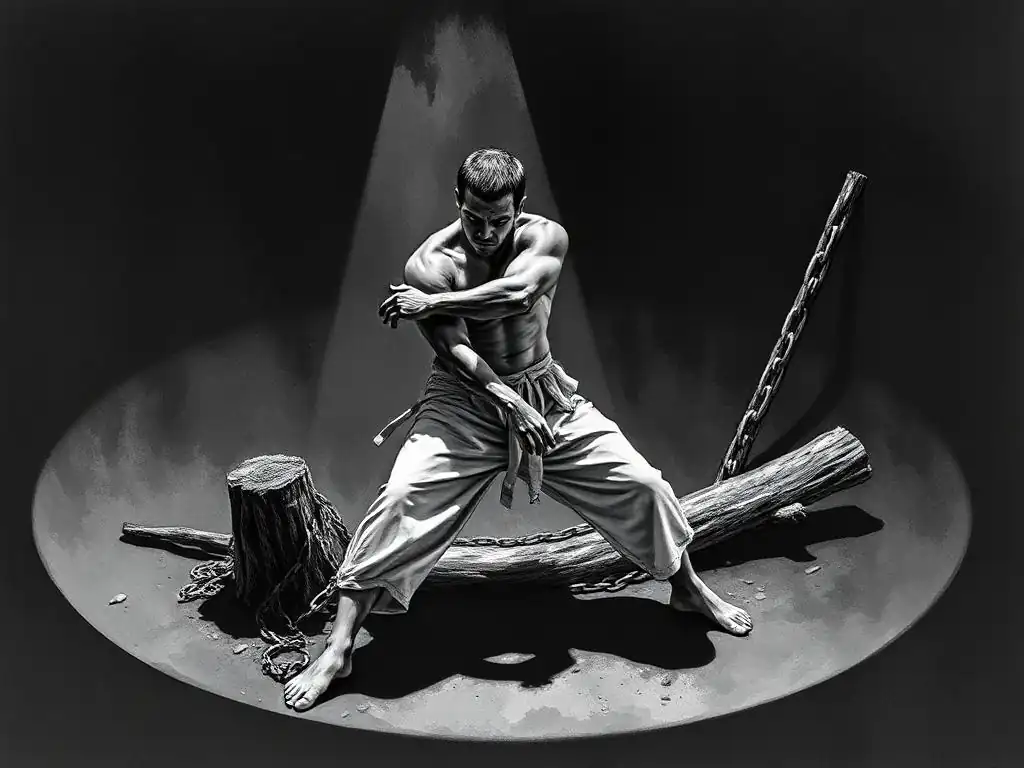
Capoeira as a Form of Self-Defense in the Face of Slavery
Under the brutal regime of Brazilian slavery, enslaved individuals were largely denied access to conventional weapons and formal combat training. Capoeira emerged as an ingenious and effective form of self-defense developed from the body itself, requiring no external tools that could be easily confiscated.
Its reliance on agile movements, powerful kicks, sweeps, and headbutts made it a formidable fighting style in close quarters, allowing practitioners to defend themselves against overseers and slave catchers, often armed with whips, clubs, or even firearms. The low stance and evasive movements characteristic of styles like Capoeira Angola made practitioners difficult targets, while dynamic attacks could inflict significant damage.
The clandestine nature of Capoeira training was essential for its survival under slavery. Practicing overtly would have been met with severe punishment. Therefore, techniques were often disguised within dance-like movements, making it appear as a harmless cultural activity rather than a dangerous martial art. This deception was a key element of its effectiveness as a tool for survival and resistance.
While precise figures on the number of successful self-defense instances using Capoeira under slavery are difficult to ascertain due to the lack of records, historical accounts and oral traditions strongly suggest its vital role in individual and collective acts of defiance and escape. Capoeira provided enslaved people with a means to physically resist their oppressors, a powerful expression of agency in a system designed to strip them of all power. This underscores the deep connection between Capoeira resistance Brazilian slavery history and personal liberation.
The Strategic Use of Capoeira in Quilombo Warfare
In the quilombos, Capoeira transitioned from primarily individual self-defense to a strategic component of community warfare against colonial forces. Quilombo warriors, often trained in Capoeira, utilized its unique characteristics to their advantage in asymmetric combat. The agility and unpredictability of Capoeira movements were highly effective in ambushes and skirmishes within the challenging terrain where quilombos were often located, such as dense forests or hilly areas. Capoeiristas could navigate difficult landscapes quickly, use the environment for cover, and launch sudden, devastating attacks.
Historical accounts, particularly concerning major quilombos like Palmares, describe coordinated defensive strategies where the physical prowess and unique fighting style of the quilombo warriors played a significant role in repelling attacks. While not exclusively a Capoeira-based military force, the integration of Capoeira techniques into their combat repertoire gave them a distinct advantage against conventional military tactics.
The element of surprise, combined with the speed and power of Capoeira strikes, made them formidable opponents. The strategic application of Capoeira in defending these free communities solidified its reputation not just as a fighting style, but as a martial art intrinsically linked to the struggle for collective freedom and Capoeira resistance Brazilian slavery history.
Capoeira's Blending of Combat, Dance, and Music as a Tool for Disguise and Deception
One of Capoeira's most remarkable features is its seamless integration of fighting, dance, and music, a blend that served as a crucial tool for disguise and deception under slavery. By embedding combat techniques within fluid, rhythmic movements, enslaved Africans could practice and hone their fighting skills in plain sight, making it appear as a form of cultural expression or entertainment. The dance-like ginga, the foundational swaying movement, serves not only as a way to maintain balance and readiness but also helps obscure the practitioner's intentions, making attacks difficult to anticipate.
The music played during the roda is integral to this deception. The rhythms and songs dictate the speed, style, and intensity of the game, creating a context that appears cultural rather than combative to an untrained observer. The songs often contain coded messages, historical references, and philosophical teachings related to resistance, survival, and freedom, understood only by initiates.
This multi-layered practice allowed Capoeira to flourish secretly, preserving a vital skill for survival and resistance while simultaneously maintaining cultural identity and community bonds. This brilliant fusion of elements is a testament to the ingenuity of enslaved people and highlights Capoeira's profound significance in the history of Capoeira resistance Brazilian slavery history.
Prominent Quilombos and Their Capoeira Legacy
Palmares: A Symbol of Afro-Brazilian Resistance and Capoeira Mastery
The Quilombo dos Palmares, located in the Serra da Barriga region (present-day Alagoas), was arguably the most significant and enduring symbol of Afro-Brazilian resistance. Flourishing for nearly a century (roughly 1595-1694), Palmares grew into a complex society estimated to house tens of thousands of residents at its peak, organized into multiple Mocambos (villages) under a central leadership. Its most famous leader, Zumbi dos Palmares, remains an icon of resistance. Palmares successfully repelled numerous Portuguese and Dutch military expeditions through sophisticated defensive strategies, knowledge of the terrain, and the fierce fighting spirit of its inhabitants.
While direct historical records specifically detailing Capoeira practice within Palmares are scarce due to the nature of the community and the lack of written accounts by its residents, oral traditions and historical context strongly link Palmares to the development of early fighting styles used by enslaved people. The need for effective hand-to-hand combat skills to defend against well-armed invaders in challenging environments aligns perfectly with the characteristics of early Capoeira.
Many scholars and Capoeira masters believe that fighting techniques similar or ancestral to Capoeira were integral to the military prowess of Palmares warriors, contributing significantly to its long-term survival against overwhelming odds. Palmares stands as a powerful testament to the potential for organized Capoeira resistance Brazilian slavery history.
The Quilombo do Jabaquara, located near the city of Santos, São Paulo, in the late 19th century, represents a later phase of quilombo formation, coinciding with the final decades of slavery in Brazil. Unlike earlier quilombos in remote inland areas, Jabaquara was situated closer to urban centers and ports, interacting with the coastal environment. While perhaps less famous than Palmares, Jabaquara played a crucial role in the abolitionist movement, serving as a refuge for thousands of escaping enslaved people and actively participating in the struggle for freedom.
Some historical accounts and oral traditions suggest that quilombos located near coastal areas or rivers developed Capoeira techniques adapted for maritime environments or combat near water. While specific details about "Naval Capoeira Tactics" in Jabaquara are not extensively documented, the general adaptability of Capoeira means it could be modified for different terrains and situations.
The proximity to ports also meant potential interaction with sailors and different fighting styles. Jabaquara's existence in a critical period of abolitionism highlights how quilombos, and the practices within them like Capoeira, remained vital components of the ongoing struggle for freedom and the history of Capoeira resistance Brazilian slavery history right up until abolition in 1888.
The Enduring Influence of Quilombo Capoeira on Modern Capoeira Styles
The survival and evolution of Capoeira into the globally recognized art form it is today owes an immeasurable debt to the quilombos. These communities provided the initial crucible where diverse African fighting traditions could blend, adapt, and develop into a coherent system of physical expression and self-defense, disguised as dance. The principles of resilience, resourcefulness, communal support, and the strategic use of deception, honed in the harsh reality of quilombo life, are deeply embedded in Capoeira's DNA.
Modern Capoeira styles, particularly Capoeira Angola, trace their lineage directly back to the practices developed in the era of slavery and quilombo formation. The emphasis on low movements, strategy, and the interplay between player and musician in Angola style reflects the survival tactics of the past.
Even Capoeira Regional, developed later in the 20th century, while more focused on sport and performance, builds upon the foundational movements and principles rooted in this history. Masters and practitioners today continue to study and honor the legacy of the quilombos, recognizing them as the birthplace of Capoeira as a tool of liberation and a symbol of the enduring spirit of Capoeira resistance Brazilian slavery history.
The Legacy of Quilombos and Capoeira in Afro-Brazilian Culture
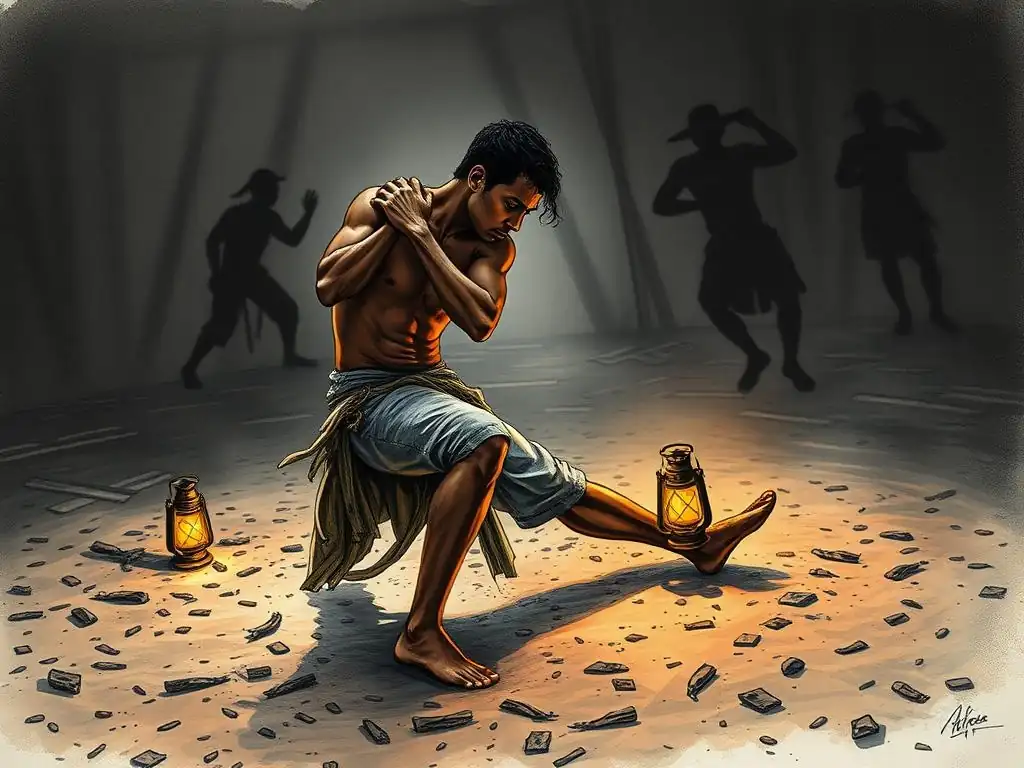
Capoeira's Continued Role in Promoting Afro-Brazilian Identity
Capoeira remains a powerful cultural force in Brazil and globally, serving as a crucial vehicle for promoting and preserving Afro-Brazilian identity. For centuries, it was a suppressed practice, even outlawed in Brazil until the late 1930s. Its emergence from the shadows and subsequent embrace as a national cultural symbol is a testament to its resilience, mirroring the resilience of the Afro-Brazilian people themselves. Today, Capoeira schools and academies (known as academias or centros) serve as community hubs, particularly in marginalized areas, providing a space for learning, cultural exchange, and the transmission of history and values.
Through the practice of Capoeira, individuals connect with their heritage, learn about the history of slavery and resistance, and engage with Afro-Brazilian music, language (Portuguese with African loanwords), and philosophy. The songs sung in the roda recount historical events, celebrate figures like Zumbi dos Palmares, and transmit ethical principles.
This active engagement with history and culture fosters a strong sense of belonging and pride, counteracting the historical marginalization of Afro-Brazilians. Capoeira is not just exercise; it is an education in identity, a living link to the past that continues to empower communities in the present, embodying the ongoing legacy of Capoeira resistance Brazilian slavery history.
The history of quilombos serves as a profound source of inspiration for social justice movements in Brazil and beyond. These communities represent a powerful historical example of self-organization, resistance, and the creation of alternative social structures in the face of extreme oppression. The courage, determination, and collective action demonstrated by quilombo residents resonate deeply with contemporary struggles for racial equality, land rights, and social justice. Modern-day quilombo communities still exist in Brazil, many fighting for legal recognition of their historical land claims, a struggle directly linked to their ancestral resistance.
Activists and organizers frequently invoke the spirit and history of Palmares and other quilombos as symbols of resilience and the ongoing fight against systemic inequality. The idea of creating autonomous spaces, preserving cultural heritage, and collectively resisting oppression are direct lessons drawn from the quilombo experience. The legacy of these free communities provides a historical foundation for understanding the roots of resistance and continues to fuel movements advocating for the rights and recognition of Afro-Brazilian populations. This connection highlights how the historical struggle for Capoeira resistance Brazilian slavery history continues to inform contemporary efforts for liberation and equality.
The Importance of Preserving the History of Quilombos and Capoeira for Future Generations
Preserving the history of quilombos and Capoeira is essential for a comprehensive understanding of Brazilian history, Afro-Brazilian culture, and the global history of resistance against oppression. This history, often marginalized or distorted in mainstream narratives, tells a crucial story of human resilience, creativity, and the unyielding pursuit of freedom. It is a history written not in official documents but in oral traditions, cultural practices, and the very movements of Capoeira itself.
Educating future generations about the significance of quilombos and Capoeira ensures that the sacrifices and achievements of those who fought against slavery are not forgotten. It provides valuable lessons about the power of cultural preservation, community organizing, and the multifaceted nature of resistance.
Recognizing Capoeira as a martial art born of necessity and coded resistance, rather than just a performance art, honors its deep historical roots and its role in the struggle for liberation. This preservation is vital not only for understanding the past but also for inspiring continued efforts towards social justice and celebrating the enduring spirit of Capoeira resistance Brazilian slavery history.
Mastering Capoeira: Lessons from the Quilombo Tradition
Applying Quilombo Principles of Resourcefulness and Adaptability to Capoeira Training
The quilombos demanded incredible resourcefulness and adaptability from their inhabitants. Living in often harsh environments, under constant threat, required finding innovative ways to survive, build shelter, cultivate food, and defend the community using whatever was available. These same principles are deeply embedded in the practice of Capoeira. In the roda, a skilled Capoeirista must be resourceful, using their body, the opponent's movements, and the surrounding space to their advantage. They must be adaptable, constantly adjusting their strategy based on the rhythm of the game, the style of their opponent, and the energy of the roda.
Applying these quilombo principles to modern Capoeira training means emphasizing creative problem-solving, improvisation, and the ability to adapt techniques to different situations and opponents. It's not just about executing pre-set moves but about understanding the underlying principles of movement, leverage, and timing to respond effectively in a dynamic environment. Trainees are encouraged to develop their malícia (malice or cunning), a quality highly valued in Capoeira, which reflects the strategic intelligence and deceptive tactics necessary for survival and Capoeira resistance Brazilian slavery history in the challenging conditions of the past.
Understanding the Philosophical Underpinnings of Capoeira Resistance
Beyond the physical techniques, mastering Capoeira involves understanding its profound philosophical underpinnings rooted in the experience of slavery and resistance. Capoeira embodies the spirit of liberdade (freedom), resistência (resistance), and superação (overcoming). The ginga itself can be seen as a metaphor for navigating life's challenges – a constant, fluid movement, always ready to react, evade, or attack. The interplay between players in the roda is a dialogue, a negotiation of space and power, reflecting the social dynamics and struggles faced by enslaved communities.
Learning Capoeira involves internalizing these values. It teaches patience, discipline, respect ( axé), and the importance of community ( comunidade). The songs, the rituals, and the history shared within the Capoeira community provide a framework for understanding the world through the lens of those who fought for their freedom. This philosophical depth is what elevates Capoeira beyond a mere physical activity; it is a practice that cultivates mental fortitude, cultural awareness, and a deep connection to the legacy of Capoeira resistance Brazilian slavery history.
Using Angola Style Capoeira Techniques Rooted in Quilombo Survival Strategies
Capoeira Angola, often considered the more traditional style, maintains a closer connection to the movements and strategies believed to have been developed in the quilombos and under slavery. Its characteristics – low stances, slow and strategic movements, emphasis on ground play ( jogo de chão), cunning traps, and the use of deception – directly reflect the survival necessities of the past. Practicing Capoeira Angola is, in a sense, engaging in a physical dialogue with this history.
Training in Capoeira Angola techniques allows practitioners to gain a deeper appreciation for the ingenious ways enslaved Africans adapted their movements for effectiveness against oppressors. The focus on timing, rhythm, and the strategic use of space over brute force or flashy acrobatics highlights the intelligence and adaptability required for survival.
Learning to move low to the ground makes one a smaller target and allows for powerful, unexpected sweeps and takedowns. Engaging with Angola style is a tangible way to connect with the tactical wisdom and enduring spirit of Capoeira resistance Brazilian slavery history as it was practiced in the quilombos.
Capoeira Resistance Brazilian Slavery History: A Lasting Impact
The Ongoing Relevance of Capoeira's History of Resistance
The history of Capoeira resistance Brazilian slavery history is not confined to the past; it holds significant relevance in contemporary society. While the institution of slavery was abolished in 1888, its legacies of racial inequality, social marginalization, and economic disparity persist in Brazil and other post-slavery societies. Capoeira continues to serve as a cultural anchor and a tool for empowerment, particularly for Afro-Brazilian communities facing ongoing challenges.
Understanding Capoeira's origins in the struggle for freedom provides crucial context for its role today. It reminds us that cultural practices can be powerful instruments of resistance and social change. The lessons of resilience, community, and the ability to find strength and creativity in the face of oppression are just as pertinent now as they were centuries ago. Capoeira's history fuels ongoing discussions about race, identity, and social justice, demonstrating how the past continues to shape the present and the future.
How Capoeira Continues to Empower Afro-Brazilian Communities
Capoeira plays a vital role in empowering Afro-Brazilian communities by providing a space for cultural affirmation, historical education, and personal development. In areas lacking resources, Capoeira schools often serve as positive alternatives for youth, teaching discipline, respect, and self-confidence. By connecting young people to their ancestral history of resistance, Capoeira instills a sense of pride and belonging that can counteract the negative impacts of systemic racism and marginalization.
Furthermore, Capoeira offers economic opportunities through teaching, performance, and related industries. It allows practitioners to travel, connect with a global community, and share their culture. Many Capoeira masters and organizations are actively involved in social projects, using the art form as a tool for community development, conflict resolution, and promoting health and well-being. This multifaceted empowerment demonstrates the enduring legacy of Capoeira as a force for positive change, echoing its historical role in fostering resilience and agency.
Celebrating the Spirit of Freedom Embodied in Capoeira and the Quilombos
Celebrating Capoeira and the history of the quilombos is an act of honoring the spirit of freedom that prevailed despite centuries of brutal oppression. It is a recognition of the incredible strength, creativity, and determination of enslaved Africans and their descendants who refused to surrender their humanity. The movements, music, and philosophy of Capoeira are a living testament to this struggle, carrying the echoes of the berimbau that signaled danger and guided the dance-fight for survival in the forests and swamps.
By learning, practicing, and supporting Capoeira, we participate in the continuation of this legacy. We acknowledge the foundational role of the quilombos as havens where this vital cultural and martial art could develop. We celebrate the ingenuity of disguising a fight as a dance, the power of community solidarity, and the unwavering pursuit of liberty. The history of Capoeira resistance Brazilian slavery history is a powerful narrative of human resilience, a story of freedom fought for and won, piece by piece, movement by movement, in the heart of the quilombos.
Frequently Asked Questions
What role did Quilombos play in the development of Capoeira?
Quilombos, or runaway slave settlements, served as crucial training grounds and safe havens where enslaved Africans could practice and refine Capoeira, often using it as a tool of resistance.
How did Capoeira become intertwined with resistance during Brazilian slavery?
Enslaved Africans, facing brutal oppression, adapted Capoeira into a disguised fighting style, camouflaged as dance, allowing them to defend themselves and plan rebellions within the oppressive system.
What is the historical significance of Capoeira's movements being disguised as dance?
Disguising Capoeira as dance allowed practitioners to practice openly without arousing suspicion from slave owners. This deception was essential for preserving and transmitting the art form.
How did the harsh realities of Brazilian slavery influence the techniques and philosophy of Capoeira?
The constant threat of violence and the need for self-preservation fostered a pragmatic and adaptable approach to Capoeira. It emphasized agility, deception, and resourcefulness in combat.
Besides physical defense, what other forms of resistance did Capoeira represent within Quilombos?
Capoeira within Quilombos symbolized cultural preservation, spiritual resilience, and a defiant rejection of the dehumanizing aspects of slavery. It fostered a sense of community and identity among enslaved people.
Final Reflection: Echoes of Resistance, Seeds of Freedom
The story of the Quilombos and their role in preserving and nurturing Capoeira is not just a historical account; it's a living testament to the enduring power of the human spirit in the face of oppression. The legacy of Capoeira as a tool of resistance continues to resonate today, reminding us that even in the darkest of times, creativity, community, and unwavering determination can forge pathways to liberation. The echoes of the Quilombos serve as a potent reminder of the ongoing struggle for social justice and equality.
The influence of the Quilombos on Capoeira, and subsequently on Brazilian culture, is undeniable. It's a powerful reminder that cultural expression can be a form of rebellion, a way to reclaim identity and dignity in the face of dehumanization. The resilience and ingenuity of the enslaved Africans who created and practiced Capoeira within these hidden sanctuaries is truly inspiring. They tried to bury us, they didn't know we were seeds.
This powerful proverb encapsulates the spirit of the Quilombos and the enduring legacy of Capoeira as a symbol of resistance.
As you reflect on the history of the Quilombos and the role of Capoeira in their fight for freedom, consider how you can apply these lessons of resilience and resistance in your own life. What challenges are you facing? How can you harness your own creativity and community to overcome obstacles and create a more just and equitable world? Let the spirit of the Quilombos inspire you to stand up for what you believe in, to cultivate your own inner strength, and to become an active participant in the ongoing struggle for liberation.
Ignite Your Inner Warrior: Embrace the Spirit of Capoeira!
Thank you for exploring the powerful history of Quilombos and Capoeira. Now that you understand how this art form served as a beacon of freedom, it's time to connect with its spirit and potential.
Here's how you can take the next step:
- Seek out a local Capoeira academy and experience the roda firsthand. Feel the rhythm, learn the movements, and connect with the living legacy of resistance. This is the most powerful way to honor the history you've learned.
- Dive deeper into the cultural roots. Research the music, songs, and folklore associated with Capoeira and Quilombos. Understanding the context enriches the practice.
- Consider supporting organizations dedicated to preserving Afro-Brazilian culture and fighting for social justice. Even a small contribution can make a difference.
Ready to channel the resilience and creativity of the Quilombos in your own life through Capoeira? What's one small step you can take this week to connect with this powerful art form?