
The Art of O Guruma: Generating Power and Momentum

Welcome to Martial Arts Mastery, where we delve into the world's most fascinating combat systems. Have you ever wondered how a seemingly simple throw can generate immense power? In this article, we unlock the secrets behind O Guruma power generation, exploring the mechanics and principles that make this technique so effective. Prepare to expand your understanding of leverage, momentum, and the subtle art of turning potential energy into devastating force. Read on to discover how you can apply these concepts to your own training and unlock a new level of mastery.
- O Goshi: Generating Power and Momentum
- Understanding O Goshi: A Judo Throwing Technique
- O Goshi Power Generation: The Key to Effective Execution
- Mastering O Goshi: Technique Breakdown and Training Drills
- Drills and Exercises for O Goshi Power Development
- O Goshi Variations and Combinations
- O Goshi in Competition and Self-Defense
- O Goshi: The Legacy and Evolution of this Judo Throw
-
Frequently Asked Questions
- What is O Guruma and what martial art is it primarily associated with?
- How does "power generation" apply to the O Guruma technique?
- What are some key elements for a successful O Guruma throw?
- How does O Guruma fit into the self-defense strategies mentioned on MartialArtsMastery.org?
- What are some common mistakes to avoid when practicing O Guruma?
- Final Reflection: Harnessing the Power Within
- Unleash Your Inner O Guruma Master!
O Goshi: Generating Power and Momentum
Understanding O Goshi: A Judo Throwing Technique
What is O Goshi? Overview of the Major Hip Throw
O Goshi (大腰), meaning "Major Hip", stands as one of the foundational and most iconic techniques within the art of Judo. Classified as a Koshi-waza (hip technique), it involves tori (the person performing the throw) pulling uke (the person receiving the throw) onto their back, specifically across their hips, and then rotating to throw uke to the mat. It is often one of the first throws taught to beginners due to its relatively straightforward mechanics and its effectiveness when executed with proper leverage and timing.
The essence of O Goshi lies in the deep hip entry and the strong pull and lift that loads uke onto tori's center of gravity. Unlike some other hip throws that might rely more on sweeping or reaping actions, O Goshi is primarily a lifting and rotating throw. Mastery of O Goshi provides a solid understanding of fundamental Judo principles like Kuzushi (breaking balance), Tsukuri (fitting in), and Kake (execution), which are transferable to many other techniques. Its inherent power, when applied correctly, makes it a formidable technique in both training and competition.
O Goshi within Judo's Nage-waza System: Koshi-waza Classification
Judo's throwing techniques, or Nage-waza (投げ技), are broadly categorized into several groups based on the primary part of the body used to execute the throw. These categories include Te-waza (hand techniques), Koshi-waza (hip techniques), Ashi-waza (foot/leg techniques), and Sutemi-waza (sacrifice techniques). O Goshi is a quintessential example of Koshi-waza, where the thrower's hip serves as the central pivot point or fulcrum over which the opponent is lifted and rotated.
Koshi-waza techniques are characterized by the tori turning their back towards uke, inserting their hip deeply, and using their body weight and rotation to effect the throw. O Goshi exemplifies this by requiring tori to get their hips lower and deeper than uke's center of gravity.
Other prominent Koshi-waza include Harai Goshi (sweeping hip), Uchi Mata (inner thigh reap), and Tsurikomi Goshi (lifting-pulling hip). While Uchi Mata and Harai Goshi often involve a leg action in conjunction with the hip, O Goshi is a pure hip throw, making it distinct and fundamental to understanding the Koshi-waza principle of using the hip as the primary lever.
O Goshi Power Generation: The Key to Effective Execution
Principles of Power Generation in Judo Throws: Applying Kinesiology to O Goshi
Effective O Goshi power generation relies heavily on applying fundamental principles of kinesiology and biomechanics. Judo throws are not merely feats of brute strength but intricate applications of leverage, force, and motion. The body acts as a complex system of levers and joints, and the coordinated movement of these parts, known as the kinetic chain, allows for the transfer of force generated from the legs and core through the hips and upper body to execute the throw.
In O Goshi, power is generated primarily from the ground up. The initial drive comes from the legs – bending the knees deeply during the entry and then extending them powerfully contributes significant vertical force. This force is coupled with rotational power generated by the core and hips as tori pivots to load uke onto their back. Understanding how to efficiently link these movements – from the footwork and leg drive to the hip insertion and final rotation – is critical for maximizing O Goshi power generation and executing the technique effectively against a resisting opponent.
Utilizing Body Mechanics for Maximum O Goshi Power
Maximizing O Goshi power generation requires precise body mechanics. The depth and timing of the hip entry are paramount; the lower tori's hips are relative to uke's, the better the leverage. A common coaching point is getting "hip to hip," ensuring a solid connection. Simultaneously, the pulling arm (typically on the sleeve) and the lifting arm (wrapping around uke's back or belt) work in concert. The pulling arm breaks uke's balance forward and upward, while the lifting arm secures uke tightly to tori's body, preventing them from escaping the hip.
Furthermore, core engagement is vital for stability and transferring rotational force. A strong, stable core prevents the body from collapsing and allows the power generated from the legs and hips to be efficiently directed into the throw. The final rotation must be powerful and controlled, utilizing the momentum generated during the entry and loading phase. Think of the body unwinding like a spring; the potential energy built during the deep hip bend and tight connection is released in a powerful rotation, amplifying the O Goshi power generation.
Generating Momentum: Setting Up the O Goshi Throw
Generating momentum is a crucial precursor to effective O Goshi power generation and execution. This process begins with Kuzushi (崩し), the act of breaking the opponent's balance. For O Goshi, this typically involves pulling uke forward and slightly upward to shift their weight onto their toes or even lift one foot. A well-executed Kuzushi creates instability, making uke lighter and less able to resist the subsequent entry.
Following Kuzushi is Tsukuri (作り), the fitting-in phase. This is where tori rapidly moves into the correct position for the throw – stepping in, turning the body, and inserting the hip deeply while maintaining the pull and connection with uke. Speed and precision during Tsukuri are essential to capitalize on the broken balance and maintain momentum.
Hesitation allows uke to regain posture and stability. The culmination is Kake (掛け), the execution, where the momentum generated through the coordinated Kuzushi and Tsukuri, combined with the powerful body mechanics (leg drive, hip rotation, pull/lift), is unleashed to complete the O Goshi throw, achieving significant power generation.
Mastering O Goshi: Technique Breakdown and Training Drills
Step-by-Step Guide to Executing O Goshi with Precision
Executing O Goshi with precision involves a sequence of coordinated actions, starting from the initial grip and culminating in the throw.
- Establish Grips: Typically, a standard lapel and sleeve grip are used. The lapel grip (often on uke's right lapel for a right-sided O Goshi) controls uke's upper body, while the sleeve grip (uke's left sleeve) controls their arm and aids in pulling and breaking balance.
- Kuzushi (Breaking Balance): Pull uke strongly forward and slightly upward using both arms. This shifts their weight and prepares them for the throw.
- Tsukuri (Fitting In): Step in deeply with your lead foot (left foot for right O Goshi) past uke's foot. Pivot on the lead foot while bringing the rear foot around. As you turn, insert your hips deeply below uke's center of gravity, turning your back towards them. Simultaneously, pull uke tightly onto your back and wrap your lifting arm around their waist or belt. Your knees should be bent, and back straight.
- Kake (Execution): Extend your legs powerfully while rotating your hips and upper body sharply. Maintain the tight pull and lift, using your hip as the fulcrum. Throw uke over your hip in a circular motion, guiding them down to the mat.
- Follow Through: Maintain control of uke as they fall and be prepared to transition to ground work if necessary.
This step-by-step process, focusing on seamless transitions between phases, is fundamental to effective O Goshi power generation and execution.
Key Grips and Posture for a Powerful O Goshi
The effectiveness of O Goshi power generation is significantly influenced by the grips and posture adopted by tori. The standard lapel and sleeve grips provide crucial control over uke's balance and movement. The pulling arm (sleeve) is used for Kuzushi and continues to pull uke onto the hip. The lifting arm (lapel) often transitions to wrap around uke's back or belt during the Tsukuri phase, ensuring a tight connection and aiding in the lift and rotation. A secure, tight grip prevents uke from slipping off the hip and allows for maximum transfer of force.
Proper posture is equally vital. Tori's knees should be bent, allowing for a lower center of gravity and a deeper hip insertion. A straight back is essential to act as a strong support for uke's weight and to facilitate efficient rotational power from the core and hips. Slouching or bending at the waist compromises leverage and significantly reduces O Goshi power generation. Maintaining an upright, yet flexible, posture allows tori to absorb uke's weight and channel their energy effectively into the throw.
Footwork and Kuzushi (Breaking Balance) in O Goshi
Precise footwork is the engine of the O Goshi entry and crucial for setting up effective O Goshi power generation. The most common footwork pattern for a right-sided O Goshi involves stepping the left foot deep past uke's right foot, followed by pivoting on the ball of the left foot as the right foot swings around to complete the turn and hip insertion. This dynamic movement allows tori to quickly close the distance, get their hips in deep, and align their body correctly relative to uke.
Simultaneously, effective Kuzushi is achieved through coordinated pulling and movement. By pulling uke forward and upward as tori steps and turns, uke's base of support is compromised. Imagine pulling a standing person's arms forward and up – their weight shifts onto their toes, making them unstable. This moment of instability is the window of opportunity for the rapid Tsukuri. Without proper Kuzushi, uke remains grounded and resistant, making it significantly harder, or impossible, to generate sufficient O Goshi power to lift and throw them. Mastering the timing of footwork and Kuzushi is paramount for successful O Goshi execution.
Drills and Exercises for O Goshi Power Development
Resistance Training for Enhancing O Goshi Strength
Developing the physical strength required for effective O Goshi power generation can be significantly aided by targeted resistance training. Exercises that build strength in the legs, core, back, and grip are particularly beneficial. Compound movements like squats and deadlifts strengthen the posterior chain, providing the powerful leg drive needed for the lift in O Goshi. Rows and pull-ups build back and arm strength, improving the pulling power used for Kuzushi and securing uke.
Specific exercises like rotational medicine ball throws or cable wood chops enhance core strength and the ability to generate rotational force, directly contributing to the final turning motion of the throw. Grip strength exercises, such as dead hangs or farmer's walks, improve the ability to maintain tight control over uke's gi. Incorporating these resistance exercises into a training regimen, focusing on functional strength that mimics the movements of O Goshi, can markedly improve a practitioner's capacity for O Goshi power generation.
Partner Drills for Improving O Goshi Timing and Coordination
Partner drills are indispensable for mastering the timing and coordination necessary for effective O Goshi power generation in a dynamic situation. Uchi-komi (打ち込み) is a fundamental drill where tori repeatedly enters for O Goshi up to the point of execution but does not throw uke. This allows for high-repetition practice of the footwork, hip insertion, and grip coordination, building muscle memory and refining the speed and depth of the entry. Practicing Uchi-komi thousands of times, focusing on speed and correct body mechanics, directly improves the efficiency of the Tsukuri phase.
Nage-komi (投げ込み), or repeated throwing practice, takes Uchi-komi a step further by completing the throw. This drill allows tori to practice the full sequence, including the final Kake, and learn to adapt to a partner's passive resistance. Randori (乱取り), or free practice, is the ultimate test, where practitioners apply O Goshi against a fully resisting opponent, learning to find opportunities and adapt their technique based on uke's reactions. These partner drills are crucial for integrating the individual components into a fluid, powerful O Goshi.
Solo Drills for Perfecting O Goshi Technique
While partner drills are essential, solo drills also play a vital role in perfecting the individual components of O Goshi technique and contributing to overall O Goshi power generation potential. Tai Sabaki (体捌き), or body movement, drills focusing on turning and pivoting help refine the footwork and hip rotation required for the Tsukuri phase. Practicing the specific O Goshi turning motion repeatedly without a partner helps to build muscle memory for the core movement pattern.
Visualization is another powerful solo tool. Mentally rehearsing the steps of O Goshi – from grip and Kuzushi to entry, lift, and rotation – can improve coordination and timing. Some practitioners use a training dummy or even a sturdy post to practice the grip and turning action, simulating the feeling of pulling and rotating around a fixed point. While solo drills cannot replicate the dynamic nature of a resisting opponent, they are invaluable for building a solid technical foundation and improving the efficiency of the movements that contribute to O Goshi power generation.
O Goshi Variations and Combinations
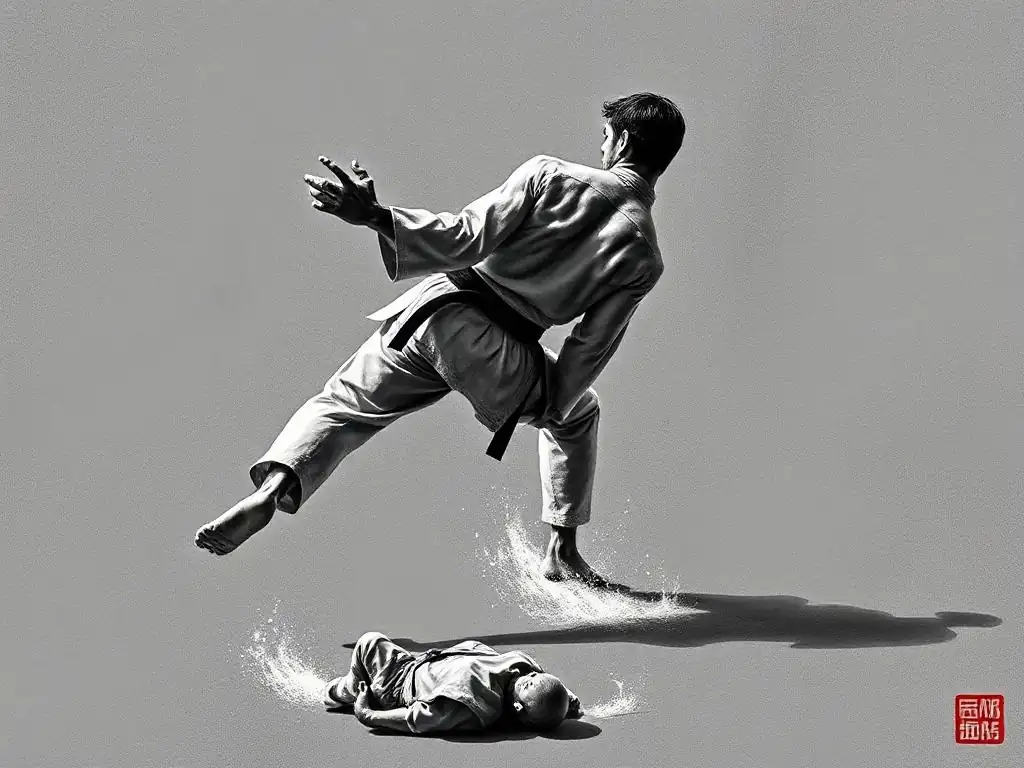
Adapting O Goshi to Different Opponent Sizes and Styles
Adapting O Goshi to opponents of varying sizes and styles is a mark of a skilled practitioner. Against a smaller opponent, a deeper hip entry might be required, leveraging the height difference to load them effectively. A larger opponent might necessitate more reliance on precise timing and momentum (Kuzushi), as brute strength alone may be insufficient. The angle of entry and the specific type of pull used for Kuzushi might also be adjusted based on uke's stance – a forward-leaning opponent might be pulled more directly upward, while a more upright opponent might require a stronger circular pull.
Furthermore, grip fighting plays a significant role. If the standard grips are difficult to establish or maintain, variations like a belt grip might be employed to secure a tighter connection and improve the mechanical advantage for O Goshi power generation. A practitioner's own style – whether favoring strong gripping or dynamic movement – will also influence how they approach applying O Goshi, potentially emphasizing a strong, static load or a more fluid, momentum-driven throw.
O Goshi Combinations with Other Judo Throws
O Goshi is a versatile technique that can be effectively combined with numerous other Judo throws (Renraku Waza - 連絡技) to create offensive sequences. A common strategy is to use an Ashi-waza technique as a primary attack to disrupt uke's balance or reaction, setting them up for O Goshi. For instance, attacking with Ouchi Gari (major inner reaping) or Kouchi Gari (minor inner reaping) often causes uke to step back or shift their weight, creating an opening to step in quickly for O Goshi.
Conversely, O Goshi can be used as the initial attack to elicit a defensive reaction that opens up another throw. If uke strongly resists the O Goshi entry by stepping back or stiffening their body, tori can transition to a technique like Harai Goshi (sweeping hip) or Uchi Mata (inner thigh reap), utilizing uke's defensive posture against them. Mastering these combinations makes a practitioner's attacks less predictable and significantly increases their chances of successfully executing a throw by creating multiple threats and leveraging uke's reactions.
Common Mistakes in O Goshi and How to Correct Them
Several common mistakes can hinder effective O Goshi power generation and execution. One frequent error is a shallow hip entry, where tori's hips are not deep enough or low enough relative to uke's, resulting in poor leverage and uke simply sliding off. This can be corrected by focusing on bending the knees more deeply during the Tsukuri phase and ensuring the hips are inserted fully.
Another mistake is a weak pulling arm, which fails to break uke's balance sufficiently or keep them tight to the body. Strengthening the back and grip, along with practicing dedicated Kuzushi drills, can address this.
Poor posture, such as bending at the waist instead of the knees, compromises the kinetic chain and reduces the force that can be transferred from the legs and core, severely limiting O Goshi power generation. Maintaining a straight back and engaged core throughout the movement is crucial. Finally, insufficient Kuzushi or poor timing between Kuzushi and Tsukuri allows uke to maintain their base and resist the throw. Practicing Uchi-komi with a focus on the initial pull and rapid entry can help synchronize these elements and overcome these common pitfalls.
O Goshi in Competition and Self-Defense
Applying O Goshi in Judo Tournaments
In competitive Judo, O Goshi remains a viable and effective scoring technique, capable of achieving Waza-ari or even Ippon when executed with power and precision. It is often used against opponents who maintain a relatively upright posture or who are strong in gripping exchanges, as a powerful pull and deep hip entry can overcome static resistance. While more dynamic techniques like Uchi Mata or Harai Goshi might be favored by some competitors, the fundamental strength and reliability of O Goshi mean it is still frequently seen at all levels of competition.
Tactically, O Goshi can be applied from various gripping situations, although the standard lapel/sleeve grip is most common. Competitors often look for opportunities when uke is stepping or shifting weight, making them momentarily unstable and susceptible to Kuzushi. Successfully executing O Goshi in a tournament requires not only technical skill but also the ability to read the opponent's movements and create the right opening, capitalizing on that brief window for maximum O Goshi power generation.
Modifying O Goshi for Self-Defense Scenarios
While the competitive Judo context emphasizes a clean throw to the back, adapting O Goshi principles for self-defense involves modifying the technique's goal and application. In a real-world confrontation, the primary objective is often to escape danger or incapacitate an attacker, rather than score points. The deep hip entry and strong pull used in O Goshi can still be incredibly effective for controlling an opponent and removing them from their feet, but the finish might be different.
Instead of focusing on a perfectly controlled fall, the throw might be more abrupt or directed towards a hard surface to end the threat quickly. Grips might be adapted from a gi to street clothes or even direct limb control. The principle of breaking balance (Kuzushi) and using body mechanics for leverage remains fundamental, but the execution (Kake) might be less about a clean throw and more about immediate impact and control. The inherent power generation of the O Goshi motion makes it a potent tool even when modified for the unpredictable nature of self-defense.
The Effectiveness of O Goshi in Real-World Situations
The effectiveness of O Goshi in real-world self-defense situations stems from its core mechanics: gaining control of an opponent's center of gravity and using leverage to disrupt their balance and take them down. Against a single, standing attacker within grappling range, the ability to quickly get inside, secure a dominant position on the hip, and apply powerful rotation can be decisive. A successful O Goshi can end a confrontation rapidly by putting the attacker on the ground, potentially stunned or injured, allowing the defender to escape.
However, its effectiveness is highly dependent on the defender's skill level and the specific circumstances. Attempting O Goshi against multiple attackers, on uneven or slippery ground, or against an opponent with significant size disparity or unusual fighting posture (e.g., low wrestling stance) can be challenging. Nevertheless, the underlying principles of O Goshi power generation – utilizing hip leverage, strong pulling, and rotational force – are universally applicable in close-quarters physical altercations and make it a valuable technique for those with grappling training.
O Goshi: The Legacy and Evolution of this Judo Throw
Historical Significance of O Goshi in Judo
O Goshi holds significant historical importance in the development of Judo. It was one of the original 40 throws (Gokyo no Waza) established by Jigoro Kano in 1895 and was part of the first group of throws taught at the Kodokan. Its inclusion reflects its fundamental nature and effectiveness as a core hip technique. Kano Sensei emphasized O Goshi as an excellent technique for beginners to learn the principles of Kuzushi, Tsukuri, and Kake, as well as the importance of using the hips as a fulcrum.
Its relative simplicity compared to some other complex techniques made it an accessible entry point into Nage-waza for early Judo practitioners. The technique's name itself, "Major Hip," highlights its prominence and foundational role within the Koshi-waza category. O Goshi's legacy is intertwined with the very origins of Judo as a martial art and sport, serving as a key example of how leverage and timing can overcome pure strength.
Modern Applications of O Goshi in Judo and MMA
Today, O Goshi remains a fundamental technique taught in Judo dojos worldwide and is still applied in competitive Judo, although perhaps less frequently than dynamic leg or sacrifice throws at the elite level. Its continued relevance lies in its reliability and the solid base it provides for learning more complex hip techniques. Many advanced throws, such as Uchi Mata and Harai Goshi, build upon the core principles of hip insertion and rotation exemplified by O Goshi.
Beyond traditional Judo, the principles of O Goshi power generation are visible in the grappling exchanges of Mixed Martial Arts (MMA). While MMA fighters don't wear gis, adaptations of hip throws, often initiated from clinch positions (like over-unders), utilize the same concepts of breaking balance, getting the hips deep, and rotating to take an opponent down. A fighter securing an overhook and underhook might effectively use the mechanics of O Goshi to throw an opponent against the cage or in open space, showcasing the enduring applicability of this "Major Hip" throw in modern combat sports.
Future Trends and Developments in O Goshi Training
The future of O Goshi training is likely to see continued integration of sports science and advanced analytical methods alongside traditional practice. Biomechanical analysis, using motion capture and force plates, could provide deeper insights into optimizing the kinetic chain for maximum O Goshi power generation, identifying minute inefficiencies in movement. Strength and conditioning programs will become increasingly tailored to develop the specific muscle groups and power outputs required for dynamic throws like O Goshi.
Video analysis is already widely used but will become more sophisticated, allowing practitioners to compare their technique against ideal models or successful competitive examples, refining their timing and entry angles. Despite these technological advancements, the core elements of O Goshi – the importance of Kuzushi, the deep hip entry, and the powerful rotation – will remain constant. The focus will likely be on enhancing the efficiency and adaptability of this classic throw against increasingly skilled and defensively minded opponents, ensuring O Goshi remains a relevant and powerful technique in the evolving landscape of grappling arts.
Frequently Asked Questions
What is O Guruma and what martial art is it primarily associated with?
O Guruma is a major hip throw in judo. It is categorized as a Koshi-Waza (hip technique) and involves using the opponent's momentum against them.
How does "power generation" apply to the O Guruma technique?
"Power generation" in O Guruma refers to efficiently using your body weight and movement to create a powerful throwing force. This involves proper posture, leverage, and the coordinated use of muscles.
What are some key elements for a successful O Guruma throw?
Essential elements include proper gripping, maintaining balance, and understanding Uke's (opponent's) movement. Timing and kuzushi (breaking balance) are also critical for success.
How does O Guruma fit into the self-defense strategies mentioned on MartialArtsMastery.org?
While primarily a judo technique, the principles of O Guruma – using an opponent's force against them and creating an off-balance situation – can be adapted for self-defense scenarios. It promotes efficient use of energy and leverage.
What are some common mistakes to avoid when practicing O Guruma?
Common mistakes include relying solely on arm strength, neglecting proper footwork, and failing to break the opponent's balance effectively. Practicing with a qualified instructor is crucial to avoid injury and develop proper technique.
Final Reflection: Harnessing the Power Within
The exploration of O Guruma power generation reveals more than just a physical technique; it unveils a profound understanding of momentum and energy transfer, principles that resonate far beyond the dojo. The ability to efficiently generate power from seemingly small movements is a lesson applicable to all aspects of life, from personal endeavors to professional pursuits. The core message is clear: focused effort, strategically applied, can yield extraordinary results.
The enduring influence of O Guruma extends beyond its martial applications; it serves as a metaphor for harnessing inner strength and converting potential into tangible outcomes. This concept of leveraging momentum, of turning perceived weaknesses into strengths, has deeply impacted my own approach to challenges. The journey of a thousand miles begins with a single step.
This ancient proverb perfectly encapsulates the essence of O Guruma – the power lies not in brute force, but in the precise and deliberate application of energy, step by step.
Now, I invite you to reflect on the principles of O Guruma in your own life. Where can you apply focused effort to generate greater momentum? How can you leverage your existing strengths to overcome obstacles? Embrace the art of O Guruma, not just as a technique, but as a philosophy for unlocking your own potential and generating the power to achieve your goals.
Unleash Your Inner O Guruma Master!
Thank you for exploring the power and momentum behind O Guruma. We hope this article has illuminated new possibilities in your martial arts journey. Now, it’s time to put that knowledge into action and elevate your practice!
- Immediately begin incorporating the principles of O Guruma into your next training session. Focus on generating power from your core and mastering the off-balancing techniques.
- Share this article with your fellow martial artists! Help spread the knowledge and spark discussions on optimizing O Guruma in various contexts.
- Challenge yourself to adapt the O Guruma principles to a grappling scenario – a surprising and potentially game-changing experiment!
What small adjustment to your stance or movement will you focus on today to amplify your O Guruma power?