
Alligator Shape Drills: Cultivating Patience and Explosive Strikes in Xing Yi

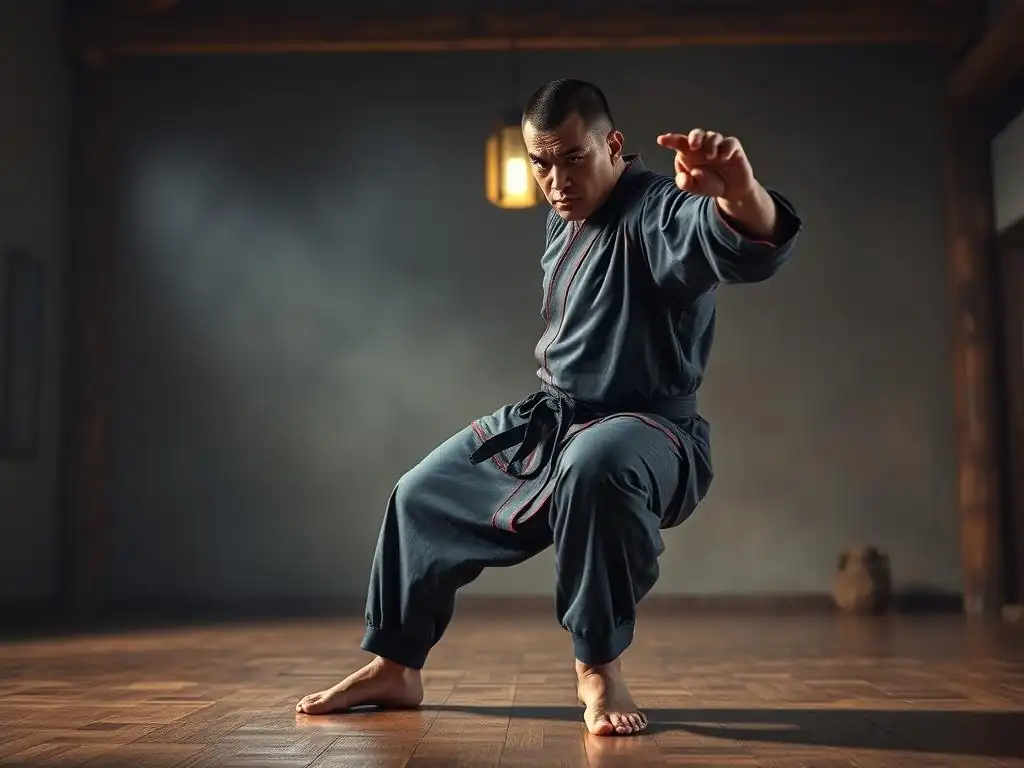
Welcome to Martial Arts Mastery, where the ancient wisdom and modern application of combat arts converge. Ever wondered how the movements of an alligator can unlock explosive power and unwavering focus? Dive into our exploration of Xing Yi alligator shape drills and discover how this unique practice cultivates patience and unleashes devastating strikes. Prepare to delve deep into the heart of this fascinating discipline and unlock its hidden potential.
- Beng Quan: Cultivating Linear Power and Directness in Xing Yi Quan
- Introduction to Xing Yi Quan and Beng Quan
- The Essence of Beng Quan in Xing Yi Quan
- Detailed Breakdown of Beng Quan Training
- Benefits of Practicing Beng Quan
- Integrating Beng Quan into Your Xing Yi Practice
- Common Mistakes and Corrections in Beng Quan Practice
- Advanced Beng Quan Applications and Variations
- Beng Quan in Xing Yi: A Pathway to Direct Power
-
Frequently Asked Questions
- What is the purpose of the Alligator Shape Drill in Xing Yi?
- How does the Alligator Shape drill relate to self-defense?
- What are the key physical benefits of practicing the Alligator Shape drill?
- Where does the Alligator Shape drill fit within the broader context of Xing Yi training?
- Why is patience considered important in the Alligator Shape drill, and how is it cultivated?
- Final Reflection: Embracing Patience, Unleashing Power
- Ignite Your Xing Yi: Unleash the Alligator Within!
Beng Quan: Cultivating Linear Power and Directness in Xing Yi Quan
Introduction to Xing Yi Quan and Beng Quan
Understanding Xing Yi Quan's Five Elements: Metal and Beng Quan
Xing Yi Quan, often translated as "Form-Intention Boxing," is a classical Chinese martial art renowned for its direct, explosive power and focus on simultaneous offense and defense. At its core lies the theory of the Five Elements (Wu Xing): Metal, Wood, Water, Fire, and Earth. Each element is associated with specific physical movements, internal qualities, and strategic applications, embodying fundamental principles of natural change and interaction. The Metal element, characterized by properties such as sharpness, cutting, purity, and unyielding strength, is deeply connected to the martial concept of penetration and direct force.
Beng Quan, meaning "Crushing Fist" or "Splitting Fist" (though Splitting Fist is Pi Quan, Beng is more accurately Crushing or Bursting), is the technique in Xing Yi Quan that most directly embodies the characteristics of the Metal element. Just as metal can be forged into a sharp blade capable of cutting through obstacles, Beng Quan is designed as a penetrating, linear strike aimed at overwhelming an opponent's guard and reaching vital targets directly.
Its movements are sharp, focused, and driven by a unified body force, reflecting the dense, cutting nature of metal. Mastery of Beng Quan is seen as cultivating the internal quality of sharpness and the ability to deliver force along the most direct path.
The Importance of Linear Movement in Xing Yi Training
Linear movement is a fundamental principle that distinguishes Xing Yi Quan from many other martial arts which might emphasize circular deflections, evasive footwork, or winding techniques. Xing Yi prioritizes moving forward directly, often simultaneously with an attack or defense. This approach is rooted in the philosophy of taking the shortest distance between two points – a straight line – to close the gap rapidly, disrupt the opponent's structure, and deliver power efficiently.
Training in linear movement within Xing Yi develops the practitioner's ability to generate power from the ground up, channeling it through a stable, aligned structure into a forward vector. This isn't just about stepping in a straight line; it's about maintaining bodily unity and projecting intent and force directly towards the adversary. This emphasis on direct, forward motion is crucial for developing the aggressive, penetrating power characteristic of the style, allowing practitioners to "enter" or bridge the distance effectively and dominate the center line.
Beng Quan (Crushing Fist): The Metal Element Technique
Beng Quan is often considered one of the most foundational and frequently used techniques among the Five Element Fists in Xing Yi Quan. It is the physical manifestation of the Metal element's principle of direct penetration and crushing force. The basic action involves a forward step coordinated with a punch or thrusting motion, typically delivered with a vertical or angled fist. The name "Crushing Fist" implies the intent behind the technique – not just a simple punch, but a strike designed to break through defenses or overwhelm the opponent's structure through sheer, focused pressure.
The power of Beng Quan does not come solely from the arm, but from the coordinated movement of the entire body. The force originates from the legs and ground, is unified through the core, and is expressed outwards through the arm and fist along a straight line. This "whole body power" is a hallmark of Xing Yi Quan and is particularly evident in the efficient, direct transmission of energy seen in a well-executed Beng Quan strike.
The Essence of Beng Quan in Xing Yi Quan
Directness and Efficiency: The Core Principles of Beng Quan
Directness and efficiency are the twin pillars upon which the practice of Beng Quan is built. Directness refers to the principle of moving straight towards the target, avoiding unnecessary curves, angles, or feints. This minimizes the time the technique takes to reach the opponent, making it faster and harder to evade or counter. It embodies the Xing Yi philosophy of "not seeking twists and turns" and meeting force directly or slightly off-line while advancing.
Efficiency in Beng Quan means achieving maximum impact with minimum wasted energy or movement. This is accomplished through precise body alignment, coordinated breathing, and the unified release of power. Every part of the body contributes to the final force, channeled along the direct line of attack. Training focuses on eliminating extraneous tension and motion, ensuring that all generated force is directed towards the opponent, making the technique both powerful and sustainable over repeated applications.
Developing Linear Power: Focusing Energy Along a Straight Line
Developing linear power is the primary objective of Beng Quan training. This involves learning how to generate force from the ground and channel it through the body's structure into a focused, forward-driving strike. Unlike arts that might rely on circular momentum or torque, Xing Yi's linear power comes from the coordinated extension and alignment of the skeletal and muscular systems, propelled by stepping and rootedness.
Practice involves refining the connection between the feet, legs, hips, torso, and striking arm, ensuring that they move as a single unit. The intent (Yi) plays a crucial role, guiding the energy along the straight line towards the target. Through countless repetitions of basic Beng Quan movements and stances like San Ti Shi, practitioners build the internal mechanics necessary to deliver a powerful, penetrating strike that can project force several inches through a target, not just to its surface. This internal cultivation is often described as forging a "steel bar" through the body, capable of delivering immense impact.
Beng Quan: A Foundation for Offensive and Defensive Actions
Beng Quan is far more than just a simple punch; it serves as a versatile foundation for both offensive and defensive maneuvers in Xing Yi Quan. As an offensive technique, its directness and power make it an excellent primary attack for entering distance, disrupting an opponent's guard, or striking vital points. A well-timed Beng Quan can overwhelm an opponent before they can fully react.
Defensively, the structure and forward intent of Beng Quan allow it to function as a simultaneous block and strike. By maintaining strong body alignment and forward pressure, a Beng Quan movement can deflect or absorb an incoming strike while simultaneously delivering a counter-attack. The principle is to meet the opponent's force with your own forward momentum and structural integrity, neutralizing their attack while continuing your own advance. This simultaneous nature is a key characteristic of Xing Yi Quan's combat strategy.
Detailed Breakdown of Beng Quan Training
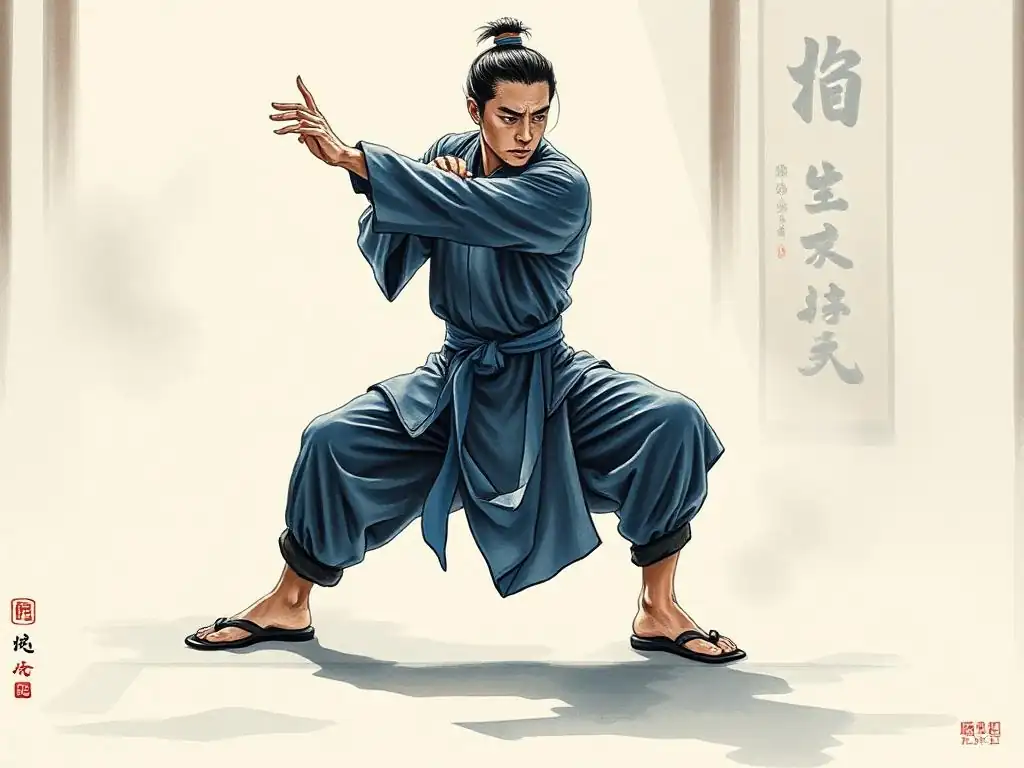
Stance and Posture in Beng Quan
The foundation for Beng Quan, like all Xing Yi Quan techniques, is the San Ti Shi (Three Body Posture) stance. This seemingly static posture is actually dynamic, serving as the primary training method for rooting, alignment, and cultivating internal energy.
In San Ti Shi, the body is aligned to create a stable, yet mobile, structure capable of generating and transmitting force linearly. Key alignment points include keeping the head erect, shoulders relaxed and sunk, elbows slightly bent and pointing downwards, chest slightly rounded inwards, lower back straight, hips tucked, knees bent, and weight distributed unevenly between the front and back legs (often around 60-70% on the front leg).
When executing Beng Quan, the transition from San Ti Shi or a similar preparatory posture involves stepping forward while maintaining this structural integrity. The posture during the forward movement and the strike itself is crucial. The body remains vertically aligned, avoiding leaning or breaking at the waist. The forward step is coordinated with the hand movement, ensuring that the body's mass and power are behind the strike. Maintaining proper posture ensures that force is channeled efficiently and that the practitioner remains stable and balanced, ready for follow-up actions or defense.
Breathing Techniques for Power Generation in Beng Quan
Coordinated breathing is essential for generating explosive power in Beng Quan and other Xing Yi techniques. While specific methods can vary between lineages, a common principle involves inhaling as the body coils or prepares for the movement and exhaling sharply and powerfully as the strike is delivered. This explosive exhalation, often likened to a "tiger's roar" or a sharp expulsion of air from the lower abdomen, helps to unify internal energy (Qi) with physical force (Li).
The breath acts as a mechanism to connect the internal intention (Yi) with the external movement. A deep inhale helps to sink the Qi and root the body, while the powerful exhale on impact helps to release tension and channel energy through the striking limb. Consistent practice synchronizing breath with movement is crucial for developing the internal power that makes Beng Quan truly effective, allowing for strikes that are both penetrating and delivered with full body commitment.
Movement Principles: Maintaining a Straight Line and Generating Force
The core movement principle in Beng Quan is maintaining a straight line of force and travel towards the opponent. This involves a coordinated step and strike. A common stepping method is the "chicken step" (Ji Bu), where the rear foot pushes off, and the front foot advances directly forward, often slightly grazing the ground. The body moves as a single unit, propelled by the legs.
Generating force involves integrating the forward momentum from the step with the internal power cultivated through posture and breath. As the foot lands or is about to land, the body's energy is released through the striking arm. The movement is not just a punch from the shoulder; it's a projection of the entire body's mass and energy. Training focuses on ensuring that the hips and torso rotate minimally, if at all, keeping the power focused linearly. Repetitive drills, often performed for hundreds or even thousands of repetitions, are used to ingrain this coordinated, linear movement and force generation.
Benefits of Practicing Beng Quan
Enhancing Linear Power and Directness in Attacks
Consistent practice of Beng Quan fundamentally improves a practitioner's ability to generate and deliver power in a straight line. This translates directly to more potent and penetrating strikes in combat scenarios. The focus on unified body movement ensures that techniques like jabs, straight punches, and thrusts are not just arm strikes but are backed by the weight and force of the entire body.
Furthermore, the emphasis on directness trains the practitioner to take the most efficient path to the target. This reduces telegraphing and increases the speed of delivery, making attacks harder for an opponent to perceive and defend against. Over time, this develops an instinct for finding the shortest route to victory, whether through striking or bridging distance. A practitioner might spend years focusing on perfecting this singular linear expression of power, leading to an intuitive understanding of direct force application.
Improving Body Alignment and Structural Integrity
The rigorous training required for Beng Quan, particularly the emphasis on San Ti Shi and maintaining proper posture during movement, significantly improves overall body alignment and structural integrity. Holding San Ti Shi for extended periods (traditionally, minutes to hours) strengthens the legs, core, and back, teaching the body how to align its skeletal structure to support weight and resist external forces.
This improved alignment carries over into all physical activities, enhancing balance, stability, and the ability to absorb impact without compromising one's own structure. It builds a resilient framework from which powerful techniques can be launched and against which incoming forces can be safely absorbed or redirected. This structural development is not merely physical; it is seen as building the "steel frame" necessary to contain and express internal energy.
Cultivating Mental Focus and Intent (Yi)
Xing Yi Quan places immense importance on the cultivation of Yi, or intent/mind-will. Beng Quan practice is a primary vehicle for developing this crucial internal skill. The repetitive, focused nature of training the same direct movement encourages the practitioner to concentrate their mind fully on the technique and its purpose – the "crushing" or penetrating intent.
By focusing the mind and will behind the physical action, the strike becomes more than just a mechanical movement; it becomes a projection of intent. This mental focus enhances the power and effectiveness of the technique and also develops mental discipline, concentration, and the ability to remain calm and centered under pressure. The mind leads the Qi, and the Qi drives the body, a fundamental principle forged through dedicated Beng Quan training.
Developing Close-Range Combat Skills
Beng Quan is inherently a close-to-medium range technique. Its directness and forward pressure are designed to be most effective once the practitioner has entered the opponent's personal space. Mastering Beng Quan trains the practitioner to be comfortable and effective in close quarters, where many other martial arts techniques may become cumbersome.
The ability to generate significant linear power even with relatively short movements makes Beng Quan ideal for overwhelming an opponent at close range. It teaches the practitioner how to use their body structure and forward momentum to disrupt the opponent's balance and create openings. This focus on direct, powerful engagement within close distance is a defining characteristic of Xing Yi Quan combat and is honed through relentless Beng Quan practice.
Integrating Beng Quan into Your Xing Yi Practice
Warm-up Exercises for Beng Quan Preparation
Preparing the body correctly is vital before engaging in rigorous Beng Quan practice to prevent injury and maximize effectiveness. A comprehensive warm-up should focus on mobilizing the joints and activating the muscles involved in the linear, explosive movements. This includes dynamic stretches for the hips, knees, ankles, shoulders, elbows, and wrists.
Specific warm-ups relevant to Beng Quan include gentle stepping drills to loosen the legs and coordinate basic forward movement, light arm swings and circles to prepare the shoulders and elbows, and torso rotations to engage the core. Practicing San Ti Shi lightly without full tension is also an excellent way to prepare the body's structure and internal feeling for the subsequent training. A typical warm-up might last 15-20 minutes, ensuring the body is supple and ready for the demands of generating unified linear force.
Combining Beng Quan with Other Five Element Fists
While Beng Quan is powerful on its own, its true versatility in combat emerges when combined with the other Four Element Fists: Pi Quan (Splitting), Pao Quan (Cannon), Zuan Quan (Drilling), and Heng Quan (Crossing). These combinations often follow the elemental cycle (e.g., Metal melts Wood, Wood resists Earth, etc.) or practical combat logic. A common example is combining Beng Quan with Pi Quan.
After a Beng Quan thrust, if the opponent blocks or evades, a follow-up Pi Quan (a downward chopping motion, representing Earth or Wood depending on lineage) can be used to clear the block or strike a different angle. Alternatively, a failed Beng Quan forward drive might transition into a Zuan Quan (upward drilling motion, Water) to attack the head or throat.
Training involves practicing smooth, seamless transitions between the Fists, understanding how the energy and intent shift from one technique to the next, creating a fluid and unpredictable attack chain. This integration develops a more complete and adaptable combat system.
Practical Applications of Beng Quan in Sparring (e.g., Jabs, Thrusts)
In sparring, Beng Quan's principles manifest as direct, penetrating attacks resembling powerful jabs, straight punches, or focused thrusts. Its primary application is to close distance quickly and strike through the opponent's guard or structure. A practitioner might use a light, probing Beng Quan as a lead hand jab to test the opponent's reactions and measure distance.
A more committed application involves stepping in with full body weight and intent behind a powerful Beng Quan aimed at vital targets like the solar plexus, sternum, or head. The goal is often to overwhelm the opponent's defense with the sheer force and directness of the strike, rather than relying on feints or complex combinations initially.
Beng Quan can also be used defensively, simultaneously striking and disrupting an incoming linear attack by meeting it with superior structure and forward drive. Mastering the timing and distance for effective Beng Quan application in dynamic exchanges is a key focus in sparring practice.
Common Mistakes and Corrections in Beng Quan Practice
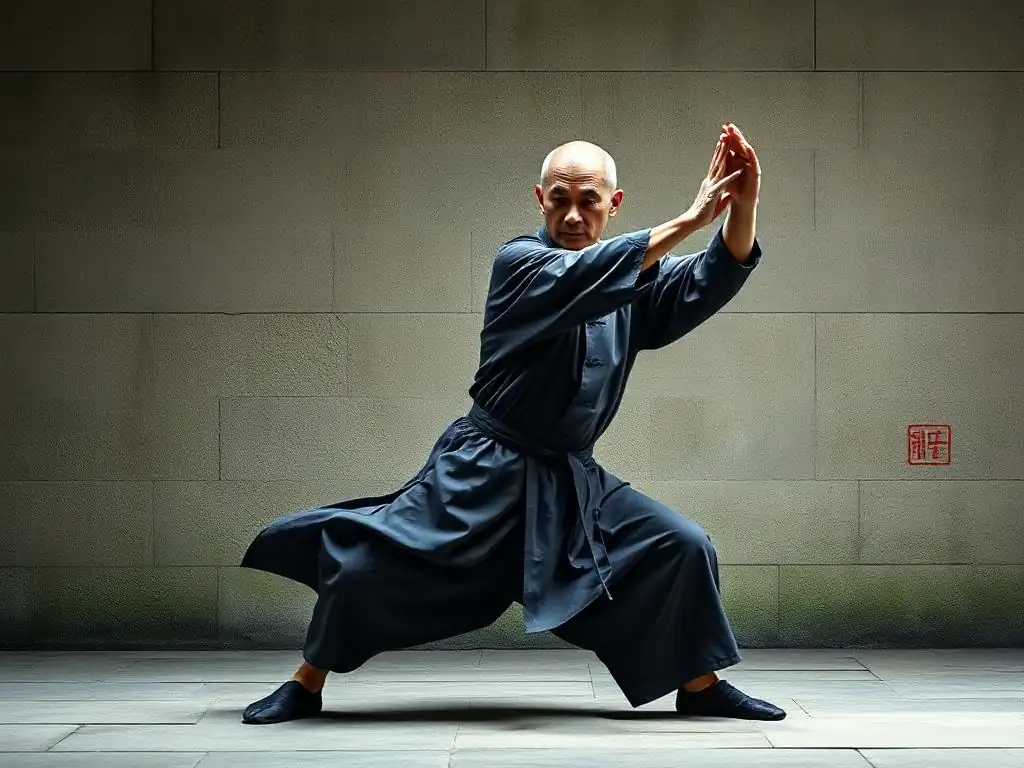
Avoiding Overextension and Maintaining Balance
A frequent error in Beng Quan practice is overextension, either leaning too far forward with the torso or extending the striking arm too much. Overextension compromises the practitioner's balance, weakens the structure, and makes recovery slow, leaving them vulnerable to counter-attack. It often stems from trying to reach the target with just the arm instead of moving the whole body.
Correction involves focusing on keeping the body's weight centered and aligned over the supporting structure (the legs and hips). The striking arm should ideally maintain a slight bend at the elbow, even at full extension, ensuring that the joint is not locked out and the structure remains connected to the core. Practicing the technique slowly, focusing purely on maintaining balance and proper alignment throughout the movement before adding speed and power, is crucial for correcting this mistake. Using a mirror or training partner for feedback can also help identify and rectify leaning or overreaching.
Correcting Elbow Position and Alignment
Improper elbow position is another common issue that diminishes Beng Quan's power and structural integrity. Allowing the elbow to flare outwards or upwards during the strike weakens the connection to the core, reduces linear force transmission, and exposes the arm to potential blocks or joint locks. The elbow should ideally stay relatively low and directed towards the target, guiding the line of force.
Correction requires conscious effort to keep the elbow "heavy" and sunk, maintaining its alignment with the line of the strike. Drills focusing specifically on the arm and shoulder mechanics, perhaps initially without the full body movement, can help isolate and correct the elbow position. Visualizing the arm as a piston moving directly forward from the shoulder, guided by a low elbow, can also be helpful. Consistent feedback from an instructor is invaluable here, as proper elbow alignment is often subtle but critical.
Developing Proper Timing and Distance
Effective Beng Quan relies heavily on proper timing and distance. Striking too early or too late, or from the wrong range, significantly reduces its impact and increases the risk of being countered. Improper timing means the strike might land before the full body force is generated or after the opponent has already moved or defended. Incorrect distance means the strike might fall short or be too close to generate full power.
Developing timing and distance requires significant practice, ideally with partners. Drills that involve stepping and striking towards a moving target or reacting to a partner's movements help refine these skills. Focusing on hitting the target precisely at the moment the body's power peaks – usually as the forward step is completed – is key. Understanding the optimal range for one's own Beng Quan, based on limb length and body mechanics, is also essential. Repetitive partner drills, starting slowly and gradually increasing speed, are necessary to develop the intuitive sense of timing and distance required for effective application.
Advanced Beng Quan Applications and Variations
Linking Beng Quan with Pi Quan (Splitting Fist)
An advanced application of Beng Quan involves seamlessly linking it with Pi Quan, the Earth (or sometimes Wood) element technique. While Beng Quan is a forward, penetrating strike, Pi Quan is typically a downward, chopping motion. The combination can be used to overcome different defensive reactions. For example, a practitioner might initiate with a Beng Quan thrust. If the opponent attempts to block horizontally or parry upwards, the practitioner can immediately transition into a downward Pi Quan chop, using the momentum from the initial strike to power the second.
This transition utilizes the principle of changing force and angle to bypass a defense. The directness of Beng Quan sets up the opportunity for the cutting action of Pi Quan. Training this combination involves practicing the smooth shift in body mechanics and intent from the linear drive of Beng Quan to the downward force of Pi Quan, ensuring there is no pause or break in the flow of energy.
Exploring Advanced Striking Techniques (e.g., Chain Punches)
While the basic Beng Quan is a singular, powerful thrust, advanced practice can explore variations and applications involving rapid, successive strikes based on the same principles. Although not traditionally called "chain punches" as in some other styles, the concept of delivering multiple, fast, linear strikes applies. This involves maintaining the core principles of Beng Quan – directness, linear power, and body unity – while executing strikes in rapid succession from slightly different angles or heights.
This might involve stepping forward with one Beng Quan, and immediately following with another from the same hand or the other hand, driven by continuous forward momentum. The focus remains on channeling power linearly with each strike, even in rapid fire. This develops the ability to overwhelm an opponent with a barrage of direct force, not allowing them time to recover or mount a counter-attack. It requires a high degree of coordination, stamina, and the ability to maintain structural integrity under dynamic conditions.
Utilizing Beng Quan Principles in Qinna (Joint Locking)
The structural integrity, forward pressure, and body unity cultivated through Beng Quan practice are highly applicable to Qinna (joint locking and controlling techniques) in Xing Yi Quan. While Qinna might seem distinct from striking, the ability to generate and maintain linear force and alignment is crucial for effective control and manipulation of an opponent's limbs and joints.
For instance, the forward drive developed in Beng Quan can be used to break an opponent's balance while simultaneously controlling their arm for a lock. The stable structure built through San Ti Shi and Beng Quan practice provides the necessary base to apply leverage and pressure. Techniques might involve using a forward Beng Quan-like motion to drive into an opponent's space, disrupting their posture, and then using the aligned body structure to execute a joint lock or throw. This demonstrates how the foundational principles of the Five Elements permeate all aspects of Xing Yi combat.
Beng Quan in Xing Yi: A Pathway to Direct Power
Consistent Practice: The Key to Mastering Beng Quan
Mastering Beng Quan, like any profound martial art technique, is a journey that demands consistent and dedicated practice. There are no shortcuts; proficiency is built through countless repetitions, focusing on the subtle nuances of posture, movement, breath, and intent. Many practitioners dedicate significant portions of their daily training to San Ti Shi and basic Beng Quan drills, sometimes performing hundreds or even thousands of repetitions to truly ingrain the movement and cultivate internal power.
This consistent effort allows the principles of directness, efficiency, and linear power to become second nature. The body learns to move and generate force intuitively, without conscious thought. It is through this persistent "grinding" of the fundamental technique that the practitioner develops the deep physical and internal understanding required for spontaneous and effective application in combat. Decades of dedicated practice are often cited as necessary to achieve true mastery.
Understanding the Metal Element and its Connection to Beng Quan
A deeper understanding of Beng Quan goes hand-in-hand with appreciating its connection to the Metal element in Xing Yi philosophy. Recognizing Metal's qualities – sharpness, cutting, penetration, purity, and unyielding strength – provides insight into the underlying intent and application of the technique. Beng Quan isn't just a physical movement; it's an embodiment of these elemental characteristics.
Meditating on the qualities of Metal while practicing Beng Quan can help the practitioner align their internal state with the physical action, enhancing the technique's effectiveness. Understanding this elemental relationship adds a layer of depth to the training, transforming it from mere physical exercise into a practice that cultivates both external skill and internal character, embodying the martial spirit of the Metal element.
Embracing Directness, Efficiency, and Power in Your Xing Yi Journey
Ultimately, the practice of Beng Quan serves as a gateway to embracing the core principles of directness, efficiency, and linear power that define Xing Yi Quan. By dedicating oneself to mastering this foundational technique, practitioners develop not only formidable striking ability but also a profound understanding of how to generate and apply force in the most effective manner possible.
The lessons learned through Beng Quan – maintaining structural integrity, unifying body and mind, taking the shortest path – are applicable throughout the entire Xing Yi system and even beyond, influencing one's approach to movement and challenges in daily life. Embracing the spirit of Beng Quan means committing to a path of straightforward, powerful action, cutting through complexity with focused intent and unyielding forward drive.
Frequently Asked Questions
What is the purpose of the Alligator Shape Drill in Xing Yi?
The Alligator Shape drill in Xing Yi is primarily designed to cultivate patience and develop explosive striking power. It also focuses on developing a strong, stable base and ground connection.
How does the Alligator Shape drill relate to self-defense?
The drill trains the practitioner to maintain a low profile, similar to an alligator, and then launch a sudden, powerful strike, mimicking the alligator's attack. This is directly applicable to close-quarters self-defense.
What are the key physical benefits of practicing the Alligator Shape drill?
Practicing the drill improves lower body strength, core stability, and full body coordination. It also enhances the practitioner's ability to generate power from the ground.
Where does the Alligator Shape drill fit within the broader context of Xing Yi training?
The Alligator Shape drill is one of the twelve animal forms of Xing Yi, each contributing to a well-rounded skillset. It specifically complements the other forms by fostering a unique combination of patience and aggression.
Why is patience considered important in the Alligator Shape drill, and how is it cultivated?
Patience is crucial because it allows the practitioner to observe, wait for the optimal moment, and then strike with maximum force. It is cultivated through consistent practice and mindful attention to body alignment and breath control.
Final Reflection: Embracing Patience, Unleashing Power
The exploration of Xing Yi alligator shape drills reveals more than just a training method; it unveils a pathway to cultivating patience and harnessing explosive power, qualities deeply relevant in today's fast-paced world. Where instant gratification often reigns, the deliberate practice inherent in these drills offers a powerful counterpoint, reminding us of the value of sustained effort and focused intention in achieving mastery, both within martial arts and in life itself.
The influence of Xing Yi, and specifically these alligator shape drills, extends beyond the dojo, shaping our understanding of perseverance and the interconnectedness of seemingly disparate qualities. The slow, deliberate movements build a foundation for the explosive strikes, mirroring how consistent effort in any endeavor can lead to moments of profound breakthrough. The journey of a thousand miles begins with a single step.
This ancient proverb resonates deeply with the spirit of Xing Yi, reminding us that even the most ambitious goals are attainable through consistent, dedicated practice.
Now, as you reflect on the principles explored within these pages, consider how you might integrate the spirit of the alligator into your own life. Can you embrace the patience required to build a solid foundation, knowing that it will ultimately unlock your own explosive potential? Let the deliberate practice of Xing Yi alligator shape drills inspire you to cultivate patience, harness your inner power, and strike with unwavering focus towards your goals.
Ignite Your Xing Yi: Unleash the Alligator Within!
Thank you for exploring the depths of Alligator Shape and its powerful impact on your Xing Yi practice! Now that you understand the nuances of patience and explosive power, it's time to translate that knowledge into action.
Here's how you can further integrate the Alligator's essence into your training:
- Dedicate 15 minutes daily to slow, mindful practice of the Alligator Shape, focusing solely on the feeling of coiled energy and the precise moment of release.
- Record yourself performing the Alligator Shape and analyze your posture and transitions frame by frame, identifying areas for improvement.
- Share your experience with a training partner or online forum, discussing the challenges and breakthroughs you encounter. Consider experimenting with incorporating Alligator Shape principles into other martial arts styles.
How will you apply the lessons of the Alligator Shape to revolutionize your current Xing Yi practice and unlock your hidden potential?