
Building Devastating Capoeira Kicking Combinations: Your Offensive Blueprint

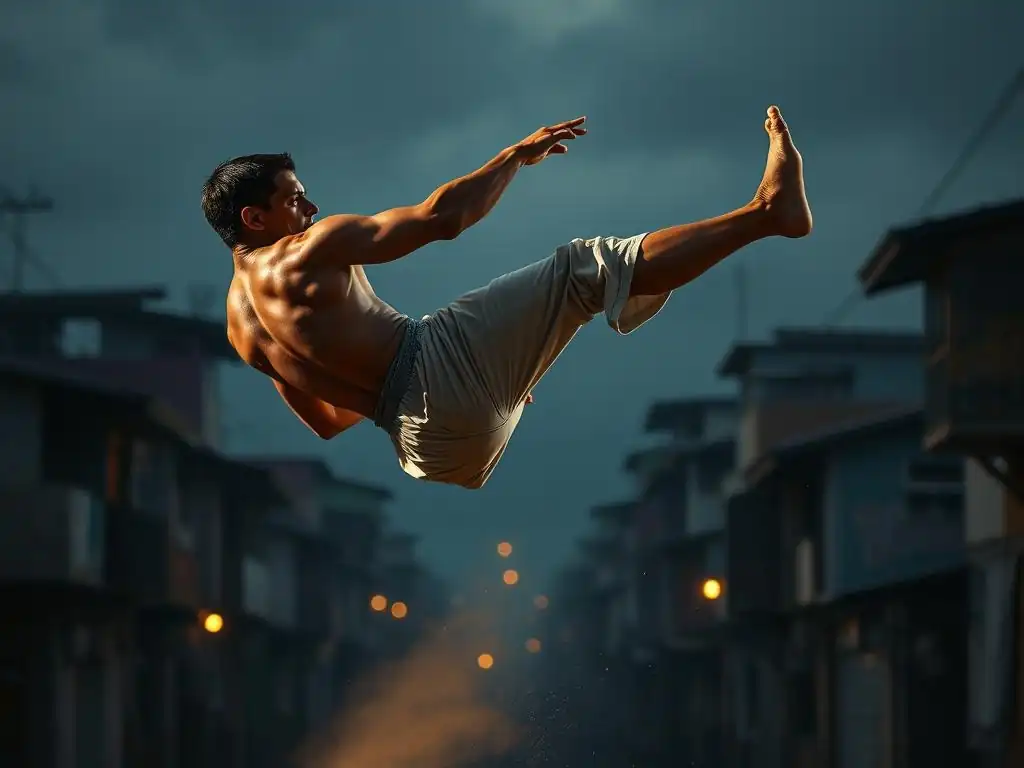
Welcome to Martial Arts Mastery, your ultimate resource for exploring the diverse and captivating world of combat disciplines! Delve into the history, philosophy, and techniques that define these ancient arts.
Are you ready to unlock the secrets of Capoeira? Prepare to build a devastating offensive game! In this article, we’ll reveal our Capoeira kicking combination techniques tutorial, giving you the blueprint for explosive movement and unpredictable strikes. Discover how to blend agility, power, and deception into a seamless flow – and just how effective this seemingly playful art can be. Ready to revolutionize your fighting style? Let's begin!
- Mastering Capoeira Kicks: An Introduction to Offensive Combinations
- Essential Capoeira Kicks for Combination Development
- The Art of Combining Capoeira Kicks: A Step-by-Step Tutorial
- Creating Effective Capoeira Kicking Combinations: Key Principles
- Advanced Capoeira Kicking Strategies: Taking Your Game to the Next Level
- Capoeira Kicking Combination Drills: Practical Training Exercises
- Common Mistakes to Avoid When Building Capoeira Kicking Combinations
- The Philosophy Behind Capoeira Kicking Combinations: More Than Just Offense
- Conclusion: Elevate Your Capoeira Game with Devastating Kicking Combinations.
-
Frequently Asked Questions
- What is Capoeira and what are its distinguishing features?
- Why are kicking combinations so important in Capoeira?
- What are some basic Capoeira kicks that I should master before attempting combinations?
- How does music influence the execution of Capoeira kicking combinations?
- What are some self-defense applications of Capoeira kicking combinations?
- Final Reflection: Unleashing the Art of Capoeira's Dance of Destruction
- Ignite Your Capoeira: Unleash Your Kicking Power!
Mastering Capoeira Kicks: An Introduction to Offensive Combinations
Unleashing the Power of Capoeira Kicking Techniques
Capoeira's offensive power lies significantly in its dynamic and often deceptive kicking techniques. Unlike many traditional martial arts that rely on linear or strictly circular attacks, Capoeira kicks frequently originate from unexpected angles, low stances, or even acrobatic movements, making them difficult to read and defend against. The goal isn't always a knockout blow, but rather disruption, control of space, and setting up subsequent movements. Mastering these individual attacks is the first step towards building effective Capoeira kicking combination techniques.
Developing proficiency in Capoeira kicking involves understanding the mechanics of each kick – the power generation from the hips and core, the trajectory of the leg, and the crucial role of balance. For instance, a well-executed Meia Lua de Compasso can generate immense centrifugal force, capable of sweeping an opponent or delivering a powerful strike. Similarly, a quick Queixada can catch an opponent off guard at a low line, forcing them to react defensively and creating an opening for a follow-up attack. This foundational understanding of individual kicks is paramount before attempting to string them together into fluid sequences.
Understanding the Ginga's Role in Setting Up Kicks
The Ginga, Capoeira's fundamental swaying movement, is not merely a dance step; it is the heart of its strategy, serving as the crucial engine for setting up Capoeira kicking combination techniques. It provides constant motion, making the practitioner a difficult target, while simultaneously creating opportunities for attack and defense. The rhythm and unpredictability of the Ginga allow a Capoeirista to mask their intentions, shifting weight and body position subtly to launch kicks from seemingly random points.
Moreover, the Ginga builds momentum and generates power for kicks. As the body shifts from side to side, weight is loaded onto the supporting leg, ready to propel the kicking leg forward or around. The Ginga allows for feints and changes in rhythm, drawing an opponent's attention or lulling them into a false sense of security before exploding into a rapid-fire Capoeira kicking combination. Without a strong, fluid Ginga, kicks become predictable and less powerful, significantly limiting the effectiveness of any attempted combination.
Essential Capoeira Kicks for Combination Development
Queixada: The Foundation of Many Capoeira Combinations
The Queixada is a versatile, often overlooked kick that serves as an excellent starting point or transitional element in many Capoeira kicking combination techniques. Executed by stepping sideways and swinging the back leg in a semicircular motion across the body, often targeting the opponent's legs or lower body, its relatively low trajectory makes it hard to block with traditional guards. It forces a reaction – either a low block, an evasion, or a retreat – which then opens up higher lines or different angles of attack.
Its utility in combinations comes from its relative speed and the angle it creates. A Queixada can be followed by a quick return to Ginga, setting up another attack, or it can transition directly into another movement as the body is already rotating. For example, a Queixada can flow smoothly into a Martelo as the leg returns, or be used to force an opponent into a position vulnerable to a Meia Lua de Compasso. Mastering the Queixada is key to developing dynamic low-to-high or angular Capoeira kicking combination techniques.
Armada: Setting Up Spinning Kicks for Maximum Impact
The Armada is a powerful spinning kick, often initiated from the Ginga or a transitional movement, where the practitioner spins on one foot and swings the other leg in a wide arc, typically targeting the head or torso. It's a kick that requires significant balance, coordination, and spatial awareness. While visually impressive, its true value in Capoeira kicking combination techniques lies in its power and the rotation it imparts, which can be used to transition into further spinning movements or return quickly to a defensive stance.
The rotation of the Armada can be used to build momentum for a subsequent spinning kick, like an Armada Dupla (double Armada) or a Meia Lua Solta (a spinning variation of the roundhouse). Alternatively, the spin can end with the practitioner facing a new direction, allowing for a quick Au Batido or a return to the Ginga from a different angle. Effective use of the Armada in Capoeira kicking combination techniques tutorial focuses on controlling the spin and maintaining balance to ensure the follow-up attack is just as potent as the initial kick.
Meia Lua de Compasso: The Versatile Roundhouse Kick
Widely considered one of Capoeira's most powerful kicks, the Meia Lua de Compasso (compass crescent) is a spinning roundhouse kick executed from a low position, often touching one or both hands to the ground for support and power generation. The power comes from the strong rotation of the hips and torso, combined with the sweeping motion of the leg. It can target the head, torso, or even sweep the legs depending on the execution angle and height. Its versatility makes it indispensable in Capoeira kicking combination techniques.
The Meia Lua de Compasso can serve as a devastating finishing move or as a powerful transition. After executing the kick, the practitioner can use the momentum to stand up into a Martelo, transition into an Aú (cartwheel), or return to a low Negativa stance ready for a sweep or low attack. Learning to chain the Meia Lua de Compasso with other movements, whether offensive or defensive, is a core part of developing advanced Capoeira kicking combination techniques. Its ability to cover distance and deliver significant force makes it a central element in offensive strategies.
Au Batido: Deceptive and Powerful
The Au Batido is a deceptive and powerful kick launched from an Aú (cartwheel) movement. Instead of completing the cartwheel, the practitioner halts mid-movement, planting their hands and whipping one leg across the ground or towards the opponent's legs or torso. This kick is particularly tricky because it originates from a movement typically used for evasion or acrobatics, making it unexpected. Its low trajectory and sudden execution can easily catch an opponent off guard.
Integrating the Au Batido into Capoeira kicking combination techniques adds an element of surprise and unpredictability. It can be used as a counter-attack after an evasion, or as a sudden low attack following a series of high kicks to disrupt the opponent's guard. For instance, a sequence might involve a high Meia Lua de Compasso, forcing a high block, followed immediately by dropping into an Aú and launching an Au Batido towards the opponent's legs. This shift in level and trajectory is a hallmark of effective Capoeira kicking combination techniques.
Martelo: The Hammer Kick for Direct Attacks
The Martelo, or hammer kick, is Capoeira's version of a snap kick or front roundhouse kick, delivered with the instep or ball of the foot. While less flashy than spinning kicks, it is fast, direct, and highly effective for straight-line attacks or quick follow-ups. It can be delivered to the body or head, often from a standing position or directly out of the Ginga. Its speed makes it excellent for interrupting an opponent's movement or landing a quick point.
In Capoeira kicking combination techniques, the Martelo often serves as a rapid secondary attack or a way to maintain pressure. It can follow a feint, a low kick like the Queixada as the leg returns, or be used in rapid succession (Martelo Duplo). For example, a combination might involve a Meia Lua de Compasso to force a reaction, followed by a quick Martelo as the practitioner recovers their balance. Its simplicity and speed make it a valuable tool for adding direct impact to more complex Capoeira kicking combination techniques.
The Art of Combining Capoeira Kicks: A Step-by-Step Tutorial
Step 1: Mastering Individual Kick Techniques
Before attempting to combine kicks, absolute mastery of each individual technique is non-negotiable. This means practicing each kick thousands of times in isolation, focusing on form, balance, power generation, and recovery. Can you execute a Meia Lua de Compasso with full power and immediately recover into a stable Ginga? Can your Queixada consistently target a specific low point? Can you throw a Martelo with speed and accuracy? Each kick must be second nature, requiring minimal conscious thought to execute correctly.
This phase involves extensive solo practice, often called "shadow kicking" or training against a stationary target like a tree or a heavy bag. The goal is muscle memory. According to many experienced Mestre, dedicating 70-80% of initial training time to perfecting the fundamentals of individual kicks is crucial before attempting complex sequences. This solid foundation ensures that when you start linking movements, the focus can be on flow and timing rather than struggling with the mechanics of each separate kick.
Step 2: Linking Basic Kicks Together: Simple Combinations
Once individual techniques are solid, the next step is to link two or three basic kicks that transition naturally from one to the next. Start with straightforward sequences that require minimal complex movement in between. A classic example is the Queixada followed by a Martelo. As the leg swings back from the Queixada, it's already in a position to chamber for a quick Martelo. Another simple link is a Meia Lua de Compasso followed by standing up into a Queixada.
Practice these simple sequences repeatedly, focusing on making the transition smooth and fluid, almost as if it's a single, multi-part movement. Don't worry about speed initially; prioritize connection and balance. For instance, practice the Queixada-Martelo link 50 times on each side, focusing on the weight transfer and hip rotation that connects the two kicks. This phase builds the fundamental coordination needed for more complex Capoeira kicking combination techniques.
Step 3: Adding Evasions and Transitions Between Kicks
Capoeira combinations are not just about linking attacks; they are about linking attacks through movement. This means incorporating defensive evasions (Esquivas) and transitional movements (like Negativa, Rolê, or Cadeira) between kicks. These movements are not just defensive; they reposition you, create new angles, and maintain the flow of the Roda. For example, throwing a kick, then dropping into a Negativa under a potential counter, and then exploding into another kick from the low position.
Practice sequences like: Ginga -> Martelo -> Esquiva Lateral -> Ginga -> Queixada. Or: Ginga -> Meia Lua de Compasso -> Rolê -> Negativa -> Au Batido. The key is to make the evasion or transition an integral part of the combination, not an interruption. The movement between the kicks is just as important as the kicks themselves in a comprehensive Capoeira kicking combination techniques tutorial. Spend significant time drilling these transitions until they feel natural and instinctive.
Step 4: Incorporating Acrobatics for Enhanced Flow and Deception
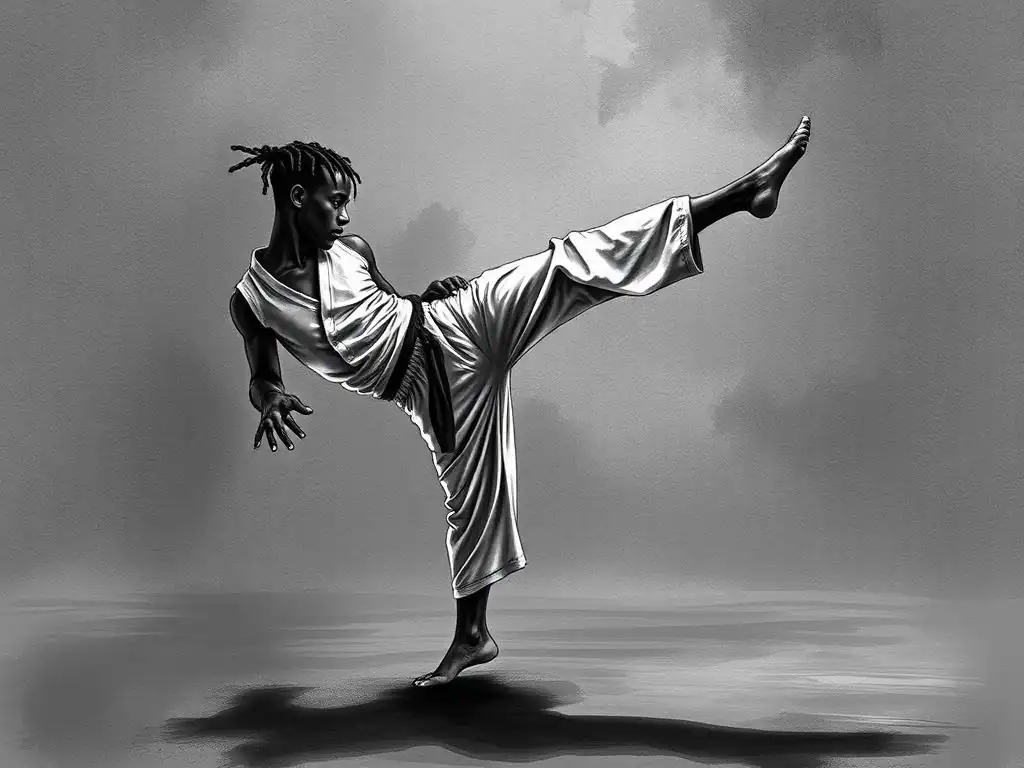
Acrobatic movements, or Floreios, like Aú (cartwheel), Queda de Rins (falling on the kidneys/back), or Macaco (ape/monkey jump), add another layer of complexity and deception to Capoeira kicking combination techniques. They can be used to evade, cover distance, regain balance, or launch attacks from unexpected positions. An Aú can evade a low sweep and transition directly into an Au Batido or a standing kick. A Queda de Rins can be used to absorb a blow or evade, then spring back up with a kick.
Integrating Floreios requires significant practice to ensure they are controlled and purposeful, not just for show. A common sequence might be: Ginga -> Armada -> Aú (to evade a counter or cover ground) -> Ginga -> Meia Lua de Compasso. Or a lower sequence: Ginga -> Au Batido -> Rolê -> Queda de Rins -> sweep or low kick (like Rasteira). While visually impressive, the effectiveness comes from how the Floreio sets up or transitions between kicks, adding fluidity and unpredictability to the Capoeira kicking combination techniques.
Step 5: Practicing with a Partner: Applying Combinations in a Roda
The ultimate test and refinement of Capoeira kicking combination techniques comes through practice with a partner and application in the Roda. Solo drills build mechanics, but a live opponent provides necessary feedback on timing, distance, and effectiveness. Start with cooperative drills where partners agree on sequences, focusing on executing the combination smoothly against a moving target. Gradually increase the resistance and unpredictability.
Move towards structured sparring ("jogo de dentro") where partners focus on applying learned combinations in a semi-live environment, reacting to each other's movements. Finally, bring the combinations into the Roda itself. Here, the combinations must flow organically with the rhythm of the game and the interaction with the opponent. Don't force combinations; let them emerge from the Ginga and the opportunities presented. Real Roda experience is invaluable for adapting and perfecting your Capoeira kicking combination techniques.
Creating Effective Capoeira Kicking Combinations: Key Principles
Balance and Stability: Maintaining Control During Combinations
Maintaining balance and stability is paramount when executing Capoeira kicking combination techniques. Each kick, evasion, or transition inherently disrupts balance. A successful combination requires regaining or maintaining control between each movement, allowing for the smooth and powerful execution of the next step. Poor balance after a kick makes you vulnerable and breaks the flow of the combination. This principle is often underestimated in Capoeira kicking combination techniques tutorial guides.
This involves strengthening core muscles, improving proprioception (body awareness in space), and practicing rapid weight shifts. Drills that focus on landing a kick and immediately recovering balance, or performing multiple kicks without touching the hands down unnecessarily (unless part of the technique like Meia Lua de Compasso or Au Batido), are crucial. Developing strong ankles and knees also contributes significantly to stability, especially during spinning or low movements common in Capoeira kicking combination techniques.
Timing and Rhythm: The Importance of Cadence
Timing and rhythm, dictated by the Berimbau and the music of the Roda, are fundamental to effective Capoeira kicking combination techniques. The speed and energy of the game (the vadiagem) influence the pace at which combinations can be deployed. Executing a slow, powerful combination in a fast game is as ineffective as trying rapid-fire kicks in a slow, strategic game. Your combinations must sync with the Roda's rhythm.
Beyond the overall rhythm, there is the internal timing of the combination itself. The interval between kicks, transitions, and evasions must be precise to catch the opponent off guard or flow seamlessly. A slight delay can allow the opponent to block or counter. Practicing combinations to the rhythm of different Capoeira songs helps develop this crucial sense of timing, making your Capoeira kicking combination techniques feel natural and effective within the game's flow.
Distance Management: Closing the Gap Effectively
Effective distance management is critical for landing Capoeira kicking combination techniques. Capoeira kicks often require specific ranges – a Meia Lua de Compasso needs space to generate power, while a Martelo is more effective at closer range. A combination must account for how each movement changes the distance between you and your opponent. Can you close the gap after an evasive move to land a kick? Can you create distance after a powerful attack to avoid a counter?
Using footwork, Ginga variations, and transitional movements like the Rolê or Aú to manage distance within a combination is key. For example, a sequence might involve using a quick Ginga forward to close distance for a Martelo, then a Rolê to the side to evade a counter and set up a Queixada from a new angle. Understanding how each element of your Capoeira kicking combination techniques affects distance allows you to position yourself optimally for each attack.
Deception and Feinting: Misleading Your Opponent
Deception is a cornerstone of Capoeira, and it's vital for successful Capoeira kicking combination techniques. Simply stringing kicks together predictably will allow a skilled opponent to read and counter your attacks. Feints, changes in rhythm, and masking intentions within the Ginga are essential for creating openings and ensuring your combinations land. A feinted high kick can draw a block, leaving the lower line open for an Au Batido or Rasteira.
Practice making your movements look similar initially, only revealing the true direction or power at the last moment. Use variations in speed – a slow, lulling Ginga can explode into a rapid combination. Integrate movements that look like evasions but transition into attacks (like the Au Batido from an Aú). Effective Capoeira kicking combination techniques tutorial emphasizes the 'malicia' or cunning – the ability to mislead your opponent – as much as the physical execution of the kicks.
Angulation and Footwork: Creating Offensive Opportunities
Using angles and precise footwork allows you to bypass an opponent's guard and create offensive opportunities for Capoeira kicking combination techniques. Attacking from unexpected angles disrupts an opponent's defensive structure and makes their reactions slower. Capoeira's circular and evasive movements naturally lend themselves to attacking from the sides or even the back.
Footwork variations within the Ginga and transitional movements like the Rolê allow you to shift your position relative to your opponent, finding lines of attack that are open. A simple step to the side during the Ginga can change the angle of a Meia Lua de Compasso, making it harder to block. Practicing combinations while constantly moving and changing angles is crucial. Focus on how each step positions you for the next move in the sequence, ensuring that your Capoeira kicking combination techniques exploit openings created by your movement.
Advanced Capoeira Kicking Strategies: Taking Your Game to the Next Level
Combining Kicks with Floreios (Acrobatic Movements)
Integrating Floreios into Capoeira kicking combination techniques moves beyond simple transitions and uses acrobatics as integral parts of the offensive flow. This requires a high level of physical conditioning, control, and timing. For example, a Macaco can be used to evade a low attack and immediately transition into a Martelo from a surprising angle as you land. A Queda de Rins can absorb a blow and allow you to launch a low Rasteira or Tesoura (scissors kick) from the ground.
Advanced practitioners might use sequences like a Meia Lua de Compasso, rolling out into a Queda de Rins to avoid a counter, and then transitioning into a Macaco that sets up an Armada. The key is that the Floreio isn't just a pause or a flashy move; it actively contributes to the combination by repositioning, creating momentum, or setting up the next kick from an unexpected vector. Mastering these complex Capoeira kicking combination techniques takes years of dedicated practice.
Utilizing Negativa and Esquivas in Kicking Combinations
At an advanced level, defensive movements like Negativa and various Esquivas become launchpads or integral links within offensive combinations, not just ways to avoid being hit. A deep Esquiva Lateral can put you in perfect position to launch a powerful Queixada or a low Au Batido. Dropping into a Negativa can bait an opponent into coming closer, only for you to sweep their leg with a Rasteira or spring up with a Martelo.
Consider a sequence: Ginga -> Opponent attacks -> Esquiva Diagonal -> Negativa -> Rasteira (sweep) -> Opponent evades sweep -> stand up with Martelo. Here, the defensive movements are woven into the offensive sequence, creating a continuous flow of attack and counter-attack. This level of integration requires not just technical skill but also sharp reflexes and the ability to read the opponent, turning defensive necessities into offensive opportunities within your Capoeira kicking combination techniques.
Developing Personalized Kicking Combinations: Experimentation and Creativity
While learning established Capoeira kicking combination techniques is essential, true mastery involves developing your own personalized sequences. This requires experimentation and creativity within the structure of Capoeira's principles. Analyze your strengths and preferences – are you faster with low kicks? Do you excel at spinning movements? Build combinations that leverage your unique physical attributes and style.
Spend time in solo training exploring different links between movements. Can you transition from an Armada directly into a Meia Lua de Compasso? What happens if you follow an Au Batido with a quick Cadeira and then a Queixada? Record yourself or get feedback from a Mestre to refine these experimental sequences. The most effective Capoeira kicking combination techniques are often those that are unique to the practitioner, making them harder for opponents to anticipate.
Adapting Combinations to Different Opponents and Scenarios
No two Capoeira games are exactly alike, and effective Capoeira kicking combination techniques must be adaptable. A combination that works against a tall, linear opponent might be ineffective against a short, low-playing practitioner. Recognizing your opponent's style, tendencies, and weaknesses in the moment is crucial for selecting or modifying your combination strategy.
Against an opponent who favors high attacks, focus on combinations that utilize low evasions (like Negativa or Rolê) that transition into low kicks (Au Batido, Rasteira) or sudden high attacks from a low stance. Against someone who stays low, use combinations that force them to stand or rely on powerful spinning kicks (Armada, Meia Lua de Compasso) from different angles. The ability to adapt your Capoeira kicking combination techniques on the fly, reading the flow of the game, is a sign of an experienced player.
Capoeira Kicking Combination Drills: Practical Training Exercises
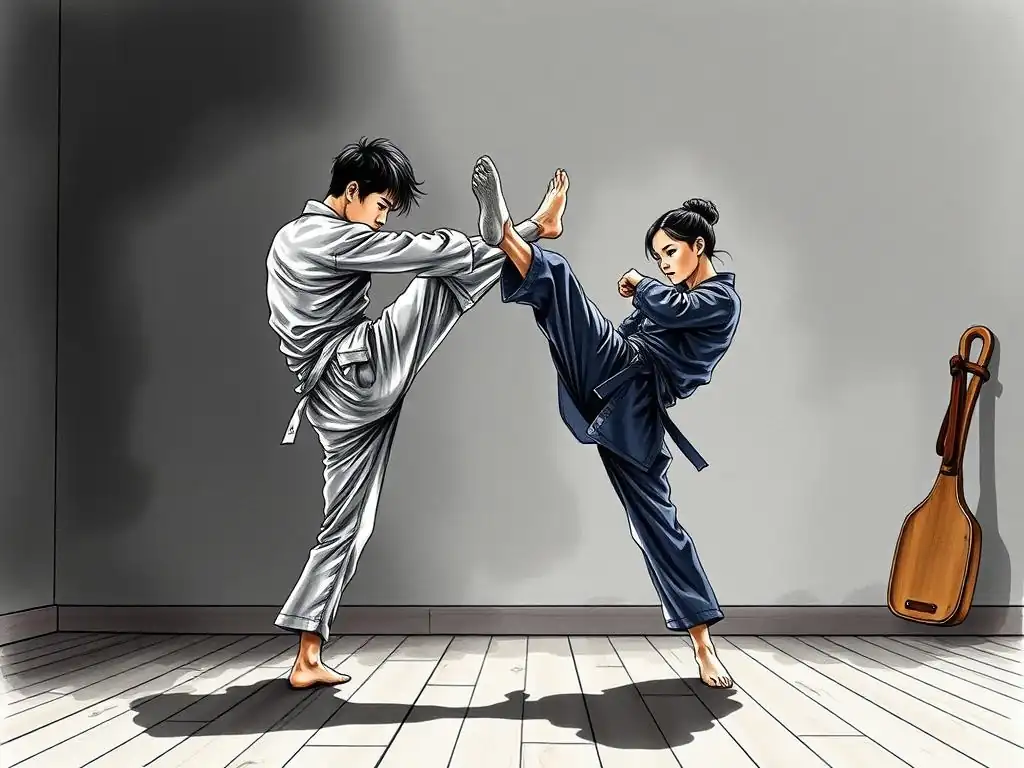
Shadow Kicking Drills for Technique Refinement
Shadow kicking is a fundamental solo training method for refining Capoeira kicking combination techniques. Stand in your Ginga and practice executing combinations sequentially, focusing purely on form, balance, and the fluidity of transitions. There's no opponent, so you can concentrate on perfecting the mechanics of each kick and the movement between them. This is where you build muscle memory for specific sequences like Queixada -> Rolê -> Armada.
Dedicate specific rounds to different types of combinations – perhaps focusing on low-to-high sequences in one round, spinning combinations in another, or evasive combinations in a third. Pay attention to your breathing, maintaining a steady rhythm that mirrors the potential energy of the Roda. Shadow kicking allows for high-repetition practice without the risk of injury, making it essential for embedding Capoeira kicking combination techniques into your physical vocabulary.
Partner Drills for Timing and Coordination
Partner drills introduce the element of interaction, crucial for developing the timing and coordination needed for effective Capoeira kicking combination techniques. Start cooperatively: Partner A executes a pre-agreed combination, and Partner B practices evading or blocking the sequence. Then switch roles. The focus is on the timing of the attacks relative to the opponent's position and movement, and the defender's ability to react appropriately.
Progress to drills where the partner provides light resistance or unpredictable movement. For instance, Partner B might move forward or backward slightly, forcing Partner A to adjust the combination's timing or distance. Another drill involves one partner initiating a simple attack (e.g., a Martelo), and the other partner practicing responding with a specific Capoeira kicking combination technique triggered by that attack, like an Esquiva followed by a Meia Lua de Compasso counter.
Sparring Drills for Application and Adaptation
Sparring drills simulate the live Roda environment, allowing you to practice applying Capoeira kicking combination techniques under pressure and against a resisting opponent. Start with low-intensity sparring, focusing on recognizing opportunities to deploy the combinations you've been drilling. Don't worry about winning; focus on execution and flow.
Gradually increase the intensity, incorporating the unpredictability of a real game. Can you still execute your planned Queixada -> Martelo combination when your opponent is constantly shifting their weight or throwing unexpected low attacks? These drills force you to adapt your timing, distance, and even modify parts of the combination based on the opponent's reactions. This is where the theory of Capoeira kicking combination techniques meets the practical reality of the game.
Drill 1: Queixada to Armada Transition Drill
This drill focuses on linking a low-line kick that forces a reaction with a powerful spinning kick.
- Start in Ginga facing your partner (or an imaginary opponent).
- Execute a Queixada towards their lower body (knee/thigh level). Focus on the angle and speed.
- As the kicking leg returns and your weight shifts, use the momentum to initiate the spin for an Armada.
- Execute the Armada, aiming for the head or torso level.
- Land back in Ginga, ready to repeat or transition.
Practice this sequence 10-15 times on each side before switching. Focus first on the smooth transition from the end of the Queixada to the start of the Armada spin. Ensure the weight transfer is efficient, allowing the momentum from the first kick to feed into the second. This drill helps build the coordination for multi-directional Capoeira kicking combination techniques.
Drill 2: Meia Lua de Compasso to Au Batido Counter Drill
This drill practices transitioning from a powerful, often concluding kick into a deceptive low counter-attack.
- Start in Ginga.
- Execute a full Meia Lua de Compasso, ensuring good power and control.
- As you recover from the Meia Lua de Compasso and your hands might touch the ground, immediately transition into an Aú movement.
- From the Aú, instead of completing it, launch the Au Batido kick towards your partner's legs or body.
- Recover into a low position or Ginga.
Practice this drill slowly at first, focusing on the smooth transition from the Meia Lua de Compasso's recovery into the Aú and the sudden shift into the Au Batido. The deception lies in the opponent expecting you to fully recover or complete the Aú, but instead you attack from the unexpected position. This drill is excellent for developing unpredictable low attacks within Capoeira kicking combination techniques.
Common Mistakes to Avoid When Building Capoeira Kicking Combinations
Over-Reliance on Acrobatics: Prioritizing Substance over Style
A common pitfall, especially for newer practitioners, is relying too heavily on flashy acrobatics (Floreios) within their Capoeira kicking combination techniques without them serving a clear tactical purpose. While acrobatics are part of Capoeira, they should enhance, not replace, effective kicking and movement. A combination filled with unnecessary flips and spins might look impressive but can leave you open, consume excess energy, and break the flow of the game.
Focus on using Floreios strategically – to evade, create distance, change levels, or set up a specific attack from an advantageous position. For example, using an Aú to evade a sweep and immediately launching an Au Batido is effective. Simply doing a series of cartwheels between kicks with no tactical reason is not. Ensure each acrobatic movement within your Capoeira kicking combination techniques contributes to the overall offensive or defensive strategy, prioritizing substance over mere visual flair.
Telegraphing Your Intentions: Maintaining Deception
One of the most significant errors in Capoeira kicking combination techniques is telegraphing your next move. If your opponent can read your intentions from your body language, weight distribution, or rhythm, they can easily evade or counter your combination. Common tells include winding up too much for a powerful kick, always attacking after a specific Ginga step, or having a predictable sequence of movements.
Maintaining deception requires constant variation in your Ginga, using feints, and ensuring your transitions between movements are fluid and subtle. Practice launching the same kick from different Ginga positions or after different evasions. Work on concealing the preparation for your kicks until the last possible moment. Effective Capoeira kicking combination techniques are built on a foundation of unpredictability and the ability to mask your true intentions until it's too late for the opponent to react effectively.
Neglecting Footwork: Limiting Mobility and Power
Poor footwork severely limits the effectiveness of Capoeira kicking combination techniques. The feet are the connection to the ground, providing balance, generating power through weight transfer, and enabling crucial movement. Neglecting footwork means your transitions will be clunky, your balance compromised, your power diminished, and your ability to manage distance and angles severely restricted.
Ensure your Ginga is active and purposeful, constantly adjusting your position. Practice transitional footwork – how you step out of a kick, how you pivot for a spin, how you use a Rolê to change direction. Good footwork allows you to quickly recover from one kick and seamlessly transition into the next, or to adjust your position mid-combination to land the final blow. Strong, agile footwork is the silent enabler of powerful and fluid Capoeira kicking combination techniques.
Lack of Conditioning: Fatigue Affecting Technique
Executing dynamic Capoeira kicking combination techniques is physically demanding, requiring strength, flexibility, endurance, and aerobic capacity. A lack of proper physical conditioning will lead to fatigue, which in turn compromises technique, speed, power, and balance. When tired, kicks become sloppy, transitions become slow, and the ability to think strategically and adapt combinations diminishes significantly.
Incorporate strength training (especially for legs, core, and shoulders), flexibility work (essential for high kicks and low movements), and cardiovascular conditioning into your training regimen. Practice executing your combinations when you are already slightly fatigued to simulate Roda conditions. Building the necessary physical base ensures that you can maintain the quality and effectiveness of your Capoeira kicking combination techniques throughout a game, even when the intensity is high.
The Philosophy Behind Capoeira Kicking Combinations: More Than Just Offense
The Importance of Respect and Control in the Roda
While building devastating Capoeira kicking combination techniques focuses on offensive power, it's crucial to remember the underlying philosophy of Capoeira which emphasizes respect and control within the Roda. The goal is not to inflict harm but to engage in a dynamic dialogue of movement, strategy, and energy. Your combinations should demonstrate skill, creativity, and effectiveness, but always within the spirit of the game.
This means maintaining control over your kicks, even the most powerful ones. Aim to demonstrate your ability to land a kick without causing injury, stopping short or pulling back the power at the last moment when necessary. Respecting the opponent's space and well-being is paramount. Effective Capoeira kicking combination techniques are those that demonstrate mastery and strategic thinking while upholding the ethical code of the Roda, showcasing skill rather than aggression.
Expressing Yourself Through Movement and Creativity
Capoeira is an art form as much as a martial art, and building Capoeira kicking combination techniques is a key way to express your individuality and creativity. While foundational techniques and combinations are taught, the beauty of Capoeira lies in how each practitioner interprets and combines them in their unique way. Your combinations become your signature within the Roda.
Experiment with different rhythms, speeds, angles, and sequences. Draw inspiration from other practitioners but don't simply copy. Find what feels natural and effective for your body and style. The most compelling Capoeira kicking combination techniques are often those that are innovative and reflect the practitioner's personality, demonstrating not just technical skill but also artistic expression and a deep understanding of the art's creative potential.
The Constant Evolution of Capoeira Kicking Techniques
Capoeira is a living art form that is constantly evolving, and this applies directly to the development and application of Capoeira kicking combination techniques. New movements are integrated, existing techniques are refined, and the strategic use of combinations adapts to the changing styles of practitioners and the influences from other movement disciplines.
Staying engaged in the Capoeira community, training with different groups and Mestres, and attending workshops exposes you to new ideas and approaches to combinations. Be open to learning and adapting your own repertoire. The journey of mastering Capoeira kicking combination techniques is ongoing, a continuous process of learning, refining, experimenting, and integrating new knowledge to keep your game fresh, unpredictable, and effective in the ever-evolving Roda.
Conclusion: Elevate Your Capoeira Game with Devastating Kicking Combinations.
Frequently Asked Questions
What is Capoeira and what are its distinguishing features?
Capoeira is a Brazilian martial art that combines elements of fight, acrobatics, music, and dance. It's distinguished by its fluid, acrobatic movements and its roots in African traditions.
Why are kicking combinations so important in Capoeira?
Kicking combinations are crucial in Capoeira as they provide offensive versatility and allow for unexpected attacks. They can be used to disorient opponents and create openings for further strikes.
What are some basic Capoeira kicks that I should master before attempting combinations?
Before attempting combinations, you should master basic kicks like the Au, Armada, and Meia Lua de Compasso. These foundational kicks are essential for building more complex sequences.
How does music influence the execution of Capoeira kicking combinations?
Music dictates the ritmo (rhythm) and energia (energy) of the roda (Capoeira circle), influencing the speed and fluidity of movements. Kicking combinations are often performed in response to the music, making them more unpredictable.
What are some self-defense applications of Capoeira kicking combinations?
Capoeira kicking combinations can be adapted for self-defense by focusing on practical targets and maintaining situational awareness. They offer options for evasion and striking in close-quarters combat.
Final Reflection: Unleashing the Art of Capoeira's Dance of Destruction
The intricate dance of Capoeira, often perceived as a flowing, acrobatic art form, holds within it the potential for devastating offensive power. This article has explored the blueprint for unlocking that power, focusing on the strategic construction of kicking combinations that can transform a Capoeirista into a formidable force. The techniques and strategies discussed are not merely theoretical; they represent a pathway to elevate one's game, bridging the gap between fluid movement and decisive impact in the Roda.
The influence of Capoeira extends far beyond the physical realm, shaping not only individual practitioners but also the broader cultural landscape. The discipline, creativity, and resilience fostered through Capoeira training are invaluable assets, empowering individuals to overcome challenges both inside and outside the Roda. Capoeira is more than just fighting; it's a way of life. It teaches you to be adaptable, resourceful, and to never give up.
This quote encapsulates the transformative power of Capoeira, highlighting its ability to instill a fighting spirit that transcends the physical.
Now, armed with the knowledge of crafting devastating Capoeira kicking combinations, I invite you to reflect on your own journey. How can you integrate these principles into your training, pushing beyond your comfort zone to unlock your offensive potential? Embrace the challenge, experiment with different combinations, and discover the unique rhythm and power that lies within you. The Roda awaits, ready to witness the evolution of your Capoeira.
Ignite Your Capoeira: Unleash Your Kicking Power!
Thank you for diving into the world of Capoeira kicking combinations! Now that you've unlocked the secrets to building devastating offensive sequences, it's time to put your knowledge into action.
Here’s how you can continue your journey:
- Head to the academy to put the ideas covered into practice. Record yourself and identify areas for improvement.
- Share your favorite kicking combination on social media using #MartialArtsMastery and inspire fellow Capoeiristas.
- Explore different Capoeira styles online, identifying how they approach kicks to discover different ideas and expand your understanding of the art.
What new kicking combination will you create this week?