
The Philosophy of Ginga: Constant Movement as a Metaphor for Life

Welcome to Martial Arts Mastery, your portal to the world's fighting traditions! Delve into the art and science behind legendary techniques, philosophical concepts, and historical figures. Prepare to be captivated by the unique and fluid Ginga movement philosophy martial arts, a dance of evasion and attack. But what deeper truths lie within this constant state of motion? Uncover the secrets and unlock your potential – your journey to mastery begins now!
- Understanding Ginga: The Core of Capoeira
- The Philosophical Underpinnings of Ginga Movement
- Ginga Beyond the Roda: Applying its Principles to Everyday Life
- Mastering the Ginga: Practical Tips and Drills for Capoeira Practitioners
- Ginga in Different Styles of Capoeira: Regional Variations and Interpretations
- The Future of Ginga: Evolution and Preservation of a Living Philosophy
-
Frequently Asked Questions
- What is Ginga movement philosophy in martial arts?
- How does the Ginga movement relate to the keyword "Ginga movement philosophy martial arts"?
- What are some practical applications of Ginga in self-defense?
- How does the philosophy of Ginga extend beyond the physical aspects of martial arts?
- Where can I learn more about the history and techniques related to Ginga movement?
- Final Reflection: Embracing the Unfolding Path
- Embrace the Ginga: Ignite Your Life's Dance!
Understanding Ginga: The Core of Capoeira
What is Ginga in Capoeira? Defining the Fundamental Movement
Ginga, pronounced "jeen-gah," is the fundamental, continuous back-and-forth motion that forms the basis of Capoeira. It is not merely a stance or a warm-up exercise; it is the rhythmic swaying movement from which all attacks, defenses, and transitions originate. This dynamic posture keeps the Capoeirista constantly mobile, shifting their weight from one foot to the other in a triangular step pattern.
Imagine a pendulum, always in motion, never static – this captures the essence of the ginga movement philosophy martial arts. It serves multiple purposes: maintaining rhythm with the music (the berimbau, atabaque, and pandeiro), creating unpredictable movement patterns, and keeping the body relaxed yet ready for explosive action.
The ginga is often described as the 'soul' of Capoeira, embodying its fluidity and deceptive nature. Unlike static stances found in many other martial arts, the ginga ensures that a Capoeirista is never a fixed target. The constant shifting of weight and position makes it difficult for an opponent to anticipate attacks or defenses.
This continuous flow is practiced from the very first lesson, becoming an ingrained habit that defines the practitioner's presence in the roda, the circle where Capoeira is played. Mastery of the ginga isn't about speed, but about maintaining a relaxed, natural rhythm that allows for effortless transitions into complex movements.
The Significance of Ginga in Capoeira Training
Training the ginga is paramount in Capoeira, consuming a significant portion of a beginner's practice time and remaining a focus even for advanced practitioners. It develops core strength, balance, coordination, and stamina – essential physical attributes for the art. Beyond the physical, it instills a deep sense of rhythm and timing, crucial for interacting within the roda and responding to the musical cues. The consistent, repetitive nature of ginga practice builds muscle memory, allowing the practitioner to execute complex movements springing from this foundation with minimal conscious thought.
The emphasis on ginga in training also cultivates a specific mindset: one of perpetual readiness and adaptability. Students learn to maintain this relaxed yet alert state, which is transferable to other aspects of life. It teaches patience and persistence, as achieving a fluid and effective ginga takes months, even years, of dedicated practice. Experienced mestres (masters) can often assess a student's level and understanding of Capoeira simply by observing their ginga, recognizing its depth, rhythm, and the potential movements hidden within its flow. The ginga movement philosophy martial arts is deeply embedded in the training methodology.
Ginga as a Foundation for Capoeira Techniques: Evasiveness and Deception
Every technique in Capoeira, from a powerful martelo (hammer kick) to a graceful aú (cartwheel), emerges from or returns to the ginga. The ginga provides the momentum and positioning necessary to launch attacks effectively, often masking the intention until the last moment. For example, a slight shift in weight during the ginga can set up a devastating kick, making it appear sudden and unexpected. The continuous motion naturally incorporates evasive principles; rather than blocking incoming attacks directly, the Capoeirista uses the ginga to move out of the line of fire, flowing around the opponent's movements.
The deceptive quality of ginga is one of its most powerful aspects. By maintaining a constant, rhythmic motion, the Capoeirista can feint, mislead, and control the distance in the roda. The opponent is forced to constantly adjust their focus and anticipate movements that may or may not come. This unpredictability is a key strategic advantage. Movements like the cabeçada (headbutt) or rasteira (sweeping kick) are often initiated from the low, grounded positions that the ginga facilitates, making them hard to see and react to. The ginga movement philosophy martial arts emphasizes not just moving, but moving intelligently and deceptively.
The Philosophical Underpinnings of Ginga Movement
Ginga and the Concept of Constant Change: Embracing Impermanence
At its philosophical core, the ginga embodies the concept of constant change and impermanence, a fundamental principle found in many philosophical traditions. Just as the Capoeirista is never static, always shifting their weight and position, life itself is a continuous flow of experiences, challenges, and opportunities. The ginga teaches practitioners to be comfortable with this state of flux, to not become rigidly attached to any single position or outcome. It encourages a fluid response to circumstances, acknowledging that what is true in one moment may change in the next.
This philosophy is particularly relevant in the unpredictable environment of the Capoeira roda. An opponent's attack can come from any direction, the rhythm of the music might change, or a fellow player might enter the space unexpectedly. The ginga prepares the practitioner to adapt instantly, flowing with the situation rather than resisting it. This acceptance of impermanence is not passive resignation, but an active engagement with the dynamic nature of reality, finding strength and opportunity within the movement itself. The ginga movement philosophy martial arts extends beyond physical technique into a way of perceiving the world.
The Metaphor of Ginga: Adaptability and Resilience in Life
The ginga serves as a powerful metaphor for adaptability and resilience in the face of life's challenges. Just as the Capoeirista uses the ginga to navigate the complexities of the roda, individuals can apply this principle to navigate personal and professional obstacles. When faced with difficulty, the ginga mindset encourages finding a way around or through the problem, rather than confronting it head-on in a rigid manner. It promotes flexibility in thinking and action, allowing one to pivot and adjust strategies as circumstances evolve.
Consider a business negotiation that isn't going as planned. Instead of rigidly sticking to the initial approach, applying the ginga metaphor means being ready to shift tactics, explore alternative solutions, and maintain composure while doing so. This ability to stay mobile and fluid, even under pressure, is a hallmark of resilience. It's about maintaining balance while in motion, absorbing shocks, and finding a stable footing even on unstable ground. The ginga movement philosophy martial arts provides a tangible model for developing this crucial life skill.
Ginga's Connection to Afro-Brazilian Philosophy: Resistance and Expression
The ginga is deeply rooted in the history and philosophy of Afro-Brazilian culture, particularly its legacy of resistance against oppression. Developed by enslaved Africans in Brazil, Capoeira often disguised martial arts training as dance and acrobatics. The ginga, with its rhythmic, almost dance-like quality, was central to this disguise, making the practice appear non-threatening to enslavers. This deceptive aspect is a direct link to survival and resistance, embodying the ingenuity and resilience of those who created it.
Beyond resistance, the ginga is also a profound form of cultural expression. It carries the rhythms and movements influenced by African dance traditions, serving as a connection to ancestral heritage. The individuality expressed within each practitioner's ginga reflects personal history and style, while simultaneously connecting them to a collective identity. This blend of practical martial application, historical resistance, and cultural expression makes the ginga far more than just a physical exercise; it is a living philosophy passed down through generations, central to the ginga movement philosophy martial arts.
Ginga Beyond the Roda: Applying its Principles to Everyday Life
Cultivating Adaptability Through Ginga's Mindset: Embracing Uncertainty
Applying the ginga mindset outside of the Capoeira roda involves actively cultivating adaptability and embracing uncertainty. Life rarely follows a straight line, and unexpected events are inevitable. The ginga teaches us to remain in a state of readiness, not paralyzed by the unknown, but prepared to respond effectively. This means developing mental flexibility – being able to change plans, adjust expectations, and pivot when necessary without excessive stress or frustration.
Practically, this can translate into being less rigid in daily routines, being open to new opportunities even if they weren't anticipated, and viewing setbacks not as failures, but as signals to change direction or approach. It encourages a proactive stance towards challenges, seeing them as dynamic situations to be navigated rather than static problems to be solved with a single, fixed method. The ginga movement philosophy martial arts provides a framework for developing this resilient and adaptable psychological posture.
Ginga and Decision Making: Maintaining Balance in Challenging Situations
The ginga's principle of maintaining balance while in constant motion offers a powerful model for decision-making, especially in challenging or high-pressure situations. In the roda, a Capoeirista must make split-second decisions about attacking, defending, or evading, all while maintaining their rhythm and balance. Similarly, in life, we often need to make choices amidst uncertainty and pressure, without losing our equilibrium.
Applying the ginga to decision-making means not rushing into actions from a static or rigid position, but rather staying mobile, assessing the situation from different angles (like shifting weight in ginga), and making a move when the moment is right, while being ready to adjust if the outcome isn't as expected. It promotes a dynamic approach to problem-solving, where one remains grounded (balanced) while exploring possibilities (moving). This nuanced approach, inspired by the ginga movement philosophy martial arts, allows for more informed and adaptable choices.
Ginga as a Tool for Stress Management: Finding Flow and Equilibrium
The rhythmic, repetitive motion of the ginga can also serve as a powerful tool for stress management, helping individuals find a state of flow and equilibrium. The focused, almost meditative nature of maintaining the ginga allows practitioners to quiet external distractions and center themselves. This physical grounding can lead to mental clarity and emotional balance, providing a moving meditation that calms the nervous system.
Beyond the physical act, the philosophy of constant motion and adaptability inherent in the ginga helps reframe stressful situations. Instead of becoming overwhelmed by a problem, one can view it as a dynamic challenge to be navigated with fluidity and resilience, much like navigating an opponent's attacks in the roda. This perspective shift, rooted in the ginga movement philosophy martial arts, empowers individuals to approach stress not as a static burden, but as a dynamic force to be managed through continuous, balanced movement and adaptation.
Mastering the Ginga: Practical Tips and Drills for Capoeira Practitioners
Essential Ginga Drills for Capoeira Practitioners: Footwork and Body Awareness
Mastering the ginga requires dedicated practice focused on fundamental drills that build proper footwork and body awareness. A core drill involves simply practicing the basic triangular step pattern repeatedly, ensuring the weight is fully transferred between the feet and the body remains relaxed yet centered. Another essential drill is the "parallel ginga," where practitioners ginga side-by-side with a partner, maintaining rhythm and distance, which enhances spatial awareness and connection.
Practicing the ginga while holding a low position, keeping the knees bent and the hips loose, is crucial for developing the necessary leg strength and stability. Incorporating small, controlled movements out of and back into the ginga, such as a subtle esquiva (escape) or a preparatory step for a kick, helps integrate the ginga with other techniques from the outset. Consistent repetition of these foundational ginga movement philosophy martial arts drills is key to building a solid base.
Common Mistakes in Ginga and How to Correct Them: Posture and Rhythm
Several common mistakes hinder the development of an effective ginga. One prevalent issue is standing too upright or having stiff knees, which reduces mobility and makes the practitioner an easier target. This can be corrected by consciously lowering the center of gravity and ensuring the knees remain softly bent and ready to move. Another mistake is a jerky or inconsistent rhythm, often due to rushing the movement or not fully transferring weight. Practicing slowly with attention to the musical beat and focusing on smooth weight transitions can help correct this.
Poor hand and arm positioning is also common; arms should protect the face and body while moving naturally with the rhythm, not flailing or held rigidly. Drilling the ginga in front of a mirror or recording oneself can help identify these postural errors. Receiving feedback from experienced practitioners or mestres is invaluable for refining the ginga, as they can spot subtle inefficiencies in posture, rhythm, or weight distribution that impact the overall ginga movement philosophy martial arts execution.
Progressing Your Ginga: From Beginner to Advanced Movement: Fluidity and Control
Progressing from a beginner's stiff ginga to an advanced, fluid movement involves refining fluidity and control. Beginners often focus on the basic steps, while intermediate practitioners start adding variations, incorporating evasions and preparatory movements more seamlessly. Advanced practitioners demonstrate a ginga that is deeply personal, highly deceptive, and effortlessly transitions into any technique. Their movement appears relaxed and natural, yet is incredibly powerful and controlled.
To progress, focus shifts from just performing the steps to embodying the flow. This involves practicing ginga at different speeds, incorporating varied rhythms, and adding subtle body shifts and feints. Training with different partners in the roda exposes one to varied rhythms and styles, pushing the practitioner to adapt and refine their own ginga. Mastery isn't about adding complexity for its own sake, but about achieving a level of control and fluidity where the ginga becomes an intuitive, dynamic state of being, fully embodying the ginga movement philosophy martial arts.
Ginga in Different Styles of Capoeira: Regional Variations and Interpretations
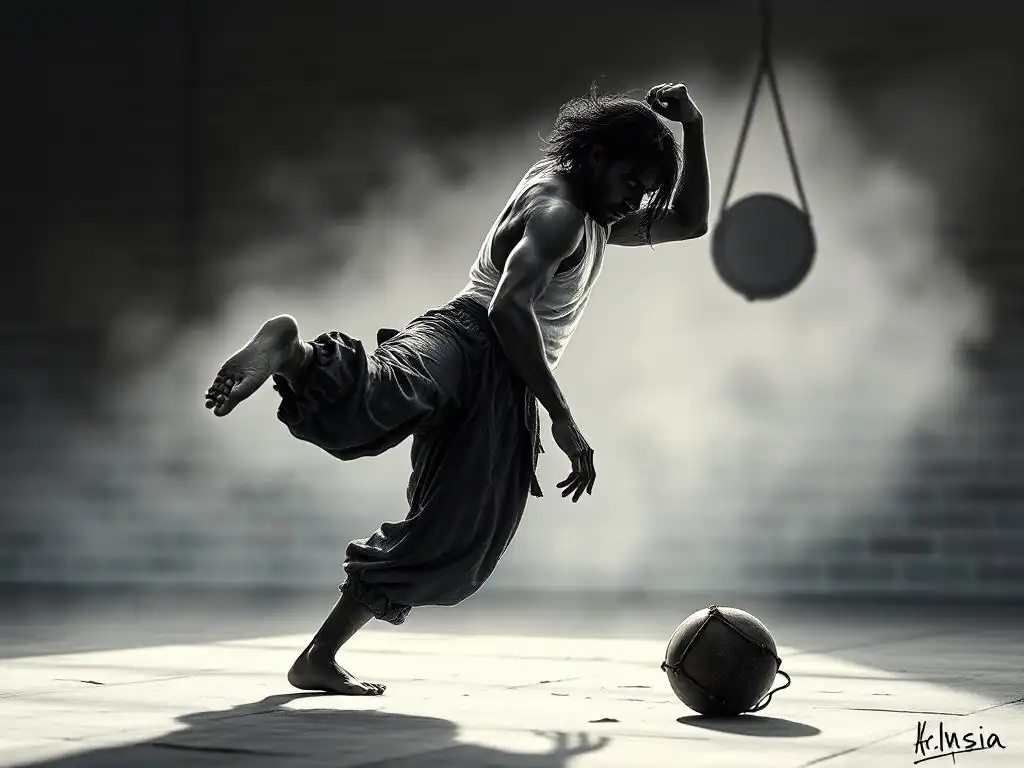
Ginga in Capoeira Angola: Tradition and Grounded Movement
Capoeira Angola, considered the more traditional style, features a ginga that is typically lower to the ground, slower, and more focused on subtle movements and strategic positioning. The ginga in Angola emphasizes deception, trickery, and close-range interaction. The movements are often wider and more circular, keeping the practitioner grounded and ready for sweeps, takedowns, and low evasions. The rhythm of the music in Angola is usually slower, which directly influences the pace and feel of the ginga.
The Angola ginga is less about explosive power and more about creating opportunities through patience and cunning. Practitioners spend more time low to the ground, utilizing movements like queda de quatro (fall of four) or negativa (negative) as extensions of their ginga. This style highlights the defensive and strategic aspects of the ginga movement philosophy martial arts, viewing it as a continuous conversation with the ground and the opponent, where every shift has meaning.
Ginga in Capoeira Regional: Dynamism and Explosiveness
Capoeira Regional, founded by Mestre Bimba, evolved with a faster pace and more emphasis on dynamic, athletic movements. The ginga in Regional is generally higher, faster, and more compact than in Angola. It is designed to facilitate quick transitions into powerful kicks, takedowns, and acrobatic movements. While still maintaining fluidity, the Regional ginga is often more linear, allowing for rapid forward and backward movement and aggressive attacks.
The focus in Regional ginga is on efficiency and readiness for explosive action. The stance is often narrower, enabling quicker pivots and weight shifts necessary for high kicks like armada or martelo. The faster rhythm of the Regional music dictates a more energetic and continuous flow. This style emphasizes the offensive and dynamic applications of the ginga movement philosophy martial arts, using it as a springboard for powerful techniques.
Ginga in Capoeira Contemporânea: Experimentation and Personal Expression
Capoeira Contemporânea, or Contemporary Capoeira, is a modern style that often blends elements from both Angola and Regional, while also incorporating influences from other martial arts, dance, and acrobatics. The ginga in Contemporânea is highly variable and often reflects the individual practitioner's lineage, training, and personal style. It can range from low and tricky to high and athletic, depending on the roda, the music, and the interaction between the players.
This style encourages experimentation and personal expression within the ginga. Practitioners may incorporate movements or rhythms not traditionally found in Angola or Regional. While acknowledging the roots of the ginga movement philosophy martial arts, Contemporânea allows for greater flexibility and innovation. The ginga serves as a versatile platform from which to launch a wide array of techniques, demonstrating the evolving nature of the art while still honoring its foundational principles.
The Future of Ginga: Evolution and Preservation of a Living Philosophy
Preserving the Roots of Ginga: Respecting the Ancestral Wisdom
Preserving the roots of ginga is crucial for maintaining the integrity and depth of Capoeira as a cultural and martial art. This involves studying the history, philosophy, and traditional practices associated with the ginga, particularly in the Angola and early Regional styles. Learning from experienced mestres who have dedicated their lives to the art is paramount, as they carry the living knowledge passed down through generations. Understanding the historical context of the ginga – its origins in resistance and its connection to Afro-Brazilian heritage – provides practitioners with a deeper appreciation for its significance.
Documentation, research, and the respectful transmission of traditional ginga forms are vital preservation efforts. Many Capoeira groups around the world prioritize teaching the historical ginga movement philosophy martial arts alongside modern applications. This ensures that new generations of practitioners understand the foundational principles and cultural significance before exploring contemporary interpretations. Preservation is not about freezing the art in time, but about understanding its origins to inform its future.
Innovating the Ginga: Embracing New Interpretations and Applications
While preserving its roots, the ginga is also a living philosophy that continues to evolve and be interpreted in new ways. Contemporânea Capoeira is a prime example of this, where practitioners experiment with incorporating diverse movement influences into their ginga. Innovation can involve exploring different rhythms, subtly altering the weight distribution for new effects, or integrating elements from other movement disciplines while maintaining the core principles of fluidity, unpredictability, and readiness.
Innovation in ginga also extends to finding new applications for its philosophy outside of Capoeira. As highlighted earlier, the ginga movement philosophy martial arts offers valuable lessons in adaptability, resilience, and navigating change, which are applicable in numerous modern contexts, from business to personal development. Embracing new interpretations ensures that the ginga remains relevant and continues to offer profound insights in a rapidly changing world.
The Enduring Legacy of Ginga: A Timeless Philosophy for Martial Artists and Beyond
The enduring legacy of ginga lies in its power as a timeless philosophy that transcends the physical movements of Capoeira. For martial artists, it offers a unique approach to combat that emphasizes continuous motion, deception, and adaptability over static power. It teaches the importance of rhythm, timing, and the ability to flow with an opponent rather than rigidly oppose them. This perspective enriches any martial arts practice, offering valuable lessons in strategy and movement.
Beyond martial arts, the ginga movement philosophy martial arts provides a universal metaphor for living a life of flexibility, resilience, and mindful presence. It encourages us to stay balanced while in motion, to embrace the constant change inherent in life, and to find strength and creativity in adaptability. The ginga's message of fluid strength and dynamic equilibrium resonates deeply, offering a profound philosophical framework for navigating the complexities of the modern world with grace and power.
Frequently Asked Questions
What is Ginga movement philosophy in martial arts?
Ginga movement philosophy is a core concept, primarily associated with Capoeira, that emphasizes constant, fluid movement. It represents a continuous adaptation to changing circumstances, both in combat and in life.
How does the Ginga movement relate to the keyword "Ginga movement philosophy martial arts"?
The keyword directly reflects the central theme of the philosophy. It highlights the importance of Ginga as a fundamental principle within martial arts, particularly Capoeira.
What are some practical applications of Ginga in self-defense?
Ginga's constant movement helps to avoid direct attacks, creating openings for counterattacks. It also improves balance and agility, crucial for effective self-defense.
How does the philosophy of Ginga extend beyond the physical aspects of martial arts?
Ginga serves as a metaphor for life, teaching adaptability and resilience in the face of challenges. It promotes a mindset of constant learning and evolution.
MartialArtsMastery.org provides in-depth resources, including historical overviews, training tips, and profiles of legendary practitioners, offering a comprehensive understanding of Ginga.
Final Reflection: Embracing the Unfolding Path
The essence of Ginga, as we've explored, isn't merely a martial arts technique, but a profound philosophy. This constant movement, this perpetual dance of adaptation, resonates deeply in our increasingly dynamic world. It reminds us that rigidity leads to stagnation, while embracing change allows us to navigate life's challenges with grace and resilience. The principles of Ginga, therefore, are not confined to the Capoeira roda, but offer a powerful framework for living a more fulfilling and adaptable life.
The influence of Ginga extends beyond the physical realm, shaping our mindset and approach to problem-solving. It teaches us to find opportunity in adversity, to flow around obstacles rather than colliding with them, and to constantly reinvent ourselves. This philosophy has profoundly impacted my own perspective, encouraging me to embrace uncertainty and view challenges as opportunities for growth. The obstacle is the way.
- Ryan Holiday, a sentiment that perfectly encapsulates the spirit of Ginga.
Now, I invite you to consider how the philosophy of Ginga can enrich your own life. How can you incorporate constant movement, both physically and mentally, to navigate the complexities of your own journey? Embrace the fluidity, the adaptability, and the unwavering spirit of Ginga. Let it guide you towards a life of constant growth, resilience, and unwavering self-expression. The dance is yours to create.
Embrace the Ginga: Ignite Your Life's Dance!
Thank you for exploring the philosophy of Ginga with us and discovering how movement can be a powerful metaphor for a fulfilling life. Now, it's time to put these principles into action and experience the transformative power of constant flow.
- Start with a step: Begin practicing a simple Ginga movement for just 5 minutes each day. Feel the rhythm and let it guide you.
- Share your reflections on how movement impacts your mindset in the comments below – what new perspectives did Ginga reveal to you?
- Explore other movement-based disciplines like dance, yoga, or even Tai Chi to discover how different forms of movement can enrich your life.
Ready to bring more flow and adaptability into your daily existence? What small step will you take today to embody the spirit of Ginga?