
The Sacred Trinity of Capoeira: Ginga, Kicks, and Acrobatics in Perfect Harmony

Welcome to Martial Arts Mastery!
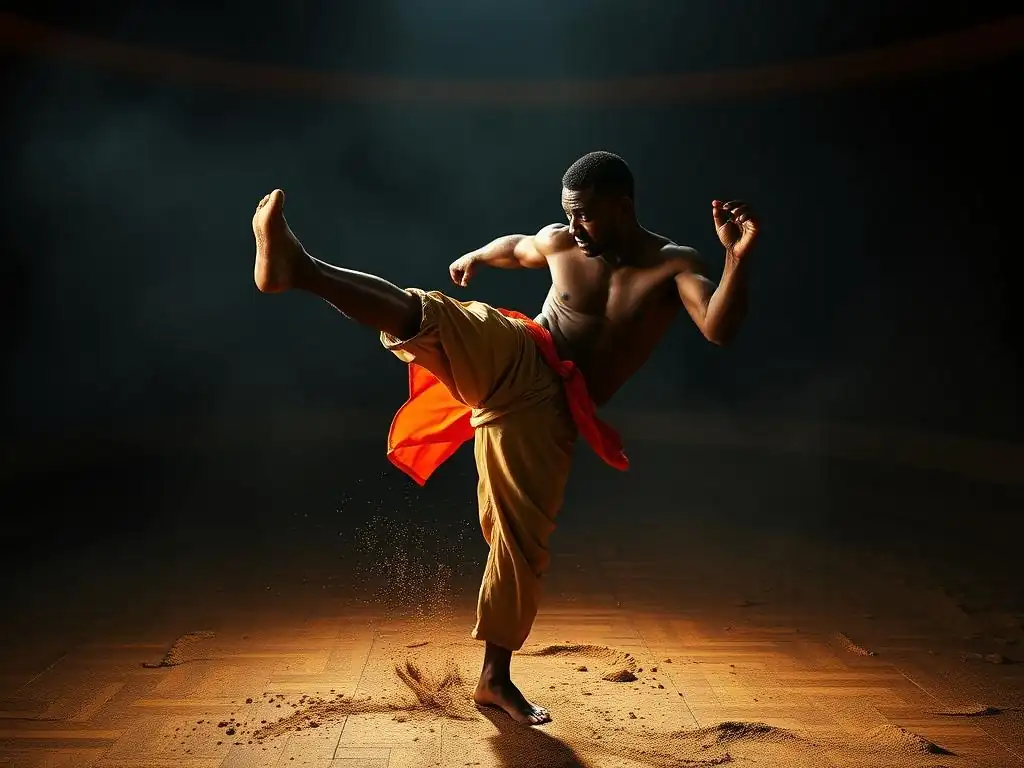
Delve into the captivating world of martial arts, where tradition meets technique and philosophy shapes power. Are you ready to explore the dynamic heart of Capoeira? This article unlocks the secrets behind the sacred trinity of Capoeira: Ginga, Kicks, and Acrobatics. Discover how these elements intertwine to create a mesmerizing dance of combat, and learn the practical steps to integrate them into your own training. Intrigued by the art of Capoeira Ginga Kicks Acrobatics Training? Then prepare to be amazed – the journey starts now!
- Understanding the Essence of Capoeira: Ginga, Kicks, and Acrobatics
- The Ginga: The Soul of Capoeira Movement
- Capoeira Kicks: Power, Precision, and Deception
- Acrobatics in Capoeira: Beyond Physicality, Embracing Expression
- Harmonizing Ginga, Kicks, and Acrobatics: The Capoeirista's Flow
- Capoeira Training Regimen: Focusing on the Trinity
- The Significance of the Roda in Practicing Ginga, Kicks, and Acrobatics
- Conclusion: Embracing the Holistic Nature of Capoeira Ginga Kicks Acrobatics
-
Frequently Asked Questions
- What is the significance of the Ginga in Capoeira training?
- How important are kicks in Capoeira combat and training?
- Why is acrobatics such a prominent element in Capoeira?
- How do Ginga, Kicks, and Acrobatics work together in Capoeira?
- Where can I find resources to begin learning Capoeira Ginga, Kicks, and Acrobatics?
- Final Reflection: Embracing the Flow of Capoeira
- Ignite Your Capoeira Journey!
Understanding the Essence of Capoeira: Ginga, Kicks, and Acrobatics
Capoeira's Core Movements: A Synthesis of Art and Combat
Capoeira is a unique Afro-Brazilian martial art that seamlessly blends elements of dance, acrobatics, and music. Its historical roots trace back to the enslaved African populations in Brazil, who developed it as a disguised form of combat and resistance. Unlike many martial arts with fixed stances and linear movements, Capoeira is characterized by continuous motion, deception, and fluidity. This constant flow, embodied by the Ginga, serves as the foundation for both offensive and defensive maneuvers, making it distinctively unpredictable and dynamic. The core movements are not merely physical techniques but are deeply intertwined with cultural expression and a sense of freedom, reflecting its origins.
The synthesis of art and combat in Capoeira is evident in how techniques are executed. A powerful kick ( chapa) might follow a graceful evasion ( esquiva), which itself is initiated from the rhythmic movement of the Ginga. Acrobatics ( floreios) are not just for show; they can be used to evade attacks, reposition, or even launch unexpected strikes. This holistic approach means that effective Capoeira training requires developing not just physical strength and technique, but also rhythm, timing, and strategic thinking within the context of the roda (the circle where Capoeira is played). The integration of these diverse elements is what gives Capoeira its distinctive character as both a fight and a dance.
Exploring the Interdependence of Ginga, Kicks, and Acrobatics in Capoeira Training
The three pillars of Capoeira – Ginga, kicks, and acrobatics – are profoundly interdependent. The Ginga is the perpetual motion that enables all other techniques. Without a solid, adaptable Ginga, kicks lack power and precision, and acrobatic movements become isolated stunts rather than functional parts of the flow. For instance, a strong martelo (hammer kick) is often launched from the deceptive rhythm of the Ginga, using the body's momentum generated by the swaying motion. Similarly, an evasive queda de rins (fall to the kidneys) is a low-level acrobatic maneuver that relies on the Ginga for positioning and balance before, during, and after the movement.
Effective Capoeira Ginga Kicks Acrobatics Training emphasizes the seamless transition between these elements. Practicing kicks in isolation is useful for developing power, but true mastery comes from integrating them into the Ginga, learning to strike from different angles and rhythms. Acrobatics, while requiring specific physical conditioning, are practiced within the context of the 'game' ( jogo), used to escape danger, bridge distance, or surprise an opponent, always returning to or flowing through the Ginga. A typical training session might involve drills that combine basic Ginga footwork with evasions, followed by a sequence involving a kick and an acrobatic recovery, highlighting how each element supports and enhances the others. This holistic approach is crucial for developing a complete capoeirista.
The Ginga: The Soul of Capoeira Movement
Mastering the Ginga: Footwork and Body Movement Fundamentals
Mastering the Ginga is the absolute cornerstone of Capoeira Ginga Kicks Acrobatics Training. It is not a static stance but a continuous, rhythmic, back-and-forth movement of the body, primarily driven by the legs and hips, with the arms guarding the face and torso. The fundamental Ginga involves stepping one leg back from a parallel stance, shifting the body's weight onto the back leg, and then returning to the parallel stance, alternating legs.
The torso remains relatively low, and the head is kept level, scanning the opponent. The hands protect the face, often moving in sync with the legs or providing deceptive feints.
The key to a good Ginga lies in its fluidity, balance, and unpredictability. It must be relaxed yet controlled, allowing the capoeirista to transition instantly into an attack, defense, or evasion. A common mistake for beginners is making the Ginga too stiff or robotic.
Experienced practitioners develop a loose, almost dance-like quality, using subtle shifts in weight and tempo to mislead their opponent. The footwork is precise, ensuring the feet are never crossed in a vulnerable position and that the base is always stable enough to launch or absorb impact. Consistent practice of the basic Ginga, focusing on rhythm, balance, and relaxation, is essential before progressing to more complex techniques.
Ginga Variations: Adapting the Foundation for Different Situations
While the basic Ginga provides the fundamental rhythm, skilled capoeiristas employ numerous variations to adapt to different situations within the jogo. These variations can involve changes in tempo, level, and angle, adding layers of complexity and deception. For instance, a capoeirista might speed up the Ginga to pressure an opponent, or slow it down to conserve energy and observe. The level can be lowered ( Ginga baixa) to invite low attacks and facilitate ground movements or raised ( Ginga alta) to prepare for higher kicks and acrobatics.
Angular variations involve changing the direction of the back step, moving sideways or even slightly forward, altering the lines of attack and defense. Some variations are specific to different Capoeira styles; for example, Capoeira Angola tends to feature a lower, slower, and more deceptive Ginga, often incorporating feints and ground movements, while Capoeira Regional often uses a slightly higher, faster, and more direct Ginga. Mastering these variations allows the capoeirista to control the distance, dictate the rhythm of the game, and create openings for effective Capoeira Ginga Kicks Acrobatics Training techniques.
Ginga's Role in Offensive and Defensive Capoeira Strategies
The Ginga is not merely a preparatory movement; it is an active component of both offensive and defensive strategies. Offensively, the rhythmic swaying motion masks the initiation of attacks. A kick can explode from the Ginga almost instantaneously, making it difficult for the opponent to anticipate. The Ginga also allows the capoeirista to constantly shift angles, creating unexpected lines of attack and keeping the opponent guessing. Feints within the Ginga, such as a subtle shoulder drop or a hand movement, can draw reactions and create openings for strikes.
Defensively, the Ginga provides the mobility necessary for evasion. By constantly moving, the capoeirista presents a difficult target. The back-and-forth motion allows for quick weight shifts needed for evasions like esquiva lateral (side evasion) or cabeçada (headbutt evasion). The Ginga also helps maintain optimal distance from the opponent, allowing the capoeirista to stay out of range of their attacks while remaining close enough to counter. Ultimately, the Ginga's primary defensive role is to keep the capoeirista alive and in a position to respond effectively, proving its centrality in all aspects of Capoeira Ginga Kicks Acrobatics Training.
Capoeira Kicks: Power, Precision, and Deception
Basic Capoeira Kicks: A Foundation for Striking Techniques
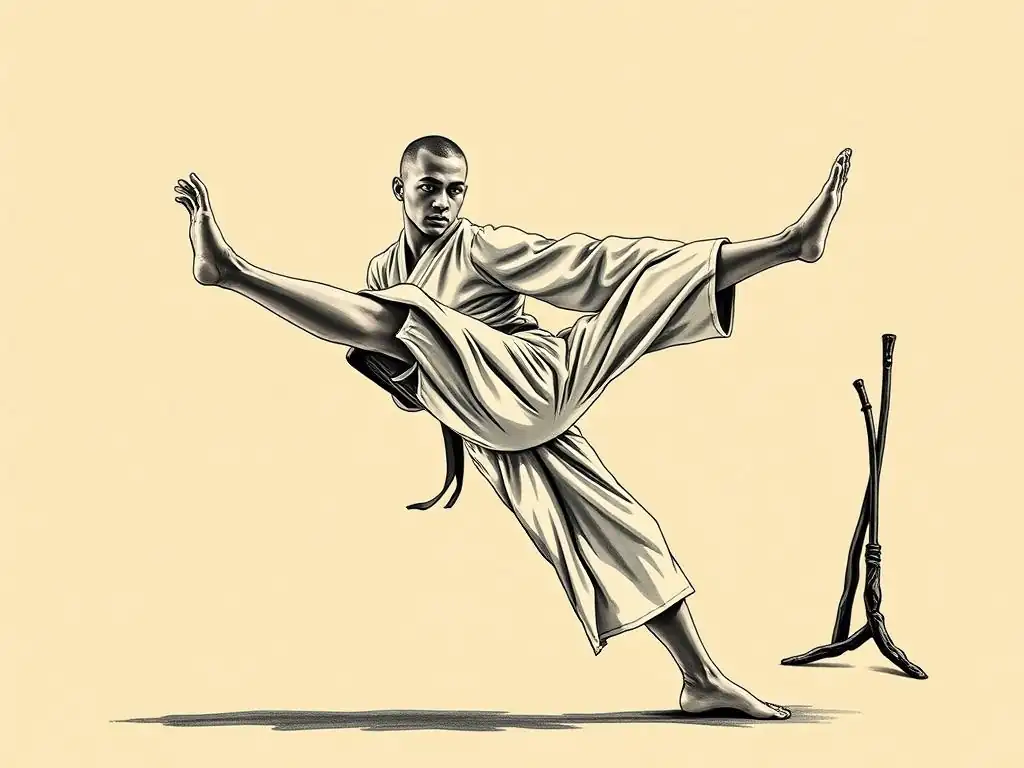
Capoeira's arsenal of kicks is diverse, ranging from simple, direct strikes to complex, spinning techniques. The foundational kicks are essential for building power, balance, and understanding the mechanics of striking from the Ginga. One of the most common basic kicks is the Meia Lua de Frente (Front Half Moon), a semicircular kick executed by swinging the leg in front of the body, often targeting the head or torso. Another fundamental is the Martelo (Hammer), a powerful straight kick delivered with the instep or ball of the foot, typically aimed at the torso or head.
Other basic kicks include the Chapa (Stomp Kick), a powerful straight push kick often targeting the torso or legs, and the Gancho (Hook Kick), a less common but effective kick where the heel strikes the target. Practicing these basic kicks repeatedly, focusing on technique, balance during and after the kick, and seamless integration with the Ginga, is crucial for developing a strong striking foundation in Capoeira Ginga Kicks Acrobatics Training. Mastery of these fundamentals allows capoeiristas to develop the power and precision required for more advanced movements.
Advanced Capoeira Kicks: Mastering Complex and Atypical Movements
Beyond the basics, Capoeira features a wide array of advanced and often visually spectacular kicks that demand significant balance, coordination, and flexibility. Spinning kicks are particularly characteristic, such as the Armada (Spinning Heel Kick), a powerful strike executed after a full 360-degree spin, and the Queixada (Jaw Kick), a spinning kick similar to the Armada but often delivered with the instep. The Meia Lua de Costas (Back Half Moon) is another spinning kick, executed while turning away from the opponent.
More complex kicks include the Paráda de Mão (Handstand Kick), where a kick is delivered from a handstand position, and various kicks involving jumps or multiple spins. These advanced techniques are not just about power; they often rely heavily on deception and timing, launching unexpectedly from the flow of the Ginga or an acrobatic movement. Mastery of advanced Capoeira kicks requires dedicated Capoeira training, focusing on body control, spatial awareness, and the ability to generate power from complex movements, seamlessly blending them into the overall game.
Integrating Kicks with the Ginga for Fluid Combat
The true effectiveness of Capoeira kicks lies in their integration with the Ginga. Kicks are rarely thrown from a static position; they erupt from the continuous motion, using the momentum generated by the Ginga. This makes them difficult to predict and defend against. Training focuses on transitioning smoothly from the Ginga into a kick and back into the Ginga or an evasion. Drills often involve practicing specific kick entries and exits, such as stepping out of the Ginga into a Martelo or using the momentum of an Armada to flow into another movement.
A skilled capoeirista can throw a kick, miss or have it blocked, and immediately transition into an evasion or another attack without losing rhythm or balance. This fluidity is achieved through countless hours of Capoeira Ginga Kicks Acrobatics Training, focusing on the connection between the rhythmic base and the explosive strike. The Ginga provides the rhythm and positioning, while the kick provides the impact. The seamless blend creates a dynamic and unpredictable fighting style where strikes are just one part of a continuous, flowing dialogue between players.
The Art of Deception in Capoeira Kicking Techniques
Deception is a critical element in Capoeira, and it is heavily employed in kicking techniques. The Ginga itself is a form of deception, masking intentions and creating false openings. Kicks are often initiated with subtle movements that don't immediately signal the upcoming strike. A capoeirista might feint a low attack before launching a high kick, or use the motion of an evasion to set up a spinning strike. The unpredictable nature of the Ginga allows for kicks to be thrown from unusual angles or at unexpected moments.
Furthermore, some kicks are designed inherently for deception. For example, the Rabo de Arraia (Ray's Tail) is a powerful spinning kick delivered with the heel, often initiated from a low position or a feint, making it difficult to see coming. The visual complexity of Capoeira movements, including acrobatics, also serves to distract the opponent, creating opportunities for kicks. Mastering deception requires not just technical skill but also strategic thinking and the ability to read the opponent's reactions, making it a vital component of advanced Capoeira Ginga Kicks Acrobatics Training.
Acrobatics in Capoeira: Beyond Physicality, Embracing Expression
The Role of Acrobatics in Capoeira's Visual Language
Acrobatics, known as floreios in Capoeira, are much more than mere gymnastic displays. They are an integral part of Capoeira's unique visual language, serving multiple functions within the jogo. Floreios add a dimension of theatricality and expression, distinguishing Capoeira from purely combat-focused martial arts. They showcase the capoeirista's skill, control, and creativity, adding beauty and fluidity to the game. While they can be spectacular, their primary purpose is often functional, used to evade, reposition, or surprise.
The visual impact of acrobatics also contributes to the psychological aspect of the game. A well-executed floreio can intimidate an opponent, demonstrate confidence, and control the energy of the roda. Historically, these movements may have also served to further disguise the combat nature of Capoeira, making it appear more like a dance or performance to onlookers who might suppress overt fighting. Thus, acrobatics weave together utility, expression, and history within the fabric of Capoeira Ginga Kicks Acrobatics Training.
Foundational Capoeira Acrobatics: Esquivas, Au, and Quedas
While many think of flashy flips when discussing Capoeira acrobatics, the foundation lies in more fundamental movements that blend evasion and ground control. The Esquiva (Evasion) is arguably the most crucial defensive movement, involving dropping the body low to avoid attacks, often with support from one or two hands on the ground ( Esquiva baixa, Esquiva lateral, Esquiva diagonal). These are not high-flying moves but essential ground-level acrobatics for survival.
The Au (Cartwheel) is another foundational movement. It is not always executed in a straight line like a typical gymnastics cartwheel; in Capoeira, the Au is often performed diagonally, sometimes with hands on the ground for only a moment ( Au sem mão - cartwheel without hands), or even incorporating kicks during the movement ( Au batizado). It serves as a versatile transition, evasion, or even a deceptive entry into an attack. Quedas (Falls) are controlled ways of going to the ground or recovering from a loss of balance, such as Queda de Rins (Fall to the Kidneys), a low defensive position, or Queda de Quatro (Fall of Four), a four-point stance used for defense or transition. Mastering these foundational movements is vital for progression in Capoeira Ginga Kicks Acrobatics Training.
Advanced Capoeira Acrobatics: Floreios and Complex Movements
Advanced Capoeira acrobatics, the floreios, encompass a wide range of complex and often visually impressive movements. These include various handstands ( Paráda de Mão), headstands ( Paráda de Cabeça), bridges ( Ponte), and more dynamic movements like aerials ( Aú sem mão), flips ( Salto), and spins ( Folha Seca - Dry Leaf, a falling spinning movement). These techniques require significant strength, flexibility, balance, and body control.
Floreios are used strategically in the jogo. An Au sem mão might be used to quickly cover distance or evade a sweeping attack. A Folha Seca can be a deceptive way to enter or exit the range. While they can be expressive, their effective use in Capoeira Ginga Kicks Acrobatics Training means integrating them seamlessly into the flow of the Ginga and kicks, ensuring they contribute to the strategic dialogue rather than being isolated stunts. Developing these advanced skills takes years of dedicated practice and physical conditioning.
Safety Considerations for Capoeira Acrobatics Training
Given the dynamic and sometimes inverted nature of Capoeira acrobatics, safety is paramount in training. Proper warm-up and conditioning are essential to prepare the muscles and joints. Learning foundational movements like Au and basic evasions with correct technique under the supervision of an experienced instructor is crucial before attempting more advanced floreios. Common injuries can include sprains, strains, and impacts from falls if not executed correctly.
Progressive training is key. Beginners should start with simple ground movements and controlled falls, gradually building strength and coordination before attempting handstands, aerials, or flips. Learning how to fall safely ( queda amortecida) is as important as learning the movements themselves. Using appropriate training surfaces, such as mats, can also reduce the risk of injury, especially when practicing new or complex techniques. Emphasizing safety allows practitioners to explore the full potential of Capoeira Ginga Kicks Acrobatics Training while minimizing risk.
Harmonizing Ginga, Kicks, and Acrobatics: The Capoeirista's Flow
Drills for Integrating Ginga, Kicks, and Acrobatics in Capoeira
Integrating Ginga, kicks, and acrobatics is the core objective of Capoeira training beyond mastering individual techniques. Drills are designed to build seamless transitions and fluid combinations. A common drill starts with the Ginga, from which the practitioner initiates a specific kick (e.g., Martelo), follows it with an evasion ( Esquiva lateral), and transitions into a low acrobatic movement ( Queda de Rins) before returning to the Ginga. These sequences are practiced repeatedly, focusing on smooth flow rather than speed initially.
More complex drills might involve chaining multiple techniques, such as Ginga -> Meia Lua de Frente -> Au -> Ginga, or Ginga -> feint -> Chapa -> Esquiva -> Queda de Quatro. Partner drills are also essential, where practitioners react to each other, applying the trinity in a dynamic, semi-controlled environment. For instance, one partner throws a slow kick, and the other practices evading with an acrobatic movement and countering, all while maintaining the Ginga rhythm. These integration drills are vital for developing the intuitive flow needed in the roda and are a key part of effective Capoeira Ginga Kicks Acrobatics Training.
Developing Fluidity and Improvisation in Capoeira Practice
Fluidity is the ability to move seamlessly between Ginga, kicks, and acrobatics without hesitation or stiffness. Improvisation is the ability to combine these elements spontaneously in response to the opponent and the rhythm of the music in the roda. Developing both requires extensive practice and a deep understanding of how the movements connect. Training often involves jogos (games) played at varying speeds and intensities, encouraging practitioners to experiment with combinations and transitions.
Listening intently to the berimbau (the main musical instrument) is also crucial, as the speed and rhythm of the music dictate the tempo and energy of the game, influencing the choice and execution of movements. Practitioners learn to 'converse' with their opponent using the language of Ginga, kicks, and acrobatics, responding creatively to their actions. This spontaneous interaction within the roda is where true fluidity and improvisation are honed, transforming technical skills into a dynamic and expressive dialogue.
Martelo-Au-Armada Sequence
A classic example of integrating the trinity is the Martelo-Au-Armada sequence. This sequence demonstrates how a kick can lead to an acrobatic movement, which then sets up another kick, all flowing from and returning to the Ginga.
- Start in the Ginga.
- Explode from the Ginga into a
Martelo(hammer kick). - Immediately after the kick, use the momentum to transition into an
Au(cartwheel), often moving diagonally or sideways to change the angle. - As the
Aufinishes, use the rotational momentum to launch into anArmada(spinning heel kick). - Land and return smoothly to the Ginga or an evasive position.
This sequence, while challenging, illustrates the principle of continuous motion and how elements of Capoeira Ginga Kicks Acrobatics Training chain together. Practicing such combinations helps build the physical coordination and mental agility needed for spontaneous play in the roda.
Capoeira Training Regimen: Focusing on the Trinity
Building a Strong Foundation for Ginga, Kicks, and Acrobatics
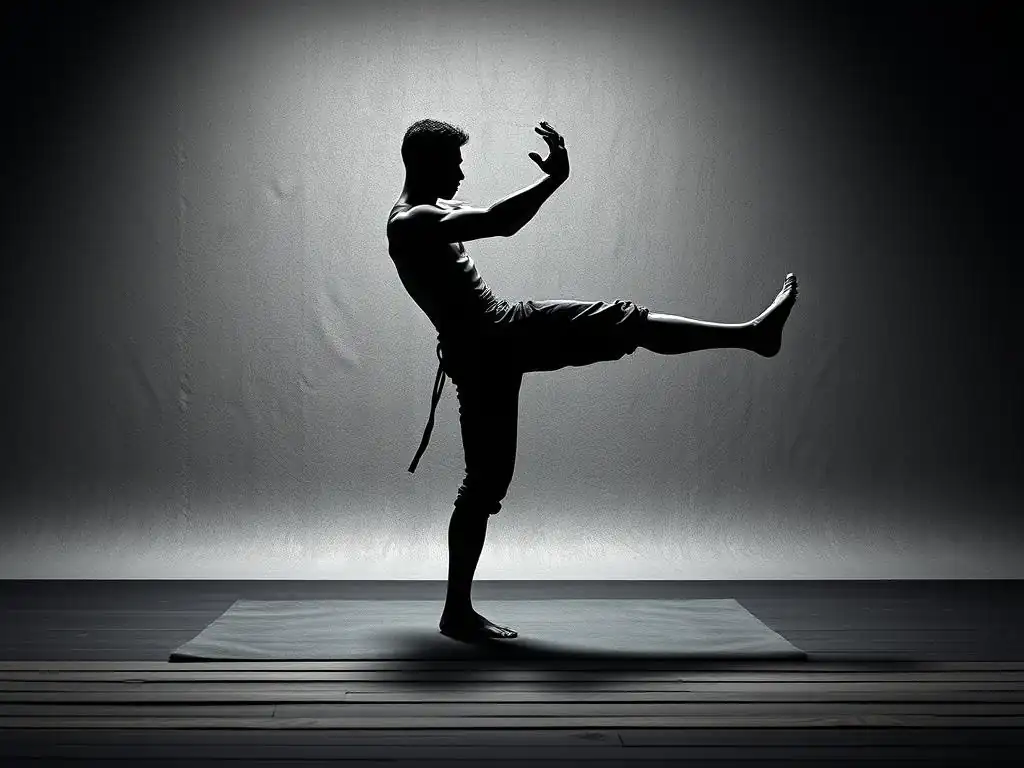
A comprehensive Capoeira training regimen prioritizes building a strong foundation in all three core areas: Ginga, kicks, and acrobatics. Beginners typically spend significant time drilling the basic Ginga until it becomes natural and fluid. This foundational work involves repetitive practice of the footwork, body weight shifts, and protective hand positions, often for 15-20 minutes per session or more. Simultaneously, basic kicks like Martelo and Meia Lua de Frente are introduced, focusing on technique, balance, and power generation.
Ground movements and basic evasions ( Esquivas, Quedas) are also taught early as they are fundamental defensive and transitional skills. A typical beginner class might dedicate roughly equal time to Ginga drills, basic kick practice, and foundational ground movements/evasions. This balanced approach ensures that students develop a well-rounded base before attempting more complex techniques, making their overall Capoeira Ginga Kicks Acrobatics Training more effective and safer.
Strength and Conditioning for Capoeira Movement
Effective execution of Capoeira movements, particularly powerful kicks and dynamic acrobatics, requires specific strength and conditioning. Lower body strength is crucial for the Ginga's stability, generating power in kicks, and executing evasions and low movements. Exercises like squats, lunges, and calf raises are beneficial. Core strength is vital for maintaining balance during kicks and acrobatics, transitioning between movements, and protecting the spine; planks, twists, and leg raises are often included in training.
Upper body strength is needed for handstands, cartwheels, and ground movements; push-ups, dips, and shoulder exercises are relevant. Flexibility, especially in the hips, hamstrings, and shoulders, is also critical for executing high kicks and acrobatic movements without injury. Conditioning includes cardiovascular endurance training, as the continuous motion of the Ginga and the explosive nature of techniques demand stamina. Many Capoeira schools incorporate bodyweight exercises, animal flow movements (like Ginga variations or Queda de Quatro transitions), and dynamic stretching as part of their Capoeira Ginga Kicks Acrobatics Training regimen.
Flexibility and Mobility Training for Capoeira
High levels of flexibility and mobility are indispensable for advanced Capoeira Ginga Kicks Acrobatics Training. Hip flexibility is paramount for executing high, powerful kicks like Martelo and Armada, as well as for achieving low, stable positions in the Ginga and evasions like Esquiva baixa. Hamstring flexibility is needed for kicks and many ground movements. Shoulder and wrist mobility are crucial for handstands, cartwheels, and other weight-bearing acrobatic moves.
Training often includes static stretching after warm-up or sessions, holding stretches for 20-30 seconds, and dynamic stretching as part of the warm-up. Specific stretches targeting the hip flexors, hamstrings, quadriceps, and shoulders are common. Mobility drills, such as hip circles, leg swings, and torso twists, help improve range of motion and prepare the joints for dynamic movements. Regular flexibility and mobility work not only enhances performance but also significantly reduces the risk of injury during rigorous Capoeira training.
Incorporating Musicality into Capoeira Training
Music is the driving force and the soul of Capoeira, and incorporating musicality into training is essential for developing the rhythm, timing, and flow characteristic of the art. The instruments of the berimbau orchestra ( berimbau, atabaque, pandeiro) dictate the speed and style of the jogo. Training involves learning to listen to the berimbau and move in time with its rhythm. This helps practitioners develop the internal timing needed to initiate movements at the right moment and maintain the flow of the game.
Singing the traditional songs ( corridos, ladainhas) is also part of the training, connecting practitioners to the history and culture of Capoeira and building community. The call-and-response structure of many songs encourages participation and builds energy. Learning the different rhythms ( toques) played on the berimbau (e.g., Angola, Regional, Iúna) teaches practitioners how to adapt their game to different styles and intensities. Integrating music into every aspect of Capoeira Ginga Kicks Acrobatics Training is not just about tradition; it's fundamental to developing the art's unique expression and combat effectiveness.
The Significance of the Roda in Practicing Ginga, Kicks, and Acrobatics
The Roda as a Training Ground for Capoeira Skills
The roda (Portuguese for "circle") is the central stage for practicing and performing Capoeira. It is formed by capoeiristas, musicians, and spectators, with the orchestra positioned at one end. The roda is where all elements of Capoeira Ginga Kicks Acrobatics Training come together in a live, dynamic interaction. It is the testing ground for techniques learned in class, providing a context where strategy, timing, and adaptability are paramount. Playing in the roda allows practitioners to experience the unpredictable nature of Capoeira combat-game and learn to apply their skills under pressure.
Within the roda, capoeiristas enter two at a time to 'play' ( jogar). This play is a dialogue expressed through movement – Ginga, kicks, evasions, acrobatics. It's not a direct fight aiming for knockout, but a strategic exchange where players challenge each other, test their defenses, and express themselves. The energy and rhythm of the roda, driven by the music and the collective participation, significantly influence the game played within it. Regular participation in the roda is indispensable for truly understanding and developing one's Capoeira.
Understanding the Interaction in the Roda
Interaction in the roda is a complex interplay of movement, rhythm, and strategy. It's a conversation where each movement is a phrase or sentence. Players use their Ginga to maintain distance, observe the opponent, and create opportunities. They use kicks to attack, test defenses, or control space. They use evasions and acrobatics to defend, escape, and surprise. The goal is often to control the rhythm and flow of the game, predicting or influencing the opponent's actions while remaining unpredictable oneself.
Players read each other's bodies, anticipating intentions based on subtle shifts in Ginga or preparatory movements. They also listen to the music and the energy of the roda, which can signal changes in the pace or intensity of the game. The interaction is not always aggressive; it can range from a slow, strategic game ( jogo de dentro) to a fast, dynamic exchange ( jogo de fora). Understanding this non-verbal dialogue and learning to respond effectively is a key aspect of Capoeira Ginga Kicks Acrobatics Training that can only be fully developed within the roda.
Applying Ginga, Kicks, and Acrobatics in the Roda Environment
Applying Ginga, kicks, and acrobatics effectively in the roda requires more than just technical proficiency; it demands strategic thinking and adaptability. The Ginga must be fluid and deceptive, constantly creating angles and masking intentions. Kicks must be timed precisely, often launched from unexpected positions within the Ginga or following an evasion or acrobatic move. Acrobatics are used functionally – to escape sweeps, avoid kicks, or change level rapidly – rather than just for performance, always with a purpose within the strategic exchange.
For example, a capoeirista might use a low Esquiva to avoid a kick, then transition immediately into a Queda de Rins to maintain a defensive ground position, from which they might launch a low Rasteira (sweep) or rise back into the Ginga to initiate a kick. Another might use an Au to evade a close attack and land in a position to counter with a spinning kick like Armada. The roda provides the real-time feedback necessary to learn which techniques work in which situations and how to combine them fluidly and strategically, making it the ultimate test and refinement ground for Capoeira Ginga Kicks Acrobatics Training.
Conclusion: Embracing the Holistic Nature of Capoeira Ginga Kicks Acrobatics
The art of Capoeira is a powerful synthesis where Ginga, kicks, and acrobatics are not isolated techniques but interconnected elements of a dynamic, holistic system. Mastery lies not in excelling at one aspect alone, but in harmonizing all three, allowing them to flow seamlessly together. The rhythmic foundation of the Ginga enables the explosive power of kicks and the expressive utility of acrobatics. Kicks provide the combative edge, while acrobatics offer escape, deception, and visual flair. All are practiced and tested within the vibrant, challenging environment of the roda, driven by the soul-stirring music. True Capoeira Ginga Kicks Acrobatics Training embraces this unity, developing practitioners who are not just fighters or dancers, but complete capoeiristas embodying the art's rich history, culture, and dynamic movement.
Frequently Asked Questions
What is the significance of the Ginga in Capoeira training?
The Ginga is the fundamental movement in Capoeira. It's not just a dance step, but a constant shifting of weight and positioning that allows for agility, evasion, and attack. It's the rhythm of Capoeira.
How important are kicks in Capoeira combat and training?
Kicks are a primary offensive weapon in Capoeira. Training focuses on power, precision, and disguise, often delivered from unexpected angles or transitions from the Ginga. Kicks are integral to the game.
Why is acrobatics such a prominent element in Capoeira?
Acrobatics enhance Capoeira's evasiveness, deception, and overall dynamism. While not strictly necessary for self-defense, they add complexity and flair to the jogo (game) and can create openings for attacks or escapes.
How do Ginga, Kicks, and Acrobatics work together in Capoeira?
They form a synergistic triad. The Ginga provides the foundation, kicks the offensive power, and acrobatics the unpredictability and agility. Mastering all three is crucial for a well-rounded Capoeira game.
Where can I find resources to begin learning Capoeira Ginga, Kicks, and Acrobatics?
Websites like MartialArtsMastery.org offer historical overviews, training techniques, and practical self-defense strategies. Look for qualified Capoeira instructors and consider supplementary training to improve flexibility and strength.
Final Reflection: Embracing the Flow of Capoeira
The essence of Capoeira, as we've explored, lies in the harmonious interplay of Ginga, Kicks, and Acrobatics. This trinity, far from being a mere collection of techniques, represents a holistic approach to movement, expression, and self-discovery that resonates deeply in today's world. In a society often fragmented and disconnected, Capoeira offers a path towards integration, both within oneself and with others.
The influence of Capoeira extends far beyond the roda. It's a living testament to resilience, creativity, and cultural heritage. Witnessing its evolution and the dedication of practitioners worldwide underscores its enduring power to inspire and transform. Capoeira is more than a fight, it's a dance, a game, a conversation, a history lesson, and a way of life.
This quote perfectly encapsulates the multifaceted nature of Capoeira and its profound impact on those who embrace it.
As you reflect on the Ginga, the Kicks, and the Acrobatics, consider how these principles can be applied to your own life. Embrace the flow, find your balance, and express yourself with courage and creativity. Let the spirit of Capoeira guide you towards a more integrated and fulfilling existence.
Ignite Your Capoeira Journey!
Thank you for exploring the dynamic world of Capoeira with us. Now that you understand the core elements, it's time to put that knowledge into action.
- Embrace the Ginga: Dedicate 15 minutes each day to practicing your Ginga in front of a mirror, focusing on fluidity and rhythm.
- Share your biggest Capoeira takeaway with a friend or fellow enthusiast on social media using #MartialArtsMastery.
- Dive deeper: Research the history of Capoeira in Brazil and uncover the stories behind this powerful art form.
What small step will you take today to honor the sacred trinity of Capoeira?