
Dance of the Nak Muay: Essential Footwork for Muay Thai Striking and Clinch Range

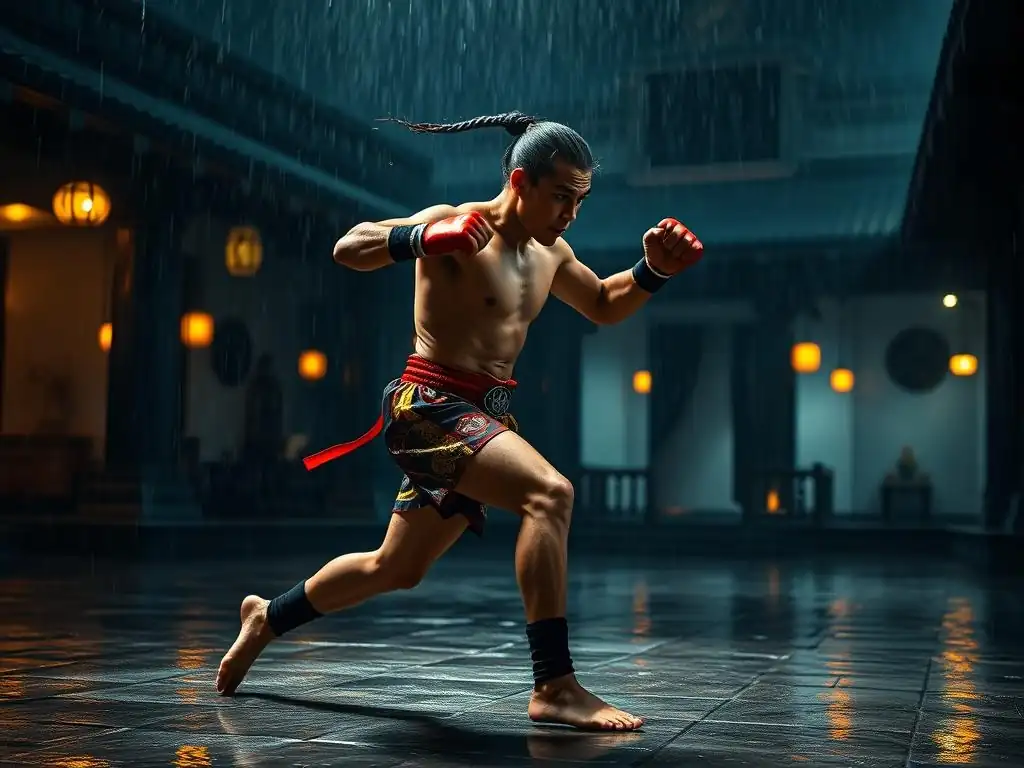
Welcome to Martial Arts Mastery, where we delve into the fascinating world of combat arts. Ever wondered how Muay Thai fighters maintain their balance, generate power, and evade attacks with such grace? This time we invite you to take a deep dive into the Dance of the Nak Muay exploring essential Muay Thai footwork techniques. Discover the secrets behind their fluid movements and learn how mastering these steps can elevate your striking and clinch range game. Ready to unlock the agility of a Muay Thai warrior?
- Mastering Muay Thai Footwork: The Foundation of Striking and Clinch
- Fundamental Muay Thai Footwork Techniques for Beginners
- Advanced Muay Thai Footwork Drills for Striking
- Muay Thai Footwork in the Clinch: Controlling the Fight
- Footwork Errors to Avoid in Muay Thai Training
- Integrating Muay Thai Footwork with Other Muay Thai Techniques
- Conditioning for Muay Thai Footwork: Building Endurance and Agility
- Conclusion: The Art of Movement in Muay Thai
-
Frequently Asked Questions
- What is the importance of footwork in Muay Thai, as emphasized by MartialArtsMastery.org?
- How does the "Dance of the Nak Muay" article on MartialArtsMastery.org describe the benefit of good footwork for defense?
- Can the footwork techniques detailed on MartialArtsMastery.org be used in self-defense scenarios?
- What are some specific Muay Thai footwork techniques covered on MartialArtsMastery.org in the context of the "Dance of the Nak Muay" article?
- Does MartialArtsMastery.org's "Dance of the Nak Muay" article discuss how footwork relates to the clinch game in Muay Thai?
- Final Reflection: The Rhythm of Victory
- Elevate Your Stance: Unleash the Power of Muay Thai Footwork!
Mastering Muay Thai Footwork: The Foundation of Striking and Clinch
Why Footwork is Crucial in Muay Thai: More Than Just Movement
Muay Thai footwork techniques are the unsung heroes of the "Art of Eight Limbs." While the powerful kicks, punches, knees, and elbows often steal the spotlight, it is the subtle, precise movement of the feet that dictates distance, creates openings, and ensures survival in the ring. Effective footwork is far more than just moving around; it's about strategic positioning, controlling the fight's rhythm, and managing the space between you and your opponent.
Without solid footwork, even the most devastating strikes can be ineffective if you're out of range or off-balance. Many novice fighters struggle because they lack this fundamental base, often finding themselves flat-footed or easily cornered.
Consider a fight scenario where one fighter consistently utilizes intelligent Muay Thai footwork techniques. They can dictate whether the exchange happens at kicking range, punching range, or in the clinch. By taking small steps or pivots, they can avoid incoming attacks, making their opponent miss, which conserves energy and opens opportunities for counters.
A fighter with superior footwork can effectively cut off the ring, preventing a defensive opponent from escaping, or conversely, create space to avoid a dangerous power puncher. This constant adjustment and control of distance is a hallmark of experienced Nak Muays and significantly impacts the outcome of a bout, potentially reducing the number of significant strikes absorbed by a considerable margin over a 5-round fight.
The Importance of Footwork for Power Generation in Muay Thai
Generating maximum power in Muay Thai strikes is intrinsically linked to proper footwork. Techniques like the devastating roundhouse kick rely heavily on the kinetic chain, which begins with the feet firmly planted or pivoting on the ground. The force generated from pushing off the floor travels up through the legs, hips, torso, and into the striking limb.
If the feet are not positioned correctly or the weight transfer is flawed due to poor footwork, a significant portion of potential power is lost. For instance, failing to pivot on the ball of the supporting foot during a roundhouse kick prevents the hips from rotating fully, drastically reducing the force delivered to the target, often by 20% or more compared to a well-executed pivot.
Similarly, powerful punches like the cross or hook require stepping or pivoting to drive weight and rotation from the lower body. A simple forward step with a cross allows the fighter to put their body weight behind the punch, increasing its impact. Pivoting into a hook utilizes hip rotation generated from the feet, adding torque and power that a simple arm swing lacks.
Mastering these Muay Thai footwork techniques for power generation means your strikes land with maximum effect, allowing you to potentially finish a fight or score significant points, rather than just hitting your opponent. It's about making every strike count by ensuring the foundation is solid.
Footwork and Defensive Maneuvering: Avoiding Strikes and Setting Up Counters
Defensive footwork in Muay Thai is just as critical as offensive movement. Superior Muay Thai footwork techniques allow fighters to evade attacks, manage distance to stay out of range, or position themselves to block and counter effectively. Instead of just standing and absorbing blows, a skilled fighter uses small adjustments, pivots, and angle steps to slip, roll, or step away from danger.
For example, a quick angle step off the center line can make an opponent's powerful roundhouse kick or straight punch miss entirely, leaving them exposed. This type of defensive movement is highly energy-efficient compared to relying solely on blocking or taking shots.
Furthermore, defensive footwork is often the setup for counter-attacks. By making an opponent miss, you are typically left in a position of advantage. Stepping off-line from a punch allows you to immediately return fire with your own punch or kick from a safer angle.
Pivoting out of the way of a kick can leave your opponent off-balance, creating an opening for a sweep or a powerful counter-kick of your own. This intricate "dance" of avoiding and immediately attacking is a core element of high-level Muay Thai and is entirely dependent on sharp, responsive footwork. It's estimated that successful defensive footwork can reduce the number of strikes taken in a round by 30-50% while simultaneously increasing counter opportunities.
Fundamental Muay Thai Footwork Techniques for Beginners
The Muay Thai Stance: Establishing a Balanced Base
The foundation of all Muay Thai footwork techniques is the basic fighting stance. This stance provides balance, stability, and readiness for both offense and defense. Typically, a fighter stands with their feet roughly shoulder-width apart, with the lead foot slightly forward. The weight distribution is crucial; often, a slightly greater percentage of weight (perhaps 60/40) is kept on the back foot, allowing the lead leg to be light and ready to check kicks, teep, or step quickly. The knees are slightly bent, keeping the fighter grounded and agile.
Maintaining this balanced stance while moving is paramount. Beginners often make the mistake of standing too tall or too narrow, which makes them easily pushed off balance. The correct stance allows for immediate movement in any direction – forward, backward, or laterally – and provides the necessary base to absorb impact or launch powerful strikes. It's not a static position but a dynamic readiness, constantly adjusted based on the opponent's movement and your own intentions. Practicing simply holding and moving within this basic stance for several rounds is a fundamental drill for anyone learning Muay Thai footwork.
Forward and Backward Movement: The Basic Step in Muay Thai
The most fundamental Muay Thai footwork techniques involve moving forward and backward while maintaining the fighting stance. This isn't a simple walk or shuffle; it's a controlled "step-drag" or "push-pull" motion. To move forward, the lead foot steps first, and the back foot quickly follows, maintaining the distance between the feet. To move backward, the back foot steps first, and the lead foot follows. The key is to keep the stance width consistent and avoid crossing the feet, which severely compromises balance.
This basic movement is used constantly throughout a round to manage distance. Stepping forward closes the gap for striking or entering the clinch, while stepping backward creates space to avoid attacks or reset. Practicing this movement for multiple rounds, focusing on smoothness and maintaining balance, is essential. A common drill involves simply moving forward and backward in a straight line, ensuring the feet never cross and the body remains centered over the base. Aim for fluid, almost gliding movement rather than jerky steps.
The Angle Step: Creating Angles for Attack and Defense
The angle step is one of the most versatile Muay Thai footwork techniques, allowing fighters to move off the linear axis. Instead of stepping straight forward or backward, the fighter steps diagonally, typically at a 45-degree angle, using either the lead or back foot to initiate the movement, with the other foot following. For example, stepping out to the left with the lead foot and bringing the back foot behind you takes you outside your opponent's lead side.
This seemingly simple movement has profound implications. Defensively, stepping off at an angle takes you out of the direct line of your opponent's attack, making it harder for them to hit you cleanly. Offensively, it creates new angles for attack, allowing you to strike from the side where your opponent might be more open.
For instance, stepping to your left and throwing a right hand can bypass an opponent's guard more easily than a straight punch. Mastering angle steps is crucial for controlling the ring and setting up effective combinations. Drills often involve moving around imaginary squares or triangles using only angle steps.
Pivoting in Muay Thai: Rotating for Power and Control
Pivoting is another essential Muay Thai footwork technique, involving rotating the body on the ball of one foot while the other foot moves to change direction or angle. Pivoting is critical for generating rotational power in strikes, particularly the roundhouse kick, where pivoting on the supporting foot allows for full hip turn. It's also vital for controlling position, especially in the clinch.
A lead-foot pivot involves rotating on the lead foot while the back foot swings around, changing your facing direction. A back-foot pivot involves rotating on the back foot while the lead foot swings. Pivoting allows you to quickly change direction, evade an attack, or reposition yourself relative to your opponent.
For example, pivoting off the lead foot can help you escape a corner or create space to counter a charging opponent. In the clinch, small pivots are used to shift weight and off-balance your opponent. Practicing pivots in isolation, rotating 90, 180, or even 360 degrees, is a valuable drill to improve balance and control.
Advanced Muay Thai Footwork Drills for Striking
Developing Footwork Agility: Cone Drills for Quick Direction Changes
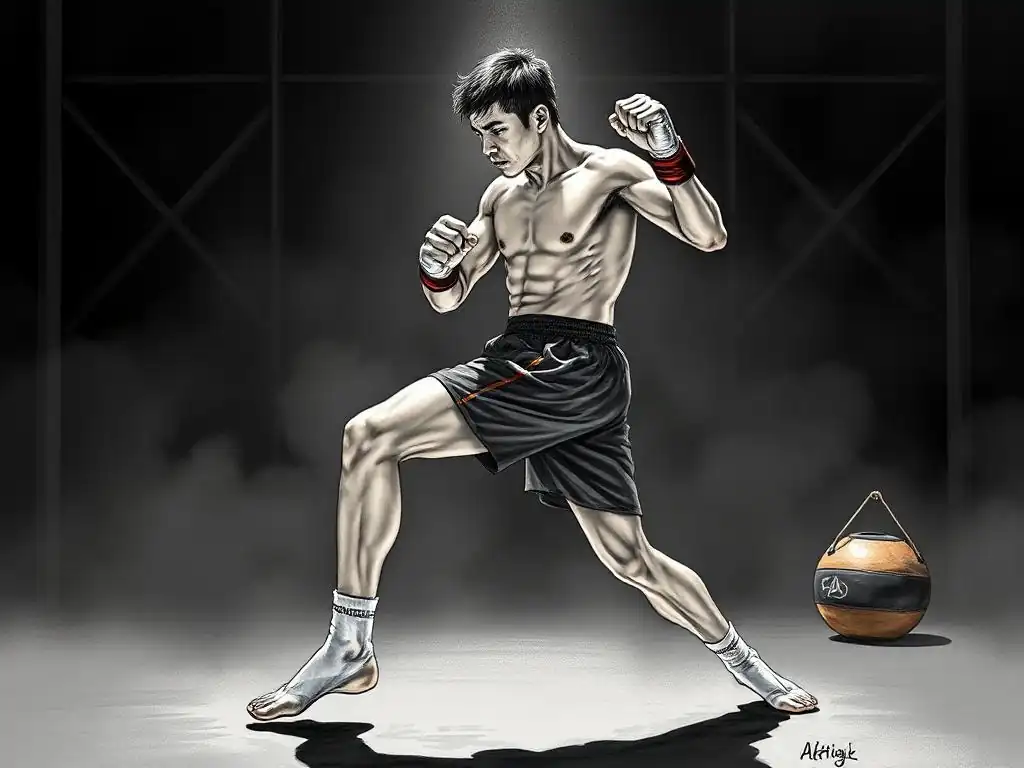
Developing agility is paramount for effective Muay Thai footwork techniques, allowing fighters to react quickly and change direction instantaneously. Cone drills are excellent for this purpose. Simple setups like placing four cones in a square (approximately 2-3 meters apart) or a line can create dynamic movement patterns. Drills might involve shuffling side-to-side between cones, sprinting forward and backward, or running figure-eights around two cones. The focus is on quick, sharp changes of direction while maintaining a low center of gravity and good balance.
Performing these drills for multiple rounds simulates the stop-and-go nature of a fight. For example, executing 3-minute rounds of shuffling and sprinting between cones, followed by 1-minute rest, repeated 4-5 times, significantly improves a fighter's ability to move rapidly and change trajectory on demand. These drills enhance ankle and knee stability while training the body to react faster to visual cues, directly translating to improved responsiveness in the ring and more effective Muay Thai footwork techniques under pressure.
Improving Footwork Speed: Shadow Boxing with Emphasis on Footwork
Shadow boxing is a cornerstone of Muay Thai training, and dedicating rounds specifically to footwork is a highly effective way to improve speed and fluidity. Instead of focusing primarily on striking, the fighter focuses on executing precise footwork patterns – forward/backward steps, angle steps, pivots – with speed and intention. Begin slowly, concentrating on perfect technique, then gradually increase the speed, aiming for quick, light movements. Add strikes after the footwork is executed, ensuring the movement sets up the strike rather than the other way around.
For instance, a round might involve 3 minutes of continuous movement, focusing on rapid forward/backward steps followed by sudden angle steps or pivots. The goal is to minimize time spent flat-footed and maximize dynamic movement. Incorporating short bursts of speed, such as a quick double-step forward or a rapid pivot, helps build explosive power in the feet and legs. Doing 2-3 rounds of footwork-focused shadow boxing per training session, perhaps 2-3 times a week, can dramatically increase overall footwork speed and efficiency, making all other Muay Thai footwork techniques faster and more reactive.
Integrating Footwork into Striking Combinations: Jab-Cross-Lead Hook with Angle Step
Effective striking in Muay Thai is rarely static; combinations are almost always linked to footwork. A common drill involves integrating specific Muay Thai footwork techniques into standard combinations. Take the classic Jab-Cross-Lead Hook combination. Instead of just throwing the punches while standing still, incorporate movement. Step forward with the jab, drive off the back foot into the cross, and then immediately execute an angle step (e.g., to your left) as you throw the lead hook.
- Step forward with Jab
- Drive off back foot for Cross
- Angle step (left or right)
- Throw Lead Hook
This drill teaches the fighter to use footwork to improve the combination's effectiveness. The forward step closes distance for the initial punches, and the angle step takes you off the center line after the cross, putting you in a safer position while simultaneously setting up a powerful hook from a slightly oblique angle, making it harder for the opponent to block. Practicing this combination with the integrated footwork repeatedly, perhaps 20-30 repetitions per side, helps build the muscle memory needed to fluidly combine movement and strikes in a fight.
Muay Thai Footwork in the Clinch: Controlling the Fight
Maintaining Balance in the Clinch: Footwork for Stability
The clinch is a unique range in Muay Thai, and specific Muay Thai footwork techniques are essential for success. In the close confines of the clinch, maintaining your balance is paramount, as losing it can lead to sweeps, throws, or being vulnerable to knees. Footwork in the clinch is less about large movements and more about small, constant adjustments to keep a wide, stable base. Fighters often widen their stance slightly and keep their knees bent, ensuring their weight is centered over their feet.
When an opponent pulls or pushes, responsive footwork is needed to prevent being unbalanced. This involves taking small, quick steps or shuffling to maintain your base and resist their forces. For example, if an opponent pulls you forward, you might take a small step back with one foot to re-establish balance. If they push, you might take a small step forward. Practicing maintaining posture and balance against resistance, using only small footwork adjustments, is crucial clinch training. Drilling with a partner, focusing solely on stability through footwork for 2-3 minute rounds, builds the necessary strength and proprioception.
Footwork for Clinch Entries and Exits: Creating Opportunities
Entering and exiting the clinch safely and effectively relies heavily on proper Muay Thai footwork techniques. You can't simply run straight in; you need to use movement to set up the entry and protect yourself.
Often, a clinch entry is initiated by stepping in behind a strike, like a jab or a straight punch, using the forward momentum and the opponent's reaction to close the distance and secure grips. An angle step is also effective, allowing you to step off-line as you move into range, making it harder for the opponent to knee or elbow you on the way in.
Exiting the clinch requires footwork to create space and avoid follow-up attacks. A common method is to use a pivot or a step-out, often combined with a push or pull to break the opponent's grip and simultaneously create distance.
For example, stepping back and to the side (an angle step) as you disengage allows you to quickly get out of immediate striking range and potentially set up your own attack as they recover. Practicing entering the clinch from various distances and angles, and drilling quick, clean exits, perhaps 10-15 repetitions per side, is vital for transitioning smoothly between ranges using effective Muay Thai footwork.
Using Footwork to Control Your Opponent's Balance in the Clinch
Beyond maintaining your own balance, skilled Muay Thai footwork techniques in the clinch are used to actively disrupt your opponent's stability. By subtly shifting your weight and using small steps or pivots, you can pressure your opponent's base, making them easier to sweep or knee. For example, stepping your foot slightly outside your opponent's foot and applying hip pressure can drive them off balance.
Another technique involves using a small pivot to turn your opponent. By securing a grip and pivoting on your own foot, you can force your opponent to turn, often making them vulnerable to knees or sweeps. Even stepping on an opponent's foot with yours can momentarily root them, hindering their ability to adjust their balance.
These are not large, obvious movements but subtle applications of pressure and positioning facilitated by precise footwork. Clinch drills often involve attempting to off-balance a partner for a set time, solely using grips and minimal footwork adjustments, highlighting the importance of these small, tactical movements.
Footwork Errors to Avoid in Muay Thai Training
Common Mistakes in Muay Thai Footwork
Beginners and even intermediate practitioners often make common mistakes with their Muay Thai footwork techniques that hinder their progress and effectiveness. One of the most prevalent errors is crossing the feet when moving forward or backward. This instantly eliminates your base and makes you extremely vulnerable to sweeps or simply being pushed over. Another frequent issue is stepping too wide or too narrow; too wide reduces mobility, while too narrow compromises balance. Many fighters also stand too tall or flat-footed, lacking the springiness and readiness provided by slightly bent knees and being on the balls of the feet.
Predictable footwork patterns are another significant error. If your opponent can easily read whether you're stepping forward, backward, or sidestepping because you always move the same way before a certain strike, they can anticipate and counter you more effectively. For example, always taking a large step back before throwing a powerful kick signals your intention. Addressing these common pitfalls early in training is crucial for building a solid foundation in Muay Thai footwork techniques.
How to Correct Footwork Imbalances
Correcting poor Muay Thai footwork techniques requires conscious effort and dedicated practice. Awareness is the first step; often, practitioners don't realize they are making these mistakes until a coach points them out or they see themselves on video. Using visual aids like lines drawn on the floor or markers can help reinforce correct spacing and prevent crossing feet. Slow-motion practice is also invaluable; perform basic movements like the step-drag at a deliberately slow pace, focusing on perfect form before increasing speed.
Partner drills where one person focuses on maintaining balance while the other tries to gently off-balance them can highlight weaknesses in the base. Receiving regular feedback from a qualified instructor is perhaps the most important aspect of correction. A coach can identify specific flaws in your Muay Thai footwork and provide targeted drills to address them. For instance, if you consistently cross your feet, a drill focusing solely on the step-drag without any striking might be prescribed for several rounds until the movement becomes natural.
The Importance of Consistent Footwork Practice for Muay Thai
Mastering Muay Thai footwork techniques is not a one-time achievement but an ongoing process that requires consistent, dedicated practice. Footwork should be integrated into every training session, whether it's during warm-ups, shadow boxing, pad work, bag work, or sparring. The goal is to make proper movement automatic, allowing you to react instinctively in the heat of a fight without having to consciously think about where your feet are going. This level of fluidity and responsiveness only comes through repetition.
Think of footwork as the language of movement in Muay Thai; the more you practice it, the more fluent you become. Even seasoned professional fighters dedicate significant time to refining their fundamental footwork. Incorporating specific footwork drills, like the cone drills or ladder drills mentioned earlier, into your weekly routine (e.g., 15-20 minutes, 2-3 times a week) ensures continuous improvement. Consistent practice builds the necessary muscle memory, endurance, and agility needed to utilize effective Muay Thai footwork techniques throughout an entire training session or a multi-round fight.
Integrating Muay Thai Footwork with Other Muay Thai Techniques
Combining Footwork with Teeps: Push Kick Following a Forward Step
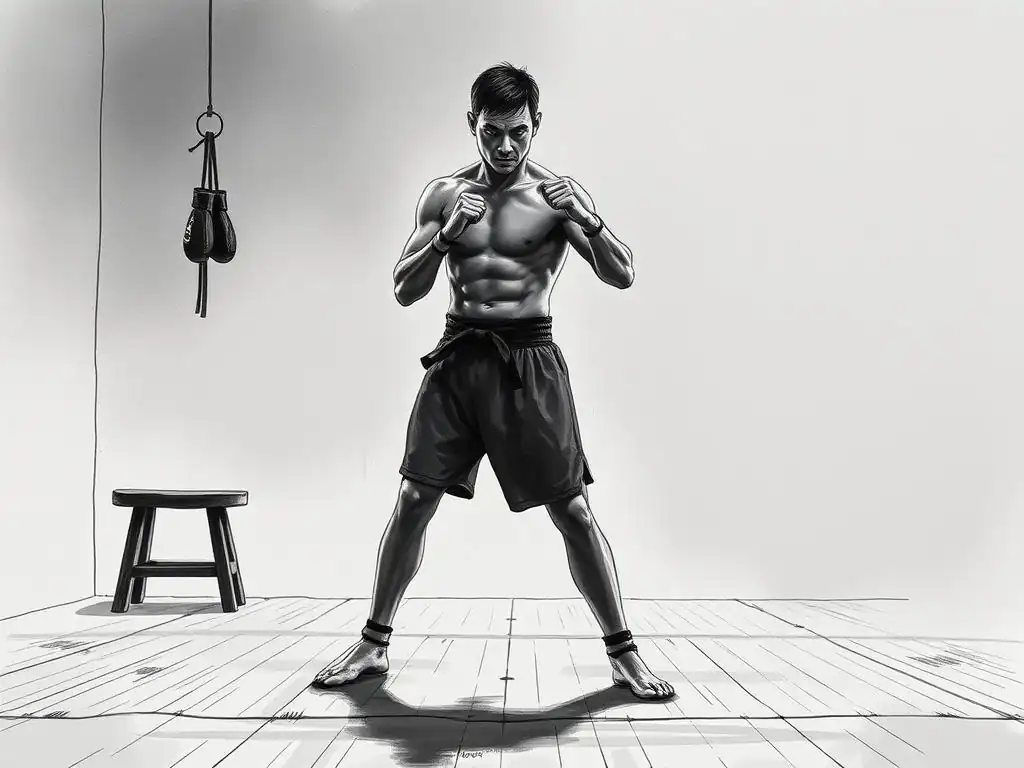
The teep, or push kick, is a fundamental tool in Muay Thai for managing distance and disrupting an opponent. Effective teeping is often enhanced by proper Muay Thai footwork techniques. A common way to use footwork with a teep is to take a small forward step with the lead foot just before or as you lift the teeping leg (usually the rear leg). This adds momentum to the teep and helps close the small distance needed to land it effectively.
Alternatively, you can use a slight hop-step forward with both feet simultaneously before extending the teep. This quicker movement can catch an opponent off guard and allows you to land the teep from a slightly greater distance. Integrating the forward step or hop-step into your teep practice, perhaps performing 20-30 teeps per leg focusing on the footwork entry, ensures that your teeps are not only powerful but also land consistently by properly managing the range. This combination of movement and strike is a staple in many fighters' arsenals.
Footwork and Knee Strikes: Closing the Distance Effectively
Knee strikes are devastating in close range and the clinch, and specific Muay Thai footwork techniques are used to bridge the distance and set them up. For short-range knees outside the clinch, a quick step-in with the supporting leg is often used to bring the knee into range. For instance, stepping forward with the lead leg allows the rear knee to be thrown with power.
In the clinch, footwork is used to create angles and close the final distance for knee strikes. Small pivots can turn an opponent, exposing their body for knees. Stepping your supporting foot slightly forward or backward can adjust the range and angle for a more effective knee strike.
Explosive footwork, like a quick shuffle or hop, can even be used to launch jumping knees, though this is a more advanced technique. Practicing stepping into knee range from varying distances, perhaps 10-15 repetitions per leg per side, helps build the timing and coordination needed to land powerful knees using responsive Muay Thai footwork.
Utilizing Footwork to Set Up Elbow Strikes
Elbow strikes are arguably the most dangerous weapons in Muay Thai at extremely close range. Setting them up effectively often requires precise Muay Thai footwork techniques to get inside the opponent's guard or defensive structure. Angle steps are particularly useful here. By stepping slightly off-line (e.g., to the side of their lead shoulder), you can create an opening to deliver an elbow strike, whether it's an upward, downward, or horizontal elbow.
Small, subtle footwork adjustments are also key in the phone booth range where elbows are most effective. Shifting your weight, taking tiny steps to gain a better angle, or using a small pivot to create space are all instances of footwork facilitating elbow strikes. For example, a small step forward and to the side with your lead foot can position you perfectly to land a rear elbow. Practicing getting into elbow range from punching distance using angle steps and small adjustments, perhaps focusing on 10-15 entries and elbow strikes per side, is crucial for utilizing these fight-ending techniques.
Conditioning for Muay Thai Footwork: Building Endurance and Agility
Exercises for Improving Footwork Endurance
Sustaining effective Muay Thai footwork techniques throughout multiple rounds requires significant physical endurance. The constant movement, stepping, and pivoting tax the muscles of the legs and core. Therefore, specific conditioning exercises are vital. Jump rope is a classic Muay Thai exercise that directly improves footwork endurance, coordination, and calf strength. Skipping for 3-5 minute rounds, mimicking fight duration, builds the capacity for continuous movement.
Running, particularly interval sprints, is also highly effective. Alternating bursts of fast running with periods of jogging or rest simulates the high-intensity, stop-and-go nature of a fight. Performing 6-8 rounds of 1-minute sprints followed by 1-minute rest, 2-3 times a week, builds both aerobic and anaerobic endurance necessary for maintaining sharp footwork late in a fight. Ladder drills, focusing on quick steps in various patterns, also contribute to muscular endurance in the feet and ankles.
Agility Drills for Muay Thai Fighters
Agility, the ability to change direction quickly and efficiently, is a cornerstone of advanced Muay Thai footwork techniques. Drills designed to improve agility enhance reaction time and coordination. Agility ladders are excellent for this, with various patterns like single steps, double steps, in-and-out, and lateral shuffles forcing quick, precise foot placement. Performing 5-10 repetitions of different ladder patterns, focusing on speed and accuracy, improves quickness.
Cone drills, as mentioned earlier, are also primary agility tools. Drills involving shuffling, backpedaling, and sprinting around cones in various shapes (squares, triangles, figure-eights) train the body to decelerate, change direction, and re-accelerate rapidly. Dot drills, using a pattern of dots on the floor to jump or step between, also improve foot speed and coordination. Incorporating 10-15 minutes of dedicated agility drills 2-3 times per week can significantly enhance a fighter's ability to execute quick, evasive, and offensive footwork movements.
The Role of Strength Training in Muay Thai Footwork
While endurance and agility are directly related to footwork, underlying strength training provides the necessary power and stability. Strong legs and a strong core are fundamental for generating force through the feet and maintaining balance under pressure. Exercises like squats, lunges, and deadlifts build overall lower body strength, which translates to more powerful steps, pivots, and the ability to absorb impact without being easily moved.
Calf raises specifically strengthen the muscles used for pivoting and staying on the balls of the feet. Core exercises such as planks, Russian twists, and medicine ball throws improve trunk stability, which is essential for maintaining balance during movement and transferring power from the lower body to the upper body strikes. Incorporating 2-3 strength training sessions per week, focusing on compound lower body and core movements, provides the physical foundation necessary to maximize the effectiveness of all Muay Thai footwork techniques.
Conclusion: The Art of Movement in Muay Thai
Frequently Asked Questions
What is the importance of footwork in Muay Thai, as emphasized by MartialArtsMastery.org?
Footwork is absolutely crucial in Muay Thai for maintaining balance, generating power, and effectively controlling distance from your opponent. MartialArtsMastery.org highlights its importance for both striking and clinch work.
How does the "Dance of the Nak Muay" article on MartialArtsMastery.org describe the benefit of good footwork for defense?
The article emphasizes that effective footwork allows you to evade attacks, angle your body to minimize target area, and create opportunities for counter-strikes. It's about avoiding damage and staying in control.
Can the footwork techniques detailed on MartialArtsMastery.org be used in self-defense scenarios?
Yes, the article explains how Muay Thai footwork provides a foundation for practical self-defense. It teaches you to maintain a stable base, move quickly, and create space when necessary, all valuable in real-world situations.
What are some specific Muay Thai footwork techniques covered on MartialArtsMastery.org in the context of the "Dance of the Nak Muay" article?
The article likely covers techniques such as the triangle step, pivot, and shuffle. These are essential for controlling angles, generating power, and maintaining balance within the ring or in a self-defense situation, according to MartialArtsMastery.org.
Does MartialArtsMastery.org's "Dance of the Nak Muay" article discuss how footwork relates to the clinch game in Muay Thai?
Yes, the article probably explains how proper footwork is essential for entering and exiting the clinch safely, as well as for maintaining a strong base while grappling. It is crucial for control in close quarters.
Final Reflection: The Rhythm of Victory
The intricate dance of Muay Thai footwork, as explored in this article, isn't merely a collection of techniques; it's the foundation of power, defense, and strategic dominance within the ring. The ability to move with purpose, to control distance, and to dictate the rhythm of the fight remains as crucial today as it was centuries ago, shaping the very essence of Muay Thai's effectiveness.
This understanding of footwork profoundly impacts the cultural landscape of Muay Thai, transforming it from a brutal exchange of blows into an art form where movement is both weapon and shield. My own journey in understanding this art has revealed the subtle nuances that separate a good fighter from a truly great one. The best fighter is never angry.
- Lao Tzu. This quote, though not directly about Muay Thai, encapsulates the calm precision that effective footwork allows, enabling a fighter to remain composed and strategic even under immense pressure.
Now, consider the lessons learned here. How can you apply the principles of balance, agility, and strategic positioning – the very essence of Muay Thai footwork – to your own life? Embrace the rhythm, find your footing, and move with intention, not just in the ring, but in every challenge you face. Let the dance of the Nak Muay inspire you to cultivate grace under pressure and to navigate life's complexities with unwavering purpose.
Elevate Your Stance: Unleash the Power of Muay Thai Footwork!
Thank you for delving into the crucial role of footwork in Muay Thai. Now that you understand how to control distance and generate power, let's translate this knowledge into action!
- Commit to 15 minutes of dedicated shadow boxing, focusing solely on the footwork drills outlined in this article. Feel the rhythm, and visualize the power you're building from the ground up.
- Explore related articles on Martial Arts Mastery to discover advanced striking combinations that complement your newfound footwork skills.
- Share this article with your training partners and spark a discussion on the most effective footwork strategies you've discovered in your own practice.
What specific footwork drill will you implement in your next training session to elevate your game?