
Dealing with Multiple Attackers: Strategies from Bujinkan Budo Taijutsu

Welcome to Martial Arts Mastery!
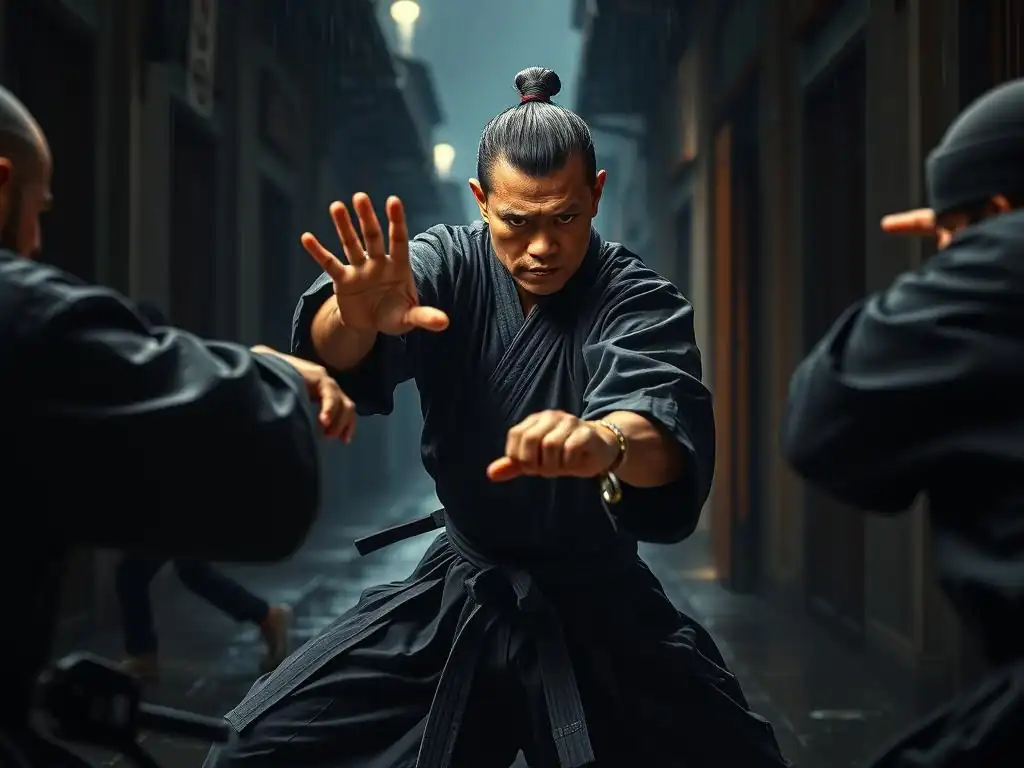
Ever wondered how ancient warriors faced overwhelming odds? Delve into the world of Bujinkan Budo Taijutsu and discover practical strategies for navigating the chaos of multiple attackers. This article unveils the core principles and techniques that empower you to defend yourself effectively, drawing from the rich historical and philosophical depth of this unique martial art. Prepare to explore the secrets of Bujinkan defense multiple attackers and unlock a new level of awareness and preparedness.
- Introduction to Bujinkan Defense Against Multiple Opponents
- Understanding the Bujinkan Perspective on Multiple Attackers
- Core Principles for Bujinkan Defense Against Multiple Attackers
- Bujinkan Taijutsu Techniques for Multiple Attackers
- Specific Bujinkan Strategies and Tactics for Multiple Attackers
- Bujinkan Weapons Training for Multiple Opponents
- Drills and Training Exercises for Bujinkan Multi-Attacker Defense
- Adapting Bujinkan Principles to Real-World Self-Defense
- Conclusion: Mastering Bujinkan Defense Against Multiple Attackers
-
Frequently Asked Questions
- How does Bujinkan Budo Taijutsu approach handling multiple attackers differently than other martial arts?
- What are some key principles of movement when facing multiple attackers according to Bujinkan?
- What specific techniques or strategies does Bujinkan employ to control multiple attackers at once?
- How important is environmental awareness in Bujinkan's multiple attacker defense strategy?
- Is Bujinkan's approach to multiple attackers primarily offensive or defensive?
- Final Reflection: Embracing Fluidity in the Face of Chaos
- Unleash Your Inner Defender: It's Time to Act!
Introduction to Bujinkan Defense Against Multiple Opponents
The Realities of Multiple Attacker Scenarios
Defending oneself against a single assailant presents significant challenges, but facing multiple attackers escalates the danger exponentially. Statistics, while varying by region and circumstance, consistently show that assaults involving more than one aggressor often result in more severe injuries to the victim. For instance, studies on street crime indicate that group attacks are frequently less predictable and more brutal than one-on-one confrontations, with the attackers often feeling emboldened by their numerical superiority. The dynamic changes from a simple fight to a survival situation where the victim is overwhelmed from multiple directions simultaneously.
In such scenarios, traditional one-on-one combat strategies can become ineffective or even detrimental. A single attacker might present a clear front and predictable lines of attack, allowing for focused defenses and counter-attacks. However, when facing a group, attacks can come from the front, sides, and rear concurrently. This requires a completely different mindset and skill set focused on managing space, disrupting coordination, and creating opportunities for escape or decisive action. The sheer volume of incoming threats means that static defenses or attempts to engage each person individually are likely to fail rapidly.
Why Bujinkan Taijutsu is Effective in Group Combat
Bujinkan Budo Taijutsu, rooted in the historical battlefield strategies of samurai and ninja, offers a unique perspective on the Bujinkan defense multiple attackers problem. Unlike many martial arts that focus primarily on dueling or sport combat, Bujinkan techniques and philosophy are inherently geared towards survival in chaotic, unpredictable environments, including engagements against multiple opponents. The emphasis is not on meeting force with force, but on using timing, distance, and natural body movement to evade danger and exploit openings.
The effectiveness of Bujinkan against multiple attackers stems from its core principles: natural movement (Shizen Gyoun Ryu), understanding distance and timing (Ma-ai), and the ability to adapt instantly to changing circumstances. Rather than locking into a fixed stance or engaging in prolonged exchanges with one person, Bujinkan practitioners are trained to move fluidly, constantly changing angles, disrupting the attackers' formation, and using momentum against them. This dynamic approach is crucial for managing the chaos of group combat, allowing the practitioner to avoid being pinned down and to create opportunities to neutralize threats or escape.
Understanding the Bujinkan Perspective on Multiple Attackers
Avoiding the Confrontation: Prevention as the First Line of Defense
In Bujinkan Budo Taijutsu, the most effective Bujinkan multiple attacker defense is often to avoid the conflict entirely. Grandmaster Masaaki Hatsumi frequently emphasizes the importance of Sakki (the ability to sense danger) and Shinobi (patience and perseverance), which translate directly into prioritizing awareness and de-escalation. This proactive approach involves recognizing potentially dangerous situations before they escalate, maintaining situational awareness in various environments, and taking steps to remove oneself from harm's way.
This principle isn't merely about running away; it's an active strategy based on the understanding that even a highly skilled practitioner faces immense odds against multiple determined assailants. Avoiding the confrontation preserves energy, minimizes risk, and is the most guaranteed way to survive intact. Training in Bujinkan includes developing heightened senses and learning to read body language and environmental cues, allowing practitioners to identify threats early and make informed decisions about navigating potentially dangerous areas or interactions.
Maintaining Awareness: Recognizing and Reacting to Threats Early
Situational awareness is paramount in any self-defense scenario, but it becomes critically important when dealing with multiple potential threats. Bujinkan training heavily emphasizes Zanshin, a state of relaxed alertness, and Ma-ai, not just physical distance but also psychological and temporal distance. Maintaining awareness means not only seeing potential attackers but also understanding their positioning, intentions, and potential lines of attack. This allows for early detection and reaction, which is vital for effective Bujinkan defense multiple attackers.
Early recognition allows the practitioner to initiate movement or action before the attackers can fully coordinate their assault. For example, noticing multiple individuals converging or exhibiting aggressive postures allows one to start moving towards an exit, seek cover, or adopt a more defensive posture before being surrounded. This contrasts sharply with reactive approaches that wait for the first physical attack, by which time the victim may already be at a significant disadvantage due to being trapped or overwhelmed by simultaneous attacks from different directions.
Core Principles for Bujinkan Defense Against Multiple Attackers
Movement and Positioning: The Key to Survival
Effective Bujinkan against multiple opponents hinges on continuous, intelligent movement and strategic positioning. Staying in one place is almost always a recipe for disaster, as it allows attackers to surround and overwhelm you. Bujinkan teaches dynamic footwork ( Aruki and Sabaki) and body shifting ( Tai Sabaki) that allow the practitioner to constantly change angles relative to the attackers, preventing them from establishing a coordinated attack front. The goal is to keep the attackers in front of you as much as possible, or to use their positions against each other.
Strategic positioning also involves using the environment. Walls, corners, doorways, or even obstacles like tables or cars can be used to limit the attackers' mobility, funnel them into a narrow space, or provide cover. For instance, positioning oneself near a wall prevents attacks from the rear, immediately reducing the number of directions from which danger can come. Training drills specifically focus on navigating complex spaces while being pressured from multiple sides, reinforcing the importance of using movement and the environment to one's advantage.
Utilizing Angles and Evasion Techniques
Angles are fundamental in Bujinkan group combat. Instead of facing attackers head-on, the practitioner constantly seeks to move off the line of attack, creating angles that force attackers to adjust their positions or even obstruct each other. Evasion techniques ( Tai Sabaki) are core to this, involving subtle shifts or larger movements to slip past grabs, strikes, or weapons attacks. The principle is to evade the immediate danger while simultaneously moving to a position that offers a strategic advantage, such as getting behind an attacker or moving towards an escape route.
For example, instead of blocking a punch from attacker A, a Bujinkan practitioner might evade to the side, putting attacker B in the line of fire or creating an opening to unbalance attacker A. This constant use of angles and evasion keeps the attackers off balance and prevents them from effectively cornering the defender. Training involves practicing these evasive movements from various directions and against simulated multiple threats, emphasizing fluidity and minimal effort to conserve energy.
Maintaining Balance and Stability Under Pressure
Maintaining one's own balance while disrupting the attackers' is a crucial principle in Bujinkan multiple attacker defense. Attacks from multiple directions inherently try to pull, push, or strike you off balance. Bujinkan emphasizes a stable base ( Koshi - centered hips) and natural posture that allows for quick changes in direction and absorption of force without falling. Techniques like Ukemi (breakfalls and rolls) are also vital, enabling the practitioner to recover quickly if taken down and return to a mobile, defensible position.
Conversely, Bujinkan techniques often target the attackers' balance. Joint locks, throws, and strikes to vulnerable points are frequently used not just to inflict damage but to disrupt an attacker's stability, making them less of a coordinated threat. In a multiple-attacker scenario, unbalancing one assailant can create a brief window of opportunity or cause them to interfere with their companions. Maintaining personal stability while simultaneously attacking the opponents' balance is a hallmark of effective Bujinkan application in chaotic situations.
Bujinkan Taijutsu Techniques for Multiple Attackers
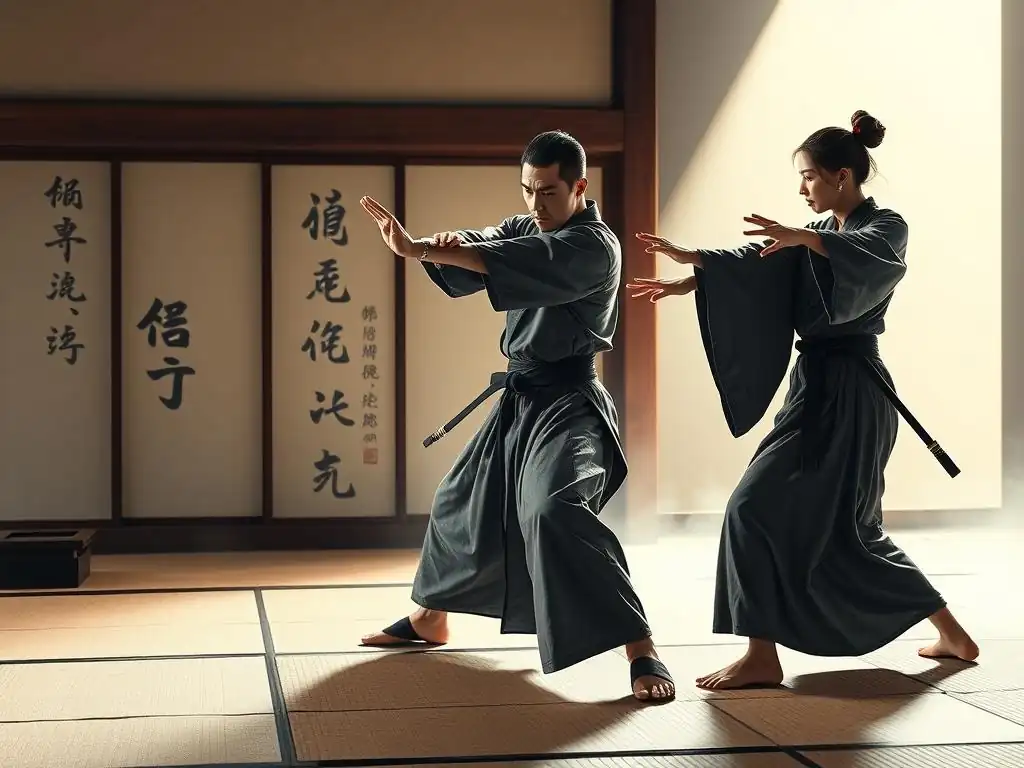
Tai Sabaki: Body Shifting and Evasion Drills for Group Combat
Tai Sabaki, or body shifting, is perhaps the most fundamental technique for Bujinkan defense multiple attackers. It involves moving the body just enough to avoid an incoming attack while simultaneously positioning oneself advantageously. In group combat drills, practitioners practice moving around multiple partners simulating attacks from different directions. A common drill involves standing in the center of a circle of partners who launch simultaneous or staggered attacks (grabs, strikes). The practitioner must use minimal movement to evade each attack, constantly pivoting and shifting their weight to stay out of danger and avoid being surrounded.
These drills are not about elaborate dodging but about subtle, efficient movement. The focus is on using hip rotation, footwork, and body angling to let attacks pass by harmlessly. For example, a slight pivot might allow a punch to miss entirely, while simultaneously positioning the practitioner to move past that attacker or use them as a shield against another. This continuous, fluid motion is essential for managing the dynamic and unpredictable nature of multiple assailants, ensuring the defender is never a static target.
Ukemi: Breakfalling and Rolling Techniques for Maintaining Mobility
While the goal is always to stay on your feet, being taken to the ground is a real possibility when facing multiple opponents. Ukemi, the art of breakfalling and rolling, is therefore a critical component of Bujinkan against multiple opponents. Proper ukemi allows the practitioner to absorb the impact of a fall safely, minimizing injury, and more importantly, to recover quickly. The ability to roll out of a takedown and immediately return to a standing or mobile ground position prevents attackers from easily pinning or stomping the defender.
Training in ukemi against multiple potential threats involves practicing rolls and breakfalls that allow the practitioner to regain their feet while aware of dangers still present. For instance, a forward roll might be used to escape a grapple, ending up facing the remaining attackers, ready to move or defend.
Side breakfalls are practiced to absorb impacts from pushes or trips, with immediate follow-up movements to stand up or transition into a ground defense that allows mobility. Ukemi transforms a potentially debilitating event (being taken down) into a brief disruption from which one can rapidly recover and continue the fight for survival.
Koppojutsu and Kyusho Jutsu: Targeting Vulnerable Points in a Crowd
When direct confrontation becomes unavoidable in Bujinkan group combat, targeting vulnerable points using Koppojutsu (bone structure methods) and Kyusho Jutsu (vital point methods) becomes highly efficient. Against multiple attackers, you don't have the luxury of extended exchanges. Techniques must be decisive and create immediate effects to disrupt the attackers' coordination or incapacitate one quickly. Strikes or pressure to points like the temple, eyes, throat, solar plexus, or specific joint areas can cause significant pain, disorientation, or temporary paralysis.
For example, a quick strike to the jaw or temple can momentarily stun an attacker, giving the defender a window to move past them or deal with another threat. Targeting knees or ankles with low kicks or joint manipulations can severely impede an assailant's mobility. While not guaranteeing a knockout, these methods aim to create enough of a reaction – pain, loss of balance, or hesitation – to break the attackers' rhythm and create an opening for escape or further action. Training focuses on precision and speed to maximize the impact of these targeted strikes amidst the chaos.
Specific Bujinkan Strategies and Tactics for Multiple Attackers
Breaking the Formation: Disrupting Attacker Coordination
One of the primary strategies for Bujinkan defense multiple attackers is actively disrupting the attackers' formation and coordination. A group of attackers is strongest when they can work together, surrounding and overwhelming the victim. Bujinkan tactics aim to prevent this by constantly moving, using evasion to force attackers to reposition, and using techniques that might cause attackers to interfere with each other. This could involve using one attacker as a shield against another or moving in a way that causes them to get in each other's way.
For example, if two attackers approach side-by-side, a rapid diagonal movement might put one attacker behind the other from the defender's perspective, forcing them to adjust and potentially creating a momentary gap or collision. Training drills often simulate this by having partners attempt to maintain a formation while the defender practices weaving through them or using evasive movements to break their lines. The goal is to turn the attackers' numbers from an advantage into a potential liability by forcing them into clumsy interactions.
Controlling the Center: Dominating the Space and Limiting Options
While seemingly counter-intuitive against multiple opponents, a key Bujinkan multiple attacker defense tactic can involve dominating the central space if avoidance is impossible. Instead of being pushed to the periphery and cornered, moving dynamically within the 'center' relative to the attackers can allow the defender to dictate the engagement. This means using footwork and body movement to stay mobile, prevent being surrounded, and keep the attackers in a position where they are manageable, ideally keeping most in front.
Controlling the center isn't about standing still; it's about moving through the space to maintain the best possible angle and distance relative to the most immediate threats. This might involve stepping into an attacker's space to disrupt their movement or using circular footwork to pivot around them. The objective is to limit the angles from which attackers can simultaneously engage, forcing them into a more linear attack pattern that is easier to defend against than being attacked from 360 degrees.
The Importance of Timing and Initiative: Striking First, Striking Hard
In a multiple-attacker scenario, waiting to react to every incoming attack is a losing proposition. Bujinkan against multiple opponents emphasizes the importance of timing and, when necessary, taking the initiative. This doesn't mean blindly rushing in, but rather acting decisively at the opportune moment – often when attackers are slightly off-balance, coordinating, or when an opening appears due to their own movements. A well-timed initial action can disrupt the entire group's plan.
This might involve a sudden, explosive movement to break through a gap in their formation, a decisive strike targeting a vulnerable point on the most immediate threat, or a quick throw to unbalance one person and create chaos among the others. The principle is to act quickly and with commitment once the decision is made, before the attackers can fully commit to their own coordinated assault. As the saying goes in martial arts, "the first mistake is often the last" in such situations, so decisive, well-timed action is paramount for survival.
Bujinkan Weapons Training for Multiple Opponents
Using the Bo (Staff) for Crowd Control
Bujinkan Budo Taijutsu includes extensive training with various weapons, and the Bo (long staff) is particularly effective for Bujinkan defense multiple attackers. Its reach allows the practitioner to keep opponents at a distance, preventing them from closing in and overwhelming with numbers. The Bo can be used to strike, thrust, sweep legs, or block multiple incoming attacks simultaneously. Its length allows the wielder to control a wider area, making it difficult for a group to surround them effectively.
Specific techniques involve sweeping motions to keep multiple attackers at bay, using the ends for thrusts to vital points, or employing the shaft for blocks and deflections against weapons or limbs. Training often involves practicing against multiple partners armed with padded weapons or pool noodles, focusing on maintaining distance and using the full length of the staff to manage the space and deter simultaneous approaches. A skilled Bo practitioner can effectively use the weapon to create a moving zone of control, making it very challenging for a group to penetrate their defense.
Shuriken and Other Thrown Weapons in a Multi-Attacker Scenario
While often romanticized, Shuriken and other thrown weapons ( Bo Shuriken, Tsubute, etc.) have a practical application in Bujinkan multiple attacker defense: distraction and deterrence. In a scenario with multiple assailants, throwing a shuriken or other small, sharp object is less about instant incapacitation (though possible if vital points are hit) and more about disrupting the attackers' focus, creating a moment of hesitation, or causing minor injury that breaks their charge.
Imagine facing three attackers closing in; a thrown shuriken directed at the lead attacker's face or chest can cause them to flinch, pause, or raise a hand to protect themselves. This brief interruption can buy the defender precious seconds to move, change direction, or prepare for the remaining threats. Training involves quick, accurate throws from various postures and movements, emphasizing the ability to deploy these tools rapidly under pressure to create tactical opportunities rather than relying on them as primary offensive weapons for incapacitation.
Utilizing the Sword (Katana) for Defensive Maneuvers
The Katana (sword) in Bujinkan is approached not just as an offensive weapon but as a tool for survival, emphasizing defensive maneuvers and control in Bujinkan group combat. Against multiple opponents, attempting to engage each with complex swordplay is often impractical and dangerous. Instead, the focus is on using the sword's presence and sharp edge to create distance, deter attacks, and utilize decisive, efficient cuts or thrusts when absolutely necessary.
Techniques involve using the sword to control space, deflecting incoming weapons or limbs with the forte (strong part of the blade), and using quick, powerful cuts to targets like wrists, hands, or legs to immediately disable a threat's ability to continue attacking. The mere act of drawing and wielding a sword can act as a significant deterrent, potentially causing less committed attackers to reconsider. Training emphasizes fluid movement, maintaining awareness of all attackers, and using the sword as an extension of the body for defense and creating openings amidst the chaos.
Drills and Training Exercises for Bujinkan Multi-Attacker Defense
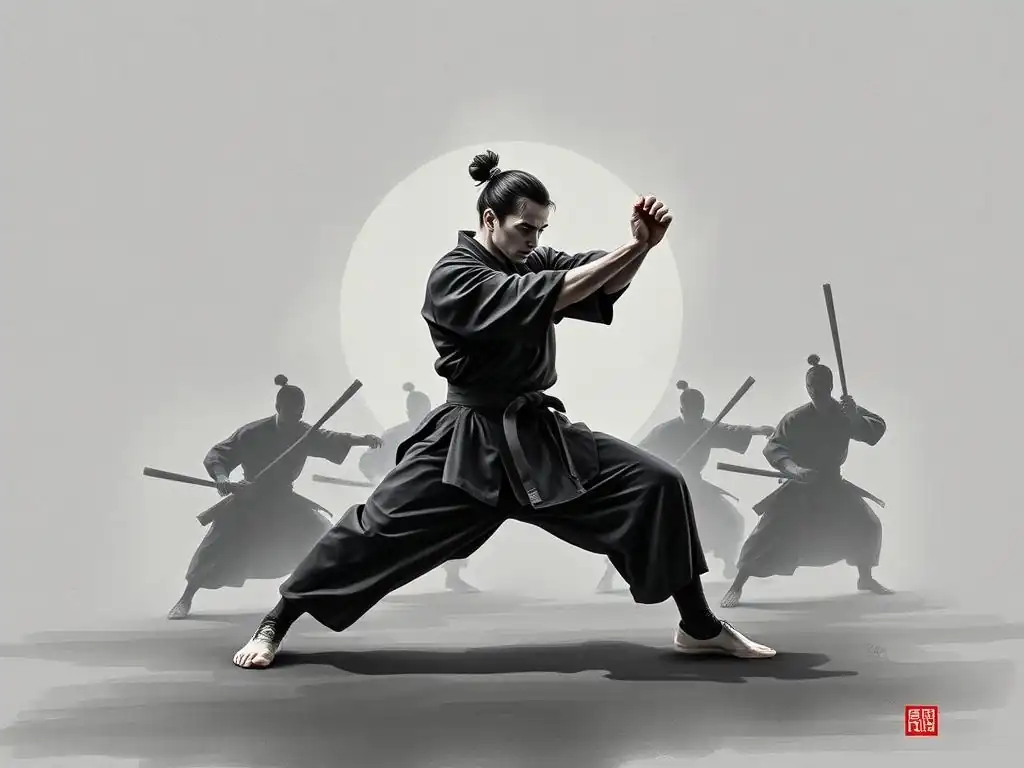
Solo Drills for Developing Speed and Agility
Solo drills are foundational for developing the speed, agility, and fluid movement necessary for Bujinkan defense multiple attackers. These include extensive practice of Tai Sabaki (body shifting), Aruki (walking), and Ukemi (breakfalls and rolls) from various angles and directions. Practitioners might drill moving around imaginary obstacles or points of attack, focusing on changing direction rapidly, pivoting efficiently, and maintaining balance while moving at speed.
A specific solo drill involves setting up markers (like cones or even shoes) in a pattern simulating attacker positions and practicing moving between them, using evasive steps and pivots to avoid the "attack zones" represented by the markers. Another involves practicing breakfalls and immediate recovery rolls followed by explosive movements back to a standing or mobile position, simulating recovering from a takedown while still under threat. These solo exercises build the fundamental physical literacy required to navigate complex and dangerous environments.
Partner Drills for Practicing Evasion and Counterattacks
Partner drills are essential for applying solo movement principles in a dynamic context relevant to Bujinkan against multiple opponents. These often start simply, with one defender facing two or three partners who throw slow, predictable attacks (like grabs or single punches). The defender focuses solely on evading without counterattacking, practicing using Tai Sabaki and positioning to make the partners collide or get in each other's way.
As skill progresses, the attacks become faster, more varied, and less predictable, and the defender begins integrating counterattacks. Drills might involve one defender in the center of a circle of partners who attack on signal, requiring the defender to evade the immediate threat and then potentially unbalance or strike one attacker before moving to evade the next. These drills train the ability to process multiple incoming threats, make split-second decisions, and execute evasive actions and targeted counterattacks under pressure, simulating the dynamic nature of Bujinkan group combat.
Scenario-Based Training: Simulating Realistic Multiple Attacker Situations
Scenario-based training is the culmination of Bujinkan multiple attacker defense preparation, aiming to simulate real-world conditions as closely as possible. This involves setting up realistic environments (e.g., a narrow hallway, a crowded room, an outdoor space) and having multiple training partners act as attackers with varying levels of aggression and intent. Scenarios might start with de-escalation attempts, progress to sudden physical assaults, and involve different numbers of attackers (from two to four or more).
In these scenarios, the practitioner must integrate all learned principles: awareness, avoidance (if possible), movement, positioning, evasion, and decisive action (using appropriate force or techniques) when necessary. Training partners are instructed to act realistically, forcing the defender to react to unpredictable movements, grabs, strikes, or even simulated weapons threats. These exercises are invaluable for developing the psychological resilience, adaptability, and tactical decision-making skills required to survive a genuine multiple-attacker encounter.
Adapting Bujinkan Principles to Real-World Self-Defense
Recognizing the Limitations of Traditional Techniques
While rooted in historical combat, Bujinkan group combat training includes recognizing that direct application of some traditional techniques might be impractical or illegal in modern self-defense situations. For instance, using a historical battlefield weapon like a Katana is generally not feasible or permissible. Similarly, techniques designed for armored opponents or specific historical contexts may need modification. The primary limitation is the legal and ethical framework of modern society, which dictates acceptable levels of force.
Therefore, adapting Bujinkan principles means understanding the core concepts – movement, timing, distance, awareness, disruption – and applying them using modern, empty-hand techniques or permissible self-defense tools. A painful joint lock might be used not to break the joint (as in historical combat) but to create an opening for escape. A strike to a vital point might be aimed to stun or incapacitate temporarily rather than kill. Recognizing these limitations is crucial for responsible and effective Bujinkan defense multiple attackers in a modern context.
Modifying Techniques for Practical Application
Adapting Bujinkan against multiple opponents for practical self-defense involves modifying techniques to be efficient, legally defensible, and applicable against unarmored modern assailants. This means focusing on gross motor skills under stress, targeting accessible vulnerable points, and prioritizing techniques that facilitate escape or control without causing excessive, unnecessary harm. For example, complex joint manipulation sequences might be simplified into quick, disruptive movements aimed at breaking a grip or unbalancing, rather than completing a full lock.
Empty-hand strikes, throws, and evasions are emphasized, using the body's natural structure and movement. Training focuses on adapting principles like using angles and disrupting balance to common street attack scenarios (grabs, pushes, wild punches). The goal is to retain the effectiveness of Bujinkan's core strategies – managing distance, disrupting attackers, creating openings – but executing them with techniques suitable for modern self-defense, prioritizing survival and minimizing legal repercussions.
Maintaining a Calm and Focused Mindset Under Stress
Perhaps the most critical aspect of Bujinkan defense multiple attackers in real-world scenarios is maintaining a calm and focused mindset under extreme stress. Facing multiple assailants is terrifying, and panic can paralyze or lead to poor decisions. Bujinkan training, through its emphasis on natural movement, awareness, and constant adaptation, aims to build mental resilience. Scenario-based training is particularly important here, as it exposes practitioners to simulated stress, helping them learn to function effectively amidst fear and adrenaline.
The philosophy of Fudoshin (immovable heart) and Heijoshin (ordinary, everyday mind) is cultivated, encouraging practitioners to remain centered and rational even when facing overwhelming odds. This allows for clearer perception of the situation, better decision-making regarding avoidance or action, and more efficient execution of techniques. Ultimately, a calm and focused mind is the most powerful tool for survival against multiple attackers, enabling the practitioner to effectively apply the physical strategies learned in Bujinkan group combat training.
Conclusion: Mastering Bujinkan Defense Against Multiple Attackers
The Importance of Continuous Training and Refinement
Mastering Bujinkan defense multiple attackers is not a destination but a continuous journey requiring dedicated, ongoing training and refinement. The dynamic and unpredictable nature of group combat means that one must constantly practice fundamental movements, techniques, and strategies. Repetition builds muscle memory and allows for instinctive reactions under pressure, while varied drills and scenario training ensure adaptability to different situations and numbers of opponents.
Regular practice sessions focusing specifically on Bujinkan multiple attacker defense scenarios, involving multiple partners and incorporating elements of surprise and chaos, are vital. This continuous refinement allows the practitioner to integrate the physical, mental, and tactical aspects of Bujinkan Taijutsu, ensuring that the principles of awareness, movement, timing, and decisive action can be applied effectively when facing the daunting challenge of multiple assailants.
Embracing the Bujinkan Philosophy of Survival
Ultimately, effective Bujinkan against multiple opponents is deeply rooted in the overarching Bujinkan philosophy of survival. This philosophy prioritizes life and escape above winning a confrontation or inflicting maximum damage. It teaches patience, adaptability, and the wisdom to avoid unnecessary conflict. When avoidance is not possible, the focus shifts to navigating the situation with minimal harm to oneself, using efficient movement and targeted actions to create an opportunity to disengage and escape.
Embracing this philosophy means understanding that there is no "fair fight" against multiple attackers and that conventional martial arts approaches may be insufficient. It means relying on awareness, intuition, and the core principles of natural movement and adaptation that define Bujinkan. By embodying this survival mindset and diligently training the specific strategies and techniques for group combat, practitioners can significantly enhance their ability to navigate and survive one of the most challenging self-defense scenarios imaginable.
Frequently Asked Questions
How does Bujinkan Budo Taijutsu approach handling multiple attackers differently than other martial arts?
Bujinkan focuses on evasion and manipulation to unbalance attackers, rather than direct confrontation. It prioritizes situational awareness and leveraging the environment to your advantage. The goal is to create openings and escape, not necessarily to defeat multiple opponents head-on.
What are some key principles of movement when facing multiple attackers according to Bujinkan?
Movement emphasizes fluidity and circular motion to avoid being surrounded. Maintaining a dynamic, unpredictable stance is crucial to remain elusive. The focus is on blending with the attacks rather than resisting them directly.
What specific techniques or strategies does Bujinkan employ to control multiple attackers at once?
Bujinkan uses techniques like tai sabaki (body shifting) and ukemi (breakfalls) to redirect force and create space. It also incorporates kansetsu waza (joint locks) and atemi waza (striking techniques) to disrupt attackers and create opportunities for escape. Control is achieved through manipulation, not brute strength.
How important is environmental awareness in Bujinkan's multiple attacker defense strategy?
Extremely important. Bujinkan stresses using the environment – walls, obstacles, even other people – to your advantage. Awareness of your surroundings allows you to control the flow of the encounter and limit the attackers' options. It's a key aspect of strategic positioning.
Is Bujinkan's approach to multiple attackers primarily offensive or defensive?
Primarily defensive. The core philosophy emphasizes avoiding direct conflict and prioritizing survival. While offensive techniques exist, they are used opportunistically to create openings for escape and disrupt the attackers' coordination. Preservation of self is the ultimate goal.
Final Reflection: Embracing Fluidity in the Face of Chaos
The principles of Bujinkan Budo Taijutsu, as explored in this article, are not merely historical techniques; they offer a powerful framework for navigating the complexities of modern life. Just as facing multiple attackers demands adaptability and awareness, so too does navigating the challenges of our increasingly interconnected and unpredictable world. The lessons learned from these ancient martial arts resonate deeply with the need for resilience and strategic thinking in all aspects of our lives.
The enduring appeal of Bujinkan Budo Taijutsu lies in its emphasis on fluidity and adaptability, qualities that are increasingly vital in a world defined by constant change. This exploration has reinforced my belief in the importance of embracing uncertainty and cultivating a mindset that prioritizes responsiveness over rigid adherence to pre-defined plans. The ultimate aim of martial arts is not to defeat the enemy, but to avoid fighting altogether.
This quote encapsulates the essence of Bujinkan, reminding us that true strength lies not in brute force, but in the wisdom to anticipate and avoid conflict whenever possible.
Now, I invite you to consider how these principles of awareness, adaptability, and strategic thinking can be applied to your own life. How can you cultivate a more fluid approach to the challenges you face? How can you anticipate potential threats and proactively mitigate risk? Embrace the spirit of Bujinkan Budo Taijutsu, not just as a system of self-defense, but as a philosophy for navigating the complexities of life with grace, resilience, and unwavering awareness.
Unleash Your Inner Defender: It's Time to Act!
Thanks for diving into the world of Bujinkan Budo Taijutsu and exploring strategies for dealing with multiple attackers! You've now gained valuable insights into movement, awareness, and practical techniques. Ready to put that knowledge into action?
Here's how you can take the next steps:
- Enroll in a local Bujinkan Dojo! Find a qualified instructor near you to learn these principles hands-on and develop practical skills. This is the most important step to internalize these concepts.
- Practice visualization exercises focusing on chaotic scenarios, simulating multiple opponents. This can significantly improve your reaction time and decision-making under pressure.
- Start a discussion on martial arts forums sharing your biggest takeaway from this article and ask other practitioners about their experience dealing with multiple opponents.
Ready to start training or share your insights? What's the first step you'll take to apply these Bujinkan strategies in your life?