
Xing Yi's Chicken Form: Independent Leg Strength and Fierce Pecks

Welcome to Martial Arts Mastery!
Delve into the rich tapestry of global martial arts as we explore their history, techniques, and the legendary figures who shaped them. Ever wondered how a single movement could encapsulate an entire fighting philosophy? Today, we unlock the secrets of Xing Yi's Chicken Form Technique, a potent exercise in independent leg strength and devastating strikes. Discover how this unique approach to combat can revolutionize your understanding of balance, power, and the art of the "fierce peck". Intrigued? Let's explore how this ancient form can empower your training!
- Introduction to Xing Yi Quan and the Chicken Form
-
Frequently Asked Questions
- What is the Xing Yi Chicken Form Technique?
- Why is independent leg strength so important in the Chicken Form?
- How does the Chicken Form relate to self-defense?
- What are some key training tips for mastering the Chicken Form?
- Where can I learn more about the history and philosophical underpinnings of Xing Yi Quan?
- Final Reflection: Embodying the Chicken's Spirit
- Unleash Your Inner Chicken: Transform Your Xing Yi Practice!
Introduction to Xing Yi Quan and the Chicken Form
Xing Yi Quan, often translated as "Form-Intention Boxing," stands as one of the major internal martial arts of China, alongside Taijiquan and Baguazhang. Its philosophy centers on direct, linear movements and explosive power generated from a unified body structure. Unlike some martial arts that emphasize complex, circular patterns, Xing Yi Quan prioritizes efficiency and immediate effectiveness.
The practice typically begins with foundational stances, like San Ti Shi (Three Body Posture), which are crucial for developing rootedness and understanding the body's alignment. Mastery of San Ti Shi is often considered the bedrock upon which all advanced Xing Yi techniques are built, requiring dedicated daily practice, sometimes for an hour or more in early training, to cultivate the necessary internal stability and strength.
The art is traditionally structured around the Five Elements (Wu Xing) – Metal, Water, Wood, Fire, and Earth – and the Twelve Animals (Shi Er Xing). Each element and animal form embodies distinct principles, energies, and combat applications. The Five Elements represent fundamental forces and movements (chopping, drilling, crushing, exploding, crossing), while the Twelve Animals (including Dragon, Tiger, Monkey, Horse, Chicken, Snake, Bear, Eagle, Swallow, Sparrow, Tai, and Yao) distill the essence of combat strategies observed in nature.
For instance, the Tiger form often emphasizes powerful, pouncing movements, while the Swallow form focuses on evasiveness and quick strikes. Integrating these diverse forms helps practitioners develop a versatile and adaptable combat system.
Understanding the Principles of Xing Yi Quan
The core of Xing Yi Quan lies in the concept of Li He (Six Harmonies) and the unification of mind, intention, and body. The external harmonies involve the coordination of hands and feet, elbows and knees, and shoulders and hips. The internal harmonies relate to the coordination of the heart and intention, intention and Qi (vital energy), and Qi and strength.
Achieving these harmonies allows the practitioner to move as a single, cohesive unit, generating immense power from seemingly simple movements. This principle is evident in all aspects of Xing Yi training, from basic stances to complex forms and applications, ensuring that every movement is purposeful and efficient.
Beyond physical alignment, Xing Yi Quan heavily emphasizes the cultivation of Yi (intention or mind). The intention leads the Qi, and the Qi leads the strength. This mental component is what distinguishes internal martial arts; it's not just about muscular force but about directing internal energy.
Training involves visualizing the desired outcome and embodying the characteristics of the movement, whether it's the chopping power of Pi Quan (Splitting Fist) or the rooted stability of San Ti Shi. This deep connection between mind and body is what allows a Xing Yi practitioner to manifest explosive power ( Fajin) from a relaxed state, making the Xing Yi Chicken Form Technique, for example, far more potent than a simple arm strike.
The Significance of Animal Forms in Xing Yi
The Twelve Animal forms in Xing Yi Quan are not merely imitations of animal movements but rather sophisticated interpretations of their fighting essence and spirit. Each animal form isolates and refines specific combat principles, stances, and techniques. For example, the Bear form teaches rooted power and shoulder strikes, while the Eagle form develops grasping and seizing techniques. These forms serve as living repositories of tactical knowledge, offering practitioners a diverse toolkit for different combat situations. They also challenge the practitioner to embody the spirit of the animal, developing qualities like the Tiger's ferocity or the Monkey's agility.
Learning the animal forms typically occurs after a solid foundation in the Five Elements and San Ti Shi has been established. This progression ensures that the practitioner has the underlying structure and power generation capabilities before attempting the more specialized movements of the animals. Mastering the Twelve Animal forms provides a comprehensive understanding of Xing Yi's diverse applications, from long-range engagements to close-quarters fighting. The Xing Yi Chicken Form Technique, with its focus on unique leg work and striking, represents a crucial piece of this larger puzzle, offering specific skills not found as prominently in other forms.
Why the Chicken Form is Crucial for Xing Yi Practitioners
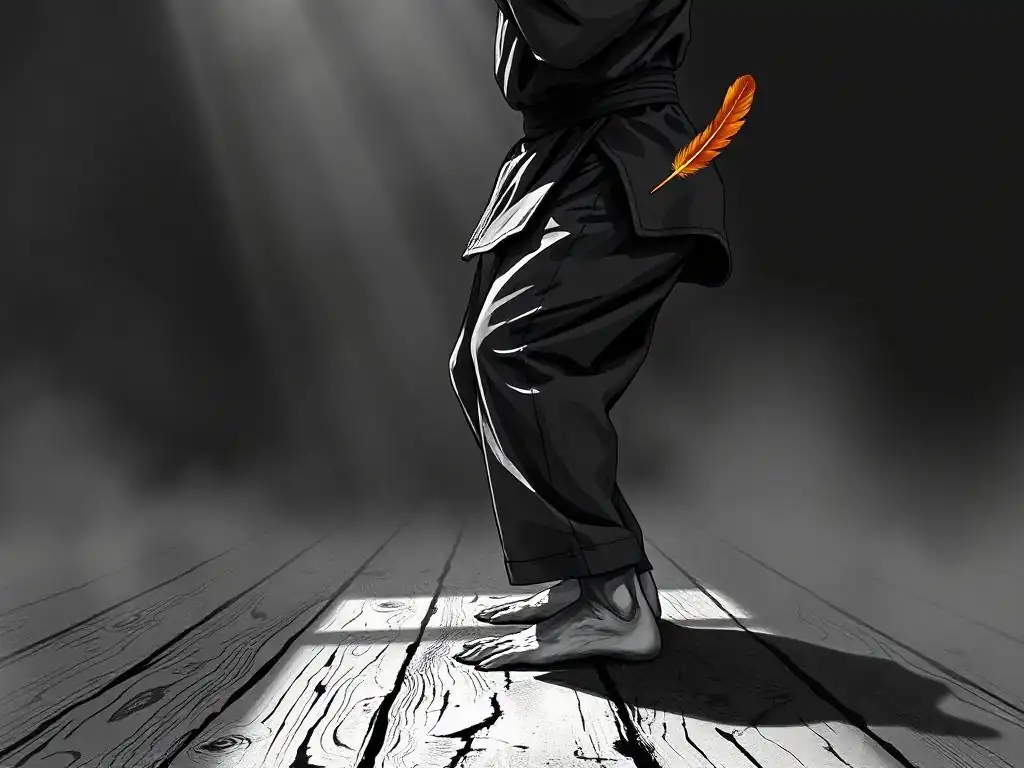
The Xing Yi Chicken Form holds a unique and vital place within the Twelve Animals, primarily for its emphasis on developing independent leg strength and balance, coupled with its distinctive "pecking" strike. While many martial arts emphasize two-legged stances, the Chicken Form specifically trains the ability to generate power and maintain stability while heavily weighted on one leg, or transitioning rapidly between legs.
This skill is paramount for dynamic movement, evasiveness, and delivering powerful strikes while off-balance or moving. The Chicken Form's focus on single-leg mechanics directly enhances skills needed for advanced footwork and striking in all other Xing Yi forms.
Furthermore, the Xing Yi Chicken Form Technique introduces a unique and highly effective close-range strike resembling a bird's peck. This isn't just a simple jab; it's a sharp, penetrating strike utilizing specific body mechanics and intention to deliver force through a small point. Training this technique refines precision, speed, and the ability to generate focused power, skills transferable to various hand techniques in Xing Yi. The combination of robust independent leg strength and the sharp, focused pecking technique makes the Chicken Form indispensable for developing a well-rounded Xing Yi practitioner, providing tools for both powerful movement and incisive striking.
Frequently Asked Questions
What is the Xing Yi Chicken Form Technique?
The Xing Yi Chicken Form is a unique posture and movement within Xing Yi Quan (Form-Intention Boxing) that emphasizes independent leg strength and explosive, pecking-like strikes. It mimics the movements of a chicken, focusing on stability and focused power.
Why is independent leg strength so important in the Chicken Form?
Independent leg strength allows for nimble footwork and the ability to maintain balance while delivering strikes. This stability is crucial for generating power and executing the fierce pecks characteristic of the form.
How does the Chicken Form relate to self-defense?
The Chicken Form develops practical self-defense skills by teaching practitioners to use their entire body to generate power in small spaces. The pecking hand strikes are designed for close-quarters combat and targeting vulnerable areas.
What are some key training tips for mastering the Chicken Form?
Focus on practicing the stance repeatedly to build independent leg strength. Also, concentrate on the accuracy and speed of the pecking motion, visualizing the target with each strike.
Where can I learn more about the history and philosophical underpinnings of Xing Yi Quan?
Websites like MartialArtsMastery.org provide detailed historical overviews, training techniques, and philosophical underpinnings of various martial arts, including Xing Yi Quan. You can explore its sections dedicated to martial arts disciplines, history, and practical self-defense strategies.
Final Reflection: Embodying the Chicken's Spirit
The exploration of Xing Yi's Chicken Form, with its emphasis on independent leg strength and focused pecking strikes, reveals a training methodology deeply rooted in observation and practical application. This ancient martial art, far from being a mere historical curiosity, offers a powerful framework for cultivating physical and mental resilience applicable to modern life. The principles of balance, precision, and explosive power, honed through the Chicken Form, translate directly into improved coordination, enhanced focus, and a deeper understanding of biomechanics, benefiting practitioners across various disciplines.
The enduring appeal of Xing Yi, and specifically the Chicken Form, lies in its ability to connect us to the natural world and unlock our inherent potential. The discipline required to master the independent leg movements and the sharp, decisive pecks fosters a sense of groundedness and unwavering determination. This is more than just physical training; it's a journey of self-discovery. The best fighter is never angry,
a common saying in martial arts, perfectly encapsulates the Chicken Form's focus on controlled aggression and strategic execution. This principle extends beyond the training hall, encouraging us to approach challenges with clarity and composure.
As you reflect on the intricacies of the Xing Yi Chicken Form Technique, consider how its principles of balance, focus, and explosive power can be integrated into your own life. Embrace the challenge of mastering independent movement, cultivate the precision of a focused strike, and allow the spirit of the chicken to inspire your own journey towards strength, resilience, and unwavering determination. Let the lessons learned here empower you to face the world with confidence and grace, embodying the spirit of the Chicken Form in all that you do.
Unleash Your Inner Chicken: Transform Your Xing Yi Practice!
Thank you for exploring the powerful independence and focused energy of Xing Yi's Chicken Form. We hope you've gained valuable insights into developing leg strength and channeling fierce intent. Now, let's put that knowledge into action!
- Commit to practicing the Chicken Stance for at least 5 minutes daily to cultivate unwavering leg strength and stability. This is your primary focus!
- Dive deeper:Research the connection between the Chicken Form and traditional Chinese medicine principles to unlock a more profound understanding.
- Share your Chicken Form journey! Post a video of your practice on social media using #MartialArtsMasteryChicken, and inspire others with your dedication.
Ready to unleash your inner chicken and transform your martial arts practice? How will you incorporate the fierce "pecking" energy into your next sparring session?