
The Mental Game of Ukemi: Building Resilience Through Falling


Welcome to Martial Arts Mastery, your definitive guide to the world of combat arts. Ever wonder how mastery begins with the ground? This week, we delve into the often-overlooked, yet fundamental, art of Ukemi falling resilience training. Discover how mastering the fall isn't just about physical technique; it's about forging an unbreakable mental fortitude. Read on to unlock the secrets of this essential skill and build a foundation for true martial arts resilience.
- Understanding Ukemi: More Than Just Falling in Aikido
- Ukemi Falling Resilience Training: Developing Mental Fortitude
- Mastering the Fundamentals of Ukemi for Mental Strength
- Types of Ukemi and Their Mental Challenges
- Ukemi and Mindfulness: Connecting Body and Mind
- Integrating Ukemi into Your Martial Arts Journey and Beyond
- The Ukemi Mindset: Key Takeaways for Mental Resilience
-
Frequently Asked Questions
- What is Ukemi and why is it important in martial arts?
- How does "The Mental Game of Ukemi" relate to physical training?
- What are some key mental strategies for improving Ukemi resilience?
- How can "Ukemi falling resilience training" be applied to life outside of martial arts?
- Where can I find more information on specific Ukemi techniques and training drills?
- Final Reflection: Embracing the Fall, Cultivating Resilience
- Embrace the Fall: Unlock Your Inner Resilience!
Understanding Ukemi: More Than Just Falling in Aikido
What is Ukemi and Why is it Crucial for Martial Arts Mastery?
Ukemi, often translated as "receiving the technique" or "breakfall," is a fundamental skill in many martial arts, particularly prominent in Aikido. It involves learning how to safely absorb the impact of a throw, fall, or takedown by rolling or distributing force across the body. While seemingly simple, mastering ukemi is far more than just learning how to fall without injury; it is the foundation upon which safe and effective training is built, allowing practitioners to fully commit to techniques without fear of harm.
Without proficient ukemi, the dynamic practice of Aikido, with its powerful throws and joint locks, would be impossible or prohibitively dangerous. It allows both the attacker (uke) and the defender (nage) to explore techniques fully, fostering mutual development and understanding.
The importance of ukemi extends beyond mere physical safety; it is crucial for developing trust between training partners and cultivating a receptive mindset. In a typical Aikido practice, a practitioner might perform hundreds of ukemi over a single session, constantly reacting to different techniques and directions of force. This repetitive process builds not only physical conditioning and spatial awareness but also a deep-seated understanding of movement and balance.
Furthermore, effective ukemi enables the nage (the one applying the technique) to execute throws with confidence, knowing their partner can receive the technique safely. This symbiotic relationship, built on trust and skill in receiving, is a cornerstone of Aikido training and essential for achieving true martial arts mastery.
Ukemi and the Principles of Aikido: Harmony, Balance, and Adaptability
Ukemi is intrinsically linked to the core principles of Aikido, embodying concepts like Aiki (harmony of energy), balance, and adaptability. When performing ukemi, the practitioner doesn't resist the incoming force but rather blends with it, redirecting its energy through a roll or breakfall. This mirrors the Aikido principle of yielding and redirecting force rather than meeting it head-on.
A successful ukemi requires precise timing and coordination, maintaining a state of dynamic balance even while being off-balanced by a technique. The ability to adjust one's body instantaneously to the direction and intensity of the throw exemplifies adaptability, a key principle in responding effectively to unpredictable situations.
Furthermore, ukemi teaches practitioners to remain centered and calm under pressure, essential for embodying Aikido's philosophy of peaceful resolution. Instead of panicking when thrown, the practitioner focuses on executing the learned mechanics of the breakfall or roll, demonstrating control and presence of mind. This mental discipline, cultivated through rigorous ukemi training, directly translates to the ability to maintain composure in conflict.
The fluid, continuous motion of a well-executed roll or breakfall also reflects the principle of circular movement central to Aikido techniques, emphasizing the flow of energy and the avoidance of rigid, linear resistance. Thus, Ukemi is not just a technique but a practical application of Aikido's fundamental principles.
Beyond the Physical: The Mental and Psychological Aspects of Ukemi
While the physical mechanics of ukemi are vital for safety, the mental and psychological dimensions are equally, if not more, significant. Learning to fall safely inherently involves confronting and overcoming fear – the primal fear of falling and potential injury. Beginners often experience hesitation, anxiety, and a lack of trust in their own bodies and their training partners. The process of repeatedly practicing ukemi, starting with simple rolls and progressing to more dynamic breakfalls, gradually erodes this fear, replacing it with confidence and self-reliance. This mental transformation is a core component of Ukemi falling resilience training.
Moreover, ukemi cultivates mental fortitude by teaching practitioners to accept being put in a vulnerable position and to react constructively. Being thrown or taken down can be humbling, but ukemi reframes this experience not as failure, but as an opportunity to practice receiving and recovering. This perspective shift builds mental toughness and a positive attitude towards challenges. The repetitive nature of ukemi also fosters discipline, patience, and perseverance, as mastery requires countless repetitions and careful refinement. Ultimately, the mental skills developed through ukemi training extend far beyond the dojo, influencing how practitioners approach difficulties and setbacks in everyday life.
Ukemi Falling Resilience Training: Developing Mental Fortitude
Overcoming Fear: How Ukemi Training Builds Confidence
Ukemi training is a powerful tool for confronting and overcoming deeply ingrained fears, particularly the fear of falling. From childhood, we are conditioned to avoid falling, associating it with pain and injury. Martial arts training, especially in disciplines like Aikido where throws are common, forces practitioners to directly engage with this fear. Through structured, progressive practice, students learn the biomechanics of safe falling, starting with low-impact rolls and gradually moving to higher, more dynamic breakfalls. This gradual exposure, combined with the tactile experience of safely hitting the mat, systematically desensitizes the practitioner to the sensation of falling.
As proficiency in ukemi grows, the practitioner gains a tangible sense of competence and control over a potentially dangerous situation. The initial anxiety is replaced by confidence, not just in the technique itself, but in one's own ability to handle adversity. For example, a beginner might flinch or stiffen up when thrown, increasing the risk of injury.
An experienced practitioner, having performed thousands of ukemi, will relax, blend with the force, and execute a smooth breakfall or roll. This ability to remain calm and effective under duress is a direct result of consistent Ukemi falling resilience training, proving that fear can be managed and replaced by a calm, capable response. This built confidence spills over into other areas of life, making individuals more willing to take calculated risks and face challenging situations.
Embracing Discomfort: The Role of Ukemi in Mental Toughness
Developing mental toughness involves becoming comfortable with discomfort, and ukemi training is an excellent vehicle for this. Falling, even safely, involves physical impact and being momentarily out of control. Beginners often find the jarring sensation of a breakfall or the disorientation of a roll uncomfortable and perhaps intimidating. However, persistent practice requires pushing through this initial discomfort and the natural instinct to resist or tense up. Learning to relax into the fall, rather than fighting it, is a crucial lesson taught by ukemi.
This process of embracing discomfort directly builds mental toughness. It teaches practitioners to tolerate unpleasant sensations, both physical and psychological, and to maintain focus on executing the necessary actions despite them. Consider the ushiro ukemi (backward breakfall); it requires trusting that your body will absorb the impact correctly as you fall backwards, a counter-intuitive action.
Consistently performing such techniques despite the initial apprehension strengthens mental resilience. Ukemi falling resilience training cultivates a mindset that views discomfort not as a signal to stop, but as a part of the learning process, fostering perseverance and grit. This ability to lean into discomfort is invaluable in any endeavor that requires pushing past perceived limitations.
Ukemi as a Metaphor: Falling Down and Getting Back Up in Life
Beyond the physical and psychological benefits within the dojo, ukemi serves as a powerful metaphor for navigating the challenges of life: falling down and getting back up. In life, we inevitably encounter setbacks, failures, and difficult experiences – moments where we feel "thrown" or knocked off balance. Just as ukemi teaches us to receive a physical fall safely and recover, it also teaches us how to process and recover from life's metaphorical falls. The act of performing ukemi involves absorbing the impact, minimizing damage, and immediately preparing to re-engage or stand up.
Applying the principles of ukemi to life means accepting that difficulties will occur, learning to absorb the "impact" of setbacks without being completely shattered, and having the resilience to recover and move forward. A well-practiced martial artist performing ukemi doesn't dwell on the fall; they execute the technique and are ready for the next interaction.
Similarly, someone with a "ukemi mindset" towards life's challenges acknowledges the setback, learns from it, and focuses on getting back on their feet. This perspective, honed through consistent Ukemi falling resilience training, transforms potential failures into learning opportunities and fosters an optimistic, action-oriented approach to adversity.
Mastering the Fundamentals of Ukemi for Mental Strength
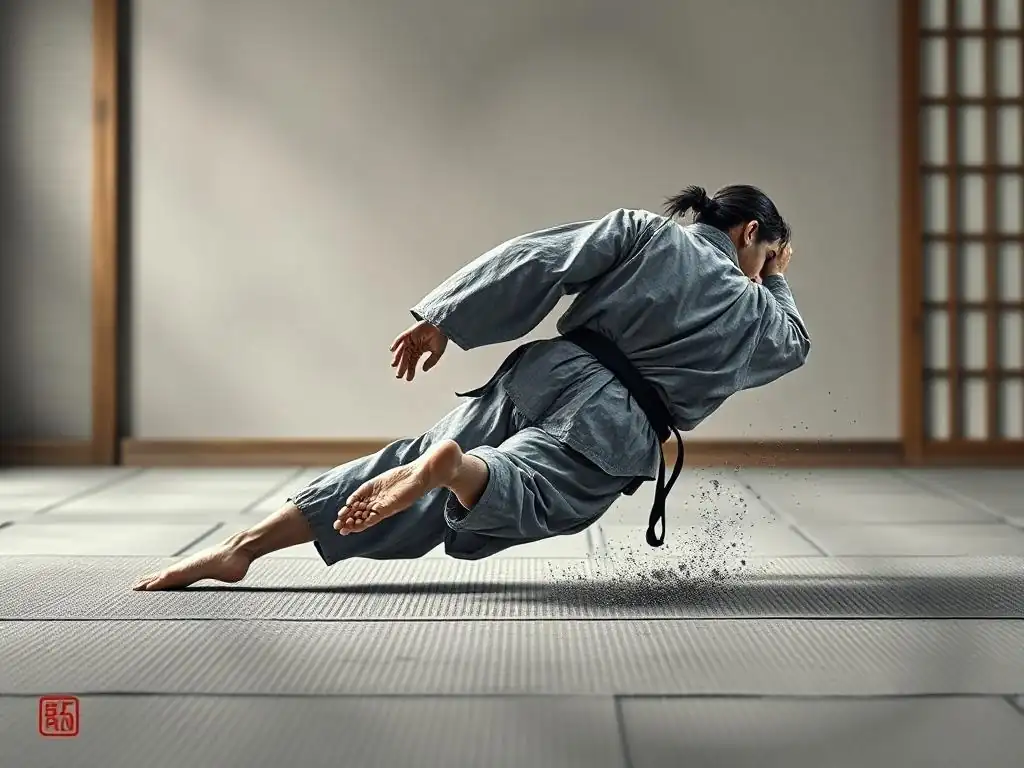
Proper Body Mechanics: Protecting Yourself and Building Mental Focus
Understanding and executing proper body mechanics is the bedrock of safe and effective ukemi. This involves learning how to position the body to distribute impact, protect vulnerable areas like the head and spine, and utilize momentum safely. For example, in a forward roll (mae ukemi), knowing how to tuck the chin, round the back, and roll diagonally across the shoulder is critical. In a backward breakfall (ushiro ukemi), understanding how to slap the mat with the arm at the moment of impact helps dissipate energy and protect the back. These precise movements require significant mental focus and awareness.
The intricate details of proper ukemi mechanics demand concentration, pulling the practitioner's attention firmly into the present moment. This intense focus on physical execution builds mental discipline, training the mind to override instinctive panic responses and adhere to trained procedures. For instance, during a dynamic throw, the mind must quickly assess the direction and speed of the fall and initiate the correct sequence of movements for the appropriate ukemi.
This rapid, focused decision-making under pressure is a direct benefit of drilling proper mechanics and contributes significantly to the mental aspect of Ukemi falling resilience training. Mastery of mechanics provides a tangible sense of control, further reinforcing mental strength.
Progressive Ukemi Drills: Gradual Exposure to Build Resilience
Ukemi is typically taught through a progressive series of drills, starting with simple, static exercises and gradually increasing complexity, height, and speed. This gradual exposure is crucial for building both physical skill and mental resilience without overwhelming the student. Beginners might start by practicing rolls from a kneeling position, then progress to standing rolls, and eventually incorporate rolls from throws. Similarly, breakfalls might begin with slapping the mat while sitting, then falling from a low squat, and finally executing breakfalls from dynamic techniques. This step-by-step approach allows students to build confidence at each stage before facing greater challenges.
This progressive methodology is key to effective Ukemi falling resilience training. It manages the inherent fear by introducing challenges incrementally, allowing the practitioner's comfort zone to expand naturally. Success at each level reinforces learning and builds confidence for the next step. For example, successfully executing a simple forward roll repeatedly builds the confidence needed to attempt a forward roll from a gentle push. This systematic exposure to increasing levels of discomfort and challenge is a fundamental principle behind developing mental toughness and resilience in any domain, mirroring how exposure therapy is used to treat phobias.
Visualization and Mental Rehearsal: Enhancing Ukemi Performance
Beyond physical practice, visualization and mental rehearsal play a significant role in mastering ukemi and enhancing mental strength. Before attempting a new or challenging ukemi, practitioners can mentally walk through the sequence of movements, imagining the feel of the roll or the timing of the breakfall. This mental practice helps solidify the technique and builds confidence by reducing the feeling of the unknown. Visualizing a smooth, controlled fall can prepare the mind and body to execute it effectively when the time comes during live practice.
Mental rehearsal also helps in anticipating potential issues and mentally preparing responses. For instance, visualizing receiving a specific throw and executing the correct ukemi allows the practitioner to process the scenario beforehand, reducing hesitation in the moment. This cognitive preparation is a powerful tool in Ukemi falling resilience training, enabling the mind to stay calm and focused even in dynamic and unpredictable situations. Elite athletes across various disciplines utilize visualization to improve performance and manage pressure, and the same principles apply effectively to the mental demands of martial arts training, particularly ukemi.
Types of Ukemi and Their Mental Challenges
Mae Ukemi (Forward Roll): Conquering the Fear of Falling Forward
Mae Ukemi, the forward roll, is often one of the first ukemi techniques taught, yet it presents a significant mental hurdle: the fear of falling forward and potentially hitting one's head. This natural protective instinct must be overridden by the learned technique of tucking the chin and creating a rounded surface to roll over. The initial attempts can be awkward and hesitant, driven by this underlying fear. Mastering mae ukemi requires trusting the body mechanics and committing to the roll, even when momentum is carrying you forward.
The process of consistently practicing mae ukemi, starting slowly and progressing to higher speeds and distances, directly addresses this fear. Each successful roll, where the practitioner smoothly transitions over their shoulder or back without jarring impact, reinforces confidence and diminishes the fear response. This repeated triumph over a primal fear is a powerful aspect of Ukemi falling resilience training. It teaches the practitioner that by applying technique and trusting the process, they can safely navigate a potentially dangerous situation, building significant mental fortitude.
Ushiro Ukemi (Backward Breakfall): Trusting Your Body and Technique
Ushiro Ukemi, the backward breakfall, introduces a different kind of mental challenge: falling backwards, away from what the eyes can see, and relying entirely on learned technique and body awareness. The instinct is often to brace oneself or reach back, both of which can lead to injury.
Executing a proper ushiro ukemi requires relaxing the body, controlling the fall onto a rounded back, and slapping the mat at the precise moment of impact to dissipate energy. This requires a deep level of trust – trust in the technique itself and trust in one's own body to perform it correctly under duress.
Overcoming the mental block associated with falling backwards without visual control is a significant step in Ukemi falling resilience training. It forces the practitioner to develop internal awareness (proprioception) and to act based on trained instinct rather than visual feedback. Successfully executing ushiro ukemi, especially from dynamic techniques, builds profound self-trust and the ability to function effectively even when disoriented or unable to see clearly. This skill translates metaphorically to navigating situations in life where we must move forward or act without a complete picture of what lies behind us, relying on our inner knowledge and preparation.
Yoko Ukemi (Side Breakfall): Maintaining Awareness and Balance
Yoko Ukemi, the side breakfall, often occurs unexpectedly during techniques that off-balance the practitioner laterally. The mental challenge here lies in reacting quickly and correctly to a sudden loss of balance while maintaining awareness of one's surroundings and the position of the training partner. Unlike a planned roll, a side breakfall often requires an immediate, reflexive response. The practitioner must quickly tuck limbs, round the side of the body, and execute the mat slap to absorb the impact.
Mastering yoko ukemi develops the mental skill of rapid assessment and reaction under pressure. It trains the mind to stay alert and adaptable, even when equilibrium is suddenly disturbed. The need to protect the head and vulnerable joints while falling sideways requires sharp spatial awareness and quick decision-making. Consistent practice of yoko ukemi in various scenarios enhances the ability to recover quickly from unexpected disruptions, both physically and mentally. This aspect of Ukemi falling resilience training fosters mental agility and the capacity to regain composure and balance after being knocked off course.
Kaiten Ukemi (Rotary Breakfall): Utilizing Momentum and Spatial Awareness
Kaiten Ukemi, or rotary breakfall, involves receiving techniques that send the practitioner into a spinning or rolling motion. The mental challenges are significant, including managing dizziness, utilizing centrifugal force safely, and maintaining spatial awareness while rotating. This type of ukemi often involves higher speeds and more complex trajectories than simpler rolls or breakfalls, demanding advanced coordination and mental control. The practitioner must blend with the rotation initiated by the technique and convert it into a controlled, safe fall or roll.
Successfully performing kaiten ukemi requires a high degree of trust in momentum and the ability to stay relaxed and centered while spinning. It trains the mind to process complex sensory input (like disorientation from spinning) and execute a planned sequence of actions simultaneously. This advanced level of Ukemi falling resilience training builds exceptional spatial awareness, coordination under dynamic conditions, and the mental capacity to remain composed in highly disorienting situations. It represents a peak in integrating physical technique with advanced mental control.
Ukemi and Mindfulness: Connecting Body and Mind
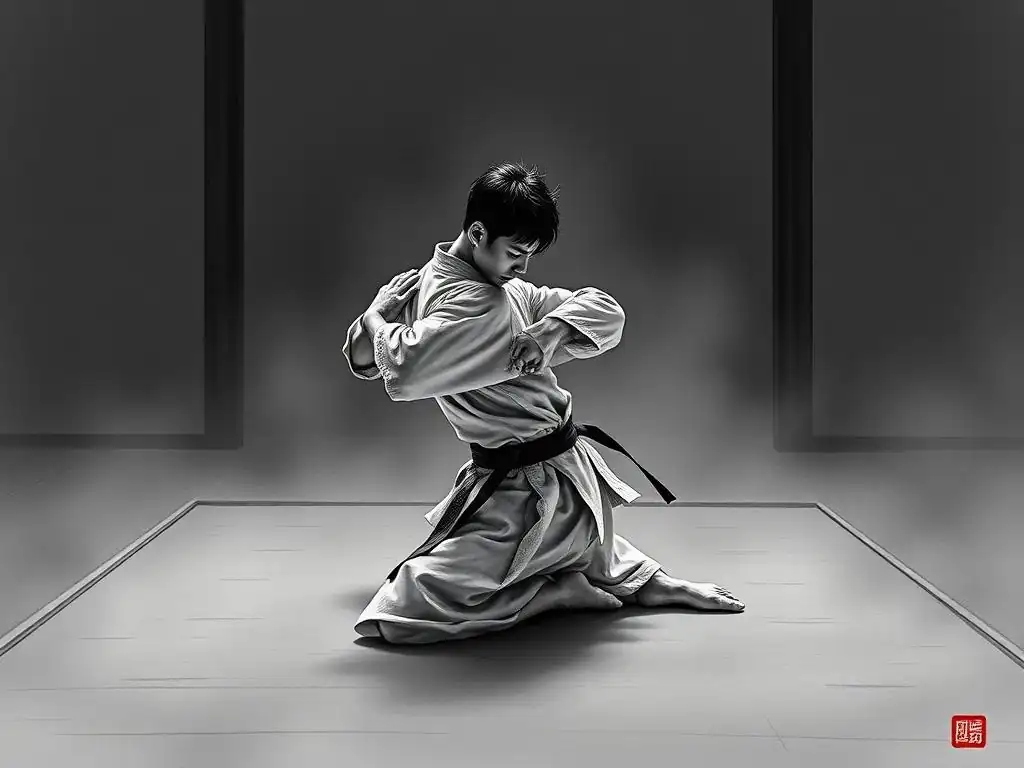
Staying Present in the Moment: Avoiding Panic During Ukemi
Mindfulness, the practice of being fully present in the moment, is intrinsically linked to effective ukemi and the development of mental resilience. When thrown, the natural, untrained reaction is often panic, which leads to tensing up, flailing limbs, and increased risk of injury. Staying present means focusing attention on the immediate sensations, the direction of the fall, and the mechanics of the planned ukemi, rather than getting lost in fearful thoughts about potential pain or injury.
Practicing ukemi repeatedly cultivates this ability to remain present. Each fall is an opportunity to practice letting go of fear and focusing purely on the physical execution of the technique. This deliberate shift in attention trains the mind to override the panic response and maintain a state of calm focus under pressure.
This skill is a core component of Ukemi falling resilience training; it teaches practitioners to anchor their attention in the 'now' during moments of stress, a valuable ability applicable far beyond the dojo. By staying present, the practitioner can react appropriately and safely, demonstrating mental control over instinctive fear.
Breathing Techniques for Calmness and Control During Falls
Conscious breathing is a powerful tool for maintaining calmness and control during ukemi, particularly during dynamic or unexpected falls. When experiencing fear or impact, the natural tendency is to hold one's breath or breathe shallowly, which increases tension and hinders relaxation. Learning to exhale during the moment of impact or throughout the roll helps the body stay relaxed and facilitates the smooth execution of the technique. A controlled exhale also helps to dissipate tension and can assist in the mat slap during a breakfall, further distributing force.
Integrating specific breathing techniques into ukemi practice enhances mental composure. For instance, some practitioners focus on a strong, audible exhale during the breakfall impact. This not only helps physically but also provides a mental anchor, a deliberate action to perform amidst the chaos of falling. Conscious breathing techniques are fundamental in mindfulness and stress management, and their application in Ukemi falling resilience training directly links the physical act of falling with intentional mental control. By focusing on breath, practitioners can mitigate anxiety and maintain a state of calm readiness even while being thrown.
Cultivating a Growth Mindset: Learning from Every Ukemi Experience
Every ukemi, whether executed perfectly or imperfectly, is an opportunity for learning and growth. Adopting a growth mindset towards ukemi means viewing each fall not as a failure if it wasn't perfect, but as valuable feedback. Did the roll feel smooth? Was the breakfall jarring? Was the timing off? Analyzing these sensations and outcomes provides crucial information for refining the technique. This iterative process of practice, analysis, and adjustment is central to mastering ukemi and developing resilience.
A growth mindset in ukemi training encourages perseverance through difficulty and mistakes. Instead of getting discouraged by awkward falls or minor impacts, the practitioner with a growth mindset sees these as temporary challenges to be overcome. They focus on incremental improvement, understanding that mastery comes through consistent effort and learning from every experience. This perspective, cultivated through Ukemi falling resilience training, fosters a positive attitude towards challenges, encourages continuous self-improvement, and builds the mental strength to persist in the face of setbacks, both on the mat and in life.
Integrating Ukemi into Your Martial Arts Journey and Beyond
Ukemi as a Foundation for Advanced Aikido Techniques
Ukemi is not just a basic skill to be learned and then forgotten; it is a fundamental prerequisite and an ongoing practice that enables the safe exploration and execution of advanced Aikido techniques. Complex throws, joint locks that off-balance the opponent dramatically, and dynamic pins all rely on the uke (the one receiving the technique) being able to perform effective ukemi. Without a skilled uke, the nage cannot fully practice the power, timing, and nuances of these advanced movements.
For example, executing a technique like kokyu-nage (breath power throw), which often sends the uke flying, requires the uke to perform a high-level dynamic ukemi, perhaps a rotary breakfall or a high forward roll. Similarly, techniques involving joint manipulation that lead to a fall necessitate the uke knowing how to breakfall safely to avoid injury. Thus, continuous refinement of ukemi allows practitioners to train advanced techniques realistically and safely, deepening their understanding of Aikido's principles and applications. Ukemi proficiency is not the end goal, but the necessary foundation for progressing along the path of martial arts mastery.
Ukemi as a Life Skill: Applying Resilience to Everyday Challenges
The mental and physical resilience developed through Ukemi falling resilience training extends far beyond the confines of the dojo. Learning to fall safely and recover quickly is a valuable life skill. Accidental falls happen in everyday life – slipping on ice, tripping on stairs, etc. Individuals with ukemi training are often better equipped to react instinctively in such situations, minimizing injury through a natural breakfall or roll learned through countless repetitions on the mat. This practical application of physical resilience is a tangible benefit.
More profoundly, the mental resilience cultivated through ukemi – the ability to overcome fear, embrace discomfort, learn from setbacks, and maintain composure under pressure – is directly applicable to navigating life's inevitable challenges. Facing a difficult project at work, dealing with personal disappointments, or recovering from failure all require a form of "getting back up" after being "thrown." The mindset honed through ukemi training provides a framework for processing these experiences constructively, fostering perseverance, adaptability, and a positive outlook. It teaches that setbacks are temporary and that recovery and continued progress are always possible.
The Role of a Sensei in Guiding Ukemi Development
The guidance of a skilled and experienced Sensei is paramount in the proper development of ukemi. A Sensei provides crucial instruction on correct body mechanics, ensuring safety and efficacy. They introduce progressive drills at the appropriate pace for each student, building confidence incrementally. More importantly, a good Sensei creates a safe and supportive training environment where students feel comfortable taking risks and making mistakes necessary for learning ukemi. They offer personalized feedback, identifying areas for improvement and helping students refine their technique.
Beyond technical instruction, a Sensei plays a vital role in cultivating the mental aspects of Ukemi falling resilience training. They encourage students to push past fear and discomfort, offering reassurance and demonstrating the techniques themselves. They emphasize the philosophical connections between ukemi and Aikido principles, helping students understand the deeper meaning of their practice.
A Sensei's patience, expertise, and encouragement are essential for students to trust the process, overcome mental barriers, and truly integrate ukemi as a fundamental skill for both physical safety and mental fortitude. Their guidance ensures that ukemi training is a journey of continuous growth and resilience building.
The Ukemi Mindset: Key Takeaways for Mental Resilience
Benefits of Ukemi for Mental and Physical Well-being
Ukemi training offers a wide array of benefits for both mental and physical well-being, making it a holistic practice for martial artists and beyond. Physically, it improves coordination, balance, flexibility, and body awareness. It strengthens core muscles and teaches efficient movement patterns. The repetitive nature provides excellent cardiovascular conditioning. Most importantly, it drastically reduces the risk of injury during martial arts practice and in everyday life by teaching safe falling techniques.
Mentally, the benefits are equally significant. Ukemi falling resilience training directly addresses and helps overcome fear, building confidence and self-efficacy. It cultivates mental toughness by requiring practitioners to embrace discomfort and persevere through challenges. It enhances focus, concentration, and presence of mind. The process of learning from each fall fosters a growth mindset and improves adaptability. Overall, ukemi training contributes to reduced anxiety, increased self-reliance, and a more resilient and positive outlook on life, demonstrating its profound impact on comprehensive well-being.
Integrating Ukemi into a Holistic Training Regimen
Ukemi should be viewed not as a separate exercise but as an integral and continuous part of a holistic martial arts training regimen. It is not something to be practiced only by beginners; even advanced practitioners benefit from regular ukemi drills to maintain and refine their skills. Incorporating dedicated ukemi practice into every training session reinforces the fundamental principles of movement, balance, and relaxation under pressure. It also serves as an excellent warm-up, preparing the body and mind for more dynamic techniques.
For those seeking to maximize the mental benefits, integrating mindfulness techniques and visualization into ukemi practice can be particularly effective. Approaching each fall with conscious awareness and a focus on breath enhances the mental resilience aspect of Ukemi falling resilience training. Furthermore, reflecting on the lessons learned from ukemi and consciously applying the "get back up" mindset to life's challenges ensures that the resilience built on the mat translates into tangible improvements in everyday mental fortitude. Making ukemi a central, ongoing part of training is key to unlocking its full potential for physical and mental development.
Frequently Asked Questions
What is Ukemi and why is it important in martial arts?
Ukemi refers to falling techniques used to safely break a fall. It's crucial because it allows practitioners to protect themselves from injury during training and in real-world self-defense situations. Mastering Ukemi is fundamental to building confidence and pushing your limits.
How does "The Mental Game of Ukemi" relate to physical training?
The article emphasizes that Ukemi isn't just about physical technique. It highlights the mental fortitude required to overcome fear and hesitation when falling. Developing a positive mindset is essential for proper execution and injury prevention.
What are some key mental strategies for improving Ukemi resilience?
Key strategies include visualization, practicing with controlled fear, and focusing on present moment awareness. By managing anxiety and building confidence, you can improve your reaction time and technique under pressure.
How can "Ukemi falling resilience training" be applied to life outside of martial arts?
The principles of Ukemi, such as accepting failure, learning from mistakes, and building resilience, are applicable to overcoming challenges in all aspects of life, like career, relationships, and personal growth.
Where can I find more information on specific Ukemi techniques and training drills?
MartialArtsMastery.org offers a range of resources, including articles on different Ukemi variations, step-by-step training guides, and videos demonstrating proper form. It's a great place to start or continue your Ukemi journey.
Final Reflection: Embracing the Fall, Cultivating Resilience
The journey through understanding Ukemi, the art of falling safely, transcends the dojo and resonates deeply with the challenges of modern life. The principles of controlled descent and adaptive response, honed through Ukemi falling resilience training, are not just physical skills; they are powerful metaphors for navigating life's inevitable stumbles. In a world demanding constant adaptation, the ability to fall gracefully and rise stronger is more crucial than ever.
This exploration of Ukemi has illuminated how physical practice can profoundly impact our mental and emotional landscapes. Learning to accept and even embrace the fall, both literally and figuratively, fosters a resilience that permeates all aspects of our being. It teaches us to confront fear, to analyze our mistakes, and to cultivate the courage to try again. Fall seven times, stand up eight.
This ancient Japanese proverb encapsulates the very essence of Ukemi and the unwavering spirit it cultivates.
Now, I invite you to consider how you can apply the lessons of Ukemi to your own life. Embrace the falls, learn from the stumbles, and cultivate the resilience to rise stronger each time. Let the art of falling safely become your guide to navigating the uncertainties of life with grace, courage, and unwavering determination.
Embrace the Fall: Unlock Your Inner Resilience!
Thanks for exploring the mental fortitude woven into the art of Ukemi! You've gained valuable insights into transforming fear into opportunity on and off the mat. Now, it's time to translate that knowledge into action and cultivate your own unwavering resilience.
- Commit to practicing Ukemi regularly, not just as a technique, but as a mindful exercise in overcoming fear and embracing discomfort.
- Share this article with a fellow martial artist or anyone who could benefit from a fresh perspective on facing challenges.
- Reflect on a past setback – can you reframe it using the principles of Ukemi and identify a hidden opportunity for growth?
What small, courageous step will you take today to apply the lessons of Ukemi to a challenge in your own life?