
The Trifecta TuneUp: Partner Drills to Master Timing, Distance, AND Coordination

Welcome to Martial Arts Mastery, where we delve into the heart of combat excellence. Ever wonder how legendary martial artists achieve that seemingly effortless flow in their movements? This week, we unlock a crucial key: partner drills. Prepare to sharpen your skills with "The Trifecta TuneUp: Partner Drills to Master Timing, Distance, AND Coordination." This isn't just about memorizing moves; it's about forging a deep understanding of timing, spatial awareness, and seamless coordination. Ready to elevate your training and unlock a new level of mastery? Let's begin!
- Introduction: Elevate Your Martial Arts Skills with Partner Drills
- Understanding the Core Elements: Timing, Distance, Coordination
- Drill 1: The Reactive Step-Back Drill for Timing and Distance
- Drill 2: The Mirror Image Drill for Coordination and Reflexes
- Drill 3: The Rhythm Tap Drill for Tempo and Precision
- Progressing Your Partner Drills: From Beginner to Advanced
- Common Mistakes and How to Correct Them
- Conclusion: The Path to Martial Arts Mastery Through Partner Training
-
Frequently Asked Questions
- What are the primary benefits of incorporating partner drills into martial arts training?
- How do partner drills specifically improve timing in martial arts?
- Why is coordination so important in martial arts, and how do partner drills help?
- What role does distance management play in martial arts, and how do partner drills refine this skill?
- Can partner drills be used for self-defense training, or are they primarily focused on sport martial arts?
- Final Reflection: Harmonizing Movement Through Partnership
- Ignite Your Skills: Master Partner Drills Today!
Introduction: Elevate Your Martial Arts Skills with Partner Drills
Partner drills are the cornerstone of effective martial arts training, transforming theoretical knowledge into practical application. While solo forms and heavy bag work build fundamental strength and technique, it is through interaction with a training partner that a practitioner truly learns to apply their skills dynamically. These drills provide invaluable feedback, forcing adaptation and refinement in real-time scenarios that static training cannot replicate.
Engaging in consistent partner work helps bridge the gap between isolated technique practice and the unpredictable nature of sparring or self-defense situations. It allows practitioners to develop a sense of flow, rhythm, and responsiveness essential for effective martial arts application. The shared learning environment also fosters camaraderie and mutual improvement, pushing both individuals to higher levels of skill.
Why Partner Drills are Crucial for Martial Arts Mastery
Martial arts mastery isn't just about knowing techniques; it's about applying them effectively against a resisting or moving opponent. Partner drills provide the dynamic context necessary for this development. They allow practitioners to practice techniques at varying speeds and intensities, reacting to an opponent's natural movements and intentions rather than performing pre-set patterns.
Consider striking or grappling. While solo drills build power and form, partner drills allow you to practice hitting a moving target or applying a lock against resistance. This interaction is crucial for understanding leverage, balance, and the subtle shifts in weight and pressure that define real combat. Regular partner drills timing coordination movement are non-negotiable for anyone serious about practical martial arts skill development.
Focusing on the Trifecta: Timing, Distance, and Coordination
While partner drills enhance many aspects of martial arts, their most significant impact lies in refining the "trifecta" of combat effectiveness: timing, distance, and coordination. These three elements are deeply intertwined; poor performance in one area inevitably compromises the others. For instance, perfect technique delivered with poor timing at the wrong distance is ineffective.
Mastering these elements allows a practitioner to maximize the impact of their techniques while minimizing vulnerability. Effective timing means acting at the opportune moment, distance control ensures you are neither too close nor too far, and coordination allows for fluid, powerful, and efficient movement. Dedicated partner drills timing coordination movement are specifically designed to isolate and improve these critical components, leading to a more dynamic and adaptable martial artist.
Understanding the Core Elements: Timing, Distance, Coordination
True proficiency in martial arts hinges on a deep understanding and practical application of timing, distance, and coordination. These aren't just abstract concepts but tangible skills that can be honed through deliberate practice. They represent the difference between a technically proficient practitioner and one who can effectively apply their skills under pressure.
Think of these elements as the fundamental physics of martial arts engagement. Timing dictates when force is applied, distance dictates where, and coordination dictates how efficiently and powerfully the body generates that force. Neglecting any one of these pillars weakens the entire structure of a martial artist's ability.
Timing in Martial Arts: The Art of Anticipation
Timing in martial arts is the ability to execute techniques at the most advantageous moment, exploiting openings as they appear or creating them through feints and rhythm changes. It involves not just speed, but also pattern recognition, anticipation, and the ability to read an opponent's intentions and movements.
A practitioner with good timing can intercept an attack before it fully develops, strike when the opponent is off-balance, or evade a technique by moving fractionally before it lands. This isn't about being faster in terms of raw speed, but about being quicker in terms of reaction and decision-making, often measured in split seconds. Developing this involves countless repetitions of dynamic interactions found in partner drills timing coordination movement.
Developing Reaction Time Through Partner Exercises
Partner exercises are indispensable for improving reaction time, a key component of timing. Drills that involve spontaneous cues, unpredictable movements, or rapid exchanges force the brain and body to respond instantly. For example, a simple drill where one partner throws a jab and the other reacts by blocking or slipping requires immediate processing and action.
Consistent practice of such drills, perhaps 10-15 minutes per training session 2-3 times a week, can noticeably reduce reaction time. This is because the nervous system becomes more efficient at recognizing common patterns and executing appropriate defensive or offensive responses. These partner drills timing coordination movement build the instinctive reactions needed in dynamic exchanges.
Distance Control: Managing Range for Effective Offense and Defense
Distance control, or managing the range between yourself and your opponent, is paramount for both offensive and defensive success. Being at the correct distance allows your techniques to land with maximum power and reach, while simultaneously keeping you out of the optimal range for your opponent's attacks.
Different martial arts and different techniques within those arts require specific optimal distances. A boxer needs to be within punching range, a Muay Thai fighter within kicking and clinching range, and a grappler within grappling range. Understanding and maintaining this dynamic range is a constant negotiation during any exchange. Effective partner drills timing coordination movement often focus heavily on this spatial awareness.
Utilizing Footwork Drills for Optimal Spacing
Footwork is the foundation of distance control. Drills specifically focused on movement, such as sliding steps, pivots, and diagonal movements, are critical. When practiced with a partner, these drills become dynamic; one partner might advance or retreat, forcing the other to constantly adjust their distance.
For example, a drill where one partner slowly advances and the other maintains a consistent distance using only backward slides trains the ability to manage range under pressure. Practicing this for several rounds, perhaps 5-minute intervals, helps build the muscle memory for efficient movement. Incorporating feints and changes of direction makes these partner drills timing coordination movement even more realistic and effective for spatial management.
Coordination: Harmonizing Movement for Fluid Execution
Coordination is the ability of different parts of the body to work together smoothly and efficiently to perform a task. In martial arts, this means linking movements seamlessly – like shifting weight while simultaneously throwing a punch, or coordinating footwork with a defensive block. Good coordination translates to greater power, speed, balance, and fluidity.
Lack of coordination often results in jerky movements, wasted energy, and techniques that lack power or precision. It affects everything from generating torque for a powerful strike to executing complex joint locks or throws. Developing coordination requires drills that challenge the body to integrate multiple actions simultaneously.
Enhancing Body Mechanics with Partner-Assisted Training
Partner-assisted training is excellent for refining body mechanics and enhancing coordination. Drills that involve mirroring movements, flowing through sequences together, or applying techniques against minimal resistance help synchronize the body's actions. For instance, practicing throws slowly with a partner allows focus on weight transfer, hip placement, and arm coordination.
Another example is a drill where one partner provides slight resistance to a striking combination, forcing the other to maintain balance and connect movements smoothly. Spending time on these partner drills timing coordination movement, focusing on the quality of movement rather than speed or power initially, builds the foundational coordination needed for more complex techniques.
Drill 1: The Reactive Step-Back Drill for Timing and Distance
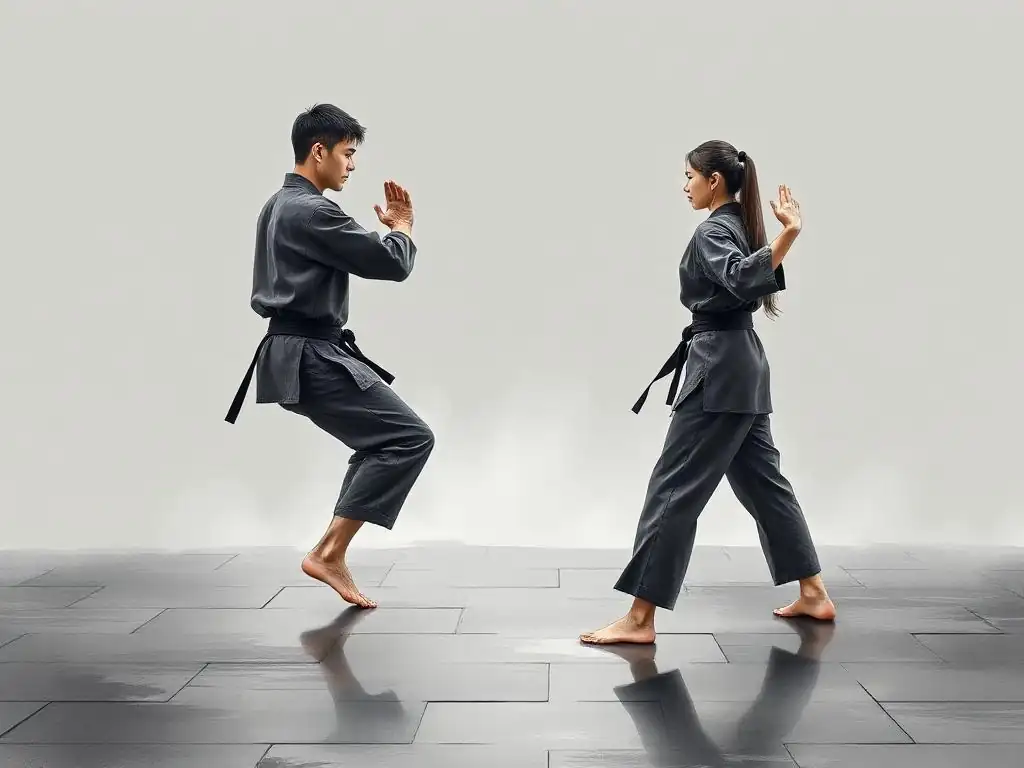
This drill specifically targets the interplay between timing and distance, forcing the practitioner to react instantly to maintain optimal range. It helps develop the instinctive footwork needed to avoid attacks or create space for counter-offensives. It's a foundational drill for understanding defensive spacing.
The Reactive Step-Back Drill emphasizes reading an opponent's intention to close distance and reacting with the appropriate backward movement. It’s simple yet incredibly effective for building the habit of managing range dynamically. This is a prime example of partner drills timing coordination movement focusing on defensive reflexes.
Setting Up the Reactive Step-Back Drill
Partners face each other at a comfortable striking distance, perhaps a step or two outside of punching range. One partner (the attacker) will initiate a forward step or feint, simulating an attack or advance. The other partner (the defender) will react by taking a single, controlled step backward to maintain the initial distance.
The attacker should vary the timing and intensity of their forward movement – sometimes a slow step, sometimes a quick lunge feint. The defender's goal is not to retreat further than necessary, but to take just enough of a step back to stay out of the immediate attack zone while remaining in a position to counter if desired (though countering isn't the focus of this specific drill). Set a timer for 2-3 minute rounds.
Execution and Variations for Enhanced Timing
During execution, the defender must focus on reacting as the attacker begins their movement, not after they've completed it. This hones reaction time. The attacker can vary the speed of their step-in, sometimes coming in quickly, sometimes slowly, forcing the defender to adjust their timing.
- Variation 1 (Adding Feints): The attacker adds upper body feints (shoulder shrugs, head movements) without stepping to test the defender's ability to distinguish between a real advance and a fake.
- Variation 2 (Multiple Steps): The attacker takes two or three steps forward, requiring the defender to match with two or three steps back while maintaining distance.
- Variation 3 (Direction Change): The attacker can step slightly offline (e.g., forward-left or forward-right), requiring the defender to step back diagonally.
These variations make the partner drills timing coordination movement more complex and improve the defender's reactive footwork in multiple directions, crucial for dynamic range management.
Focusing on Proper Distance Management in the Drill
The core objective is maintaining a consistent, safe distance. The defender should not end up too far away (making it hard to counter later) or too close (still within attack range). The step back should be just enough.
A common mistake is taking too large a step, losing ground unnecessarily. Conversely, too small a step leaves the defender vulnerable. Partners should provide feedback – "You stepped too far back," or "You were still too close." Using floor markers can help visually gauge the starting and ending distance. This meticulous focus on range makes these partner drills timing coordination movement highly effective for developing spatial awareness under simulated pressure.
Drill 2: The Mirror Image Drill for Coordination and Reflexes
This drill is excellent for developing overall body coordination, balance, and visual reflexes. It requires partners to move in sync, reacting instantaneously to each other's actions without pre-planning. It builds proprioception and the ability to move fluidly in relation to another person.
The Mirror Image Drill removes the combative element initially, focusing purely on movement synchronization and reactive coordination. It's a fundamental drill for enhancing the non-verbal communication and fluid motion needed in dynamic martial arts exchanges. This type of partner drills timing coordination movement is great for warm-ups or cool-downs.
Preparing for the Mirror Image Drill
Partners face each other, standing roughly arm's length apart. One partner is designated the "leader" and the other the "mirror." The leader will begin to move slowly and deliberately. The mirror's job is to copy the leader's movements exactly, as if looking into a mirror.
Movements should initially be simple and slow: raising an arm, shifting weight, stepping side to side, bending knees. The focus is on quality of mirroring, not speed. Ensure there is enough space around both partners to move safely without bumping into obstacles or other people.
Enhancing Coordination Through Mimicry
The act of mirroring requires intense focus and coordination. The mirror must process the leader's movement visually and translate it instantly into their own body's action. This strengthens the mind-body connection and improves motor control.
As the drill progresses, the leader can introduce more complex movements:
- Combining upper and lower body actions (e.g., step forward while raising an arm).
- Adding turns or pivots.
- Varying the speed of movements slightly (still keeping it controlled).
The mirror must coordinate multiple body parts to replicate the movement accurately and smoothly. This constant mirroring of partner drills timing coordination movement builds fluidity and responsiveness.
Advancing the Drill: Adding Complexity and Speed
Once partners are comfortable with basic mirroring, the drill can be advanced:
- Switch Roles: Partners switch leader/mirror roles frequently.
- Increased Speed: Gradually increase the speed of the movements, requiring quicker reactions.
- Adding Martial Arts Context: The leader incorporates basic martial arts movements (blocks, simple strikes, stances), and the mirror copies them. This applies the coordination directly to martial arts techniques.
- Simultaneous Leading: Both partners try to lead and follow simultaneously, reacting to each other's subtle cues – a more advanced, free-form variation.
These progressions challenge the partners' ability to maintain coordination and reflexes under increasing demands, making these partner drills timing coordination movement highly effective for dynamic skill transfer.
Drill 3: The Rhythm Tap Drill for Tempo and Precision
This drill focuses on developing timing and precision, often incorporating simple striking or blocking motions executed to a specific rhythm or tempo set by the partner. It helps internalize timing principles and improves accuracy in striking or defensive actions.
The Rhythm Tap Drill can be adapted for various techniques, from simple jabs and crosses to blocks and parries. Its core principle is executing a technique precisely on cue, which directly translates to hitting a target or defending at the correct moment in a real exchange. This is a focused example of partner drills timing coordination movement emphasizing rhythmic accuracy.
Establishing the Rhythm Tap Drill Setup
Partners face each other at an appropriate range for the technique being practiced (e.g., punching range for strikes, slightly closer for blocks). One partner (the "cue-giver") will provide a rhythmic cue, typically a tap on the other partner's shoulder, hand, or even a focus mitt. The other partner (the "executor") will perform the designated technique precisely as they feel or see the tap.
Start with a simple, consistent rhythm, like a steady beat. The cue-giver provides the tap, and the executor performs the technique. For example, if practicing a jab, the cue-giver taps the executor's lead shoulder, and the executor throws a jab.
Emphasizing Timing and Accuracy with Each Tap
The key to this drill is executing the technique exactly on the tap. Not before, not after. This trains the practitioner to initiate their action based on an external stimulus, mimicking reacting to an opponent's opening or attack.
- Timing Focus: The cue-giver can vary the rhythm – slowing down, speeding up, adding pauses, or creating simple patterns (e.g., tap-tap... pause... tap). The executor must adjust their timing to match the irregular rhythm.
- Accuracy Focus: If practicing striking, the executor must aim for a specific point (like a focus mitt held by the cue-giver) with precision on the tap. For blocking, the block must be executed cleanly and effectively as the tap is received, indicating the simulated incoming attack.
This rhythmic element in partner drills timing coordination movement helps internalize different tempos of exchange.
Integrating Footwork for Improved Movement and Coordination
While the core is timing and precision, the Rhythm Tap Drill can easily incorporate footwork and enhance coordination:
- Adding Steps: The executor performs the technique while simultaneously stepping forward, backward, or offline on the tap.
- Combining Techniques: The cue-giver gives multiple taps in sequence, requiring the executor to perform a combination of techniques (e.g., tap-tap = jab-cross) with proper timing and coordination between the movements.
- Cue-Giver Movement: The cue-giver moves slightly (forward, back, or side-to-side) while tapping, forcing the executor to adjust distance and angle using footwork before executing the technique on the tap.
These additions turn the drill into a comprehensive exercise for partner drills timing coordination movement, linking rhythmic action with dynamic movement and technique execution.
Progressing Your Partner Drills: From Beginner to Advanced
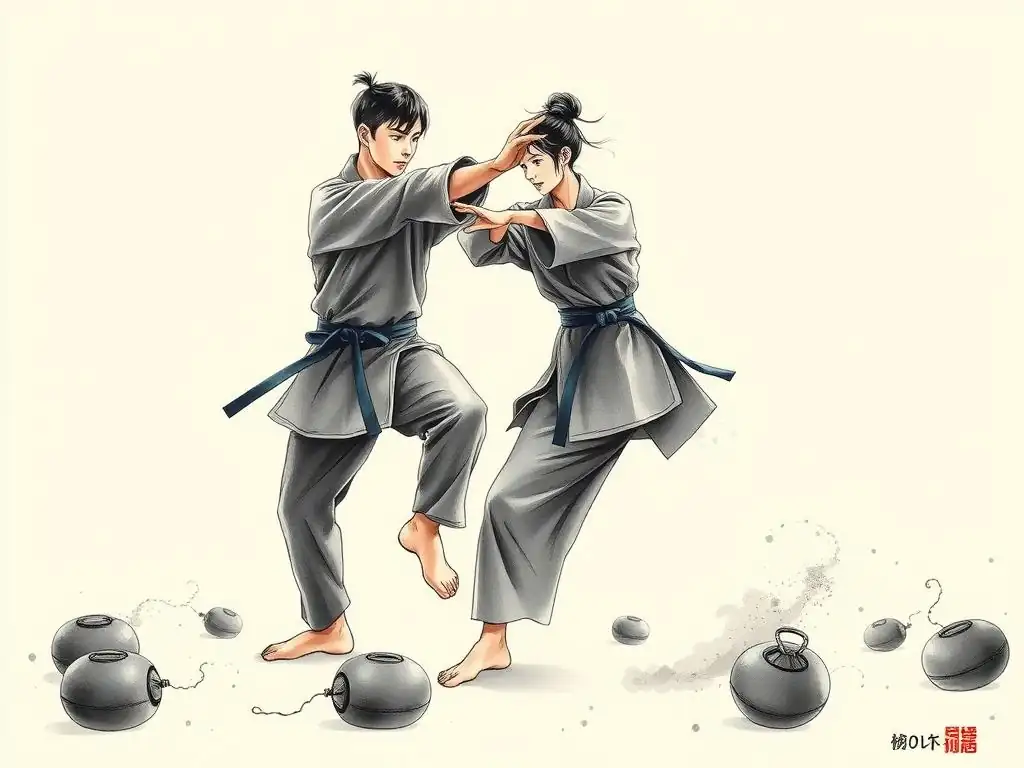
Effective partner training isn't static; drills must evolve with the practitioner's skill level. What works for a beginner might be too slow or simple for an advanced student, and vice versa. Progressing drills ensures continued challenge and development.
The key is a gradual increase in complexity, speed, and realism. Start simple, master the fundamentals, and then layer on additional elements. This systematic approach ensures that the core principles of timing, distance, and coordination are solidified before adding the pressure of higher intensity or more techniques.
Modifying Drills for Different Skill Levels
Beginners should focus on slow, deliberate movements with clear cues and minimal variations. The emphasis is on understanding the mechanics and reacting correctly without speed pressure. For instance, the Reactive Step-Back Drill might start with the attacker just taking a single, obvious step forward.
Intermediate practitioners can handle increased speed, more complex cues, and simple combinations. Variations like those described for the drills become standard. Advanced students can perform drills at near-sparring speed, incorporate feints, multiple techniques, and unpredictable rhythms, blurring the lines between drill and free application. Modifying these partner drills timing coordination movement ensures everyone is challenged appropriately.
Increasing Speed and Intensity Gradually
Speed and intensity should be added incrementally. Starting too fast can lead to sloppy technique, injuries, and the development of bad habits. Begin at a speed where techniques can be performed correctly and reactions are accurate.
Once proficiency is achieved at a slower speed, gradually increase the pace. This might mean the attacker steps in faster in the Reactive Step-Back Drill, the leader moves quicker in the Mirror Image Drill, or the rhythm speeds up in the Rhythm Tap Drill. Intensity can also be increased by adding slight resistance or making the cues less obvious. This controlled progression is vital for safely developing dynamic partner drills timing coordination movement.
Incorporating Sparring Applications of the Drills
The ultimate goal of these partner drills is to improve performance in live exchanges like sparring. As skill progresses, try to integrate the principles learned into light sparring.
- Reactive Step-Back: Consciously look for opportunities to use the step-back to evade an incoming attack or create space for a counter during sparring.
- Mirror Image: Notice how your body naturally mirrors or anticipates your opponent's movements; consciously try to match or disrupt their rhythm.
- Rhythm Tap: Pay attention to the tempo of the exchange; look for opportunities to break rhythm or attack on a beat when your opponent is vulnerable.
Discuss with your partner how you can specifically look for opportunities to apply the skills from these partner drills timing coordination movement during light, controlled sparring rounds.
Common Mistakes and How to Correct Them
Even with dedicated practice, practitioners can fall into common pitfalls when working on timing, distance, and coordination through partner drills. Recognizing these errors is the first step to correcting them and ensuring that the training is effective.
Consistency in feedback and self-awareness are key. Regularly reviewing the purpose of each drill and focusing on the specific element being trained helps prevent drifting into unproductive habits. Addressing mistakes promptly solidifies good technique and understanding.
Addressing Timing Errors in Partner Drills
Common timing errors include reacting too early (flinching or anticipating excessively) or too late (getting hit or missing the opportunity). In the Reactive Step-Back, reacting too early means stepping back before the attacker commits; too late means stepping back as the "attack" would have landed. In the Rhythm Tap, hitting before or after the tap is a timing error.
- Correction: Slow down the drill significantly. The cue-giver should make their action very clear. The executor should focus intently on reacting only when the cue begins. For reaction time, drills focusing on simple, single-action responses (like blocking a single, slow jab) can help isolate the reaction itself. Using verbal cues ("Now!") along with the physical cue can also help initially. Consistent practice of partner drills timing coordination movement at controlled speeds is crucial.
Correcting Distance Miscalculations
Distance errors include being consistently too close or too far. In the Reactive Step-Back, stepping back too much or too little indicates poor distance judgment. In striking drills, techniques falling short or overextending show miscalculation.
- Correction: Use visual markers on the floor to define starting distance. Have the partner provide immediate feedback ("Too close!" "Too far!"). Practice drills that only involve movement and distance management without techniques initially, like simply maintaining a set distance while the partner moves. Focus on the feel of the correct range for different techniques. Regular partner drills timing coordination movement that force constant distance adjustment, like the Reactive Step-Back, are essential.
Refining Coordination and Movement Patterns
Coordination issues often manifest as jerky movements, poor balance during execution, or a lack of power despite effort. In the Mirror Image Drill, choppy or delayed mirroring indicates coordination problems. In other drills, awkward transitions between movements show a lack of fluidity.
- Correction: Return to very slow, deliberate practice of the movements or techniques. Break down complex actions into smaller parts and practice them individually before linking them. Focus on smooth transitions. Drills like the Mirror Image, performed slowly and focusing on replicating the quality of movement, are excellent for building foundational coordination. Yoga or other balance and flexibility exercises can also complement partner drills timing coordination movement by improving overall body control.
Conclusion: The Path to Martial Arts Mastery Through Partner Training
Mastering timing, distance, and coordination is fundamental to achieving proficiency in any martial art. While solo practice builds a strong foundation, it is the dynamic interaction provided by partner drills that truly refines these critical combat attributes. These drills offer real-time feedback and force practitioners to adapt their techniques and movements to a live, unpredictable element – a training partner.
Integrating dedicated partner drills timing coordination movement into your regular training regimen is not just beneficial; it is essential for practical skill development. They bridge the gap between theory and application, preparing the martial artist for the dynamic challenges of sparring and self-defense.
Integrating Partner Drills into Your Regular Training Regimen
Make partner drills a consistent part of every training session. Allocate specific time slots, perhaps 15-20 minutes per session, solely for these interactive exercises. Rotate through different drills focusing on timing, distance, and coordination.
Consider structuring your training week to emphasize different aspects – one day focusing on timing drills, another on distance, and another on coordination, while still touching on all three. Ensure that partners understand the specific goals of each drill and provide constructive feedback. Consistent, focused application of partner drills timing coordination movement yields significant results.
The Long-Term Benefits of Consistent Practice
Consistent practice of partner drills leads to profound long-term benefits. Reaction times decrease, spatial awareness becomes instinctive, and movements become fluid and powerful. This translates directly into improved performance in sparring, kata application, and self-defense scenarios.
Beyond technical skill, partner training builds trust, communication, and mutual respect between training partners – valuable aspects of martial arts philosophy. The physical and mental conditioning gained through repetitive, focused partner drills timing coordination movement builds resilience and adaptability crucial for advanced practitioners.
Mastering Timing, Distance, and Coordination for Martial Arts Excellence
Ultimately, mastery in martial arts is not solely about possessing a vast repertoire of techniques, but about the ability to apply a few techniques exceptionally well under pressure. This ability is directly tied to superior timing, impeccable distance control, and fluid coordination.
By dedicating time and effort to partner drills specifically designed to hone these elements, practitioners can elevate their skills dramatically. The Reactive Step-Back, Mirror Image, and Rhythm Tap drills are just a starting point. Embrace the challenge of dynamic interaction, learn from your partner, and commit to refining your partner drills timing coordination movement as the true path to martial arts excellence.
Frequently Asked Questions
What are the primary benefits of incorporating partner drills into martial arts training?
Partner drills significantly enhance timing, coordination, and movement skills, allowing practitioners to apply techniques against a moving, resisting opponent. This bridges the gap between static practice and live sparring.
How do partner drills specifically improve timing in martial arts?
Partner drills force you to react to your partner's movements, developing your ability to anticipate attacks and time your responses accurately. This reactive timing is crucial in real-world self-defense situations.
Why is coordination so important in martial arts, and how do partner drills help?
Effective martial arts requires seamless coordination between different body parts. Partner drills force you to synchronize your movements, improving muscle memory and overall body control.
What role does distance management play in martial arts, and how do partner drills refine this skill?
Maintaining proper distance is vital for both offense and defense. Partner drills provide dynamic scenarios where you must constantly adjust your positioning to effectively strike, block, or evade attacks.
Can partner drills be used for self-defense training, or are they primarily focused on sport martial arts?
While beneficial for sport, partner drills are invaluable for self-defense training. They allow you to practice techniques under pressure, developing the reflexes and awareness needed to respond effectively in a real-world confrontation.
Final Reflection: Harmonizing Movement Through Partnership
The journey through partner drills reveals a profound truth: mastering timing, distance, and coordination isn't just about physical skill, it's about connection. What we've explored transcends mere exercise; it's a blueprint for building synergy, both on the training ground and in our broader interactions. The ability to anticipate, adapt, and move in unison with another is a powerful metaphor for navigating the complexities of life itself.
The ripple effect of improved timing and coordination extends far beyond the gym, influencing our communication, collaboration, and even our empathy. It's about understanding the unspoken cues, the subtle shifts in energy, and the shared rhythm that binds us together. Alone we can do so little; together we can do so much.
- Helen Keller. This quote encapsulates the essence of partner drills, highlighting the exponential potential unlocked when we synchronize our efforts.
Now, take a moment to consider how you can apply these principles of timing, distance, and coordination to your own life. How can you become a better partner, a more attuned collaborator, a more empathetic listener? Embrace the challenge of harmonizing your movements with those around you, and you'll discover a newfound grace, efficiency, and joy in every interaction. The rhythm of partnership awaits; are you ready to dance?
Ignite Your Skills: Master Partner Drills Today!
Thank you for diving into the world of partner drills and discovering how they can elevate your martial arts prowess! Now, it's time to put that knowledge into action and experience the benefits firsthand.
Here's how you can take the next step:
- Schedule your first dedicated partner drill session this week. Carve out just 30 minutes to focus solely on improving timing, distance, and coordination with a training partner.
- Share this article with fellow martial artists! Help them unlock the power of partner drills and strengthen your training community.
- Try introducing a new or unique drill to your partner next session – something unexpected to challenge your combined skills.
What small adjustment will you make to your partner drills this week to see a bigger impact?