
The Roman Scutum: A Defensive Weapon Used with Brutal Martial Offense

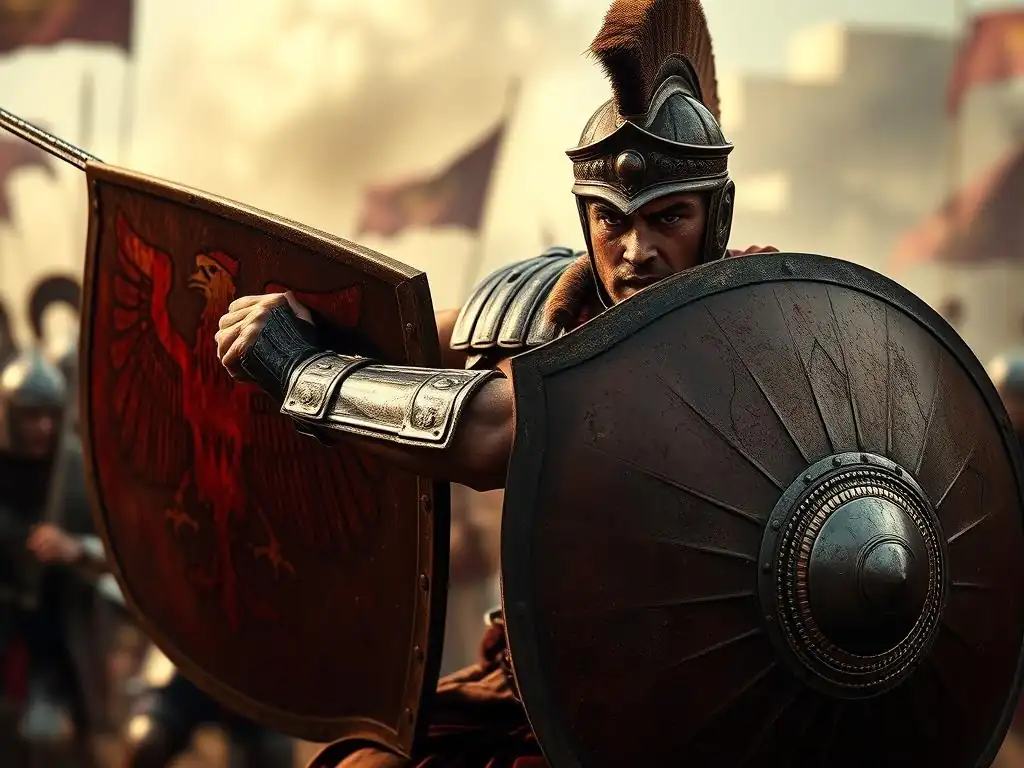
Welcome to Martial Arts Mastery, where the ancient echoes of combat resonate! Delve into the rich tapestry of martial traditions, from the philosophical depths to the brutal realities of self-defense. Ever wondered how ancient warriors wielded their shields as more than mere protection? Prepare to be surprised as we uncover the secrets of Roman scutum fighting techniques, revealing a sophisticated system of offense and defense forged in the crucible of conquest.
Discover how this iconic shield was not just a barrier, but a weapon in its own right, and unlock the fighting methodology of one of history's most formidable empires. Intrigued? Read on to learn more!
- Introduction: The Scutum in Roman Military History
- Understanding the Roman Scutum
- Roman Scutum Fighting Techniques: An Offensive Defense
- The Scutum as a Defensive Implement
- Integrating the Scutum with Other Roman Weapons
- The Scutum in Roman Military Strategy
- The Legacy of the Roman Scutum
- Conclusion: The Enduring Impact of the Roman Scutum
-
Frequently Asked Questions
- ### What was the primary purpose of the Roman scutum?
- ### What made the Roman scutum such an effective weapon in close combat?
- ### What types of martial arts techniques were associated with the Roman scutum?
- ### How did the Roman scutum influence Roman military tactics?
- ### Where can I learn more about Roman scutum fighting techniques?
- Final Reflection: The Enduring Legacy of Roman Shieldcraft
- Unleash Your Inner Legionary!
Introduction: The Scutum in Roman Military History
The Significance of the Scutum in Roman Warfare
The scutum, the iconic large rectangular or oval shield of the Roman legions, was far more than just a piece of defensive equipment; it was a cornerstone of Roman military effectiveness. Unlike the round shields common among many contemporary armies, the scutum's large size and curved shape provided extensive protection to a soldier's body, from shoulder to knee.
This allowed Roman legionaries to fight in incredibly dense formations, minimizing casualties from missile fire and close combat. Its design facilitated the infamous Roman shield wall and the nearly impenetrable Testudo formation, which were critical to Rome's military dominance across diverse terrains and against various enemies.
The scutum fundamentally shaped Roman tactics and training. Legionaries spent countless hours drilling with the scutum, mastering not only its defensive capabilities but also its potential as an offensive tool. The shield became an extension of the soldier, used to shove, punch, and even strike opponents, creating openings for attacks with the gladius or pilum. This emphasis on the scutum's dual role in defense and offense was a hallmark of Roman military martial prowess and a significant factor in their battlefield success, allowing them to absorb enemy charges and then transition seamlessly into aggressive counter-attacks.
Understanding the Roman Scutum
Construction and Design of the Scutum: A Detailed Overview
The construction of a Roman scutum was a sophisticated process, reflecting Roman engineering and military standardization. Early Republic scuta were often oval, but by the Imperial period, the rectangular, curved design became predominant. This curvature, typically forming a half-cylinder, offered greater protection against blows from the side and helped deflect missiles more effectively than a flat surface. The core structure was usually made from several layers of thin wooden planks or strips, glued together to form a strong, yet relatively lightweight, laminate. This layered construction, similar to modern plywood, provided significant strength and resistance to penetration.
The edges of the wooden core were often reinforced with U-shaped bronze or iron binding, protecting the wood from damage and preventing splitting. The most distinctive feature was the central boss, or umbo. This prominent metal hemisphere or cone, typically made of iron or bronze, covered a handgrip located behind the shield's center.
The umbo served to protect the hand holding the shield and was a crucial element in Roman scutum fighting techniques, as it could be used offensively with considerable force. The outer surface of the scutum was often covered with leather or canvas, sometimes painted with legionary insignia or protective coatings.
Materials Used in Scutum Construction: Wood, Leather, and Metal
The primary material for the scutum's core was wood, commonly poplar, oak, or pine. These woods were chosen for their balance of strength, availability, and weight. Thin strips, perhaps 5-10 mm thick, were laminated together, often in alternating directions, to create a board approximately 6-10 mm thick. This multi-layered approach significantly increased the shield's resilience against impacts compared to a single piece of wood of the same thickness. The use of readily available timber sources across the Roman Empire facilitated mass production for the legions.
Beyond the wooden core, metal and leather played vital roles. The umbo was typically cast or hammered from iron or bronze, chosen for its hardness and ability to withstand direct impacts. Edge bindings were also metal, usually bronze or iron, providing crucial structural integrity. The outer face was commonly covered with animal hide (leather) or thick linen/canvas. This covering protected the wood from moisture, prevented splintering upon impact, and provided a surface for decoration or identification markings. Some sources suggest a layer of raw hide might have been applied and allowed to shrink, further tightening the entire structure.
Size and Weight Considerations for Roman Shield Design
Imperial scuta were substantial pieces of equipment, designed to offer maximum protection. A typical rectangular scutum stood approximately 1 to 1.2 meters (around 3.3 to 4 feet) tall and was about 0.6 to 0.8 meters (around 2 to 2.6 feet) wide. The curved depth was usually around 30 cm (about 1 foot). This size allowed a legionary to cover most of their body while standing, providing a significant defensive barrier against incoming threats. The curvature meant that while the frontal area was large, it was less cumbersome than a flat shield of the same dimensions for movement.
Despite their size, scuta were engineered to be manageable in combat. While exact historical weights vary based on materials and construction, estimates for a standard Imperial scutum range from 5.5 to 7.5 kg (about 12 to 16.5 pounds). While this might seem heavy, especially when held for extended periods, it was a necessary trade-off for the level of protection offered.
Roman training emphasized strength and endurance, enabling soldiers to effectively wield the scutum for hours. The weight, combined with the shield's robustness, also contributed to its effectiveness in offensive maneuvers like bashing and pushing, leveraging the mass behind the impact.
Roman Scutum Fighting Techniques: An Offensive Defense
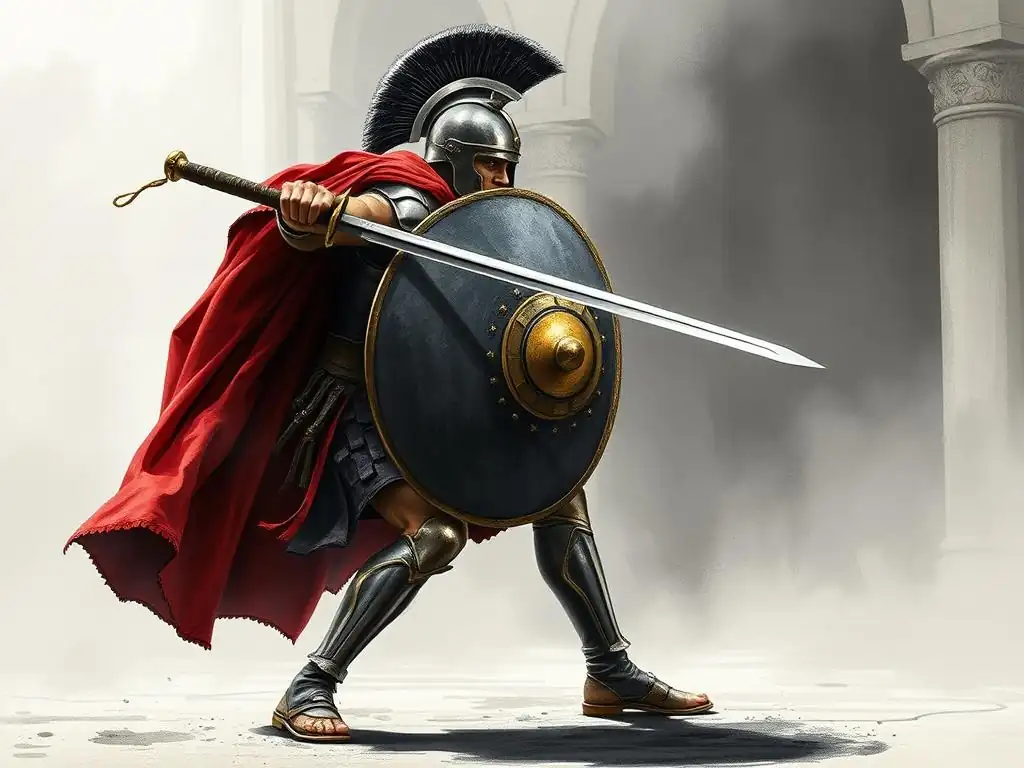
Basic Scutum Maneuvers: Shield Wall Tactics
At its most fundamental level, the scutum was integral to the Roman shield wall, or acies. This basic formation involved soldiers standing shoulder-to-shoulder, interlocking or overlapping their scuta to create a continuous, impenetrable barrier. The curved shape of the scutum allowed soldiers to stand closer together, minimizing gaps and maximizing the collective protection. In a typical advance or defensive stand, the front rank would present their scuta forward, while ranks behind might hold theirs slightly higher, providing overhead protection against missiles. The discipline and training required to maintain this wall under pressure were immense.
Within the shield wall, basic Roman scutum fighting techniques involved using the shield for forward pressure. Legionaries would brace their scuta against the weight of an enemy charge, using their body mass to hold the line. They would push forward collectively, attempting to disrupt enemy formations and create disarray. The scutum was also used to subtly shift position, maintaining the integrity of the wall while allowing individual soldiers just enough space to thrust their gladius into any opening presented by the enemy. This coordinated movement and collective bracing defined the primary use of the scutum in large-scale combat.
Advanced Scutum Combat Techniques: Umbo Strikes and Shield Punches
Beyond forming a static wall, Roman scutum fighting techniques incorporated dynamic offensive uses. The most notable was the use of the umbo (shield boss) as a striking weapon. In close combat, a legionary could deliver a powerful punch or thrust with the scutum, aiming the heavy metal umbo at an opponent's face, chest, or limbs.
Such a blow, delivered with the force of a trained soldier and the weight of the shield, could stun, injure, break bones, or even kill, immediately incapacitating an enemy or creating a critical opening for a sword thrust. This technique was particularly effective in the tight confines of a melee or within the shield wall itself.
Another offensive technique involved using the entire face or edge of the scutum to strike. A "shield punch" involved thrusting the scutum forward, similar to an umbo strike but potentially using the whole shield face to impact the enemy. A quick, sharp jab with the scutum could knock an opponent off balance, interrupt their attack, or create space. These aggressive scutum maneuvers were not merely defensive reactions but deliberate offensive actions, integrated seamlessly into the legionary's fighting style alongside their sword and spear use. Mastery of these Roman scutum fighting techniques required significant strength, agility, and coordination.
Utilizing the Scutum for Shield Bashing and Pushing
Shield bashing and pushing were fundamental Roman scutum fighting techniques used to control the space in front of the legionary and break enemy formations. A powerful shield bash involved stepping forward and driving the scutum directly into an opponent with significant force, often using the lower edge or corner. This could knock an enemy off their feet, dislodge them from a formation, or force them to retreat. The curved shape of the scutum also facilitated pushing maneuvers, allowing a soldier to use their body weight to drive an opponent back or to maintain pressure during an advance.
In dense formations, coordinated shield pushing was critical. Legionaries would push forward together, a solid mass of wood and metal, slowly but inexorably driving back enemy ranks. This relentless pressure, combined with the threat of gladius thrusts, was demoralizing and physically exhausting for opponents. The scutum acted as a mobile battering ram, clearing the way for the legionaries to advance. These forceful applications of the scutum highlight its role not just as a defensive shield but as an active tool for controlling the battlefield and delivering physical punishment, central to Roman scutum fighting techniques.
The Scutum as a Defensive Implement
Deflecting Attacks with the Scutum: Protection Against Swords and Spears
The primary defensive function of the scutum was to protect the legionary from enemy attacks. Its large size provided extensive coverage against strikes from swords, axes, and spears. The curved surface was particularly effective at deflecting blows, causing them to glance off rather than land squarely. When facing a sword cut, a legionary would angle the scutum to absorb the impact and guide the blade away. Against spear thrusts, the scutum's robust construction and central umbo were vital; the umbo could catch or deflect the point, while the thick wooden layers were designed to resist penetration.
Training emphasized precise shield movements to parry or block incoming attacks while simultaneously maintaining position within the formation. A well-trained legionary could use the scutum to absorb a blow and immediately follow up with an offensive action. The scutum allowed soldiers to withstand volleys of enemy missiles, such as javelins or arrows, significantly reducing casualties before closing to melee range. The effectiveness of the scutum in deflecting and absorbing attacks allowed Roman soldiers to fight with confidence, knowing they had a reliable barrier protecting them.
The Scutum's Role in Creating a Mobile Fortress
The scutum was essential in transforming individual soldiers into a collective, mobile fortress. By interlocking their scuta, legionaries created a continuous barrier that was difficult for enemies to penetrate or flank. This was most famously demonstrated in the Testudo formation, where soldiers covered the top and sides with their scuta, creating a tortoise-like shell impervious to most missile fire from above and the flanks. This formation allowed Roman units to advance safely through barrages of arrows or stones, or approach fortified positions.
Even in standard line formations, the overlapping scuta created a formidable defensive wall. This allowed the Romans to absorb the shock of barbarian charges, enduring the initial onslaught behind their shields. The collective mass and defensive strength of the shield wall meant that individual soldiers were rarely isolated and vulnerable. The scutum facilitated this collective defense, enabling Roman units to maintain cohesion and stability even under intense pressure, a critical factor in their battlefield endurance.
Defensive Strategies Employing the Curved Surface of the Scutum
The curved surface of the scutum offered distinct defensive advantages. As mentioned, the curve helped deflect blows, causing weapons to slide off rather than bite deeply into the wood. This reduced the force transferred to the soldier and minimized damage to the shield itself, increasing its durability in prolonged combat. The curvature also provided a slightly wider field of view for the soldier compared to a flat shield of the same width, allowing them to see around the edges more easily.
Furthermore, the curve allowed soldiers to stand in tighter formations. The overlapping edges of adjacent scuta fit together more naturally with a curve, creating a seamless wall without large gaps. This was crucial for maintaining the integrity of formations like the shield wall or Testudo. The slight angle presented by the curve also made it harder for enemies to hook or pull the shield away, as the surface presented less of a flat edge to catch onto. These subtle design features significantly enhanced the scutum's defensive capabilities.
Integrating the Scutum with Other Roman Weapons
The Scutum and Gladius: A Deadly Combination
The combination of the scutum and the gladius, the short Roman thrusting sword, formed the core of the legionary's close-combat system. The scutum provided protection, allowing the legionary to close the distance and engage in tight quarters. Roman scutum fighting techniques often involved using the shield to control the opponent's weapon or body, creating an opening for a quick, powerful thrust with the gladius. A common tactic was to use a shield bash or umbo strike to momentarily stun or displace an enemy, immediately followed by a gladius thrust to a vulnerable area.
The scutum could also be used to parry an incoming blow, freeing the gladius hand to deliver a counter-attack simultaneously or immediately after the parry. The close-quarters nature of fighting within or against a shield wall favored the short, effective thrusts of the gladius over longer, sweeping cuts. The scutum provided the necessary defense to survive the initial clash and create the conditions where the gladius was most effective. This synergy between shield and sword was a defining characteristic of Roman infantry combat.
Synergy Between the Scutum and Pilum: Pre-Charge Tactics
Before engaging in hand-to-hand combat, Roman legionaries would typically hurl one or two pila, heavy javelins designed to penetrate enemy shields and armor, or at least become lodged and unusable. The scutum played a crucial role during this phase. As legionaries advanced or prepared to receive a charge, they would hold their scuta forward, providing protection against incoming missiles from the enemy. The scutum allowed the ranks to advance relatively safely to within effective throwing range for the pilum.
After throwing the pila, the scutum was immediately brought back into position as the legionaries charged into melee. The scutum provided cover during the final seconds of the charge and was instantly ready for use in close combat with the gladius. The ability of the scutum to protect against early missile exchanges and then transition directly into a close-combat shield was essential to the effectiveness of the pilum-scutum-gladius sequence that characterized Roman battle tactics.
The Scutum in Legionary Formations: Coordinated Warfare
The scutum was the physical building block of Roman legionary formations. Whether in the standard triple line triplex acies, the defensive circle, or the offensive wedge, the scutum's consistent size and shape allowed for tight, disciplined arrangements. The ability to interlock or overlap scuta enabled the Romans to present a solid, unified front that was difficult to break through. This coordinated use of the scutum allowed the entire unit to move and fight as a single entity.
Training emphasized maintaining formation integrity above individual heroism. Soldiers were drilled to keep their position within the shield wall, relying on their neighbors for protection and support, and using Roman scutum fighting techniques in concert. This collective approach, facilitated by the scutum, allowed smaller Roman forces to stand against numerically superior enemies by presenting an unbreakable barrier and fighting with coordinated aggression, leveraging the combined strength of the legion.
The Scutum in Roman Military Strategy
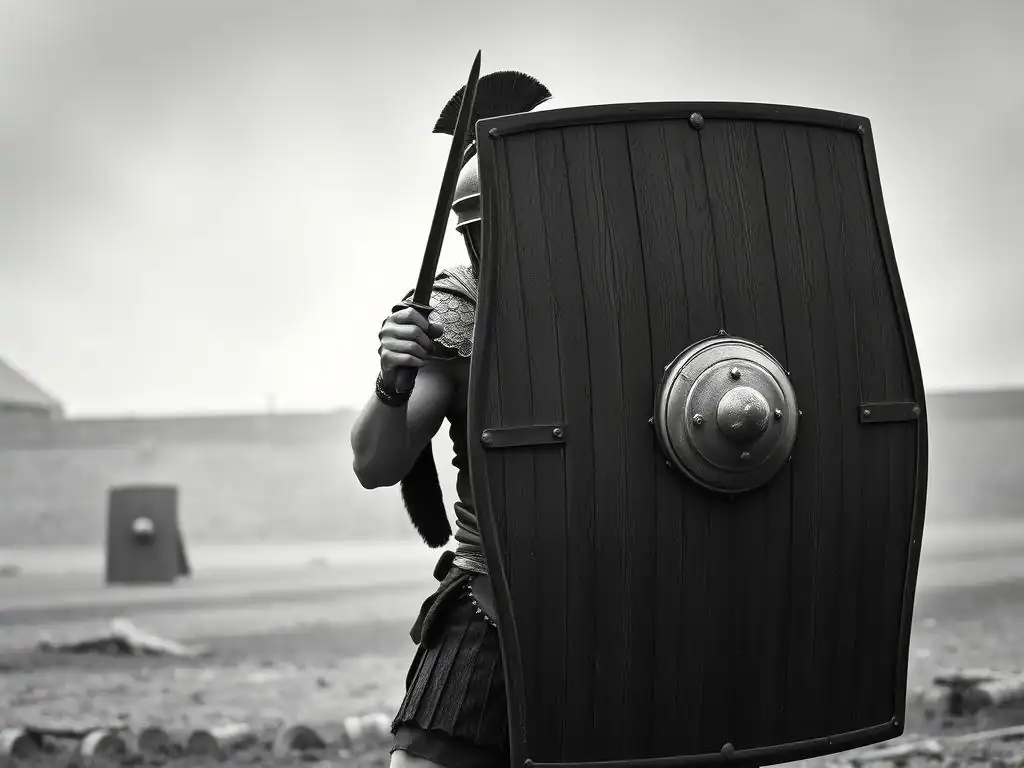
Scutum Formations: The Testudo and Other Defensive Walls
Beyond the basic shield wall, the scutum enabled complex and highly effective formations critical to Roman strategy. The Testudo (tortoise) is the most famous, used for protection against missiles during sieges or when advancing through open ground under heavy fire. Soldiers in the front ranks held their scuta forward, while those in the ranks behind held their scuta overhead, often overlapping them like roof tiles. Soldiers on the flanks held their scuta to the sides, creating a box-like structure. This formation could withstand immense pressure and allow safe movement through dangerous zones.
Other formations utilized the scutum for specific strategic purposes. The orbis (circle) formation, used when a unit was surrounded, involved soldiers forming a defensive ring with scuta facing outwards. The wedge formation ( cuneus) used scuta to create a narrow, pointed front designed to punch through enemy lines, with shields providing protection as the unit advanced. These specialized formations, all reliant on the scutum, gave Roman commanders tactical flexibility and the ability to overcome diverse challenges on the battlefield.
Deploying the Scutum in Siege Warfare: Breaching Walls and Defending Positions
The scutum was indispensable in Roman siege warfare. When assaulting fortified positions, the Testudo formation allowed legionaries to advance to the base of walls or gates relatively safely, protected from defenders' projectiles. This enabled engineers to bring up siege engines or soldiers to begin sapping or attempting to breach defenses. The scutum provided cover for those operating battering rams or scaling ladders.
When defending besieged positions, scuta were used to reinforce barricades or create temporary defensive walls. Soldiers positioned on walls or behind ramparts used their scuta to protect themselves while firing missiles or engaging attackers attempting to climb. The robustness of the scutum made it an excellent piece of personal protective equipment in the confined and dangerous environment of siege combat, both offensive and defensive.
Adapting Scutum Tactics to Different Terrains
Roman scutum tactics were adapted to various terrains, showcasing the shield's versatility. In open fields, the large size of the scutum was ideal for forming solid lines and executing maneuvers like the charge and shield wall. In hilly or broken terrain, formations might be looser, but the individual protection offered by the scutum remained crucial, allowing soldiers to maintain defensive integrity even when the line was uneven.
In forests or confined spaces, the scutum's size could be cumbersome, but its defensive capabilities were still vital in tight-quarters fighting. Roman training included drilling in different environments, ensuring legionaries could effectively wield their scuta regardless of the battlefield conditions. The ability to adapt Roman scutum fighting techniques and formations to marshes, mountains, or plains was a key factor in Rome's military success across a vast empire.
The Legacy of the Roman Scutum
Influence of Scutum Fighting Techniques on Later Military Tactics
While the specific design of the scutum eventually faded with the evolution of warfare and armor, the principles behind Roman scutum fighting techniques had a lasting influence. The concept of using a large shield for both defense and offense, creating a solid defensive barrier, and integrating shield work with weapon use persisted in various forms. The Byzantine army, the direct successor to the Eastern Roman Empire, continued to use large shields and formations reminiscent of Roman tactics for centuries.
Medieval shield walls, particularly those of the Anglo-Saxons and Vikings, while using different shield shapes (often round or kite-shaped), echoed the Roman emphasis on collective defense and using the shield as a physical barrier. The idea of soldiers fighting shoulder-to-shoulder behind shields to absorb charges and then counter-attack remained a fundamental tactic. The scutum's legacy lies in its demonstration of how a shield, when used with discipline and integrated offensive techniques, could be the central element of an army's combat system.
Re-enactment and Modern Interest in Roman Combat
Today, there is significant interest in Roman military history, and re-enactment groups strive to recreate Roman combat drills and tactics, including Roman scutum fighting techniques. Enthusiasts build historically accurate scuta and practice the formations and maneuvers described in ancient texts and depicted on monuments like Trajan's Column. This practical engagement provides valuable insights into the physical demands and effectiveness of Roman combat methods.
Through re-enactment, participants gain a deeper understanding of how the scutum was used, the strength required to wield it, and the coordination necessary for formations like the Testudo. These modern practitioners contribute to our understanding of Roman martial arts and military life, keeping the legacy of the scutum and the legionary alive.
The Scutum as a Symbol of Roman Military Prowess
More than just a piece of equipment, the scutum became a powerful symbol of Roman military strength, discipline, and resilience. Its distinctive shape is instantly recognizable and is synonymous with the image of the Roman legionary. Depicted on countless coins, sculptures, and historical illustrations, the scutum represented the protection and might of Rome.
The scutum embodied the Roman approach to warfare: disciplined, organized, and effective, relying on collective strength and practical engineering. It was a shield designed not just to survive, but to enable victory through aggressive, coordinated tactics. As such, the scutum endures as a potent icon of one of history's most successful military forces.
Conclusion: The Enduring Impact of the Roman Scutum
Roman Scutum Fighting Techniques: A Summary of Key Principles
Roman scutum fighting techniques were a sophisticated blend of defense and offense. Key principles included using the shield for extensive body protection, deflecting blows with its curved surface, and maintaining formation integrity within the shield wall. Offensively, techniques centered on using the umbo or the shield face for powerful strikes and using the shield's mass for bashing and pushing to disrupt enemy ranks and create openings. The scutum was not merely held; it was actively wielded as a weapon to control the fight, enabling the effective use of the gladius and pilum.
The Scutum: More Than Just a Shield - A Tool of War
The Roman scutum transcended its function as a simple shield. It was a critical piece of military technology that defined Roman infantry tactics. Its design facilitated the famous formations that allowed Rome to conquer and maintain an empire. It was a tool of war that provided individual protection, enabled collective strength, and was an integral part of the legionary's offensive capabilities. The scutum was a symbol of Roman discipline and effectiveness, allowing soldiers to fight with confidence and aggression.
Further Exploration of Roman Military History
The study of the Roman scutum and Roman scutum fighting techniques offers a fascinating window into the martial arts and military history of the ancient world. Exploring the construction, training, and tactical deployment of this iconic shield provides insights into the factors that contributed to the success of the Roman legions. Further research into ancient texts, archaeological finds, and modern re-enactment can deepen our understanding of the practical realities of Roman combat and the enduring legacy of this remarkable piece of equipment.
Frequently Asked Questions
### What was the primary purpose of the Roman scutum?
The primary purpose of the Roman scutum was defense, providing superior protection to the legionary from enemy attacks. It was a large shield designed to cover a significant portion of the body.
### What made the Roman scutum such an effective weapon in close combat?
The scutum's effectiveness in close combat stemmed from its size, shape, and construction. It allowed for shield wall formations and could be used for offensive maneuvers like shield bashes.
### What types of martial arts techniques were associated with the Roman scutum?
While not a formal "martial art" per se, scutum fighting techniques involved shield strikes, pushes, and defensive blocks used in conjunction with short swords like the gladius.
### How did the Roman scutum influence Roman military tactics?
The scutum was integral to Roman military tactics, enabling formations like the testudo (tortoise formation) and facilitating aggressive advances while maintaining a strong defensive line.
### Where can I learn more about Roman scutum fighting techniques?
While formal training might be limited, resources like historical reenactment groups and academic studies on Roman military history can provide insights into the techniques and effectiveness of the scutum.
Final Reflection: The Enduring Legacy of Roman Shieldcraft
The exploration of the Roman scutum and its fighting techniques reveals more than just historical military tactics; it highlights the timeless principles of discipline, strategy, and adaptability that continue to resonate in modern leadership and teamwork. The scutum wasn't merely a shield; it was an integral part of a highly effective fighting system, a testament to the Roman ability to innovate and conquer. Understanding its use offers valuable insights into the mindset and methods of a civilization that shaped the course of Western history.
The impact of the Roman military, and the scutum's role within it, extends far beyond the battlefield. Its influence is visible in our understanding of organization, logistics, and the power of collective action. The scutum, as a symbol of Roman strength and resilience, reminds us of the importance of preparation and unwavering commitment to a shared goal. Fortune favors the bold,
a sentiment often attributed to Virgil, encapsulates the Roman spirit of embracing challenges and seizing opportunities, a spirit embodied in the effective use of the scutum.
As we reflect on the Roman scutum and its fighting techniques, let us consider how we can apply these lessons to our own lives. How can we cultivate a similar sense of discipline and teamwork in our own endeavors? How can we use our own "shields" – our skills, knowledge, and support systems – to boldly face the challenges that lie ahead? Let the legacy of the Roman scutum inspire you to forge your own path to success, armed with strategy, resilience, and unwavering determination.
Unleash Your Inner Legionary!
Thank you for exploring the formidable world of the Roman scutum. Now that you understand its power and brutal effectiveness, it's time to take action and integrate this knowledge into your own martial journey.
Here’s how to further connect with the legacy of the Roman legions:
- Embrace Functional Defense: Experiment with a shield in your training, focusing on how it can create offensive opportunities and dictate the flow of combat.
- Delve deeper: Research other Roman military tactics and discover how their principles might apply to your existing martial arts discipline.
- Share this article: Connect with fellow martial arts enthusiasts, and start a conversation about the role of historically effective defense in modern combat training.
How will you adapt the lessons of the scutum to fortify your own martial arts strategy?