
The Aegis: Athena's Divine Shield and Its Terrifying Power in Greek Myth


Welcome to Martial Arts Mastery, where history and skill collide!
Delve into the captivating world of ancient combat and discover the secrets of the past. Ever wondered how mythology might inform modern martial arts? In this article, we explore the legendary Athena’s shield defensive techniques training, drawing parallels between myth and practical application. Uncover the terrifying power of the Aegis and its potential to revolutionize your defensive strategy. Are you ready to unlock a god-like defense? Read on to begin your journey...
- Introduction: Athena, Warfare, and the Aegis
- The Aegis: Defining Athena's Unbreakable Defense
- Athena's Shield: Defensive Strategies and Psychological Warfare
- The Aegis in Action: Mythological Examples of its Power
- The Aegis Beyond Combat: Symbolism and Cultural Significance
- Athena's Aegis and Modern Strategic Thinking
- Conclusion: The Enduring Legacy of Athena's Shield
-
Frequently Asked Questions
- How does Athena's Aegis, as described on MartialArtsMastery.org, relate to practical self-defense training?
- What are some key aspects of "Athena's shield defensive techniques training" that might be explored on MartialArtsMastery.org?
- Does MartialArtsMastery.org offer historical context for the defensive principles associated with Athena's Aegis?
- How might the philosophical underpinnings discussed on MartialArtsMastery.org connect to the concept of Athena's shield?
- Where can I find specific training tips related to "Athena’s shield defensive techniques training" on MartialArtsMastery.org?
- Final Reflection: Embracing the Aegis Within
- Unveil Your Inner Aegis: Claim Your Power!
Introduction: Athena, Warfare, and the Aegis
In the rich tapestry of Greek mythology, Athena stands as a unique deity – the goddess of wisdom, craft, and strategic warfare. Unlike her volatile brother Ares, who embodied the brutal frenzy of battle, Athena represented disciplined combat, cunning tactics, and defensive prowess.
Her association with warfare was not one of mindless aggression but of thoughtful strategy and protective defense, qualities perfectly embodied by her most iconic attribute: the Aegis. This formidable object, often depicted as a shield or a cloak, was far more than simple armor; it was a symbol of divine authority, an instrument of terror, and an impenetrable defense, central to understanding Athena's role and influence in the ancient world and offering insights into timeless principles of strategy and protection.
Understanding Athena's connection to the Aegis is crucial for appreciating her multifaceted nature. She was revered by warriors, strategists, and even artisans, seen as a patron of civilized life and prudent action.
The Aegis, therefore, wasn't just a weapon of war; it was an extension of her divine will, capable of inspiring courage in allies and striking paralyzing fear into enemies. Exploring the Aegis allows us to delve into the ancient Greek perspective on divine power, psychological warfare, and the fundamental concepts of defense, providing a fascinating lens through which to view ancient strategic thinking and its potential, albeit abstract, connection to principles applicable even in modern Athena’s shield defensive techniques training (metaphorically speaking).
The Aegis: Defining Athena's Unbreakable Defense
What is the Aegis? Etymology and Origins
The exact nature and origin of the Aegis are subjects of varying accounts in ancient Greek texts, contributing to its mystique. The name "Aegis" itself is thought to derive from the Greek word "aix" (αἴξ), meaning "goat." This etymology points to one prominent tradition that describes the Aegis as a goatskin, specifically the skin of the nymph Amalthea's goat (which nursed the infant Zeus) or, in other versions, the skin of a monstrous giant named Pallas, whom Athena defeated. This original conception as a skin suggests a more flexible, perhaps cloak-like or apron-like, covering rather than a rigid shield.
Early literary sources, such as Homer's Iliad, consistently portray the Aegis as an attribute primarily associated with Zeus, the king of the gods, and frequently loaned to Athena, his favorite daughter. Homer describes it as a "terrible" or "fearful" object, sometimes fringed with tassels, each said to be worth a hundred oxen.
While its connection to Zeus highlights its supreme divine power, its frequent use by Athena solidifies her status as a key figure in divine strategy and defense. The transition from a simple goatskin to a more elaborate, often metallic, shield in later depictions reflects evolving artistic conventions and perhaps a desire to make the divine defense more visually imposing and akin to human military equipment.
Depictions of the Aegis: From Goatskin to Gorgon's Head
The visual representation of the Aegis evolved significantly throughout ancient Greek art and literature. Initially, as suggested by its etymology and some early texts, it may have been conceived as a simple, rough goatskin. However, by the Classical period (roughly 5th-4th centuries BCE), depictions on pottery, sculpture, and architectural friezes consistently show the Aegis as a stiff, scale-covered garment worn over the shoulders or as a round shield. This scale-like texture might allude back to its animal skin origins or represent metallic scales, emphasizing its invulnerability.
Perhaps the most iconic feature added to the Aegis was the head of the Gorgon Medusa. According to myth, after the hero Perseus slew Medusa with Athena's aid, he presented her head to the goddess. Athena then affixed the petrifying head to the center of her Aegis.
This addition transformed the Aegis from a symbol of passive defense into an active weapon of terror and psychological warfare. The Gorgon's gaze was said to turn anyone who looked upon it to stone, making the Aegis not just a barrier against physical harm but a terrifying instrument capable of paralyzing or destroying enemies with fear and petrification, a key element in understanding Athena’s shield defensive techniques training as depicted in mythology.
The Aegis: A Shield or More? Exploring its Multifaceted Nature
While often referred to as Athena's shield, the Aegis's nature is more complex and appears to be multifaceted. In some accounts, particularly early ones, it functions more like a divine cloak or breastplate, covering Athena's chest and shoulders and providing impenetrable protection. Homer's Iliad, for instance, sometimes describes it as shaken by Zeus to create storms or instill panic, suggesting a dynamic object capable of generating powerful effects beyond simple physical blocking.
Later depictions solidified its form as a round shield, similar in shape to the hoplon used by Greek hoplite soldiers, but imbued with divine properties. Regardless of its exact form – whether a shield, cloak, or breastplate – its primary function remains consistent: it is an object of unparalleled divine authority and protection.
It can deflect any weapon, withstand any force, and is often described as shimmering or radiating light, further emphasizing its divine and awe-inspiring nature. This duality and flexibility in its representation highlight its symbolic power over its literal form, making it a potent emblem of Athena's dominion over strategic defense and divine power.
Athena's Shield: Defensive Strategies and Psychological Warfare
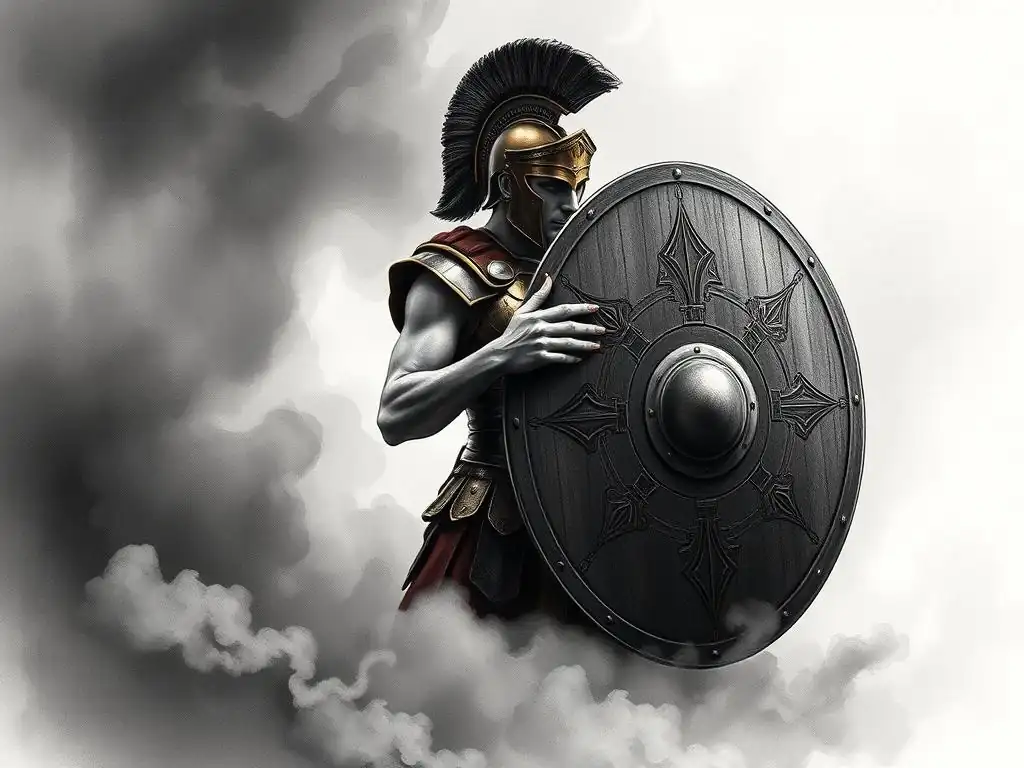
Immovable Defense: The Aegis as a Symbol of Unwavering Protection
The most fundamental aspect of the Aegis, whether viewed as a shield or a cloak, is its absolute impenetrability. No weapon, mortal or divine, could pierce it. In the Iliad, the Aegis is described as capable of repelling the bolts of Zeus himself, signifying its status as the ultimate divine defense. This quality makes the Aegis a powerful symbol of unwavering protection and resilience. It represents a defense so perfect that it renders its wielder impervious to physical harm, allowing them to stand firm and unbroken against any onslaught.
For a martial arts perspective, the Aegis embodies the ideal of an unbreakable guard or stance – a defensive posture so solid it cannot be breached. While no human defense is truly impenetrable, the concept inspires the pursuit of perfect technique, structural integrity, and mental fortitude in defense.
Studying the mythological accounts of Athena's shield's defensive techniques provides a conceptual framework for understanding the principle of absolute defense, encouraging practitioners to develop their own foundational defenses to be as robust and reliable as possible within human limitations. It highlights that true defense is not just about blocking, but about presenting an obstacle that the opponent cannot overcome, forcing them to break their attack or seek another path.
Psychological Warfare: Instilling Fear with the Gorgon's Gaze
Beyond its physical properties, the Aegis was a potent weapon of psychological warfare, primarily due to the addition of the Gorgon's head. The terrifying visage of Medusa, capable of turning onlookers to stone, instilled paralyzing fear in enemies. This wasn't merely discomfort; it was a dread so profound it could freeze opponents in place, rendering them helpless and vulnerable. In battles involving Athena or those wielding the Aegis, the mere display of the Gorgon's head could rout armies or petrify individual foes, winning the conflict before a single blow was struck.
This aspect of Athena's shield defensive techniques training (as understood through myth) emphasizes the critical role of the mind in combat. Fear is a powerful weapon, and the Aegis wielded it masterfully. It teaches that intimidating the opponent, disrupting their composure, and striking fear into their heart can be as effective, if not more so, than physical force.
This principle resonates in various martial arts and military strategies that employ feints, loud kiai (shouts), intense stares, or overwhelming displays of force to break the opponent's will or concentration before engaging physically. The Gorgon's gaze is the ultimate mythological representation of this psychological dominance.
Utilizing Deception and Intimidation in Combat
The Aegis, particularly with the Gorgon's head, exemplifies the use of both intimidation and a form of 'deception' in combat. The intimidation factor is obvious – the sheer terror induced by the Gorgon. The 'deception' comes not from trickery but from the overwhelming nature of the defense and the gaze; it presents a reality (petrification or paralyzing fear) that the opponent cannot physically overcome or mentally process, effectively deceiving their expectations of a normal fight. The opponent expects a physical contest and is met with supernatural horror.
This mythological approach to combat highlights strategies that go beyond direct physical engagement. It suggests that controlling the narrative of the fight, presenting an insurmountable presence, or using elements that disorient and terrify the opponent are valid and powerful strategic tools.
For those interested in Athena’s shield defensive techniques training from a conceptual standpoint, it underscores the importance of developing a formidable presence, mastering techniques that disrupt the opponent's mental state, and understanding that sometimes, the most effective defense is one that prevents the attack from ever being fully launched due to fear or hesitation. It's about creating an aura of invincibility and terror.
The Aegis in Action: Mythological Examples of its Power
Athena vs. Ares: Divine Combat and the Aegis's Role
One of the most striking examples of the Aegis's power in divine combat occurs in Homer's Iliad (Book 5) during the Trojan War. Athena, siding with the Achaeans, confronts Ares, who supports the Trojans. Athena, wearing the terrifying Aegis, steps into the fray. Diomedes, a mortal hero aided by Athena, is urged to strike Ares. As Ares charges, Athena, standing in her chariot, holds up the Aegis "terrible, not to be spoken of...around it Terror is set as a crown." When Ares thrusts his spear, Athena deflects it effortlessly with her Aegis, guiding the weapon harmlessly away.
This episode vividly illustrates the Aegis's primary function as an impenetrable defense, capable of nullifying even the attack of the god of war himself. Ares's powerful thrust, embodying brute force and aggression, is rendered futile by Athena's strategic defense and the divine protection of the Aegis. It's a clear mythological demonstration that disciplined, divine defense, amplified by the Aegis, can overcome even the most formidable offensive power, highlighting the superiority of Athena's strategic approach to warfare over Ares's chaotic fury.
Perseus and the Aegis: Slaying Medusa with Athena's Aid
While Perseus is the hero credited with slaying Medusa, his success was heavily dependent on divine assistance, particularly from Athena and Hermes. Athena provided Perseus with several crucial tools, including a highly polished shield (or sometimes described as a bronze shield reflecting like a mirror). Although not the Aegis itself, this shield allowed Perseus to view Medusa's reflection and avoid her direct, petrifying gaze. After the deed was done, Perseus gifted Medusa's severed head to Athena.
Athena then affixed the Gorgon's head to the center of her Aegis. This act fundamentally changed the Aegis, adding the active power of petrification and terror to its passive defense.
While the Aegis wasn't used during the slaying of Medusa by Perseus, the story is integral to the Aegis's most famous depiction. It explains the origin of the Gorgon emblem, turning the Aegis into the terrifying symbol it is most remembered as – a shield that not only protects but actively frightens and incapacitates enemies with its gaze, a potent example for considering mythological Athena’s shield defensive techniques training concepts.
Zeus and the Aegis: Borrowing Power from Athena's Shield
Although most strongly associated with Athena, the Aegis is often described as belonging originally to Zeus, who would occasionally lend it to his favorite daughter. Homer frequently refers to Zeus as the "Aegis-holder" (aegis-bearing Zeus). This highlights the Aegis's status as a symbol of supreme divine authority and power, emanating from the king of the gods himself. When Zeus wields the Aegis, he uses it not just for defense but also to create thunder, lightning, and storms, shaking it to terrify gods and mortals alike and assert his dominance over the cosmos.
In the Iliad, Zeus shakes the Aegis from Mount Ida, causing panic among the Achaeans and enabling the Trojans to gain the upper hand. This demonstrates that the Aegis is more than just a physical object; it is imbued with immense power capable of influencing the course of battles and even manipulating the elements. When Athena uses it, she is wielding a portion of her father's ultimate power, reinforcing her authority on the battlefield and her close relationship with Zeus. This shared ownership underscores the Aegis's status as one of the most powerful divine artifacts in Greek mythology.
The Aegis Beyond Combat: Symbolism and Cultural Significance
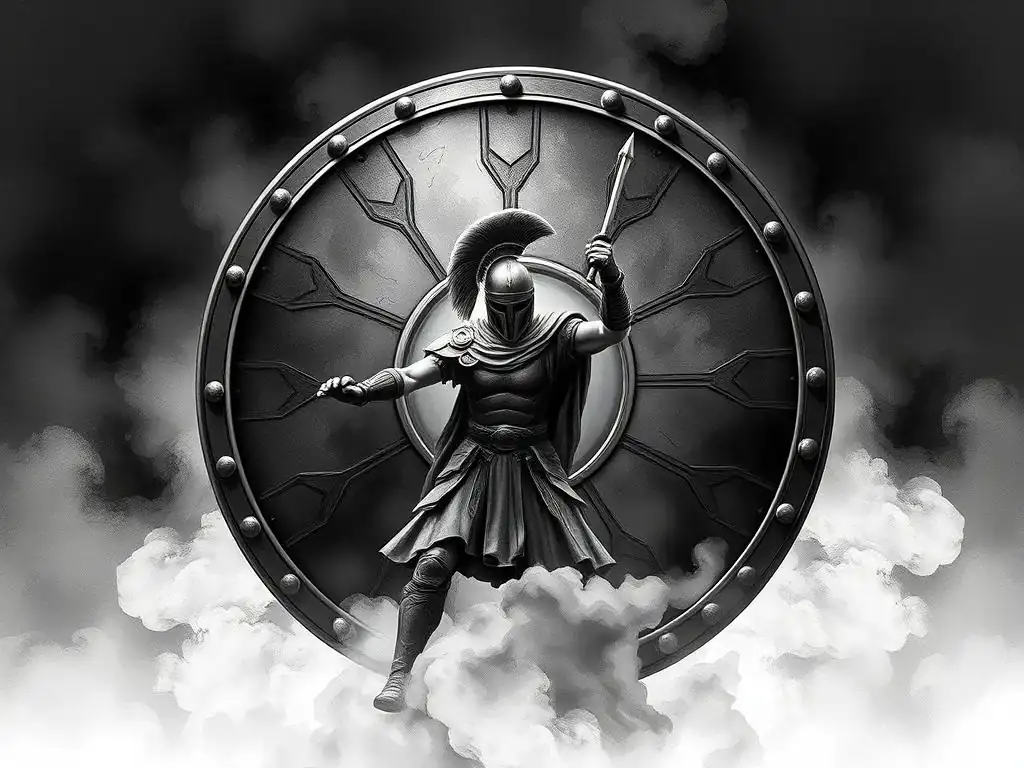
Beyond its function in battle, the Aegis served as a powerful symbol of divine authority. Its association with both Zeus and Athena cemented its status as an emblem of supreme power and protection granted by the highest deities. Carrying or displaying the Aegis was a clear sign that one acted under divine sanction and possessed formidable, insurmountable power. It represented the unchallengeable will and protective might of Olympus.
In art and literature, the Aegis often appears simply as an attribute identifying Athena or Zeus, signifying their presence and power. It communicated their divine status and their capacity to intervene decisively in mortal affairs. This symbolic weight meant that even its mere representation could evoke feelings of reverence or dread, reminding mortals of the gods' power and their potential influence on the world. It was not just a piece of equipment but a divine warrant.
Protection and Patronage: Athena's Role as a Guardian
As the goddess of wisdom, strategy, and crafts, Athena was also a principal patron deity of many Greek cities, most famously Athens. Her role extended to protecting these cities and their inhabitants, and the Aegis was a potent symbol of this protective function. Just as she defended herself and her allies in divine conflicts, she was invoked to defend cities from invasion, protect heroes on quests, and safeguard the established order.
The Aegis, in this context, represents Athena's unwavering commitment to protecting those under her patronage. It symbolizes the divine shield cast over her favored mortals and communities, offering a sense of security and invincibility against external threats. Citizens might look upon depictions of Athena with the Aegis as a reassurance of their city's divine protection, embodying the idea that with Athena's favor, their defenses were as strong as the Aegis itself, a concept perhaps metaphorically relevant to collective Athena’s shield defensive techniques training for a community or army.
Influence of the Aegis on Art, Literature, and Political Imagery
The powerful imagery of the Aegis, particularly with the Gorgon's head, permeated ancient Greek art, literature, and even political symbolism. Sculptures, vase paintings, and temple friezes frequently depicted Athena wearing or holding the Aegis, making it one of her most recognizable attributes. These artistic representations reinforced its symbolic meaning as divine protection and terrifying power.
Literary works, from epic poems like the Iliad and Odyssey to tragedies and philosophical texts, referenced the Aegis when describing divine intervention or the terrifying aspects of godly power. Furthermore, the concept of the Aegis as a protective emblem was sometimes adopted in a secular context.
Leaders or states might use imagery reminiscent of the Aegis to symbolize their own strength, authority, and protective role over their people, drawing a parallel between divine power and earthly rule. Even in modern times, the term "aegis" is used metaphorically to mean protection or support, a testament to the enduring cultural legacy of Athena's divine shield.
Athena's Aegis and Modern Strategic Thinking
Defensive Strategies: Parallels to Modern Military Doctrine
While the Aegis is a mythological artifact, the principles it embodies – impenetrable defense and psychological impact – have parallels in modern military and strategic thinking. The concept of an "unbreakable" defense resonates with the development of advanced defensive systems aimed at intercepting any incoming threat, such as missile defense shields. While no human technology achieves the Aegis's absolute invulnerability, the goal of creating layered, robust defenses is a constant pursuit.
Furthermore, the Aegis's ability to project power and deter enemies through its mere presence and terrifying aspect aligns with modern doctrines of deterrence. Possessing overwhelming defensive or retaliatory capabilities (like nuclear arsenals, though a dark parallel) is intended to prevent an attack from ever occurring, similar to how the Gorgon's gaze could freeze enemies before they struck. Studying the mythological function of Athena’s shield defensive techniques offers a conceptual backdrop for discussing how the perception of invincibility and the threat of severe consequences influence strategic interactions.
Mental Fortitude: Lessons in Resilience and Determination
The Aegis, as a symbol of unwavering protection, also offers lessons in mental fortitude. Facing an opponent wielding the Aegis would require immense courage and determination, as physical attacks are rendered useless. Conversely, for the wielder, the Aegis provides not just physical safety but also psychological confidence, allowing them to stand firm and resolute against any challenge.
This translates metaphorically to the importance of mental resilience in martial arts and combat. Developing an 'internal Aegis' involves cultivating mental toughness, the ability to remain calm under pressure, and unwavering determination. It's about building a psychological defense that complements physical training, allowing one to face adversity without breaking. This aspect of Athena’s shield defensive techniques training, viewed through a lens of mental discipline, is crucial for overcoming fear and maintaining focus in high-stress situations.
Applying Principles of Deterrence Inspired by the Aegis
The Aegis's power to deter enemies through terror and perceived invincibility provides a mythological model for understanding the principles of deterrence. The Gorgon's head acts as the ultimate deterrent – the consequence of attacking is immediate and catastrophic (petrification). This is a clear, unambiguous threat that discourages aggression.
Applying these principles involves establishing a credible defense or retaliatory capability that makes the cost of attacking outweigh any potential gain. This can be seen in military postures, cybersecurity strategies, or even personal self-defense approaches where projecting confidence and capability can deter potential aggressors. The Aegis serves as a powerful, albeit extreme, illustration of how projecting an image of insurmountable strength and the certainty of negative consequences can be a highly effective strategic defense, influencing thought processes around Athena’s shield defensive techniques training from a psychological perspective.
Conclusion: The Enduring Legacy of Athena's Shield
The Aegis: A Timeless Symbol of Divine Protection and Strategic Warfare
The Aegis, Athena's divine shield (or cloak), remains one of the most potent and enduring symbols from Greek mythology. It represents the pinnacle of divine protection, an object capable of repelling any attack and rendering its wielder invulnerable. More than mere defense, particularly with the addition of the Gorgon's head, it became a formidable tool of psychological warfare, capable of instilling paralyzing fear and terror in the hearts of enemies. Its association with both Zeus and Athena underscores its status as a symbol of supreme authority and strategic power.
From its debated origins as a goatskin to its iconic depiction as a scale-covered shield bearing the terrifying visage of Medusa, the Aegis evolved in imagery but retained its core significance. It embodies the principles of unwavering defense, the strategic use of fear, and the projection of overwhelming power. Its legacy persists not just in classical studies but also in language and strategic thought, where "under the aegis" signifies protection and patronage.
Key Takeaways: Lessons from the Aegis
Exploring the myth of the Aegis offers several valuable takeaways, particularly for those interested in the intersection of mythology, strategy, and the principles behind defensive training:
- Impenetrable Defense: The Aegis represents the ideal of an unbreakable guard or defense, inspiring the pursuit of perfection in defensive techniques.
- Psychological Warfare: The Gorgon's head highlights the critical role of the mind in combat, demonstrating how fear and intimidation can be powerful strategic tools.
- Strategic Deterrence: The Aegis illustrates how projecting an image of overwhelming strength and inevitable consequences can deter potential aggressors.
- Symbolism of Authority: The Aegis is a powerful emblem of divine power, protection, and the authority to defend.
- Multifaceted Nature: Its depiction as both a shield and a cloak suggests that true protection can take various forms, both physical and psychological.
These lessons, drawn from the mythological Athena’s shield defensive techniques, offer abstract but profound insights into the nature of defense, strategy, and the importance of both physical and mental strength in confronting challenges.
Further Exploration: Resources for Studying Ancient Greek Warfare and Mythology
For those wishing to delve deeper into the world of ancient Greek warfare and mythology, numerous resources are available. Primary sources like Homer's Iliad and Odyssey, Hesiod's Theogony, and the works of tragedians like Aeschylus, Sophocles, and Euripides provide direct accounts of myths and divine interactions. Historical texts by authors such as Herodotus and Thucydides offer insights into actual Greek military practices and beliefs, though they focus on human, not divine, combat.
Secondary sources, including academic books on Greek mythology, ancient history, and military history, provide analysis and context. Works by classicists and historians exploring Greek religion, art, and philosophy can illuminate the cultural significance of the Aegis and figures like Athena. Libraries and online academic databases offer access to scholarly articles detailing specific aspects of the Aegis's depiction and interpretation across different periods and sources, providing a rich foundation for understanding this powerful and enduring symbol.
Frequently Asked Questions
How does Athena's Aegis, as described on MartialArtsMastery.org, relate to practical self-defense training?
While a mythical shield, the Aegis inspires defensive strategies that emphasize awareness, protection, and decisive counter-attacks, mirroring principles found in various martial arts disciplines.
What are some key aspects of "Athena's shield defensive techniques training" that might be explored on MartialArtsMastery.org?
The site likely explores techniques rooted in blocking, parrying, and creating openings based on an opponent's aggression, much like the mythical Aegis deflected attacks.
Does MartialArtsMastery.org offer historical context for the defensive principles associated with Athena's Aegis?
Yes, the site provides historical overviews of martial arts, potentially drawing parallels between the Aegis and real-world shields or defensive strategies employed in ancient warfare.
How might the philosophical underpinnings discussed on MartialArtsMastery.org connect to the concept of Athena's shield?
The site examines martial arts philosophies, and may connect the Aegis to concepts like discipline, courage, and strategic thinking, crucial for effective defense.
Look within the training tips section, particularly under disciplines emphasizing close-quarters combat and defensive maneuvers, searching for keywords related to blocking, parrying, and strategic positioning.
Final Reflection: Embracing the Aegis Within
The exploration of Athena's Aegis, a shield of both divine protection and terrifying power, resonates deeply even today. The concept of a powerful defense, both literal and metaphorical, remains profoundly relevant in a world demanding resilience and strategic thinking. Just as Athena wielded the Aegis to protect and inspire, we too must cultivate our own defenses against the challenges we face, drawing strength from knowledge, wisdom, and unwavering resolve.
The Aegis, beyond its mythical origins, serves as a potent symbol of inner strength and the power of preparedness. Its enduring presence in art and literature underscores its timeless appeal and its continued influence on our understanding of defense and empowerment. The best defense is a good offense,
a sentiment often attributed to various military strategists, echoes the Aegis's dual nature, reminding us that true protection often lies in proactive engagement and unwavering confidence.
Now, consider the lessons of the Aegis in your own life. What shields do you carry, both visible and invisible? How can you strengthen your defenses, not just against external threats, but also against internal doubts and fears? Embrace the power of knowledge, cultivate your inner strength, and wield your own Aegis with wisdom and courage, forging a path of resilience and unwavering purpose.
Unveil Your Inner Aegis: Claim Your Power!
Thanks for exploring the formidable Aegis with us! We hope you've gained a new appreciation for its symbolic power and the strength it represents. Now, it's time to channel that energy into your own life.
Here's how to harness the spirit of the Aegis:
- Embrace Focused Intention: Define Your Personal "Shield" – What values and goals are most important to you? Decide what you need to protect and defend in your life with unwavering focus.
- Explore unconventional training. Consider a martial art that combines discipline and mental fortitude, like Kendo or Iaido, to cultivate your inner strength.
- Share this article with a friend who needs a reminder of their own inner power. Let's empower each other!
What one aspect of your life will you "shield" and fiercely defend starting today?