
The Kinetic Chain: Partner Drills to Optimize Power Through Coordination


Welcome to Martial Arts Mastery, your comprehensive resource for unlocking the secrets of combat disciplines worldwide. Ever wonder how to truly harness the kinetic chain for devastating power? Our exploration of partner drills will show you how synchronized movement and focused energy can revolutionize your coordination. Read on to discover how these exercises, applicable across various martial arts styles, will transform your training and amplify your fighting prowess.
- Understanding the Kinetic Chain in Martial Arts
- Partner Drills for Enhancing Kinetic Chain Coordination
-
Essential Partner Drills to Maximize Power Output
- Drill 1: Medicine Ball Rotational Throws for Core Engagement and Power Transfer
- Drill 2: Reactive Jab-Cross Drills for Speed and Power Transfer
- Drill 3: Footwork and Evasion Drills for Agility and Power Generation
- Drill 4: Pad Work for Power Development and Precision Targeting
- Drill 5: Resistance Band Rotation Drills for Enhanced Muscle Activation and Power
- Optimizing Your Training for Maximum Power Transfer
- Advanced Kinetic Chain Drills for Martial Arts Mastery
- Conclusion: Unleashing Your Power Potential Through Coordinated Partner Training
-
Frequently Asked Questions
- How do partner drills specifically improve coordination in martial arts?
- What is the "kinetic chain" and why is it important for martial arts power?
- Which martial arts disciplines benefit most from partner drills focused on the kinetic chain?
- Can partner drills for coordination also improve self-defense capabilities?
- What are some examples of partner drills that emphasize power and coordination?
- Final Reflection: Unleashing Potential Through Collaborative Movement
- Unlock Your Potential: Ignite Your Kinetic Chain Now!
Understanding the Kinetic Chain in Martial Arts
What is the Kinetic Chain and How Does it Relate to Martial Arts Power?
The kinetic chain in martial arts refers to the sequential movement of body segments to generate force. It's the concept that force isn't produced by a single muscle or limb in isolation, but rather through a coordinated sequence starting from the ground up – feet, ankles, knees, hips, core, shoulders, and finally the striking or grappling limb.
Think of a powerful punch: the force originates from pushing off the ground, transferring through the legs and hips via rotation, channeling through a strong core, and culminating in the arm and fist. If any link in this chain is weak or out of sync, the overall power generated is significantly diminished.
This sequential transfer of energy is crucial for developing martial arts power. A strike that relies solely on arm strength, for instance, might generate 50-100 pounds of force. However, engaging the full kinetic chain through proper mechanics can easily multiply that force output, potentially reaching several hundred or even over a thousand pounds in advanced practitioners.
This is why a smaller individual with superior kinetic chain efficiency can often generate more power than a larger, stronger person who lacks this coordination. Understanding and optimizing this chain is fundamental to unlocking true striking power and efficient movement in any martial art.
The Importance of Kinetic Chain Sequencing for Efficient Movement
Proper sequencing of the kinetic chain ensures that force is transferred smoothly and efficiently from one body segment to the next. In martial arts, this means that movements like punches, kicks, throws, or takedowns are not only powerful but also fast and energy-efficient. An incorrect sequence – for example, leading with the arm before the hips and core rotate – causes energy leaks and reduces the total force delivered to the target. It's like pushing a rope; the force dissipates if the connection isn't taut.
Efficient kinetic chain sequencing also plays a vital role in balance, stability, and injury prevention. When the body moves as a unified, coordinated system, stress is distributed more evenly across joints and muscles. Conversely, poor sequencing can overload specific areas, increasing the risk of strains, sprains, or more serious injuries, particularly in high-impact techniques. Mastering the correct timing and coordination of each segment's contribution is essential for peak performance and longevity in martial arts training.
Common Kinetic Chain Deficiencies in Martial Artists
Many martial artists exhibit common deficiencies in their kinetic chain, often due to insufficient foundational training or over-reliance on isolated strength. One frequent issue is a weak or disengaged core, which acts as the central hub for force transfer. If the core is unstable, the energy generated by the lower body cannot be effectively transmitted to the upper body, resulting in a significant power loss in strikes and throws. Studies using force plates and motion capture have shown that athletes with poor core stability demonstrate reduced peak power output compared to those with strong, engaged cores.
Another common deficiency is poor hip-shoulder separation or rotation. Powerful rotational movements, critical for hooks, crosses, roundhouse kicks, and many grappling techniques, rely on the ability to rotate the hips independently (or slightly ahead) of the shoulders. Lacking this dissociation means the upper and lower body move as one unit, limiting the range of motion and speed of rotation, thereby reducing power and reach. Furthermore, inadequate ground force generation due to weak leg drive or improper footwork often represents the first breakdown in the kinetic chain, preventing the initial burst of energy needed for powerful techniques.
Partner Drills for Enhancing Kinetic Chain Coordination
Why Partner Drills are Effective for Power Development
Partner drills are exceptionally effective for developing power because they introduce reactive elements and real-time feedback that solo training often lacks. When working with a partner, you are constantly adapting to their movement, resistance, or targets. This dynamic interaction forces your body to spontaneously coordinate multiple segments of the kinetic chain under varying conditions. For instance, pad work requires you to generate power into a target that provides immediate feedback on force and impact, unlike striking air.
Moreover, partner drills allow for specific resistance training and assisted movements that can isolate and strengthen weak links in the kinetic chain. Drills involving medicine balls, resistance bands, or even just physical resistance from a partner can help train the body to transfer force more efficiently through different planes of motion. This targeted training, combined with the need for precise timing and coordination with another person, makes partner drills an invaluable tool for optimizing power output in martial arts.
Benefits of Partner Training for Coordination and Timing
Beyond power, partner training offers significant advantages for improving coordination and timing, two critical components of effective martial arts technique. Working with a partner simulates the unpredictable nature of combat or sparring, requiring practitioners to develop split-second timing for attacks, defenses, and transitions. Drills involving striking targets, defensive movements, or grappling exchanges demand precise coordination between footwork, body rotation, and limb action, often under pressure.
The interactive nature of partner drills provides immediate, tangible feedback on the effectiveness of one's coordination and timing. Missing a target, being off-balance after a technique, or failing to synchronize with a partner's movement instantly highlights areas needing improvement. This constant feedback loop accelerates the learning process, helping martial artists refine their motor skills, improve proprioception, and develop the intuitive sense of timing and distance necessary for executing techniques with maximum efficiency and power.
Essential Partner Drills to Maximize Power Output
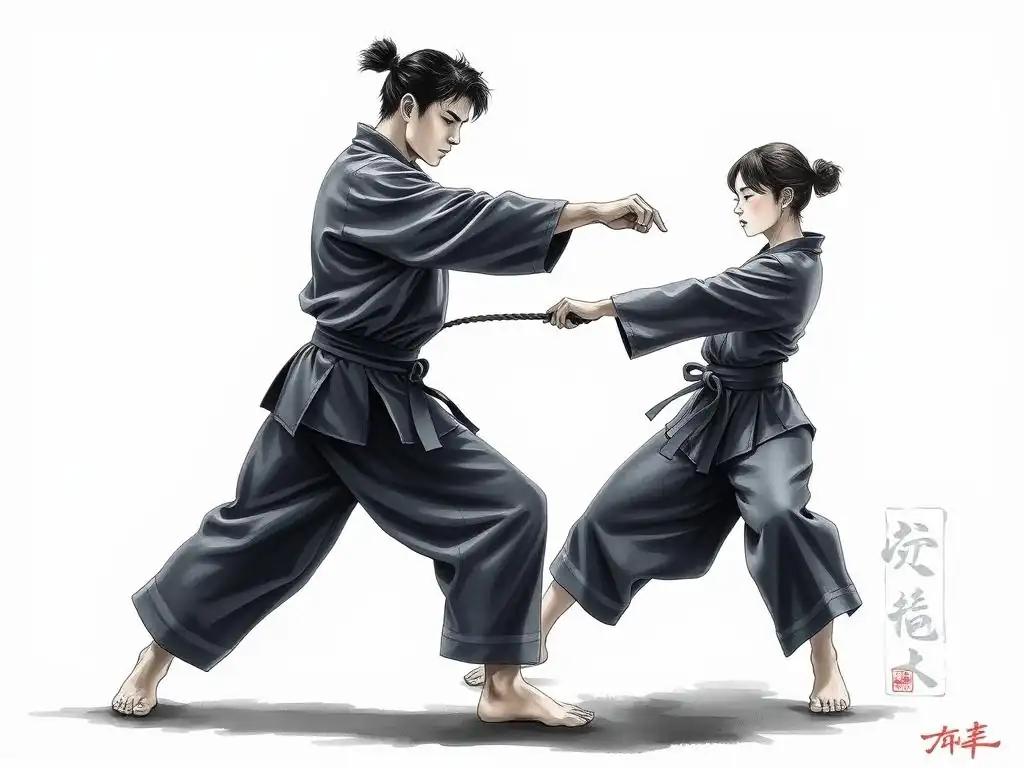
Drill 1: Medicine Ball Rotational Throws for Core Engagement and Power Transfer
Medicine ball rotational throws are a fundamental partner drill for building explosive core power and training the rotational component of the kinetic chain, crucial for generating force in strikes like hooks and crosses, or rotational throws. This drill mimics the body mechanics of many powerful martial arts techniques by emphasizing rotation from the hips and torso. It helps practitioners understand how to channel force generated from the lower body through the core and out to the upper body.
Performing this drill consistently can significantly increase rotational power. For example, athletes training with medicine ball throws 2-3 times a week for 6-8 weeks have shown measurable improvements in rotational velocity and peak torque output. The weight of the medicine ball provides resistance that strengthens the oblique muscles and deep core stabilizers, while the throwing action trains the coordinated sequence of hip rotation, core bracing, and arm extension needed for powerful strikes and movements.
How to Perform Medicine Ball Rotational Throws Effectively
To perform medicine ball rotational throws, stand side-by-side with your partner, approximately 5-10 feet apart, facing perpendicular to each other. One partner holds the medicine ball. From a slightly staggered stance (like a fighting stance), rotate your torso away from your partner, loading the hips and core. Then, explosively rotate back towards your partner, transferring the energy from your lower body through your core to throw the ball forcefully to them. Your partner catches the ball and immediately performs the throw back to you, rotating in the opposite direction.
Focus on maintaining a stable base with your feet, initiating the movement from your hips, and keeping your core engaged throughout the throw. Avoid just using arm strength; the power should come from the rotation of your entire body. Use a weight that is challenging but allows for explosive movement – typically 6-12 lbs for developing speed and power. Perform sets of 10-15 repetitions on each side, focusing on speed and power generation with each throw.
Focus Points: Core Activation, Hip Rotation, and Coordinated Throw
Key focus points for medicine ball rotational throws include ensuring deep core activation throughout the movement. Think about bracing your abdominal muscles as you rotate and throw, stabilizing the spine and efficiently transferring force. Proper hip rotation is paramount; initiate the movement by pivoting the back foot and driving the hips forward, leading the torso rotation. The shoulders and arms should follow the hips and core in a fluid, coordinated sequence.
Visualize the force traveling from the ground, up through the legs, into the rotating hips, through the braced core, and finally out through the arms delivering the ball. The timing between hip rotation, core engagement, and arm release is critical for maximizing power. Avoid reversing direction too quickly without fully completing the rotation; allow the kinetic chain to fully extend before transferring the force. This drill directly translates to power in rotational strikes and throws.
Drill 2: Reactive Jab-Cross Drills for Speed and Power Transfer
Reactive jab-cross drills with a partner are excellent for developing speed, timing, and the coordinated power transfer needed for straight line strikes. These drills involve a partner holding focus mitts or pads and calling out combinations or presenting targets randomly, forcing the practitioner to react quickly and generate power on demand. Unlike static bag work, the moving target and reactive nature of the drill enhance both speed and the ability to apply power accurately under dynamic conditions.
This type of training improves the neuromuscular pathways responsible for rapid force production. By reacting to a partner's cues, martial artists train their bodies to fire muscles in the correct sequence with minimal delay. Regular practice of reactive partner drills can significantly reduce reaction time and increase the velocity and force of strikes. For example, boxers often see a 10-15% increase in punch speed after several weeks of incorporating focused reactive pad work.
Setting Up Reactive Jab-Cross Drills with a Partner
To set up reactive jab-cross drills, one partner wears focus mitts. The striking partner stands in their fighting stance, approximately striking distance away. The partner with the mitts presents a target for the jab (usually the lead mitt) and then the cross (usually the rear mitt), either sequentially or with variations. The striking partner reacts instantly to the presented target, throwing a sharp, powerful jab followed by a cross, focusing on using their body weight and hip rotation.
The mitt-holder should vary the timing and location slightly to prevent predictability, forcing the striker to adjust footwork and distance. It's crucial for the mitt-holder to provide appropriate resistance and 'catch' the punch firmly to give the striker tactile feedback on their power and accuracy. Both partners should communicate – the striker calling out the technique as they throw helps with focus, and the mitt-holder providing feedback on power, speed, and form is invaluable.
Varying the Drill: Adding Slips, Rolls, and Counters
To increase the complexity and effectiveness of reactive jab-cross drills, incorporate defensive movements and counters. After the striker throws the jab-cross, the mitt-holder can simulate a counter-attack (e.g., a hook or straight punch) by moving a mitt towards the striker's head. The striker must then react by slipping, rolling, or blocking before immediately throwing a counter strike (e.g., a hook after slipping the partner's simulated hook).
This variation significantly enhances coordination under pressure and trains the kinetic chain for transitions between offensive and defensive actions. It forces the practitioner to maintain balance and structural integrity while moving, ensuring that they can generate power even when slightly off-center or recovering from a defensive maneuver. Adding these elements makes the partner drills power coordination training more realistic and comprehensive.
Drill 3: Footwork and Evasion Drills for Agility and Power Generation
Footwork is the foundation of power generation and efficient movement in martial arts. Without proper footwork, the ability to generate force from the ground up, transfer weight, and maintain balance while striking or defending is severely limited. Partner footwork and evasion drills focus on developing agility, the ability to move quickly and change direction, and the skill to evade attacks while simultaneously setting up opportunities for powerful counters.
These drills emphasize maintaining a strong, balanced base throughout movement. Practicing evading a partner's simulated attacks (e.g., stepping off-line, pivoting, circling) teaches the practitioner to absorb incoming force or avoid it entirely, and then immediately transition into an offensive technique using the momentum and positioning gained from the evasion. This seamless transition from defense to offense, powered by efficient footwork, is a hallmark of advanced martial artists and a key component of devastating counter-attacks.
Developing Footwork Patterns for Optimal Power Delivery
Partner footwork drills can involve one partner acting as a moving target or providing gentle pressure/resistance to guide the other partner's movement. Drills might include shadowing a partner, moving around the training area while maintaining proper distance and angle. Another effective drill involves one partner slowly advancing or attacking, forcing the other to use specific footwork patterns (e.g., step-and-slide, pivots, lateral steps) to evade or maintain position.
The focus is on staying light on the feet, keeping the weight balanced, and using small, efficient movements rather than large, clumsy steps. Proper footwork ensures that the hips and core are always in a position to generate rotational or linear force quickly. For instance, a small pivot or step-out can instantly align the body for a powerful cross or roundhouse kick. Partner drills help internalize these patterns through reactive practice.
Integrating Evasion Techniques to Maintain Balance and Control
Integrating evasion techniques into partner drills adds another layer of complexity and realism. One partner can throw slow, telegraphed attacks (punches, kicks, grappling entries) while the other focuses solely on evading using footwork, head movement, and body angling. The goal is not just to avoid being hit, but to do so while maintaining balance and control, ensuring that the kinetic chain remains ready to fire back.
For example, a partner might throw a slow jab; the other partner slips off-line, focusing on keeping their weight centered and knees slightly bent. After the slip, they immediately reset or step into a position to counter. This trains the body to absorb or redirect force without becoming unbalanced, which is critical for delivering powerful counter-strikes. Partner drills provide the necessary interactive environment to practice these dynamic transitions effectively.
Drill 4: Pad Work for Power Development and Precision Targeting
Pad work, using focus mitts or Thai pads, is a cornerstone partner drill for developing striking power and precision. Unlike heavy bag work, which provides consistent resistance, pad work involves hitting a moving target held by a partner, requiring greater timing, accuracy, and the ability to adjust power and angle on the fly. The partner holding the pads provides immediate tactile and auditory feedback on the quality and force of the strike.
Hitting pads effectively requires the full engagement of the kinetic chain. The partner holding the pads can call out specific combinations, angles, and power levels, forcing the striker to execute techniques with proper form and maximum force transfer. Consistent pad work is directly correlated with increased striking power and accuracy in martial artists across disciplines like boxing, Muay Thai, and Karate. It allows for high-intensity, skill-specific training that directly translates to performance.
Utilizing Focus Mitts to Enhance Punching Power and Accuracy
Focus mitts are particularly useful for developing punching power and intricate hand combinations. The partner holding the mitts can simulate an opponent's guard, head movement, or body targets. The striker practices delivering punches with full body engagement – driving from the legs, rotating the hips and core, and extending through the shoulder and arm – aiming for the center of the mitt with precision.
The mitt-holder plays a crucial role by providing appropriate resistance (catching the punch firmly) and moving the mitts to train the striker's accuracy and ability to hit moving targets. They can also call out defensive actions or counter-attacks after the combination, forcing the striker to transition quickly. This dynamic interaction is key to refining the timing and coordination needed for powerful, accurate punches in a real scenario.
Focus Points: Full Body Engagement, Impact Absorption, and Target Acquisition
When doing pad work, focus on engaging the entire kinetic chain for every strike. Ensure your feet are properly positioned to generate force from the ground. Drive power through your legs and rotate your hips and torso fully. Keep your core braced to transfer energy efficiently. The strike should feel like it's coming from your core and hips, not just your arm.
For the partner holding the pads, proper technique is vital for both safety and effectiveness. They must absorb the impact correctly by slightly moving with the punch or bracing their body, preventing injury to themselves and providing realistic feedback to the striker. The striker should also focus on acquiring the target visually and maintaining awareness of their partner's position, simulating the need for target acquisition in a dynamic environment.
Drill 5: Resistance Band Rotation Drills for Enhanced Muscle Activation and Power
Resistance band rotation drills, often performed with a partner, are excellent for targeting and strengthening the muscles responsible for rotational power in the kinetic chain, particularly the core and obliques. The continuous tension provided by the resistance band throughout the range of motion helps build strength and endurance in these crucial muscle groups, improving their ability to generate and transfer force during punches, kicks, and throws.
Using resistance bands adds a variable load that challenges the muscles differently than free weights or bodyweight exercises. Partner-assisted band drills allow for specific angles and ranges of motion relevant to martial arts techniques. Consistent training with resistance bands can lead to increased muscle activation, improved rotational speed, and greater overall power output, especially in techniques relying heavily on torso rotation.
Partner-Assisted Resistance Band Training for Power
A common partner-assisted resistance band drill involves one partner holding the end of a resistance band while the other partner holds the handle or loop. The partner with the handle stands in a fighting stance, perpendicular to the partner holding the band, who provides resistance by stepping back or maintaining tension. The striking partner then performs rotational movements, mimicking punches or kicks, against the band's resistance.
For example, to train a cross or hook, the striking partner rotates their hips and torso explosively against the band's pull, extending their arm as if throwing the strike. The partner holding the band ensures consistent tension and can adjust their position to vary the angle of resistance. This allows for targeted strength development in the specific movement patterns used in martial arts techniques.
Targeting Obliques and Core Stabilizers for Increased Rotational Force
Resistance band rotation drills are particularly effective at targeting the oblique muscles and deep core stabilizers. These muscles are essential for both generating rotational force and bracing the core to prevent energy leaks during force transfer. By performing exercises like standing rotational pulls or chops against band resistance, martial artists can build the specific strength needed for powerful, stable rotational movements.
Focus on controlled movement against the resistance, emphasizing the concentric (explosive rotation) and eccentric (controlled return against the pull) phases. Maintain a strong, stable base and avoid letting the band pull you off balance. Aim for sets of 10-20 repetitions, focusing on quality of movement and engaging the target muscles. Integrating these partner drills power coordination exercises can significantly boost rotational power.
Optimizing Your Training for Maximum Power Transfer
Implementing a Progressive Overload Approach to Partner Drills
To continuously improve power output through partner drills, it is crucial to implement a progressive overload approach. This means gradually increasing the challenge over time to force your body to adapt and get stronger. With partner drills, this isn't just about adding weight (like a heavier medicine ball) but also increasing intensity, speed, complexity, or duration.
For example, you might start with slower, more controlled reactive drills and gradually increase the speed and unpredictability of your partner's cues. You could increase the number of repetitions or rounds performed, or decrease the rest time between sets. As your coordination improves, add more complex combinations, defensive movements, or transitions between techniques. Progressively challenging yourself and your partner in these drills is key to unlocking higher levels of power and coordination.
The Role of Recovery in Power Development
Adequate recovery is just as critical as the training itself for maximizing power development. High-intensity partner drills, especially those focused on explosive power, place significant stress on the neuromuscular system. Without proper recovery, the body cannot repair muscle tissue, replenish energy stores, and adapt to the training stimulus. This can lead to plateaus, decreased performance, and increased risk of injury.
Ensure you incorporate rest days into your training schedule. This might mean taking a full day off or engaging in active recovery like light stretching, foam rolling, or low-intensity cardio. Nutrition also plays a vital role; consuming sufficient protein and carbohydrates supports muscle repair and energy replenishment. Prioritizing sleep (aiming for 7-9 hours per night) is arguably the most important recovery tool, as this is when the body undergoes crucial repair and growth processes. Proper recovery allows your body to consolidate the gains made during partner drills power coordination training.
Measuring Progress and Identifying Areas for Improvement [Tracking Punching Power and Speed]
Tracking progress is essential for staying motivated and identifying specific areas in the kinetic chain that need more attention. While not always available, technology like punch trackers or force sensors can provide objective data on striking power and speed. Even without specialized equipment, you can track progress subjectively or through simple tests.
For instance, time how quickly you can perform a specific combination during reactive pad work, or count how many powerful, well-formed strikes you can deliver in a set time frame. Use a partner to provide consistent feedback on the feel and sound of your strikes on the pads – a crisp, solid impact indicates good power transfer. Regularly review your technique with your partner, focusing on the sequence of movements: Are your hips rotating before your shoulders?
Is your core engaged? Are you generating force from the ground? Identifying weaknesses allows you to tailor your partner drills to target those specific links in your kinetic chain, leading to more efficient power development.
Advanced Kinetic Chain Drills for Martial Arts Mastery
Developing Complex Combinations for Enhanced Coordination
As proficiency increases, integrating complex combinations into partner drills becomes crucial for advanced kinetic chain coordination. This involves chaining together multiple techniques – strikes, defensive movements, feints, transitions, and even grappling entries – in a fluid, seamless sequence. Executing complex combinations requires the kinetic chain to fire and re-sequence rapidly, often while moving or reacting to a partner.
Examples include throwing a jab-cross, slipping a simulated counter, pivoting, and then launching a powerful roundhouse kick, or initiating a striking combination that transitions directly into a takedown attempt. These drills, performed with a partner providing realistic reactions and resistance, train the body to maintain structural integrity and generate power across multiple planes and movements within a single exchange. Mastering complex combinations significantly elevates a martial artist's ability to apply power effectively in dynamic situations.
Integrating Feints and Deceptions for Increased Effectiveness
Advanced partner drills often incorporate feints and deceptions. A feint is a false attack or movement designed to draw a reaction from an opponent, creating an opening for a real technique. Integrating feints into partner drills requires the practitioner to initiate the kinetic chain for one movement but then quickly switch to another.
For example, faking a jab (starting the motion but not completing it) to draw a parry, and then immediately firing a cross or hook. This trains the body's ability to 're-route' energy and momentum, demanding high-level coordination and control. Partner drills allowing for realistic feint-counter exchanges develop this skill, making a martial artist's power techniques harder to anticipate and defend against, thereby increasing their effectiveness in sparring or combat.
Adapting Drills to Specific Martial Arts Disciplines [Example: Adapting for Boxing]
While the principles of the kinetic chain are universal, the specific partner drills power coordination exercises should be adapted to the demands of a particular martial art discipline. For instance, in boxing, where the focus is solely on punching, partner drills will heavily emphasize upper body rotation, linear force generation (jab/cross), head movement, and intricate footwork within a confined space.
A boxing-specific adaptation of partner drills might involve extensive focus mitt work with complex punch combinations and head movement requirements, reactive drills focusing on slipping and countering punches, and resistance band drills specifically targeting rotational power for hooks and uppercuts. Grappling arts like Judo or Wrestling would adapt partner drills to focus on generating force for throws and takedowns, emphasizing lower body drive, core stability during transitions, and coordination in clinch work or ground exchanges. The core principles remain, but the application and specific drills evolve based on the art's techniques and goals.
Conclusion: Unleashing Your Power Potential Through Coordinated Partner Training
Key Takeaways for Optimizing the Kinetic Chain
Optimizing the kinetic chain for power in martial arts hinges on understanding that force is generated through a coordinated sequence of body movements, starting from the ground. Key takeaways include recognizing the importance of a strong foundation (feet, legs), a powerful engine (hips and core), and efficient energy transfer through proper sequencing and timing. Identifying and addressing weak links in this chain, whether it's poor hip rotation, a weak core, or inefficient footwork, is paramount.
Partner drills are invaluable tools for this optimization because they provide dynamic, reactive training that solo practice cannot replicate. They offer real-time feedback on timing, coordination, and power transfer, forcing the body to adapt and refine its movements under realistic conditions. Incorporating a variety of partner drills, from medicine ball throws to reactive pad work and resistance band exercises, targets different aspects of the kinetic chain, leading to more balanced and effective power development.
The Path to Martial Arts Mastery Through Consistent Training
Mastering the kinetic chain and unleashing your full power potential is not a destination but a journey requiring consistent, focused training. Integrating partner drills power coordination exercises regularly into your routine is essential. This isn't just about hitting hard; it's about hitting right, using your entire body as a unified system.
By diligently practicing partner drills, progressively increasing the challenge, prioritizing recovery, and continuously seeking feedback to refine your technique, you can significantly enhance your power, speed, and overall efficiency. The path to martial arts mastery is paved with consistent effort, smart training, and the dedicated pursuit of perfect coordination throughout your kinetic chain, enabling you to perform techniques with maximum force and fluidity.
Frequently Asked Questions
How do partner drills specifically improve coordination in martial arts?
Partner drills force you to react to a moving target, enhancing timing and spatial awareness. They help synchronize your movements with another person, leading to improved coordination and balance. This fosters a deeper understanding of the kinetic chain.
What is the "kinetic chain" and why is it important for martial arts power?
The kinetic chain refers to the interconnected system of body parts working together to generate force. Efficient use of the kinetic chain allows for maximum power output by transferring energy from the ground up through the body.
Which martial arts disciplines benefit most from partner drills focused on the kinetic chain?
All martial arts that involve striking or grappling benefit, including Karate, Muay Thai, Judo, and Brazilian Jiu-Jitsu. Any discipline requiring power generation through coordinated movement will see improvements. Partner drills are essential for refining technique.
Can partner drills for coordination also improve self-defense capabilities?
Yes, by improving reaction time, balance, and power generation, partner drills directly translate to enhanced self-defense effectiveness. They allow for realistic training scenarios that build confidence and practical skills.
What are some examples of partner drills that emphasize power and coordination?
Examples include medicine ball throws, striking pad drills focusing on proper form and power transfer, and grappling drills emphasizing smooth transitions and leverage. Shadow boxing with a partner can also improve timing and rhythm.
Final Reflection: Unleashing Potential Through Collaborative Movement
The exploration of the kinetic chain and its optimization through partner drills reveals a profound truth: power isn't solely an individual pursuit, but a collaborative symphony of coordinated movement. What we've discussed transcends mere physical training; it speaks to the inherent interconnectedness of systems, both within our bodies and within our relationships. The ability to synchronize movements with another person, to feel their energy and respond in kind, unlocks a potential far greater than what can be achieved in isolation.
This understanding of coordinated power extends far beyond the gym or training field. It underscores the importance of teamwork, communication, and mutual support in all aspects of life. From professional collaborations to personal relationships, the principles of the kinetic chain – efficient energy transfer, synchronized movement, and responsiveness – are fundamental to achieving shared goals. Alone we can do so little; together we can do so much.
- Helen Keller. This quote perfectly encapsulates the essence of leveraging the kinetic chain with a partner; it's about amplifying individual strengths through collective action.
Now, consider how you can apply these principles in your own life. Reflect on the areas where you seek to optimize your own "kinetic chain," whether it's in your physical endeavors, your professional collaborations, or your personal relationships. How can you better coordinate your efforts with others to unlock new levels of power and efficiency? Embrace the power of partnership, and discover the extraordinary potential that lies within synchronized movement and shared purpose.
Unlock Your Potential: Ignite Your Kinetic Chain Now!
Thank you for exploring the power of coordinated movement with us. You've just gained valuable insights into harnessing your kinetic chain for enhanced power and efficiency. Now, it's time to put that knowledge into action!
- Partner up and immediately begin practicing the fundamental drill outlined in this article to internalize the kinetic chain sequence.
- Share this article with your training partners or coach and discuss how you can incorporate these drills into your regular training regime.
- Record yourself performing the drill, analyze your form, and identify areas for improvement – then share your progress in the comments!
What specific aspect of the kinetic chain are you most eager to improve in your own training this week, and what drill will you use to do it?