
Beyond the Point: The Hidden Uses of the HEMA Dagger Hilt and Pommel


Welcome to Martial Arts Mastery!
Delve into the intricate world of combat where history meets technique. Ever wondered if the HEMA dagger hilt and pommel are just decorative flourishes? Prepare to have your perceptions challenged. This exploration reveals the surprising and often overlooked tactical applications of these crucial components, adding a new dimension to your understanding of Historical European Martial Arts. Discover how they were employed not just for grip, but as integral tools for leverage, control, and even devastating strikes. Intrigued? Read on to unlock the secrets held within this often-underestimated aspect of dagger combat.
- Introduction to HEMA Dagger Combat and the Hilt
- The HEMA Dagger Hilt: More Than Just a Grip
- The HEMA Dagger Pommel: A Multi-Functional Weapon Component
- Advanced HEMA Dagger Techniques: Integrating Hilt and Pommel
- Historical Examples of Hilt and Pommel Usage in Dagger Fighting
- Training Drills for Mastering HEMA Dagger Hilt and Pommel Techniques
- The Tactical Advantage of Understanding HEMA Dagger Hilt and Pommel Functionality
- Conclusion: Appreciating the Versatility of the HEMA Dagger Hilt and Pommel
-
Frequently Asked Questions
- What are the primary functions of a HEMA dagger hilt and pommel beyond simply gripping the weapon?
- How can the hilt of a HEMA dagger be used defensively?
- What role does the pommel play in grappling techniques with a HEMA dagger?
- Does the historical context of HEMA influence how the dagger hilt and pommel are used?
- How does understanding the hilt and pommel enhance overall HEMA dagger proficiency?
- Final Reflection: Unveiling the Dagger's Deeper Story
- Unveil Hidden Techniques: Master the Dagger!
Introduction to HEMA Dagger Combat and the Hilt
Understanding the Importance of the Dagger Hilt in Historical Fencing
The dagger, while often perceived primarily as a stabbing weapon, holds a far more nuanced role in Historical European Martial Arts (HEMA). Its effectiveness is not solely reliant on the sharp point or edge, but equally on the structural components beyond the blade: the hilt and the pommel. In the close-quarters grappling and fighting scenarios typical of historical dagger combat, these seemingly secondary parts of the weapon become integral tools for defense, control, and striking. Understanding the full functionality of the HEMA dagger hilt pommel is crucial for any serious practitioner looking to master this complex weapon system.
Historical treatises, such as those by Fiore dei Liberi or Filippo Vadi, consistently illustrate techniques where the hilt and pommel are actively used. These manuals depict fighters blocking, striking, and manipulating their opponents with parts of the dagger other than the blade. This historical emphasis highlights that a practitioner who only focuses on stabbing or cutting is missing a significant portion of the dagger's potential. Mastery in HEMA dagger combat requires appreciating the entire weapon as a multi-functional tool, where the hilt and pommel are just as vital as the blade.
The Often Overlooked Functionality of the Dagger Pommel
While the hilt might receive some attention for providing grip security, the pommel, the weighted end opposite the blade, is perhaps the most underestimated component of the HEMA dagger. Many modern interpretations or casual observers might see it merely as counterweight or decoration. However, in the context of historical fighting systems, the pommel served a distinct and impactful purpose, particularly in infighting where blade use was restricted or impractical.
The weight and hardness of the pommel make it a potent striking surface capable of delivering forceful, localized blows. These blows are often aimed at vulnerable points on the opponent's head or body, designed to stun, injure, or create openings for subsequent techniques. Furthermore, the pommel's shape and position at the base of the weapon allow it to be used for leverage, control, and even as a makeshift hook or point in grappling exchanges. Ignoring the pommel is akin to fighting with half a weapon, severely limiting one's tactical options in a HEMA dagger encounter.
The HEMA Dagger Hilt: More Than Just a Grip
Securing the Grip: Hand Placement and Hilt Design in HEMA Dagger Fighting
The primary, and most obvious, function of the HEMA dagger hilt is to provide a secure and stable grip for the wielder. However, the design of hilts in historical daggers varies significantly, influencing grip options and overall weapon handling. Styles range from simple crossguards to more elaborate rings or quillons, each offering different levels of hand protection and control. Proper hand placement on the hilt is fundamental; a firm grip allows for precise control of the blade and effective application of force when striking or defending.
Historical manuals often show specific grip configurations depending on the intended technique. For instance, a standard grip might be used for thrusting, while a reversed grip might be preferred for close-in grappling or using the pommel. The texture, material (often wood, bone, or metal), and diameter of the hilt all contribute to grip security, especially when hands might be sweaty or gloved (as was common in armored combat). A well-designed and properly held HEMA dagger hilt is the foundation upon which all other techniques are built.
Hilt as a Defensive Tool: Blocking and Deflecting with the Dagger Hilt
Beyond securing the hand, the HEMA dagger hilt, particularly the crossguard (quillons), serves as a vital defensive tool. While not as robust as a sword guard, it can effectively block or deflect incoming blade attacks from another dagger or even a larger weapon at close range. This is especially true in the tight confines of grappling exchanges where space is limited. By presenting the crossguard, a practitioner can intercept a thrust or cut, protecting their hand and body.
Historical illustrations frequently show daggers being used defensively in this manner. A swift parry using the quillons can momentarily disrupt an opponent's attack, creating an opportunity for a counter-attack or disengagement. This defensive capability is a crucial aspect of the HEMA dagger hilt pommel system, providing a layer of protection in scenarios where simply moving out of the way is not feasible. Mastering hilt blocks requires precise timing and angle, leveraging the small guard to redirect significant force.
Hilt as a Striking Implement: Hilt Strikes and Pommeling Techniques
The hilt itself, specifically the crossguard ends or the base where it meets the grip, can be used offensively. These parts are often made of metal and present hard, sometimes pointed, surfaces. In extremely close range or grappling, striking with the hilt can be a quick, jarring attack aimed at vulnerable areas like the face, hands, or ribs. This is distinct from pommel strikes but falls under the broader category of using the non-blade parts for offense.
These hilt strikes are typically short-range techniques, often delivered with a snap of the wrist or a quick rotation of the hand. They might not have the concussive force of a full pommel strike but can be used to surprise an opponent, break their structure, or create space. For example, in a bind, a quick jab with the quillon end towards the opponent's face could momentarily blind or distract them. Integrating hilt strikes adds another dimension to the offensive capabilities derived from the HEMA dagger hilt pommel complex.
The HEMA Dagger Pommel: A Multi-Functional Weapon Component
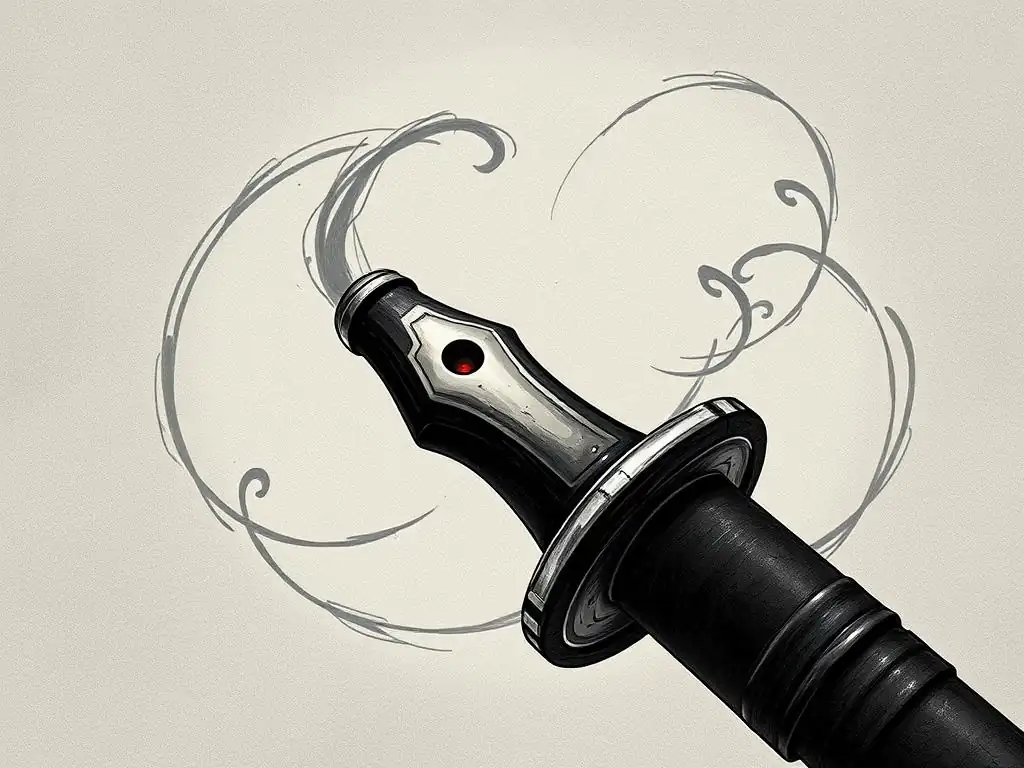
Pommeling Techniques in HEMA Dagger Fighting: Utilizing the Pommel for Strikes
The pommel is arguably the most potent striking surface of the HEMA dagger after the point. Its weight and density, typically metal, make it excellent for delivering blunt force trauma. Pommel strikes are commonly aimed at hard targets like the head, jaw, collarbone, or even armored joints. These are not mere taps but forceful blows intended to incapacitate, stun, or break bone. Historical texts and modern HEMA practice confirm the efficacy of these techniques.
Consider the pommel strike depicted in Fiore dei Liberi's Flos Duellatorum in the context of dagger grappling. Often, after achieving a secure bind or control position, the practitioner delivers a sharp blow with the pommel to the opponent's head or face. This technique, known as "pommeling," leverages the short distance and the solid mass of the HEMA dagger hilt pommel to generate significant impact. It's a technique frequently drilled in HEMA schools due to its effectiveness in ending an encounter quickly in close quarters.
The Pommel as a Control Device: Gripping and Manipulating with the Pommel
Beyond striking, the pommel can be used creatively as a control device in grappling. Its shape and position allow it to be hooked around limbs, clothing, or even the opponent's weapon. In a close embrace, the pommel end of the HEMA dagger can be used to press into sensitive areas, control posture, or create discomfort to force a reaction. This manipulative use is less about delivering damage and more about gaining or maintaining a dominant position.
For example, in a standing grapple, the pommel could be hooked behind an opponent's knee to disrupt their balance or pressed into their ribs to create an opening. In ground fighting, the pommel might be used to pin a limb or apply pressure to a joint. This subtle, yet effective, use of the HEMA dagger hilt pommel as a control tool demonstrates its versatility far beyond simple stabbing or cutting. It requires a deep understanding of body mechanics and leverage.
Using the Pommel for Leverage: Gaining an Advantage in Close Quarters
The pommel, especially when held in a reversed grip (icepick grip), provides excellent leverage. This is particularly useful in defensive applications or when attempting joint locks and manipulations. By gripping the blade or hilt and using the pommel as a fulcrum or point of pressure, a practitioner can generate significant force in grappling exchanges. This leverage can be applied against an opponent's limbs, neck, or body.
Imagine being seized from behind. Using a reversed grip on the dagger, the pommel can be driven into the attacker's body or used to apply pressure to their arms or hands to break the grip. Similarly, in a bind against another weapon, the pommel can be used to gain mechanical advantage, potentially leading to a disarm or control of the opponent's weapon. This application of the HEMA dagger hilt pommel highlights its utility not just as a weapon for striking, but as a tool for applied force and leverage in grappling.
Advanced HEMA Dagger Techniques: Integrating Hilt and Pommel
Combining Edge, Point, Hilt, and Pommel in Complex Dagger Sequences
True mastery of the HEMA dagger involves seamlessly integrating the use of the edge, point, hilt, and pommel into fluid combat sequences. An attack might begin with a thrust (point), transition to a close-range grappling exchange where the hilt blocks an incoming strike, followed by a powerful pommel strike to the head, and potentially end with an edge cut or another thrust. This multi-faceted approach makes the dagger a highly unpredictable and dangerous weapon in skilled hands.
Historical sources like Vadi's De Arte Gladiatoria Dimicandi show complex exchanges where techniques flow from one to another, utilizing different parts of the weapon based on distance and opportunity. A sequence might involve using the pommel to create an opening, then following immediately with a thrust, or using the hilt to bind an opponent's arm before striking with the point. Practicing drills that combine these elements is essential for developing the reflexes needed to switch between using the HEMA dagger hilt pommel and the blade effectively.
Hilt and Pommel as Pressure Points: Targeting Vulnerable Areas
The hard surfaces of the HEMA dagger hilt and pommel are ideal for targeting pressure points or vulnerable anatomical locations. While a pommel strike might target major structures like the skull or jaw, the quillons of the hilt or the edge of the pommel can be used with precision against nerves, tendons, or joints. This application is less about raw power and more about disrupting the opponent's structure or causing intense localized pain.
Targeting areas like the temple, base of the skull, collarbone, ribs, hands, or even the groin with a sharp jab from the pommel or hilt can quickly incapacitate or create a significant opening. In grappling, pressing the pommel into the solar plexus or behind the ear can be highly effective. This strategic use of the HEMA dagger hilt pommel against vulnerable targets maximizes the impact of these components, even against an armored opponent where bladed attacks might be less effective.
Disarming Techniques: Using the Hilt and Pommel to Control the Opponent's Weapon
The HEMA dagger hilt and pommel can also be employed in disarming techniques. In a bind or grappling situation involving weapons, the crossguard or pommel can be used to trap, lever, or strike the opponent's hand or weapon, forcing them to drop it. This requires precise timing and control, often leveraging the structure of the HEMA dagger hilt pommel against the opponent's grip or weapon.
For instance, Fiore dei Liberi illustrates techniques where the hilt is used to catch an opponent's blade during a parry, or the pommel is used to strike their hand holding the weapon. By securing a bind with the hilt, the practitioner can then use their free hand or bodyweight, potentially aided by the pommel for leverage, to wrench the weapon away. These disarming applications underscore the defensive and control potential inherent in the HEMA dagger hilt pommel system.
Historical Examples of Hilt and Pommel Usage in Dagger Fighting
Examining Historical Treatises on Dagger Combat: Fiore dei Liberi's Flos Duellatorum, Filippo Vadi's De Arte Gladiatoria Dimicandi
Historical European Martial Arts are fundamentally based on the study and interpretation of surviving manuscripts. Two of the most prominent sources for medieval Italian dagger combat are Fiore dei Liberi's Flos Duellatorum (c. 1410) and Filippo Vadi's De Arte Gladiatoria Dimicandi (c. 1482). Both treatises dedicate significant sections to dagger fighting, often in the context of unarmed or armored combat, and provide invaluable insight into the techniques of the era, including the use of the HEMA dagger hilt pommel.
Fiore's work, in particular, is rich with illustrations showing grappling techniques integrated with dagger use. His "Plays of the Dagger" demonstrate numerous instances where the pommel is used for striking after a bind or control is established. Vadi also illustrates close-quarters dagger techniques that imply the use of the entire weapon, not just the blade. Studying these sources directly is the cornerstone of understanding historical HEMA dagger hilt pommel applications.
Analyzing Illustrations and Descriptions of Hilt and Pommel Techniques
The illustrations in these historical treatises are often highly stylized but convey crucial information about body mechanics, grips, and weapon usage. Examining the postures and actions depicted provides strong evidence for the intended use of the HEMA dagger hilt pommel. For example, an image might show a fighter holding their dagger in a reversed grip (punta riversa) and striking downwards with the pommel towards an opponent's head, a technique explicitly taught for its concussive power.
Similarly, analyzing the text accompanying these illustrations offers detailed descriptions of the techniques. Fiore's text might describe how to "strike him in the head with the pommel" after securing a specific grip or throw. Vadi's descriptions might outline using the guard to ward off a blow before transitioning into a thrust or grapple. By cross-referencing the images and text, modern practitioners can reconstruct and interpret the specific methods for utilizing the HEMA dagger hilt pommel as taught centuries ago.
Reconstructing Practical Applications from Historical Sources
The process of reconstructing HEMA techniques from historical sources involves not just reading and viewing, but also physically practicing and testing interpretations. HEMA practitioners and researchers spend considerable time on the training floor, attempting to make the techniques described in manuscripts like Flos Duellatorum and De Arte Gladiatoria Dimicandi work in a practical context. This includes understanding the biomechanics behind using the HEMA dagger hilt pommel for strikes, blocks, and control.
For instance, reconstructing a pommel strike from Fiore involves understanding the optimal distance, angle, and body mechanics to generate force, often practicing against padded targets or willing partners with protective gear. Reconstructing a hilt block requires drilling parries against simulated attacks to develop timing and precision. This hands-on approach, combined with scholarly analysis, allows for a deeper appreciation of the sophisticated and multi-functional role of the HEMA dagger hilt pommel in historical combat.
Training Drills for Mastering HEMA Dagger Hilt and Pommel Techniques

Drills for Developing Hilt Blocking and Deflection Skills
Developing proficiency in using the HEMA dagger hilt for defense requires dedicated practice. Simple partner drills can focus on receiving and deflecting simulated thrusts and cuts aimed at the hand or forearm. One common drill involves a partner making slow, controlled thrusts while the other practices rotating their wrist and using the crossguard to redirect the attack away from their body.
More advanced drills might involve dynamic exchanges where the defender must react to unpredictable attacks, using the hilt for primary defense or as a follow-up parry if the initial defense fails. Focus is placed on minimal movement, precise timing, and the angle of the hilt's presentation.
- Practice receiving a thrust from different angles, deflecting with the crossguard.
- Drill deflecting light cuts targeting the hand.
- Incorporate footwork while practicing hilt blocks.
- Introduce multiple attacks requiring successive hilt defenses.
Pommel Strike Training: Accuracy and Power Development
Mastering pommel strikes involves both accuracy in targeting vulnerable areas and developing the power to make the strike effective. Initial training often uses padded targets or focus mitts held by a partner, allowing the practitioner to practice the motion and impact without risk of injury. This helps in understanding the necessary body mechanics – often a short, sharp motion involving wrist snap and core rotation.
Later, drills can incorporate grappling entries or binds, simulating the context where pommel strikes are most likely to occur.
- Practice striking a padded target held at head height from different grips (standard and reversed).
- Drill pommel strikes immediately following a successful grapple entry or control.
- Use heavy bags to practice generating power with pommel strikes.
- Incorporate feints and setup techniques before delivering the pommel strike.
Ensuring safe practice with appropriate protective gear is paramount when training HEMA dagger hilt pommel techniques, especially striking.
Integrating Hilt and Pommel Techniques into Sparring and Freeplay
Ultimately, the goal is to seamlessly integrate hilt and pommel techniques into realistic combat scenarios, such as sparring or freeplay. This is done gradually, starting with light, cooperative exchanges and progressing to more dynamic, resistant sparring with full protective gear. Sparring allows practitioners to test the timing and effectiveness of their HEMA dagger hilt pommel skills against a live, unpredictable opponent.
Initial integration might focus on recognizing opportunities to use the hilt defensively during exchanges or identifying moments when a pommel strike is viable after a bind. As proficiency grows, practitioners work on flowing between using the blade, hilt, and pommel organically.
[ ] Practice identifying opportunities for hilt blocks in sparring.
[ ] Attempt pommel strikes during grappling exchanges in freeplay.
[ ] Drill transitioning from a bladed attack to a hilt or pommel technique.
[ ] Focus on defensive applications of the hilt and pommel in sparring scenarios.
This iterative process of drilling specific techniques and then testing them in sparring is crucial for developing reactive and effective use of the HEMA dagger hilt pommel in combat.
The Tactical Advantage of Understanding HEMA Dagger Hilt and Pommel Functionality
Enhancing Self-Defense Capabilities with HEMA Dagger Training
While HEMA focuses on historical contexts, the principles of close-quarters combat, leverage, and utilizing all parts of a tool translate remarkably well to modern self-defense. Training with the HEMA dagger, including its hilt and pommel, instills an understanding of vital targets, managing distance in tight spaces, and the effectiveness of blunt force trauma. This knowledge is applicable even without a weapon, informing empty-hand techniques and awareness.
Understanding how a HEMA dagger hilt pommel can be used defensively or offensively in a struggle provides a framework for analyzing similar situations. The focus on grappling and infighting inherent in HEMA dagger systems is highly relevant to real-world altercations, which often devolve into messy scrambles. The ability to use a hard object (like a pommel or hilt) effectively in a close-range struggle is a valuable skill, even if the "object" is not a historical dagger.
Applying Hilt and Pommel Techniques in Realistic Combat Scenarios
In historical combat scenarios, particularly armored fighting or duels where opponents closed distance rapidly, the HEMA dagger hilt pommel became indispensable. The point might be less effective against plate armor, but a forceful pommel strike to the head or a joint could still cause significant damage or disorientation. Similarly, in the chaos of a melee or a street encounter, the ability to use the dagger's non-blade parts for control and striking was a significant advantage.
Consider a scenario where an opponent grapples you. A thrust might be difficult or impossible due to position. However, a quick, powerful pommel strike to the side of the head is often feasible and highly effective at breaking the grapple or ending the fight. Using the hilt to create space or the pommel for leverage in a bind are realistic applications drawn directly from historical HEMA dagger fighting principles, demonstrating the tactical depth provided by understanding the full functionality of the weapon.
Beyond Offense: The Defensive Power of a Well-Utilized Dagger Hilt and Pommel
While striking with the pommel is a clear offensive application, the defensive capabilities offered by the HEMA dagger hilt pommel are equally significant. The hilt provides a crucial, albeit small, guard against incoming attacks, protecting the hand and allowing for deflections. The pommel, when held in certain grips or used in grappling, can act as a point of leverage or control, disrupting an opponent's balance or structure.
In a defensive situation where disengagement is not possible, the ability to use the hilt to parry or the pommel to create distance or apply pressure can be life-saving. A well-timed hilt block can turn a potentially fatal thrust into a glancing blow. Using the pommel to lever an opponent's arm away can break their hold or prevent them from delivering a follow-up strike. This defensive versatility underscores that the HEMA dagger is not just an offensive weapon but a complete system for close-quarters survival, heavily reliant on the often-underestimated HEMA dagger hilt pommel.
Conclusion: Appreciating the Versatility of the HEMA Dagger Hilt and Pommel
The HEMA Dagger: A Complete Weapon System
The HEMA dagger, when viewed through the lens of historical sources and practical application, reveals itself as far more than a simple stabbing tool. It is a complete, multi-functional weapon system where the blade, hilt, and pommel work in concert. Mastery involves understanding how to transition seamlessly between using the sharp point or edge for thrusts and cuts, the hilt for defense and close-in striking, and the pommel for powerful blunt-force trauma and leverage in grappling. Ignoring any of these components severely limits a practitioner's effectiveness.
The rich historical record, particularly in Italian treatises, demonstrates that medieval and Renaissance fighters fully appreciated the versatility of the HEMA dagger hilt pommel. They developed sophisticated techniques that leveraged the unique properties of each part of the weapon in the complex and often brutal reality of close combat. Approaching the HEMA dagger with this holistic perspective unlocks its full potential and provides a deeper connection to the historical methods of fighting.
Further Exploration of HEMA Dagger Techniques and Resources
For those interested in delving deeper into the world of HEMA dagger combat and the intricate uses of the HEMA dagger hilt pommel, numerous resources are available. Studying translations and interpretations of key treatises like Fiore dei Liberi's Flos Duellatorum and Filippo Vadi's De Arte Gladiatoria Dimicandi is highly recommended. Many modern HEMA schools offer classes specifically focused on dagger fighting, providing hands-on instruction based on these historical sources.
Online communities and forums dedicated to HEMA also offer platforms for discussion, sharing interpretations, and finding training partners. Attending workshops and events focused on dagger combat can further enhance understanding and skill. By committing to study and practice, enthusiasts can gain a profound appreciation for the depth and effectiveness of the HEMA dagger as a complete weapon, utilizing every part from point to pommel.
Frequently Asked Questions
What are the primary functions of a HEMA dagger hilt and pommel beyond simply gripping the weapon?
The hilt and pommel in HEMA dagger combat offer crucial defensive capabilities, such as trapping an opponent's blade, and contribute to leverage during grappling. They also serve as a counterweight for better balance.
How can the hilt of a HEMA dagger be used defensively?
The hilt can be employed to deflect or parry incoming attacks, creating openings. It can also be used to bind the opponent's weapon, controlling their movements and disrupting their attacks.
What role does the pommel play in grappling techniques with a HEMA dagger?
The pommel can be used to apply pressure to an opponent's limbs or pressure points during grappling. It can also be used as a striking surface in close-quarters combat for disorienting blows.
Does the historical context of HEMA influence how the dagger hilt and pommel are used?
Absolutely. Historical manuals detail specific techniques that leverage the hilt and pommel for disarming, grappling, and striking, reflecting the combative realities of the time.
How does understanding the hilt and pommel enhance overall HEMA dagger proficiency?
Mastering these aspects provides a more complete and versatile skillset. It allows practitioners to effectively utilize the dagger in a wider range of combat scenarios, moving beyond purely offensive techniques.
Final Reflection: Unveiling the Dagger's Deeper Story
The journey through the hidden uses of the HEMA dagger hilt and pommel reveals more than just forgotten techniques; it underscores the enduring power of historical martial arts to connect us with the past. The seemingly simple dagger, often overlooked in favor of its larger counterparts, holds within its design a wealth of knowledge and ingenuity, a testament to the resourcefulness of those who wielded it centuries ago.
The rediscovery and application of these techniques in modern HEMA practice highlights the cyclical nature of knowledge and the importance of preserving our martial heritage. This exploration has personally deepened my appreciation for the intricate details often missed in the pursuit of broader skills, reminding me that true mastery lies in understanding the nuances. The devil is in the details,
as they say, and in the case of the HEMA dagger, the devil is also a surprisingly effective tool.
Now, consider the implications of this rediscovered knowledge. How can you, as a practitioner or enthusiast, further explore the hidden potential within your own training? Embrace the challenge of delving deeper into the seemingly mundane aspects of your art. Let the HEMA dagger hilt and pommel serve as a reminder that even the smallest details can unlock a world of possibilities, enriching your practice and connecting you to the rich tapestry of martial history.
Thanks for exploring the surprising potential hidden within your HEMA dagger! Now, take your understanding to the next level.
- Master the Art: Practice gripping and maneuvering your dagger using the hilt and pommel in unexpected ways, focusing on control and precision.
- Share this article with fellow HEMA enthusiasts and spark a discussion about innovative dagger techniques.
- Experiment with these techniques in your next practice session and document your findings – you might uncover something revolutionary!
What unexpected advantage did you discover using the hilt or pommel in your training today?