
Countering Specific Kicks: A Taekwondo Kyorugi Guide

Welcome to Martial Arts Mastery, your gateway to unlocking the profound knowledge and skills of martial arts. Are you ready to elevate your Taekwondo sparring game? This article dives deep into Taekwondo kick defense techniques, providing a Kyorugi-focused guide to countering specific attacks. Discover practical strategies to anticipate, evade, and neutralize your opponent's kicks. Curious how to transform their offensive power into your advantage? Let's begin your journey to mastery…
- Taekwondo Kyorugi Kick Defense Strategies
- Introduction to Taekwondo Kick Defense
- Defending Against the Roundhouse Kick (Dollyo Chagi)
- Neutralizing the Front Kick (Ap Chagi)
- Defending Against the Side Kick (Yeop Chagi)
- Defending the Back Kick (Dwihuryeo Chagi)
- Mastering Defensive Footwork
- Advanced Kick Defense: Parrying and Evasion
- Developing a Comprehensive Training Plan
- Analyzing Defensive Strategies of Elite Fighters
- Conclusion: Elevating Your Kyorugi Game.
-
Frequently Asked Questions
- What are some common kicks used in Taekwondo Kyorugi that this guide focuses on for defense?
- Why is understanding the timing and range of a kick crucial for effective Taekwondo kick defense?
- What are some general principles that apply to defending against most Taekwondo kicks, regardless of the specific kick being thrown?
- Besides blocking, what other defensive strategies are beneficial when facing a Taekwondo kicker?
- How does the "Martial Arts Mastery" website contribute to improving my Taekwondo kick defense skills beyond this guide?
- Final Reflection: Mastering the Art of Defense
- Elevate Your Kyorugi: Unlock the Winning Move!
Taekwondo Kyorugi Kick Defense Strategies
Introduction to Taekwondo Kick Defense
Importance of Effective Kick Defense in Kyorugi
In the dynamic world of Taekwondo Kyorugi, the ability to effectively defend against a barrage of kicks is not merely a supplementary skill but a foundational necessity for success. Kicks are the primary scoring techniques in competitive Taekwondo, accounting for the vast majority of points awarded in a match.
Without robust Taekwondo kick defense techniques, a competitor is constantly vulnerable, unable to establish their own offense or control the distance and tempo of the fight. A lapse in defense can lead to immediate point deductions or even knockouts, highlighting the critical role of defense in maintaining a competitive edge and ensuring safety.
Mastering kick defense allows practitioners to absorb attacks, create openings, and transition seamlessly into counter-offense. Elite athletes spend countless hours honing their defensive reflexes and understanding kick trajectories to minimize damage and maximize scoring opportunities. Studies and observations of competitive bouts consistently show that fighters with superior defensive capabilities tend to have longer match durations and higher success rates, demonstrating that effective Taekwondo kick defense techniques are indispensable components of a winning strategy. It's the shield that allows the sword to strike effectively.
Key Elements of a Strong Defensive Strategy
A strong Taekwondo kick defense strategy in Kyorugi is multifaceted, encompassing more than just physical blocks. It involves a blend of anticipation, positioning, timing, and mental fortitude. The key elements include maintaining an optimal fighting stance, utilizing intelligent footwork to manage distance, recognizing opponent's tells and setups, executing timely blocks or evasions, and being prepared to counter immediately. Understanding the opponent's preferred kicks and patterns is also crucial, allowing for preemptive defensive adjustments.
Developing these elements requires dedicated training that integrates physical conditioning, technical drills, and tactical sparring. A fighter must cultivate sharp reflexes to react instantly to incoming attacks, while also developing the tactical awareness to read the opponent's intentions before the kick is even fully launched. This holistic approach to Taekwondo kick defense techniques ensures that a practitioner is not just reacting defensively but actively participating in the strategic flow of the match, turning defense into a proactive component of their overall performance.
Defending Against the Roundhouse Kick (Dollyo Chagi)
Identifying Roundhouse Kick Variations
The roundhouse kick, or Dollyo Chagi, is arguably the most common and versatile kick in Taekwondo Kyorugi, making its defense a top priority. It can be delivered to multiple targets: the head (often 3 points), the body (2 points), or the leg (not a scoring target in Kyorugi but used for setup or damage). Variations include the standard step-behind roundhouse, the quick rear-leg roundhouse without a step, the front-leg roundhouse, and spinning variations. Recognizing which leg is initiating the kick (front or rear) and the intended target is vital for selecting the appropriate Taekwondo kick defense technique.
Furthermore, the trajectory and power of a roundhouse kick can vary significantly based on the opponent's technique and intent. Some fighters favor speed and snap for quick points, while others generate immense power for potential knockouts. Identifying these subtle differences in preparation, hip rotation, and leg extension allows a defender to anticipate the kick's speed and force. Observing an opponent's habits in previous matches or rounds provides valuable insights into their preferred roundhouse variations and setups, enhancing the defender's ability to predict and counter effectively.
Roundhouse Kick Blocking Techniques
The most common Taekwondo kick defense techniques against a roundhouse kick involve blocking with the arms or forearms for head kicks, or the lead leg shin/forearm for body kicks. For a head kick, a cross block using both forearms raised high is standard, aiming to absorb the impact on the stronger bone structure. Against a body kick, the defender typically raises their lead leg, bending the knee and rotating the shin outwards to meet the incoming kick with the thickest part of the shin bone, often simultaneously protecting the ribs with the lead arm.
Effective blocking requires precise timing and tension. The block must be initiated just as the kick arrives, with the blocking limb tensed to absorb the impact without being driven back excessively. Practicing drills where a partner delivers controlled roundhouse kicks to specific targets helps develop this timing and the physical conditioning needed to withstand repeated impacts. While blocks don't score points, a successful block prevents the opponent from scoring and maintains the defender's position and balance, creating an opportunity for immediate follow-up.
Counter-Attacking Opportunities After Blocking
Successfully blocking a roundhouse kick often leaves the attacker momentarily off-balance or with their kicking leg extended, presenting prime opportunities for counter-attack. One common strategy after blocking a body kick with the shin is to immediately drop the blocking leg and launch a quick front-leg roundhouse or side kick to the opponent's body before they can fully recover their stance. The slight pause or shift in weight by the attacker after their kick is deflected provides a critical window.
Alternatively, after blocking a head kick, a defender might step in quickly and deliver a close-range punch (though less common for scoring in WT Kyorugi) or a fast turning kick (like a spinning hook kick or back kick) if the opponent is still retracting their leg. The key is instantaneous transition – the moment the block is complete, the counter-attack should be initiated. This requires training drills that link blocking movements directly into offensive techniques, making the counter-attack an automatic response to a successful Taekwondo kick defense technique.
Neutralizing the Front Kick (Ap Chagi)
Recognizing Front Kick Trajectory
The front kick, or Ap Chagi, is a linear kick typically used for maintaining distance, checking an opponent's advance, or striking the body or head. Its trajectory is straight forward, driven by extending the leg from the hip and knee, often targeting the opponent's chest, abdomen, or face. Recognizing a front kick involves observing the opponent's lead leg lifting straight up, with the knee driving towards the target before the final extension. Unlike the circular motion of a roundhouse, the front kick is direct and piercing.
Subtle variations include pushing front kicks (used more for force and pushing back) and snapping front kicks (faster, used for quick points). The target area provides a strong clue; a low knee lift might indicate a body target, while a higher knee lift signals a potential head attack. Experienced fighters also use feints, starting with a front kick motion but transitioning into another technique. Developing the ability to distinguish a genuine front kick from a feint requires extensive sparring experience and careful observation of opponent habits.
Front Kick Blocking Techniques
Defending against a front kick primarily involves deflection or absorption using the arms or torso. For a body-level front kick, a common Taekwondo kick defense technique is to use the lead arm to parry or sweep the incoming kick sideways, diverting its force. This requires precise timing to meet the kick just before it reaches full extension. Alternatively, a defender might absorb the impact on their chest protector, leaning back slightly to reduce the force, though this risks giving up a point.
Against a head-level front kick, a defender can use a high block with both arms, similar to a head roundhouse block, or utilize a single forearm block/parry depending on the angle and force. The goal is to either deflect the kick entirely or absorb the impact safely. Practicing drills focused on timing the parry or block against a straight-line attack is crucial. Unlike blocking a roundhouse with the shin, blocking a front kick often relies more on quick hand/arm movements and torso control.
Footwork for Evading Front Kicks
While blocking is an option, footwork is often a highly effective Taekwondo kick defense technique against the linear front kick. Since the kick travels in a straight line, stepping offline (to the side) or stepping back quickly can easily take the defender out of the kick's path. A quick lateral step or a sharp angle step can completely evade the attack without needing to absorb any impact. This preserves the defender's balance and energy.
Stepping back is also effective, but requires sufficient distance to move out of range. A small backward hop or slide is common. Combining a slight backward lean with a step can also help. The choice between stepping back or sideways often depends on the opponent's follow-up potential and the defender's tactical goal. Evading maintains distance, while stepping offline can sometimes set up a counter-angle. Mastering agile footwork allows a defender to choose the most advantageous position relative to the incoming front kick.
Defending Against the Side Kick (Yeop Chagi)
Understanding Side Kick Power and Range
The side kick, or Yeop Chagi, is renowned for its immense power and deceptive range. Delivered with the heel or outer edge of the foot, it is a linear kick generated by rotating the body and extending the leg sideways. Elite practitioners can generate significant force, often cited as exceeding 1000 Newtons, making it a potent scoring technique and knockout threat, particularly to the body or head. Its range is often longer than it appears, as the hip extension adds several inches to the reach.
Recognizing the side kick setup involves observing the chambering of the leg sideways towards the target, often preceded by a step and body rotation. The defender must anticipate this rotation and extension. Due to its power, simply blocking with an arm or shin is often insufficient or carries a high risk of injury. Therefore, Taekwondo kick defense techniques against the side kick often prioritize evasion or deflection over direct absorption. Its straight, powerful trajectory requires a different defensive approach compared to the circular roundhouse.
Effective Side Kick Blocking Methods
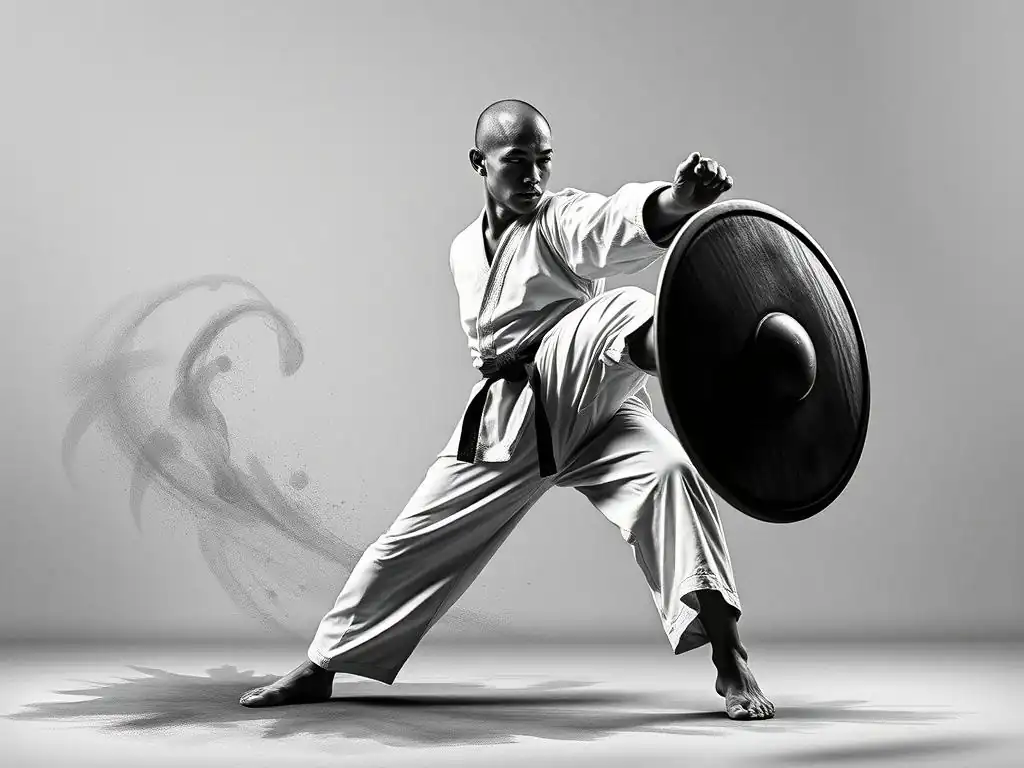
Given the power of the side kick, direct blocking is less common than deflection or strategic absorption. Against a body side kick, some fighters use a reinforced block, bringing both forearms together to cover the target area, absorbing the impact across a larger, stronger surface. However, this can still result in being pushed back significantly. A more active block involves using a lead leg shin block combined with a hand defense, similar to defending a powerful body roundhouse, but adjusting for the linear impact.
A more effective Taekwondo kick defense technique against a side kick is often a parry or deflection using the arms to redirect the kick's energy offline. This requires precise timing and strength to push the incoming leg away from the target without being overpowered. For head-height side kicks, a high block with crossed forearms is used, but again, the power necessitates strong technique and timing. Due to the risks associated with blocking a full-power side kick, combining blocking with footwork or evasion is often the preferred strategy.
Counter-Attacking After Defending a Side Kick
Countering after defending a side kick can be highly effective because the attacker is often committed to the kick and may be momentarily off-balance, especially if their kick is deflected or evaded. If the defender successfully parries the kick offline, they can immediately step in at an angle and launch a fast scoring kick, such as a roundhouse or a quick push kick, targeting the attacker's exposed side or back as they recover their balance.
If the defender used footwork to evade the side kick by stepping offline, they are already in a position to counter-attack from an angle. A quick pivot and a fast turning kick, like a spinning hook kick or back kick, can catch the attacker before they can turn back to face the defender. The key is exploiting the attacker's linear commitment and rotational momentum. The moment the side kick is neutralized, the defender must transition instantly into their counter-technique to capitalize on the brief opening.
Defending the Back Kick (Dwihuryeo Chagi)
Recognizing Back Kick Setups
The back kick, or Dwihuryeo Chagi, is a powerful, linear kick delivered backwards with the heel, often used as a surprise attack or a counter-attack when an opponent is pressuring. Recognizing its setup is critical due to its speed and potential for a knockout. The setup typically involves the fighter turning their back partially or fully towards the opponent, looking over their shoulder at the target, and then extending the kicking leg straight back. This rotation and head check are key tells.
Back kicks can be delivered from a stationary position, after a spin (spinning back kick), or as a step-behind technique. The spinning back kick is particularly deceptive due to the added momentum from the spin. Observing the opponent's weight shift, head turn, and the initial lifting of the heel are crucial for early recognition. Fighters often use feints or combinations ending in a back kick to mask the setup, requiring the defender to read the entire sequence, not just the final movement.
Back Kick Blocking and Evading Techniques
Defending against a back kick requires immediate reaction, often relying more on evasion than blocking due to its power and speed. The most effective Taekwondo kick defense technique is to quickly step offline or backward to avoid the linear trajectory entirely. Since the kick is aimed directly behind the attacker, moving sideways or back takes the defender out of the line of fire. This is particularly effective against spinning back kicks, where the spin commits the attacker to a specific line.
If evasion is not possible, a defender may attempt to absorb the impact with a reinforced block, similar to defending a powerful side kick, using forearms across the body to cover the target. However, this carries a high risk of injury or being knocked down. Another defensive tactic is to jam the kick by stepping in very close as the opponent turns, disrupting the full extension and power generation. This requires excellent timing and judgment of distance.
Exploiting Back Kick Openings
The back kick, while powerful, leaves the attacker significantly exposed if it misses or is defended. The attacker has their back turned to the opponent, is often off-balance, and requires time to recover their stance and turn back around. This recovery period presents a major opening for the defender.
If the back kick misses or is evaded, the defender should immediately move in and attack the attacker's exposed back or side before they complete their turn. A quick roundhouse kick to the body or head, or even a simple push kick to disrupt their balance further, can score points or set up follow-up techniques. The key is to capitalize on the attacker's temporary disorientation and inability to defend effectively during their recovery phase. This makes defending the back kick, especially through evasion, a high-reward Taekwondo kick defense technique strategy.
Mastering Defensive Footwork
Importance of Agility and Movement
In Taekwondo Kyorugi, agility and effective footwork are the bedrock of a strong defensive game, arguably as important as the blocking techniques themselves. Good footwork allows a fighter to control the distance, move in and out of range quickly, create angles, and evade attacks without needing to absorb impact. It enables the defender to dictate the terms of the engagement rather than simply reacting passively to the opponent's offense. Agility ensures that movements are sharp, balanced, and ready for immediate transition into defense or counter-attack.
Fighters with superior footwork can make opponents miss repeatedly, frustrating their attacks and conserving their own energy. They can use subtle shifts to make a target appear and disappear, or larger movements to reset the fight to their preferred distance. This constant, intelligent movement is a fundamental layer of Taekwondo kick defense techniques, preventing many kicks from even reaching their intended target or reducing their power by changing the range and angle at the last moment.
Footwork Drills for Reaction Time
Improving reaction time through footwork drills is essential for effective Taekwondo kick defense. Drills should focus on rapid, precise movements in response to visual or auditory cues. Examples include ladder drills for quick feet, cone drills for changing direction, and partner drills where one person simulates kicks or movements, and the other reacts with specific footwork patterns (e.g., stepping back from a front kick, stepping sideways from a roundhouse).
Specific drills for Taekwondo kick defense techniques include having a partner throw slow, predictable kicks, gradually increasing speed and unpredictability, while the defender practices stepping, sliding, and pivoting to evade. Mirroring drills, where one partner moves and the other imitates, help develop responsiveness and spatial awareness. Incorporating reaction balls or light-based reaction trainers can also enhance visual processing speed and physical response, translating into faster footwork during a match.
Combining Footwork with Blocking
The most advanced and effective Taekwondo kick defense techniques often involve combining footwork with blocking or parrying. Instead of relying solely on a static block, the defender uses footwork to slightly adjust their position, reducing the force of the impact or changing the angle of the incoming kick, while simultaneously using a block or parry as a secondary layer of defense or deflection. This hybrid approach minimizes the risk of injury and maintains better balance for countering.
For instance, against a powerful roundhouse kick, a defender might take a small step back or slightly angle their body away while executing a shin block. This subtle movement decreases the momentum of the incoming kick upon impact. Against a side kick, a defender might step to the side and parry simultaneously. This combination reduces the need for brute force in the block and makes the defense more fluid and less likely to compromise the defender's position, setting them up perfectly for an immediate counter-attack.
Advanced Kick Defense: Parrying and Evasion
Utilizing Parrying Techniques
Parrying in Taekwondo kick defense involves using the hands or arms to deflect or redirect an incoming kick, rather than absorbing its full force with a block. This requires exceptional timing, sensitivity, and control. A well-executed parry can send the opponent's leg offline, disrupt their balance, and create a significant opening. Parrying is often used against less powerful kicks or as a setup for a counter. For example, a quick hand parry can deflect a snapping front kick, leaving the opponent momentarily open.
Parrying techniques are more subtle than blocks and rely on redirecting kinetic energy. Against a body roundhouse, a fighter might use a sweeping motion with the lead arm to brush the kick past their side. This is a higher-risk technique than blocking, as mistiming can lead to taking the full force of the kick. However, when successful, it is highly energy-efficient and immediately sets up a counter. Developing effective parrying requires extensive partner drills focusing on touch, timing, and sensitivity to the opponent's movement.
Mastering Evasive Maneuvers
Evasion is a cornerstone of advanced Taekwondo kick defense techniques, focusing on avoiding contact with the kick entirely through sophisticated footwork and body movement. This includes quick steps offline, pivots, slips, and even controlled falling or rolling in extreme circumstances. Mastering evasion requires excellent spatial awareness, balance, and the ability to read the opponent's intentions early. The goal is to make the opponent miss, expending their energy without the defender expending much energy or taking damage.
Advanced evasive maneuvers often involve feinting or drawing the opponent in before stepping out of the way, using their momentum against them. For example, a fighter might appear to be a stationary target, enticing a kick, and then use a rapid pivot and step to the side as the kick arrives. This level of evasion requires not just physical agility but also tactical intelligence and psychological control. It's a highly efficient form of Taekwondo kick defense when executed correctly.
Integrating Parrying and Evasion
The most sophisticated Taekwondo kick defense techniques integrate parrying and evasion seamlessly, often within the same movement. A fighter might initiate an evasion, and if the opponent adjusts their kick, use a parry to finish the defense, or vice versa. For instance, a fighter might step back to evade a front kick, and if the opponent overextends, use a hand parry to unbalance them further. This requires a fluid and adaptable defensive system.
Combining these elements makes the defender unpredictable and difficult to hit cleanly. They are not limited to one defensive response but can layer techniques based on the nuances of the incoming attack. Training drills should focus on transitioning between footwork patterns and hand defenses, practicing scenarios where a primary evasion is partially thwarted, requiring a secondary parry or block. This integrated approach represents a high level of mastery in Taekwondo kick defense techniques.
Developing a Comprehensive Training Plan
Drills for Improving Reaction Time
A comprehensive training plan for improving Taekwondo kick defense techniques must heavily feature drills aimed at enhancing reaction time. Simple drills like catching a falling stick or ruler can improve hand-eye coordination and quick reflexes. More specific drills involve a partner throwing padded kicks at varying speeds and angles while the defender practices specific blocks, parries, or evasive footwork. Using focus mitts or body shields allows for full-power practice of defensive techniques.
Visual cue drills, such as a partner holding up colored cards corresponding to different defensive actions, can train the fighter to process information and react quickly. Sound cues, like a clap or a specific word, can also be used. These drills should start slowly and predictably, gradually increasing in speed and complexity to simulate the chaotic environment of a real Kyorugi match. Consistency in these drills is key to building automatic, lightning-fast reactions crucial for Taekwondo kick defense.
Sparring Exercises for Defensive Techniques
Sparring is indispensable for integrating individual Taekwondo kick defense techniques into a realistic combat scenario. Specific sparring exercises can be designed to focus solely on defense. For example, one partner focuses entirely on throwing a specific kick (like a body roundhouse) while the other focuses solely on defending it using various techniques (blocking, evading, parrying). Roles are then switched.
Another effective exercise is "reaction sparring," where partners engage at light to medium contact, with the focus being on the defender's ability to react appropriately to whatever kick is thrown, without necessarily counter-attacking with full force. This helps fighters develop the timing and judgment needed to select the correct defense under pressure. Limited sparring, where only certain kicks or target areas are allowed, can also isolate and refine specific defensive responses.
Sample Training Schedule
A sample weekly training schedule focused on enhancing Taekwondo kick defense techniques might look like this:
- Monday: Footwork and agility drills (ladder, cones, reaction balls), followed by basic blocking drills (partner kicking shields).
- Tuesday: Specific kick defense drills (e.g., 15 minutes defending roundhouse, 15 minutes defending front kick), focusing on technique and timing.
- Wednesday: Light sparring with a focus on defensive reactions and movement, incorporating parrying drills.
- Thursday: Power and conditioning relevant to defense (core strength, leg strength for blocking/evading), followed by advanced evasion drills.
- Friday: Controlled sparring scenarios focusing on specific defensive strategies against different opponents or kick types.
- Saturday: Open sparring, integrating all learned Taekwondo kick defense techniques under match conditions.
- Sunday: Rest and recovery.
This schedule balances foundational physical attributes, technical repetition, and realistic application through sparring, ensuring a well-rounded approach to improving Taekwondo kick defense techniques.
Analyzing Defensive Strategies of Elite Fighters
Case Studies of Successful Defensive Tactics
Analyzing how elite Taekwondo athletes employ Taekwondo kick defense techniques provides invaluable insights. Consider the strategies of multiple-time world champions or Olympic medalists. Many employ a highly mobile, evasive style, using intricate footwork to frustrate opponents. Others build their defense around a solid, impenetrable block, daring opponents to kick them. For instance, studying matches of athletes known for their strong defensive posture reveals their reliance on precise timing and positioning to absorb or deflect powerful attacks while minimizing point exposure.
Looking at specific matches where an underdog defeated a favored aggressive fighter often highlights the effectiveness of a superior defensive game plan. These case studies demonstrate how intelligent movement, timely blocks, and capitalizing on the opponent's errors through defense-to-offense transitions can overcome raw power or speed. Analyzing video footage frame-by-frame allows practitioners to break down the subtle movements and decisions that constitute high-level Taekwondo kick defense techniques.
Analyzing Techniques from World Taekwondo Championships
The World Taekwondo Championships are a showcase of the highest level of Kyorugi, offering a rich source for analyzing advanced Taekwondo kick defense techniques. Observing the defensive patterns of medalists provides concrete examples of successful strategies against diverse kicking styles. Pay attention to how fighters defend against high-scoring head kicks – do they rely on blocks, evasions, or a combination? How do they handle the relentless attack of a pressure fighter versus the counter-attacking style of another?
Statistical analysis from championships can also reveal trends. For example, data might show that fighters with a high percentage of successful blocks against body kicks tend to advance further, or that those who effectively evade spinning techniques concede fewer points. While specific data points require access to detailed match analytics, general observations from watching numerous bouts confirm that defensive proficiency is a common trait among champions. They rarely get hit cleanly with high-scoring techniques, a testament to their honed Taekwondo kick defense techniques.
Lessons Learned from Olympic Taekwondo Athletes
Olympic Taekwondo competitions represent the pinnacle of the sport, and the defensive strategies employed by medal winners are highly refined. A key lesson from analyzing Olympic athletes is the emphasis on efficiency and minimizing risk. They use just enough movement or blocking force needed for the defense, conserving energy for offense. They are masters of distance management, using subtle shifts to stay out of range or draw opponents into traps.
Another lesson is the psychological aspect – maintaining composure under pressure and not being rattled by aggressive opponents. Olympic champions demonstrate patience in their defense, waiting for the precise moment to counter rather than reacting impulsively. Their Taekwondo kick defense techniques are integrated seamlessly with their offensive repertoire, making them unpredictable. Studying their matches teaches not just the physical techniques but also the strategic mindset required for elite-level defense in Kyorugi.
Conclusion: Elevating Your Kyorugi Game.
Frequently Asked Questions
What are some common kicks used in Taekwondo Kyorugi that this guide focuses on for defense?
This guide focuses on defenses against commonly used kicks in Taekwondo Kyorugi such as the Roundhouse Kick, Axe Kick, and Back Kick. We explore effective counters against these high-frequency attacks.
Why is understanding the timing and range of a kick crucial for effective Taekwondo kick defense?
Understanding timing and range is essential for predicting an opponent's kick and positioning yourself effectively. This allows you to intercept or evade the attack with minimal risk.
What are some general principles that apply to defending against most Taekwondo kicks, regardless of the specific kick being thrown?
General principles include maintaining a stable stance, keeping your hands up for protection, and utilizing footwork for evasion and counter-attack. These principles are fundamental to effective defense.
Besides blocking, what other defensive strategies are beneficial when facing a Taekwondo kicker?
Besides blocking, strategies like evasion, redirection, and counter-attacking are beneficial. These techniques allow you to minimize damage and create opportunities to score.
How does the "Martial Arts Mastery" website contribute to improving my Taekwondo kick defense skills beyond this guide?
MartialArtsMastery.org provides a comprehensive resource for martial arts, offering historical context, training techniques, and practical self-defense strategies. This includes content on various martial arts disciplines, allowing for a well-rounded understanding.
Final Reflection: Mastering the Art of Defense
The journey through Taekwondo kick defense techniques, as explored in this guide, highlights more than just physical prowess; it underscores the importance of anticipation and adaptability in the face of adversity. Just as a skilled fighter analyzes an opponent's movements to predict and counter attacks, so too must we approach the challenges in our lives with a similar blend of awareness and strategic thinking.
The principles of balance, timing, and spatial awareness that are crucial in Taekwondo extend far beyond the dojang. They resonate with the need for resilience and calculated response in navigating the complexities of the modern world. As Bruce Lee wisely stated: Adapt what is useful, reject what is useless, and add what is specifically your own.
This philosophy, so central to martial arts, encourages us to not only learn from established techniques but also to cultivate our own unique approaches to overcoming obstacles.
Now, consider how you can apply these defensive strategies to your own life. Are you prepared to anticipate challenges, adapt your approach, and maintain your balance when faced with unexpected "kicks"? Embrace the spirit of Taekwondo, not just in the ring, but in every aspect of your journey, and discover the strength and resilience within you to defend against any obstacle that comes your way.
Elevate Your Kyorugi: Unlock the Winning Move!
Thank you for diving deep into the art of countering kicks in Taekwondo! Now that you're equipped with these strategic insights, it's time to put your knowledge into action and transform your sparring game.
Here's how to continue your journey to Kyorugi mastery:
- Master the Intercept: Dedicate your next sparring session to perfecting the timing of your chosen counter-kick against your partner's most frequent attack. Focus on speed and precision.
- Explore alternate kicks: Research kicks that are less well-known (such as the heel kick) and use them to surprise your opponent.
- Share your experience: Discuss your experiences with fellow martial artists! The best growth happens in the community.
What is one new technique you will try in your next sparring session?