
Kung Fu's Internal Secrets: The Role of Meditation in Chinese Martial Arts

Welcome to Martial Arts Mastery!
Delve into the profound connection between mind and body as we explore the internal secrets of Kung Fu. Our journey begins with a crucial element often overlooked: meditation. Discover how harnessing the power of mindful practice can dramatically elevate your Kung Fu skills and unlock a deeper understanding of this ancient art. Intrigued? Keep reading to uncover the surprising science behind how Meditation Improves Kung Fu Skill.
- Unveiling the Power of Meditation in Kung Fu Training
- Understanding the Philosophical Foundations of Kung Fu and Meditation
- How Meditation Improves Kung Fu Skill: Key Benefits
- Meditation Techniques for Kung Fu Practitioners
- Integrating Meditation into Your Kung Fu Training Routine
- Case Studies: Legendary Kung Fu Masters and Their Meditation Practices
- Common Misconceptions About Meditation in Kung Fu
- Advanced Meditation Practices for Kung Fu Black Belts
- Meditation: A Vital Component of Holistic Kung Fu Training
-
Frequently Asked Questions
- How does meditation specifically enhance Kung Fu skill?
- What styles of meditation are most commonly used in Kung Fu training?
- What are the historical roots of meditation within Kung Fu traditions?
- How often should a Kung Fu practitioner meditate to see improvements?
- Can meditation help with the mental aspects of self-defense in Kung Fu?
- Final Reflection: Cultivating Inner Harmony for Martial Mastery
- Ignite Your Inner Power: Embark on Your Kung Fu Journey!
Unveiling the Power of Meditation in Kung Fu Training
Exploring the Link Between Mindfulness and Martial Arts Mastery
The intricate relationship between mindfulness and martial arts, particularly Kung Fu, is deeply rooted in centuries of tradition. While often perceived externally as a system of physical techniques for combat or self-defense, authentic Kung Fu training has always incorporated internal cultivation practices. Mindfulness, at its core, involves paying attention to the present moment without judgment, a skill directly applicable and immensely beneficial in the dynamic and demanding environment of martial arts practice. This focused awareness allows a practitioner to observe their own movements, internal state, and external surroundings with greater clarity and precision.
Developing mindfulness through practices like meditation significantly improves Kung Fu skill by refining sensitivity and control. For instance, during form practice, a mindful practitioner is acutely aware of their posture, alignment, and the flow of energy (Qi) through their body, enabling subtle corrections that enhance technique and efficiency. In sparring, mindfulness translates into heightened situational awareness, allowing for quicker recognition of an opponent's intentions and openings.
Historical accounts, such as those from Shaolin temples dating back over 1500 years, consistently mention the integration of Chan (Zen) Buddhist meditation, highlighting its indispensable role alongside physical training in developing not just fighting prowess but also mental discipline and control. This dual cultivation of body and mind is considered essential for achieving mastery in traditional Chinese martial arts.
Understanding the Philosophical Foundations of Kung Fu and Meditation
The Influence of Taoism and Buddhism on Kung Fu Practice
Kung Fu's philosophical bedrock is heavily influenced by both Taoism and Buddhism, two major thought systems that emphasize internal harmony, self-awareness, and discipline. Taoism, with its focus on nature, spontaneity, and the concept of Wu Wei (non-action or effortless action), teaches practitioners to move in harmony with the natural flow of energy and events. This philosophy encourages a relaxed yet alert state, where movements are efficient and powerful because they are not forced or strained. Taoist principles underpin many internal Kung Fu styles, emphasizing soft, yielding movements that redirect an opponent's force.
Buddhism, particularly the Chan (Zen) school associated with the Shaolin Monastery, introduced rigorous meditation practices aimed at calming the mind and cultivating insight. The legend of Bodhidharma bringing Chan Buddhism to Shaolin around the 5th or 6th century CE links monastic discipline, physical training, and meditation directly.
This confluence created a holistic training system where physical exertion was a form of moving meditation, and seated meditation refined the mental fortitude and focus necessary for both spiritual insight and martial effectiveness. This philosophical blend means that improving Kung Fu skill through meditation is not just about physical technique but about cultivating a balanced, centered, and aware state of being.
The Concept of "Qi" and its Connection to Meditation
Central to Chinese martial arts and traditional Chinese philosophy is the concept of "Qi" (or Chi), often translated as vital energy or life force. Qi is understood as the fundamental energy that animates all living things and flows throughout the body along specific pathways called meridians. In Kung Fu, cultivating and controlling Qi is paramount for generating explosive power, maintaining stamina, and developing internal strength. Blocked or stagnant Qi is believed to lead to weakness and vulnerability.
Meditation and related practices like Qigong are considered primary methods for sensing, cultivating, and directing Qi. Through focused breathing, visualization, and still postures, practitioners learn to quiet the external distractions and become attuned to the subtle sensations of energy within their bodies.
This internal awareness is crucial for performing advanced Kung Fu techniques that rely on unified body movement and the release of internal power ( Fajin). Therefore, the ability to effectively manipulate Qi, honed through consistent meditation, directly improves Kung Fu skill by providing the practitioner with a deeper source of power and resilience than mere muscular strength alone.
How Meditation Improves Kung Fu Skill: Key Benefits
Enhanced Focus and Concentration for Kung Fu Practitioners
In the complex execution of Kung Fu techniques, split-second decisions and unwavering attention are critical. Meditation training, particularly mindfulness meditation, cultivates the ability to sustain focus on a chosen object (like the breath) and to gently return attention when the mind wanders. This practice directly translates to the martial arts environment.
During form practice, enhanced focus allows practitioners to concentrate on intricate sequences, proper alignment, and the flow of movement without distraction. In sparring or self-defense scenarios, this heightened concentration enables rapid processing of information – an opponent's stance, movement, or intention – leading to faster and more appropriate responses.
Studies in cognitive psychology, while not always specifically on Kung Fu practitioners, have shown that regular mindfulness meditation can improve attention span and working memory. For example, some research indicates that just a few weeks of consistent meditation practice can lead to measurable improvements in tasks requiring sustained attention. Applying this to Kung Fu, a practitioner with enhanced focus can maintain concentration throughout a strenuous training session or a prolonged engagement, making fewer errors and executing techniques with greater precision. This sharpened mental edge is a significant way meditation improves Kung Fu skill.
Improved Body Awareness and Control Through Meditation
Meditation practices encourage a deep connection between the mind and the body. Techniques like body scan meditation involve systematically bringing awareness to different parts of the body, noticing sensations without judgment. This cultivated sensitivity allows Kung Fu practitioners to develop an incredibly refined sense of their physical form in space. They become more aware of their posture, balance, weight distribution, and the subtle movements of their muscles and joints.
This heightened body awareness is fundamental to executing Kung Fu techniques correctly and efficiently. A practitioner with good body awareness can identify and correct misalignments in a stance, understand where tension is hindering movement, and coordinate complex actions with greater fluidity.
For example, developing the "root" – a stable connection to the ground crucial in many Kung Fu styles – relies heavily on subtle adjustments in posture and weight distribution that are only possible with acute body awareness. Meditation provides the internal feedback system necessary to refine these physical attributes, demonstrating a clear path for how meditation improves Kung Fu skill at a foundational level.
Cultivating Inner Peace and Reducing Stress in Combat Situations
Combat or self-defense situations are inherently stressful. The surge of adrenaline and the pressure of potential harm can lead to panic, clouded judgment, and physical tension that hinders performance. Meditation provides tools for cultivating inner peace and managing physiological responses to stress. Practices like focusing on the breath offer an anchor in moments of high intensity, allowing the practitioner to regulate their nervous system, reduce anxiety, and maintain a state of calm alertness.
This ability to remain centered under pressure is a critical, often overlooked, aspect of martial effectiveness. A practitioner who can manage stress is less likely to freeze or make impulsive mistakes. They can think more clearly, react more effectively, and maintain composure even when facing aggression.
This mental resilience, forged through consistent meditation, allows the physical skills to be applied optimally even in chaotic circumstances. Historical accounts often speak of masters who remained calm and collected in the face of danger, a state directly linked to their internal cultivation practices, reinforcing how meditation improves Kung Fu skill by building mental fortitude.
Increased Reaction Time and Reflexes with Mindful Training
While reaction time involves physical speed, the mental component – recognizing a stimulus and initiating a response – is equally vital. Mindful training, cultivated through meditation, sharpens the mind's ability to perceive and process information quickly. By reducing mental clutter and improving focus, practitioners can more rapidly identify threats or opportunities. This heightened perceptual speed translates into faster decision-making and quicker physical reactions.
Consider a defensive block or evasion; the speed of execution is important, but it begins with instantly recognizing the incoming attack. Meditation training enhances this initial recognition phase.
Furthermore, the improved body awareness gained from meditation allows for more efficient physical responses, as the body can react with less conscious thought and more intuitive movement. While specific quantitative data on meditation's impact on martial arts reaction time is an area needing extensive research, anecdotal evidence from practitioners and the principles of cognitive function suggest that a calm, focused, and aware mind, honed through meditation, is better equipped for rapid, effective responses, illustrating how meditation improves Kung Fu skill through enhanced cognitive-motor processing.
Meditation Techniques for Kung Fu Practitioners
Zhan Zhuang (Standing Post Meditation) for Rooting and Stability
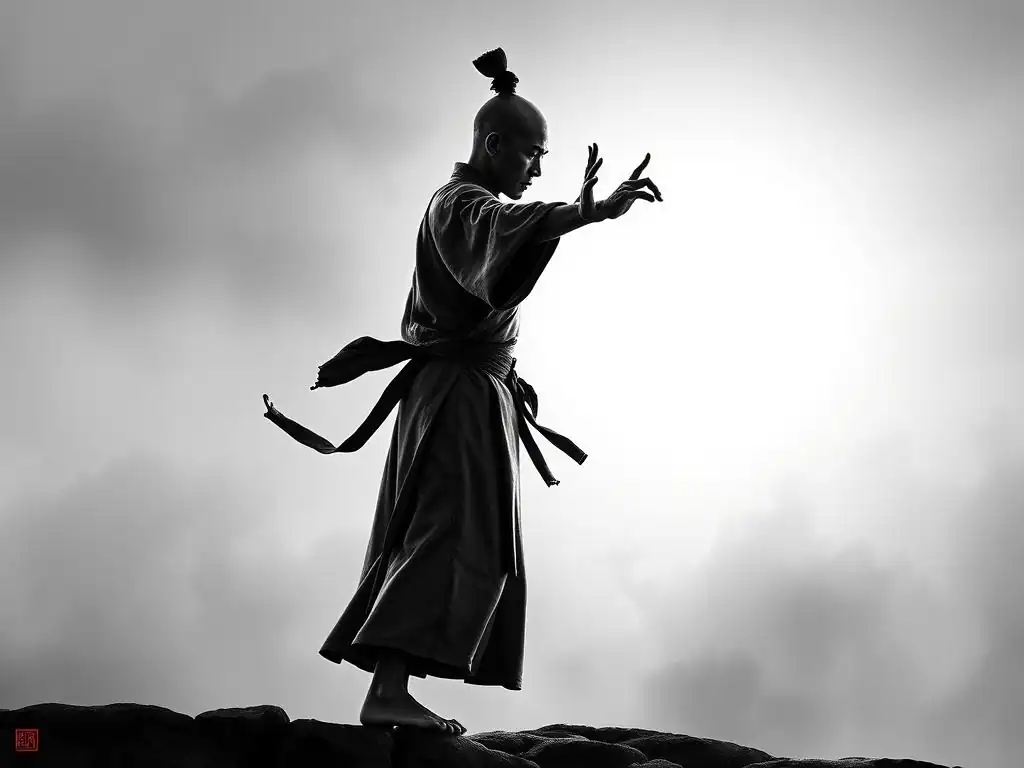
Zhan Zhuang, often translated as "Standing Post" or "Pole Standing," is a foundational meditation practice in many Chinese internal martial arts styles, including various forms of Kung Fu. It involves standing still in specific postures, such as the classic "holding the ball" stance, for extended periods, sometimes ranging from 15 minutes to over an hour. The primary goals are to relax the body while maintaining structural integrity, cultivate physical and mental stillness, and build root and stability.
During Zhan Zhuang, practitioners focus on relaxing muscles, aligning the skeletal structure, and settling their weight deeply into the ground. Initially, physical discomfort and mental restlessness are common, but through sustained practice, one learns to release tension, improve posture, and cultivate a profound sense of being grounded. This practice directly improves Kung Fu skill by developing leg strength, endurance, and a stable base crucial for generating power and maintaining balance in dynamic movements. It also cultivates the ability to remain calm and centered despite physical stress, a vital mental attribute for martial artists.
Guided Imagery and Visualization for Kung Fu Skill Enhancement
Guided imagery and visualization are powerful meditation techniques that can be specifically tailored to improve Kung Fu skill. This involves mentally rehearsing techniques, forms, or combat scenarios with vivid detail. A practitioner might visualize performing a complex form flawlessly, feeling the movement of energy, the correct alignment, and the power generated. Alternatively, they might visualize successfully executing a specific technique against an imaginary opponent, anticipating movements and reacting effectively.
Neuroscience research suggests that the brain activates similar neural pathways when visualizing an action as it does when physically performing it, albeit to a lesser extent. Consistent visualization can help refine motor skills, improve muscle memory, and enhance strategic thinking without the physical exertion or risk of injury. Many top athletes, including martial artists, use visualization to mentally prepare and improve performance. By mentally practicing perfect execution through guided imagery, Kung Fu practitioners can accelerate their learning curve and improve the precision and fluidity of their techniques, demonstrating a mental pathway for how meditation improves Kung Fu skill.
Mindfulness Meditation for Cultivating Presence in Kung Fu Forms
Mindfulness meditation, particularly focusing on breath and body sensations, is highly effective for cultivating presence during Kung Fu form practice. Forms are choreographed sequences of movements that embody the techniques, principles, and spirit of a particular style. Performing forms mindlessly, merely going through the motions, limits their effectiveness as a training tool. Mindfulness brings conscious awareness to each posture, transition, and breath within the form.
By practicing mindfulness during forms, practitioners pay attention to their body's alignment, the flow of energy, the quality of their breath, and the intention behind each movement. This deep engagement transforms the form from a physical exercise into a moving meditation, enhancing body awareness, coordination, and internal connection. It also trains the mind to stay focused and present during complex physical activity, a skill directly transferable to the dynamic environment of sparring or self-defense. This conscious engagement ensures that the physical practice is also a mental and energetic cultivation, highlighting how meditation improves Kung Fu skill holistically.
Breathing Exercises (Qigong) for Energy Cultivation and Control
Breathing is fundamental to life and central to energy cultivation in Chinese philosophy and martial arts. Qigong, often practiced alongside meditation, involves specific breathing techniques combined with gentle movement or stillness to cultivate, circulate, and control Qi. Deep, slow, and regulated abdominal breathing (Dantian breathing) is a common practice, promoting relaxation, increasing oxygen flow, and strengthening the core.
Advanced Qigong practices involve directing the breath and intention to specific parts of the body or along meridian pathways. In Kung Fu, control over breath and Qi is essential for generating explosive power ( Fajin), maintaining stamina, absorbing impact, and developing internal resilience. For example, coordinating breath with movement can amplify force, while specific breathing patterns can help manage pain or fear. Regular Qigong practice, a form of moving or static meditation, directly contributes to a practitioner's internal power and endurance, showing a tangible way meditation improves Kung Fu skill by working with the body's vital energy.
Integrating Meditation into Your Kung Fu Training Routine
Creating a Daily Meditation Practice for Martial Artists
Integrating meditation into a busy training schedule requires discipline and planning, but the benefits for improving Kung Fu skill are substantial. Start small; even 5-10 minutes of dedicated meditation daily can make a difference. Find a quiet space where you won't be disturbed. Consistency is more important than duration initially. Many martial artists find it beneficial to meditate in the morning to set a focused intention for the day or in the evening to relax and process the day's experiences.
Consider your personal training goals when choosing a meditation style. If you need better focus, try mindfulness of breath. If you need grounding and stability, incorporate Zhan Zhuang. If you're working on specific techniques, use visualization. Schedule your meditation time just like you schedule your physical training sessions. Treating meditation as a non-negotiable part of your overall martial arts regimen is key to reaping its benefits for improving Kung Fu skill.
Combining Meditation with Kung Fu Forms and Sparring
Meditation principles can be integrated directly into physical Kung Fu practice. During form practice, approach it as a moving meditation. Pay attention to your breath, the feeling of your feet on the ground, the alignment of your body, and the intention behind each movement. Don't rush; focus on quality over speed. This mindful approach deepens your understanding of the form and improves body awareness.
In sparring or self-defense, the goal is to maintain a state of calm alertness and presence cultivated through meditation. Before sparring, take a few moments to center yourself, focusing on your breath to calm any pre-fight jitters. During sparring, practice observing your opponent and your own reactions without judgment. If you get hit or make a mistake, acknowledge it without letting frustration or fear overwhelm you, returning your focus to the present moment. This applied mindfulness significantly improves Kung Fu skill under pressure.
Sample 15-Minute Meditation Routine for Kung Fu: Focus on Breath and Stance
Here is a simple 15-minute routine integrating elements beneficial for Kung Fu:
- Minutes 0-2: Find a comfortable seated posture (on a cushion or chair), spine straight but relaxed. Close your eyes or lower your gaze. Take a few deep breaths, exhaling fully, to settle in.
- Minutes 2-7: Focus your attention on your breath. Notice the sensation of the breath entering and leaving your nostrils or the rise and fall of your abdomen. When your mind wanders (and it will), gently guide your attention back to the breath without self-criticism. This builds concentration.
- Minutes 7-12: Transition to a standing posture, such as a basic horse stance (Ma Bu) or an upright Zhan Zhuang stance (like Wuji stance - standing naturally with feet shoulder-width apart). Maintain relaxation while holding the structure. Bring your awareness to your feet, feeling your connection to the ground (cultivating root). Notice your posture, ensuring alignment from head to heels. Breathe deeply into your lower abdomen (Dantian). This builds body awareness and stability.
- Minutes 12-15: Return to a seated posture or remain standing. Take a few moments to notice the sensations in your body and the state of your mind. Reflect briefly on your intention for your Kung Fu training. End with a conscious breath.
This routine combines breath focus for concentration with stance work for body awareness and rooting, directly contributing to improving Kung Fu skill.
Tips for Maintaining Consistency in Your Meditation Practice
Consistency is paramount for unlocking the full potential of meditation in improving Kung Fu skill. Here are some tips:
- Schedule it: Treat your meditation time like any other important appointment. Put it on your calendar.
- Start small: Begin with 5-10 minutes if 15 feels daunting. Gradually increase the duration as you become more comfortable.
- Be flexible: If your usual time isn't possible, find another slot. A short meditation is better than none.
- Find an accountability partner: Practice with a fellow martial artist or friend.
- Track your progress: Note down your practice sessions. This can provide motivation.
- Don't strive for perfection: Some days will be easier than others. Simply show up and practice with patience and self-compassion. The goal is the practice itself, not achieving a specific state.
- Connect it to your Kung Fu: Remind yourself why you are meditating – to improve your focus, control, and overall Kung Fu skill. This motivation can help maintain consistency.
Case Studies: Legendary Kung Fu Masters and Their Meditation Practices
Profile of Bodhidharma: The Founder of Zen Buddhism and His Influence on Shaolin Kung Fu
Bodhidharma (circa 5th-6th century CE) is a pivotal figure in the history of both Chan (Zen) Buddhism and, according to legend, the development of Shaolin Kung Fu. An Indian monk, he is traditionally credited with traveling to China and founding the Chan school at the Shaolin Monastery. While the historical accuracy of all legends surrounding him is debated by scholars, his story profoundly influenced the integration of meditation and physical discipline within monastic life and, subsequently, Chinese martial arts.
Upon arriving at Shaolin, Bodhidharma is said to have found the monks physically weak and unable to endure long hours of meditation. To remedy this, he supposedly developed a series of exercises to strengthen their bodies and minds, allowing them to sustain their spiritual practice.
These exercises, often linked to early forms of Qigong and martial arts training, were integrated with his teachings on meditation and mindfulness. His emphasis on direct experience, intuition, and the unity of mind and body laid the philosophical groundwork for the holistic approach to training that characterizes traditional Shaolin Kung Fu, where physical prowess is inseparable from mental and spiritual cultivation.
Analysis of Bodhidharma's Training Methods and the Role of Meditation
Bodhidharma's legendary methods, as described in texts like the Yi Jin Jing (Muscle/Tendon Change Classic) and Xi Sui Jing (Marrow Washing Classic) attributed to him (though likely compiled later), highlight a system designed to cultivate both external strength and internal energy. The Yi Jin Jing focuses on dynamic tension exercises and stretches to improve physical conditioning and flexibility, while the Xi Sui Jing is said to focus on internal cultivation and Qi circulation, often through meditation and breathing techniques.
Regardless of the precise historical origins of these texts, their association with Bodhidharma and Shaolin underscores the traditional understanding that physical training must be paired with internal practice. The monks' ability to perform demanding martial arts techniques and endure rigorous training was seen as a direct result of their disciplined lifestyle, which included extensive meditation.
Meditation was not just a separate spiritual practice but a tool for building the mental resilience, focus, and internal energy necessary for martial application. This historical example strongly supports the principle that meditation improves Kung Fu skill by addressing both the physical and internal dimensions of training.
Common Misconceptions About Meditation in Kung Fu
Debunking the Myth That Meditation is Passive and Ineffective
One common misconception is that meditation is a purely passive activity, involving merely sitting still and doing nothing, and therefore has little relevance to the dynamic and physically demanding practice of Kung Fu. This view fails to grasp the active internal work involved in meditation. While the body may be still, the mind is actively engaged in cultivating focus, awareness, and control. This internal training builds mental discipline and resilience, qualities essential for effective martial arts.
Furthermore, many meditation practices relevant to Kung Fu, such as Zhan Zhuang or certain Qigong forms, involve physical postures and subtle movements that actively engage the body while cultivating internal energy and stability. These practices are far from passive; they require significant physical endurance and mental fortitude. The mental clarity, improved body awareness, and stress reduction gained through meditation directly enhance a practitioner's ability to learn, perform, and apply Kung Fu techniques effectively, proving that it is a vital and active component that improves Kung Fu skill.
Addressing Concerns About Time Commitment and Difficulty
Another concern is that meditation requires a significant time commitment or is too difficult to learn. While advanced meditation practices can be complex and require dedicated time, the foundational practices beneficial for Kung Fu can be integrated in short, manageable sessions. As mentioned earlier, even 5-10 minutes of daily practice focusing on breath or simple standing can yield noticeable benefits in focus and body awareness.
Learning to meditate, especially dealing with a restless mind, can be challenging initially. However, like any skill, it improves with practice. The process of repeatedly bringing the mind back to the object of focus is the training itself. There is no need to achieve a completely empty mind; the goal is simply to cultivate awareness of the mind's activity and gently redirect it. Approaching meditation with patience and consistency, just as one approaches learning a complex Kung Fu technique, makes it accessible and rewarding, leading to tangible improvements in Kung Fu skill over time.
Clarifying the Purpose of Meditation in Martial Arts
The purpose of meditation in martial arts is not solely spiritual enlightenment, although that may be a parallel benefit for some. Its primary purpose in the context of Kung Fu training is to cultivate specific mental and internal qualities that directly enhance physical performance and martial effectiveness. This includes developing razor-sharp focus, heightened body awareness, emotional regulation under pressure, improved energy control (Qi), and mental resilience.
Meditation serves as the internal training that complements the external physical conditioning and technical practice. It addresses the mental and energetic aspects of combat, which are just as crucial as physical strength or speed. By clarifying this functional purpose – that meditation is a tool specifically designed to improve the practitioner's internal state for external application – it becomes clear why it is considered an indispensable part of traditional Kung Fu training and how meditation improves Kung Fu skill in a profound and integrated way.
Advanced Meditation Practices for Kung Fu Black Belts
Exploring Deeper States of Consciousness for Enhanced Performance
For advanced Kung Fu practitioners, often at the black belt level and beyond, meditation can delve into deeper states of consciousness to further refine martial abilities. This is not about dissociating from reality but about cultivating heightened states of awareness, intuition, and presence. Practices might involve prolonged focus, intricate visualization of energy flows, or techniques aimed at quieting the internal dialogue to achieve a state of pure, unhindered responsiveness.
These advanced practices can lead to a more integrated mind-body connection, where reactions become almost instinctual and effortless, guided by a deep inner knowing rather than conscious thought. While specific states are difficult to quantify, experienced masters often describe moments of heightened clarity and flow during challenging situations. This level of internal refinement, achieved through dedicated advanced meditation, significantly improves Kung Fu skill by allowing the practitioner to operate at peak mental and physical capacity, often described as achieving a state of "no-mind" or effortless action ( Wu Wei).
Using Meditation to Develop Intuition and Insight in Combat
Intuition and insight are crucial in high-level combat, allowing a practitioner to anticipate an opponent's moves or perceive subtle openings that are not immediately obvious. Meditation, particularly practices that cultivate mindfulness and quiet the analytical mind, can foster the development of this martial intuition. By learning to observe thoughts and sensations without getting caught up in them, the practitioner trains their mind to be receptive to subtler cues from their environment and their opponent.
Advanced meditation techniques can help practitioners move beyond purely logical processing to access a more intuitive understanding of the situation. This might involve cultivating a state of heightened peripheral awareness or developing the ability to sense an opponent's intent through subtle energetic or physical cues. While not mystical, this refined intuition is a practical skill honed through internal awareness practices, demonstrating how meditation improves Kung Fu skill by enhancing perceptual abilities beyond the superficial.
Advanced Techniques for Mastering Internal Energy (Qi) Through Neigong
Neigong, often translated as "internal skill" or "internal work," encompasses a range of advanced meditation and Qigong practices specifically focused on cultivating and manipulating internal energy (Qi) for martial purposes. These techniques go beyond basic energy circulation and aim to build significant internal power, resilience, and control. Practices can involve complex breathing patterns, specific visualizations, and subtle physical movements or stillness held with intense internal focus.
Mastering Neigong allows practitioners to develop explosive internal power ( Fajin), increase their body's ability to absorb impact, improve stamina, and gain a profound level of internal sensitivity and control. This internal strength is distinct from mere muscular power and is considered the hallmark of true mastery in internal Kung Fu styles. Achieving proficiency in Neigong requires years of dedicated meditation and internal practice, representing the pinnacle of how meditation improves Kung Fu skill by unlocking the practitioner's full energetic potential.
Meditation: A Vital Component of Holistic Kung Fu Training
Summary of the Benefits of Meditation for Kung Fu Practitioners
Meditation is not merely an optional add-on to Kung Fu training but a vital, integrated component of a holistic practice. Its benefits for improving Kung Fu skill are numerous and profound, impacting practitioners on mental, emotional, and energetic levels.
Key benefits include:
- Enhanced focus and concentration, leading to greater precision in techniques and heightened situational awareness.
- Improved body awareness and control, enabling better posture, balance, and coordination.
- Cultivation of inner peace and stress reduction, allowing for calm and effective responses under pressure.
- Increased reaction time and reflexes through sharpened perceptual abilities.
- Development of internal energy (Qi) for greater power, resilience, and stamina.
- Refinement of intuition and insight for advanced martial application.
These advantages collectively contribute to a deeper understanding and more effective execution of Kung Fu, highlighting the significant impact meditation has on improving Kung Fu skill.
Encouragement to Incorporate Meditation into Your Training
For any serious Kung Fu practitioner, regardless of style or experience level, incorporating meditation into your training routine is highly recommended. It is the missing piece for many who focus solely on physical techniques. By dedicating time to cultivate your internal landscape, you not only enhance your martial abilities but also foster greater self-awareness, discipline, and well-being in all aspects of life.
Start today, even with just a few minutes. Experiment with different techniques – seated mindfulness, Zhan Zhuang, or visualization – to find what resonates with you. Be patient and consistent. The journey of improving Kung Fu skill is a lifelong pursuit, and meditation is an invaluable companion on that path, unlocking deeper levels of mastery and understanding within yourself and your art. The tangible improvements in your focus, control, and presence will serve as powerful motivation to continue this essential internal cultivation.
Frequently Asked Questions
How does meditation specifically enhance Kung Fu skill?
Meditation cultivates focus and concentration, allowing practitioners to react more quickly and efficiently during training and combat. It also helps develop body awareness, crucial for precise movements.
What styles of meditation are most commonly used in Kung Fu training?
While techniques vary, mindfulness meditation and visualization practices are frequently employed. These methods aid in cultivating qi and enhancing internal strength.
What are the historical roots of meditation within Kung Fu traditions?
Meditation's integration stems from Buddhist and Taoist philosophies, which heavily influenced the development of Kung Fu. These philosophies emphasize inner peace and harmony.
How often should a Kung Fu practitioner meditate to see improvements?
Consistency is key; even short, regular sessions (15-30 minutes daily) can yield significant benefits. Longer, less frequent sessions are less effective.
Can meditation help with the mental aspects of self-defense in Kung Fu?
Yes, meditation fosters calmness under pressure and improved decision-making, vital for effective self-defense. It reduces fear and anxiety in confrontational situations.
Final Reflection: Cultivating Inner Harmony for Martial Mastery
The journey through Kung Fu's internal landscape reveals that meditation is not merely an adjunct, but the very bedrock of true martial skill. The principles explored throughout this article highlight how mental clarity, emotional control, and heightened awareness, cultivated through meditative practices, directly translate into enhanced physical prowess and strategic acumen in the art of Kung Fu. This connection remains profoundly relevant today, as we seek holistic approaches to self-improvement and mastery in all aspects of life.
The profound influence of meditation on Kung Fu extends far beyond the training hall, shaping the practitioner's character and worldview. This understanding has personally deepened my appreciation for the discipline, recognizing it not just as a fighting art, but as a path to self-discovery and inner peace. The supreme art of war is to subdue the enemy without fighting.
- Sun Tzu. This quote encapsulates the essence of Kung Fu's internal focus, where mental and spiritual strength become the ultimate weapons.
Now, consider how you can integrate the principles of mindful awareness into your own pursuits. Whether you are a martial artist, an athlete, or simply seeking greater focus and resilience in your daily life, embrace the power of meditation. Take a moment each day to quiet your mind, connect with your inner self, and cultivate the inner harmony that unlocks your full potential. The path to mastery, in Kung Fu and in life, begins within.
Ignite Your Inner Power: Embark on Your Kung Fu Journey!
Thank you for exploring the profound connection between meditation and Kung Fu. We hope you've gained valuable insights into unlocking your inner potential. Now, it's time to transform knowledge into action and experience the benefits firsthand.
Here's how to continue your journey:
- Start your day with just 5 minutes of mindful meditation. Focus on your breath and feel the flow of energy within.
- Share this article with fellow martial arts enthusiasts to inspire them to integrate meditation into their training regime.
- Explore our "Resources" section for recommended meditation apps and guided practices tailored for martial artists, found on martialartsmastery.org.
Ready to feel the difference that inner peace can make in your Kung Fu practice?