
From Shinobi to Budoka: The Transformation of the Ninja Ideal

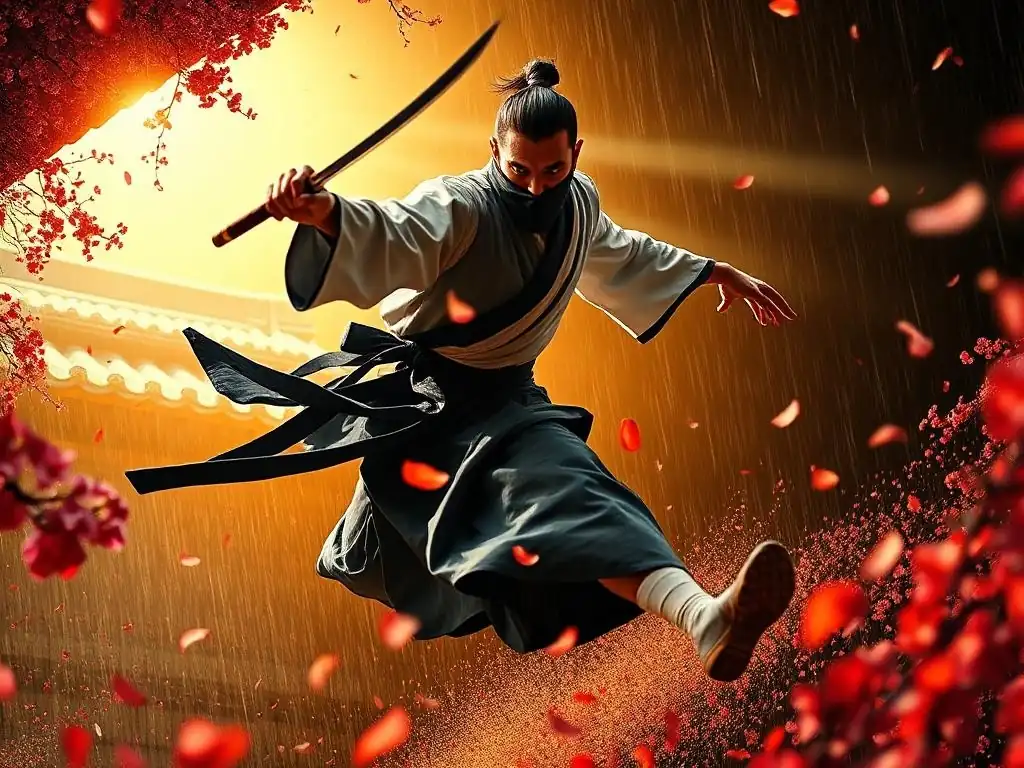
Welcome to Martial Arts Mastery, where history, technique, and philosophy converge! Ever wondered how shadowy shinobi transformed into respected budoka? Delve into the captivating history of the "Ninja Ideal Transformation," exploring its evolution and enduring impact on martial arts today. Discover the secrets behind this fascinating journey and unlock a deeper understanding of this legendary discipline. Intrigued? Read on to unravel the mysteries...
- Understanding the Historical Ninja Ideal: Shinobi Origins
- The Shift in Focus: The Evolution Towards "Budo"
- Bujinkan and the Modern Interpretation of the Ninja Ideal
- Key Factors Driving the Ninja Ideal Transformation History
- Comparing the Shinobi and Budoka Approaches
- The Enduring Legacy of the Ninja Ideal Transformation
- Analyzing the Ninja Ideal Transformation History: A Conclusion
-
Frequently Asked Questions
- What is the core focus of the article "From Shinobi to Budoka: The Transformation of the Ninja Ideal"?
- How did the historical role of the Shinobi differ from the modern perception of the Ninja?
- What key factors contributed to the transformation of the Ninja ideal?
- What is the significance of the term "Budoka" in relation to the ninja transformation?
- Where can I learn more about the historical accuracy of Ninja practices versus their portrayal in popular media?
- Final Reflection: Embracing the Evolving Ninja Ideal
- Embrace the Warrior Within: Begin Your Transformation!
Understanding the Historical Ninja Ideal: Shinobi Origins
The Role of Espionage and Guerrilla Warfare in Early Ninjutsu
The historical figure known as shinobi operated primarily during Japan's turbulent feudal era, particularly peaking during the Sengoku period (roughly 1467 to 1615). Their role was fundamentally different from the open warfare practiced by samurai. Instead, shinobi specialized in unconventional tactics essential for survival and advantage in a fragmented, conflict-ridden landscape. This included extensive espionage, gathering intelligence on enemy troop movements, castle layouts, and strategic weaknesses. They were masters of infiltration, often operating under cover of darkness or disguise to penetrate heavily guarded areas.
Beyond intelligence gathering, shinobi were also adept at sabotage and guerrilla warfare. This involved disrupting enemy supply lines, setting fires within fortifications, or conducting targeted assassinations of key personnel. Their methods were pragmatic and focused solely on achieving the mission objective, often employing tactics considered dishonorable by the samurai code of Bushido.
The Iga and Kōga regions, located near the historical capital of Kyoto, are often cited as centers for the development of these skills, providing services to various warring lords who needed clandestine operatives. The Ninja ideal transformation history is intrinsically linked to the shifting needs of these feudal lords.
Defining "Shinobi": Unveiling the Original Ninja Concept
The term "shinobi" itself derives from the verb shinobu, meaning "to sneak," "to endure," or "to conceal." This highlights the core function of these individuals: to operate unseen and withstand hardship to accomplish their tasks. Unlike the romanticized image prevalent today, the historical shinobi was not necessarily a member of a distinct, unified clan or a master of exotic weaponry in every case. Many were likely individuals or small groups from non-samurai classes – farmers, mercenaries, or local toughs – who developed specialized skills out of necessity or opportunity.
The concept of a "ninja" as a distinct, uniformed warrior class is largely a later construct, heavily influenced by Edo period literature and modern media. The original shinobi were defined by their function rather than a rigid social or martial structure. They were specialists in intelligence, subversion, and irregular warfare, utilizing whatever tools and techniques were effective for their mission. Understanding this practical, mission-oriented definition is crucial for grasping the initial Ninja ideal transformation history away from this functional role.
The Ninja's Tools and Techniques: Beyond the Myths
While popular culture often depicts shinobi wielding elaborate and unique weapons, the reality was far more grounded in practicality. Many tools attributed to the ninja were either common implements adapted for covert use or simplified, easily concealable items. For instance, the kunai, often shown as a throwing knife, was likely a multi-purpose tool used for digging, climbing, or prying. The shuriken (throwing stars) certainly existed, but their primary use was likely for distraction or minor injury rather than as lethal projectiles in open combat.
Other techniques involved mastery of stealth, disguise, and unconventional movement. This included methods for scaling walls, moving silently across various terrains, blending into crowds, and using knowledge of the natural environment for concealment and navigation. While some historical texts like the Bansenshūkai (a 17th-century compilation of ninja knowledge) describe specialized equipment, much of the shinobi's effectiveness relied on their physical conditioning, mental discipline, and deep understanding of human psychology and tactics, far more than reliance on fantastical gadgets.
The Shift in Focus: The Evolution Towards "Budo"
From Covert Operations to Self-Perfection: A Changing Philosophy
With the establishment of the Tokugawa Shogunate in 1603, Japan entered a long period of relative peace known as the Edo period. This political stability dramatically reduced the demand for the clandestine services of the historical shinobi. As the need for espionage, sabotage, and assassination waned, martial traditions that had focused on battlefield or covert efficacy began to adapt or fade away. Some schools preserved their techniques by shifting their focus from practical warfare to personal discipline and moral cultivation – the path of budō.
This shift represented a fundamental change in the Ninja ideal transformation history. The goal moved from mission accomplishment through any means necessary to the development of the self through rigorous training. While combat techniques were still practiced, their purpose increasingly became a vehicle for developing physical health, mental fortitude, and ethical character. The emphasis moved from killing or disrupting the enemy to mastering one's own body and mind.
The Influence of Samurai Culture on the Ninja's Path
Although often portrayed as adversaries, historical shinobi and samurai traditions existed within the same feudal society and sometimes interacted. As the Edo period progressed, the dominant cultural and ethical framework was heavily influenced by the samurai class and their evolving concept of Bushido (the way of the warrior). While Bushido itself was not static and varied across time and schools, it generally emphasized loyalty, honor, duty, and self-discipline.
For martial traditions seeking relevance in a peaceful era, aligning with or incorporating elements of this dominant ethical framework became important. While historical shinobi methods often contradicted Bushido principles (e.g., deception vs. honesty, assassination vs. honorable combat), the transformation of the ninja ideal towards budō often involved adopting a more structured, philosophical approach that resonated with the prevailing samurai-influenced values of the time, emphasizing personal development over pragmatic, ruthless efficacy.
Exploring the Concept of "Bushido" and its Impact on Ninjutsu
Bushido is a complex term that evolved significantly over centuries, from the practical code of early warriors to a more formalized philosophy during the Edo period. It encompassed virtues such as rectitude, courage, benevolence, respect, honesty, honor, and loyalty, often culminating in the concept of self-control and preparedness for death. While historical shinobi operated outside the strictures of Bushido, the shift towards budō saw later interpretations and practitioners of traditions linked to ninjutsu grappling with similar philosophical questions.
For those preserving these traditions in the Edo period and beyond, the physical techniques became a means to an end – not the end of defeating an enemy, but the end of perfecting oneself. This mirrors the budō approach seen in many other Japanese martial arts like Kendo or Judo, where the physical practice is inseparable from the cultivation of character. The Ninja ideal transformation history reflects this broader cultural movement towards martial arts as a path of personal enlightenment, influenced by the established ethical ideals of the warrior class.
Bujinkan and the Modern Interpretation of the Ninja Ideal
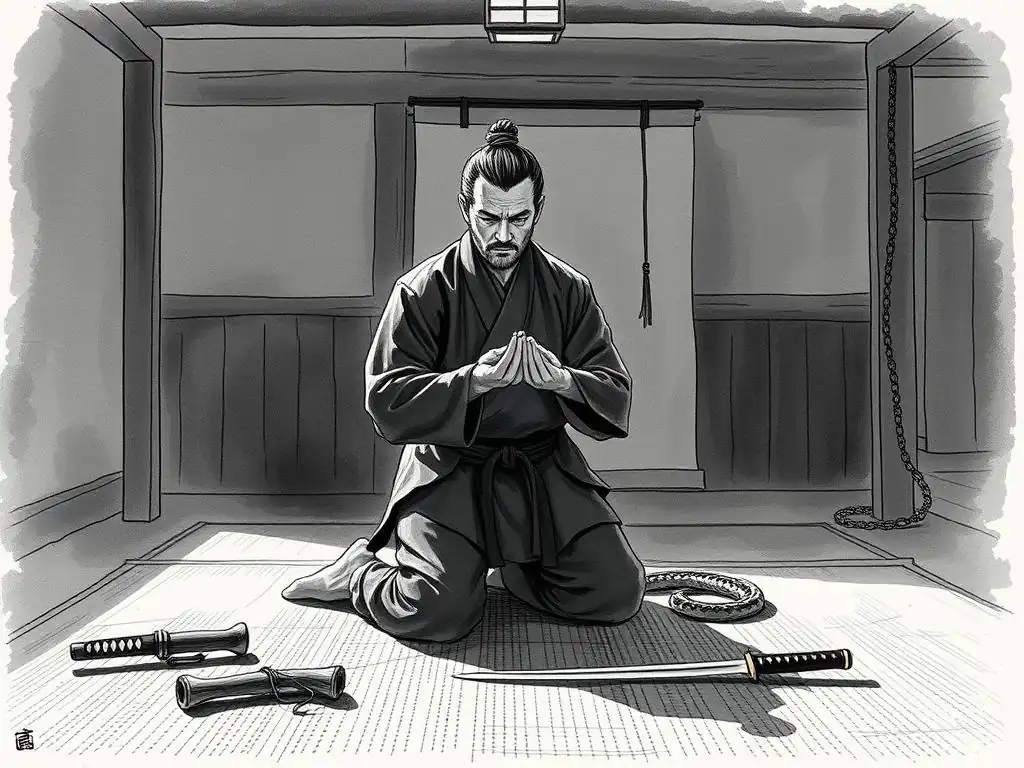
Soke Masaaki Hatsumi and the Nine Schools of Bujinkan
In the modern era, one of the most prominent organizations associated with the Ninja ideal transformation history is the Bujinkan, founded by Soke Masaaki Hatsumi. Dr. Hatsumi inherited the headmastership (Soke) of nine distinct martial arts ryū (schools) from his teacher, Toshitsugu Takamatsu. These nine schools are said to trace their lineages back through centuries of Japanese feudal history, encompassing traditions related to both ninjutsu and samurai arts.
The nine schools are: Togakure-ryū Ninpō Taijutsu, Kumogakure-ryū Ninpō Taijutsu, Gyokushin-ryū Ninpō Taijutsu (these three are often associated with ninjutsu traditions), and six samurai schools: Kotō-ryū Koppō Jutsu, Gyokko-ryū Kosshi Jutsu, Shinden Fudō-ryū Dakentai Jutsu, Takagi Yoshin-ryū Jūtai Jutsu, Gikan-ryū Koppō Jutsu, and Kukishinden-ryū Happō Biken Jutsu. Bujinkan training encompasses the techniques and philosophies preserved within these nine lineages, offering a comprehensive system.
Mutō Dori and Silent Movement: Techniques Emphasized in Bujinkan Training
Bujinkan training emphasizes a wide range of techniques, including unarmed combat ( Taijutsu), traditional weapons ( Bikenjutsu, Bojutsu, etc. ), and principles of movement and strategy. A key concept is mutō dori, which translates to "empty-handed capture." This involves defending against an armed opponent using only unarmed techniques, highlighting the importance of timing, distance, and body dynamics. While potentially rooted in historical self-defense, in modern Bujinkan it is practiced as a principle of adaptability and resilience.
Another aspect often associated with the historical shinobi and explored in Bujinkan is the concept of silent or natural movement. This isn't just about stealth in a military sense, but about efficient, relaxed movement that allows one to move naturally and effectively in any situation. Training often focuses on understanding body mechanics, balance, and adapting to different environments, applying principles that could be linked to the historical need for covert movement and physical resilience.
How Bujinkan Connects the Shinobi Past with the Budoka Present
Bujinkan seeks to bridge the gap between the historical shinobi traditions and the modern budō path. While acknowledging the practical, survival-focused origins of some of the techniques, the training is framed within a budō context. The emphasis is on personal development, understanding historical principles, and applying them to modern life for self-protection and self-improvement. It is presented as a living tradition, adapting its methods and philosophy for contemporary practitioners.
The transformation of the ninja ideal within Bujinkan means the techniques are studied not solely for warfare or espionage, but as a means to cultivate physical skill, mental toughness, and spiritual depth. Practitioners learn historical forms and strategies but are encouraged to understand the underlying principles and apply them spontaneously. This represents the culmination of the Ninja ideal transformation history, moving from a purely functional role to a holistic path of personal mastery.
Key Factors Driving the Ninja Ideal Transformation History
The primary catalyst for the Ninja ideal transformation history was the profound social and political upheaval in Japan. The end of the Sengoku period and the unification under the Tokugawa Shogunate brought an unprecedented era of peace that lasted over 250 years. This eliminated the constant warfare that had created the demand for covert agents. The feudal lords who had employed shinobi were brought under strict control, and the need for independent intelligence networks and guerrilla operatives vanished.
Furthermore, the rigid class structure of the Edo period, with samurai at the top, meant that non-samurai traditions, while sometimes tolerated or even respected, had to find ways to exist within this new order. Martial skills were increasingly formalized and regulated. For traditions linked to ninjutsu, survival meant adapting their purpose and presentation to fit the changing social landscape, moving away from their controversial, often illegal, historical activities.
The Decline of Warfare and the Rise of Individual Development
As large-scale warfare ceased, the focus of martial arts shifted from collective military strategy to individual practice and self-cultivation. Many ryū that had specialized in battlefield techniques pivoted to emphasize the physical, mental, and ethical development of the individual practitioner. This was a widespread phenomenon across Japanese martial arts during the Edo period.
For traditions claiming lineage from ninjutsu, this meant re-contextualizing their skills. Techniques designed for survival in a brutal environment were re-interpreted as methods for building resilience, adaptability, and self-awareness. The focus on stealth and deception in warfare transformed into an emphasis on natural movement and understanding human behavior for self-protection and avoiding conflict. This era solidified the transformation of the ninja ideal from a military function to a personal pursuit.
The Preservation and Adaptation of Ancient Skills in Modern Times
The Ninja ideal transformation history continues into the modern era, marked by the efforts of practitioners like Soke Hatsumi to preserve and teach these ancient skills. In a world vastly different from feudal Japan, the techniques cannot be practiced in their original context. Therefore, adaptation is key. While historical forms are studied, the focus is on understanding the underlying principles – distance, timing, balance, psychology, adaptation – and applying them to contemporary situations.
This adaptation allows the core principles of resilience, awareness, and effective movement to remain relevant. For example, skills in navigating difficult terrain can be applied to modern urban environments, or principles of remaining undetected can be understood in terms of situational awareness and avoiding danger. The goal is to keep the tradition alive by making its lessons applicable to the challenges of the 21st century, demonstrating the ongoing transformation of the ninja ideal.
Comparing the Shinobi and Budoka Approaches
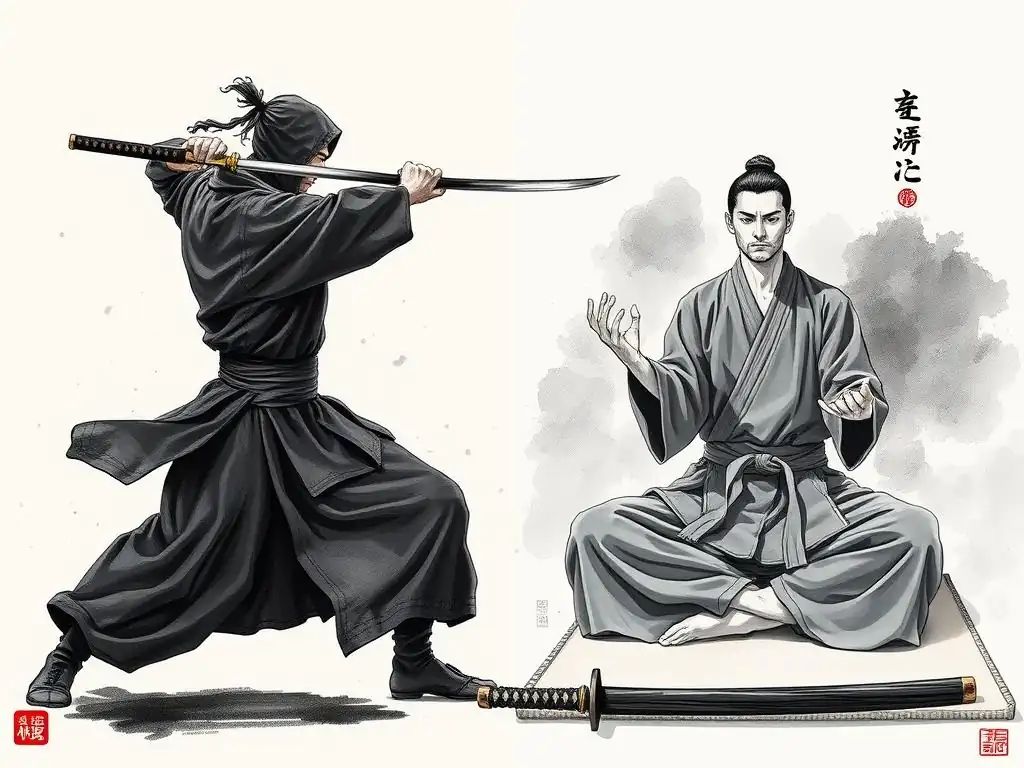
Shinobi: Focus on Practicality and Survival
The historical shinobi operated in a world where survival was paramount. Their methods were dictated by the immediate needs of their mission and their own self-preservation. Practicality trumped honor or ethical considerations in the conventional sense. If a mission required deception, ambush, or even assassination, these were considered legitimate tools of the trade. Their training was geared towards effectiveness in covert operations, intelligence gathering, and guerrilla tactics.
This focus on practicality meant utilizing whatever was at hand, adapting to circumstances, and prioritizing the outcome above the method's moral standing within the dominant societal code. The Ninja ideal transformation history starts from this point of pure, often brutal, pragmatism driven by the demands of feudal conflict.
Budoka: Emphasis on Personal Growth and Ethical Conduct
In contrast, the Budoka path, particularly in the modern interpretation of traditions linked to ninjutsu, places a strong emphasis on personal growth and ethical conduct. While techniques with historical roots are practiced, the primary goal is not military victory or covert operations, but the cultivation of character, self-discipline, and a deeper understanding of oneself and the world. There is a focus on developing physical skill as a means to achieve mental and spiritual maturity.
This approach often incorporates philosophical principles, sometimes drawing parallels with Bushido ideals or broader Buddhist and Shinto concepts. The training is seen as a lifelong journey of self-improvement. The transformation of the ninja ideal into a budō reflects this shift from external mission accomplishment to internal self-mastery and adherence to an ethical framework.
The Use of Poison vs. Emphasis on Non-Lethal Techniques
One stark example often cited to highlight the difference is the historical association of shinobi with tools like poisons, used to achieve objectives discreetly. While the extent of this practice is debated and often exaggerated in popular culture, the willingness to use such methods aligns with the historical shinobi's pragmatic, results-oriented approach, operating outside conventional warfare's rules.
Modern budō practice, including in organizations like Bujinkan, explicitly rejects such tactics. The emphasis in training is on control, using techniques to evade, subdue, or incapacitate an opponent without causing unnecessary harm. While techniques can be lethal if applied with full force, the intent in budō training is typically centered on self-defense, de-escalation, and ethical application of force. This fundamental difference underscores the significant transformation of the ninja ideal history, moving from tools of war and espionage to methods for personal protection and ethical living.
The Enduring Legacy of the Ninja Ideal Transformation
The Ninja's Influence on Modern Martial Arts and Pop Culture
Despite their historical roots in a specific feudal context, the legend and perceived skills of the shinobi have had a remarkable and enduring influence on modern martial arts and global pop culture. The mystique surrounding their covert operations, mastery of stealth, and unconventional tactics has inspired countless books, films, video games, and comics worldwide. This widespread fascination keeps the idea of the "ninja" alive, even if the popular image often deviates significantly from historical reality.
In martial arts, elements attributed to ninjutsu – such as emphasis on natural movement, adaptability, and awareness – resonate with practitioners seeking a holistic approach beyond sport or combat alone. While direct lineage claims are subject to historical debate, the transformation of the ninja ideal into a symbol of resilience and unconventional skill continues to inspire training philosophies in various disciplines.
Parkour and Special Forces Training: Elements Influenced by Ninjutsu
The principles associated with historical shinobi – efficient movement through complex environments, overcoming obstacles, blending in, and situational awareness – find surprising echoes in modern disciplines like Parkour and specialized military or law enforcement training. Parkour, focused on navigating urban landscapes using running, climbing, swinging, and jumping, shares a conceptual link with the historical need for shinobi to move effectively and often vertically through fortified areas or challenging terrain.
Similarly, modern special forces training emphasizes stealth, infiltration, intelligence gathering, and unconventional tactics – roles historically performed by shinobi. While modern methods are technologically advanced and follow strict protocols, the core principles of operating unseen, gathering crucial information, and achieving objectives discreetly reflect the functional origins of ninjutsu. This highlights how the practical skills of the historical shinobi have found new life and relevance, showcasing the long arc of the Ninja ideal transformation history.
The Ongoing Debate: Authenticity vs. Modern Interpretation of the Ninja
The legacy of the shinobi and the modern practice of ninjutsu are subjects of ongoing debate among historians, martial artists, and practitioners. Questions arise about the historical accuracy of lineage claims, the extent to which modern techniques truly reflect historical practices, and the balance between preserving tradition and adapting for the present.
Some scholars argue that the modern interpretation, particularly the budō focus, represents a significant departure from the historical shinobi's purely functional, often morally ambiguous role. Others, particularly within organizations like Bujinkan, maintain that they are preserving the core principles and essence of these ancient traditions, adapted for modern times while honoring their historical roots. This debate is a natural part of the Ninja ideal transformation history, reflecting the complex process of preserving, interpreting, and evolving a tradition over centuries.
Analyzing the Ninja Ideal Transformation History: A Conclusion
The Importance of Understanding the Historical Context
To truly appreciate the Ninja ideal transformation history, it is crucial to understand the specific historical context in which the original shinobi operated. They were products of Japan's feudal conflicts, individuals or groups whose skills in espionage, sabotage, and unconventional warfare were vital for survival and political gain. Separating the historical reality from later romanticized myths allows for a clearer view of their practical function and the demanding nature of their work.
Ignoring the historical context risks misinterpreting both the past and the present. The transition from the pragmatic, mission-driven shinobi to the ethically-minded, self-cultivating budōka is a direct consequence of radical shifts in Japanese society, particularly the advent of prolonged peace and the rise of new ethical frameworks.
The Continued Blending of Combat and Philosophical Elements in Modern Practice
One of the most fascinating aspects of the transformation of the ninja ideal into modern practice is the continued blending of combat techniques with philosophical elements. While the immediate goal is no longer battlefield victory, the study of historical methods of movement, strategy, and self-protection is intertwined with lessons on perseverance, adaptability, awareness, and ethical conduct.
Modern practitioners engage with physical techniques as a vehicle for mental discipline and character development. This mirrors the budō approach found in many other martial arts, demonstrating how traditions rooted in conflict can evolve into paths of self-mastery. The Ninja ideal transformation history shows a continuous evolution where the physical practice informs and supports a deeper philosophical journey.
Further Research: Exploring the Nuances of Ninja History and Philosophy
The journey from the historical shinobi to the modern budōka is rich with complexity and warrants further exploration. Delving into primary historical sources (while acknowledging their limitations and potential biases), comparing different interpretations of lineage, and studying the philosophical underpinnings of both historical traditions and modern budō organizations can provide deeper insights.
Understanding the Ninja ideal transformation history requires looking beyond popular portrayals and engaging with the historical, social, and philosophical factors that shaped these traditions over centuries. The evolution of the shinobi ideal is a testament to the adaptability of martial traditions and their enduring relevance as paths for both physical skill and personal development.
Frequently Asked Questions
What is the core focus of the article "From Shinobi to Budoka: The Transformation of the Ninja Ideal"?
The article explores the evolution of the ninja ideal, tracing its path from a focus on covert operations and espionage (Shinobi) to a more disciplined and martial arts-oriented (Budoka) philosophy. It highlights how the perception of the ninja has changed over time.
How did the historical role of the Shinobi differ from the modern perception of the Ninja?
Historically, Shinobi were primarily involved in espionage and sabotage. Modern perception often romanticizes them as martial arts masters engaged in honorable combat, which is a later development.
What key factors contributed to the transformation of the Ninja ideal?
Factors include popular culture's influence, the integration of martial arts principles, and the romanticization of the ninja in literature and film. This led to a shift from stealth and deception to a focus on skill and discipline.
What is the significance of the term "Budoka" in relation to the ninja transformation?
"Budoka" signifies the adoption of martial arts principles and a focus on self-improvement and ethical conduct. This contrasts with the Shinobi's more pragmatic and utilitarian approach to achieving objectives.
Where can I learn more about the historical accuracy of Ninja practices versus their portrayal in popular media?
MartialArtsMastery.org offers resources on the historical context of ninja practices, differentiating between factual accounts and fictional representations in popular media.
Final Reflection: Embracing the Evolving Ninja Ideal
The journey from shadowy Shinobi to disciplined Budoka reveals a fascinating evolution, and its relevance today lies in understanding the power of adaptation and self-improvement. The ninja ideal, far from being a static historical relic, embodies a dynamic process of transformation that mirrors our own potential for growth and reinvention.
The ninja's transformation from a figure of espionage to one of self-mastery has profoundly influenced our understanding of resilience and discipline. This shift underscores the importance of embracing change and finding strength in adversity, a lesson that resonates deeply in our constantly evolving world. The true warrior understands that victory is not just about defeating an opponent, but about conquering oneself.
This sentiment, though often attributed to various martial arts traditions, perfectly encapsulates the essence of the ninja ideal's transformation.
As we reflect on the "Ninja ideal transformation history," let us consider how we can apply these lessons to our own lives. Embrace the spirit of continuous improvement, adapt to the challenges that come your way, and strive to become the best version of yourself. Just as the ninja transformed, so too can you unlock your hidden potential and forge your own path to self-mastery.
Embrace the Warrior Within: Begin Your Transformation!
Thank you for exploring the fascinating evolution of the ninja ideal with us. We hope you've gained a deeper appreciation for the dedication and discipline at the heart of this transformation. Now, it's time to apply that inspiration to your own journey!
Here's how you can take the next step:
- Commit to one week of focused training in a martial art you admire, even if it's just 15 minutes a day. Experience the discipline firsthand!
- Research a historical figure who embodies the principles of Bushido and share your findings with a friend.
- Reflect on how the core values of the ninja—stealth, perseverance, and adaptability—can be applied to a challenge you're currently facing.
Which of these steps will you embrace first to cultivate your inner warrior?