
Solo Drills for Impact: Maximizing Power Without a Partner

Welcome to Martial Arts Mastery, your comprehensive guide to the world of martial arts!
Delve into the fascinating realm where discipline meets power. Ever wondered how to hone your skills and amplify your impact even without a partner? Our article, "Solo Drills for Impact: Maximizing Power Without a Partner," unlocks the secrets to effective individual training. Prepare to discover how focused solo practice can significantly elevate your martial arts prowess. Curious to learn more? Let's begin!
- Introduction: Unleashing Power Through Solo Martial Arts Training
- Understanding Impact Mechanics: The Foundation of Powerful Strikes
-
Solo Drills for Developing Striking Power
- Shadow Boxing: Refining Technique and Power Generation
- Heavy Bag Training: Building Strength and Impact Endurance
- Medicine Ball Training: Enhancing Core Strength and Explosiveness
- Resistance Band Training: Building Strength and Speed for Impact
- Kicking Dummy Drills: Perfecting Technique and Power
- Target Kicking Drills: Improving Accuracy and Precision
- Flexibility and Range of Motion Exercises for Kicking Power
- Advanced Solo Training Techniques for Impact
- Optimizing Your Solo Training for Maximum Impact
- Conclusion: Mastering Impact Power Through Dedicated Solo Practice
-
Frequently Asked Questions
- What are solo martial arts drills, and why are they important?
- How can solo drills help improve my striking power in martial arts?
- What are some examples of effective solo martial arts drills for impact?
- How often should I incorporate solo drills into my martial arts training routine?
- Are solo drills a substitute for sparring or partner work?
- Final Reflection: Unleashing Potential Through Solitude
- Unleash Your Inner Powerhouse: Start Training Solo Today!
Introduction: Unleashing Power Through Solo Martial Arts Training
The Importance of Solo Practice in Martial Arts Mastery
Solo martial arts drills are an indispensable component of achieving true mastery in any discipline, from Karate and Taekwondo to Muay Thai and Wing Chun. While partner work is crucial for timing, distance, and application, dedicated solo practice allows practitioners to focus intensely on fundamental techniques, body mechanics, and personal conditioning without external variables. This focused repetition is the bedrock upon which complex skills are built and refined.
Studies in motor learning suggest that consistent, deliberate practice, even without immediate feedback from a partner, strengthens neural pathways and improves muscle memory significantly. For instance, a Karate practitioner performing hundreds of solo kata repetitions is not just memorizing movements; they are internalizing stances, transitions, and the precise execution of strikes and blocks, leading to greater efficiency and power generation when applied.
Furthermore, solo training provides the flexibility to practice anytime, anywhere, removing dependency on class schedules or training partners. This consistency is vital for continuous improvement. Elite athletes across various martial arts often attribute a significant portion of their success to hours spent drilling alone, perfecting their form and building endurance.
Consider the rigorous solo conditioning and form work common in traditional martial arts like Kung Fu, where intricate hand forms and weapons drills are practiced for years in solitude. This solitary dedication fosters deep self-awareness regarding one's own body mechanics, balance, and power generation, which are critical elements that can be harder to isolate and analyze during dynamic partner interactions. Mastering solo martial arts drills lays a robust foundation that enhances all other aspects of training.
Focusing on Impact Power in Solo Drills
Developing devastating impact power is a primary goal for many martial artists, whether for self-defense, competition, or breaking demonstrations. While hitting targets like focus mitts or sparring partners provides valuable feedback, solo drills offer unique opportunities to specifically isolate and amplify the mechanics of power generation before impact.
Instead of merely hitting a surface, solo training allows for intense concentration on the kinetic chain – the sequence of movements from the ground up that culminates in a powerful strike. This involves everything from proper weight transfer and hip rotation to core engagement and breath control, elements that can be practiced and perfected in isolation.
Integrating power-focused solo martial arts drills into a routine ensures that practitioners are not just going through the motions but are actively seeking to maximize the force behind each technique. This might involve exaggerating movements in shadow boxing to feel the full range of motion, using resistance bands to build speed-strength for strikes, or employing heavy bags to test and improve the actual force delivered.
For example, a Taekwondo practitioner focusing on solo roundhouse kick drills can spend minutes refining the chamber, pivot, extension, and recoil, ensuring maximum hip drive and snap, leading to significantly harder kicks compared to someone who only practices the kick during sparring. This deliberate focus on power mechanics during solo practice translates directly to increased effectiveness in real-world applications.
Understanding Impact Mechanics: The Foundation of Powerful Strikes
Generating Force: Key Principles for Effective Impact
Generating significant impact force in martial arts strikes and kicks relies on fundamental principles of physics, primarily Newton's second law: Force = Mass × Acceleration. While a practitioner's body mass is relatively constant in the short term, maximizing acceleration is key. This involves coordinating the body's larger muscle groups (like the legs, hips, and core) to generate speed and transfer that momentum efficiently through the striking limb.
A powerful strike isn't just the arm or leg moving fast; it's the culmination of energy generated by the entire kinetic chain, starting from the ground reaction force. Consider a powerful cross punch: the power originates from the back foot pushing off the ground, rotating the hip and torso, which then accelerates the shoulder, arm, and finally the fist. Any weak link or inefficiency in this chain diminishes the final impact.
Effective force generation also involves the principle of timing and sequencing. The different segments of the body must accelerate and decelerate in a specific order to transfer energy optimally. Think of cracking a whip: the handle moves first, and the speed increases as the wave travels down the whip to the tip, which moves at tremendous speed.
Similarly, in a strike, the core and hips initiate rotation, followed by the shoulder, then the elbow, and finally the hand or foot. Practicing solo martial arts drills focused on isolating and perfecting these sequential movements—like hip-rotation drills or exercises emphasizing core stability—builds the foundation for generating maximal force by ensuring the body acts as a unified, efficient power generator.
Body Mechanics: Optimizing Stance, Posture, and Movement
Optimal body mechanics are the bedrock of powerful and efficient martial arts techniques. This includes maintaining a stable stance, proper posture, and utilizing efficient movement patterns. A strong, balanced stance provides a solid base from which to generate power and absorb recoil. For instance, in a fighting stance, the feet are typically shoulder-width apart or slightly wider, with knees bent and weight distributed to allow for quick shifts and powerful pushes off the ground.
An unstable stance leaks power and can lead to loss of balance. Proper posture ensures that the spine is aligned, allowing for efficient transfer of force from the lower body through the core to the upper body or limbs. Slouching or poor alignment hinders the kinetic chain and reduces potential impact power.
Furthermore, efficient movement, such as pivoting, shifting weight, and rotating the hips and torso, is crucial for generating momentum and transferring it into strikes. The rotation of the hips and core is often the largest contributor to striking power, particularly in techniques like hooks, crosses, and roundhouse kicks.
Practicing solo martial arts drills that emphasize these fundamental movements, such as pivoting drills or exercises focusing on hip rotation, directly enhances power generation. For example, a simple solo drill of standing in a horse stance and practicing powerful hip rotations with hands held across the chest can dramatically improve the feeling and execution of hip-driven power, which is essential for delivering impactful strikes across various disciplines.
The Role of Breath Control in Impact Power
Breath control, often overlooked by beginners, is a critical element in generating and supporting impact power in martial arts. The coordinated exhalation of breath, frequently accompanied by a sharp vocalization (like a "Kiai" in Japanese arts), coincides with the moment of impact or peak tension in a technique. This forceful exhalation helps to tighten the core muscles, creating a stable base and increasing intra-abdominal pressure.
This core stability is vital for efficiently transferring power from the lower body through the torso and into the strike. Without this stabilization, energy is lost, and the strike lacks the same "snap" or force.
Beyond core engagement, proper breath control also plays a role in managing tension and relaxation. Holding your breath or tensing muscles unnecessarily throughout a movement hinders speed and fluidity, thereby reducing power. Learning to exhale sharply at the point of impact allows the rest of the movement to be relatively relaxed and fast, reserving maximum tension for the precise moment it's needed.
Practicing solo martial arts drills that integrate conscious, forceful exhalation with each strike or block helps to build this crucial coordination. For instance, during shadow boxing, deliberately timing a sharp exhale with every punch or kick reinforces the mind-body connection necessary for maximizing impact power during real-world application.
Solo Drills for Developing Striking Power
Shadow Boxing: Refining Technique and Power Generation
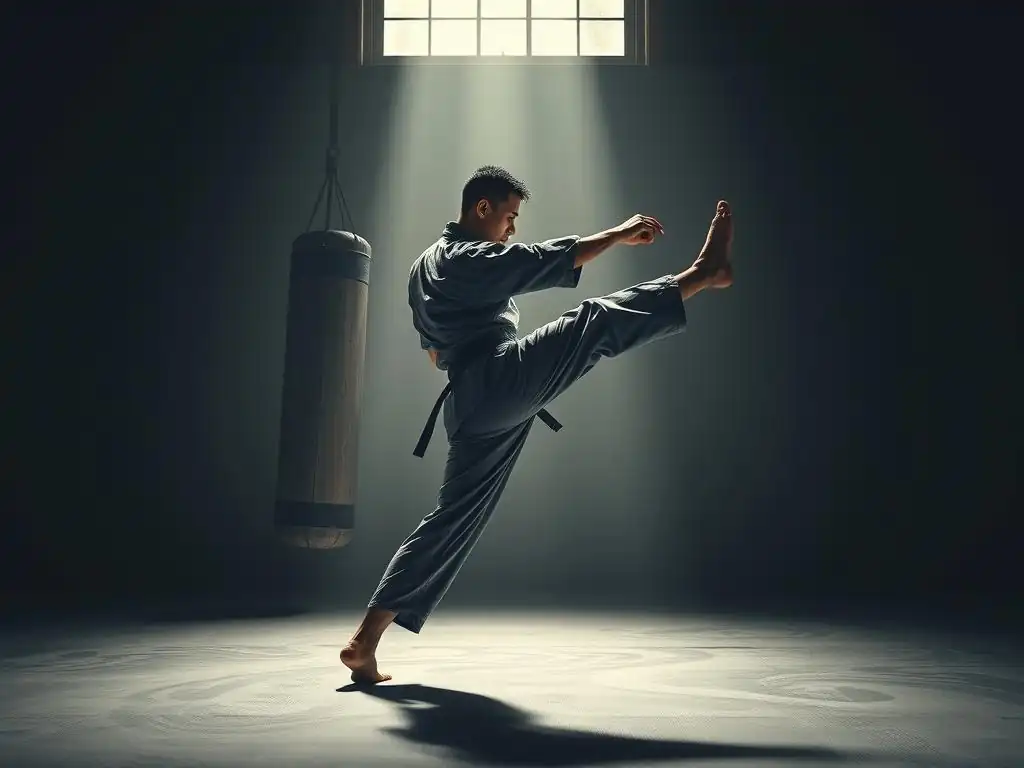
Shadow boxing is perhaps the most fundamental of all solo martial arts drills, offering a versatile platform for refining technique, improving footwork, and building endurance. While it might seem like simply punching air, effective shadow boxing is a dynamic exercise where practitioners visualize an opponent and execute techniques with focus and intent. This allows for meticulous attention to detail: ensuring proper hand position, elbow tuck, shoulder rotation, weight transfer, and follow-through for every strike.
The absence of a physical target means there's no external resistance to distort form, enabling perfect repetition of mechanics essential for power generation. Spending dedicated rounds focusing solely on accelerating the body through the kinetic chain for each punch, feeling the connection from the ground up, is a powerful way to build muscle memory for impact.
Beyond technique, shadow boxing is also a potent tool for developing power-speed and endurance. By performing combinations at increasing speeds or maintaining a high intensity for extended rounds, practitioners build the muscular endurance required to deliver powerful strikes repeatedly. Incorporating movement, defensive maneuvers, and offensive attacks against an imaginary opponent enhances spatial awareness and timing, which indirectly contributes to power application in dynamic situations.
For example, practicing pivoting and throwing a lead hook simultaneously in shadow boxing teaches the body to integrate footwork and hip rotation for maximum power, a coordination that is essential but difficult to perfect when hitting a stationary target. Regular shadow boxing, performed with focus on mechanics and intensity, is a cornerstone for developing impactful strikes through solo martial arts drills.
Shadow Boxing Variations for Karate
Karate-specific shadow boxing often involves practicing fundamental techniques (Kihon) and forms (Kata) with full power and intent, visualizing applications. A variation involves focusing on snapping techniques, such as the gyaku-zuki (reverse punch) or mae-geri (front kick), emphasizing the rapid contraction and relaxation of muscles to generate speed and penetration power. Practitioners might perform these techniques in sequences, moving across the floor, ensuring each strike is executed with maximum hip torque and a sharp Kiai.
Another variation is integrating transition movements between stances, practicing striking from movement, which is critical for applying power effectively in dynamic exchanges. For example, practicing moving from a Zenkutsu Dachi (forward stance) to a Kokutsu Dachi (back stance) while delivering a powerful block and counter-strike sequence in the air refines the coordination and power transfer needed in real combat.
Focusing on Jab and Cross in Shadow Boxing
Dedicate specific shadow boxing rounds to mastering the jab and cross, the fundamental straight punches. For the jab, focus on the rapid extension from the lead shoulder, utilizing a slight rotation of the hips and torso for added snap, ensuring the non-punching hand stays up for defense. Practice variations like stepping jabs, double jabs, and jabs followed by movement. For the cross, emphasize the powerful rotation originating from the back foot pushing off the ground, driving the hip and shoulder through, and pivoting on the ball of the back foot.
Visualize hitting through a target, not just to it. Combine these two in various sequences (jab-cross, double jab-cross) focusing on fluidity, speed, and transferring weight efficiently. Spending just 3-minute rounds solely on perfecting the mechanics and feeling the power generation of these two strikes in isolation, perhaps for 3-5 rounds, can yield significant improvements in their impact force.
Heavy Bag Training: Building Strength and Impact Endurance
The heavy bag is arguably the most popular tool for solo martial arts drills aimed at developing striking power. It provides significant resistance, allowing practitioners to hit with full force and receive tactile feedback. This resistance helps build the specific muscular strength and conditioning required for delivering powerful blows.
Unlike shadow boxing, hitting a heavy bag allows you to gauge the actual force of your strikes and provides a forgiving target to practice hitting through, rather than just to, a point. Regular heavy bag work improves bone density, strengthens connective tissues in the hands, wrists, elbows, and shoulders, and builds the core strength necessary to absorb the impact feedback. A typical heavy bag workout might involve 3-minute rounds, similar to sparring, allowing practitioners to develop both explosive power and power endurance.
Moreover, the heavy bag is excellent for practicing combinations and developing rhythm and timing for sustained offense. While it doesn't move like a partner, its swing can be used to practice moving in and out of range and hitting a moving target. The feedback from the bag helps identify weaknesses in technique; a poorly executed strike will feel awkward or lack penetration.
Focusing on driving through the bag, engaging the hips and core with every strike, rather than just slapping it, is key to developing true impact power. Incorporating diverse solo martial arts drills on the heavy bag, targeting different areas and using various strikes, ensures well-rounded power development.
Choosing the Right Heavy Bag for Power Training
Selecting the appropriate heavy bag is crucial for effective power training. Bags vary significantly in weight, size, and material. For developing sheer impact power, a heavier bag is generally preferable.
A bag weighing between 70 to 150 pounds allows you to hit with significant force without the bag swinging excessively, providing solid resistance. Lighter bags (40-60 lbs) are better for speed drills and footwork, while heavier bags (100+ lbs) build strength and power endurance. The material also matters; leather or high-quality synthetic materials offer durability and a realistic feel, while canvas bags can be harder on the knuckles.
The bag's length should ideally allow you to practice both punching and kicking techniques effectively. For example, a 6-foot heavy bag is suitable for practitioners who want to incorporate low kicks and knee strikes into their solo martial arts drills. Investing in a bag that can withstand powerful strikes and provides sufficient resistance is key to maximizing power development.
Heavy Bag Drills for Developing Hook Punch Power
To build hook punch power on the heavy bag, focus on hip rotation and driving the force through the knuckle area. A key drill involves standing relatively close to the bag and practicing single, powerful hooks, ensuring the lead foot pivots, the hip rotates forcefully, and the non-punching hand protects the face. Aim to hit the side of the bag, driving through the center. Another effective drill is the "figure-eight" hook drill: standing slightly further back, shuffle or step in with a lead hook, pivot, and immediately follow with a rear hook, circling around the bag slightly with each strike.
This drill emphasizes continuous hip rotation and weight transfer. Perform these drills in rounds, focusing on delivering each hook with maximum power and proper form. For instance, dedicate 3-minute rounds alternating between powerful lead hooks and powerful rear hooks, aiming for 15-20 powerful strikes per round while maintaining form.
Heavy Bag Drills for Developing Roundhouse Kick Power
Developing roundhouse kick power on the heavy bag requires focusing on hip drive, pivot, and striking with the shin or instep. A fundamental drill is standing sideways to the bag and practicing single, powerful roundhouse kicks, pivoting strongly on the supporting foot and driving the hip through the target. Ensure the kicking leg chambers correctly and extends fully, making contact with the shin against the bag's center.
A progression is to add movement: stepping or shuffling into the kick. Another effective solo martial arts drill is the "pendulum" kick: stand facing the bag, swing the kicking leg back and forth like a pendulum a few times to build momentum, then pivot and snap the roundhouse kick into the bag. Practice kicking with both legs.
Aim for sets of 10-15 powerful kicks per leg, focusing on hip rotation and impact, rather than speed, initially. The goal is to feel the entire body's power transferring into the kick.
Medicine Ball Training: Enhancing Core Strength and Explosiveness
Medicine balls are excellent tools for developing the core strength and rotational power that are crucial for impactful strikes. Many powerful martial arts techniques, particularly punches and rotational kicks, rely heavily on the ability of the core muscles (abdominals, obliques, lower back) to generate and transfer force from the lower body to the upper body or vice versa.
Medicine ball drills mimic the dynamic, explosive movements used in martial arts, strengthening these critical muscle groups in functional ways. For example, throwing a medicine ball against a wall or to the ground requires explosive core contraction and coordination, similar to throwing a powerful punch or driving a knee.
Incorporating medicine ball work into solo martial arts drills builds explosive power and improves the efficiency of the kinetic chain. The weight of the ball provides resistance, forcing the muscles to work harder and faster than bodyweight exercises alone. Regularly training with a medicine ball, even just 1-2 times per week, can significantly enhance your ability to generate rotational force, which translates directly to harder punches and kicks. Choose a medicine ball weight that is challenging but allows you to perform movements quickly and explosively, typically between 6-20 pounds depending on your strength level.
Medicine Ball Throws for Rotational Power
Rotational medicine ball throws are excellent solo martial arts drills for developing powerful hip and core rotation. Stand sideways to a sturdy wall, holding the medicine ball at your chest. Rotate your hips and torso away from the wall, then explosively rotate back and throw the ball against the wall, catching it on the rebound. Repeat for repetitions, then switch sides.
Another variation is the "scoop toss": stand facing the wall, squat down holding the ball between your legs, then explosively extend your hips and knees while rotating your torso and throwing the ball upward against the wall. These drills directly mimic the rotational mechanics used in powerful hooks, crosses, and roundhouse kicks, strengthening the obliques and transverse abdominis. Aim for 3 sets of 10-15 explosive throws on each side.
Medicine Ball Slams for Full-Body Power
Medicine ball slams are a high-intensity solo martial arts drill that builds explosive full-body power, particularly in the core, shoulders, and hips. Stand with feet shoulder-width apart, holding the medicine ball overhead. Rise onto your toes, then explosively slam the ball down towards the ground directly in front of you, engaging your core and driving through your hips. Catch the ball on the bounce or pick it up and repeat.
This movement engages the entire kinetic chain, from the legs pushing off the ground to the arms accelerating the ball downwards, mimicking the powerful downward force generated in techniques like axe kicks or certain takedowns. Perform these slams for repetitions or timed rounds, focusing on maximal speed and force with each slam. A typical set might involve 8-12 explosive slams, repeated for 3-4 sets.
Resistance Band Training: Building Strength and Speed for Impact
Resistance bands are a highly versatile tool for solo martial arts drills, offering variable resistance to build both strength and speed, crucial components of impact power. Unlike free weights, resistance bands provide tension throughout the entire range of motion, including the explosive phase and the follow-through. This helps strengthen the muscles responsible for the acceleration of a strike and also the stabilizing muscles. Training with resistance bands allows practitioners to mimic the exact movement patterns of their techniques against resistance, building muscle memory and power specifically for those motions.
Using resistance bands allows for targeted strength training that directly translates to increased speed and force in punches and kicks. Attaching a band to a fixed point and practicing punches or kicks against the tension builds the explosive power needed for rapid, forceful execution. The variable resistance means the muscles are challenged more as they extend fully, which is often the point of impact. Incorporating resistance band work into your solo martial arts drills, perhaps 2-3 times per week, can provide a significant boost in striking power and speed.
Resistance Band Drills for Punching Power
For punching power, resistance bands can be used in several ways. Loop a band around a sturdy post or partner (if available, but can be done solo with a strong anchor point) and hold the ends. Stand facing away from the anchor and practice throwing straight punches (jabs, crosses) or hooks against the band's tension. Focus on driving through the resistance with speed and full extension.
Another drill involves looping a band around your back and holding the ends in your hands, then practicing punching forward against the resistance. This specifically targets the chest, shoulders, and triceps. Aim for sets of 10-15 explosive punches per arm, focusing on speed and snap against the resistance.
Resistance Band Drills for Kicking Power
Resistance bands are excellent for building kicking power. Loop a band around a sturdy anchor near the ground and attach the other end to your ankle. Standing facing the anchor, practice front kicks or side kicks against the resistance, focusing on driving the leg forward explosively. For roundhouse kicks, stand sideways to the anchor and loop the band around your kicking ankle, practicing the circular motion and hip drive against the tension.
You can also loop a band around your thighs just above the knees and practice kicks; this engages the hip abductors and adductors, crucial for stability and power in kicks. Perform sets of 10-15 kicks per leg, focusing on controlled power and full extension against the band's pull. These solo martial arts drills isolate and strengthen the specific muscle groups used in kicking.
Kicking Dummy Drills: Perfecting Technique and Power
Kicking dummies, such as the traditional Okinawan makiwara or modern freestanding dummies like the Century Wavemaster, provide a solid, unforgiving target for developing kicking power. The makiwara, a padded post designed to bend slightly upon impact, is specifically used for conditioning the striking surface (shin or instep) and developing penetrating power. Striking the makiwara requires precise technique and controlled force to avoid injury and maximize energy transfer. Repeated practice builds resilience in the bone and muscle while providing immediate feedback on whether the force is being delivered correctly.
Modern freestanding kicking dummies offer a larger surface area and are less rigid than a makiwara, making them suitable for a wider range of kicks and techniques. Practicing solo martial arts drills on a dummy allows you to work on accuracy, timing (if the dummy swings), and driving power through a target. You can practice combinations of kicks, target specific heights (low, middle, high), and work on developing the "snap" and penetration of techniques like the side kick or front kick.
For example, dedicating 3-minute rounds to delivering powerful roundhouse kicks to the body of a Wavemaster, focusing on hip drive and shin contact, helps build both power and conditioning. These dummies are invaluable for perfecting the application of kicking power developed through other solo drills.
Target Kicking Drills: Improving Accuracy and Precision
While hitting a heavy bag or dummy builds raw power, target kicking drills focus on directing that power precisely to specific points. This can be done solo using wall-mounted targets, freestanding kicking paddles, or even visualizing small targets on a heavy bag or dummy. The goal is not just to hit hard, but to hit a defined area with maximum force and accuracy. Practicing kicking to small targets improves proprioception and control, ensuring that the power generated translates into effective strikes on a moving or vulnerable area of an opponent.
These solo martial arts drills help refine the trajectory and terminal velocity of the kick. For instance, using a wall-mounted target circle, a practitioner can practice delivering consecutive front kicks or side kicks, aiming to strike precisely within the circle each time. This level of precision requires fine motor control and body awareness developed through focused repetition.
Setting up multiple targets at different heights allows for practicing transitions and targeting various levels, mimicking real combat scenarios. Even simple solo martial arts drills like aiming for a specific seam on a heavy bag for every kick can dramatically improve accuracy and the ability to land powerful strikes where they are most effective.
Flexibility and Range of Motion Exercises for Kicking Power
Flexibility and a full range of motion are not just about high kicks; they are fundamental to generating maximum power and speed in all kicks. Tight hips, hamstrings, or groin muscles restrict the movement of the legs and limit the ability to drive the hip through the kick, which is a primary source of power.
Limited flexibility can also lead to injuries, hindering consistent training. Solo martial arts drills focused on improving flexibility, such as dynamic stretches before training and static stretches during cool-down, directly contribute to kicking power by allowing for a larger, faster, and more efficient range of motion.
Specific flexibility exercises targeting the hip flexors, hip rotators, hamstrings, and groin are crucial for kick development. Examples include hip flexor stretches (like the kneeling lunge), hamstring stretches (seated or standing), and groin stretches (butterfly stretch, side splits).
Dynamic stretches like leg swings (forward/backward and side to side) help improve range of motion and warm up the muscles for kicking. Incorporating 15-20 minutes of dedicated flexibility work into your weekly routine, separate from or integrated with your solo martial arts drills, can unlock significant potential for increased kicking power and speed by allowing your body to move freely and powerfully through the entire kicking motion.
Advanced Solo Training Techniques for Impact
Plyometric Training: Developing Explosive Power
Plyometric training involves exercises that enable muscles to exert maximum force in short intervals of time, with the goal of increasing both speed and force—key components of explosive power. These exercises utilize the stretch-shortening cycle (SSC), where a muscle is rapidly stretched (eccentric phase) before being forcefully contracted (concentric phase), like compressing and then releasing a spring. In martial arts, this translates to the ability to generate sudden, powerful movements, such as launching into a strike or a rapid change of direction. Incorporating plyometric solo martial arts drills can significantly enhance the explosiveness needed for devastating impact.
Common plyometric exercises include various jumps, bounds, and hops. These drills improve the reactivity of the muscles and nervous system, allowing for faster and stronger contractions. While many plyometrics require no equipment, a box or elevated surface can be used for depth jumps or box jumps.
Proper form is critical to prevent injury, especially due to the high impact nature of some exercises. Starting with basic movements and gradually increasing intensity and complexity is recommended. Integrating plyometric solo martial arts drills 1-2 times per week can lead to noticeable improvements in the speed and power of your strikes and movements.
Jump Training for Increased Leg Power
Jump training is a fundamental type of plyometrics that directly targets the leg muscles, which are the primary source of power for kicks and the initial drive for many strikes. Squat jumps, where you squat down and explode upward as high as possible, build lower body explosive strength. Box jumps, jumping onto an elevated surface, improve vertical power and require precise landing control.
Depth jumps, stepping off an elevated surface and immediately jumping upward upon landing, train the muscles to react quickly and powerfully to eccentric loading. Performing 3 sets of 6-10 repetitions for exercises like squat jumps or box jumps, focusing on maximal height and minimal ground contact time, can significantly enhance the explosive power in your legs, translating to faster, stronger kicks and more powerful movement into strikes during solo martial arts drills.
Reactive Training for Improved Striking Speed
Reactive training, a component of plyometrics, focuses on minimizing the transition time between the eccentric and concentric phases of muscle action, thereby improving speed and explosiveness. Drills like clap push-ups (pushing up with enough force to clap your hands before landing) develop explosive upper body power relevant to punching. Medicine ball chest passes thrown explosively against a wall train fast-twitch fibers in the chest and shoulders. For lower body reactivity, bounding drills or repetitive short jumps emphasize quick ground contact and rapid powerful extensions.
These solo martial arts drills train the nervous system to fire muscles more quickly and forcefully, increasing the speed and snap of strikes. Perform these exercises in short, intense bursts, focusing on speed and explosiveness rather than endurance. For instance, 3 sets of 5-8 explosive clap push-ups or 10-12 rapid medicine ball chest passes can be highly effective.
Isometrics: Building Strength at Specific Angles
Isometric exercises involve holding a static position against resistance without movement, building strength at specific joint angles. While dynamic movements build power through a range of motion, isometrics build maximal strength at a particular point, which can be beneficial for reinforcing the strongest positions within a strike or hold. For example, holding a punching position against resistance strengthens the muscles involved at that specific extension. This type of training can improve muscular endurance in key positions and potentially increase the maximum force output at critical points of impact.
Incorporating isometric solo martial arts drills allows practitioners to focus on generating maximum tension in the muscles involved in a strike or block, even without movement. This helps develop the mind-muscle connection and the ability to generate force instantly. Isometrics are also useful for building stability in joints and core, providing a stronger platform for power generation. While they don't build speed or range of motion like dynamic exercises, they are a valuable supplement for increasing peak force potential at specific points within a technique.
Isometric Exercises for Punching Power
To use isometrics for punching power, find a sturdy wall or post. Stand in your punching stance and press your fist into the wall as hard as possible, maintaining proper punching form (hip rotation, core engagement, straight wrist). Hold this maximal contraction for 5-10 seconds.
Repeat for multiple sets, focusing on generating force at different points of the punch's trajectory, from the initial extension to full extension. You can also perform this with a resistance band looped around a post and held in your fist, holding the band taut at various punching angles. This builds static strength and endurance in the shoulder, chest, triceps, and core, reinforcing the power-generating muscles during solo martial arts drills.
Isometric Exercises for Kicking Power
Isometric exercises can also enhance kicking power. Stand facing a wall and press your foot or shin into it as if executing a powerful front kick or side kick, holding the position with maximal force. Alternatively, stand sideways to a wall and press into it with your shin as if performing a roundhouse kick.
Hold each position for 5-10 seconds, focusing on engaging your hip, core, and leg muscles intensely. Another method is to use a resistance band looped around a post and your ankle, holding kicking positions against the band's tension. These solo martial arts drills build static strength in the hip flexors, quadriceps, hamstrings, and glutes at critical angles of the kick, improving stability and peak force potential.
Visualization and Mental Training: Enhancing Focus and Power
Visualization and mental training are powerful solo martial arts drills that complement physical practice by enhancing focus, technique, and even perceived power. By mentally rehearsing techniques, practitioners can refine movements, identify potential inefficiencies, and build confidence. Visualization involves vividly imagining performing techniques with perfect form, maximum speed, and devastating impact. This mental rehearsal activates the same neural pathways used in physical execution, effectively providing additional "practice" without physical fatigue or risk of injury. Elite athletes across disciplines use visualization extensively to prepare for performance.
Mental training also involves cultivating focus and intensity. When performing solo physical drills, maintaining concentration on the specific goal—whether it's hip rotation in a roundhouse kick or core engagement in a punch—is paramount. Mental discipline helps prevent simply going through the motions. Visualizing the target and the desired effect of the strike during shadow boxing or heavy bag work enhances the intent behind the movement, which translates to greater power. Combining physical solo martial arts drills with dedicated mental rehearsal and visualization amplifies the effectiveness of training, improving both the technical execution and the forceful application of techniques.
Optimizing Your Solo Training for Maximum Impact
Setting Realistic Goals and Tracking Progress
To maximize the effectiveness of your solo martial arts drills for impact power, setting realistic goals and consistently tracking your progress is essential. Vague goals like "get stronger" are less effective than specific, measurable goals like "increase my heavy bag roundhouse kick power so the bag swings visibly wider within 8 weeks" or "be able to perform 15 explosive medicine ball slams in a set within 4 weeks." Realistic goals should be challenging but achievable within a set timeframe, considering your current fitness level and training frequency.
Tracking progress provides valuable feedback and helps maintain motivation. This could involve using a simple training log to record the number of repetitions, sets, or duration of drills, noting improvements in form, speed, or perceived power. For heavy bag work, you might subjectively rate the power of your strikes or, if possible, use a training device that measures impact force (though these are less common for solo use).
For plyometrics, track jump height or speed. Seeing tangible improvements, however small, reinforces the value of your solo martial arts drills and encourages continued effort. This structured approach ensures your solo training is purposeful and leads to measurable gains in impact power.
The Importance of Proper Warm-up and Cool-down
Neglecting warm-up and cool-down routines is a common mistake that can hinder progress and increase the risk of injury during solo martial arts drills. A proper warm-up prepares the body for the demands of training by increasing heart rate, blood flow to muscles, and joint mobility. This includes light cardio (like jogging in place or jumping jacks) followed by dynamic stretches that mimic the movements you'll be performing, such as arm circles, leg swings, and torso twists. A good warm-up should last 10-15 minutes and leave you feeling warm and limber.
A cool-down is equally important for recovery and flexibility. After finishing your solo martial arts drills, spend 5-10 minutes gradually reducing intensity, perhaps with light shadow boxing or movement drills, followed by static stretching. Static stretches involve holding a stretch for 20-30 seconds to improve flexibility and help muscles recover.
Focusing on the muscle groups worked during your session is key. Proper warm-up prevents muscle strains and joint sprains, while a cool-down aids recovery, reduces muscle soreness, and maintains the flexibility necessary for powerful, efficient techniques. Consistent warm-up and cool-down routines are non-negotiable components of effective and safe solo training.
Preventing Injuries During Solo Training
Preventing injuries is paramount when performing solo martial arts drills, especially those focused on impact power. While training alone removes the risk of accidental contact with a partner, the risk of overuse injuries, strains, or sprains from improper form or excessive intensity remains significant. Always prioritize correct technique over speed or power, particularly when learning new drills or increasing intensity. If a technique feels awkward or causes pain, stop and review your form. Watching instructional videos or even recording yourself can help identify errors.
Using appropriate protective gear is also crucial. Hand wraps and gloves are essential for heavy bag work to protect wrists and knuckles. If using a makiwara, start with light strikes and gradually increase force as your knuckles condition. Ensure your training environment is safe and clear of obstacles.
Listen to your body; pushing through sharp pain is never advisable. Incorporating sufficient rest days allows muscles and connective tissues to recover and rebuild stronger. By being mindful of technique, using protection, ensuring a safe environment, and respecting your body's limits, you can minimize the risk of injury and maintain consistent progress with your solo martial arts drills.
Nutrition and Recovery for Optimal Performance
Optimal nutrition and recovery are foundational to building strength, power, and endurance through solo martial arts drills. Your body needs adequate fuel and building blocks to perform intensely and repair itself afterward. A balanced diet rich in lean protein, complex carbohydrates, healthy fats, vitamins, and minerals supports muscle growth and energy levels. Protein is particularly important for muscle repair after strenuous power-focused training. Staying well-hydrated is also critical, as dehydration can impair performance and slow recovery.
Recovery involves getting sufficient sleep (typically 7-9 hours per night) and allowing adequate rest time between intense training sessions. Muscles don't grow stronger during the workout itself, but during the recovery period when they repair and adapt. Overtraining without sufficient rest can lead to diminishing returns, increased injury risk, and burnout. Incorporating active recovery, such as light stretching or gentle movement on rest days, can also help. By fueling your body properly and prioritizing recovery alongside your solo martial arts drills, you create the optimal conditions for maximizing gains in impact power and overall performance.
Conclusion: Mastering Impact Power Through Dedicated Solo Practice
Integrating Solo Drills into Your Overall Martial Arts Training Regimen
Achieving mastery in martial arts, particularly in generating impactful power, requires a holistic approach that effectively integrates solo martial arts drills with partner training and instruction. Solo practice is not a replacement for working with others or learning from a qualified instructor, but rather a vital supplement that allows for focused, personal development.
By dedicating time to solo drills, practitioners can polish techniques learned in class, build foundational strength and power, and develop the muscle memory necessary for executing techniques effectively under pressure. Consider dedicating 30-60 minutes several times a week to specific solo drills targeting power, technique, and conditioning, in addition to your regular classes or partner sessions.
The skills honed in isolation directly enhance performance in partnered activities. Improved body mechanics from shadow boxing lead to more efficient strikes during sparring. Increased core strength from medicine ball slams provides a stronger base for grappling or generating power in close quarters. The endurance built on the heavy bag allows for sustained power output in competition. By viewing solo martial arts drills as an indispensable pillar supporting all other aspects of your training, you unlock your full potential for developing truly devastating impact power and achieving a higher level of martial arts mastery.
The Path to Power: Continuous Improvement Through Solo Practice
The journey to mastering impact power through solo practice is one of continuous improvement. There is no single drill or technique that provides a quick fix; rather, it is the consistent, dedicated application of various solo martial arts drills that yields lasting results. This path requires patience, discipline, and a willingness to constantly refine your technique and challenge your physical limits. Regularly evaluating your progress, adjusting your training plan, and seeking feedback (even if just from recording yourself) are crucial steps in this ongoing process.
Embracing solo training means taking ownership of your development. It offers an opportunity for deep introspection into your movements and physical capabilities. As you become more attuned to your body through solo drills, you gain a better understanding of how to generate force efficiently and powerfully.
Whether you practice traditional forms, hit the heavy bag, or incorporate plyometrics, the hours spent honing your craft in solitude are investments that pay dividends in increased power, speed, and overall martial arts proficiency. Continue to explore different solo martial arts drills, push your boundaries safely, and commit to consistent practice, and you will undoubtedly forge a path towards maximizing your impact power.
Frequently Asked Questions
What are solo martial arts drills, and why are they important?
Solo drills are exercises performed alone to improve technique, strength, and endurance. They are important because they allow practitioners to refine movements and build muscle memory without needing a partner.
How can solo drills help improve my striking power in martial arts?
Solo drills like shadow boxing and bag work help develop proper form, muscle strength, and explosive power necessary for impactful strikes. They allow you to focus on technique and speed without the pressure of sparring.
What are some examples of effective solo martial arts drills for impact?
Examples include shadow boxing (practicing strikes in the air), heavy bag work (punching and kicking a weighted bag), and form practice (repeating specific sequences of movements). These drills build strength, speed, and accuracy.
How often should I incorporate solo drills into my martial arts training routine?
Ideally, solo drills should be incorporated several times a week. The frequency depends on your goals and training schedule, but consistency is key to improving technique and building power.
Are solo drills a substitute for sparring or partner work?
No, solo drills are not a substitute. They complement sparring and partner work by building a strong foundation of technique and power. Partner work allows for practical application and real-time adjustments.
Final Reflection: Unleashing Potential Through Solitude
The journey through solo martial arts drills, as explored in this article, highlights a profound truth: true power often blossoms in moments of individual dedication. The techniques and strategies discussed aren't merely exercises; they are pathways to self-discovery and the cultivation of inner strength, a relevance that resonates deeply in our increasingly isolated yet interconnected world.
The impact of solo practice extends far beyond the physical realm, shaping discipline, focus, and resilience. This journey of self-improvement, undertaken in solitude, fosters a deeper understanding of oneself and one's capabilities, ultimately translating into enhanced performance and confidence in all aspects of life. The ultimate aim of martial arts is not having to use them.
- Miyamoto Musashi. This quote underscores the transformative power of training, even in isolation, to cultivate inner peace and strength that transcends the need for external validation.
Now, as you step away from this exploration of solo martial arts drills, consider the potential within you waiting to be unlocked. Embrace the solitude, the challenge, and the opportunity for self-improvement. Let the lessons learned here inspire you to dedicate time to your own personal growth, forging a stronger, more resilient, and more powerful version of yourself, one solo drill at a time.
Unleash Your Inner Powerhouse: Start Training Solo Today!
Thanks for exploring the world of solo martial arts training with us! We hope you've gained some valuable insights into honing your power and technique without needing a partner. Now, it's time to put that knowledge into action and truly maximize your potential.
Here's how you can continue your journey:
- Commit to 15 minutes of focused solo drills three times this week, concentrating on form and power generation.
- Explore different training surfaces (like soft mats or harder floors) to understand how they affect your impact and balance.
- Share your favorite solo drill variations or challenges you encounter in the comments below – let's learn from each other!
What specific solo drill will you incorporate into your training routine this week to elevate your striking power?