
Gladiatorial Combat: The Deadly Martial Spectacles of Ancient Rome

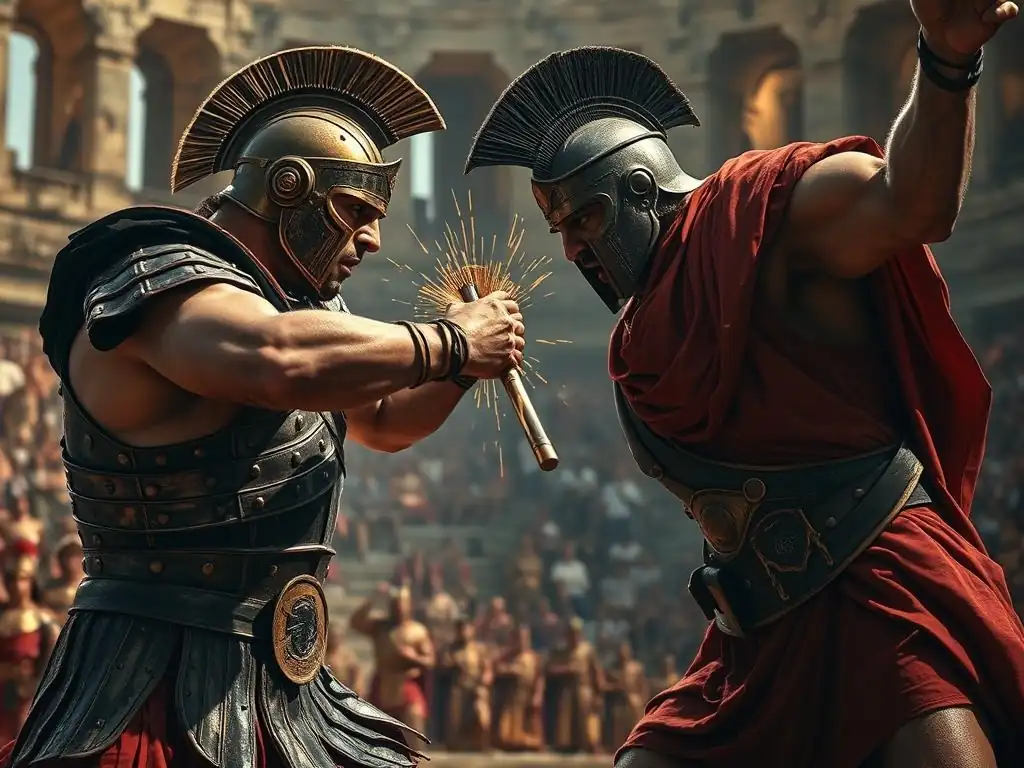
Welcome to Martial Arts Mastery, where we delve into the rich tapestry of fighting traditions worldwide. Ever wondered about the brutal origins of combat sports? Prepare to be captivated as we journey back in time to explore the deadly arena of Ancient Rome gladiatorial combat. Uncover the training, weapons, and societal impact of these legendary warriors, and discover how their legacy resonates even today. Intrigued? Read on to unlock the secrets of the gladiators and their unforgettable battles.
- Introduction to Gladiatorial Combat
- The Origins of Gladiatorial Combat
- Gladiators: Warriors of the Arena
- The Arena: Stage for Deadly Combat
- The Social and Political Significance of Gladiatorial Games
- The Decline and End of Gladiatorial Combat
- Legacy of Gladiatorial Combat
- Understanding Gladiatorial Combat: A Historical Perspective
- Conclusion: The Enduring Fascination with Gladiatorial Combat
-
Frequently Asked Questions
- What were the main objectives of gladiatorial combat in Ancient Rome?
- Where did most gladiators come from, and what were their lives like?
- What types of weapons and armor were commonly used in gladiatorial combat?
- How did different gladiator types (e.g., Retiarius, Secutor) differ in their fighting styles?
- What role did gladiatorial combat play in the political landscape of Ancient Rome?
- Final Reflection: Echoes of Courage and Cruelty
- Unleash Your Inner Gladiator: Embrace the Arena of Knowledge!
Introduction to Gladiatorial Combat
The Allure and Brutality of Gladiatorial Games
Gladiatorial combat stands as one of the most iconic and brutal spectacles of ancient Rome. These contests, pitting trained fighters against each other or wild animals, captivated Roman society for centuries. Far from being mere entertainment, the games were deeply intertwined with Roman religion, politics, and social structure, serving as public displays of power, courage, and the harsh realities of life and death.
The sheer scale of some events was staggering; for instance, Emperor Trajan celebrated his Dacian victories in 107 AD with games lasting 123 days, involving an estimated 10,000 gladiators and 11,000 animals. This massive undertaking highlights the immense resources and societal focus dedicated to these deadly martial spectacles.
The fascination with gladiatorial combat wasn't just about the bloodshed; it was also about the display of martial skill, discipline, and courage in the face of death. Gladiators, often drawn from slaves, prisoners of war, or condemned criminals, underwent rigorous training to become skilled warriors. Their fights, though often fatal, were governed by rules and protocols.
The crowd's reaction played a significant role, with the editor (the organizer of the games) often influenced by the spectators' calls for mercy ( missio) or death ( iugula). This dynamic interaction between fighter, organizer, and audience created a unique and intense atmosphere that defined the experience of Ancient Rome gladiatorial combat.
Exploring Ancient Combat Traditions
Ancient Rome gladiatorial combat was not an isolated phenomenon but part of a broader landscape of historical combat traditions. Across various cultures and eras, organized fighting, duels, and martial displays served multiple purposes, ranging from religious rituals and funeral rites to military training and public entertainment. Examining gladiatorial combat within this context reveals its unique characteristics while also highlighting common threads, such as the emphasis on martial prowess, the use of specific weaponry and armor, and the societal significance attributed to such contests.
Compared to other ancient combat forms, like the pankration of ancient Greece – a brutal mix of boxing and wrestling with few rules – or the formalized duels found in many warrior societies, Ancient Rome gladiatorial combat was distinct in its scale, institutionalization, and primary function as a mass public spectacle controlled by the state or wealthy individuals. While other traditions might focus on individual honor or military preparation, the Roman games evolved into a complex industry designed to entertain, awe, and maintain social order, reflecting the unique imperial ambitions and social dynamics of Rome.
The Origins of Gladiatorial Combat
Etruscan Roots and Funeral Rites
The origins of Ancient Rome gladiatorial combat are commonly traced back to the funeral practices of the Etruscans, an ancient civilization in Italy that predated the rise of Rome. Evidence suggests that the Etruscans performed blood sacrifices and ritual combat as part of funerary ceremonies for important individuals.
These munera, or duties/offerings, were believed to appease the spirits of the deceased and ensure their passage into the afterlife. While the exact nature of these early Etruscan contests is debated among historians, archaeological findings, such as tomb paintings depicting armed combatants, support the theory of a ritualistic, possibly lethal, fighting component tied to death rites.
The earliest recorded gladiatorial contest in Rome itself occurred in 264 BC during the Punic Wars. Decimus Junius Pera and Decimus Junius Paetus staged a munus in the Forum Boarium, the cattle market, to honor their deceased father, Junius Brutus Pera. This event involved three pairs of gladiators fighting to the death. This early Roman example explicitly links gladiatorial combat to the Etruscan tradition of funeral games, marking the transition of this ritualistic combat from a purely private, funerary context to a public spectacle, albeit still initially tied to honoring the dead.
The Evolution of Gladiatorial Contests
From their humble beginnings as funeral rites, gladiatorial contests underwent a significant evolution in Rome, transforming into large-scale public spectacles. Initially reserved for aristocratic funerals, the games soon became a popular means for ambitious politicians and generals to gain public favor. By sponsoring increasingly elaborate munera, individuals could demonstrate their wealth, generosity, and power, garnering support from the populace. This political dimension fueled the growth and complexity of the games, moving them beyond their original religious purpose.
The transition from funeral games to imperial entertainment accelerated during the Republic and reached its zenith under the Empire. Emperors like Augustus recognized the power of the games to entertain the masses and project imperial authority. The construction of massive amphitheaters, culminating in the iconic Colosseum completed in 80 AD, provided dedicated venues capable of hosting tens of thousands of spectators for elaborate gladiatorial shows and other spectacles like venationes (animal hunts) and naumachiae (staged naval battles). This institutionalization solidified gladiatorial combat as a central element of Roman public life.
Gladiators: Warriors of the Arena
Types of Gladiators: Equipment and Fighting Styles
Ancient Rome gladiatorial combat featured a diverse array of fighter types, each distinguished by their unique armor, weaponry, and fighting style. This specialization was a key element of the spectacle, creating interesting matchups and allowing spectators to develop favorites. The equipment was often based on the arms and armor of real-world enemies of Rome, or stylized versions thereof, adding a layer of cultural reference to the contests. Understanding these types is crucial to appreciating the tactical nuances of Ancient Rome gladiatorial combat.
Gladiators were typically matched against types with complementary strengths and weaknesses to ensure a dynamic and engaging fight. For instance, a heavily armed Murmillo might face a lightly armored Retiarius. This created inherent tactical challenges – the Murmillo needing to close the distance against the elusive net-fighter, while the Retiarius sought to ensnare his opponent before the Murmillo could bring his heavy sword to bear. The specific equipment dictated the strategy, making each pairing a distinct martial puzzle.
The Murmillo: Heavily Armed and Shielded
The Murmillo was one of the most iconic gladiator types, easily recognizable by his large rectangular shield ( scutum) and a helmet with a prominent fish-crest ( mormylos). He was armed with a short, straight sword known as the gladius, the same weapon used by Roman legionaries. His armor typically included a greave on his left leg and an arm guard ( manica) on his right arm. This heavy equipment made the Murmillo a formidable, defensive fighter, relying on his shield for protection and his sword for close-quarters combat.
Murmillos were often paired against gladiators with lighter armor or different weapons, such as the Thraex or the Retiarius. Their fighting style involved using the large scutum to block attacks and advance, seeking to engage their opponent in a direct sword fight. The heavy armor provided excellent protection but limited mobility, making endurance and defensive technique paramount for the Murmillo in the arena.
The Retiarius: The Net Fighter
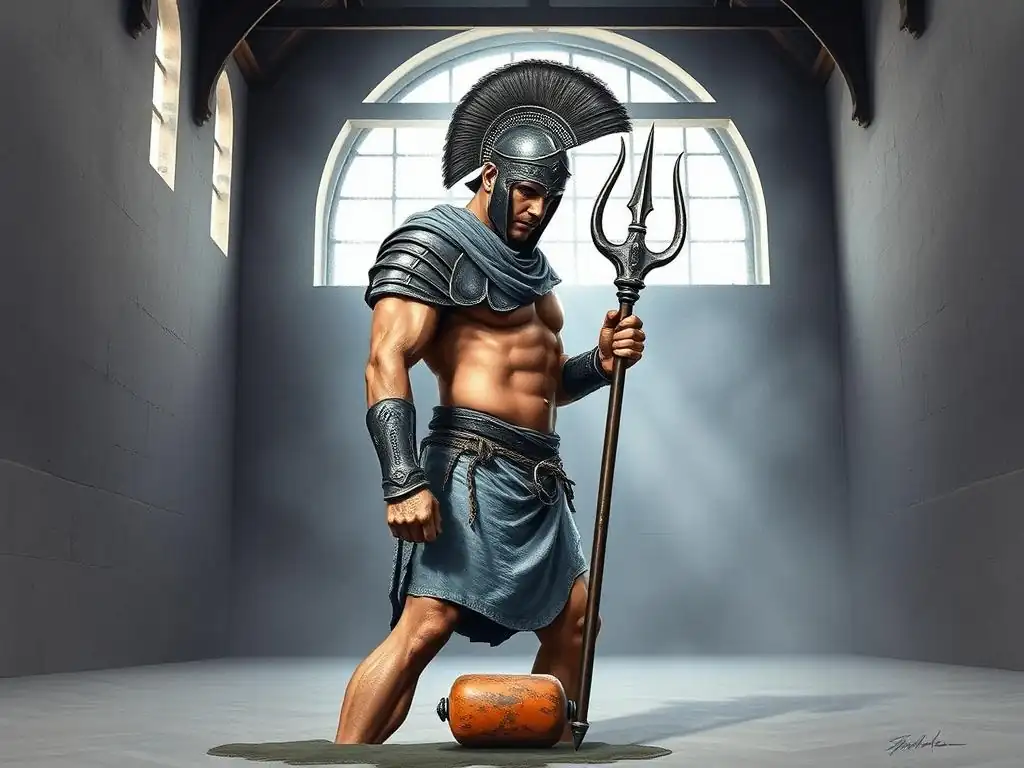
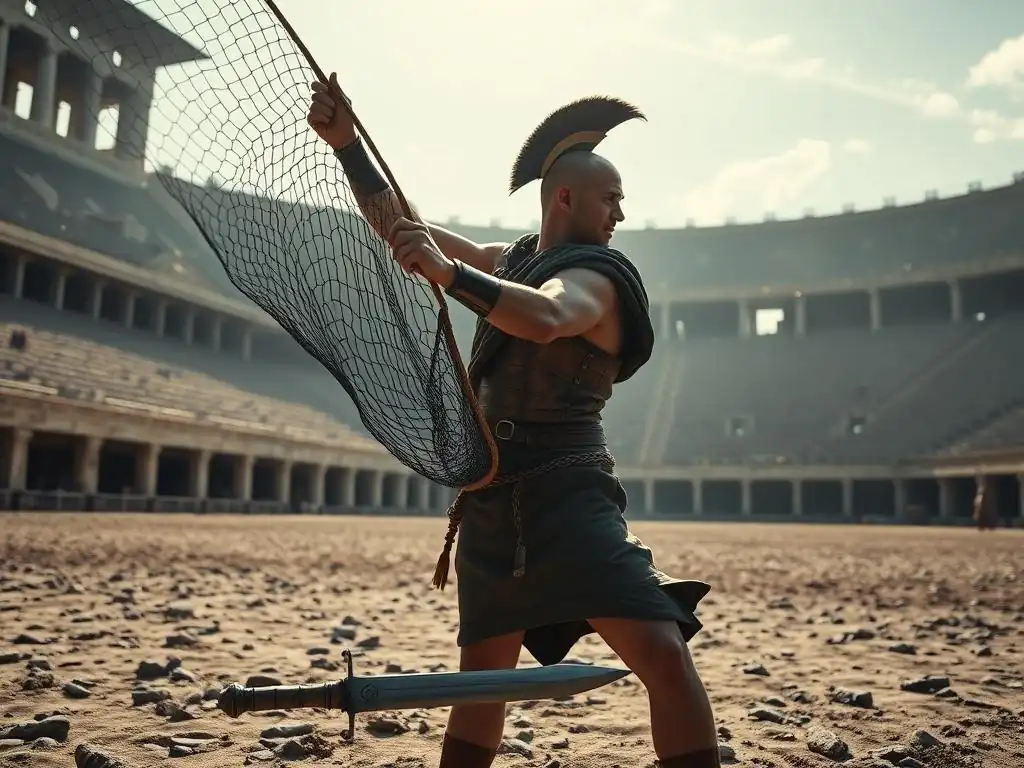
The Retiarius was a unique gladiator type, fighting with minimal armor and relying on speed, agility, and specialized tools. His primary weapons were a weighted net ( rete), a trident ( fuscina), and sometimes a dagger ( pugio). He wore virtually no defensive armor, save for a shoulder guard ( galerus) on his left arm and shoulder, and sometimes padding on his left arm ( manica). This lack of protection made him vulnerable but also incredibly fast and difficult to pin down.
The Retiarius's strategy centered around ensnaring his opponent with the net, rendering them immobile and vulnerable to attacks from his trident. If the net failed, he would use the trident as a spearing weapon or resort to the dagger in a desperate close-quarters struggle. His typical opponent was the heavily armored Secutor, creating a classic matchup of speed and cunning against brute force and defense in Ancient Rome gladiatorial combat.
The Thraex: Armed with a Curved Sword
The Thraex, or Thracian, represented a gladiator type whose equipment was based on that of the Thracians, a people conquered by Rome. He was distinguished by his small, rectangular shield ( parmula) and a curved sword known as the sica. He wore substantial armor, including greaves on both legs, a padded or scaled arm guard ( manica) on his sword arm, and a helmet with a griffin crest and a wide brim protecting his face.
The sica, with its inwardly curved blade, was designed for stabbing and hooking attacks, particularly effective against armored opponents or for bypassing shields. The Thraex's smaller shield allowed for greater mobility compared to the Murmillo's scutum, enabling a more agile and aggressive fighting style focused on exploiting openings with the curved sword. Thraeces were commonly pitted against Murmillos or Hoplomachi.
The Secutor: The Pursuer
The Secutor, meaning "pursuer" or "chaser," was a gladiator type specifically developed to fight the Retiarius. His equipment was designed to counter the net-fighter's strengths. He wore heavy armor, including a smooth, egg-shaped helmet with minimal openings to prevent the Retiarius's trident from piercing it or the net from catching on protrusions. He was armed with a gladius and carried a large, rectangular shield ( scutum).
The Secutor's fighting style was direct and relentless. His heavy armor made him slower than the Retiarius, but it offered excellent protection against the trident and net. His goal was to withstand the initial attacks, close the distance, and engage the lightly armored Retiarius in a sword fight where his heavy shield and gladius gave him a significant advantage. This specialized pairing highlights the tactical depth inherent in Ancient Rome gladiatorial combat matchups.
Gladiator Training: Schools and Discipline
Becoming a gladiator required rigorous and often brutal training within specialized schools known as ludi. These institutions were essentially barracks combined with training grounds, where recruits were transformed from ordinary individuals into skilled combatants. The training regimen was intense, focusing on physical conditioning, weapon proficiency, and the specific techniques required for their assigned gladiator type. Discipline was paramount, enforced with harsh punishments, including whipping and branding.
Recruits, often referred to as tiros, would spend months or even years honing their skills under the tutelage of a lanista (the owner/manager of the school) and experienced gladiators known as doctores. They practiced with wooden weapons ( arma lignea) against wooden training posts ( pali) before progressing to real weapons. The goal was not just to teach them to fight, but to instill the discipline and technique necessary to survive and entertain in the arena, ensuring they became valuable assets for the lanista.
The Ludus: Gladiator Schools and Living Conditions
Gladiator schools, or ludi, were formidable, self-contained complexes designed for training and housing gladiators. A typical ludus in a major city like Rome would feature barracks for housing hundreds of gladiators, a central courtyard or arena for training, armories, workshops for repairing equipment, baths, and sometimes even a small infirmary. The most famous ludus in Rome was the Ludus Magnus, located right next to the Colosseum, connected by an underground tunnel. Archaeological remains of the Ludus Magnus show rows of small cells surrounding a central training arena.
Living conditions within the ludus were spartan and communal. Gladiators lived in small cells, often in pairs or small groups. Despite the harsh discipline and confinement, successful gladiators could attain a degree of status within the school and even accumulate personal wealth. The ludus served as both a prison and a specialized training facility, a unique environment where individuals were prepared for the life-or-death struggles of Ancient Rome gladiatorial combat.
Gladiator Diet and Physical Conditioning
The diet of gladiators was carefully managed to support their demanding physical training and combat readiness. Archaeological evidence, particularly studies of gladiator cemeteries like the one found in Ephesus (modern Turkey), suggests that gladiators consumed a diet rich in carbohydrates. Analysis of bone composition from the Ephesus gladiators indicates high levels of strontium, consistent with a diet heavily reliant on grains, particularly barley, and legumes like beans. They were sometimes referred to as hordearii, or "barley-men."
This high-carbohydrate diet, supplemented possibly with calcium-rich drinks made from plant ash to strengthen bones, provided the necessary energy for intense training and helped gladiators build a layer of subcutaneous fat. While seemingly counterintuitive for fighters, this fat layer may have offered some protection against blows and cuts, preventing quick fatal injuries and allowing for longer, more entertaining fights. Their physical conditioning involved not just weapon practice but also strength training, endurance exercises, and possibly massage and hydrotherapy in the school's baths.
The Arena: Stage for Deadly Combat
The Colosseum and Other Amphitheaters
The arena was the heart of Ancient Rome gladiatorial combat, the grand stage where life and death played out before thousands of spectators. The most famous of these venues is undoubtedly the Colosseum in Rome, officially known as the Flavian Amphitheater. Completed in 80 AD, it could hold an estimated 50,000 to 80,000 spectators, making it the largest amphitheater in the Roman world. Its complex structure included the arena floor, seating tiers for different social classes, and an elaborate underground network ( hypogeum) for holding gladiators, animals, and stage machinery.
While the Colosseum is the most famous, hundreds of amphitheaters of varying sizes were built throughout the Roman Empire, from Britain to North Africa. Cities like Pompeii, Verona, and El Jem (modern Tunisia) boast well-preserved amphitheaters that hosted local gladiatorial games. These structures were specifically designed for viewing spectacles, providing tiered seating that offered good sightlines to the central arena floor, emphasizing the public nature and visibility of Ancient Rome gladiatorial combat.
The Rules of Engagement: Combat Protocols
While gladiatorial combat was deadly, it was not a chaotic free-for-all. Fights were governed by established rules and protocols, overseen by a referee ( summa rudis or rudis) who was often a former gladiator. The rules varied depending on the type of gladiators involved but generally involved specific starting positions, limitations on certain types of attacks (though these were often loosely enforced), and procedures for signaling surrender. A gladiator could signal surrender by raising a finger, usually the index finger.
Upon a gladiator's surrender, the decision for life or death rested with the editor, the organizer of the games. The crowd's reaction played a significant role in this decision, often signaling their preference with gestures – a "thumbs up" or "thumbs down" (though the exact gesture is debated by historians) – accompanied by shouts. The referee would stop the fight when a gladiator was clearly defeated, wounded, or had surrendered, allowing the editor to make the final judgment. This structured approach, even in a fight to the death, underscores the formalized nature of Ancient Rome gladiatorial combat.
The Role of the Editor: Deciding Life and Death
The editor was the individual who financed and organized the gladiatorial games. This could be a private citizen seeking political advancement, a magistrate fulfilling a public duty, or the emperor himself. The editor bore the considerable expense of hiring gladiators, providing animals, and staging the entire spectacle. In return, they gained prestige, popularity, and political influence, making the games a powerful tool in Roman public life.
Crucially, the editor held the power of missio, the decision to spare a defeated gladiator's life. While the crowd's will heavily influenced this decision, the editor had the final say. Granting missio was seen as an act of mercy and generosity, further enhancing the editor's public image. Conversely, ordering the death of a defeated gladiator, particularly a popular one, could be risky but might also be seen as a display of unwavering resolve. This power over life and death made the editor a central and potent figure in the drama of Ancient Rome gladiatorial combat.
Bread and Circuses: Entertainment and Control
Gladiatorial games, along with other public spectacles like chariot races, were a key component of the Roman policy known as "Bread and Circuses" ( panem et circenses). This phrase, coined by the Roman poet Juvenal, refers to the practice of providing free or subsidized food (bread) and lavish entertainment (circuses, including gladiatorial games) to the Roman populace. The primary aim was to keep the large, potentially restive urban population content and distracted, thereby preventing unrest and maintaining political stability.
By providing regular, exciting, and often free entertainment, emperors and politicians diverted the public's attention from political issues and socioeconomic grievances. The games fostered a sense of shared identity and community, bringing people together in a collective experience of spectacle and emotion. While the moral implications were debated even in antiquity, the effectiveness of the games in maintaining social order and reinforcing the power of the ruling elite is undeniable, making them a crucial tool of political control in Ancient Rome.
Gladiators as Celebrities: Fame and Fortune
Despite their often low social status (many were slaves or condemned criminals), successful gladiators could achieve significant fame and even fortune. Victories in the arena brought recognition, praise from the crowd, and sometimes gifts from wealthy patrons. The most celebrated gladiators became household names, with their images appearing on lamps, mosaics, and graffiti. Their prowess and courage were admired, and they were often seen as embodiments of Roman virtues like bravery and discipline.
Some gladiators, particularly those who survived many combats or won their freedom ( rudis), could achieve a degree of wealth and independence. There are records of former gladiators becoming trainers ( doctores) or even owning their own ludi. While the life expectancy of a gladiator was likely short, and the vast majority remained enslaved or died in the arena, the possibility of fame and a better life served as a powerful, albeit distant, aspiration for those trapped in the brutal world of Ancient Rome gladiatorial combat.
The Morality of Gladiatorial Combat: Ethical Debates
Even in ancient Rome, the morality of gladiatorial combat was a subject of debate among intellectuals and philosophers. While the games were wildly popular with the general populace, some Roman writers expressed discomfort or outright condemnation of the violence and the disregard for human life. Seneca, the Stoic philosopher, famously criticized the games for their cruelty, noting how they encouraged brutality in the spectators.
Christianity, as it gained influence in the later Roman Empire, also strongly opposed gladiatorial combat, viewing it as a pagan and inhumane practice. Christian writers and figures actively campaigned against the games. Despite these moral objections and philosophical critiques, the games remained incredibly popular and deeply entrenched in Roman culture for centuries, highlighting the complex and often contradictory values of Roman society regarding life, death, and entertainment.
The Decline and End of Gladiatorial Combat
Factors Contributing to the Decline
Several factors contributed to the gradual decline of Ancient Rome gladiatorial combat from its peak popularity. Economic pressures played a role; organizing games was incredibly expensive, and as the empire faced financial difficulties, the lavishness and frequency of the spectacles diminished. Changing social attitudes, influenced by philosophical critiques and the growing prominence of Christianity, also chipped away at the widespread acceptance of the games.
Furthermore, the political landscape shifted. While emperors initially used games to consolidate power, the focus eventually shifted towards other forms of public expenditure and display. The source of gladiators also changed; as the empire's borders stabilized, the supply of prisoners of war decreased, making it more expensive to acquire and train fighters. These cumulative pressures led to a slow but steady decrease in the prominence of gladiatorial combat.
The Last Gladiatorial Games
The final, definitive end of gladiatorial combat is not marked by a single, universally accepted date but rather a gradual cessation. While Christian emperors had issued edicts against the games starting in the late 4th century AD (Constantine issued one around 325 AD, Honorius in 399 AD and 404 AD), these laws were not always strictly enforced, particularly in more remote parts of the empire. The games held a powerful cultural inertia.
A commonly cited date for the last known gladiatorial contest in Rome itself is 404 AD. According to the historian Theodoret, a monk named Telemachus entered the arena during a fight in an attempt to stop it and was killed by the crowd. This event is said to have prompted Emperor Honorius to issue a definitive ban on gladiatorial combat. While animal hunts ( venationes) continued for a longer period, the era of man-versus-man combat in the Roman arenas essentially ended in the early 5th century AD, bringing the centuries-long tradition of Ancient Rome gladiatorial combat to a close.
Legacy of Gladiatorial Combat
Influence on Modern Combat Sports
While direct lineage is difficult to trace, Ancient Rome gladiatorial combat has had an undeniable, albeit indirect, influence on modern combat sports and entertainment. The concept of organized, one-on-one combat as a public spectacle, the use of specialized equipment, and the creation of distinct fighter types resonate in modern forms like boxing, wrestling, and mixed martial arts (MMA). The idea of a central arena, tiered seating for spectators, and the dramatic presentation of fighters also echoes Roman practices.
The structure of modern fight promotions, with their emphasis on individual athletes, rivalries, and high-stakes contests, mirrors aspects of the lanista system and the promotion of star gladiators. While modern sports are governed by strict safety rules and are not contests to the death, the fundamental human fascination with watching skilled individuals test their limits in physical competition, a core element of Ancient Rome gladiatorial combat, remains a driving force behind the popularity of contemporary combat sports.
Gladiators in Popular Culture: Film and Literature
Gladiatorial combat has captured the imagination of writers and filmmakers for centuries, becoming a staple theme in popular culture. From 19th-century novels to epic Hollywood blockbusters, the image of the gladiator fighting for survival and freedom against the backdrop of Roman grandeur has proven enduringly compelling. Films like Spartacus (1960) and Gladiator (2000) have brought the Roman arena to life for modern audiences, shaping many people's perceptions of Ancient Rome gladiatorial combat.
These cultural portrayals, while often taking historical liberties for dramatic effect, reflect a persistent fascination with the gladiators' courage, the brutality of their world, and the moral complexities of the games. They explore themes of oppression, rebellion, heroism, and the human will to survive, solidifying the gladiator's place as a powerful and tragic figure in the collective consciousness.
Archaeology provides tangible links to the world of Ancient Rome gladiatorial combat. Excavated amphitheaters across the former Roman Empire offer direct evidence of the scale and design of the venues. Sites like the Colosseum in Rome, the Arena of Verona, the amphitheater at Pompeii, and the impressive structure at El Jem in Tunisia allow visitors to walk in the footsteps of gladiators and imagine the roar of the crowd.
Beyond the arenas, archaeological finds include gladiator barracks (like the Ludus Magnus), burial sites (such as the gladiator cemetery in Ephesus which provided invaluable information on diet and injuries), gladiator equipment (helmets, greaves, weapons found in various locations), and even graffiti and mosaics depicting gladiator fights. These material remains offer crucial insights into the lives, training, and reality of those who participated in Ancient Rome gladiatorial combat, complementing the information found in historical texts.
Understanding Gladiatorial Combat: A Historical Perspective
Separating Fact from Fiction: Debunking Common Myths
Popular culture has often created enduring myths about Ancient Rome gladiatorial combat that diverge from historical reality. One common misconception is that gladiators always fought to the death. While fatal outcomes were frequent, they were not guaranteed. Gladiators were valuable assets, requiring significant investment to train and maintain. Missio (sparing a defeated gladiator) was a common occurrence, and many gladiators survived multiple fights. Records suggest some gladiators fought dozens of bouts.
Another myth is the image of the emperor giving a "thumbs down" for death. The exact gesture used by the crowd and editor to signal death is debated, but it may have been a "thumbs up" towards the chest or throat, or a downward thumb, while missio was often signaled by a closed fist or upward thumb. The idea of thumbs-down universally meaning death is likely a later invention. Separating these myths from historical facts is essential for a true understanding of Ancient Rome gladiatorial combat.
Further Research: Exploring Scholarly Sources
For those wishing to delve deeper into the fascinating world of Ancient Rome gladiatorial combat, a wealth of scholarly sources is available. Ancient historians like Suetonius, Tacitus, and Cassius Dio provide contemporary accounts, though often colored by their own biases and agendas. Later writers, such as the Christian apologists Tertullian and Augustine, offer perspectives critical of the games.
Modern scholarly works, drawing on archaeological evidence, inscriptions, and re-evaluation of ancient texts, offer detailed analyses of gladiator types, training, the social structure of the ludi, the economics of the games, and their political and social significance. Consulting academic books and peer-reviewed articles by historians and archaeologists specializing in Roman social history and archaeology provides the most accurate and nuanced understanding of this complex aspect of Ancient Roman life.
Conclusion: The Enduring Fascination with Gladiatorial Combat
Remembering the Warriors of the Arena
Ancient Rome gladiatorial combat remains a compelling and complex subject. It was a brutal spectacle that embodied aspects of Roman society's power, entertainment, and relationship with violence and death. From its ritualistic origins to its evolution into a massive industry, the games were deeply woven into the fabric of Roman life, serving political, social, and religious functions. The gladiators themselves, whether slaves, criminals, or volunteers, were skilled warriors forced or choosing to confront death in the arena, becoming both objects of entertainment and, sometimes, figures of admiration.
Remembering the warriors of the arena requires looking beyond the simplistic portrayals often found in popular culture. It means acknowledging the harsh realities of their lives, the discipline of their training, the tactical nuances of their combat, and the complex social world of the ludus and the amphitheater. The legacy of Ancient Rome gladiatorial combat endures, not just in the ruins of the Colosseum or the echoes in modern sports, but in the questions it raises about human nature, the power of spectacle, and the value placed on life in different societies throughout history.
Frequently Asked Questions
What were the main objectives of gladiatorial combat in Ancient Rome?
Gladiatorial combat served primarily as a form of public entertainment and a way to provide ritualistic offerings to the deceased. It also functioned as a powerful tool for political influence and social control.
Where did most gladiators come from, and what were their lives like?
Most gladiators were either slaves, prisoners of war, or condemned criminals. Despite their brutal training and short life expectancy, some achieved celebrity status and even earned their freedom.
What types of weapons and armor were commonly used in gladiatorial combat?
Gladiators employed a diverse range of weapons and armor, often dictated by their specific gladiator class. Examples include swords, shields, spears, nets, tridents, and various types of protective helmets and body armor.
How did different gladiator types (e.g., Retiarius, Secutor) differ in their fighting styles?
Each gladiator type, such as the Retiarius (net-fighter) and the Secutor (pursuer), had a specialized fighting style dictated by their weapons and equipment. The Retiarius relied on agility and entrapment, while the Secutor focused on close-quarters combat with a sword and shield.
What role did gladiatorial combat play in the political landscape of Ancient Rome?
Gladiatorial games were frequently used by emperors and politicians to gain popular support and demonstrate their power. By sponsoring lavish spectacles, they could influence public opinion and solidify their rule.
Final Reflection: Echoes of Courage and Cruelty
The echoes of the arena still resonate today, reminding us that the spectacle of violence, even when packaged as entertainment, holds a complex and often uncomfortable place in human history. From the roar of the crowd to the clash of steel, the gladiatorial games of Ancient Rome offer a stark reflection of our enduring fascination with power, survival, and the boundaries of morality.
The legacy of gladiatorial combat extends beyond historical texts and archaeological findings. It forces us to confront the uncomfortable truth that entertainment can be built upon suffering, and that societal norms can normalize even the most brutal practices. The Roman shows were not just entertainment; they were a reflection of the Roman character, its love of spectacle, its reverence for strength, and its acceptance of death.
This quote underscores the profound impact these games had on shaping Roman identity and values, a legacy that continues to inform our understanding of ancient civilization.
As we close this exploration of Ancient Rome's gladiatorial combat, let us not simply marvel at the historical details. Instead, let us reflect on the enduring questions it raises about our own values and the choices we make. Consider the spectacles we consume today, and ask yourself: what do they reveal about our society, and what responsibility do we have to ensure that entertainment does not come at the cost of human dignity?
Unleash Your Inner Gladiator: Embrace the Arena of Knowledge!
Thank you for diving into the brutal world of gladiatorial combat! Now that you've journeyed back in time and witnessed the deadly spectacles of ancient Rome, it's time to translate that knowledge into action.
- Research a specific gladiator type that resonated with you, and share a brief (3-sentence) summary with a friend or on social media. Become the expert on that style!
- Explore the modern-day interpretations of gladiatorial combat in film, literature, or even stage combat classes. See how these historical fights continue to inspire.
- Imagine you are an advisor to a Roman emperor seeking to improve the gladiatorial games for public appeal. What one new element or rule would you introduce to maximize excitement and safety (for the gladiators, of course! )?