
Shaolin Qiang (Spear): The Art of Thrusting, Piercing, and LongRange Dominance

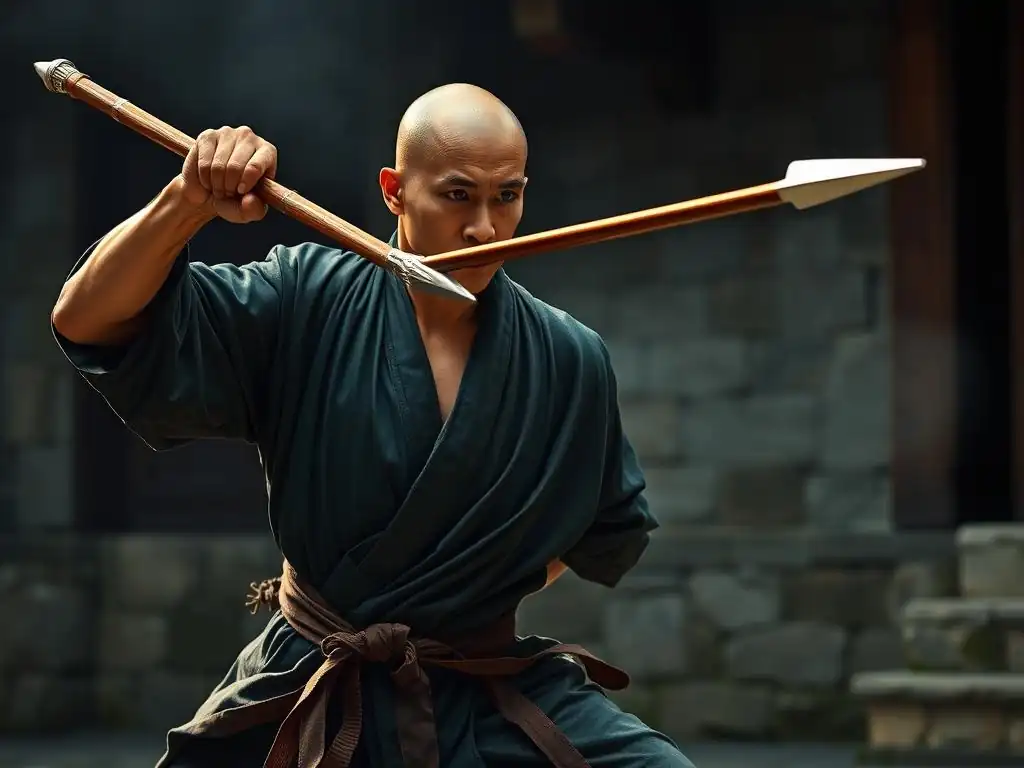
Welcome to Martial Arts Mastery, your gateway to the world's most fascinating fighting traditions. Delve into the rich tapestry of history, technique, and philosophy that defines each discipline. Ever wondered how a simple weapon could become an extension of the body, a conduit for Qi? Explore the ancient secrets and devastating power behind Shaolin spear techniques training in our detailed analysis of Qiang forms. Prepare to be captivated as we unlock the art of thrusting, piercing, and long-range dominance – a journey that begins with a single, well-placed point.
- Introduction to Shaolin Spear Techniques Training
- Mastering the Fundamentals of Shaolin Spear Techniques
- Shaolin Qiang Forms (Taolu): A Detailed Analysis
- Advanced Shaolin Spear Fighting Techniques for Long-Range Dominance
- Shaolin Spear Training Drills for Enhanced Skill
- The Philosophy and Spiritual Significance of Shaolin Spear
- The Shaolin Spear vs. Other Weapons: A Comparative Analysis
- Shaolin Spear for Self-Defense: Practical Applications
- Tips for Effective Shaolin Spear Techniques Training
- Conclusion: The Enduring Legacy of Shaolin Qiang
-
Frequently Asked Questions
- How does Shaolin spear training differ from other spear-based martial arts?
- What are the key stances and movements emphasized in Shaolin Qiang training?
- What is the significance of qi in Shaolin spear techniques training?
- What types of drills and exercises are used to develop proficiency in Shaolin Qiang?
- Can Shaolin spear techniques be applied for self-defense purposes in modern contexts?
- Final Reflection: Embracing the Legacy of the Shaolin Spear
- Unleash Your Inner Warrior: Master the Qiang!
Introduction to Shaolin Spear Techniques Training
What is Shaolin Qiang (Spear)? A Historical Overview
The Shaolin Qiang, or Shaolin Spear, is one of the most revered long weapons in the Shaolin Temple martial arts system. Its history is deeply intertwined with the development of Chinese warfare and self-defense, dating back centuries. While the staff (Gun) is often considered the king of Shaolin weapons, the spear (Qiang) holds a unique and vital place, often referred to as the "King of A Hundred Soldiers" (百兵之王) due to its widespread use and effectiveness on the battlefield. The Shaolin lineage adopted and refined spear techniques, integrating them into their rigorous training curriculum.
Historically, the spear was a primary weapon for soldiers and guards across China, valued for its reach and piercing capability. Shaolin monks, initially focused on self-defense and later participating in military campaigns (most famously aiding the Tang dynasty in the 7th century), naturally incorporated spear methods into their practice. The Shaolin Qiang evolved not just as a combat tool but also as a vehicle for physical conditioning, mental discipline, and the study of martial principles, forming a crucial part of traditional Shaolin spear techniques training.
The Importance of Shaolin Spear in Kung Fu History
The Shaolin spear holds significant importance within the broader history of Chinese Kung Fu. Its techniques influenced many other spear styles developed throughout China. Unlike some flashier weapons, the Shaolin Qiang emphasizes directness, efficiency, and powerful, penetrating strikes. This focus aligns with the practical, combat-oriented nature of traditional Shaolin arts before they became primarily performance-focused.
Mastery of the spear was considered a high level of achievement, requiring exceptional coordination, strength, and precision. Studying the Shaolin Qiang provided practitioners with a deep understanding of leverage, distance management, and the principle of using minimal effort for maximum effect. This weapon's study was integral to developing a well-rounded martial artist within the Shaolin system, and Shaolin spear techniques training remains a respected part of the curriculum today, preserving ancient combat wisdom.
Mastering the Fundamentals of Shaolin Spear Techniques
Stance and Footwork in Shaolin Qiang: The Foundation of Power
Effective Shaolin spear techniques training begins with a solid foundation in stances and footwork. Power generation in spear techniques is not solely derived from the arms but originates from the ground, transferring through the legs, hips, and torso into the weapon. Key stances include the Gong Bu (Bow Stance), Ma Bu (Horse Stance), and Pu Bu (Crouching Stance), each offering stability and power for different actions. For instance, a deep Gong Bu allows for powerful forward thrusts, while Ma Bu provides a stable base for sweeping or defensive maneuvers.
Footwork is equally critical, enabling rapid movement, changing angles, and maintaining optimal distance from an opponent. Techniques like Jin Bu (Advancing Step), Tui Bu (Retreating Step), and Ce Bu (Sideways Step) are fundamental. The footwork must be fluid and coordinated with the spear movements, allowing the practitioner to close distance quickly for an attack or retreat instantly from danger. Proper footwork in Shaolin spear techniques training ensures balance and mobility, making the difference between a static target and a dynamic, unpredictable fighter.
Grip Techniques for Optimal Spear Control
Controlling the Shaolin Qiang effectively requires specific grip techniques that vary depending on the intended action. The primary grip is typically with one hand further down the shaft (near the butt end) and the other hand closer to the tip, allowing for powerful thrusts and sweeping movements. The hands should grip firmly enough for control but loosely enough to allow the shaft to slide slightly during certain techniques, facilitating rapid extension and retraction.
Variations include gripping with both hands close together for short-range power or holding the spear near the middle for balancing and transitional movements. The grip must be adaptable, changing seamlessly as the practitioner transitions between offense and defense, thrusts and parries. Mastering these grip nuances is a vital part of Shaolin spear techniques training, ensuring the practitioner can manipulate the weapon with speed, precision, and power.
Basic Shaolin Spear Thrusting Techniques: Accuracy and Speed
The thrust (刺, Ci) is the quintessential Shaolin spear technique. Executed properly, it is a swift, linear attack aimed at vital points. Basic thrusting involves driving the spear forward using power generated from the legs and waist, not just the arms. The shaft should remain relatively straight, moving along a direct line to the target. Accuracy is paramount; training often involves targeting small objects or specific points on a dummy.
Speed is achieved through coordinated body movement and a relaxed yet focused execution. Drills emphasize rapid extension and equally rapid retraction of the spear, preventing the opponent from grabbing the shaft. Common basic thrusts include the level thrust (平刺, Ping Ci), upward thrust (上刺, Shang Ci), and downward thrust (下刺, Xia Ci). These fundamental thrusting methods form the core of offensive Shaolin spear techniques training.
Shaolin Qiang Forms (Taolu): A Detailed Analysis
Understanding the Structure and Purpose of Shaolin Spear Forms
Shaolin spear forms, known as Taolu, are prearranged sequences of movements that preserve and transmit the techniques and principles of Shaolin Qiang. These forms are not merely performance pieces; they are dynamic training manuals in motion. Each movement within a form represents a practical application, whether it's a thrust, parry, sweep, or defensive maneuver. The structure of a form typically includes a variety of techniques, transitions between stances, and changes in direction, simulating combat scenarios.
The purpose of practicing Shaolin spear forms is multifaceted. They develop muscle memory, improve coordination, enhance balance and focus, and cultivate internal energy (Qi). By repeatedly performing the sequences, practitioners internalize the rhythm, timing, and spatial awareness necessary for effective spear combat. Studying the applications hidden within the movements is a critical aspect of Shaolin spear techniques training through forms.
Key Movements and Sequences in Yin Shou Gun (Silver Hand Spear)
Yin Shou Gun, often translated as "Silver Hand Spear," is a prominent Shaolin spear form known for its practical and direct movements. It emphasizes powerful thrusts and tight, efficient bodywork. Key movements include the rapid Ci (thrust), often executed with a coordinated step, and deceptive maneuvers like Sao (sweep) or Liao (upward cut/flick). The form frequently utilizes the principle of "one hand silver, one hand iron," referring to the dynamic interplay between the front and rear hands on the shaft.
Sequences in Yin Shou Gun often involve combinations of thrusts and parries, demonstrating how to simultaneously defend and attack. For example, a parry might immediately transition into a powerful forward thrust. The form's compact nature, despite the spear's length, teaches practitioners to use the weapon effectively even in relatively close quarters, a hallmark of practical Shaolin spear techniques training.
Analyzing the Application of Shaolin Spear Fighting Techniques in Mei Hua Qiang (Plum Blossom Spear)
Mei Hua Qiang, or "Plum Blossom Spear," is another significant Shaolin form, known for its intricate footwork and circular movements that evoke the pattern of plum blossoms. While Yin Shou Gun is direct, Mei Hua Qiang incorporates more evasive footwork and fluid transitions, emphasizing adaptability. The "plum blossom" pattern often refers to moving around a central point (the opponent) or striking from multiple angles.
Analyzing Mei Hua Qiang reveals a sophisticated approach to Shaolin spear fighting techniques. Applications include circling the opponent while thrusting, using the shaft to deflect attacks before countering, and utilizing body evasion alongside spear movements. The form teaches practitioners to use the spear's full length for both offense and defense, demonstrating how to maintain distance while probing for openings or delivering decisive strikes. This form adds a layer of complexity and fluidity to Shaolin spear techniques training.
Advanced Shaolin Spear Fighting Techniques for Long-Range Dominance
Circular Movements and Evasive Maneuvers with the Spear
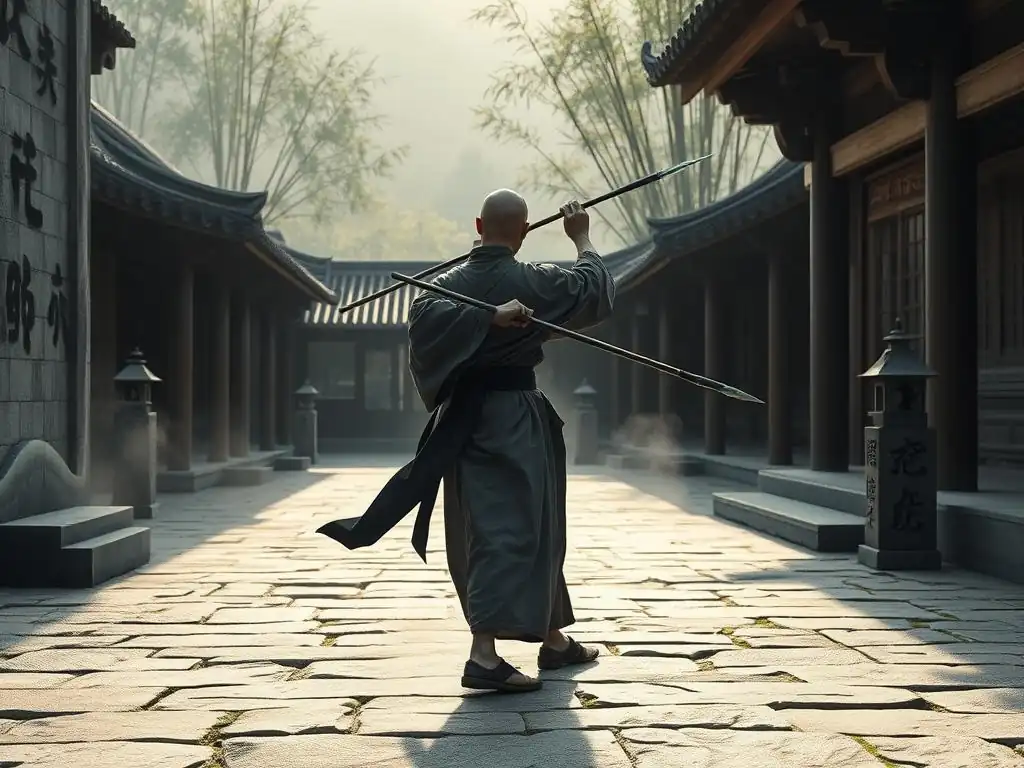
Advanced Shaolin spear techniques training incorporates circular movements and evasive maneuvers to enhance the practitioner's ability to control distance and create openings. Beyond linear thrusts, techniques involve circling the tip or the butt end of the spear to deflect incoming attacks ( Ge), hook limbs ( Gou), or disrupt the opponent's balance. These circular motions can also be used to generate momentum for powerful strikes or sweeps.
Evasive maneuvers, combined with footwork, are crucial for survival against a skilled opponent. This includes stepping offline to avoid a direct attack while simultaneously using the spear to parry or counter. Techniques like Shan (evasion) and Teng Nuo (shifting and moving) are integrated with spear handling, allowing the practitioner to flow around attacks and strike from unexpected angles, maximizing the long-range advantage afforded by the Shaolin Qiang.
Combining Thrusts, Sweeps, and Deflections in Shaolin Spear Combat
True mastery of Shaolin spear fighting techniques lies in the seamless combination of different actions. A practitioner must be able to transition instantly from a powerful thrust to a sweeping motion with the shaft, or use the spear to deflect an attack and immediately follow up with a piercing strike. This fluidity makes the Shaolin Qiang a versatile weapon capable of controlling multiple ranges.
For example, a sequence might involve using the shaft to parry an incoming weapon ( Ge), sliding the hand down the shaft for a powerful downward strike or sweep ( Sao), and then recovering into a stance for a rapid thrust ( Ci). Practicing these complex combinations is a significant part of advanced Shaolin spear techniques training, building the practitioner's ability to react effectively in dynamic combat situations.
Developing Power and Precision in Shaolin Spear Strikes
Developing devastating power and pinpoint precision is the goal of advanced Shaolin spear techniques training. Power comes from the coordinated movement of the entire body, channeling energy from the legs and core through the arms and into the spear tip. This is often described as Fa Jing (releasing energy). Drills focus on striking targets with maximum force concentrated at the tip upon impact.
Precision involves the ability to consistently hit small, specific targets at varying distances and angles. This requires acute spatial awareness, excellent hand-eye coordination, and fine motor control over the weapon. Training methods include striking moving targets, practicing techniques with speed and power while maintaining accuracy, and focusing on the intent behind each movement. Achieving both power and precision makes the Shaolin Qiang a formidable weapon.
Shaolin Spear Training Drills for Enhanced Skill
Footwork Drills for Agility and Mobility
Effective Shaolin spear techniques training heavily relies on strong and agile footwork. Drills are designed to improve speed, balance, and coordination between the feet and the spear movements. Simple drills include stepping forward and backward in various stances while maintaining balance, or practicing rapid side-to-side movements. More complex drills involve combining steps with basic thrusts or parries, moving around imaginary obstacles or opponents.
A common drill involves drawing a pattern on the ground, such as a plum blossom shape, and practicing moving along the lines while executing spear techniques. Another is practicing advancing and retreating ( Jin Tui Bu) with a partner, maintaining optimal distance while performing defensive and offensive actions. These drills build the foundational mobility required for dynamic Shaolin spear combat.
Thrusting and Piercing Drills for Accuracy and Speed
Developing accurate and speedy thrusts is central to Shaolin spear techniques training. Solo drills often involve repeatedly thrusting at a fixed target, such as a sandbag or a marked point on a wall, focusing on hitting the exact spot with consistency. The drill is then performed with increasing speed, ensuring accuracy is not sacrificed.
Partner drills can involve one person holding a padded target or a ring for the other to thrust through, forcing precision. Another drill is practicing rapid alternating thrusts (e.g., left, right, left) at multiple targets or points on a partner's padded body, emphasizing both speed and the ability to quickly transition between targets. These focused drills hone the primary offensive capability of the Shaolin Qiang.
Partner Drills for Developing Reaction Time and Combat Skills
Partner drills are essential for applying Shaolin spear techniques training in a simulated combat environment. These drills range from cooperative exercises, where partners practice specific attack-and-defense sequences, to more dynamic sparring-like scenarios using padded spears or focusing on controlled movements. Drills might involve one partner initiating an attack (e.g., a thrust), and the other reacting with a parry or evasion and a counter-attack.
More advanced drills incorporate timing and distance challenges, requiring practitioners to react to unpredictable movements. For instance, one partner might move and attack randomly within a defined space, forcing the other to use appropriate footwork and spear techniques to defend and counter. These interactive drills are crucial for developing reaction time, adaptability, and the practical application of learned Shaolin spear fighting techniques.
The Philosophy and Spiritual Significance of Shaolin Spear
The Connection Between Shaolin Spear and Chan Buddhism
The practice of Shaolin spear techniques training is deeply intertwined with the philosophy of Chan Buddhism, the spiritual foundation of the Shaolin Temple. For the monks, martial arts were not just about fighting but were a path to self-cultivation and enlightenment. The discipline required to master the spear, the focus needed during practice, and the control exercised over the weapon all reflect principles of Chan Buddhism.
Holding the spear, feeling its balance, and coordinating mind and body in movement can be a form of moving meditation. The concentration required during forms or drills helps to quiet the 'monkey mind' and bring the practitioner into the present moment. The pursuit of perfection in technique mirrors the Buddhist pursuit of enlightenment – a continuous process of refinement and understanding.
Developing Mindfulness and Focus Through Shaolin Spear Training
Shaolin spear techniques training inherently develops mindfulness and focus. Handling a long, potentially dangerous weapon demands complete attention; a lapse in concentration can lead to injury. This necessity fosters a heightened state of awareness, not just of the weapon itself but of one's own body, surroundings, and intentions.
During practice, practitioners are encouraged to clear their minds of distractions and focus solely on the movement, the breath, and the connection between mind and body. This sustained focus during repetitive drills or complex forms trains the mind to remain present, a skill applicable both within and outside of martial arts practice. This mental discipline is a significant benefit derived from dedicated Shaolin spear techniques training.
The Ethical Considerations of Using Shaolin Spear Techniques
As with all martial arts, the study of Shaolin spear fighting techniques carries significant ethical considerations. The Shaolin philosophy emphasizes using martial skills for self-defense and the protection of others, never for aggression, bullying, or unwarranted violence. The power inherent in spear techniques means they can cause serious harm, placing a heavy responsibility on the practitioner.
Training includes understanding when and how to use force appropriately, prioritizing de-escalation and avoidance whenever possible. The ethical framework teaches respect for opponents (even in training), humility in skill, and the importance of controlling one's ego. Practitioners are reminded that the ultimate goal is self-mastery, not dominance over others, underscoring the moral dimension of Shaolin spear techniques training.
The Shaolin Spear vs. Other Weapons: A Comparative Analysis

Shaolin Spear vs. Shaolin Staff (Gun): Strengths and Weaknesses
Comparing the Shaolin Qiang to the Shaolin Gun (staff) reveals distinct characteristics. The staff is often called the 'father' of weapons, known for its versatility in striking, blocking, and sweeping. It's generally more robust and forgiving than the spear, making it an excellent training tool. Staff techniques emphasize power generation through centrifugal force and body rotation.
The spear, conversely, is primarily a piercing weapon. Its strength lies in its point and reach, allowing for rapid, linear attacks that are difficult to defend against head-on. While the staff can deliver powerful blunt force trauma, the spear is designed for concentrated, penetrating strikes. The spear requires greater precision and control due to its sharp tip and the flexibility of the shaft, making Shaolin spear techniques training distinct from staff work.
Shaolin Spear vs. Sword (Dao/Jian): Range and Maneuverability
Comparing the Shaolin spear to Chinese swords (Dao, the saber; Jian, the straight sword) highlights differences in range and maneuverability. Swords are shorter, single-handed weapons (though some Dao are two-handed), making them much more maneuverable in close quarters. They excel at cutting, slashing, and thrusting at shorter distances.
The Shaolin spear's primary advantage is its significantly longer reach, allowing the practitioner to engage an opponent from a distance well beyond the range of a sword. This provides a defensive buffer and the ability to strike before the opponent can close the gap. However, the spear is less agile in very close combat and requires more space to wield effectively compared to a sword. Shaolin spear techniques training emphasizes utilizing this reach advantage.
Adapting Shaolin Spear Techniques Against Various Weapon Styles
A skilled Shaolin spear practitioner must be able to adapt their techniques against opponents wielding different weapons. Against shorter weapons like swords or knives, the strategy is to maintain distance, using the spear's reach to keep the opponent at bay while probing for openings with rapid thrusts. Evasive footwork is key to preventing the opponent from closing range.
Against longer weapons like staves or other spears, the engagement becomes more of a distance-management battle. Techniques involve parrying incoming strikes with the shaft ( Ge), attempting to trap or control the opponent's weapon, and using feints to create opportunities for a decisive thrust. Shaolin spear techniques training includes drills specifically designed to practice these adaptive strategies against various weapon types.
Shaolin Spear for Self-Defense: Practical Applications
Utilizing Long-Range Advantage in Self-Defense Scenarios
In a self-defense scenario, the Shaolin spear's most apparent advantage is its long reach. This allows a trained individual to keep a potential threat at a significant distance. If faced with an aggressor armed with a shorter weapon or no weapon, the spear provides a formidable deterrent and the ability to control the engagement range. The ability to deliver a precise thrust from several feet away means the defender can neutralize a threat without needing to engage in close-quarters grappling or striking.
Practical application focuses on maintaining this distance, using footwork to stay out of the aggressor's reach while using the spear to create barriers or deliver disabling (not necessarily lethal) strikes to limbs or less vital areas if necessary. This emphasis on distance control is a core principle derived from Shaolin spear techniques training applicable to self-defense.
Disarming and Controlling Opponents with the Shaolin Spear
Beyond simply striking, Shaolin spear techniques can be adapted for disarming and controlling an opponent. The shaft can be used to trap or deflect an incoming weapon, while the butt end can be used for strikes or joint manipulation at closer range if the distance collapses. Specific techniques involve hooking an opponent's limb or weapon with the spear tip or shaft, allowing the practitioner to control their movement or force them to drop a weapon.
Controlling techniques might involve using the shaft to pin an opponent against a wall or the ground, or using the spear to maintain distance while waiting for assistance or an opportunity to escape. While the spear is primarily offensive, its structure allows for versatile control methods, which are sometimes explored in practical Shaolin spear techniques training applications.
Legal Considerations and Responsible Use of Shaolin Spear Skills
Understanding the legal ramifications of using any martial art for self-defense is crucial, especially with a weapon like the Shaolin spear. Laws vary significantly by location regarding weapon ownership, carrying, and the use of force. Generally, the use of deadly force (which a spear can deliver) is legally permissible only when facing an imminent threat of death or serious bodily harm.
Responsible Shaolin spear techniques training includes education on these legal aspects and reinforces the ethical principle of using skills only as a last resort for necessary self-preservation. Practitioners are taught to prioritize de-escalation, avoidance, and escape, and to use only the minimum force necessary to neutralize a threat. This responsible approach is integral to the complete training.
Tips for Effective Shaolin Spear Techniques Training
Choosing the Right Shaolin Spear for Your Training
Selecting an appropriate spear is vital for effective Shaolin spear techniques training. Beginners often start with a practice spear made of waxwood or bamboo, which are flexible and lighter than metal. Waxwood is traditionally preferred for its resilience and feel. The length of the spear should generally match the practitioner's height, or be slightly longer, allowing for proper extension without being unwieldy.
As skills advance, practitioners might move to heavier or metal spears to build strength and experience the weapon's true weight and balance. Ensure the spear is well-balanced, typically slightly weighted towards the tip, and that the shaft is smooth and free of splinters. A good training spear facilitates proper technique development and reduces the risk of injury.
Maintaining and Caring for Your Shaolin Spear
Proper maintenance is essential for preserving a training spear and ensuring its safety. Wooden spears should be kept clean and dry to prevent warping or cracking. Traditional practitioners sometimes rub the shaft with oil (like tung oil) to nourish the wood. Regularly inspect the spearhead (if present) and the butt end for damage.
Metal spears require cleaning to prevent rust and damage. Store the spear vertically or horizontally in a way that prevents it from bending or becoming damaged. A well-maintained spear lasts longer and remains a safe and effective tool for Shaolin spear techniques training. Treat your weapon with respect; it is an extension of your body and a partner in your practice.
Finding a Qualified Shaolin Spear Instructor
Finding a qualified instructor is perhaps the most critical tip for effective Shaolin spear techniques training. The nuances of grip, footwork, body mechanics, and the applications within forms are best learned through direct guidance from someone with deep experience. An unqualified teacher might pass on incorrect techniques or principles, which can be difficult to correct later and could even lead to injury.
Look for instructors with a clear lineage, significant training experience under recognized masters, and a teaching style that prioritizes safety, fundamentals, and a holistic understanding of the art, including its historical and philosophical aspects. Reputable martial arts schools or cultural centers may offer authentic Shaolin training programs that include the Qiang.
Conclusion: The Enduring Legacy of Shaolin Qiang
The Future of Shaolin Spear Techniques Training
The future of Shaolin spear techniques training appears promising, sustained by dedicated practitioners worldwide and the growing interest in traditional martial arts. While modern applications may differ from ancient battlefield combat, the value of spear training for physical fitness, mental discipline, and understanding martial principles remains high. Online resources and international workshops are making this art more accessible, albeit reinforcing the need for qualified in-person instruction for true mastery.
Efforts by institutions like the Shaolin Temple and its authorized cultural centers globally ensure that the traditional forms and methods are preserved accurately. As people seek deeper connections to historical practices and effective self-cultivation methods, the intricate and powerful art of Shaolin Qiang is likely to continue attracting students, ensuring its survival for generations to come.
Preserving the Art of Shaolin Spear for Future Generations
Preserving the art of Shaolin spear techniques training is a collective effort involving masters, practitioners, and enthusiasts. Documentation through books and videos plays a role, but the heart of preservation lies in direct transmission from teacher to student, maintaining the integrity of the movements, principles, and underlying philosophy. Supporting authentic schools and instructors is vital.
Furthermore, sharing the art through demonstrations, cultural exchanges, and educational programs helps raise awareness and appreciation. By emphasizing not just the physical techniques but also the historical context, ethical considerations, and philosophical depth, the art of Shaolin Qiang is passed on as a complete system, a rich cultural heritage, and a powerful path of self-mastery for future practitioners.
Frequently Asked Questions
How does Shaolin spear training differ from other spear-based martial arts?
Shaolin spear training emphasizes qi cultivation and spiritual development alongside physical technique. It integrates Chan Buddhism principles and focuses on internal energy flow.
What are the key stances and movements emphasized in Shaolin Qiang training?
Key stances include mabu (horse stance) and gongbu (bow stance), providing stability. Movements focus on linear thrusts, circular parries, and evasive footwork.
What is the significance of qi in Shaolin spear techniques training?
Qi is vital for generating power and speed in thrusts and deflections. Shaolin spear training cultivates qi flow to enhance weapon control and combat effectiveness.
What types of drills and exercises are used to develop proficiency in Shaolin Qiang?
Training includes solo form practice, partner drills, and sparring to refine technique. Students also practice weapon conditioning and strength training to improve physical capabilities.
Can Shaolin spear techniques be applied for self-defense purposes in modern contexts?
Yes, the principles of distance management, precise targeting, and swift execution can be adapted for self-defense. However, legal restrictions on weapon use must be considered.
Final Reflection: Embracing the Legacy of the Shaolin Spear
The journey through Shaolin Qiang, the art of the spear, reveals more than just techniques; it unveils a philosophy of discipline, precision, and unwavering focus. This ancient martial art, far from being a relic of the past, offers invaluable lessons in mindfulness and strategic thinking that resonate deeply in our fast-paced modern world. The principles of thrusting, piercing, and maintaining long-range dominance translate into effective communication, decisive action, and the ability to anticipate challenges in any field.
The Shaolin spear's influence extends beyond the physical realm, shaping character and fostering a profound connection to tradition. Witnessing the dedication and artistry of Shaolin practitioners underscores the importance of preserving cultural heritage and embracing the wisdom passed down through generations. The spear is the king of weapons, demanding respect and rewarding diligence.
This quote encapsulates the essence of Shaolin Qiang, reminding us that mastery requires unwavering commitment and a deep understanding of its underlying principles.
Now, as you reflect on the power and grace of the Shaolin spear, consider how its lessons can enrich your own life. Embrace the discipline, cultivate your focus, and strive for precision in all that you do. Let the spirit of the Qiang guide you towards greater self-awareness, strategic thinking, and a deeper appreciation for the enduring legacy of Shaolin martial arts.
Unleash Your Inner Warrior: Master the Qiang!
Thank you for diving into the world of Shaolin Qiang! We hope you've gained a deeper appreciation for the spear's history, techniques, and the dedication required to master it. Now, it's time to take your newfound knowledge and put it into action:
- Embark on your journey by researching local martial arts schools that offer Qiang training or related spear techniques.
- Share this article with fellow martial arts enthusiasts to spark discussion and expand their understanding of the Qiang.
- Challenge yourself to begin a simple spear-conditioning routine focusing on grip strength and flexibility to prepare for future training.
What aspect of Qiang technique are you most eager to explore further in your training?