
The Feedback Loop: How Chi Sao Informs Dummy Work, and Vice Versa

Welcome to Martial Arts Mastery, your gateway to the world's fighting arts. Ever wondered how the fluid sensitivity of Chi Sao can truly unlock the potential of your wooden dummy training? This article, "The Feedback Loop: How Chi Sao Informs Dummy Work, and Vice Versa," delves deep into this fascinating connection, revealing how these two Wing Chun pillars mutually reinforce each other. Discover the subtle nuances that will elevate your practice and sharpen your understanding of this dynamic art. Intrigued? Let's begin...
- The Feedback Loop: How Sensitivity Drills Inform Structural Training, and Vice Versa
- Understanding the Interplay of Sensitivity Drills and Structural Training in Martial Arts
- Sensitivity Drills: The Foundation for Reflex Development and Adaptive Response
- Structural Training: Refining Power Generation and Body Mechanics
- The Feedback Loop in Action: Integrating Sensitivity and Structural Training
- Specific Drills and Exercises to Bridge Sensitivity and Structural Training
- Common Mistakes and How to Avoid Them in Sensitivity and Structural Training
- Advanced Concepts: Bridging the Gap Between Theory and Application
- Conclusion: Maximizing Your Martial Arts Potential Through Integrated Training
-
Frequently Asked Questions
- How does Chi Sao training benefit dummy work in Wing Chun?
- Conversely, how does dummy work improve Chi Sao skills?
- What are the key differences between Chi Sao and dummy work?
- Can dummy work replace Chi Sao training entirely?
- What are some common mistakes to avoid when integrating Chi Sao and dummy work?
- Final Reflection: The Intertwined Dance of Sensitivity and Structure
- Ignite Your Wing Chun: Unlock Deeper Insights Now!
The Feedback Loop: How Sensitivity Drills Inform Structural Training, and Vice Versa
Understanding the Interplay of Sensitivity Drills and Structural Training in Martial Arts
The Core Relationship: Sensitivity and Structure as Complementary Skills
Martial arts training often involves cultivating two seemingly distinct, yet profoundly interconnected, skill sets: sensitivity and structure. Sensitivity drills, exemplified by practices like Wing Chun's Chi Sao (sticking hands), focus on developing tactile reflexes, proprioception, and the ability to read an opponent's force and intention through physical contact. These drills emphasize adaptability, flow, and instantaneous response to dynamic pressure. A skilled practitioner in sensitivity drills can feel subtle shifts in weight, pressure, and direction, allowing them to neutralize incoming force and exploit openings almost instinctively. The goal is not brute strength but intelligent application of minimal effort.
Conversely, structural training, often embodied in solo forms and specialized equipment like the Wing Chun Wooden Dummy (Mook Yan Jong), hones body alignment, power generation, root, and the ability to transmit force effectively. This type of training builds a solid foundation, ensuring that techniques are delivered with maximum efficiency and impact while maintaining balance and stability.
It focuses on the integrity of the body's framework, teaching practitioners how to absorb impact without collapsing and how to generate explosive power from a connected, unified structure. While sensitivity deals with the interaction with external force, structural training solidifies the internal mechanics of power and stability.
Sensitivity Drills: The Foundation for Reflex Development and Adaptive Response
Developing Sensitivity and Sticking Hands for Close-Range Combat
Developing sensitivity, particularly through "sticking hands" drills like Chi Sao, is paramount for proficiency in close-quarters combat. These exercises train practitioners to maintain contact with an opponent's limbs, becoming acutely aware of their movements and intentions through tactile feedback.
This constant contact allows for immediate adjustments, preventing opponents from gaining favorable angles or generating significant power. The goal is to develop a reflex that responds not to visual cues, but to the feeling of pressure, redirection, and force, often reacting in mere fractions of a second – potentially as low as 0.1 to 0.2 seconds for a trained reflex, compared to 0.25-0.3 seconds for a visual reaction.
Through countless repetitions in drills involving various hand positions ( Tan Sao, Bong Sao, Fook Sao, etc. ), practitioners learn to adhere to the opponent, follow their force without resisting directly, and redirect it off-line. This creates a dynamic feedback loop where every slight movement or pressure change from the partner elicits an immediate, adaptive response. It cultivates a state of "listening" with the hands, allowing one to anticipate attacks, control distance, and find openings by exploiting the opponent's imbalance or structural weaknesses revealed through contact. This constant, fluid interaction is the core of sensitivity development.
Exploring the Principles of Sensitivity: Bridging the Gap, Following the Force, and Maintaining Contact
Sensitivity drills are built upon fundamental principles that guide the practitioner's interaction with an opponent. "Bridging the gap" refers to the initial act of establishing contact and closing the distance, often done safely by controlling the opponent's arms. Once contact is made, the principle of "following the force" becomes critical. Instead of meeting force with equal force (which leads to a strength contest), one learns to yield slightly, redirecting the incoming pressure while maintaining contact and control. This is akin to a skilled sailor adjusting sails to the wind rather than trying to stand against it.
"Maintaining contact" is the continuous thread that links these principles. By keeping a light, yet persistent, connection, practitioners receive a constant stream of information about the opponent's actions. This allows for instantaneous transitions between defense and offense. If the opponent pulls back, you follow; if they push, you yield and redirect. This continuous feedback loop ensures that you are always in a position to sense and respond, exploiting the opponent's commitment to their action. These principles, practiced rigorously in drills like Chi Sao, lay the groundwork for reflexive, adaptive combat.
Applying Sensitivity Principles to Real-World Scenarios
The seemingly abstract principles practiced in sensitivity drills have direct and critical applications in real-world combat scenarios. The ability to "listen" to an opponent's body through touch allows a practitioner to react effectively even in low-light conditions or when visual cues are limited. For instance, in a crowded environment where movement is restricted, the close-range sensitivity honed in Chi Sao dummy work training becomes invaluable for controlling an aggressor's limbs and preventing them from generating power for strikes or grabs.
Consider a scenario where an opponent attempts a powerful push or grab. A practitioner trained in sensitivity won't stiffen and resist head-on. Instead, they will yield slightly, redirecting the force off-line while maintaining contact. This not only nullifies the initial attack but also puts the opponent in a vulnerable position. The constant contact allows the practitioner to immediately transition into strikes or joint controls as opportunities arise, all based on the tactile information received. This adaptive response, developed through dedicated Chi Sao training, transforms static techniques into fluid, dynamic actions applicable under pressure.
Structural Training: Refining Power Generation and Body Mechanics
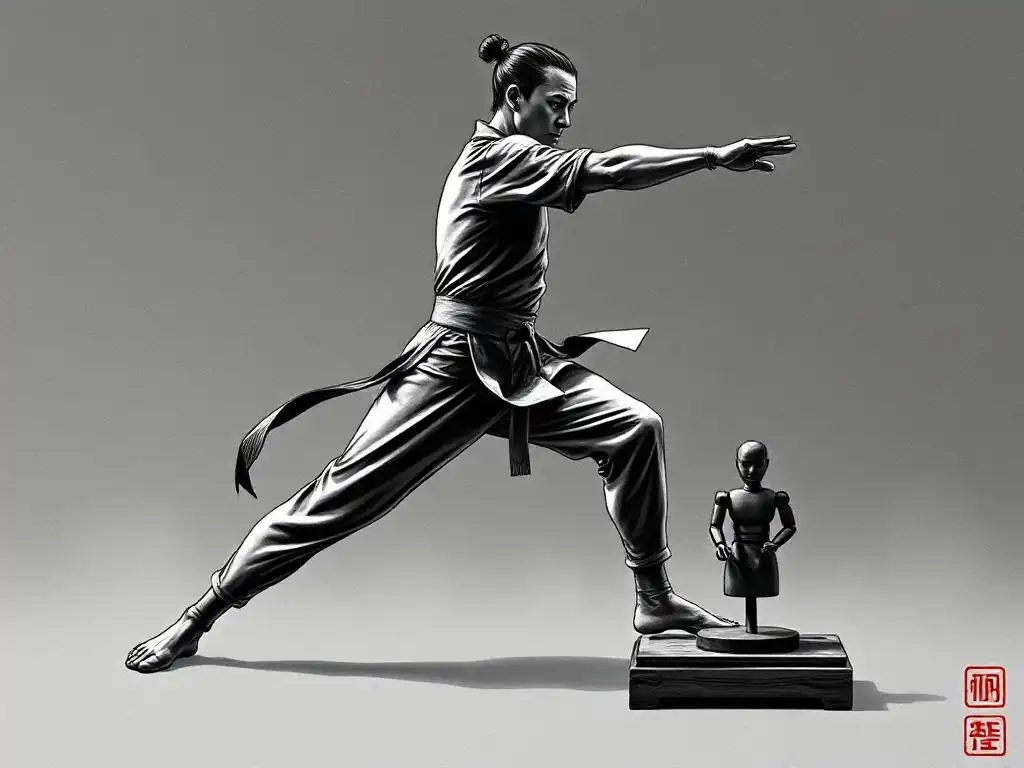
Structural Training: A Comprehensive Approach to Body Alignment and Force Transmission
Structural training in martial arts, often using solo forms and specialized equipment like the Wooden Dummy, focuses on building a resilient and powerful physical framework. It's a comprehensive approach that addresses posture, balance, root, and the efficient transmission of force throughout the body. Through repetitive movements and forms, practitioners learn to align their skeletal structure to support weight, absorb impact, and generate power from the ground up, channeling it through a stable core and into the limbs. This systematic approach ensures that techniques are not just performed, but executed with intrinsic power derived from correct body mechanics.
A key aspect of structural training is developing a strong "root" – the feeling of being deeply connected to the ground, allowing force to be drawn up from the feet and projected outwards, or incoming force to be absorbed and grounded. Training on the Wooden Dummy, for example, forces practitioners to maintain their structure and root against the unyielding resistance of the apparatus.
Each strike and block against the dummy's arms and leg teaches the body how to absorb impact without losing balance and how to deliver force efficiently through proper alignment, minimizing energy loss. This focused structural refinement is critical for both defensive stability and offensive power generation.
Utilizing Structural Training to Enhance Striking and Grappling Techniques
Structural training significantly enhances both striking and grappling techniques by optimizing body mechanics for power and stability. For striking, a strong structure ensures that force is generated from the entire body, not just the arm or leg. Training with the Wooden Dummy teaches practitioners to coordinate hip rotation, waist turning, and shoulder movement with limb extension, ensuring that each strike carries the weight and power of the whole body. For example, a simple straight punch ( Pak Sao followed by punch) against the dummy requires precise alignment of the elbow, shoulder, hip, and stance to deliver maximum force without compromising balance.
In grappling or close-quarters control, structural integrity is paramount. A practitioner with a strong structure is much harder to unbalance or manipulate. Training exercises that emphasize maintaining a low center of gravity, proper spinal alignment, and connected limbs allow one to absorb pushes, pulls, and joint locks more effectively. The principles learned from interacting with the sturdy Mook Yan Jong – such as maintaining forward pressure while absorbing force ( Jut Sao) or using body weight to generate power ( Gaan Sao) – translate directly into the ability to control an opponent's structure or resist their attempts to break yours.
Mastering Proper Body Mechanics and Structure Through Solo and Partnered Drills
Mastering proper body mechanics and structure requires diligent practice through both solo and partnered drills. Solo forms, like the Wing Chun Siu Lim Tao, are foundational, teaching the basic postures, hand shapes, and internal energy flow without external resistance. Progressing to the Wooden Dummy provides external feedback, forcing the practitioner to apply structural principles against a fixed object that simulates an opponent's limbs and torso. This allows for repetitive refinement of angles, distances, and force application.
Partnered drills, even those focused on sensitivity like Chi Sao, are also crucial for structural development. While sensitivity teaches adaptation, interacting with a live partner who provides variable pressure forces you to constantly check and reinforce your own structure. If your stance is weak or your alignment is off, your partner's force will immediately exploit it. This dynamic feedback loop in Chi Sao dummy work training highlights structural flaws in real-time, prompting immediate correction. Drills focusing on absorbing pushes or maintaining ground against resistance further solidify the body's structural integrity under pressure.
The Feedback Loop in Action: Integrating Sensitivity and Structural Training
How Sensitivity Enhances Your Structural Training
Improving Responsiveness and Adaptability in Structural Exercises
Sensitivity training, particularly through exercises like Chi Sao, significantly improves responsiveness and adaptability within structural exercises. While structural training on the Wooden Dummy often follows a set sequence, the principles of sensitivity allow a practitioner to approach the dummy with a more dynamic mindset. Instead of just executing pre-programmed movements, the practitioner can use the feedback from the dummy's arms and leg to refine their application. For instance, feeling the angle of resistance on a Bong Sao (wing arm) on the dummy can inform subtle adjustments in body angle and structure that a purely rote execution might miss.
This enhanced responsiveness means that even in a seemingly static drill like the Wooden Dummy form, the practitioner is 'listening' to the dummy's structure. If the dummy's arm pushes back unexpectedly (simulating an opponent's reaction), the sensitivity developed in Chi Sao allows for an immediate, adaptive structural adjustment rather than just pushing harder against the resistance. This dynamic interaction transforms structural training from a purely mechanical exercise into a more intelligent, responsive practice that better simulates the unpredictability of a live opponent, directly linking Chi Sao dummy work training.
Refining Angles and Force Application Based on Real-Time Feedback
Sensitivity training excels at teaching a practitioner to read force and angles in real-time, a skill that directly refines structural training. When practicing Chi Sao dummy work training, the tactile feedback from the dummy's arms and leg provides a constant stream of information.
A strike or block that feels "dead" or lacks power against the dummy indicates a structural weakness or incorrect angle. The sensitivity developed in sticking hands allows the practitioner to feel why it feels wrong – perhaps the force is leaking out, the angle of attack is slightly off, or the body isn't properly aligned behind the technique.
Using this tactile feedback, the practitioner can make immediate, subtle adjustments to their body mechanics and angles of attack or defense. If a Lop Sao (pulling hand) followed by a punch feels weak against the dummy, the practitioner can use their sensitivity to feel if their root is disconnected, if their waist isn't turning correctly, or if the pulling force isn't integrated with the punch. This iterative process of feeling, adjusting structure, and feeling again, driven by the sensitivity cultivated in Chi Sao, leads to a much deeper understanding and refinement of structural principles than simply going through the motions.
How Structural Training Enhances Your Sensitivity
Strengthening Core Stability and Stance for Better Balance and Control
Structural training provides the essential physical foundation that significantly enhances sensitivity. Sensitivity drills like Chi Sao require immense balance, stability, and the ability to absorb and redirect force without being uprooted. A strong core and stable stance, developed through structural exercises like forms and Wooden Dummy practice, provide this necessary base. Without a solid structure, any attempt to yield or redirect force in Chi Sao would likely result in the practitioner being pushed off balance or collapsing.
Consider interacting in Chi Sao. When a partner applies pressure, your ability to remain centered and rooted comes directly from your structural training. A strong stance allows you to absorb their force into the ground rather than being moved. A stable core enables you to redirect their energy using minimal physical effort, relying on leverage and alignment rather than brute strength. This increased stability and control, honed through dedicated structural practice on the Wooden Dummy, frees up the practitioner's nervous system to focus purely on feeling and responding, rather than constantly struggling to maintain balance.
Developing Power and Precision Through Structural Drills
Structural training is crucial for developing the power and precision required to effectively apply sensitivity in combat. While sensitivity teaches when and how to redirect or exploit an opening, structural training provides the means to do so with devastating efficiency. A practitioner might feel the perfect moment to deliver a strike in Chi Sao, but without the power generated through correct body mechanics and alignment learned on the Wooden Dummy, the strike will lack impact.
Similarly, precision in angles and timing is refined through structural repetition. Practicing the precise angles of blocks and strikes against the Wooden Dummy's fixed arms and leg instills muscle memory for efficient movement.
This precision, combined with the power developed through proper structural alignment, ensures that when an opportunity arises in a dynamic Chi Sao drill, the practitioner can capitalize on it with a technique that is not only timely and well-angled but also carries significant force. This synergy between the adaptive timing of sensitivity and the precise power of structure is the hallmark of advanced Chi Sao dummy work training.
Specific Drills and Exercises to Bridge Sensitivity and Structural Training
Sensitivity Drills That Translate to Structural Application
Many sensitivity drills inherently build structural awareness. Basic Chi Sao rolling drills, where partners maintain circular contact, teach constant forward pressure ( Jing) while maintaining structure. Any yielding or breaking of posture is immediately felt by the partner. More advanced Chi Sao dummy work training drills, like single-hand Chi Sao or drills focusing on specific limb controls, require the practitioner to maintain a strong, rooted structure while adapting to dynamic external force.
- Single Hand Chi Sao: Focuses one hand on continuous contact and feeling while the other hand is free to strike or defend. This demands maintaining a stable structure with half the usual contact, forcing reliance on core strength and balance.
- Pak Sao/Lop Sao Drills: These common Wing Chun drills involve deflecting/slapping (
Pak Sao) or pulling (Lop Sao) while simultaneously striking. Practicing these with a partner who provides resistance forces the practitioner to integrate the sensitivity of feeling the limb with the structural requirement of delivering a powerful, rooted strike. The feedback loop in Chi Sao dummy work training is evident here as the partner's reaction dictates the timing and angle, while the practitioner's structure determines the effectiveness of their response.
Structural Drills That Improve Sensitivity and Reflexes
Structural drills, particularly those involving the Wooden Dummy, can be modified to enhance sensitivity and reflexes. While the Dummy is static, focusing on the feel of the contact points and the immediate structural adjustments required for each movement cultivates a form of tactile awareness. Practicing the Dummy form with varying levels of "stickiness" – imagining the dummy's arms are trying to adhere to yours like in Chi Sao – forces a different kind of interaction than just hitting.
- Dummy Form with Emphasis on Contact Pressure: Instead of hitting hard, focus on maintaining a consistent, light pressure on the dummy's arms throughout the transitions. This trains the subtle feeling of contact and flow, similar to Chi Sao, but applied within the structural framework of the form.
- Reactive Dummy Drills: While the traditional Dummy is static, some training methods involve a partner providing variable resistance or slight movements to the dummy's arms (if the dummy allows for slight give). This introduces an element of unpredictable feedback, forcing faster reflexes and more adaptive structural responses, bridging the gap directly to Chi Sao dummy work training.
Drill 1: Bridging the Gap with Correct Posture
This drill combines the sensitivity of closing distance with the structural requirement of proper entry posture.
- Starting Position: Partners stand a few steps apart, in a ready stance (e.g., Wing Chun's
Irm Saoor guarding position). - Execution: One partner initiates a controlled forward step (
Bil Saoor thrusting fingers motion can simulate an entry). The other partner's task, based on the sensitivity of seeing/feeling the intention, is to immediately close the distance while simultaneously executing a structural block or deflection (Pak SaoorGan Sao) with correct body alignment and root. - Focus: The emphasis is on maintaining a strong, stable structure while moving forward and making contact. The partner receiving focuses on yielding just enough to redirect the energy, maintaining their own structure. The feedback is immediate: if your structure is weak during the 'bridge', you'll be pushed off balance. If you are too slow in sensing the entry, you fail to bridge effectively. This directly translates the Chi Sao principle of controlled entry into a structural movement.
Drill 2: Maintaining Root While Receiving Force
This drill integrates the sensitivity of absorbing force with the structural strength needed to remain rooted.
- Starting Position: Partners stand in contact, one slightly behind the other, with the front partner in a stable stance.
- Execution: The rear partner applies a controlled, steady push to the front partner's back or shoulders, simulating incoming force. The front partner's task is to absorb this force into the ground through their legs and stance, maintaining their upright posture and root, without stepping back or becoming rigid. They use their sensitivity to read the amount and direction of pressure and adjust their weight distribution subtly.
- Focus: This drill highlights the importance of structural integrity under pressure. It trains the body to act as a conduit for force, grounding it rather than resisting it head-on with muscular tension. The sensitivity comes from feeling the nuances of the push and responding with the minimum necessary adjustment to maintain balance. This directly reinforces the structural principles practiced on the Wooden Dummy when receiving impact, linking it back to Chi Sao dummy work training by adding the dynamic element of a partner's force.
Common Mistakes and How to Avoid Them in Sensitivity and Structural Training
Pitfalls in Sensitivity Training: Over-Thinking, Lack of Contact
A common pitfall in sensitivity training, particularly in Chi Sao, is over-thinking. Instead of reacting instinctively based on tactile feedback, practitioners get caught in their heads, trying to consciously decide which technique to use. This hesitation breaks the flow and defeats the purpose of developing reflexive action. The solution is dedicated, repetitive drilling focused on the feeling rather than the visual or cognitive. Hours spent simply rolling hands, focusing solely on maintaining contact and feeling pressure changes, build the subconscious reflexes needed.
Another significant error is a lack of genuine, persistent contact. Sensitivity requires continuous touch to receive information. If practitioners break contact too easily or become floppy, they lose the vital feedback loop. This often stems from a fear of being controlled or a misunderstanding of yielding.
Correcting this involves emphasizing the principle of "sticking" and "following." Drills where partners deliberately try to break contact (and the other tries to maintain it) can help highlight this issue. Focusing on a light, elastic connection rather than a rigid one is key; think of being glued together with a flexible adhesive, not welded. This persistent, informed contact is crucial for effective Chi Sao dummy work training principles.
Pitfalls in Structural Training: Rigidity, Ignoring Real-Time Feedback
In structural training, especially when using equipment like the Wooden Dummy, a major mistake is becoming rigid. Practitioners might tense up, trying to use muscular force to power through the movements or absorb impact, rather than relying on skeletal alignment and proper body mechanics. This leads to wasted energy, reduced power, and increased risk of injury. Structural strength comes from connection and relaxation within the framework, not from muscular tension.
Ignoring real-time feedback, even from a static object like the Dummy, is another pitfall. If a technique feels awkward, weak, or causes strain against the Dummy, it's providing crucial feedback about a structural flaw. Simply repeating the movement incorrectly reinforces bad habits. A practitioner must use their growing body awareness (which sensitivity helps cultivate) to feel the inefficiency and adjust their posture, angle, or root accordingly. Approaching the Dummy with the same "listening" mindset developed in Chi Sao dummy work training turns structural practice into a more intelligent, self-correcting process.
Corrective Exercises for Common Training Errors
Addressing these pitfalls requires targeted corrective exercises. For over-thinking in sensitivity, simple, slow, single-concept Chi Sao drills are beneficial – e.g., just focusing on maintaining forward pressure while rolling, without any techniques. For lack of contact, partner drills where the goal is purely to stay "stuck" to the opponent's arms, even if they are trying to pull away or push past, reinforce the sticking principle.
To combat rigidity in structural training, emphasize relaxation within forms and Dummy work. Practice forms very slowly, focusing on releasing tension in non-essential muscles. Against the Dummy, use lighter contact initially, focusing on the feeling of alignment and force transmission rather than hitting hard. For ignoring feedback, video recording your structural practice can provide objective insight into posture and movement flaws you might not feel. Additionally, incorporating partner drills that specifically test your structure under controlled, variable pressure (like the "Maintaining Root" drill mentioned earlier) provides undeniable feedback on structural weaknesses, directly improving Chi Sao dummy work training application.
Advanced Concepts: Bridging the Gap Between Theory and Application
Applying Sensitivity Principles in Complex Structural Sequences
Advanced practitioners bridge the gap between sensitivity and structure by applying sensitivity principles within complex structural sequences, such as the Wooden Dummy form. While the Dummy form has a set pattern, a sensitive practitioner doesn't just execute moves; they interact with the Dummy's arms and leg as if they were a live opponent. They feel the "pressure" and "resistance" of the Dummy and adjust their structure, angles, and timing accordingly, even within the fixed sequence.
For example, performing a Bong Sao/ Lop Sao/Punch combination on the Dummy is not just about hitting the right spots. An advanced practitioner uses their sensitivity to feel the connection on the Dummy's arm during the Bong Sao, using that feedback to perfectly time the Lop Sao pull and align their structure for the subsequent punch. They are constantly "listening" to the Dummy, allowing the feel of the contact to guide their structural movements, making the form a dynamic, rather than static, practice of Chi Sao dummy work training principles.
Integrating Structural Concepts into Free-Flowing Sparring
The ultimate goal of integrating sensitivity and structural training is seamless application in free-flowing sparring or self-defense. Here, the static nature of structural training meets the dynamic unpredictability of sensitivity drills. A practitioner must maintain their strong structure while simultaneously adapting instantaneously to an opponent's movements based on sensitivity.
When sparring, the ability to absorb an unexpected impact without collapsing your structure (learned from Dummy work) is crucial, as is the ability to immediately sense an opening or imbalance through contact (learned from Chi Sao). The structural integrity allows you to generate power from any position, while sensitivity ensures that power is applied precisely when and where it will be most effective. This fluid integration, where structure provides the power and stability and sensitivity provides the timing and direction, represents the pinnacle of Chi Sao dummy work training applied under pressure.
Conclusion: Maximizing Your Martial Arts Potential Through Integrated Training
The Synergistic Benefits of Combining Sensitivity and Structural Practice
The synergistic benefits of combining sensitivity and structural practice are profound, leading to a more complete and effective martial artist. Structural training builds the power, stability, and correct mechanics necessary for techniques to be effective. Sensitivity training cultivates the reflexes, adaptability, and timing needed to apply those techniques appropriately in a dynamic situation. Neither is truly complete without the other; a strong structure without sensitivity is rigid and easily defeated by yielding, while high sensitivity without structure lacks the power and stability to capitalize on openings or withstand force.
By training them together, allowing feedback from one to inform the other – as in dedicated Chi Sao dummy work training – practitioners develop a martial art that is both powerful and fluid, rooted and adaptive. The structure provides the engine and framework, while sensitivity provides the steering and navigation system. This integrated approach ensures that techniques are not just performed correctly but are also applied intelligently and effectively under the unpredictable conditions of actual combat.
Continuing Your Journey: Resources for Further Study
To continue your journey in understanding and integrating sensitivity and structural training, seek out qualified instructors in martial arts styles that emphasize these principles, such as Wing Chun for its rich tradition of Chi Sao and Wooden Dummy practice. Study classical texts and analyses of these training methods, focusing on the underlying principles rather than just the techniques.
Engage in consistent, mindful practice, paying attention to the feedback your body and your training partners (or equipment like the Wooden Dummy) provide. Remember that mastery comes not just from knowing the techniques, but from understanding the fundamental principles that connect sensitivity and structure in a continuous, beneficial feedback loop.
Frequently Asked Questions
How does Chi Sao training benefit dummy work in Wing Chun?
Chi Sao refines your sensitivity and reflexes in close-quarters combat, allowing you to better understand and react to the feedback provided by the dummy. This translates to more effective and adaptable dummy work.
Conversely, how does dummy work improve Chi Sao skills?
Dummy work strengthens your structure, alignment, and power generation, crucial elements for successful Chi Sao. It provides a stable platform to practice techniques and develop the necessary muscle memory.
What are the key differences between Chi Sao and dummy work?
Chi Sao involves a live, reactive partner, demanding adaptability and real-time adjustments. Dummy work offers a static, predictable structure for honing technique and building a solid foundation.
Can dummy work replace Chi Sao training entirely?
No, dummy work cannot entirely replace Chi Sao. While it builds a strong foundation, the dynamic, unpredictable nature of Chi Sao is essential for developing true martial arts skill. Both are necessary.
What are some common mistakes to avoid when integrating Chi Sao and dummy work?
Avoid relying solely on memorized sequences; focus on understanding the underlying principles. Don't neglect sensitivity and awareness in favor of brute force. Remember the dummy is a tool, not an opponent.
Final Reflection: The Intertwined Dance of Sensitivity and Structure
The exploration of the feedback loop between Chi Sao and dummy work training reveals a dynamic relationship that transcends mere technical skill. It highlights a continuous cycle of learning and adaptation, where sensitivity cultivated in close-range sparring directly informs the precision and power developed through solitary practice, and vice versa. This interplay is not just about mastering techniques; it's about cultivating a deeper understanding of oneself and one's opponent.
The impact of this interconnected training extends beyond the Wing Chun practitioner. It offers a powerful metaphor for how we learn and grow in all aspects of life, emphasizing the importance of both intuitive response and structured discipline. The best fighter is never angry,
Bruce Lee famously said, and this sentiment resonates deeply with the principles of Chi Sao and dummy work. Both demand a calm, focused mind capable of adapting to ever-changing circumstances, a skill applicable far beyond the martial arts.
Now, consider how you can apply this feedback loop to your own pursuits. Are you relying solely on structured practice, or are you actively seeking the sensitivity and adaptability that comes from real-time interaction? Embrace the dynamic interplay between intuition and structure, and you'll find yourself not only mastering new skills, but also cultivating a deeper understanding of yourself and the world around you.
Ignite Your Wing Chun: Unlock Deeper Insights Now!
Thank you for exploring the dynamic interplay between Chi Sao and Wooden Dummy training! We hope this article has provided valuable insights into enhancing your Wing Chun journey. Now, it's time to put these principles into action and elevate your understanding.
Here are a few steps to take:
- Prioritize a focused training session this week, where you consciously apply principles learned in Chi Sao to your Wooden Dummy practice, and vice versa. Focus on smooth transitions and energy control.
- Review your training journal and identify three key areas where you can specifically implement the Chi Sao/Dummy connection. Dedicate specific sessions to these areas.
- Share your experiences and challenges in applying this integrated approach with a training partner and on the Martial Arts Mastery community forum.
What new insights will you uncover by integrating your Chi Sao and Dummy practice this week, and how will you document your progress?