
Footwork Fundamentals: The Foundation for All Taekwondo Kicks and Strikes

Welcome to Martial Arts Mastery, where we delve into the rich tapestry of combat traditions! Are you ready to unlock the secrets behind powerful and precise strikes in Taekwondo? In this article, we're dismantling the foundational Taekwondo kick footwork technique, revealing how mastering these core movements will not only improve your kicks but also elevate your entire game. Discover the agility and control that separates the amateur from the master – and prepare to transform your fighting stance!
- Introduction to Taekwondo Kick Footwork Technique: The Essential Foundation for Effective Strikes
- The Basics of Taekwondo Footwork: Core Movements and Positioning
- Taekwondo Kick Footwork Technique: Building Blocks for Powerful Kicks
- Integrating Footwork with Hand Strikes in Taekwondo: Coordinated Attack Strategies
- Common Mistakes in Taekwondo Kick Footwork Technique and How to Correct Them
- Training Drills to Develop Mastery of Taekwondo Kick Footwork Technique
- The Impact of Proper Footwork on Advanced Taekwondo Techniques and Competition Success
- Conclusion: Building a Strong Foundation in Taekwondo Kick Footwork for Long-Term Martial Arts Mastery
-
Frequently Asked Questions
- What is the most important aspect of footwork in Taekwondo, according to MartialArtsMastery.org?
- How does effective footwork contribute to a Taekwondo practitioner's self-defense capabilities?
- Why does MartialArtsMastery.org emphasize footwork as a foundational element for Taekwondo kicks?
- Can improved footwork technique enhance the power of Taekwondo kicks?
- What are some common footwork mistakes that Taekwondo students often make, according to MartialArtsMastery.org?
- Final Reflection: Mastering the Dance of Taekwondo
- Elevate Your Taekwondo: Put Your Footwork to the Test!
Introduction to Taekwondo Kick Footwork Technique: The Essential Foundation for Effective Strikes
Understanding the Role of Footwork in Taekwondo Kicks and Hand Strikes
In Taekwondo, the dynamic martial art renowned for its powerful kicks and agile movements, footwork serves as the invisible engine driving every technique. Far from being a mere means of locomotion, precise Taekwondo kick footwork technique dictates balance, generates power, controls distance, and enables rapid transitions between offense and defense. Without a solid understanding and application of fundamental footwork, even the most theoretically perfect kick or strike will lack efficacy and impact. It’s the critical link that translates raw physical strength into explosive, controlled action, ensuring that a practitioner is always in an optimal position to deliver or evade.
This foundational aspect is crucial for both beginners and advanced practitioners. For instance, a properly executed roundhouse kick (Dollyo Chagi) relies heavily on the pivot of the supporting foot and the preceding step to align the hips and transfer kinetic energy into the target.
Similarly, a quick lateral shuffle (Yup Bal Guh Reum) can create an opening for a devastating side kick (Yup Chagi) or allow for immediate evasion from an opponent's attack. The subtle shifts in weight distribution and the precise timing of steps are what differentiate a clumsy, telegraphed movement from a swift, powerful, and unexpected strike, making Taekwondo kick footwork technique an indispensable part of the art.
Why Mastering Footwork Fundamentals Elevates Taekwondo Performance
Mastering the fundamentals of Taekwondo kick footwork technique profoundly elevates a practitioner's overall performance. Firstly, it directly enhances power generation. When footwork is executed correctly, the body’s weight and momentum are efficiently channeled into the strike, significantly increasing its force. For example, a well-timed step-and-slide before a turning kick can add an estimated 15-20% more power compared to a static kick, by leveraging the body's full kinetic chain. This is not just about raw strength, but about intelligent application of physics through movement.
Secondly, superior footwork dramatically improves agility and speed, which are paramount in competitive Taekwondo and self-defense scenarios. The ability to quickly close or create distance, change angles, and react to an opponent's movements is directly tied to a practitioner's command of their feet.
Elite Taekwondo athletes, such as those competing at the Olympic level, often demonstrate an almost effortless fluidity in their Taekwondo kick footwork technique, allowing them to launch multiple kicks in rapid succession or evade a barrage of attacks with minimal effort. This mastery translates into better timing, more effective combinations, and a significant tactical advantage, often being the deciding factor in securing points or avoiding critical damage.
The Basics of Taekwondo Footwork: Core Movements and Positioning
Key Stances and Their Importance in Taekwondo Kick Footwork
In Taekwondo, various stances serve as the launching pads for all techniques, and their correct application is paramount for effective Taekwondo kick footwork technique. The primary stances, such as Ap Kubi (forward stance), Dwit Kubi (back stance), and Naranhi Seogi (parallel stance), dictate weight distribution and readiness for movement.
For example, in Ap Kubi, approximately 60-70% of the body weight is distributed onto the front leg, providing a stable base from which to launch powerful rear-leg kicks like the roundhouse or front kick. This forward bias allows the rear leg to be quickly unweighted and chambered, maximizing the speed of the kick's initiation.
Conversely, Dwit Kubi, with about 70-80% of the weight on the back leg, offers excellent defensive capabilities and prepares the front leg for a quick snap kick or a defensive block. The ability to seamlessly transition between these stances, often with subtle shifts in weight, is a core aspect of advanced Taekwondo kick footwork technique. Proper understanding of each stance's purpose ensures that a practitioner is always balanced and poised, ready to execute a technique with maximum efficiency and minimal wasted motion, whether attacking or defending.
Fundamental Steps: Forward, Backward, and Lateral Movements for Strike Setup
The bedrock of Taekwondo kick footwork technique lies in its fundamental steps: forward, backward, and lateral movements. These movements are not merely about covering ground but about setting up strikes, creating angles, and managing distance. The step-and-slide (often called "chasing step" or Charyeot Bal Guh Reum variation) involves moving one foot and then bringing the other foot to meet it, maintaining the original stance. This allows for rapid closing or opening of distance without compromising balance, crucial for delivering a sudden front kick or evading a counter.
Lateral movements, such as the shuffle step (Yup Bal Guh Reum), enable practitioners to move side-to-side, creating angles for side kicks or evading linear attacks. For instance, a quick shuffle to the left can open up the opponent's right side for a powerful turning kick. Backward steps are essential for defense, allowing a practitioner to retreat from an aggressive opponent while maintaining readiness for a counter-attack. The skillful combination and fluid execution of these basic steps are what allow Taekwondo practitioners to navigate the sparring area effectively and position themselves for optimal Taekwondo kick footwork technique application.
Maintaining Balance and Stability Through Proper Foot Placement
Maintaining impeccable balance and stability is the cornerstone of effective Taekwondo kick footwork technique. Every step, pivot, and stance adjustment is designed to keep the body's center of gravity within its base of support, even during dynamic movements. Proper foot placement involves ensuring that the feet are neither too close (compromising stability) nor too wide (slowing down movement). The ideal width often approximates shoulder-width apart, allowing for rapid weight shifts and quick changes in direction.
Furthermore, stability is enhanced by actively engaging the core muscles and maintaining a slight bend in the knees, which acts as natural shock absorbers and allows for explosive power generation. During a kick, the supporting foot must pivot precisely on the ball of the foot, enabling the hips to rotate fully and transfer maximum force.
Any deviation from this precise placement, such as being flat-footed or having the supporting foot improperly aligned, can lead to a significant loss of power, reduced speed, and an increased risk of losing balance. Thus, meticulous attention to foot placement is a continuous process in developing superior Taekwondo kick footwork technique.
Taekwondo Kick Footwork Technique: Building Blocks for Powerful Kicks
Transitioning Smoothly Between Footwork and Kick Execution
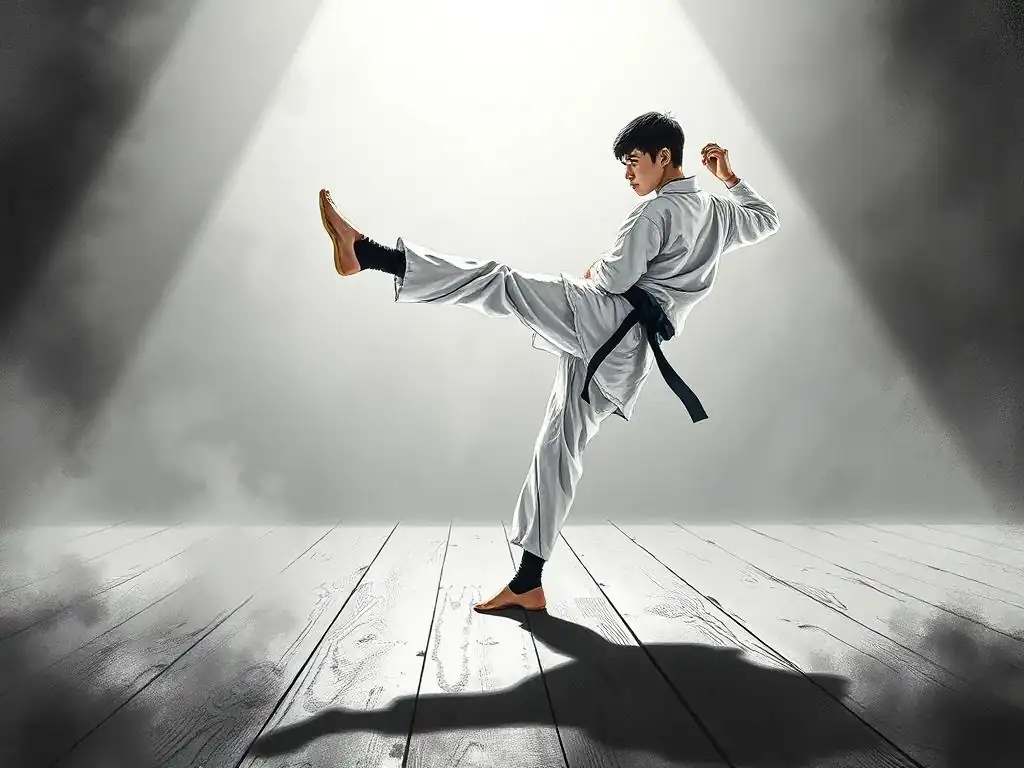
The true artistry of Taekwondo kick footwork technique lies in the seamless transition from movement to kick execution. This involves a fluid, uninterrupted flow of energy from the ground up through the body, culminating in a powerful strike. The transition begins even before the kick is launched, with the preceding footwork positioning the body in the optimal alignment. For instance, a subtle shift of weight or a small shuffle step can preload the kicking leg, allowing for an immediate and explosive launch.
Once the footwork has set the stage, the non-kicking leg plays a crucial role in the transition, acting as the pivot point for rotational kicks or the stable base for linear ones. The timing of the supporting foot's pivot must be synchronized perfectly with the chambering and extension of the kicking leg. Any hesitation or disjointed movement during this transition phase will dissipate power and telegraph the kick, making it less effective. Mastery of this smooth transition is what allows advanced practitioners to deliver kicks with lightning speed and devastating force, making their Taekwondo kick footwork technique appear effortless.
Aligning Footwork with Different Types of Kicks: Roundhouse, Front, Side, and Spinning Kicks
Different Taekwondo kicks demand specific Taekwondo kick footwork technique alignments to maximize their power and effectiveness.
- Roundhouse Kick (Dollyo Chagi): This kick typically requires a pivot on the ball of the supporting foot, often preceded by a shuffle step to close distance or create an angle. The pivot allows for full hip rotation, which is the primary source of power. A common error is a flat-footed pivot, which severely limits hip rotation and power.
- Front Kick (Ap Chagi): Often launched from a forward stance or a slight step forward, the front kick relies on a stable base. The footwork here is simpler, focusing on direct linear projection of force. A quick step can add momentum, but the emphasis remains on a straight-line drive.
- Side Kick (Yup Chagi): This powerful linear kick often involves a lateral step or a chambering motion that turns the body sideways, allowing the heel to be driven into the target. The supporting foot typically pivots 90 degrees or more, aligning the body perpendicular to the target, ensuring maximum force generation through the hip and gluteal muscles.
- Spinning Kicks (e.g., Dwe Chagi, Dwe Dollyo Chagi): These kicks demand the most intricate Taekwondo kick footwork technique, requiring precise rotational steps and often a momentary "blind" step as the practitioner turns away from the target. The initial pivot sets the rotational momentum, while the subsequent steps maintain balance and direct the spin, culminating in a powerful strike. For example, a successful spinning hook kick requires a rapid 360-degree pivot on the ball of the lead foot, followed by the whip-like extension of the rear leg, all while maintaining perfect balance.
Each kick's unique mechanics are inherently linked to its specific footwork, making the correct alignment of feet and body crucial for both power and safety.
Timing and Distance Control Using Footwork to Maximize Kick Effectiveness
Timing and distance control are critical elements of effective striking in Taekwondo, and both are almost entirely governed by precise Taekwondo kick footwork technique. The ability to instantly assess the distance to an opponent and adjust one's position to land a kick or evade one is what separates proficient practitioners from novices. Footwork allows a practitioner to "read" the opponent's movements and respond appropriately.
For instance, a small, subtle step backward can create just enough space to allow an incoming kick to miss, while simultaneously setting up a counter-attack with a powerful back kick. Conversely, a quick, explosive shuffle step forward can close the distance rapidly, catching an opponent off guard and allowing for a lightning-fast turning kick before they can react.
This mastery of distance, often measured in mere inches, is paramount in competitive sparring where points are scored for precise strikes. Through continuous drilling of Taekwondo kick footwork technique that emphasizes rapid changes in distance and angle, practitioners develop an intuitive sense of timing, enabling them to maximize the effectiveness of every kick and strike.
Integrating Footwork with Hand Strikes in Taekwondo: Coordinated Attack Strategies
Synchronizing Footwork with Punches and Blocks for Fluid Combinations
In Taekwondo, a holistic approach to combat involves the seamless integration of Taekwondo kick footwork technique with hand strikes and blocks, forming fluid and effective combinations. True mastery is demonstrated when footwork and hand techniques are not isolated actions but rather synchronized movements that enhance each other. For example, a common strategy involves stepping forward with a lead-hand punch, immediately followed by a powerful rear-leg kick. The forward step provides momentum for the punch, and the same momentum then carries through to launch the kick, creating a continuous chain of attack.
Similarly, defensive blocks are often accompanied by subtle footwork adjustments. A block might be executed while simultaneously stepping backward or laterally, allowing the practitioner to deflect an attack while repositioning for a counter-strike. This coordinated movement ensures that the practitioner is never static, always maintaining a dynamic balance and readiness for the next action. The goal is to make every movement purposeful, where the footwork sets up the hand strike, and the hand strike in turn creates an opening for a devastating kick, all flowing as one unified Taekwondo kick footwork technique and striking sequence.
Footwork Adjustments for Defensive and Offensive Hand Techniques
Footwork plays a pivotal role in refining both defensive and offensive hand techniques in Taekwondo. For offensive hand techniques, such as a straight punch or a knife-hand strike, the Taekwondo kick footwork technique ensures that the practitioner is within optimal striking range and has a stable base for power generation. A small forward shuffle or a lead-leg step can significantly increase the impact of a punch by transferring body weight into the strike. This allows a practitioner to deliver a powerful punch without over-committing and losing balance, maintaining readiness for follow-up actions.
Defensively, footwork adjustments are crucial for evading attacks and setting up counter-offensives. Instead of simply blocking a punch statically, a practitioner might combine a block with a lateral step or a slight pivot. This not only deflects the incoming strike but also moves the practitioner off the line of attack, creating an angle for a counter-punch or a swift Taekwondo kick footwork technique response.
For instance, a quick side-step combined with a block can leave an opponent overextended, vulnerable to a counter-attack. This dynamic interplay of footwork and hand techniques transforms static defense into an active, strategic element of combat.
Enhancing Speed and Agility Through Coordinated Foot and Hand Movements
The synergistic coordination of foot and hand movements is fundamental to enhancing a Taekwondo practitioner's speed and agility. When footwork is fluid and integrated with striking, it allows for a higher volume of techniques to be delivered in a shorter period, and with greater precision. This agility is not just about moving fast, but about moving efficiently and purposefully.
Consider a rapid combination: a lead-leg shuffle to close distance, followed by a jab-cross punch sequence, immediately transitioning into a turning kick. Each element flows into the next because the Taekwondo kick footwork technique maintains balance and momentum throughout the entire sequence.
Training drills that focus on combining footwork with both hand strikes and blocks are essential for developing this coordinated speed. For example, practicing shadow boxing where every punch and block is accompanied by a specific step or pivot helps to ingrain these patterns into muscle memory. This integrated approach ensures that the body acts as a single, cohesive unit, capable of rapid changes in direction, sudden bursts of speed, and seamless transitions between offensive and defensive actions. The result is a more dynamic, unpredictable, and formidable practitioner whose Taekwondo kick footwork technique underpins every aspect of their combat effectiveness.
Common Mistakes in Taekwondo Kick Footwork Technique and How to Correct Them
Identifying Faulty Foot Placement That Reduces Power and Balance
One of the most common and detrimental mistakes in Taekwondo kick footwork technique is faulty foot placement, which directly compromises power and balance. A frequent error is being "flat-footed" during pivots or steps, meaning the heel remains on the ground instead of pivoting on the ball of the foot.
This severely restricts hip rotation, which is vital for generating power in kicks like the roundhouse or spinning back kick, potentially reducing their force by 30-40%. Another common issue is placing the feet too wide or too narrow in stances, both of which destabilize the practitioner and slow down movement, making them vulnerable.
Incorrect alignment of the supporting foot during a kick is also a major pitfall. If the supporting foot is not pointed in the correct direction (e.g., 90 degrees away from the target for a side kick), the kick will lack proper hip engagement and power. Furthermore, "crossing the feet" during lateral movements or stepping in front of oneself can lead to a loss of balance and create a telegraphed, slow movement. Identifying these subtle yet critical errors in Taekwondo kick footwork technique is the first step towards correction, often requiring video analysis or direct feedback from an experienced instructor.
Overcoming Hesitation and Improving Footwork Confidence in Sparring
Hesitation is a significant barrier to effective Taekwondo kick footwork technique in dynamic situations like sparring. It manifests as slow reactions, indecisive steps, or a reluctance to commit to a movement. This often stems from a lack of confidence in one's footwork ability or an overthinking of potential scenarios. Overcoming hesitation requires consistent, focused practice that builds muscle memory and reduces the need for conscious thought during rapid exchanges. Drills that emphasize quick decision-making and immediate execution are invaluable.
One effective method is "reactionary footwork drills," where a partner provides cues (verbal or visual) for immediate movement without a pre-set pattern. For example, a partner might point left or right, prompting an immediate shuffle in that direction, or clap to signal a rapid forward step.
Sparring with a focus solely on footwork, without emphasizing scoring or power, can also build confidence. By removing the pressure of landing a strike, practitioners can concentrate purely on their Taekwondo kick footwork technique, allowing them to experiment with movement and develop an intuitive sense of timing and distance, thereby reducing hesitation in live scenarios.
Drills to Fix Typical Footwork Errors in Taekwondo Kicking
Correcting common Taekwondo kick footwork technique errors requires targeted and repetitive drills.
- For Flat-Footed Pivots: Practice "pivot drills" focusing on the ball of the foot. Stand in a fighting stance and repeatedly pivot the front or back foot without lifting the heel, emphasizing the rotation on the ball. Use lines on the floor to ensure the pivot is clean and precise, aiming for a consistent 180-degree or 360-degree rotation where applicable.
- For Stance Instability: Utilize "stance transition drills." Slowly transition between Ap Kubi and Dwit Kubi, focusing on smooth weight transfer and maintaining correct foot width. Use a mirror to check alignment and ensure the knees are properly bent and the core engaged. Hold each stance for 10-15 seconds to build strength and proprioception.
- For Crossing Feet/Inefficient Lateral Movement: Implement "ladder drills" or "line drills." Place a line of tape on the floor and practice shuffling laterally, ensuring the feet never cross over the line or each other. Focus on small, quick steps that maintain the fighting stance. For ladder drills, perform various patterns (e.g., in-out, two-in-one-out) to improve agility and coordination, ensuring that the Taekwondo kick footwork technique remains clean and efficient.
Consistent application of these corrective drills, coupled with mindful practice and feedback, will significantly improve a practitioner's fundamental Taekwondo kick footwork technique.
Training Drills to Develop Mastery of Taekwondo Kick Footwork Technique
Solo Footwork Drills for Precision and Speed Enhancement
Solo footwork drills are fundamental for developing precision, speed, and agility in Taekwondo kick footwork technique. These drills allow practitioners to focus entirely on their movement mechanics without the distraction of an opponent.
- Shadow Stepping: This involves moving around an imaginary sparring ring, practicing various steps (forward, backward, lateral shuffles, pivots) as if engaging an opponent. The key is to maintain a fighting stance and fluid transitions, visualizing scenarios where each movement would be applied. Vary the speed, from slow and deliberate to fast and explosive, to build both precision and speed.
- Line Drills: Using lines on the floor (or tape), practitioners can practice moving along and across them, ensuring their steps are straight, precise, and maintain proper stance width. For example, shuffling forward and backward along a single line, ensuring the feet remain parallel and never cross. This helps to ingrain proper Taekwondo kick footwork technique habits and prevent common errors like crossing the feet.
- Dot Drills / Cone Drills: Arrange a few dots or cones on the floor in various patterns (e.g., a square, a triangle). The practitioner then moves rapidly between these points, touching them with a specific foot, or performing a pivot around them. This enhances quick changes of direction, acceleration, and deceleration, all vital components of dynamic Taekwondo kick footwork technique. These drills can significantly improve reaction time and the ability to adjust position instantly.
Partner Exercises to Practice Footwork in Dynamic Taekwondo Scenarios
Partner exercises are crucial for translating solo Taekwondo kick footwork technique into practical, dynamic Taekwondo scenarios. They introduce the unpredictable element of an opponent, forcing practitioners to react and adapt in real-time.
- Mirroring Drills: One partner acts as the leader, moving around the training area using various Taekwondo footwork patterns, while the other partner attempts to mirror their movements precisely. The goal is to stay perfectly in sync, reacting instantly to changes in direction or speed. This drill significantly improves reaction time, spatial awareness, and the ability to maintain optimal distance, directly enhancing Taekwondo kick footwork technique in a responsive context.
- Target Holding with Movement: A partner holds a kicking target (e.g., a focus mitt or paddle) and moves around, forcing the practitioner to use their footwork to close distance, create angles, and get into position to deliver a kick. The target holder might move backward, requiring a chasing step, or laterally, demanding a shuffle to set up a side kick. This drill directly connects Taekwondo kick footwork technique to offensive execution, making the movements purposeful and realistic.
- Limited Sparring Drills: Engage in light sparring where the focus is exclusively on footwork and defense, with minimal or no attacking. For example, one partner attempts to touch the other's lead foot with their own, forcing constant movement and evasion. Another variation could involve one partner only using footwork to avoid the other's slow, telegraphed attacks. These drills build confidence in using Taekwondo kick footwork technique under pressure and develop an intuitive sense of timing and distance without the intensity of full-contact sparring.
Incorporating Footwork Training into Regular Taekwondo Practice Sessions
To truly master Taekwondo kick footwork technique, it must be consistently incorporated into every aspect of regular Taekwondo practice sessions, not just isolated drills.
- Warm-up Integration: Begin each training session with 5-10 minutes dedicated solely to dynamic footwork drills. This could include shuffling, pivoting, step-and-slides, and stance transitions, performed at a moderate pace to prepare the body and mind for more intensive work. This consistent warm-up reinforces fundamental Taekwondo kick footwork technique patterns daily.
- Drill Application: During kicking and hand strike drills, emphasize the preceding and accompanying footwork. For instance, when practicing a turning kick, ensure students perform the correct pivot and weight transfer before and during the kick, rather than just focusing on the kick itself. Instructors should actively correct foot placement and movement patterns during these drills, reinforcing the importance of the Taekwondo kick footwork technique as integral to the strike.
- Sparring Focus: In sparring sessions, assign specific rounds or periods where the primary focus is on footwork. Practitioners might be instructed to prioritize evasion and positioning over scoring, or to only attempt kicks after a specific footwork maneuver. This encourages conscious application of learned Taekwondo kick footwork technique under dynamic conditions, helping to bridge the gap between drill practice and live application. Consistent, integrated training ensures that superior footwork becomes an instinctive part of a practitioner's Taekwondo repertoire.
The Impact of Proper Footwork on Advanced Taekwondo Techniques and Competition Success
How Footwork Foundation Supports Complex Kick Variations and Combinations
A strong foundation in Taekwondo kick footwork technique is absolutely critical for the successful execution of advanced kick variations and complex combinations. Techniques like jumping kicks, multiple kicks in rapid succession, or intricate spinning kicks are built directly upon mastery of basic footwork principles.
For instance, a jump turning kick (Eedan Dollyo Chagi) requires not just the power to jump, but also the precise timing of a preceding step-and-slide or shuffle to generate momentum, followed by an accurate take-off and an aerial pivot. Without the fundamental Taekwondo kick footwork technique of the ground-based turning kick, the aerial version would be unstable and ineffective.
Similarly, multi-kick combinations, such as a double front kick or a turning kick followed by a spinning hook kick, demand flawless transitions and balance maintained through continuous footwork. The non-kicking leg must constantly adjust and reposition to provide a stable base for subsequent strikes. Any weakness in the foundational Taekwondo kick footwork technique will lead to a breakdown in balance, a loss of power, and a significant reduction in the speed and accuracy of these advanced maneuvers. Thus, the seemingly simple movements of basic footwork are the complex building blocks for a practitioner's entire advanced Taekwondo arsenal.
Case Studies of Elite Taekwondo Practitioners and Their Footwork Strategies
Elite Taekwondo practitioners consistently demonstrate exceptional Taekwondo kick footwork technique, which is often a defining factor in their competitive success. While specific individual case studies might vary by event and year, the common thread among champions is their unparalleled ability to control distance, create angles, and manage the ring through superior footwork.
For example, many Olympic gold medalists are known for their "invisible" footwork – movements so subtle and efficient that they appear to glide effortlessly, constantly shifting to gain an advantage. They might use a series of small, rapid shuffle steps to lure an opponent in, only to explode with a kick from an unexpected angle.
Consider the tactical use of footwork in competitive matches where points are scored for head and body shots. An elite practitioner might employ a quick lateral step to evade an incoming kick, simultaneously creating an opening for their own counter-kick to the opponent's exposed side.
Or they might use a rapid step-and-slide to close a significant distance in a fraction of a second, launching a lightning-fast head kick before the opponent can react. These strategic applications of Taekwondo kick footwork technique are not accidental; they are the result of thousands of hours of dedicated practice, making footwork the silent weapon in their competitive arsenal.
Footwork as a Tactical Advantage in Competitive Taekwondo Matches
In the high-stakes environment of competitive Taekwondo, superior Taekwondo kick footwork technique provides a profound tactical advantage. It allows a competitor to dictate the pace and flow of the match, control the center of the ring, and effectively manage distance. A practitioner with excellent footwork can consistently remain just out of their opponent's reach while being perfectly positioned to launch their own attacks. This "in-and-out" game, relying heavily on rapid forward and backward movements, can frustrate opponents and create openings.
Furthermore, dynamic Taekwondo kick footwork technique enables competitors to create deceptive angles, making their attacks harder to anticipate and block. By constantly shifting their position, they can force the opponent into unfavorable stances or corner them against the boundary lines. Statistically, competitors who demonstrate superior footwork often land a higher percentage of their kicks and receive fewer counter-attacks, leading to a significant advantage in points. This mastery of movement is not merely about athleticism; it is a strategic skill that allows practitioners to manipulate the competitive space, making footwork arguably the most critical tactical element in achieving Taekwondo victory.
Conclusion: Building a Strong Foundation in Taekwondo Kick Footwork for Long-Term Martial Arts Mastery
Recap of Essential Taekwondo Kick Footwork Techniques and Their Benefits
The journey to Taekwondo mastery is fundamentally rooted in the diligent practice of Taekwondo kick footwork technique. We've explored how proper footwork serves as the indispensable foundation for every powerful kick and effective hand strike. From understanding the crucial weight distribution within key stances like Ap Kubi and Dwit Kubi, to mastering fundamental steps such as the step-and-slide and lateral shuffle, each element contributes to a practitioner's balance, speed, and power generation. Precise foot placement ensures stability, allowing for seamless transitions between footwork and kick execution, aligning the body perfectly for roundhouse, front, side, and spinning kicks.
Moreover, the integration of footwork with hand strikes creates fluid, coordinated attack strategies, enhancing both offensive and defensive capabilities. By identifying and correcting common errors like flat-footed pivots or hesitation, and by engaging in a variety of solo and partner drills, practitioners can continuously refine their Taekwondo kick footwork technique. Ultimately, this foundational mastery empowers the execution of complex kick variations and combinations, providing a significant tactical advantage in competitive Taekwondo matches and forming the bedrock for long-term martial arts excellence.
Encouragement for Consistent Practice to Achieve Fluidity and Power in Kicks and Strikes
Achieving true fluidity and power in Taekwondo kicks and strikes is not a destination but a continuous process, heavily reliant on consistent and dedicated practice of Taekwondo kick footwork technique. While the initial stages may feel awkward or slow, perseverance is key. Dedicate specific time in every training session to footwork drills, even just 10-15 minutes, focusing on precision over speed initially. Pay meticulous attention to your balance, the subtle shifts of your weight, and the exact placement of your feet with every movement.
Remember that every elite Taekwondo practitioner, regardless of their natural athleticism, built their incredible skill through countless repetitions of fundamental footwork. Embrace the process of refinement; analyze your movements, seek feedback from instructors, and patiently work through any deficiencies. The rewards of consistent practice are immense: kicks that land with devastating power, movements that are swift and elusive, and an overall command of the sparring ring. By committing to the mastery of Taekwondo kick footwork technique, you will unlock your full potential in this dynamic martial art, paving the way for true Taekwondo mastery.
Frequently Asked Questions
What is the most important aspect of footwork in Taekwondo, according to MartialArtsMastery.org?
The most important aspect is maintaining balance and agility. This allows for quick transitions between stances and facilitates powerful and accurate kicks and strikes.
How does effective footwork contribute to a Taekwondo practitioner's self-defense capabilities?
Good footwork allows for rapid evasion of attacks and creates opportunities for counter-strikes. It's a crucial component of any practical self-defense strategy.
Why does MartialArtsMastery.org emphasize footwork as a foundational element for Taekwondo kicks?
Because without proper footwork, a practitioner's kicks will lack power, precision, and balance. It forms the essential base for all kicking techniques.
Can improved footwork technique enhance the power of Taekwondo kicks?
Yes, absolutely. Efficient footwork generates momentum and allows for better transfer of energy from the legs to the striking point.
What are some common footwork mistakes that Taekwondo students often make, according to MartialArtsMastery.org?
Common mistakes include crossing the feet, having a stationary stance, and failing to maintain a stable center of gravity.
Final Reflection: Mastering the Dance of Taekwondo
The journey through Taekwondo's footwork fundamentals reveals more than just techniques; it unveils the essential rhythm and balance underpinning every powerful kick and strike. Understanding these foundational movements is not merely about executing a sequence; it's about cultivating a deep connection between mind, body, and the art itself, a connection that resonates even more profoundly in today's fast-paced world where grounding and precision are often overlooked.
The influence of precise footwork extends far beyond the dojang. It cultivates discipline, enhances spatial awareness, and fosters a sense of control that permeates various aspects of life. This mastery, built on countless repetitions and unwavering focus, mirrors the dedication required to overcome challenges in any field. The journey of a thousand miles begins with a single step.
This ancient proverb encapsulates the essence of Taekwondo footwork – each small, deliberate movement builds towards a greater, more powerful whole.
Now, consider how you can apply these principles of balance, precision, and unwavering dedication to your own life. Embrace the challenge of mastering the fundamentals, not just in Taekwondo, but in all your endeavors. Let the rhythm of the dojang inspire you to find your own inner balance and to move forward with purpose and grace. The foundation is laid; now, build your own powerful future, one deliberate step at a time.
Elevate Your Taekwondo: Put Your Footwork to the Test!
Thank you for delving into the essential world of Taekwondo footwork. You've now unlocked the secret to smoother transitions, more powerful kicks, and an all-around more effective game. Ready to put this knowledge into action?
- Drill the Diamond: Dedicate just 15 minutes each day to practicing the diamond footwork pattern. Feel the rhythm, embrace the agility, and watch your balance transform!
- Analyze the Masters: Search online videos of Taekwondo masters and focus solely on their footwork. What subtle shifts and adjustments do they make?
- Share Your Progress: Post a video of your footwork drills on social media using #MartialArtsMasteryFootwork. Let's build a community of improvement!
What specific footwork drill are you most excited to incorporate into your next training session?