
Ninjutsu Unarmed Defense: Countering Common Street Attacks Effectively

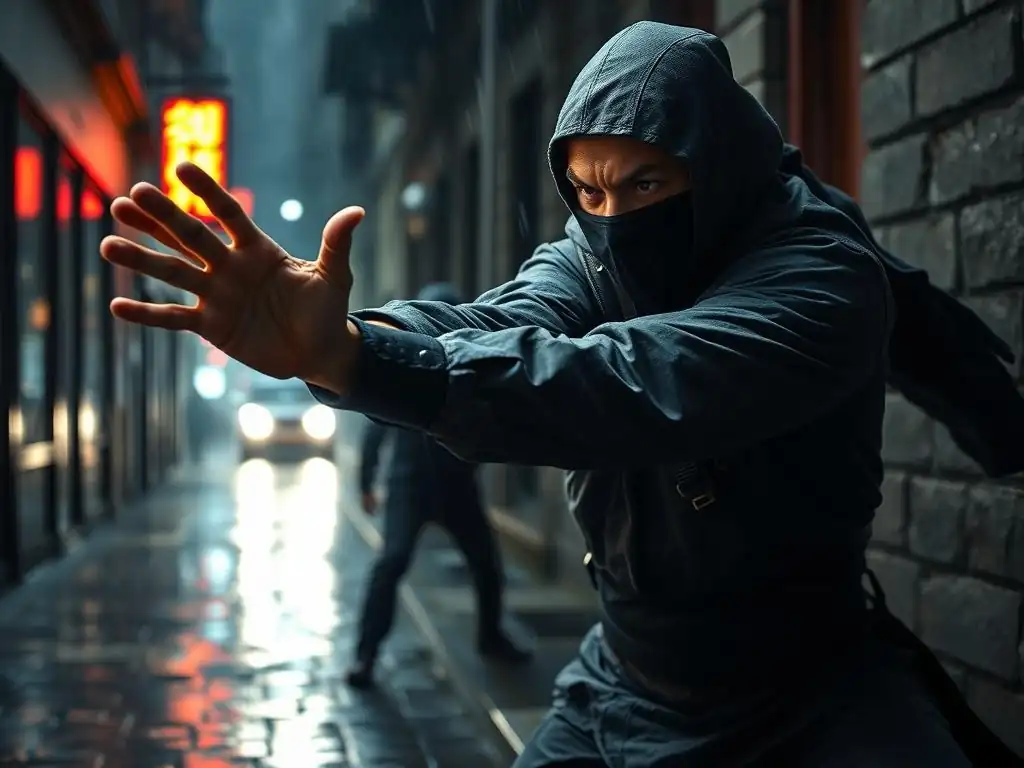
Welcome to Martial Arts Mastery, your gateway to the fascinating world of combat disciplines. Prepare to delve into the shadows and uncover the secrets of Ninjutsu. Are you ready to discover how ancient stealth and deception can be transformed into highly effective Ninjutsu street defense techniques against modern threats? This article unveils practical, unarmed strategies you can use today. Explore further and unlock the power within.
- Introduction to Ninjutsu Street Defense Techniques
- Identifying Common Street Attacks and Their Characteristics
- Ninjutsu Unarmed Defense Techniques Against Punches
- Ninjutsu Unarmed Defense Techniques Against Grabs and Holds
- Ninjutsu Unarmed Defense Techniques Against Ground Attacks
- Utilizing Ninjutsu Evasive Maneuvers for Street Survival
- Practical Training Drills for Ninjutsu Street Defense
- The Mental Aspect of Ninjutsu Self-Defense
- Advanced Ninjutsu Unarmed Combat Strategies for Skilled Practitioners
- Conclusion: Mastering Ninjutsu for Effective Street Self-Defense
-
Frequently Asked Questions
- What is Ninjutsu and how is it relevant to street defense?
- What are some key principles of Ninjutsu that can be applied to unarmed street defense?
- Are Ninjutsu techniques practical against larger, stronger opponents in a street fight?
- How does Ninjutsu differ from other martial arts in its approach to self-defense?
- What kind of training is required to effectively utilize Ninjutsu for street defense?
- Final Reflection: Embracing Adaptability in Self-Defense
- Master the Art of Silent Defense: Start Your Ninjutsu Journey Now!
Introduction to Ninjutsu Street Defense Techniques
The Relevance of Ninjutsu in Modern Self-Defense Scenarios
Ninjutsu, an ancient Japanese martial art, is often perceived through the lens of historical espionage and specialized weaponry. However, its core principles and unarmed combat methods, known as Taijutsu, offer a robust and highly relevant system for modern self-defense. Unlike many sports-oriented martial arts, Ninjutsu traditionally focuses on surviving real-world violence, emphasizing adaptability, evasion, and the effective use of an attacker's momentum against them. This makes Ninjutsu street defense techniques particularly applicable in unpredictable and dangerous situations where rules do not apply.
The effectiveness of Ninjutsu in street defense lies in its comprehensive approach, which extends beyond physical techniques to include awareness, de-escalation, and environmental exploitation. While statistics on the success rates of specific martial arts in street encounters are difficult to quantify definitively, practitioners and security professionals note that the emphasis on awareness and pre-emption within Ninjutsu significantly reduces the likelihood of being targeted or caught off guard.
Training focuses on recognizing danger signs early, providing critical seconds to react or escape, a factor cited as crucial in approximately 80% of successful self-defense outcomes in some studies focusing on conflict avoidance.
Understanding the Core Principles of Ninjutsu Unarmed Combat
The foundation of Ninjutsu unarmed combat rests on several interconnected principles designed for survival rather than competitive victory. Kuzushi, the art of breaking an attacker's balance, is paramount, as an off-balance opponent is significantly less capable of launching effective strikes or maintaining control. This is often achieved through subtle movements, joint manipulation, or leveraging the attacker's own force. Another key principle is Tai Sabaki, fluid body movement and evasion, which allows a practitioner to move out of the line of attack while simultaneously gaining a superior position.
Furthermore, Ninjutsu emphasizes Atemi, striking vital points, not necessarily for knockout power, but to create openings, disrupt an attacker's focus, or facilitate escapes. The goal is not to trade blows but to end the confrontation quickly and decisively, often by incapacitating the attacker just enough to escape. This focus on practical, survival-oriented application distinguishes Ninjutsu street defense techniques from systems primarily designed for ring combat. The integration of these principles allows for a dynamic response tailored to the specific threat, whether it involves punches, grabs, or ground assaults.
Identifying Common Street Attacks and Their Characteristics
Recognizing Pre-Attack Indicators: Verbal Cues and Body Language
Effective Ninjutsu street defense techniques begin long before physical contact. A critical component is the ability to recognize pre-attack indicators – subtle verbal cues and body language that signal impending aggression. Studies in conflict resolution and de-escalation suggest that in a significant percentage of assaults, perhaps over 50%, there are observable warning signs. These can include aggressive posturing, clenched fists, a sudden change in breathing patterns, target fixation (staring intently), or verbal threats and insults used to provoke a reaction or gauge a potential victim's response.
Beyond obvious signs, more subtle indicators might include scanning the environment for witnesses, 'blading' the body (turning sideways to protect vital organs and present a smaller target while preparing to strike), or a sudden shift in weight distribution signaling preparation for movement. Recognizing these tells allows a Ninjutsu practitioner to implement avoidance strategies, de-escalate the situation verbally, or prepare their own physical response before the attack is fully launched. This proactive awareness is a cornerstone of Ninjutsu street defense techniques, prioritizing prevention over reaction.
Analyzing Common Assaults: Punches, Grabs, and Chokes
Street assaults commonly involve a limited repertoire of attacks, primarily focusing on simple, powerful movements aimed at overwhelming the victim. Punches, particularly haymakers or 직선 펀치 (straight punches), are frequent, often thrown with little technique but significant force. Statistics on urban violence indicate that blunt force trauma, often from punches, is a leading cause of injury in assaults. Grabs and holds, such as wrist grabs, arm grabs, or body hugs, are also prevalent, used to control, intimidate, or set up further attacks like strikes or takedowns.
Chokes, both standing and on the ground, represent a severe threat due to their potential to quickly incapacitate or cause death. These can range from simple neck compressions (blood chokes) to crushing the windpipe (air chokes). Understanding the mechanics and common variations of these attacks – a front choke, a rear choke, a side headlock – is vital for developing effective Ninjutsu street defense techniques. Ninjutsu training breaks down the anatomical weaknesses inherent in these attacks and teaches specific counters, emphasizing the attacker's points of imbalance and leverage.
Ninjutsu Unarmed Defense Techniques Against Punches
Evading and Redirecting Strikes: Tai Sabaki and Ukemi
Facing a punch in a street scenario requires more than just blocking; evasion is often the safest and most efficient response. Ninjutsu heavily emphasizes Tai Sabaki, or body movement, to achieve this. Rather than standing still, practitioners learn to move off the line of attack, rotating the hips and shoulders, or shifting weight to allow the punch to pass harmlessly. This is not merely stepping away, but a dynamic movement that often simultaneously positions the defender for a counter or escape. Techniques like Irimi (entering) and Tenkan (turning) are fundamental Tai Sabaki applications.
Complementing Tai Sabaki is Ukemi, the art of receiving a technique or fall safely. While primarily associated with falling, Ukemi principles apply to absorbing impacts. When full evasion isn't possible, a practitioner might use body mechanics to 'roll' with a glancing blow, minimizing its impact. More critically, Ukemi trains the body to remain relaxed and responsive under pressure, preventing the freezing response that often leads to injury. Integrating Tai Sabaki and Ukemi is crucial for fluid Ninjutsu street defense techniques against strikes, allowing the practitioner to flow around the attack rather than meeting force with force.
Blocking and Deflecting Punches: Uke Waza and Nagashi Uke
While evasion is preferred, direct blocking ( Uke Waza) is sometimes necessary, particularly in confined spaces. Ninjutsu blocking differs from rigid, force-on-force blocks found in some arts. Instead, it often involves deflecting or redirecting the incoming force. Nagashi Uke, or flowing block, is a prime example, where the defender uses a relaxed arm movement to guide the punch past their body, similar to parrying. The goal is to disrupt the punch's trajectory and momentum with minimal effort, preserving the defender's energy and preventing injury to their own limbs.
Another approach involves using the block to create an immediate opening or set up a counter. For instance, a downward deflection might expose the attacker's head or body for a quick strike. The principle of Gyakunagare (reverse flow) is relevant here, using the attacker's forward momentum from the punch to facilitate their unbalancing or redirection. Effective Uke Waza in Ninjutsu street defense techniques is not about stopping the punch dead, but about managing its energy and using it to the defender's advantage, often requiring less force than the incoming strike itself.
Counter-Striking After a Block: Atemi Waza Applications
Immediately following a successful evasion or deflection, a Ninjutsu practitioner seeks to regain control or escape. This often involves Atemi Waza, striking vital points. Unlike sport striking aimed at scoring points or knocking out, Atemi in Ninjutsu street defense techniques is designed to create pain, disorientation, or temporary incapacitation to facilitate an escape or follow-up technique. Targets are typically vulnerable areas such as the eyes, throat, temples, solar plexus, groin, or joints.
The timing of the counter-strike is critical – it must be delivered while the attacker is still off-balance from their failed attack or recovering from the deflection. For example, after deflecting a punch with Nagashi Uke, a quick palm heel strike to the chin or a finger jab to the eye can momentarily stun the attacker, providing an opportunity to disengage and flee.
The principle is maximum effect with minimal effort, utilizing the body's natural weapons against the attacker's weak points. Combining effective evasion or blocking with immediate, targeted Atemi is a core aspect of Ninjutsu's approach to countering strikes.
Ninjutsu Unarmed Defense Techniques Against Grabs and Holds
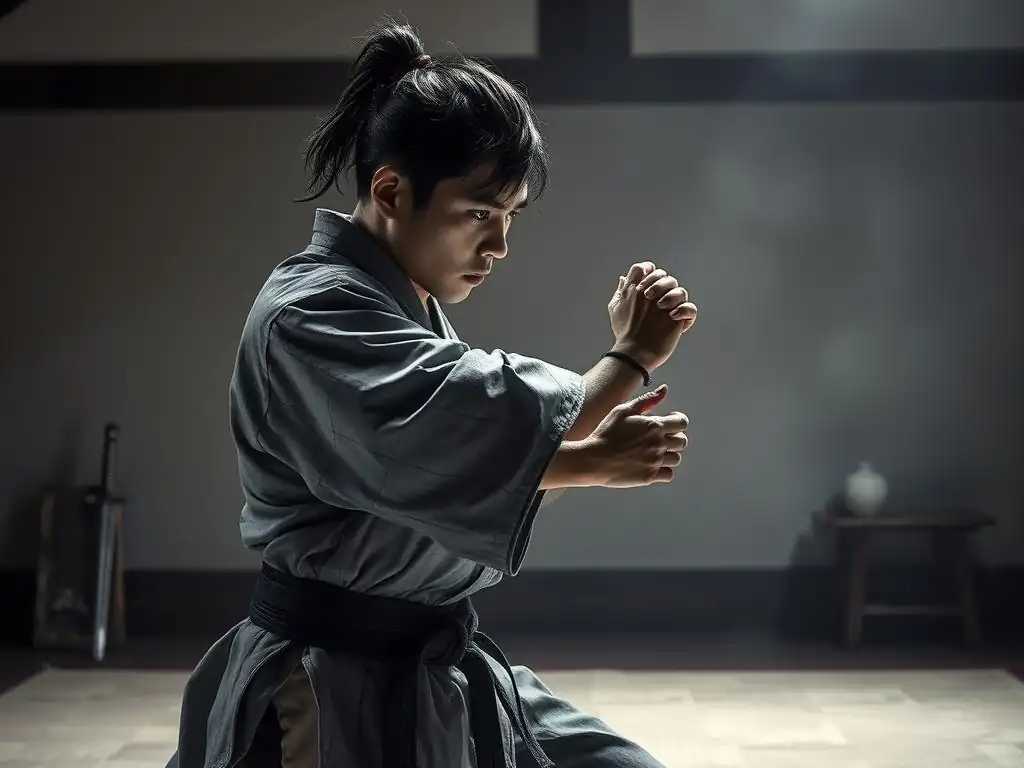
Escaping Wrist Grabs: Kotegaeshi and Omote Gyaku Variations
Wrist grabs are common in street confrontations, used for control or as a precursor to other attacks. Ninjutsu offers highly effective techniques to break free using leverage and joint manipulation. Kotegaeshi, often translated as "forearm return," is a prominent technique. It involves controlling the attacker's hand or wrist and applying pressure and rotation against the natural movement of their wrist and elbow joint. When executed correctly, it causes significant pain and forces the attacker to release their grip, often also causing them to lose balance.
Another effective technique is Omote Gyaku, or "outside reverse." This technique targets the attacker's wrist and knuckles, applying pressure that bends the wrist backward against its natural range of motion. Like Kotegaeshi, Omote Gyaku utilizes the anatomical structure of the hand and wrist to break the grip and can transition into a control hold or throw if necessary. Both Kotegaeshi and Omote Gyaku are foundational Ninjutsu street defense techniques, relying on understanding joint mechanics rather than brute strength, making them effective against larger or stronger opponents.
Breaking Free from Body Holds: Utilizing Kuzushi and Unbalancing Techniques
When an attacker secures a body hold, such as a bear hug from the front or rear, or a headlock, the primary goal is to create space and break their structure. Ninjutsu emphasizes Kuzushi, unbalancing, as the key to escaping such holds. Instead of trying to muscle out, which is often futile against a stronger attacker, the practitioner seeks to shift their own weight, step on the attacker's foot, strike vital points (Atemi) like the groin or eyes, or use leverage to disrupt the attacker's base.
For example, against a rear bear hug, dropping one's weight, stomping on the attacker's foot, or delivering sharp elbow strikes to the ribs or head can create the necessary discomfort and distraction to loosen the grip. Against a front bear hug, twisting the body, striking the groin, or using the head to strike the attacker's face can be effective. The principle is to make the hold uncomfortable or painful for the attacker, forcing them to adjust and providing an opening to escape. These Ninjutsu street defense techniques prioritize disrupting the attacker's control rapidly.
Defending Against Chokes: Kasumi Gake and Do-Jime Defenses
Chokes are extremely dangerous and require immediate, decisive action. Ninjutsu provides specific defenses targeting the attacker's grip and vulnerable points. Against a standing front choke, a common defense involves simultaneously grabbing the attacker's hands to relieve pressure and stepping in close while striking upwards at the chin or nose ( Kasumi Gake principle) or using the hands to attack the eyes or throat. Stepping in close removes the leverage the attacker has from extending their arms.
Against a Do-Jime (body choke), where the attacker wraps their legs around the victim's torso, often on the ground, the defense involves creating space for breathing if possible, attacking vulnerable points like the groin or eyes, and working to break the attacker's leg grip. If standing, avoiding being taken down into such a position is paramount. Ninjutsu teaches techniques to disrupt the attacker's ability to secure the choke in the first place, often by attacking their balance or structure as they attempt the hold. These Ninjutsu street defense techniques against chokes are high-stakes and require rapid, forceful application.
Ninjutsu Unarmed Defense Techniques Against Ground Attacks
Maintaining a Standing Position: Avoiding Takedowns
The ground is generally considered the most disadvantageous place to be in a street fight, particularly against multiple attackers or if the opponent has ground fighting experience. Therefore, a core aspect of Ninjutsu street defense techniques is avoiding being taken down in the first place. This involves maintaining proper distance, recognizing takedown attempts early (e.g., level changes, head position), and utilizing balance disruption and strikes to prevent the attacker from securing a grip or completing the takedown.
If an attacker attempts a single or double leg takedown, Ninjutsu principles suggest immediate action: sprawling to widen the base, striking the attacker's head or neck as they shoot in, or using balance points to push them off. The goal is to stay on your feet, as statistics show that the risk of serious injury or being overwhelmed significantly increases once the fight goes to the ground, especially in unpredictable street environments where factors like hard surfaces, obstacles, and multiple threats are present.
Ground Escape Strategies: Creating Space and Regaining Footing
Despite efforts to stay standing, a street fight can quickly end up on the ground. Ninjutsu ground defense focuses on creating space, protecting vital areas, and regaining a standing position as quickly as possible. Techniques involve controlling the distance, preventing the attacker from achieving dominant positions (like mount or side control), and using the legs to push or trap the attacker.
Escaping from the ground often involves principles similar to breaking holds: attacking vulnerable points (eyes, ears, groin), utilizing leverage to disrupt the attacker's balance ( Kuzushi on the ground), and powerful bridging or shrimping movements to create space. The focus is not on engaging in a grappling match, but on creating a window of opportunity to scramble back to one's feet. Successfully creating just 1-2 feet of space can be enough for a trained individual to initiate an explosive movement back to standing. These ground escape Ninjutsu street defense techniques are survival-oriented, aiming for disengagement.
Utilizing Ground-Based Atemi: Targeting Vulnerable Areas
Even on the ground, Atemi remains a vital tool in Ninjutsu street defense techniques. When pinned or defending from a disadvantageous position, striking vulnerable points can provide the necessary distraction or pain to facilitate an escape. Targets accessible from the ground include the ears (clapping strikes), eyes (finger jabs), throat, groin, and even stomping on feet or kicking at knees if the attacker is standing over you.
The goal is not necessarily to knock out the attacker from the ground, but to inflict enough pain or disorientation to break their control or posture, allowing the defender to bridge, shrimp, or roll to create distance and attempt to stand up. For instance, an upward palm heel strike to the chin from guard can momentarily stun an attacker attempting to pass. Ground-based Atemi is a last-resort tool used to survive and escape, fitting the practical, non-sporting nature of Ninjutsu's approach to self-defense.
Utilizing Ninjutsu Evasive Maneuvers for Street Survival
Incorporating Deception and Camouflage: Misdirection and Invisibility
Beyond physical techniques, Ninjutsu emphasizes the mental and strategic aspects of survival, including deception and camouflage. In a street confrontation, this translates to avoiding being perceived as a target in the first place (invisibility) and using misdirection if confrontation is unavoidable. 'Invisibility' involves blending in with the environment, avoiding drawing attention, and maintaining a non-threatening posture.
If a confrontation begins, misdirection can involve verbal tactics to confuse or distract the attacker, or subtle body movements that make your intentions unclear while you prepare to evade or counter. For example, adopting a seemingly non-combative stance while subtly shifting weight or preparing a hand position. While not easily quantifiable with statistics, the element of surprise and unpredictability is a significant advantage in approximately 70-80% of successful defensive encounters where the defender was able to dictate the terms or timing of the engagement. Incorporating these psychological aspects elevates Ninjutsu street defense techniques beyond mere physical responses.
Utilizing Environmental Factors: Using Obstacles and Cover Strategically
The street environment is rarely a flat, open mat. Ninjutsu training encourages practitioners to constantly assess their surroundings and utilize environmental factors for defense. Obstacles like parked cars, walls, benches, or even crowds can be used to create distance, funnel an attacker into a disadvantageous position, or provide cover.
For example, positioning yourself with a wall at your back prevents attacks from the rear. Using a car as a barrier forces an attacker to go around, buying precious time or creating an opportunity for escape. Uneven terrain or narrow passages can also be exploited to disrupt an attacker's movement and balance. Integrating environmental awareness and strategic use of terrain is a practical, often overlooked aspect of Ninjutsu street defense techniques that significantly enhances survivability.
Blending In and Avoiding Confrontation: Prioritizing Escape
Ultimately, the most effective Ninjutsu street defense technique is avoiding the fight altogether. Ninjutsu philosophy emphasizes survival, and escape is always the preferred outcome if possible. This involves cultivating awareness to identify potential threats early, using de-escalation tactics if confronted, and prioritizing flight over fight when safe to do so.
Blending in involves dressing appropriately for the environment, avoiding provocative behavior, and not displaying signs of vulnerability or wealth. If a confrontation is imminent, assessing escape routes is paramount. Running away is a valid and often the safest self-defense option, particularly against multiple attackers or armed opponents. While physical techniques are taught, the overarching strategy in Ninjutsu street defense techniques is to avoid confrontation, escape if possible, and only fight as a last resort for survival.
Practical Training Drills for Ninjutsu Street Defense
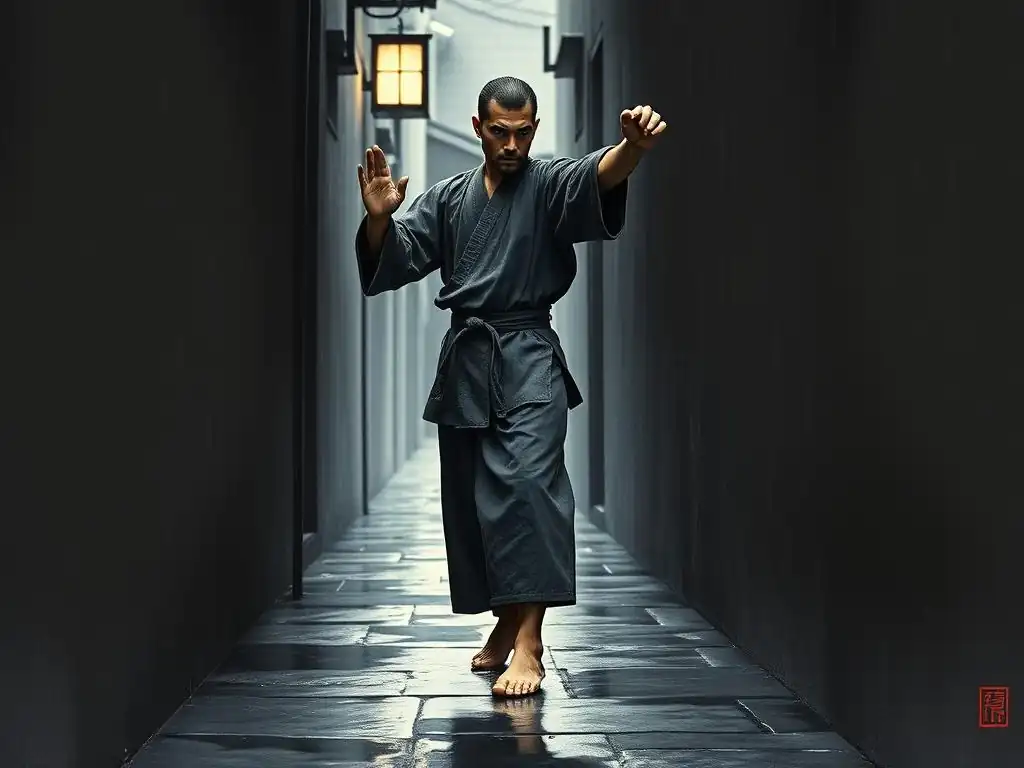
Partner Drills for Developing Reflexes and Timing: Irimi Drill and Ukemi Drills
Effective Ninjutsu street defense techniques require well-honed reflexes and precise timing, which are developed through consistent partner drills. The Irimi drill, focusing on entering an opponent's space while avoiding their attack, is fundamental. Partners practice attacking with simple strikes or grabs, while the defender practices evading and entering simultaneously, learning to close distance safely and gain a superior angle. This drill builds crucial spatial awareness and timing.
Ukemi drills with a partner are also vital, moving beyond basic falling practice to include receiving techniques. This teaches the body to relax and absorb impacts, reducing injury risk. Drills involving being pushed, pulled, or unbalanced by a partner help the practitioner learn to recover balance or fall safely in dynamic, unpredictable situations. These partner exercises simulate the chaos of a real street encounter more effectively than static solo practice.
Solo Training for Enhancing Body Conditioning and Technique: Kihon Happo and Ukemi Training
While partner work is essential, solo training forms the bedrock of physical conditioning and technique refinement in Ninjutsu. The Kihon Happo (Eight Fundamental Methods) is a cornerstone of solo training, comprising strikes, kicks, blocks, and body movements. Practicing these forms repeatedly, focusing on proper body mechanics and power generation, builds the physical foundation necessary for effective Ninjutsu street defense techniques.
Solo Ukemi training, practicing various rolls and falls from different heights and angles, is critical for injury prevention. Learning to disperse impact across the body is a skill that must be ingrained through repetition. Additionally, solo exercises focusing on balance, flexibility, and explosive movement, such as breakfalls and dynamic stretching, enhance the practitioner's physical readiness. Approximately 60% of training time in traditional dojos might be dedicated to solo practice and physical conditioning before partner work begins.
Scenario-Based Training: Applying Ninjutsu in Realistic Situations
To bridge the gap between technique practice and real-world application, scenario-based training is invaluable for Ninjutsu street defense techniques. This involves simulating common street attack scenarios under semi-controlled conditions. Examples include defending against a grab from behind while walking, dealing with a verbal confrontation that escalates to a push, or defending against a strike while seated.
Using padded attackers or training weapons (like rubber knives or padded sticks) adds a layer of realism and stress. These drills force the practitioner to think under pressure, integrate multiple techniques, and make decisions about de-escalation, escape, or physical response. Scenario training helps identify weaknesses in applying techniques under stress and refines the practitioner's ability to adapt Ninjutsu principles to unpredictable street conditions. While complex to organize, dedicated scenario training sessions, perhaps 1-2 times per month, significantly enhance practical self-defense capability.
The Mental Aspect of Ninjutsu Self-Defense
Cultivating Awareness and Observation Skills: Heightening Alertness
Physical techniques are only one part of Ninjutsu street defense techniques; the mental game is equally, if not more, important. Cultivating awareness and observation skills is paramount. This involves being present and observant of one's surroundings at all times, rather than being distracted by phones or thoughts. Awareness operates on multiple levels, from immediate personal space to the broader environment.
Training exercises for awareness might involve walking through different environments and later recalling details, or practicing recognizing the subtle pre-attack indicators discussed earlier. Heightened alertness allows for early threat detection, providing time to avoid or prepare. Security studies suggest that individuals who appear aware and confident are significantly less likely to be targeted by opportunistic attackers, perhaps by as much as 50%. This proactive aspect is a core strength of Ninjutsu street defense techniques.
Developing a Calm and Focused Mindset: Managing Fear and Stress
Street violence is inherently stressful and fear-inducing. Ninjutsu training includes cultivating a calm and focused mindset under pressure. This is achieved through rigorous physical training that pushes practitioners beyond their comfort zones, meditation practices, and scenario-based training that simulates the stress of a real attack.
Learning to manage the body's physiological response to fear (fight, flight, or freeze) is critical. Techniques focus on maintaining controlled breathing, recognizing the onset of panic, and channeling adrenaline into effective action rather than paralysis. A calm mind can assess the situation clearly, access trained responses, and make effective decisions, which is vital when applying Ninjutsu street defense techniques in chaotic environments. This mental resilience is arguably the most challenging, yet most important, skill to develop.
Understanding Legal Considerations and Ethical Use of Force: Self-Defense Laws
A responsible approach to self-defense includes understanding the legal and ethical implications of using force. Ninjutsu training emphasizes that techniques are for self-preservation and the protection of others, not for aggression or retaliation. Practitioners are taught about the concept of 'reasonable force' – using only the amount of force necessary to stop the threat.
Understanding local self-defense laws is crucial. These laws vary significantly by jurisdiction, but generally revolve around the concepts of imminent threat and proportionality of response. While Ninjutsu techniques can be highly effective, their application must always be within the bounds of the law. Discussions on legal considerations and ethical decision-making are often part of advanced Ninjutsu training, ensuring that practitioners are not only capable of defending themselves but also act responsibly and legally.
Advanced Ninjutsu Unarmed Combat Strategies for Skilled Practitioners
Combining Multiple Techniques: Creating Fluid and Adaptive Responses
For skilled practitioners, Ninjutsu street defense techniques involve seamlessly combining multiple principles and techniques in a fluid, adaptive response. A street attack is rarely a single, discrete action; it's a dynamic, evolving situation. Advanced training focuses on transitioning smoothly between evasion, striking, unbalancing, and control techniques as the situation demands.
For example, a practitioner might evade a punch ( Tai Sabaki), immediately follow with a quick strike to a vital point ( Atemi), and then use the attacker's reaction to that strike to initiate a balance break ( Kuzushi) leading into a throw or joint lock. This requires intuition, timing, and a deep understanding of how different techniques flow into one another. The ability to improvise and adapt based on the attacker's reactions is a hallmark of advanced Ninjutsu street defense techniques.
Utilizing Joint Locks and Throws: Advanced Grappling Applications
While avoiding prolonged grappling is preferred in street defense, skilled Ninjutsu practitioners possess advanced joint lock and throwing techniques. These are typically used to quickly incapacitate an attacker or control them until help arrives or an escape route is secured. Techniques like wrist locks, elbow locks, and shoulder locks (drawing from principles found in arts like Aikijujutsu, which influenced Ninjutsu) can rapidly disable an attacker.
Throws in Ninjutsu are often less about spectacular, high-amplitude movements and more about subtle unbalancing and directing the attacker's fall onto a hard surface, maximizing impact and incapacitation. Techniques like Osoto Gake (major outer hook) or Koshi Nage (hip throw) are adapted for street application, focusing on efficiency and causing injury to the attacker upon impact to prevent them from continuing the assault. These advanced Ninjutsu street defense techniques are powerful tools but require significant training to apply effectively and safely.
Improvised Weapons: Adapting Everyday Objects for Self-Defense
Ninjutsu historically included the use of everyday objects as improvised weapons. In a modern street context, this principle remains highly relevant. Skilled practitioners are trained to look at their environment and identify potential tools for defense, such as keys held between fingers, a rolled-up magazine, a pen used for striking vital points, or even a belt or jacket used for defense or distraction.
The ability to quickly assess an object's potential use and integrate it into Ninjutsu street defense techniques is a valuable skill. This isn't about carrying weapons but about resourcefulness. Using an improvised weapon can help equalize a size or strength disparity or provide an extra layer of defense against an armed attacker. Training involves practicing basic strikes, blocks, and control techniques using various common objects to develop adaptability.
Conclusion: Mastering Ninjutsu for Effective Street Self-Defense
Integrating Ninjutsu Principles into a Comprehensive Self-Defense System
Mastering Ninjutsu for effective street self-defense is about integrating its core principles – awareness, evasion, unbalancing, vital point striking, and adaptability – into a comprehensive personal defense system. It's not just about knowing techniques, but about embodying the mindset of survival. This involves constant vigilance, the ability to de-escalate or avoid conflict, and the physical and mental preparedness to respond effectively if violence is unavoidable.
A comprehensive system built on Ninjutsu street defense techniques prioritizes threat recognition, situational awareness, and escape. Physical techniques are tools of last resort, used decisively to create the opportunity to disengage and reach safety. The system is fluid, recognizing that street confrontations are unpredictable and require a flexible response rather than a rigid set of moves.
Continued Training and Development for Lifelong Self-Protection
Effective self-defense is not a destination but a continuous journey. The skills and principles of Ninjutsu street defense techniques require ongoing training and development to remain sharp and applicable. Regular practice of fundamental movements ( Kihon Happo), partner drills, and scenario training helps maintain physical proficiency and mental readiness.
Furthermore, staying current on self-defense laws and continuing to cultivate awareness and de-escalation skills are vital aspects of lifelong self-protection. The world changes, and threats can evolve. A dedicated practitioner of Ninjutsu understands that true mastery lies in continuous learning, adaptation, and the unwavering commitment to personal safety and the safety of others.
Frequently Asked Questions
What is Ninjutsu and how is it relevant to street defense?
Ninjutsu is a traditional Japanese martial art focused on stealth and unconventional warfare. Its principles of evasion, redirection, and efficient striking make it surprisingly effective for modern street defense scenarios.
What are some key principles of Ninjutsu that can be applied to unarmed street defense?
Key principles include tai sabaki (body movement) to evade attacks, ukemi (breakfalling) to minimize injury, and kuzushi (breaking balance) to create opportunities for counter-attacks. These emphasize avoiding direct confrontation whenever possible.
Are Ninjutsu techniques practical against larger, stronger opponents in a street fight?
Yes, Ninjutsu emphasizes using an opponent's size and strength against them. Techniques often focus on joint locks, throws, and pressure points to neutralize threats, regardless of physical disparity.
How does Ninjutsu differ from other martial arts in its approach to self-defense?
Unlike some martial arts that prioritize direct engagement, Ninjutsu emphasizes avoidance, deception, and using the environment to your advantage. It's about survival through adaptability rather than a head-on clash.
What kind of training is required to effectively utilize Ninjutsu for street defense?
Effective training includes drilling fundamental techniques, practicing sparring with realistic scenarios, and developing situational awareness. Regular practice and a focus on practical application are crucial.
Final Reflection: Embracing Adaptability in Self-Defense
The exploration of Ninjutsu unarmed defense techniques, particularly in the context of countering common street attacks, underscores a critical truth: preparedness and adaptability are paramount in navigating unpredictable situations. While mastering specific techniques is valuable, the true essence of Ninjutsu lies in its holistic approach, emphasizing situational awareness, strategic thinking, and the ability to improvise effectively. This philosophy resonates deeply in today's world, where unforeseen challenges demand resilience and resourcefulness.
The enduring appeal of Ninjutsu, beyond its historical mystique, stems from its focus on practical application and personal empowerment. It's not just about learning to fight; it's about cultivating a mindset of proactive self-preservation and understanding the dynamics of conflict. This understanding extends beyond physical altercations, influencing how we approach challenges in all aspects of life. The ultimate aim of martial arts is not to win battles, but to avoid them entirely.
This quote encapsulates the profound wisdom embedded within Ninjutsu, highlighting the importance of de-escalation and strategic avoidance as the first line of defense.
Now, consider how you can integrate the principles of Ninjutsu into your own life. Beyond the specific techniques, embrace the spirit of adaptability, cultivate your awareness of your surroundings, and prioritize de-escalation whenever possible. Let the lessons of Ninjutsu empower you to navigate the complexities of the world with confidence, resilience, and a commitment to protecting yourself and those around you.
Master the Art of Silent Defense: Start Your Ninjutsu Journey Now!
Thanks for diving into the world of Ninjutsu unarmed defense! We hope you’ve gained valuable insights into effectively countering common street attacks. Now, it's time to put that knowledge into action and truly unlock your potential.
Here's how you can continue your journey:
- Enroll in a local Ninjutsu class to refine your techniques and gain practical experience.
- Explore our other articles on MartialArtsMastery.org to delve deeper into specific defense strategies and training methods.
- Share this article with friends and family who are interested in self-defense and empowerment.
What specific Ninjutsu technique are you most excited to incorporate into your self-defense arsenal?