
Unraveling Choy Li Fut's Short Range Trapping Skills: The Art of Immobilization


Welcome to Martial Arts Mastery, your premier resource for exploring the depths of combat traditions worldwide. Are you ready to delve into the intricate world of Choy Li Fut? This powerful system boasts a rich history and devastating techniques. Today, we unravel the secrets of Choy Li Fut trapping techniques, exploring how its short-range skills can effectively immobilize an opponent. Discover the principles and applications that make this art so formidable and prepare to expand your understanding of close-quarters combat. Intrigued? Let's begin.
- Introduction to Choy Li Fut and Close-Range Combat
- The Fundamentals of Choy Li Fut Trapping Techniques
- Choy Li Fut's Specific Trapping Techniques Explained
- Integrating Trapping with Footwork and Body Shifting
- Drills and Training Methods for Mastering Choy Li Fut Trapping
- Common Mistakes to Avoid in Choy Li Fut Trapping
- Real-World Applications of Choy Li Fut Trapping Techniques
- The Legacy and Evolution of Choy Li Fut Trapping
- Conclusion: Embracing the Art of Immobilization in Choy Li Fut
-
Frequently Asked Questions
- What is the main focus of Choy Li Fut trapping techniques?
- How does Choy Li Fut's trapping differ from other martial arts?
- What are some common tools used within Choy Li Fut trapping techniques?
- Why are Choy Li Fut trapping techniques effective in self-defense scenarios?
- Where can I learn more about Choy Li Fut trapping techniques?
- Final Reflection: Embracing the Art of Immobilization
- Master Close Combat: Seize Your Inner Choy Li Fut Warrior!
Introduction to Choy Li Fut and Close-Range Combat
The Essence of Choy Li Fut in Self-Defense
Choy Li Fut, a formidable Southern Chinese martial art, is renowned for its dynamic movements, powerful long-range techniques, and extensive hand forms. However, its effectiveness extends significantly into close-quarters combat, where its unique approach to self-defense truly shines. Unlike styles that might strictly favor grappling or striking, Choy Li Fut seamlessly integrates powerful strikes, sweeps, and throws with sophisticated hand techniques designed to control and immobilize an opponent in tight spaces. This versatility makes Choy Li Fut a comprehensive system for various self-defense scenarios.
At its core, Choy Li Fut's self-defense strategy emphasizes overwhelming the opponent with a barrage of strikes while maintaining mobility and structure. Yet, when distance collapses, the system transitions fluidly into its short-range arsenal. This transition often involves disrupting the opponent's structure and balance through close-range strikes and, crucially, employing a set of specialized hand Choy Li Fut trapping techniques. These techniques are not merely defensive blocks but active controls that neutralize threats by preventing the opponent from striking or grappling effectively, creating openings for decisive counter-attacks or escapes.
Understanding Short Range Fighting in Kung Fu Systems
Short-range fighting, often referred to as "close combat" or "infighting," is a critical component of many traditional Kung Fu systems. It involves engaging an opponent within arm's reach, where linear movement is limited and techniques must be adapted for proximity. While some styles might focus heavily on grappling or throws in this range, others, like Choy Li Fut, emphasize striking and control through limb manipulation. The ability to fight effectively in this range is paramount because encounters often begin or quickly devolve into close proximity.
In Kung Fu, mastery of short range requires acute sensitivity (often called ting jin or listening energy) to the opponent's movements and intentions through physical contact. It's less about brute force and more about leverage, timing, and structural integrity.
Choy Li Fut trapping techniques are prime examples of this principle, utilizing subtle hand and arm movements to intercept, deflect, and control an opponent's limbs upon contact. This allows the practitioner to neutralize incoming attacks, create imbalances, and set up powerful close-range strikes like elbow strikes, knee strikes, or rapid-fire hand combinations, demonstrating the sophisticated nature of close-quarters engagement within the art.
The Fundamentals of Choy Li Fut Trapping Techniques
Defining Choy Li Fut Hand Trapping
Choy Li Fut hand trapping can be defined as the strategic use of hand and arm movements to control, obstruct, or neutralize an opponent's limbs (typically arms) during close-range combat. It is not a static block but a dynamic interaction designed to disrupt the opponent's attack, break their structure, and create opportunities for counter-offense. These techniques are often applied upon contact with an opponent's incoming limb or during an exchange, using principles of leverage, sensitivity, and timing rather than pure physical strength.
The goal of Choy Li Fut trapping techniques is multifaceted: to prevent the opponent from striking, to off-balance them, to expose vulnerable targets, and to maintain control of the engagement distance. Techniques involve pressing, pulling, diverting, and sticking to the opponent's limbs, effectively "trapping" them and rendering their offensive capabilities temporarily inert. Mastery of these techniques requires developing proprioception and reflex, allowing the practitioner to react instinctively to the opponent's energy and movement.
Key Principles of Choy Li Fut's Immobilization Strategies
Several core principles underpin the effectiveness of Choy Li Fut's immobilization strategies. Firstly, sensitivity (ting jin) is crucial; practitioners must learn to "listen" to the opponent's energy through physical contact to anticipate their movements and apply the appropriate trapping technique. This is developed through dedicated partner drills focusing on touch and reaction.
Secondly, maintaining strong body structure and rooted stances is vital. A solid base provides the power for strikes and the stability needed to control an opponent's limbs without being easily pushed or pulled off balance. Thirdly, timing and leverage are paramount.
Trapping is most effective when applied at the precise moment of contact or during the initiation of an opponent's movement, using minimal force to redirect or control a much larger force. Finally, trapping is rarely an end in itself but is integrated into combinations, immediately followed by strikes, throws, or transitions to another range, emphasizing the fluid and dynamic nature of Choy Li Fut trapping techniques.
Stance and Body Mechanics for Effective Trapping
Effective Choy Li Fut trapping techniques are heavily reliant on proper stance and body mechanics. The characteristic Choy Li Fut stances, such as the Horse Stance (Maa Bou) and Bow-Arrow Stance (Ji Ng Bou), provide a stable and powerful base from which to operate at close range. These stances allow for rapid weight shifts and explosive power generation needed for both striking and controlling an opponent's limbs. Maintaining a low center of gravity and rooted connection to the ground prevents the practitioner from being easily swept or off-balanced during close exchanges.
Furthermore, body mechanics involving waist rotation and coordinated movement of the hips and shoulders are essential for generating leverage and power in trapping actions. Rather than relying solely on arm strength, the entire body's structure is used to press, pull, or redirect an opponent's limb.
The concept of "six harmonies" (liu he) – harmony of hands and feet, elbows and knees, shoulders and hips – is applied, ensuring that the body moves as a unified unit. This integrated body movement allows Choy Li Fut practitioners to execute Choy Li Fut trapping techniques with efficiency, control, and the potential to immediately follow up with devastating strikes.
Choy Li Fut's Specific Trapping Techniques Explained
Gum Sao: The Pressing Hand Technique
Gum Sao, often translated as "Pressing Hand," is a fundamental Choy Li Fut trapping technique used to neutralize an opponent's upward or forward energy. It involves applying downward or forward pressure onto the opponent's arm or wrist upon contact. The purpose is to inhibit their ability to strike or maintain their guard, effectively pinning their limb against their body or pushing it out of the way to create an opening.
This technique is highly versatile and can be used against various attacks, such as straight punches or rising blocks. For example, if an opponent throws a straight punch, a Gum Sao can be applied to their forearm or wrist as their arm extends, pressing it down and out of the line of attack while simultaneously disrupting their balance and posture. Mastery of Gum Sao requires significant sensitivity to feel the opponent's energy and apply just enough pressure to control without becoming locked up oneself.
Fut Sao: The Buddha Hand Technique for Control
Fut Sao, meaning "Buddha Hand," is another crucial Choy Li Fut trapping technique focused on control and redirection. It often involves using the palm or side of the hand in a circular or sweeping motion to divert an opponent's attack or limb. The name "Buddha Hand" might refer to the open-hand shape often used or the benevolent (yet firm) nature of the technique in controlling rather than purely striking.
Fut Sao is particularly effective against circular attacks or hooks, or when the opponent's arm is already extended. It can be used to sweep an opponent's arm aside, off-balancing them, or to stick and follow their limb, maintaining contact and control. For instance, against a looping hook punch, a Fut Sao can be used to meet the incoming arm, redirecting its energy outward while maintaining contact, allowing the practitioner to step inside or follow up with a counter-strike, showcasing the dynamic control offered by these Choy Li Fut trapping techniques.
Kup Jeung: The Intercepting Palm Strike and Trap
Kup Jeung, or "Intercepting Palm," is a dynamic technique that often serves a dual purpose: a strike and a trap. It involves using the palm to strike a target while simultaneously using the contact to control the opponent's limb or body. This blends the concepts of striking and trapping into a single, efficient movement, characteristic of Choy Li Fut's integrated approach.
This technique can be applied to various targets, including the chest, face, or shoulders. Upon impact, the palm "sticks" to the opponent, allowing the practitioner to feel their movement and maintain control, preventing them from immediately counter-attacking or regaining posture. For example, a Kup Jeung to the chest can drive the opponent back, disrupt their breathing, and the lingering palm contact can be used to guide them off-balance or transition into another trapping or striking technique, highlighting the seamless nature of Choy Li Fut trapping techniques within offensive sequences.
Lan Sao: The Bar Arm Technique for Deflection and Trapping
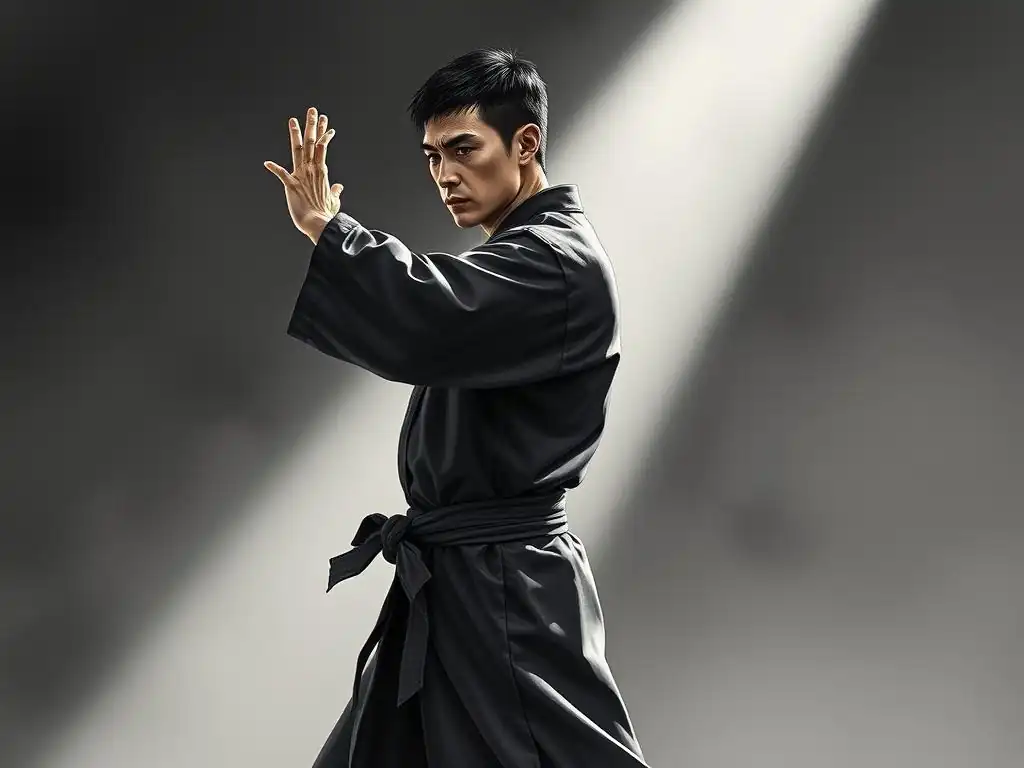
Lan Sao, translated as "Bar Arm," is a powerful Choy Li Fut trapping technique used to block, deflect, and control an opponent's incoming limb with the forearm or arm. It involves using a strong, often outward or diagonal, motion to meet the opponent's attack, using the practitioner's arm as a "bar" to obstruct and control the opponent's limb.
This technique is particularly effective against straight punches or forward thrusts. By meeting the incoming force with a strong Lan Sao, the practitioner can deflect the attack offline while simultaneously gaining control of the opponent's arm. From this controlled position, they can immediately transition into strikes with the other hand, joint locks, or other trapping combinations. Lan Sao is a prime example of how Choy Li Fut trapping techniques turn a defensive necessity (blocking) into an offensive opportunity (control and counter).
Dim Mak Applications Within Trapping Sequences
While often shrouded in mystique, Dim Mak, or "Death Point Striking," in the context of Choy Li Fut trapping techniques, refers to the strategic application of strikes to vulnerable points on the body during or immediately after a trapping action. Trapping creates the necessary control and opening to precisely target these points, which might include nerve centers, pressure points, or vital areas.
Trapping techniques like Gum Sao or Fut Sao can momentarily immobilize an opponent's arm, leaving their body exposed. A practitioner skilled in Dim Mak applications might then use a finger strike (Dit Git Sao), knuckle strike (Ging Ji Keuk), or palm strike to a specific point on the torso or head.
The trapping ensures the target is stationary and accessible, maximizing the effectiveness of the strike. While the extreme claims of Dim Mak are debated, striking nerve points during a trapping sequence can undoubtedly cause significant pain, disorientation, or temporary paralysis, aiding in self-defense by incapacitating the opponent or creating a clearer escape route.
Integrating Trapping with Footwork and Body Shifting
Importance of Agile Footwork in Closing the Distance
Agile footwork is absolutely critical for effectively utilizing Choy Li Fut trapping techniques. Trapping occurs in close range, meaning the practitioner must first close the distance safely and efficiently. Choy Li Fut's dynamic footwork, such as the Gung Jong Bou (Forward Arrow Step) and Choi Heng Bou (Plum Blossom Step), allows practitioners to quickly cover ground, evade attacks, and position themselves optimally for close-quarters engagement.
Without precise footwork, attempting to trap can leave a practitioner vulnerable. For instance, stepping too early or too late can result in being hit before the trap can be applied, or being out of position to follow up. The ability to rapidly adjust distance and angle using footwork ensures that the practitioner can initiate trapping sequences from a position of advantage, maximizing the chances of success and minimizing risk. Smooth transitions between stances and steps are practiced extensively to make this movement instinctive.
Using Body Shifting to Create Trapping Opportunities
Body shifting, the subtle or significant movement of the torso and weight distribution, is another vital element integrated with Choy Li Fut trapping techniques. Shifting the body allows the practitioner to evade incoming attacks while simultaneously moving into a position to trap the opponent's limb. It's about using minimum movement for maximum effect – getting offline from an attack while closing the gap and setting up the hands.
For example, a slight lateral shift of the body can cause an opponent's punch to miss while bringing the practitioner's arm into position to apply a Lan Sao or Gum Sao to the passing limb. This concurrent evasion and positioning creates a perfect opportunity for trapping without needing a dedicated block. Body shifting also helps generate power and leverage for the trapping techniques themselves, as the movement of the core contributes to the force applied by the hands and arms. Mastering body shifting alongside footwork is essential for the fluid and opportunistic application of Choy Li Fut trapping techniques.
Combining Footwork and Trapping Drills for Practical Application
To truly master Choy Li Fut trapping techniques, practitioners must integrate footwork and body shifting into their training. Static trapping drills build mechanics, but dynamic drills simulate real combat scenarios. A common drill involves a partner throwing simple attacks (like a straight punch or hook) while the practitioner practices stepping offline (using footwork and body shifting) and immediately applying a specific trapping technique like Gum Sao or Fut Sao to the incoming arm.
More advanced drills might involve multiple steps, changes in angle, and combinations of different trapping techniques seamlessly linked with footwork transitions. For instance, stepping in with a Gung Jong Bou while executing a Lan Sao, followed by a shift to the side and a Gum Sao on the same arm, then stepping back out. These drills, often performed with increasing speed and resistance, build the muscle memory, reflexes, and spatial awareness needed to apply Choy Li Fut trapping techniques effectively under pressure, making the combined movement instinctive.
Drills and Training Methods for Mastering Choy Li Fut Trapping
Partner Drills for Developing Sensitivity and Reflexes
Partner drills are indispensable for developing the sensitivity (ting jin) and reflexes required for effective Choy Li Fut trapping techniques. These drills typically start slowly, focusing on feeling the partner's energy and reacting correctly. A foundational drill might involve partners standing close and gently pushing or pulling on each other's wrists or forearms, trying to maintain contact and control while preventing the other from doing the same. This builds tactile sensitivity.
Another common drill involves one partner extending an arm or making a slow, predictable attack, while the other practices applying specific Choy Li Fut trapping techniques like Gum Sao, Fut Sao, or Lan Sao. As proficiency increases, the speed and complexity of the partner's movements are increased, incorporating feints, multiple attacks, and varying levels of resistance. Blindfolded trapping drills are also used to heighten tactile sensitivity, forcing practitioners to rely solely on touch rather than sight to react to the opponent's movements and apply the appropriate trapping technique.
Solo Training Exercises to Refine Technique
While partner drills build sensitivity and timing against a live opponent, solo training is crucial for refining the mechanics and power generation behind Choy Li Fut trapping techniques. Solo practice allows practitioners to focus intently on their own body mechanics, stance, and the precise movements of their hands and arms without the unpredictable element of a partner.
Shadow boxing that incorporates trapping movements is a key solo exercise. Practitioners visualize an opponent and practice stepping, shifting, and executing trapping techniques followed by strikes. Repetitive practice of individual techniques, such as performing Gum Sao or Fut Sao hundreds of times in the air, helps build muscle memory and perfect the trajectory and force generation. Using a wall bag or a mook jong (wooden dummy) can also simulate contact and provide resistance for practicing the physical application and structural alignment required for robust Choy Li Fut trapping techniques.
Developing Speed and Power in Trapping Sequences
Developing speed and power in Choy Li Fut trapping techniques is the final stage after mechanics and sensitivity are established. Speed is developed through repetitive, fast-paced drills, starting with simple movements and gradually increasing the tempo. Reaction drills, where a partner gives a random signal (visual or tactile) prompting a specific trap, also enhance speed and responsiveness.
Power in trapping comes from the coordinated use of the entire body, not just the arms. Drills focusing on rooting through the stance and generating force from the ground up, through the waist and into the hands, are essential. Explosive exercises like short sprints or plyometrics can also improve the dynamic power needed for rapid, forceful trapping applications.
Incorporating power into sequences of Choy Li Fut trapping techniques and strikes ensures that the trapping not only controls but also sets up truly devastating follow-ups. Practicing hitting targets (like focus mitts or heavy bags) immediately after a simulated trap helps link the control with the subsequent powerful strike.
Common Mistakes to Avoid in Choy Li Fut Trapping
Over-Reliance on Strength Instead of Technique
A frequent mistake practitioners make when learning Choy Li Fut trapping techniques is relying too heavily on muscular strength. Trapping is fundamentally about leverage, timing, and redirecting energy, not overpowering the opponent through brute force. Attempting to simply muscle through a trap against a stronger opponent is inefficient and often ineffective, leading to quick fatigue and a loss of control.
Correct application of Choy Li Fut trapping techniques involves using the body's structure, weight transfer, and understanding of angles to control the opponent's limb with minimal physical effort. Beginners might try to hold an arm down with sheer force, whereas a skilled practitioner uses a slight shift in weight and a precise hand position to disrupt the opponent's balance and structure, achieving control with far less energy expenditure. Focusing on sensitivity and structural integrity in training helps overcome this tendency towards over-reliance on strength.
Telegraphing Trapping Movements
Telegraphing, or giving away the intention of a movement before executing it, significantly reduces the effectiveness of Choy Li Fut trapping techniques. If an opponent sees a trap coming, they can easily withdraw their limb, change their attack, or counter before the technique is applied. Subtle movements, minimal tells, and reacting with the opponent's movement rather than to it are key to avoiding telegraphing.
Developing fluid, natural movements through consistent practice is crucial. Trapping should flow seamlessly from other movements, such as blocks or strikes, rather than being a distinct, isolated action. Partner drills focusing on spontaneous reaction and minimizing unnecessary preliminary movements help practitioners learn to execute Choy Li Fut trapping techniques without telegraphing, making them surprising and difficult for the opponent to evade or counter. The goal is for the trap to appear as a natural consequence of the interaction, not a planned, obvious maneuver.
Neglecting Footwork and Body Mechanics
As previously emphasized, neglecting footwork and body mechanics is a critical error that undermines the entire purpose of Choy Li Fut trapping techniques. Without proper positioning and structural support from the lower body and core, trapping becomes weak, unstable, and leaves the practitioner vulnerable. Poor footwork means being out of range or angle, while poor body mechanics means lacking the leverage and power needed for effective control and follow-up strikes.
Practitioners must understand that the hands and arms are only the final point of contact; the power and stability for trapping originate from the ground up, through the legs, hips, and torso. Training should always integrate footwork and body shifting with hand techniques. Drills that isolate trapping movements from the rest of the body should be minimal; the focus should be on integrated, whole-body movement. A trap executed with solid structure and good footwork is exponentially more effective than one attempted with just the arms, highlighting the importance of holistic training in Choy Li Fut trapping techniques.
Real-World Applications of Choy Li Fut Trapping Techniques
Self-Defense Scenarios Where Trapping Excels
Choy Li Fut trapping techniques are particularly effective in self-defense scenarios that occur in close proximity, such as altercations in crowded spaces, narrow hallways, or when being grabbed or held. In such situations, the dynamic, long-range movements Choy Li Fut is known for may be impractical or impossible. Trapping provides a means to control the immediate threat posed by the opponent's limbs.
Imagine being cornered or grabbed. While a powerful long-range strike might be ideal in open space, in a confined area, using a Gum Sao to pin a grabbing arm, a Lan Sao to deflect a close punch, or a Fut Sao to sweep away an arm attempting to grapple allows you to neutralize the immediate threat and create space or opportunity for a follow-up. These techniques are designed for the messy, unpredictable nature of real-world self-defense encounters where space is often limited and control is paramount.
Adapting Trapping to Different Opponent Sizes and Strengths
One of the strengths of Choy Li Fut trapping techniques lies in their adaptability to opponents of varying sizes and strengths. Because these techniques rely heavily on leverage, timing, and sensitivity rather than brute force, a smaller or weaker individual can effectively control a larger, stronger aggressor. The key is understanding how to use the opponent's own size and momentum against them.
Against a larger opponent, techniques like Gum Sao or Lan Sao are applied to redirect their greater force. Instead of trying to stop their momentum, the trap guides it offline. Using body shifting and footwork to get to the opponent's side or rear also minimizes the impact of their size advantage. Trapping allows a smaller practitioner to control the larger limbs of an opponent, breaking their structure and balance, making them vulnerable despite their physical power. The focus shifts from meeting force with equal or greater force to using skillful manipulation and redirection.
Legal and Ethical Considerations for Self-Defense Application
While Choy Li Fut trapping techniques are highly effective for self-defense, it is crucial to understand the legal and ethical considerations surrounding their use. Self-defense laws vary significantly by jurisdiction, but generally, the force used must be reasonable and proportionate to the threat. Trapping techniques, while often non-damaging in themselves, are typically part of a larger sequence that may include strikes or other forceful actions.
Using trapping to control an opponent and then escaping is often viewed favorably as a proportionate response. However, using trapping to set up excessive force or continuing to apply techniques after the threat has been neutralized could have legal consequences. Ethically, the use of any martial art technique in self-defense should be a last resort, employed only when faced with an imminent threat of harm. Practitioners are encouraged to be aware of local laws regarding self-defense and to prioritize de-escalation and escape when possible, reserving Choy Li Fut trapping techniques and other forceful responses for genuine, unavoidable danger.
The Legacy and Evolution of Choy Li Fut Trapping
Historical Roots of Trapping in Choy Li Fut
The roots of Choy Li Fut trapping techniques are deeply embedded in the history of Southern Chinese Kung Fu. Founded by Chan Heung in the mid-19th century, Choy Li Fut synthesized elements from various martial arts taught by his masters: Choy Fook, Li Yau San, and Chan Cheung. These masters themselves drew from diverse traditions, including Shaolin and other Southern styles known for their close-range hand techniques and emphasis on practical combat.
Many Southern Kung Fu styles feature sophisticated hand control methods, often referred to collectively as "bridge hand" (Kiu Sao) techniques, which focus on using the forearms and hands to make contact with, control, and strike the opponent's limbs or body at close range. Choy Li Fut integrated and adapted these principles, developing its own unique set of trapping maneuvers like Gum Sao, Fut Sao, and Lan Sao, tailored to complement its dynamic stances and powerful strikes. These techniques were honed through rigorous training and practical application, becoming an essential part of the system's comprehensive combat strategy.
Modern Interpretations and Adaptations of These Techniques
In the modern era, Choy Li Fut trapping techniques continue to be taught and practiced worldwide, though interpretations and adaptations exist across different lineages and schools. While the core principles remain consistent – sensitivity, leverage, timing, and integration with strikes – some schools might emphasize certain trapping techniques over others, or adapt them slightly for different training goals, such as sport application (though Choy Li Fut is traditionally a combat-focused art) or specific self-defense scenarios.
Some modern practitioners explore the application of Choy Li Fut trapping techniques in cross-training contexts, seeing parallels or complementary aspects with techniques found in arts like Wing Chun (known for its trapping hands), Filipino Martial Arts, or even grappling arts like Judo or Brazilian Jiu-Jitsu in terms of limb control principles. While the fundamental forms and techniques are preserved, contemporary training methodologies might incorporate sports science principles to enhance speed, power, and conditioning relevant to effective trapping. The emphasis remains on practical application, ensuring these historical techniques remain relevant for modern self-defense.
The Future of Choy Li Fut's Immobilization Art
The future of Choy Li Fut trapping techniques appears secure, sustained by dedicated practitioners and masters committed to preserving and propagating the art. As interest in practical self-defense and traditional martial arts continues, the unique effectiveness of Choy Li Fut's close-range control methods is likely to attract new students. The detailed forms and partner drills provide a systematic way to learn these complex skills.
Furthermore, the increasing accessibility of information and cross-cultural exchange in the martial arts world means that the principles behind Choy Li Fut's immobilization art can be shared and understood by a wider audience. While purists will focus on preserving the traditional methods, the underlying concepts of using sensitivity, leverage, and timing for limb control are universal martial principles. As long as practitioners continue to train diligently, focus on practical application, and adapt teaching methods to new generations, the art of immobilization within Choy Li Fut will continue to thrive, providing valuable self-defense skills.
Conclusion: Embracing the Art of Immobilization in Choy Li Fut
Mastering Choy Li Fut Short Range Skills for Self-Defense Proficiency
Mastering the short-range skills, particularly the sophisticated Choy Li Fut trapping techniques, is essential for achieving true proficiency in this dynamic martial art. While the powerful long-range strikes are iconic, the ability to control and neutralize an opponent in close quarters provides a critical layer of defense and offense. Techniques like Gum Sao, Fut Sao, Kup Jeung, and Lan Sao are not mere supplementary movements but form a cohesive system for managing distance, disrupting the opponent, and creating openings when space is limited.
Developing proficiency in these immobilization skills requires dedication to consistent training, focusing on sensitivity drills, refining body mechanics, and integrating trapping seamlessly with footwork and striking. It demands patience to move beyond simply blocking and learn to actively control the opponent's limbs. By embracing the art of immobilization, practitioners unlock the full potential of Choy Li Fut as a comprehensive and highly effective system for self-defense in any range.
Further Study and Resources for Aspiring Practitioners
For aspiring practitioners interested in delving deeper into Choy Li Fut trapping techniques and the art of immobilization, seeking qualified instruction from an experienced Choy Li Fut master or certified instructor is paramount. Learning these techniques requires hands-on guidance to correct subtle body mechanics and develop the crucial tactile sensitivity that cannot be fully grasped from books or videos alone.
Look for schools with a lineage back to the founders or renowned masters, as the quality of instruction can vary. Many schools offer introductory classes where you can experience the fundamental movements and principles firsthand. Additionally, reputable books and instructional materials specific to Choy Li Fut can serve as valuable supplements to in-person training, providing historical context, detailed descriptions of forms, and explanations of principles. Engaging with the Choy Li Fut community, attending seminars, and practicing diligently with training partners are all vital steps on the path to mastering these intricate and effective trapping skills.
Frequently Asked Questions
What is the main focus of Choy Li Fut trapping techniques?
The main focus is on short-range immobilization and controlling an opponent's limbs to create openings for strikes or takedowns. It emphasizes disrupting balance and preventing effective attacks.
How does Choy Li Fut's trapping differ from other martial arts?
Choy Li Fut trapping often incorporates circular movements and bridging the gap with the opponent, utilizing techniques specific to the style's unique stances and hand forms, unlike more linear approaches. It focuses on simultaneous attack and defense.
What are some common tools used within Choy Li Fut trapping techniques?
Common tools include sticky hands (chi sao), wrist locks, and elbow destructions. These techniques aim to control the opponent's center and create openings for follow-up maneuvers.
Why are Choy Li Fut trapping techniques effective in self-defense scenarios?
They are effective because they allow you to quickly control an attacker's movements, neutralize their offensive capabilities, and create opportunities for counter-attacks in close-quarters combat.
Where can I learn more about Choy Li Fut trapping techniques?
MartialArtsMastery.org offers resources on Choy Li Fut, including its history, training methods, and practical self-defense applications, allowing you to further explore these techniques.
Final Reflection: Embracing the Art of Immobilization
The exploration of Choy Li Fut's short-range trapping skills, as detailed in this article, reveals more than just a set of fighting techniques; it unveils a profound understanding of leverage, timing, and control. The true power of these Choy Li Fut trapping techniques lies in their ability to neutralize an opponent's aggression, transforming potential conflict into a display of precision and mastery. This resonates deeply in a world often characterized by reactive violence, offering a pathway toward de-escalation and mindful engagement.
The influence of Choy Li Fut's trapping techniques extends beyond the martial arts arena. Its principles of redirecting force and controlling movement offer valuable lessons in communication, negotiation, and even personal growth. The ability to anticipate and subtly guide another's actions, without resorting to brute force, is a skill applicable to countless aspects of life. The supreme art of war is to subdue the enemy without fighting,
as Sun Tzu famously stated, and Choy Li Fut's trapping methods embody this philosophy beautifully.
Now, consider how you can apply these principles of immobilization and redirection in your own life. Reflect on situations where you might have reacted impulsively, and imagine how a more controlled, strategic approach could have yielded a more positive outcome. Embrace the art of subtly influencing the flow of events, not through dominance, but through understanding and skillful application of leverage. The power to immobilize, ultimately, lies not in physical strength, but in the wisdom to choose a more mindful path.
Master Close Combat: Seize Your Inner Choy Li Fut Warrior!
Thank you for exploring the intricacies of Choy Li Fut's close-range trapping techniques. We hope you've gained valuable insights into the art of immobilization and its practical applications. Now, it's time to put that knowledge into action!
Here's how to continue your journey:
- Immediately begin practicing the wrist-locking drills outlined in the article, focusing on precision and controlled movements with a training partner.
- Deepen your understanding by researching the "Cham Kiu" form, and find out how the principles applied in the form apply to short range trapping.
- Share the article with other martial arts enthusiasts and discuss which trapping techniques resonated most with you, compare the similarities to Wing Chun or other arts.
What specific immobilization technique are you most eager to master, and how do you plan to integrate it into your existing training regimen?