
Taekwondo Grandmaster Park: The Art and Science of the Flying Side Kick – An Interview

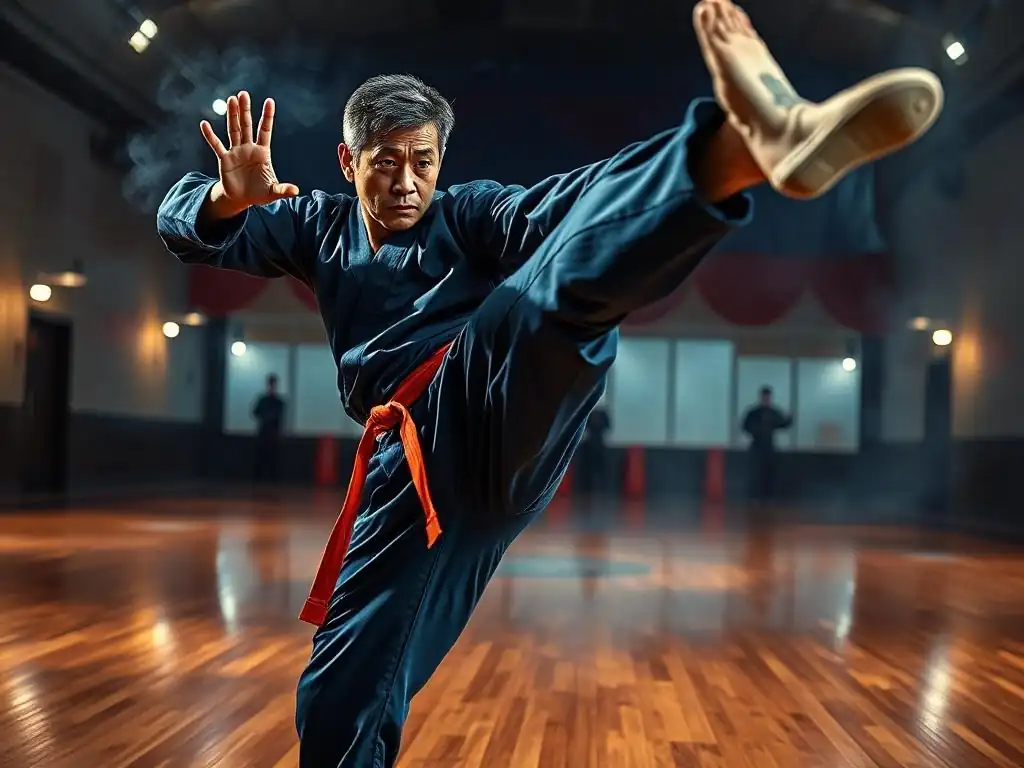
Welcome to Martial Arts Mastery, where the wisdom of ages meets the cutting edge of technique. Ever wondered how the Taekwondo flying side kick transcends mere athleticism to become an art form? Prepare to be amazed as we delve into the secrets behind this iconic move, explored through the lens of a true master. Grandmaster Park shares his insights, revealing not just the 'how,' but the 'why' and 'what' that elevate this technique to legendary status.
Discover the discipline, dedication, and strategic brilliance woven into every soaring strike. What are the underlying principles that make this more than just a kick? Read on to find out...
- Grandmaster Hee Il Cho: The Power of Traditional Taekwondo - An Interview
- Introduction: Grandmaster Cho and the Pursuit of Authentic Taekwondo
- The Foundations of Taekwondo: A Historical Perspective
- Unveiling the Turning Kick: A Fundamental Taekwondo Technique
- Grandmaster Cho's Insights on Mastering the Taekwondo Turning Kick Technique
- The Science Behind the Turning Kick: Biomechanics and Application
- The Art of the Turning Kick: Precision and Control
- Training Drills and Exercises for the Taekwondo Turning Kick
- Grandmaster Cho on Preserving Traditional Taekwondo Values
- Grandmaster Cho's Advice for Aspiring Martial Artists
- Conclusion: Grandmaster Cho's Enduring Influence on Taekwondo
-
Frequently Asked Questions
- What is the Flying Side Kick and why is it so emphasized in Taekwondo?
- Who is Grandmaster Park, and why is his perspective on the Flying Side Kick significant?
- What are the key elements of the Flying Side Kick technique according to Grandmaster Park?
- How does the article explore the history and science behind the Taekwondo Flying Side Kick?
- What practical self-defense applications does the article suggest for the Taekwondo Flying Side Kick?
- Final Reflection: The Enduring Legacy of Flight
- Ignite Your Inner Warrior: Unleash Your Potential!
Grandmaster Hee Il Cho: The Power of Traditional Taekwondo - An Interview
Introduction: Grandmaster Cho and the Pursuit of Authentic Taekwondo
Martial Arts Legacy: An Exclusive Interview
Grandmaster Hee Il Cho is a name synonymous with traditional Taekwondo. With decades dedicated to the art, teaching, and refining techniques, his legacy extends globally through his schools, books, and students. This exclusive interview delves into his profound insights, offering a unique perspective on the history, philosophy, and practical application of Taekwondo, particularly focusing on fundamental yet powerful techniques like the turning kick. We explore the journey of mastering this dynamic martial art, from its historical roots to the biomechanics and mental discipline required for effective execution.
Grandmaster Cho's approach emphasizes the core principles of Taekwondo, distinguishing between superficial performance and true mastery. He stresses the importance of understanding not just how to perform a technique, but why it works, and the underlying principles that govern power and precision. This interview aims to capture the essence of his teachings, providing valuable lessons for both novice practitioners and seasoned martial artists seeking to deepen their understanding of Taekwondo's rich heritage and practical efficacy in self-defense and sport.
Grandmaster Cho: A Pioneer in Western Taekwondo
Grandmaster Hee Il Cho played a pivotal role in establishing and popularizing traditional Taekwondo in the Western world. Arriving in the United States in the 1960s, a time when martial arts were gaining traction but often misunderstood, he founded his own organization, the Action International Martial Arts Association (AIMAA). Through AIMAA, he has overseen the training and grading of thousands of students and instructors worldwide, maintaining a steadfast commitment to the authentic curriculum and values he learned in Korea.
His pioneering efforts weren't limited to teaching; Grandmaster Cho authored numerous influential books and instructional videos that became standard resources for Taekwondo students globally. Works like "Complete Taekwondo Poomsae" and "Taekwondo: Basic Techniques & Fighting" provided detailed guides to forms, stances, and fundamental movements, including various kicks and strikes. His dedication ensured that practitioners far from Korea could access high-quality, systematic instruction, helping to preserve the integrity of the art amidst its rapid international expansion.
The Foundations of Taekwondo: A Historical Perspective
Taekwondo's Roots and Evolution
Taekwondo's history is a complex tapestry woven from ancient Korean martial traditions and modern influences. Its formal establishment is often dated to the mid-20th century, specifically around 1955, when General Choi Hong Hi proposed the name "Taekwondo" to unify various kwans (schools) practicing similar arts like Tang Soo Do and Gong Soo Do. These arts themselves drew upon older Korean practices like Taekkyeon and Gwonbeop, as well as influences from Japanese karate during the occupation period (1910-1945). The unification aimed to create a distinct national martial art for Korea.
The early years saw a focus on practical self-defense and military training. As Taekwondo spread internationally from the 1960s onwards, particularly through demonstrations and the efforts of masters like Grandmaster Cho, it began to evolve into a sport.
The establishment of organizations like the International Taekwon-Do Federation (ITF) in 1966 and the World Taekwondo Federation (WTF, now World Taekwondo - WT) in 1973 marked different paths of development, leading to variations in forms (poomsae vs. patterns), sparring rules, and even technique emphasis. Despite these divergences, the core principles of powerful kicking techniques and mental discipline remain central to all major styles of Taekwondo.
The Significance of Forms (Poomsae) in Taekwondo Training
Forms, known as Poomsae in World Taekwondo or Patterns in ITF Taekwon-Do, are pre-arranged sequences of defensive and offensive movements performed against imaginary opponents. They are absolutely fundamental to Taekwondo training, serving as a living library of techniques and principles. Practicing Poomsae allows students to internalize stances, blocks, strikes, and kicks, including essential movements like the turning kick and even advanced techniques like the Taekwondo flying side kick technique, in a systematic and repeatable manner.
Beyond technique memorization, Poomsae training develops crucial physical attributes such as balance, coordination, flexibility, and power generation. It also cultivates mental discipline, focus, and the ability to visualize application. For instance, mastering a specific Poomsae might involve performing over 30 distinct movements with precise timing and power application within a minute or two. This rigorous practice builds the muscle memory and proprioception necessary for executing techniques effectively in dynamic situations, whether in sparring or self-defense.
Unveiling the Turning Kick: A Fundamental Taekwondo Technique
The Turning Kick: A Versatile and Powerful Strike
The turning kick, or Dollyo Chagi, is arguably the most iconic and frequently used technique in modern Taekwondo, particularly in sport sparring. It is a circular kick executed by pivoting on the ball of the supporting foot while rotating the hips and torso to whip the striking leg around. The primary striking surface is typically the ball of the foot or the instep, aimed at the opponent's torso or head. Its versatility lies in its ability to be delivered from various stances, at different heights, and with significant speed and power.
Grandmaster Cho emphasizes that the turning kick is not just a simple swing of the leg. It requires a complex coordination of movements involving the entire body. The power is generated not just from leg strength, but from the rotational energy of the hips and torso, transferring kinetic energy through the leg. A well-executed turning kick can deliver a force equivalent to several hundred pounds, capable of knocking an opponent down or scoring significant points in competition. It's a technique that bridges the gap between basic leg movements and more complex strikes like the Taekwondo flying side kick technique.
The Turning Kick in Self-Defense and Sport
While the turning kick is a staple of sport Taekwondo, its application in self-defense differs significantly. In sport, the focus is on speed, timing, and scoring points, often involving chambering the knee high and using the instep to tap or snap the opponent's body protector or headgear. The rules dictate target areas and discourage excessive force or targeting vulnerable points. Sport application is highly dynamic, often involving combinations and rapid exchanges.
In self-defense, the turning kick is utilized with full power, aimed at vulnerable targets to neutralize a threat quickly. The striking surface might shift to the ball of the foot for greater penetration, or even the heel for certain applications. The setup is less about competitive points and more about creating an opening or exploiting an attacker's vulnerability. While perhaps less common for beginners in self-defense compared to simpler strikes, a properly trained turning kick can be a devastating technique when applied effectively against a real threat, showcasing the technique's potential beyond the sporting arena.
Grandmaster Cho's Insights on Mastering the Taekwondo Turning Kick Technique
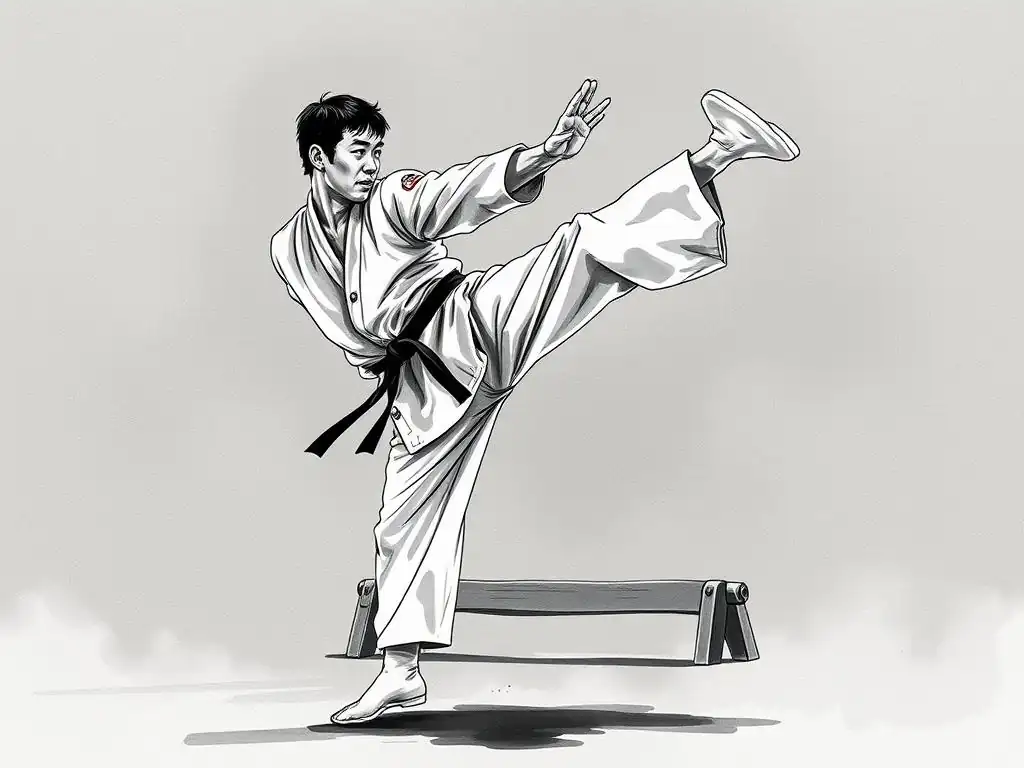
Developing Proper Stance and Balance for the Turning Kick
Mastering the Taekwondo turning kick technique begins with a solid foundation: proper stance and balance. Grandmaster Cho teaches that a stable base is paramount. The supporting foot must pivot smoothly on the ball of the foot, not the heel, allowing for rapid rotation and stability. The non-kicking leg's knee should be slightly bent, acting as a shock absorber and anchor. Maintaining an upright posture, with the core engaged, helps keep the center of gravity over the supporting leg during the rotation.
Balance is not just about staying upright; it's about controlling your body throughout the entire movement. This involves learning to shift weight efficiently and using the arms for counter-balance. Some practitioners use the arms to generate additional momentum, while others use them for guard or stability. Consistent practice of basic stances and balance drills, such as standing on one leg or performing slow, controlled pivots, is essential before attempting to generate power and speed in the turning kick. Without proper balance, power dissipates, and the risk of injury increases.
The Importance of Hip Rotation in Generating Power
Grandmaster Cho consistently emphasizes that the true power of the Taekwondo turning kick technique comes from the hips, not just the leg muscles. The kick is initiated by a powerful rotation of the hips and torso, similar to the torque generated in throwing a punch or swinging a bat. As the supporting foot pivots, the hip of the kicking leg drives forward and around, pulling the leg behind it like a whip. This rotational force is then transferred down the leg to the point of impact.
Neglecting hip rotation is a common mistake that results in a weak, "pushing" kick. Instead of a sharp, impactful strike, the kick becomes a mere extension of the leg using only quadriceps strength. Grandmaster Cho advises students to feel the "snap" in their hips and focus on driving the hip through the target. Drills involving hip rotation exercises, like turning drills without kicking or practicing the hip movement while holding onto a stable object, are crucial for developing this fundamental aspect of the Taekwondo turning kick technique.
Common Mistakes to Avoid When Learning the Turning Kick
Learning the Taekwondo turning kick technique involves navigating several common pitfalls. One frequent error is failing to pivot correctly on the supporting foot, which hinders hip rotation and strains the knee joint. Another is dropping the hands during the kick, compromising guard and balance. Many beginners also neglect to chamber the knee properly before extending the leg, reducing both speed and power, or they extend the leg too early in the rotation, resulting in a pushing motion rather than a snap.
Another significant mistake is focusing solely on height or speed before mastering the basic mechanics of the Taekwondo turning kick technique. Attempting head kicks before the hip rotation and balance are solidified often leads to poor form and reduced power. Grandmaster Cho advises a patient, step-by-step approach: first focus on the pivot and hip rotation, then the knee chamber and extension, and finally integrating speed and height as the fundamental movement becomes natural and powerful. Correcting these early mistakes is vital for long-term technical development and preventing bad habits.
The Science Behind the Turning Kick: Biomechanics and Application
Utilizing Leverage and Body Weight for Maximum Impact
The effectiveness of the Taekwondo turning kick technique is deeply rooted in biomechanical principles, particularly the use of leverage and body weight. The body acts as a complex lever system. The supporting leg serves as a stable base, while the torso and kicking leg form levers rotating around the hip joint. By pivoting on the ball of the foot, the practitioner creates a rotational axis that allows for the generation of angular momentum. This momentum is then transferred to the kicking leg.
Furthermore, the strategic use of body weight is crucial. As the hips rotate, the body's mass contributes to the force behind the kick. Leaning slightly away from the target (counter-leaning) can also help maintain balance and allow the hip to drive further through the rotation, increasing leverage and power. The snapping motion at the end of the kick is a result of rapid extension and retraction of the leg, utilizing elastic energy from the muscles and tendons, similar to cracking a whip. Understanding these principles helps practitioners refine their Taekwondo turning kick technique for maximum efficiency and impact.
Understanding Target Zones and Strategic Execution
Effective application of the Taekwondo turning kick technique requires a clear understanding of target zones and strategic execution. In sport Taekwondo, the primary legal targets are the torso (covered by a body protector) and the head (covered by a helmet). Points are awarded based on the technique used and the target struck, with head kicks typically scoring higher. Strategic execution involves timing the kick to land when the opponent is off-balance or during an opening, often delivered as a counter-attack or part of a combination.
In a self-defense context, target zones expand to include vulnerable areas like the ribs, solar plexus, and even the knees or thighs to incapacitate an attacker. Strategic execution here focuses on delivering maximum power to end the confrontation swiftly. This might involve setting up the turning kick with a distraction or utilizing movement to create distance or angle. Unlike the continuous movement of sport sparring, self-defense application might involve a single, decisive kick. Understanding these different contexts allows practitioners to adapt their Taekwondo turning kick technique for various situations.
The Art of the Turning Kick: Precision and Control
Achieving Speed and Accuracy in the Turning Kick
Beyond raw power, the art of the Taekwondo turning kick technique lies in achieving speed and accuracy. Speed allows the kick to land before the opponent can react or block. Accuracy ensures the kick lands on the intended target with the correct part of the foot. Developing speed involves refining the mechanics to eliminate unnecessary movements and improving muscular power and explosiveness. Drills focusing on rapid chambering and extension, and practicing multiple kicks in quick succession, are key.
Accuracy is honed through consistent target practice. This could involve kicking specific points on a stationary target, like different colored zones on a paddle, or practicing against moving targets held by a partner. Visual focus on the target throughout the kick is also critical. Grandmaster Cho emphasizes that precision isn't just about hitting the target; it's about hitting it with the right force and timing. This level of control distinguishes a truly skilled practitioner's Taekwondo turning kick technique from a merely powerful one.
The Mental Focus Required for Effective Execution
The physical execution of the Taekwondo turning kick technique is inseparable from the mental focus required. Effective kicking demands concentration, presence of mind, and the ability to read an opponent or situation. In sparring, this means anticipating movements, identifying openings, and making split-second decisions on when and how to deploy the kick. Distractions or hesitation can cause a loss of balance, timing, or power.
Grandmaster Cho teaches that mental discipline is cultivated through consistent training and mindfulness. This includes focusing on breath control, visualizing successful execution, and maintaining composure under pressure. The ability to remain calm and focused allows the practitioner to react instinctively and efficiently, integrating physical technique with strategic intent. This mental aspect is just as vital as the physical training in mastering the Taekwondo turning kick technique and other complex movements like the Taekwondo flying side kick technique.
Training Drills and Exercises for the Taekwondo Turning Kick
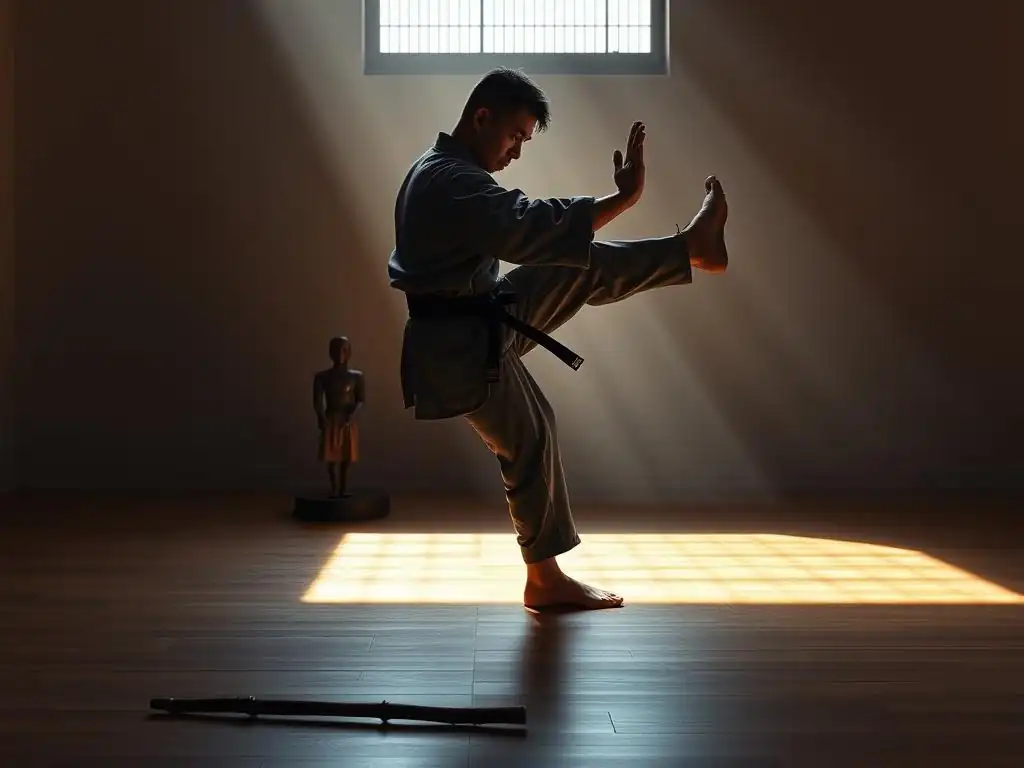
Repetitive Practice for Muscle Memory and Coordination
Repetitive practice is the cornerstone of developing muscle memory and coordination for the Taekwondo turning kick technique. This involves performing the kick thousands of times, initially slowly to focus on correct form, and then gradually increasing speed and power. Basic drills include kicking into the air (shadow kicking), practicing the pivot and chamber while holding onto a wall or chair, and performing sets of kicks with each leg.
A typical training session might involve hundreds of repetitions of the turning kick from various stances, such as fighting stance or even while stepping. For instance, a student might be assigned 100 turning kicks on each leg daily as part of their regimen. This consistent repetition programs the complex sequence of movements into the nervous system, allowing the kick to be performed instinctively and efficiently without conscious thought, forming the basis for advanced applications like the Taekwondo flying side kick technique.
Partner Drills for Dynamic Application and Timing
Partner drills are essential for translating solo practice into dynamic application. These drills introduce elements of timing, distance, and reaction. A common partner drill involves one person holding a kicking paddle or target shield while the other practices the Taekwondo turning kick technique, focusing on hitting the target with proper force and timing. The partner can vary the position or timing of the target to challenge the kicker.
More advanced partner drills might involve light sparring scenarios where partners practice exchanging techniques, specifically looking for opportunities to land the turning kick. This helps develop the ability to read an opponent's movements and deploy the kick effectively in a non-static situation. Practicing against a partner also provides valuable feedback on the impact and effectiveness of the kick, helping to refine the technique further.
One-Step Sparring (Ilbo Taeryon) for Practical Application
One-Step Sparring, or Ilbo Taeryon, is a traditional training method that bridges the gap between basic technique practice and free sparring. It involves pre-arranged sequences of attack and defense, where one partner executes a single, predetermined attack (like a punch or a stepping kick), and the other partner executes a predetermined defense and counter-attack. This format allows students to practice applying specific techniques, including the Taekwondo turning kick technique, in a controlled, semi-realistic scenario.
For the turning kick, a common one-step scenario might involve the attacker stepping forward with a punch, and the defender blocking and immediately countering with a turning kick to the body or head. This drill helps students practice reacting to an attack, judging distance, and delivering their counter-attack with power and precision. While not as spontaneous as free sparring, Ilbo Taeryon provides a valuable framework for learning practical application in a step-by-step manner.
Target Training with Paddles and Bags
Target training using paddles, shields, and heavy bags is indispensable for developing power, accuracy, and impact in the Taekwondo turning kick technique. Kicking paddles, held by a partner, provide a mobile target for practicing speed and timing, often used for rapid-fire drills. Shield targets offer a larger surface for practicing full-power kicks and combinations.
Heavy bags allow practitioners to practice delivering maximum power without a partner, developing strength, endurance, and the feeling of impact. Hitting a heavy bag helps condition the striking surface (instep or ball of the foot) and provides resistance to build power. Grandmaster Cho stresses the importance of hitting through the target, not just to it, when using bags. Consistent target training is vital for ensuring that the Taekwondo turning kick technique is not only visually correct but also functionally effective.
Grandmaster Cho on Preserving Traditional Taekwondo Values
Maintaining the Integrity of Taekwondo Philosophy
Grandmaster Cho is a staunch advocate for maintaining the integrity of Taekwondo's philosophical underpinnings alongside its physical techniques. He teaches that Taekwondo is more than just a sport or a fighting method; it is a way of life that cultivates character. The five tenets of Taekwondo – Courtesy, Integrity, Perseverance, Self-Control, and Indomitable Spirit – are not just words but guiding principles for behavior both inside and outside the dojang (training hall).
Preserving the philosophy means emphasizing respect for instructors, seniors, and fellow students, humility in learning, and the pursuit of continuous self-improvement. It involves understanding the historical context and the sacrifices made by the founders and early masters. Grandmaster Cho believes that neglecting the philosophical aspect reduces Taekwondo to mere physical exercise or competitive sport, stripping it of its deeper meaning and transformative potential. This holistic approach is central to his teaching methodology.
The Importance of Respect for Instructors and Fellow Students
Respect, or Yeh Ui, is the first and arguably most important tenet of Taekwondo. Grandmaster Cho places immense value on demonstrating respect within the dojang. This includes bowing upon entering and leaving the training area, bowing to the flag and the instructor, and using proper etiquette when addressing seniors. Respect for the instructor is seen as respect for the knowledge and tradition they embody, while respect for fellow students fosters a positive and safe training environment.
This culture of respect extends to sparring and partner drills, where control and consideration for one's partner's safety are paramount. Even when practicing powerful techniques like the Taekwondo turning kick technique or the Taekwondo flying side kick technique, control is emphasized to prevent injury. Grandmaster Cho teaches that true strength in Taekwondo is tempered with humility and respect for others, creating a community built on mutual trust and shared dedication to the art.
Grandmaster Cho's Advice for Aspiring Martial Artists
Embracing the Journey of Self-Discovery Through Taekwondo
Grandmaster Cho encourages aspiring martial artists to view their Taekwondo training as a journey of self-discovery. It's not just about earning belts or winning competitions, but about understanding one's own strengths and weaknesses, both physical and mental. The challenges faced in training – mastering a difficult technique like the Taekwondo turning kick technique, pushing through physical fatigue, or overcoming fear in sparring – provide valuable lessons that extend beyond the dojang.
He advises students to be patient with themselves, recognizing that progress takes time and consistent effort. The process of learning Taekwondo reveals aspects of one's character and builds resilience. Embracing the struggles and celebrating the small victories along the way are part of this journey. The discipline and self-control developed in Taekwondo training contribute to personal growth, helping individuals navigate challenges in other areas of life.
The Importance of Consistent Training and Dedication
Perhaps the most crucial advice Grandmaster Cho offers is the importance of consistent training and unwavering dedication. Mastery in Taekwondo is not achieved through sporadic bursts of effort but through persistent, regular practice over many years. He often quotes the saying, "The difference between a black belt and a white belt is time in the dojang."
Consistency builds skill, strength, and understanding gradually. Dedication means showing up for class even when tired or unmotivated, practicing techniques diligently, and seeking to improve constantly. It's the commitment to the process that yields results. Whether aiming to perfect the Taekwondo turning kick technique, learn the Taekwondo flying side kick technique, or simply improve fitness and discipline, Grandmaster Cho's message is clear: regular, dedicated effort is the only path to true mastery.
Conclusion: Grandmaster Cho's Enduring Influence on Taekwondo
Recognizing a Lifetime of Leadership and Innovation
Grandmaster Hee Il Cho's impact on the world of Taekwondo is undeniable. Through a lifetime dedicated to teaching, writing, and leading, he has shaped the training of countless students and instructors across the globe. His commitment to preserving the traditional values and techniques of Taekwondo, while also adapting its instruction for a global audience, demonstrates both leadership and innovation. He built a respected international organization, authored foundational texts, and produced instructional materials that brought high-quality Taekwondo education to practitioners worldwide.
His influence is seen in the technical proficiency of his students, the ethical standards upheld in his schools, and the enduring popularity of the traditional Taekwondo curriculum he championed. He has been a bridge between the art's Korean origins and its international practice, ensuring that the depth and richness of Taekwondo are not lost as it continues to evolve. His legacy is a testament to the power of dedication and the profound impact one individual can have on a global martial art community.
The Continuing Relevance of Traditional Taekwondo Principles
In an age where martial arts are often viewed primarily through the lens of sport or self-defense fads, Grandmaster Cho's emphasis on traditional Taekwondo principles remains profoundly relevant. The values of courtesy, integrity, perseverance, self-control, and indomitable spirit are timeless qualities essential for personal development and positive societal contribution. His teaching reminds us that true martial arts training is about building character as much as building physical skill.
The technical foundation he advocates, rooted in fundamental movements and detailed understanding of techniques like the Taekwondo turning kick technique, provides a solid base for practitioners regardless of their specific goals, whether competitive sparring, self-defense, or personal mastery. Grandmaster Cho's enduring influence lies in his successful preservation and transmission of Taekwondo as a comprehensive discipline that nurtures both the body and the mind, ensuring its continued relevance for generations to come.
Frequently Asked Questions
What is the Flying Side Kick and why is it so emphasized in Taekwondo?
The Flying Side Kick is a dynamic and powerful Taekwondo technique. It's emphasized due to its demonstration of skill, agility, and power, reflecting core Taekwondo principles.
Who is Grandmaster Park, and why is his perspective on the Flying Side Kick significant?
Grandmaster Park is a renowned Taekwondo expert. His perspective is significant because of his extensive experience and deep understanding of the technique's nuances.
What are the key elements of the Flying Side Kick technique according to Grandmaster Park?
According to Grandmaster Park, key elements include proper stance, precise timing, and controlled execution. He also emphasizes the importance of consistent practice and mental discipline.
How does the article explore the history and science behind the Taekwondo Flying Side Kick?
The article explores the history by tracing its origins and evolution within Taekwondo. It delves into the science by examining the biomechanics and physics involved in executing the kick effectively.
What practical self-defense applications does the article suggest for the Taekwondo Flying Side Kick?
The article may suggest using the Flying Side Kick for creating distance and surprising an opponent. However, it will likely also emphasize the need for careful consideration and responsible application in self-defense situations.
Final Reflection: The Enduring Legacy of Flight
The interview with Grandmaster Park underscores the profound dedication and meticulous precision required to master the Taekwondo flying side kick. This technique, far from being a mere athletic feat, represents a synthesis of art and science, discipline and creativity, a principle that resonates deeply in today's world where innovation demands a similar blend of seemingly disparate skills. The pursuit of perfection in this single technique mirrors the broader human endeavor to push boundaries and achieve the seemingly impossible.
The flying side kick, as Grandmaster Park eloquently demonstrates, transcends the realm of martial arts; it becomes a metaphor for overcoming obstacles and achieving personal growth. My own understanding of this technique has shifted from viewing it as a purely physical skill to appreciating its deeper philosophical implications, its embodiment of focus, balance, and unwavering commitment. The flying side kick is not just about kicking; it's about understanding your body, your mind, and your spirit,
Grandmaster Park stated, encapsulating the holistic nature of Taekwondo and its potential for self-discovery. This philosophy continues to inspire practitioners worldwide, shaping not only their physical abilities but also their character and outlook on life.
Now, consider the lessons Grandmaster Park has shared. How can you apply the principles of dedication, precision, and unwavering focus to your own endeavors? Embrace the challenge of mastering your own "flying side kick," whatever form it may take. Let the pursuit of excellence in one area of your life inspire you to reach new heights in all others. The journey may be demanding, but the rewards of discipline and perseverance are immeasurable.
Ignite Your Inner Warrior: Unleash Your Potential!
Thank you for delving into the world of Taekwondo with Grandmaster Park! We hope this interview inspired you to appreciate the dedication, discipline, and artistry behind this incredible martial art. Now, take that inspiration and turn it into action!
Here's how you can continue your journey:
- Begin your own Taekwondo journey! Find a reputable Taekwondo school near you and experience the power of the flying side kick firsthand.
- Share this interview with fellow martial arts enthusiasts – let's spread the passion for Taekwondo!
- Explore the history of Taekwondo. Dig into the story of it's evolution.
What new aspect of Taekwondo resonated with you the most, and how will you incorporate it into your training or daily life?