
Fundamental Staff Strikes: Building Your Arsenal with the Gun

Welcome to Martial Arts Mastery, your gateway to the world's most effective and fascinating fighting systems. Delve into the rich history, intricate techniques, and profound philosophies that shape martial arts.
Intrigued by the power and versatility of weapons? Then prepare to expand your arsenal! This article unlocks the secrets of Gun staff striking techniques, a fundamental skill for any martial artist seeking mastery. Discover how to harness the staff's reach and leverage to deliver devastating blows, and uncover the principles that make these techniques so effective. Are you ready to elevate your staff work? Let's begin.
- Introduction to Gun Staff Striking Techniques
- Stance and Grip Fundamentals for Effective Staff Strikes
- Core Gun Staff Striking Techniques: A Detailed Breakdown
- Advanced Gun Staff Striking Techniques and Combinations
- Training Drills and Exercises for Staff Striking Mastery
- Common Mistakes to Avoid When Learning Staff Strikes
- The Role of "Gun" in Traditional Chinese Martial Arts Philosophy
- Conclusion: Embracing the Gun Staff as a Martial Art
-
Frequently Asked Questions
- What is a "Gun" in the context of staff striking techniques?
- Why is the Gun staff considered a good starting point for learning staff techniques?
- What are some of the most fundamental Gun staff striking techniques?
- How does training with the Gun staff improve self-defense capabilities?
- What are some common mistakes to avoid when practicing Gun staff striking techniques?
- Final Reflection: Mastering the Art of the Gun Staff
- Ignite Your Staff Skills: Master the Gun Form!
Introduction to Gun Staff Striking Techniques
Understanding the Versatility of the Gun (Staff) in Chinese Martial Arts
The staff, known as "Gun" (棍) in Mandarin, holds a revered position within the extensive pantheon of Chinese martial arts weaponry. Historically, it was often referred to as the "Grandfather of all Weapons" because its techniques are foundational and can be adapted to other polearms.
Its simplicity belies its incredible versatility; a well-trained practitioner can use the Gun for striking, thrusting, sweeping, blocking, joint locks, and even throws. Unlike edged weapons, the staff was also a common tool used by monks and travelers, making it a practical weapon for self-defense without necessarily implying lethal intent, though its power is undeniable.
The Gun's adaptability stems partly from its common lengths, typically ranging from 6 to 9 feet (approximately 1.8 to 2.7 meters), providing significant reach. This range allows for controlling distance, engaging multiple opponents, and leveraging the weapon's mass for powerful impacts.
Various Chinese martial arts styles, including Shaolin Kung Fu, Tai Chi Chuan, and Wing Chun (with its long pole), incorporate extensive staff training, each developing unique Gun staff striking techniques and applications tailored to their specific principles and strategies. Mastering the Gun provides a deep understanding of leverage, timing, and body mechanics crucial for proficiency with many other weapons and even empty-hand techniques.
Importance of Mastering Basic Staff Strikes for Self-Defense
For practical self-defense, focusing on fundamental Gun staff striking techniques is paramount. While complex forms and advanced maneuvers are visually impressive, basic strikes like the overhead chop, horizontal sweep, and direct thrust are the most immediately applicable in a chaotic situation.
These core movements allow a practitioner to effectively manage distance, disrupt an assailant's balance, and deliver disabling force if necessary. The inherent reach of the staff (e.g., an 8-foot staff provides a significant advantage over an attacker armed with fists or a knife) means that basic striking skills can keep a threat at bay while allowing the defender to assess the situation or create an opportunity to escape.
Developing proficiency in these fundamental Gun staff striking techniques builds the essential foundation for all more advanced applications. A powerful and accurate basic strike requires proper body alignment, weight transfer, and grip control – elements that are crucial for executing intricate combinations or defensive maneuvers. Neglecting the basics in favor of flashy techniques leaves a practitioner ill-prepared for real-world confrontations, where simplicity and effectiveness often trump complexity. Therefore, dedicated practice of core staff strikes is not just a step in learning; it is the cornerstone of practical staff-based self-defense.
Stance and Grip Fundamentals for Effective Staff Strikes
Proper Stance for Generating Power and Balance in Gun Techniques
A stable and dynamic stance is the bedrock upon which all effective Gun staff striking techniques are built. Without a solid base, power generation is compromised, and balance is easily disrupted, leaving the practitioner vulnerable. Traditional Chinese martial arts utilize various stances, such as the Horse Stance (Mabu), Bow Stance (Gongbu), and Empty Stance (Xubu), each offering unique advantages depending on the intended technique and direction of movement. The Horse Stance, for instance, provides exceptional stability and power for horizontal strikes and blocks, while the Bow Stance is ideal for generating linear force for thrusts and powerful forward strikes.
Regardless of the specific stance, key principles remain consistent: the feet should provide a wide enough base for stability, the knees should be bent to lower the center of gravity and allow for explosive movement, and the body should be aligned to facilitate efficient transfer of power from the ground up through the core and into the staff. Maintaining a rooted yet mobile stance is crucial; the practitioner must be able to quickly shift weight, pivot, and transition between stances while maintaining balance and readiness to execute Gun staff striking techniques or defenses.
Mastering the Grip: Hand Placement and Control for Staff Maneuverability
The grip is the practitioner's direct connection to the staff, dictating control, speed, and power application. The most common grip for basic Gun staff striking techniques involves placing the hands roughly shoulder-width apart, palms facing each other or slightly angled. This "standard" grip allows for rapid manipulation of the staff for striking, blocking, and transitioning between techniques. The hands should be firm enough to control the weapon's movement but relaxed enough to allow for fluid motion and prevent unnecessary tension, which saps endurance and speed.
Varying the grip is essential for different Gun staff striking techniques and defensive actions. For powerful overhead strikes or downward blocks, one hand might slide closer to the end of the staff for leverage (an "end grip"). For rapid thrusts or close-quarters maneuvering, the hands might shift closer together or one hand might slide along the shaft. Mastering grip changes – the ability to quickly and smoothly adjust hand placement – is a critical skill that enhances the staff's versatility and allows for seamless transitions between different types of Gun staff striking techniques.
Core Gun Staff Striking Techniques: A Detailed Breakdown
The Overhead Strike: Delivering Powerful Vertical Attacks
Proper Execution of the Overhead Staff Strike
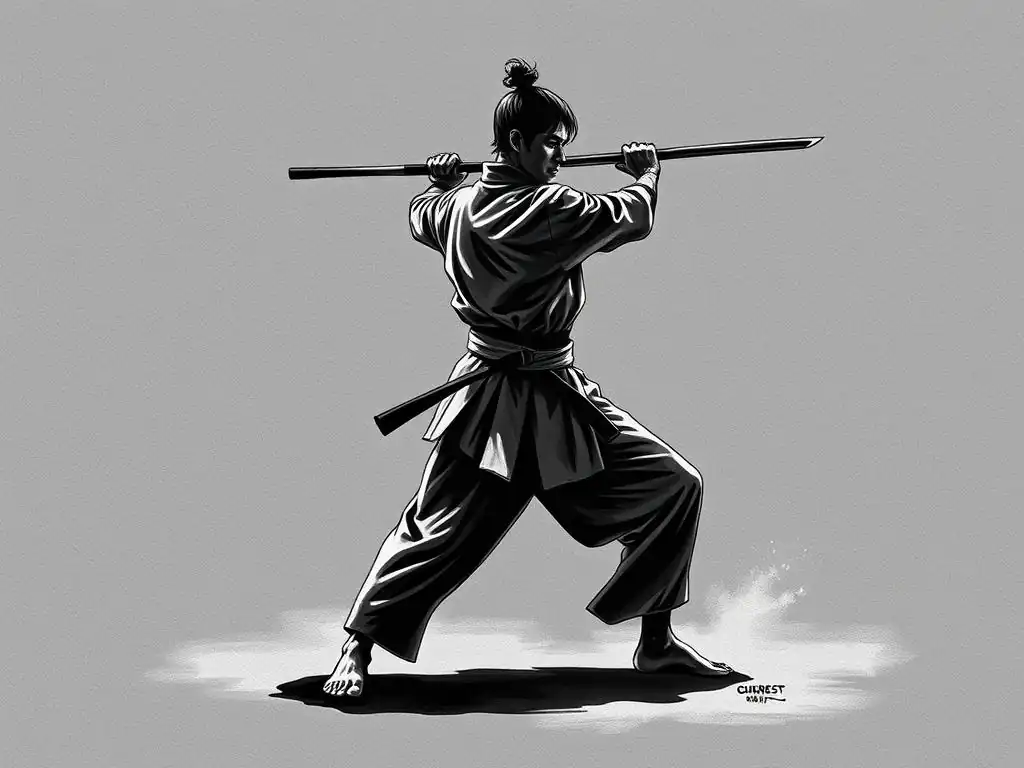
The overhead strike, often called a "chop" or "smash," is one of the most fundamental and powerful Gun staff striking techniques. It involves raising the staff high, typically over the head or to one side, and bringing it down vertically onto the target. Power is generated not just from the arms but from a combination of body weight, core rotation, and driving force from the legs.
As the staff descends, the leading hand guides the strike, while the trailing hand provides leverage and force. The target is usually the head, shoulders, or collarbone area, aiming to deliver a decisive impact. A proper follow-through is important, allowing the momentum to carry the staff naturally or setting up the next technique.
Drills for Improving Overhead Strike Accuracy and Power
To improve the overhead strike, practitioners can engage in several focused drills. A simple solo drill involves repeatedly executing the strike against an imaginary target, focusing on proper body mechanics, power generation, and follow-through. For accuracy, hanging a target, such as a tennis ball or a small piece of cloth (e.g., aiming for a target area roughly 8 inches in diameter), and repeatedly striking it helps refine targeting.
To build power, striking a padded surface or a heavy bag designed for weapon work allows the practitioner to feel the impact and practice driving force through the target. Aiming for consistent, powerful strikes that could hypothetically break a sturdy branch requires dedicated practice.
The Horizontal Strike: Utilizing Circular Motion for Impact
Mastering the Horizontal Staff Strike: Body Mechanics and Footwork
The horizontal strike, often referred to as a "sweep" or "swing," involves moving the staff in a horizontal arc, typically targeting the sides of the head, torso, or legs. This Gun staff striking technique utilizes circular motion, often powered by hip rotation and weight transfer. Starting from a stance, the practitioner pivots on the ball of the foot, rotating the hips and torso to whip the staff around.
The hands guide and control the arc, ensuring the strike connects with maximum force at the desired point in the swing. Footwork, such as a shuffle step or a pivot, is crucial for positioning and adding momentum to the strike.
Variations of the Horizontal Strike: High, Mid, and Low Targets
The horizontal strike is highly versatile due to its ability to target different levels. A high horizontal strike might target the head or neck (e.g., aiming at a height of 5.5 to 6 feet), delivered with a circular motion at head level. A mid-level horizontal strike targets the torso or ribs (e.g., aiming at 3.5 to 4.5 feet), often used to create distance or disrupt an opponent's guard.
A low horizontal strike, sometimes called a "leg sweep" or "ankle chop" (e.g., aiming at 1 to 2 feet), targets the legs or feet, aiming to disrupt balance or disable mobility. Each variation requires slight adjustments in body mechanics and angle but utilizes the same fundamental horizontal circular power generation.
The Thrust: Direct and Penetrating Staff Attacks
Perfecting the Staff Thrust: Targeting Vital Areas
The thrust is a direct, linear Gun staff striking technique that utilizes the end of the staff to deliver a penetrating blow. Unlike strikes that rely on momentum and impact, the thrust focuses on concentrated force applied to a small point. Power comes from driving the lead hand forward while the rear hand pushes, combined with forward body movement or a step.
Target areas are typically vital points or soft tissues, such as the solar plexus, throat, face (eyes), or joints (e.g., knee). The thrust requires precision and speed, aiming to cover distance quickly and deliver force along the staff's axis.
Training Drills for Developing Thrusting Speed and Precision
Developing a fast and accurate thrust involves specific training drills. Practicing repeated thrusts against a wall, focusing on extending fully and retracting quickly, builds speed and muscle memory. For precision, targeting small marks on a wall or a hanging object (e.g., aiming for a target approximately 3 inches in diameter) helps refine accuracy. Partner drills using a focus mitt or a padded target held by a training partner allow for practicing timing and judging distance. Emphasizing a straight, direct line of attack and minimizing any upward or downward deviation is key to perfecting this Gun staff striking technique.
The Sweeping Strike: Controlling Distance and Disrupting Balance
Executing the Sweeping Staff Strike: Targeting the Legs and Feet
The sweeping strike is a low-level horizontal Gun staff striking technique specifically designed to target the opponent's base – their legs and feet. Executed close to the ground, it involves a wide, horizontal arc of the staff aimed at tripping, unbalancing, or striking the lower limbs. The power is often generated through hip rotation and a low stance, keeping the staff's path close to the floor.
This technique can be performed from the front, side, or even behind, depending on the tactical situation. Its primary goal is to eliminate the opponent's stable platform, making them vulnerable to follow-up techniques or simply allowing the practitioner to disengage.
Defensive Applications of the Sweeping Strike
While primarily an offensive technique for disrupting balance, the sweeping strike also has significant defensive applications. Used defensively, it can be employed to create distance by forcing an approaching opponent to jump or check their advance. A well-timed sweep can also interrupt an opponent's footwork as they attempt to close distance or launch their own attack. For example, if an opponent steps forward to punch, a low sweep aimed at their lead leg can break their momentum and compromise their stance. It's a versatile Gun staff striking technique for controlling the lower plane of combat.
Advanced Gun Staff Striking Techniques and Combinations
Combining Basic Strikes into Fluid Sequences
Mastering individual Gun staff striking techniques is merely the beginning; true proficiency lies in seamlessly combining these basic movements into fluid, dynamic sequences. For example, a practitioner might block an incoming strike with the staff, immediately transition into a powerful thrust, and follow up with a low sweep to the legs. These combinations are not random; they are practiced transitions designed to exploit openings created by previous techniques or to set up subsequent attacks. Developing these sequences requires understanding the momentum and flow generated by each strike and how to efficiently channel that energy into the next movement.
Incorporating Footwork and Body Movement for Enhanced Power
Effective Gun staff striking techniques are deeply integrated with footwork and full-body movement. Power originates from the ground, traveling up through the legs, hips, and core before being delivered through the staff. Simple techniques become devastating when combined with proper stepping, pivoting, or shuffling. For instance, a simple horizontal strike gains significant power when coupled with a dynamic pivot that transfers the practitioner's weight fully into the swing. Likewise, footwork is essential for managing distance, closing in for a thrust, or retreating after a sweeping strike, ensuring that every technique is delivered from an optimal position.
Defensive Applications: Blocking and Deflecting with the Staff
Beyond offensive Gun staff striking techniques, the staff is an excellent defensive tool. Its length and strength allow it to effectively block incoming strikes from various weapons or empty hands. Blocking techniques utilize the shaft of the staff to intercept force, often leveraging its length to redirect energy away from the practitioner.
Deflection involves using the staff to lightly parry or guide an opponent's weapon or limb off-line, disrupting their attack without meeting force head-on. These defensive applications are often integrated into combinations, where a block or deflection is immediately followed by a counter-attack using one of the core Gun staff striking techniques.
Training Drills and Exercises for Staff Striking Mastery
Solo Training Drills for Developing Speed and Accuracy
Solo training is fundamental for developing speed and accuracy in Gun staff striking techniques. Practicing basic strikes like overhead chops, horizontal swings, and thrusts repeatedly builds muscle memory and refines movement patterns. Drills like performing figure-eight patterns with the staff, focusing on smooth, continuous motion, improve wrist and forearm strength and coordination. Striking imaginary targets at different heights and distances helps develop spatial awareness and targeting precision. Aiming for a specific number of repetitions for each technique, perhaps 50 or 100 per side, ensures consistent practice volume.
Partner Drills for Practicing Staff Striking Combinations
Training with a partner introduces dynamic elements crucial for applying Gun staff striking techniques effectively. Partner drills can involve one person holding a padded target while the other practices specific strikes or combinations, focusing on timing and distance. Simulated sparring with padded staffs (ensuring appropriate safety gear like head protection and gloves) allows practitioners to practice applying techniques against a moving, resisting opponent. Call-out drills, where a partner calls out specific strikes or targets for the practitioner to execute, improve reaction time and adaptability in applying Gun staff striking techniques.
Conditioning Exercises for Building Strength and Endurance for Staff Fighting
Effective staff work requires not just technique but also physical conditioning. Exercises that build grip strength, forearm endurance, and core power are essential. Simple drills like holding the staff extended horizontally for increasing periods (e.g., starting with 20 seconds and building up to 60 seconds, repeated 5-10 times) build shoulder and arm endurance.
Wrist rolls with the staff improve wrist flexibility and strength. Full-body exercises like squats, lunges, and push-ups build the foundational strength needed for generating power from the lower body and core. Cardiovascular conditioning is also vital, as maintaining intensity during a prolonged staff exchange requires significant stamina.
Common Mistakes to Avoid When Learning Staff Strikes
Incorrect Stance and Posture: Hindering Power and Balance
One of the most common mistakes beginners make when learning Gun staff striking techniques is neglecting their stance and posture. Standing too upright, having feet too close together, or failing to bend the knees significantly hinders power generation and makes the practitioner unstable. A weak stance means power cannot be effectively transferred from the legs and core into the strike, resulting in weak, ineffective techniques. Furthermore, poor posture, such as hunching over or leaning excessively, compromises balance and makes recovery difficult after a strike, leaving the practitioner exposed.
Telegraphing Strikes: Improving Concealment and Speed
Telegraphing strikes is another frequent error. This occurs when a practitioner makes obvious preparatory movements – like a large wind-up, tensing shoulders, or even changes in facial expression – that signal their intention before the strike is launched. This gives the opponent precious time to react, evade, or counter. Effective Gun staff striking techniques are launched with minimal tells, starting the movement from the core and using efficient, direct paths. Learning to strike without unnecessary preliminary movements improves both the speed and the deceptive quality of the attack.
Over-reliance on Strength: Emphasizing Technique and Precision
Beginners often try to compensate for lack of technique with brute force, especially with a weapon like the staff. However, effective Gun staff striking techniques prioritize precision, timing, and body mechanics over raw strength. While strength is beneficial, a smaller, technically proficient practitioner can often overcome a larger, stronger opponent who relies solely on power. Focusing on proper leverage, efficient movement, and hitting the target with accuracy rather than simply swinging as hard as possible leads to more effective, less tiring, and ultimately more powerful strikes.
The Role of "Gun" in Traditional Chinese Martial Arts Philosophy
The Staff as an Extension of the Body and Mind
In traditional Chinese martial arts, the staff, or Gun, is often viewed philosophically as an extension of the practitioner's body and mind, not merely an external tool. Through dedicated practice, the weapon ceases to feel like a separate object and becomes integrated into the practitioner's proprioception and intention.
This concept emphasizes the mental connection to the weapon; the practitioner must feel the staff's weight, balance, and movement as if it were their own limb. Achieving this state requires deep focus, sensitivity, and countless hours of repetitive training, allowing the mind's intent to flow effortlessly through the body and into the staff, guiding the execution of Gun staff striking techniques.
Cultivating Focus and Discipline Through Staff Training
Training with the Gun demands significant focus and discipline, qualities highly valued in martial arts philosophy. The length and potential danger of the staff require constant awareness of one's surroundings and the weapon's trajectory. Practicing complex staff forms (like the Shaolin Gun form, which might contain dozens of distinct movements) demands patience, perseverance, and meticulous attention to detail. The repetitive nature of perfecting basic Gun staff striking techniques instills discipline and mental fortitude. This rigorous training process cultivates not only physical skill but also mental resilience, concentration, and a deeper understanding of the principles of movement and power.
Conclusion: Embracing the Gun Staff as a Martial Art
Frequently Asked Questions
What is a "Gun" in the context of staff striking techniques?
The term "Gun" refers to a specific type of long staff commonly used in Chinese martial arts. It emphasizes fluid and powerful striking motions rather than intricate manipulations.
Why is the Gun staff considered a good starting point for learning staff techniques?
The Gun staff emphasizes fundamental striking patterns and body mechanics, making it a solid foundation. It simplifies complex staff work, focusing on power generation and basic defense.
What are some of the most fundamental Gun staff striking techniques?
Basic techniques include thrusts, sweeps, and overhead strikes. These movements focus on utilizing the full length of the staff and leveraging body weight for maximum impact.
How does training with the Gun staff improve self-defense capabilities?
Gun staff training enhances range control and impact power. It offers a practical means of defending against attacks by maintaining distance and delivering debilitating strikes.
What are some common mistakes to avoid when practicing Gun staff striking techniques?
Avoid telegraphing your movements, losing balance, and neglecting proper grip. Focus on maintaining a stable stance and generating power from your core, not just your arms.
Okay, I can help you craft a final reflection for your article on Gun Staff Striking Techniques. Here's a draft that follows your requested structure and incorporates the article's theme:
Final Reflection: Mastering the Art of the Gun Staff
The techniques explored in this article, while focused on the practical application of gun staff striking, represent far more than just combat maneuvers. They embody a discipline, a dedication to precision, and a deep understanding of leverage and control that resonates far beyond the dojo. In a world increasingly reliant on technology and instant gratification, the commitment to mastering a traditional martial art like gun staff striking offers a tangible connection to history and a powerful reminder of the value of persistent effort.
The journey of learning these techniques has profoundly shaped my understanding of movement and focus. It's a constant reminder that true mastery comes not from innate talent, but from consistent practice and a willingness to learn from every mistake. As Bruce Lee eloquently stated: I fear not the man who has practiced 10,000 kicks once, but I fear the man who has practiced one kick 10,000 times.
This sentiment perfectly encapsulates the spirit of gun staff striking – the relentless pursuit of perfection in fundamental movements.
Now, I invite you to consider how the principles of discipline, precision, and persistent practice, so crucial to mastering gun staff striking, can be applied to your own life. Whether you're pursuing a new skill, tackling a challenging project, or simply striving to become a better version of yourself, remember the dedication required to wield the gun staff effectively. Embrace the challenge, commit to the process, and unlock your own potential for mastery.
Ignite Your Staff Skills: Master the Gun Form!
Thanks for delving into the fundamentals of staff strikes. You've now unlocked a foundational understanding of how to effectively wield this versatile weapon. Ready to take your skills to the next level?
Here’s how to continue your journey:
- Commit to Mastery: Dedicate 15 minutes daily to practicing the gun form's basic strikes. Consistent practice is key to building muscle memory and fluid movements.
- Explore Related Forms: Research how these strikes translate to other staff variations and weapons. Understanding the universal principles will enhance your adaptability.
- Share Your Progress: Post a short video of your practice on social media using #MartialArtsMasteryGun. Let's build a community of learners!
What small step will you take today to begin mastering the gun form?