
Unraveling the Mystery: A Systematic Approach to Bunkai Analysis

Welcome to Martial Arts Mastery, your ultimate resource for understanding the depth and breadth of martial arts.
Dive into the fascinating world of Bunkai analysis, the systematic breakdown of kata techniques, and unlock the hidden applications within. Are you ready to go beyond rote memorization and discover the true fighting principles embedded in each movement? Explore the secrets within and begin your journey to Martial Arts Mastery!
- Introduction to Bunkai Analysis for Martial Arts Mastery
- Defining Bunkai: Beyond the Obvious
- The Need for a Systematic Approach to Bunkai Analysis
- A Step-by-Step Guide to Systematic Bunkai Analysis
- Tools and Resources for Effective Bunkai Analysis
- Common Challenges in Bunkai Analysis and How to Overcome Them
- The Benefits of Mastering Systematic Bunkai Analysis
- Conclusion: Embracing a Continuous Journey of Discovery Through Bunkai
-
Frequently Asked Questions
- What is Bunkai analysis, and why is it important in martial arts?
- How does MartialArtsMastery.org approach Bunkai analysis?
- What are some common misconceptions about Bunkai analysis?
- How can I improve my Bunkai analysis skills?
- Does MartialArtsMastery.org offer resources for learning Bunkai analysis?
- Final Reflection: Embracing Clarity in Complexity
- Unlock Your Kata: Embrace Deeper Understanding!
Introduction to Bunkai Analysis for Martial Arts Mastery
Understanding Bunkai: Deconstructing Kata for Practical Application
Bunkai, a term often translated as "analysis" or "breakdown," is the practice of interpreting the movements within martial arts forms (kata, poomsae, taolu) to understand their practical applications in self-defense or combat scenarios. It's the crucial step that transforms the seemingly abstract sequences of a kata into a dynamic library of techniques. Without effective bunkai, a kata remains merely a choreographed dance, its potential for practical use locked away.
Engaging in bunkai requires martial artists to look beyond the surface-level performance of a kata. It involves asking critical questions: Why is this movement performed? What is its intended target?
How does it interact with an opponent? This process reveals that many seemingly simple movements, like a basic block or strike, often contain multiple layers of application, including joint locks, throws, pressure points, or even combinations of techniques. For example, a standard gedan barai (downward block) might be interpreted not just as a block against a low attack, but also as a wrist grab, a takedown entry, or a control technique, depending on the context and the practitioner's understanding.
The Importance of Systematic Bunkai Analysis in Kata Interpretation
While many martial artists explore bunkai, adopting a systematic approach is paramount for true mastery. An unstructured approach can lead to random, impractical interpretations or a failure to uncover the deeper principles embedded within the kata. A systematic bunkai analysis provides a framework for consistent, logical, and practical exploration, ensuring that the applications derived are effective and aligned with the kata's underlying principles.
A systematic breakdown helps martial artists move beyond isolated techniques and see how movements connect and flow together in realistic scenarios. It allows for the rigorous testing and refinement of applications, often through partner drills and controlled sparring. This methodical process prevents the development of "kata-shaped" applications that only work in a static, compliant environment. Instead, it fosters a deeper understanding of timing, distance, leverage, and opponent reaction, making the derived techniques truly applicable under pressure.
Defining Bunkai: Beyond the Obvious
What is Bunkai? A Comprehensive Definition for Martial Artists
Bunkai, at its core, is the process of extracting practical fighting techniques and principles from the formalized movements of martial arts forms (kata). It is the interpretation of these prearranged sequences into potential applications against one or more opponents in realistic combat situations. This isn't simply about finding an application for a movement, but rather understanding the original or most effective intended applications, while also exploring variations based on context and opponent actions.
A comprehensive definition recognizes that bunkai is not a static concept but a dynamic process of discovery. It involves historical research into the origins of the kata, understanding the prevailing fighting methods of the era in which the kata was created, and rigorous physical experimentation.
It acknowledges that a single movement within a kata might have multiple valid interpretations, depending on the angle of attack, the distance, and the practitioner's body mechanics. For instance, the opening movement of many Pinan/Heian kata, a rising block followed by a stepping punch, could be interpreted as defending a high attack and counter-attacking, or alternatively, as seizing an opponent's arm and striking to the body.
Common Misconceptions About Bunkai and Their Impact
One of the most prevalent misconceptions about bunkai is that kata movements are literal representations of techniques. This "one-to-one" mapping often leads to rigid, inefficient, and impractical applications. For example, seeing a high block in kata and only interpreting it as blocking a high punch misses the potential for that same movement to be a throw, a joint lock setup, or a control technique against a different type of attack or from a different angle.
Another common pitfall is the belief that bunkai applications must resemble the kata movement exactly. This ignores the principle of henka (variation) and oyo (application), where the core principle of a movement is applied flexibly. For instance, a twisting motion in kata might represent anything from a joint manipulation to an escape from a grab, not necessarily a literal twist of the wrist performed in isolation. These misconceptions hinder a deeper bunkai analysis systematic breakdown, limiting the practitioner's ability to unlock the full potential of their forms and develop truly effective self-defense skills.
The Need for a Systematic Approach to Bunkai Analysis
Avoiding Random Interpretations: The Pitfalls of Unstructured Bunkai
Without a systematic approach, bunkai can devolve into a chaotic exercise of finding any application for a movement, often leading to techniques that are impractical, inefficient, or completely unrelated to the kata's underlying principles. This unstructured exploration might produce flashy but ultimately ineffective techniques that fail under pressure. For example, devising a complex counter-grappling sequence from a simple blocking movement without considering the mechanics, balance, and timing required in a real clinch is a common pitfall of random interpretation.
Furthermore, a lack of structure makes it difficult to build a coherent understanding of the kata as a whole. Kata are often designed with interconnected movements and underlying themes. Randomly interpreting isolated movements fails to reveal these patterns and principles, such as transitions between ranges, entries into throws or joint locks, or methods for dealing with multiple attackers. This prevents the practitioner from gaining the holistic knowledge that the kata is intended to impart through a thorough bunkai analysis systematic breakdown.
Ensuring Practicality: Why a System Matters for Self-Defense Applications
A systematic bunkai analysis is essential for ensuring that the applications derived from kata are practical and effective for self-defense. A structured process emphasizes testing applications against resistance, considering real-world attack angles and forces, and refining techniques based on feedback. This moves bunkai beyond theoretical interpretation into functional skill development.
A system allows practitioners to categorize applications, understand their underlying biomechanical principles, and adapt them to different body types and situations. For example, a systematic approach might involve analyzing a kata sequence through the lens of different attack types (strikes, grabs, pushes) or ranges (close, medium, long). This structured exploration, supported by partner drills and pressure testing, ensures that the bunkai applications are not just intellectually interesting but are physically viable and reliable when needed most.
A Step-by-Step Guide to Systematic Bunkai Analysis
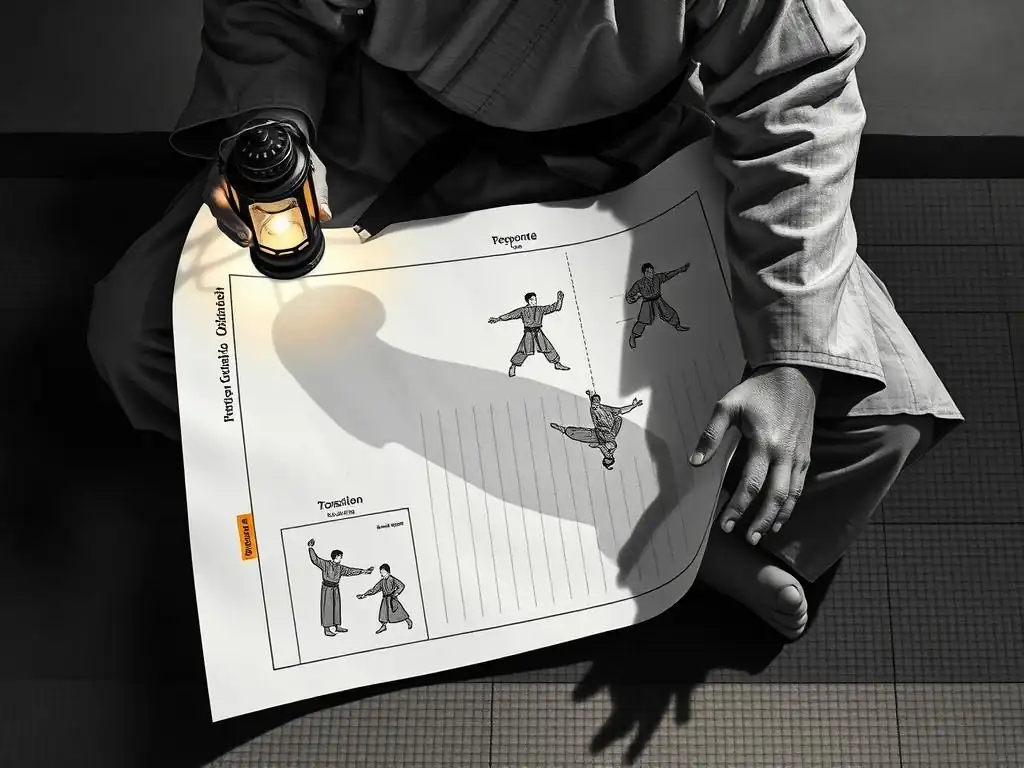
Step 1: Initial Kata Observation and Recording
Documenting the Kata Sequence: Detailed Movement Breakdown
The first step in a systematic bunkai analysis is a meticulous observation and recording of the kata. This goes beyond merely performing the sequence; it involves breaking down each movement, transition, and posture into granular detail.
Documenting this can involve writing detailed notes, sketching movements, or using video recording for later review. For instance, for a movement described simply as "stepping punch," a detailed breakdown would note: the type of step (e.g., oi-zuki, gyaku-zuki), the stance depth and width, the exact path and angle of the punching arm, the non-punching hand's position ( hikite), body rotation, hip engagement, and breathing.
This detailed documentation captures the nuances that are often overlooked in casual practice but are crucial for understanding the potential applications. It involves noting the timing of movements, the points where power is generated or absorbed, and the direction of energy flow. A comprehensive record serves as the baseline for all subsequent analysis, ensuring that interpretations are grounded in the specific details of the kata as it is performed. Consider a kata with 30 distinct movements; documenting each one thoroughly might require several pages of notes or annotations on video timestamps.
Identifying Key Postures and Transitions: Points of Interest
Within the detailed sequence, specific postures and transitions often represent critical moments or hidden techniques. Identifying these points of interest is vital for effective bunkai analysis. Key postures, such as deep stances, specific hand positions (like open hand blocks or grabs), or moments of significant body torque, are often indicators of potential applications like throws, joint locks, or powerful strikes.
Transitions between movements are equally important. The subtle shift from one stance to another, the winding up or unwinding of the body, or the timing of a hand movement relative to a step can conceal takedown entries, control techniques, or defensive maneuvers. For example, the transition from a high block to a downward punch might represent seizing an opponent's wrist during the block and simultaneously striking to a vulnerable point as you shift weight. Highlighting these specific moments allows the practitioner to focus their analytical efforts on where the most potent or non-obvious applications might reside.
Step 2: Identifying Potential Applications (Initial Hypothesis)
Brainstorming Possible Scenarios: Considering Context and Intent
Once the kata sequence is meticulously documented, the next step is to brainstorm potential applications for each movement or sequence of movements. This initial hypothesis generation involves considering various self-defense scenarios and imagining how the kata movements could be applied. It requires thinking about common attacks like punches, kicks, grabs, shoves, or holds, and how the kata's techniques might counter, evade, or neutralize them.
Considering the context and historical intent is crucial here. Was the kata designed for defense against specific weapons? Against multiple opponents? In confined spaces? While direct historical records are often scarce, understanding the general era and style can provide clues. For instance, many Okinawan kata developed in a time when grappling and close-range fighting were prevalent, suggesting that joint locks, throws, and control techniques are likely embedded within the movements, not just simple blocks and strikes. This phase is about generating a wide range of possibilities before narrowing them down.
The Role of History and Tradition in Application Discovery
Leveraging historical knowledge and traditional interpretations is a critical part of systematic bunkai analysis. While not always definitive, studying the history of the kata, its lineage, and the teachings of past masters can offer invaluable insights into the intended applications. Old training manuals, historical accounts, and the interpretations passed down through generations within a specific ryu (school) can provide context and suggest potential meanings for seemingly abstract movements.
For example, researching the history of Karate kata might reveal connections to earlier Okinawan Ti or Chinese martial arts, which often contained sophisticated joint manipulation and throwing techniques. Consulting with senior practitioners who have studied under masters with deep historical knowledge can also unlock traditional interpretations that might not be obvious from the movements alone. This historical grounding helps differentiate plausible, lineage-based applications from purely speculative ones, enriching the bunkai analysis systematic breakdown.
Step 3: Partner Training and Experimentation
Testing Bunkai Hypotheses: Practical Application with a Training Partner
Theoretical analysis is essential, but bunkai remains abstract without practical testing. This step involves working with a training partner to physically test the hypothesized applications. The partner provides controlled resistance, simulates attacks, and offers feedback on the effectiveness and practicality of the techniques. This is where the interpretations move from the intellectual realm to the physical.
Begin with slow, compliant drills to understand the mechanics and flow. Gradually increase speed and resistance to simulate real-world conditions more closely. For instance, if a movement is hypothesized as a wrist lock, practice applying it against a partner who is actively resisting a grab. This testing reveals whether the technique is biomechanically sound, whether it requires specific timing or distance, and how an opponent is likely to react. It quickly exposes impractical interpretations that look good in theory but fail under pressure.
Refining Techniques Based on Resistance and Feedback
The purpose of partner training isn't just to validate interpretations but to refine them. Based on the resistance and feedback received from the partner (and potentially from instructors observing), techniques are adjusted, modified, and optimized. This iterative process is central to a truly systematic bunkai analysis.
If a hypothesized application consistently fails when the partner resists in a certain way, the practitioner must analyze why. Is the angle wrong? Is the timing off? Is the leverage insufficient? This leads to modifications – perhaps a slight change in body position, a different grip, or integrating a preceding or succeeding movement from the kata to create a more effective sequence. This continuous cycle of testing, feedback, and refinement ensures that the bunkai applications become increasingly practical and robust.
Step 4: Analyzing Biomechanics and Body Mechanics
Understanding Leverage, Balance, and Power Generation
A deep understanding of biomechanics and body mechanics is fundamental to effective bunkai analysis. This involves analyzing how the human body moves, generates force, maintains balance, and utilizes leverage. Applying these principles to kata movements helps validate or refine hypothesized applications and uncover hidden techniques. For example, understanding how rotating the hips generates power in a punch ( kime) helps confirm that a kata movement involving hip rotation is likely a strike or a technique requiring explosive force.
Analyzing leverage reveals how seemingly small movements can create significant effects, particularly in joint locks, throws, and control techniques. Understanding balance points helps identify movements designed to disrupt an opponent's equilibrium or maintain one's own. This analytical layer provides a scientific basis for bunkai, moving beyond mere imitation to understanding the underlying physical principles that make techniques effective. It explains why certain movements work, not just what they might represent.
Optimizing Technique for Efficiency and Effectiveness
Applying biomechanical principles allows for the optimization of techniques derived from bunkai. By understanding the most efficient ways to generate power, transfer weight, and apply force, practitioners can refine their applications to be more effective with less effort. This optimization process ensures that the techniques are not only functional but also sustainable and powerful.
For instance, analyzing the body mechanics of a kata block might reveal how engaging the core and using body weight, rather than just arm strength, makes the block more powerful and less likely to be overwhelmed. Similarly, understanding how to use leverage can transform a difficult joint lock into an effortless control technique. This focus on efficiency and effectiveness, guided by biomechanics, is a hallmark of advanced bunkai analysis systematic breakdown.
Step 5: Adapting Bunkai for Different Scenarios
Considering Variables: Distance, Angle, and Opponent Size
Real-world self-defense situations are rarely static. A systematic approach to bunkai analysis must include considering how techniques adapt to varying factors such as distance, angle, and opponent size or strength. A technique that works perfectly against a compliant partner at a specific distance might be useless if the distance is slightly different or the opponent is significantly larger.
This step involves exploring variations of the bunkai application based on these variables. How does the technique change if the opponent is closer or further away? What adjustments are needed if the attack comes from the side rather than head-on? How can leverage be modified to work against a heavier opponent? This adaptability training ensures that the bunkai is not limited to a single, rigid application but can be flexibly applied in a range of realistic contexts.
Developing Versatile Applications: Expanding Your Bunkai Repertoire
The ultimate goal of this step is to develop versatile applications from each kata movement or sequence. Instead of having one interpretation for a movement, the practitioner develops a repertoire of potential applications, understanding when and how to apply each one based on the specific circumstances of an encounter.
This expands the practitioner's self-defense toolkit significantly. A single movement might yield applications against a punch, a grab, and a push, each slightly modified for the specific threat. This versatility makes the kata a truly rich source of practical techniques, far more than just a fixed set of responses. It underscores the depth and complexity available through a thorough bunkai analysis systematic breakdown.
Tools and Resources for Effective Bunkai Analysis
Utilizing Video Analysis Software for Kata Study
Modern technology offers powerful tools for enhancing bunkai analysis. Video analysis software allows practitioners to record their kata performance or demonstrations of bunkai applications and review them in detail. Features like slow-motion playback, frame-by-frame analysis, drawing tools to mark lines of force or angles, and side-by-side comparisons of different performances or applications can reveal subtleties missed during live training.
For instance, using video analysis, a practitioner can precisely measure the angle of a block at impact, analyze the coordination of hip and hand movement, or compare their execution of a technique against an instructor's. This objective visual feedback is invaluable for identifying areas for improvement, ensuring precision in movement, and verifying that the physical execution matches the theoretical understanding derived from the bunkai analysis systematic breakdown.
Cross-Referencing with Historical Martial Arts Texts
Delving into historical martial arts texts, where available, can provide crucial context and potential interpretations for kata movements. While direct manuals for specific kata from centuries ago are rare, texts describing the fighting methods and principles prevalent in the era and region where the kata originated can offer significant clues. Works on Okinawan Te, Chinese Quanfa, or Japanese Jujutsu from relevant periods might illustrate techniques or concepts that mirror movements found in modern kata.
For example, a historical text detailing joint locks common in 19th-century Okinawa might shed light on the intended application of a specific hand or arm movement in a Karate kata. While interpretation is required, these historical sources provide a link to the original context and intent, grounding bunkai in tradition rather than pure speculation. Accessing academic research or translations of such texts can be a valuable resource in this process.
Seeking Guidance from Experienced Instructors and Senior Practitioners
Perhaps the most valuable resource for effective bunkai analysis is the guidance of experienced instructors and senior practitioners within a reputable lineage. These individuals often possess decades of training and have received interpretations passed down through their school's tradition. Their practical experience and deeper understanding of the kata's principles can illuminate applications that are not immediately obvious.
An experienced instructor can correct technical errors, offer alternative interpretations based on their extensive knowledge, and guide the practitioner through practical testing safely and effectively. They can provide context from the history and philosophy of the art that informs the bunkai. While independent analysis is important, mentorship accelerates the learning process and helps avoid common pitfalls, ensuring the bunkai analysis systematic breakdown is accurate and aligned with the art's core teachings.
Common Challenges in Bunkai Analysis and How to Overcome Them
Overcoming "Kata-Shaped" Thinking: Breaking Free from Rigid Interpretations
One of the primary challenges in bunkai is breaking free from the tendency to see applications only in the rigid, stylized way they appear in kata. This "kata-shaped" thinking limits creativity and practicality. For example, always interpreting a stepping punch as only applicable against an opponent standing directly in front at a specific distance misses its potential use against an opponent at an angle, or as part of a combination following a block or evasion.
Overcoming this requires conscious effort to explore variations. Practice performing the kata movement but then immediately transitioning into different potential applications against a partner from various angles and distances. Ask "What else could this movement be?" or "How would this work if the opponent did X instead of Y?". This systematic exploration, moving beyond the obvious, is key to unlocking the deeper layers of bunkai analysis systematic breakdown.
Dealing with Ambiguity: Embracing Multiple Interpretations
Many kata movements are deliberately ambiguous, allowing for multiple valid interpretations depending on the context. This ambiguity can be challenging, as practitioners may seek a single "correct" answer. However, embracing this multiplicity is crucial. A single hand movement might represent a block, a strike, a grab, a pressure point attack, or a combination thereof.
Accepting ambiguity means exploring and testing several potential applications for a single movement. Instead of asking "What is this movement? ", ask "What could this movement be used for?". Documenting these multiple interpretations and understanding the scenarios where each is most applicable enriches the practitioner's understanding and provides a wider range of tactical options. It's about building a versatile toolkit, not finding a single master key.
Maintaining Respect for Tradition While Exploring New Possibilities
Balancing respect for traditional interpretations with the exploration of new possibilities is a delicate but necessary act in bunkai analysis. While historical and lineage-based interpretations provide invaluable context and a connection to the art's roots, blindly adhering to potentially outdated or incomplete explanations can stifle practical discovery.
The key is to use tradition as a foundation and a guide, not a rigid constraint. Start by understanding the traditional interpretations passed down through your school. Then, using a systematic approach, test these interpretations for practicality and explore logical extensions or alternative applications that align with the kata's biomechanical principles and the realities of modern self-defense. This allows the practitioner to honor the past while ensuring the art remains relevant and effective for the present. It's about building upon tradition through rigorous bunkai analysis systematic breakdown.
The Benefits of Mastering Systematic Bunkai Analysis
Enhanced Understanding of Kata Principles
Mastering systematic bunkai analysis leads to a profound enhancement in the understanding of kata principles. Kata are not just collections of techniques; they embody core principles of movement, balance, timing, distance management, and energy generation specific to the martial art style. By breaking down movements and testing applications, practitioners uncover how these principles are applied in practical contexts.
For example, through bunkai, a practitioner learns not just to perform a stance, but why that stance is used in that specific sequence – perhaps for stability during a throw, mobility for an evasion, or power generation for a strike. This deeper understanding transforms kata from a series of memorized steps into a living textbook of strategic and tactical knowledge.
Improved Self-Defense Skills and Practical Application
The most direct benefit of systematic bunkai analysis is a significant improvement in practical self-defense skills. By deriving and rigorously testing applications from kata, practitioners develop techniques that are not only theoretically sound but also effective under pressure. This process bridges the gap between the training hall and potential real-world confrontations.
Regular practice of bunkai applications with partners builds muscle memory, improves reaction time, and develops the ability to apply techniques dynamically. The focus on practicality ensures that the skills learned are relevant to common threats and scenarios, making the martial artist more capable and confident in their ability to defend themselves.
Deeper Appreciation for the Art and Science of Martial Arts
Engaging in systematic bunkai analysis fosters a deeper appreciation for the artistry and scientific principles embedded within martial arts. Understanding the layers of meaning within kata, the intricate biomechanics behind effective techniques, and the historical context of the movements reveals the depth and sophistication of the art form.
This intellectual and physical exploration transforms the practitioner's relationship with their training. Kata practice becomes more meaningful and engaging, as each movement is viewed through the lens of potential application. This deeper connection to the art, fueled by effective bunkai analysis systematic breakdown, encourages lifelong learning and mastery.
Conclusion: Embracing a Continuous Journey of Discovery Through Bunkai
The Ongoing Evolution of Bunkai Interpretation
Bunkai is not a destination but a continuous journey of discovery. As a practitioner gains experience, their understanding of biomechanics, strategy, and self-defense evolves, leading to new insights and interpretations of kata movements. Furthermore, the study of different kata within a style, or even different martial arts, can shed new light on familiar movements.
The evolution of bunkai is also influenced by ongoing research into the history of martial arts and the realities of modern conflict. What was a primary application centuries ago might be less relevant today, while other, perhaps secondary, applications gain importance. Embracing this ongoing evolution keeps the art dynamic and relevant, ensuring that bunkai remains a vibrant and essential part of martial arts training.
The Importance of Critical Thinking and Open-Mindedness in Bunkai Analysis
Effective bunkai analysis systematic breakdown demands critical thinking and open-mindedness. Practitioners must be willing to question assumptions, test hypotheses rigorously, and consider multiple perspectives. Blindly accepting interpretations without personal exploration and testing limits growth and understanding.
Cultivating a mindset of curiosity and intellectual honesty allows the martial artist to delve deeper into the kata, uncovering its hidden lessons. It means being open to the possibility that a movement might have an application vastly different from what was initially assumed, or that there might be multiple valid ways to interpret a sequence. This critical and open approach is the engine that drives the continuous journey of discovery through bunkai.
Frequently Asked Questions
What is Bunkai analysis, and why is it important in martial arts?
Bunkai analysis is the systematic breakdown of martial arts kata (forms) to understand their practical applications. It's important because it reveals the hidden combat techniques embedded within the movements and prevents kata from becoming merely a dance.
How does MartialArtsMastery.org approach Bunkai analysis?
MartialArtsMastery.org emphasizes a structured and methodical approach to Bunkai analysis. We delve into the historical context of kata, examining the original intent of the movements and exploring various interpretations.
What are some common misconceptions about Bunkai analysis?
A common misconception is that Bunkai analysis is simply about finding one correct interpretation. Instead, it's about exploring a range of possibilities and understanding the underlying principles that drive the techniques.
How can I improve my Bunkai analysis skills?
Focus on understanding the fundamental principles of body mechanics, leverage, and distancing. Practice applying these principles to different sections of kata and seek guidance from experienced instructors.
Does MartialArtsMastery.org offer resources for learning Bunkai analysis?
Yes, MartialArtsMastery.org provides articles, videos, and profiles of legendary practitioners that offer insights into Bunkai analysis. We focus on providing a comprehensive understanding of the art and science behind this systematic breakdown.
Final Reflection: Embracing Clarity in Complexity
The journey through Bunkai analysis, as outlined in this article, underscores a vital truth: systematic understanding unlocks hidden potential. What might initially appear as a complex and impenetrable martial art form can, with a structured approach, reveal layers of meaning and practical application. This systematic breakdown isn't just an academic exercise; it's a pathway to deeper mastery and a more profound appreciation for the art itself, resonating deeply in a world often overwhelmed by superficiality.
The impact of a systematic approach to Bunkai extends beyond the dojo. It fosters critical thinking, problem-solving, and a relentless pursuit of understanding, qualities invaluable in all aspects of life. The ability to dissect complex systems, identify core principles, and apply them effectively is a skill that transcends martial arts. The art of war teaches us to rely not on the likelihood of the enemy's not attacking, but rather on our own readiness to receive him; not on the chance of his not attacking, but rather on the fact that we have made our position unassailable.
- Sun Tzu. This quote, though about warfare, perfectly encapsulates the essence of Bunkai: preparedness through understanding.
Now, dear reader, I invite you to consider how you can apply this systematic approach to unraveling complexities in your own life. Whether it's a challenging project at work, a complex relationship, or a personal goal that seems insurmountable, remember the power of a structured breakdown. Embrace the challenge, dissect the problem, and unlock the hidden potential within yourself. The clarity you gain will not only lead to success but also to a deeper understanding of yourself and the world around you.
Unlock Your Kata: Embrace Deeper Understanding!
Thanks for diving into the world of Bunkai! We hope you've discovered new ways to look at your kata and unlock its hidden techniques. Now, let's put that knowledge into action!
- Dive into your own Bunkai exploration. Select one sequence you've been struggling with and dedicate a focused training session to deciphering its applications.
- Share your insights! Start a discussion on our forums at MartialArtsMastery.org and see how others interpret the same movements.
- Challenge yourself by applying a discovered technique in sparring, safely of course, to test its real-world effectiveness.
What single Bunkai revelation are you most excited to explore in your next training session?