
Advanced Jian Taolu: Exploring Intricate Footwork and Sword Maneuvers

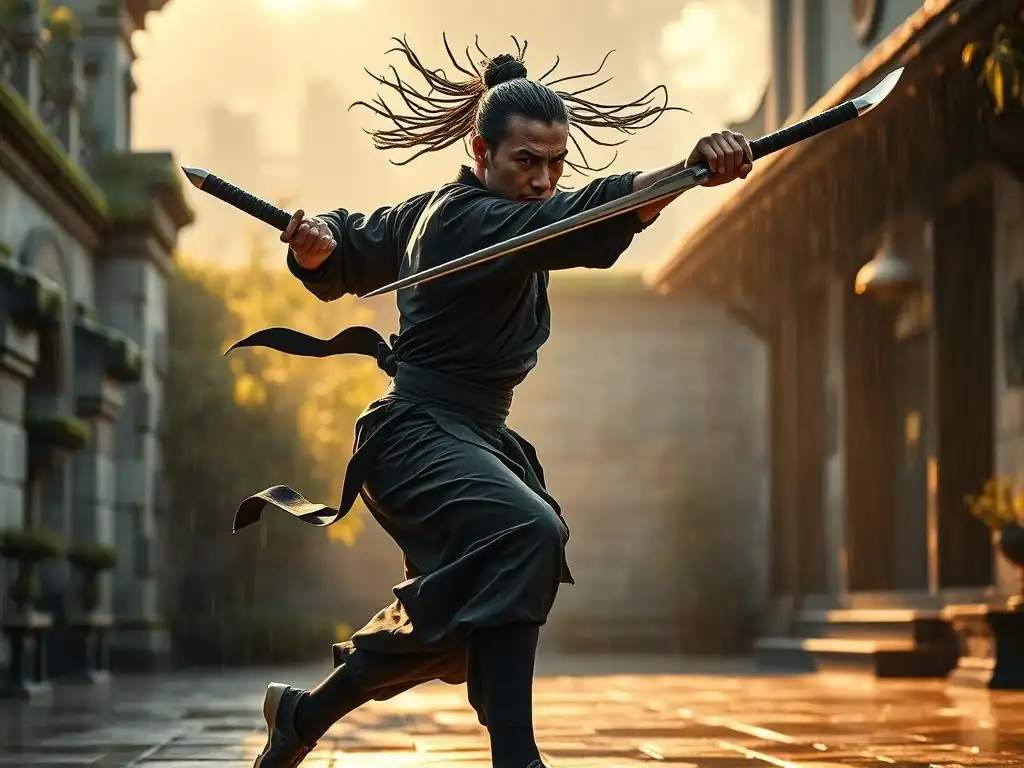
Welcome to Martial Arts Mastery, your ultimate resource for delving into the world of combat traditions!
Unravel the elegance and precision of the Jian sword, where every step and strike tells a story. Our latest exploration delves deep into the intricate world of Jian sword footwork techniques, revealing the secrets behind graceful movements and devastating power. Intrigued? Discover the advanced taolu that elevate your swordsmanship to new heights, blending history, technique, and philosophy into a comprehensive understanding. Let's begin the journey – what secrets will you unlock?
- Introduction to Advanced Jian Sword Techniques
- Mastering Advanced Jian Footwork Techniques
- Exploring Complex Jian Sword Maneuvers
- Integrating Footwork and Swordplay: Advanced Combinations
- Training Drills for Enhanced Jian Sword Footwork and Maneuvers
- The Importance of Visualization and Mental Training
- Conclusion: Elevating Your Jian Sword Skills
-
Frequently Asked Questions
- What is Jian Taolu and why is footwork important in it?
- How do Jian sword footwork techniques contribute to effective self-defense?
- Can you explain some basic Jian sword footwork techniques beginners should learn?
- What makes advanced Jian Taolu footwork different from basic techniques?
- How can I improve my Jian sword footwork techniques outside of formal training?
- Final Reflection: The Enduring Dance of the Jian
- Ignite Your Sword Journey Now!
Introduction to Advanced Jian Sword Techniques
The Jian, often referred to as the "Gentleman of Weapons," is a double-edged straight sword from China, renowned for its grace, speed, and complex techniques. Mastering the Jian Taolu, or forms, goes far beyond simply memorizing sequences of movements. It requires a deep understanding of body mechanics, energy flow, and critically, intricate Jian sword footwork techniques. Advanced practitioners recognize that the power and elegance of swordplay are inextricably linked to the precision and agility of the feet.
This article delves into the more sophisticated aspects of Jian Taolu, focusing specifically on how advanced Jian sword footwork techniques integrate with complex sword maneuvers. We will explore specific steps and their applications, dissecting how movement patterns create opportunities for offense and defense, enhance power generation, and maintain balance and control. Elevating your Jian practice means refining the connection between your steps and your sword, transforming individual techniques into a seamless, dynamic expression of martial art.
Understanding the Foundations of Jian Footwork
Basic Jian footwork establishes the essential principles of stability, balance, and mobility required for effective sword manipulation. Stances like the Gong Bu (Bow Stance), Ma Bu (Horse Stance), and Xu Bu (Empty Stance) provide platforms for generating power and executing techniques. Fundamental steps such as Jin Bu (Advancing Step), Tui Bu (Retreating Step), and Ce Bu (Side Step) allow for basic movement across the training area.
These foundational Jian sword footwork techniques are the building blocks upon which all advanced movement patterns are constructed. Without a solid grasp of these basics, attempting complex steps will lead to instability and inefficiency.
Developing proficiency in foundational footwork involves countless repetitions. Many traditional schools advocate practicing basic stances and steps for several months before introducing complex forms. For instance, dedicating 20-30 minutes daily solely to transitioning between basic stances and executing simple advancing and retreating steps can significantly improve lower body strength, balance, and spatial awareness – crucial prerequisites for mastering advanced Jian sword footwork techniques. The ability to shift weight smoothly and maintain a low center of gravity is paramount.
The Significance of Footwork in Jian Taolu Performance
In advanced Jian Taolu, footwork is not merely a means of transportation; it is an integral part of every sword technique. Proper Jian sword footwork techniques dictate the angle of attack or defense, generate momentum for powerful cuts and thrusts, and enable rapid changes in direction or distance. The flow of movement through a form is largely determined by the transitions between stances and steps, ensuring that the body's energy is channeled effectively into the sword. A common error in Taolu is treating the feet and the sword as separate entities, resulting in disjointed movements and diminished power.
Consider the execution of a powerful horizontal cut (Ping Dai). While the arm and waist initiate the movement, the stability provided by a solid stance, such as a well-executed Ma Bu or Gong Bu, anchors the body and allows for maximum force generation. Similarly, a rapid advance combined with a thrust requires precise timing between the Jin Bu and the extension of the arm.
Studies in biomechanics suggest that optimal coordination between lower body movement and upper body technique can increase strike force by upwards of 30% compared to relying solely on arm strength. Thus, mastering advanced Jian sword footwork techniques is essential for both the aesthetic grace and martial effectiveness of Taolu.
Mastering Advanced Jian Footwork Techniques
The Seven-Star Step (Qi Xing Bu) in Jian Swordplay
The Seven-Star Step (Qi Xing Bu) is one of the most iconic and versatile Jian sword footwork techniques, deriving its name from the pattern of the Big Dipper constellation. It involves a series of quick, often small, steps that allow the practitioner to shift weight rapidly, pivot, and change direction with deceptive speed and agility. This technique is crucial for closing distance, creating angles, and evading attacks while maintaining readiness to strike. It is not a single step but a complex sequence of weight shifts and foot placements that can be adapted to various situations.
Executing the Qi Xing Bu effectively requires exceptional balance and coordination. The steps are typically low to the ground, minimizing vertical displacement and maintaining a stable center of gravity. For example, a common application involves a rapid sequence of shifting weight from one foot to the other while pivoting slightly, allowing the practitioner to circle an opponent or change their facing angle by 45-90 degrees in under a second. This rapid repositioning is a hallmark of advanced Jian sword footwork techniques and is frequently seen in combat applications implied within the Taolu.
Applying the Seven-Star Step for Offensive Maneuvers
Offensively, the Seven-Star Step is invaluable for creating openings and launching surprise attacks. A practitioner might use a quick Qi Xing Bu sequence to rapidly close the distance on an opponent, transitioning directly into a thrust or cut as the final step lands. The unpredictable nature of the footwork makes it difficult for an opponent to anticipate the direction or timing of the attack. For instance, a deceptive step to the left might be immediately followed by a pivot and an attack to the right, exploiting a momentary lapse in the opponent's defense.
Another offensive application involves using the Qi Xing Bu to circle an opponent, seeking to flank them or attack from an unexpected angle. By maintaining constant, fluid movement, the practitioner pressures the opponent while simultaneously setting up an advantageous position. Many traditional Jian forms feature sections dominated by Qi Xing Bu, demonstrating its importance in offensive strategy. Mastering this sequence of Jian sword footwork techniques allows for dynamic entries and unpredictable attack trajectories, keeping the opponent off balance.
Defensive Applications of the Qi Xing Bu
Defensively, the Qi Xing Bu is equally potent, allowing for agile evasion and repositioning. When faced with an incoming attack, a practitioner can use the rapid weight shifts and pivots of the Seven-Star Step to quickly move out of the line of force while remaining close enough to counter-attack. This is often more efficient than large, sweeping evasions which can leave the practitioner vulnerable or too far away to respond effectively. A slight shift combined with a pivot can deflect or avoid a strike by mere inches.
Furthermore, the Qi Xing Bu can be used to disrupt an opponent's rhythm or break their structure. By constantly shifting position, even slightly, the practitioner forces the opponent to adjust their attack, potentially creating an opening for a defensive counter. Some defensive applications involve using the Qi Xing Bu to step inside an opponent's attack zone, nullifying their range advantage while setting up a close-quarters technique. This defensive use of Jian sword footwork techniques emphasizes fluidity and adaptability under pressure.
The Treading Step (Tang Ni Bu) for Agile Movement
The Treading Step (Tang Ni Bu), sometimes translated as "Mud Walking Step," is characterized by a smooth, low, and continuous movement, as if walking through thick mud. It emphasizes maintaining a consistent level and flowing motion, minimizing bobbing or vertical shifts. This step is crucial for moving stealthily, adjusting distance incrementally, and maintaining balance during complex transitions. It allows the practitioner to cover ground deliberately and powerfully, often generating significant momentum.
Tang Ni Bu typically involves placing the foot down heel-first, rolling forward onto the ball of the foot, and then pushing off, creating a powerful forward or backward drive. The body's center of gravity remains relatively constant, and the movement is initiated from the hips and waist. This type of Jian sword footwork technique is particularly effective when needing to advance or retreat smoothly under pressure, such as closing distance for a thrust or creating space after a block. The continuous nature of the step ensures that balance is maintained throughout the movement.
Utilizing the Treading Step to Change Direction
While often used for linear movement, the Treading Step can also be adapted for subtle changes in direction. By slightly altering the angle of the advancing or retreating foot and coordinating with a waist turn, a practitioner can execute smooth curves or diagonal movements. This allows for tactical repositioning without breaking the fluid, grounded nature of the step. For example, a Tang Ni Bu forward might subtly shift into a diagonal advance to bypass an opponent's guard.
The power generated by the rolling motion of the foot in Tang Ni Bu makes it effective for driving through resistance or maintaining forward momentum. This makes it a valuable Jian sword footwork technique when needing to press an attack or recover ground quickly. Practicing Tang Ni Bu involves focusing on the sensation of "pushing the ground away" with each step, ensuring maximum power transfer from the legs through the body.
Combining Tang Ni Bu with Sword Cuts
The smooth, powerful momentum generated by the Treading Step pairs exceptionally well with various Jian cutting techniques. A forward Tang Ni Bu provides the driving force for a powerful downward slash (Pi) or a sweeping horizontal cut (Sao). The continuous motion of the step allows the body's weight and momentum to be fully integrated into the sword's trajectory, increasing the force and reach of the cut. For instance, a Tang Ni Bu covering 1.5 to 2 meters can be used to launch a devastating cut that leverages the full body's mass.
Conversely, a retreating Tang Ni Bu can be combined with defensive cuts or parries. Stepping back smoothly while executing a block-and-cut sequence allows the practitioner to evade the initial force of an attack while immediately responding. The stability of the Tang Ni Bu ensures that the defensive posture is maintained throughout the retreat. The coordination between this type of Jian sword footwork technique and the sword movement is key to fluid, powerful transitions in Taolu.
The Hook Step (Gou Bu) for Close-Range Combat
The Hook Step (Gou Bu) is a distinctive and highly effective Jian sword footwork technique primarily used for rapid evasions, pivots, and creating angles in close quarters. It involves placing one foot behind the other and pivoting sharply on the balls of the feet, often rotating the body 90 degrees or more in a fraction of a second. This step is characterized by its speed and compactness, making it ideal for tight situations where space is limited.
Gou Bu is frequently executed from a forward stance, where the rear foot hooks behind the front foot, allowing for a sudden rotation away from an incoming threat or towards a new target. The weight shifts quickly from one foot to the other during the pivot. Mastery of Gou Bu requires strong ankles and knees, as well as excellent balance, as the entire body's weight is momentarily supported on a small base during the rotation. It's a vital technique for disengaging or changing facing in close combat scenarios.
Executing the Hook Step for Evasive Action
One of the primary uses of the Hook Step is for rapid evasion. If an opponent closes distance unexpectedly or launches a close-range attack, a quick Gou Bu allows the practitioner to pivot out of the line of attack almost instantly. This can be more effective than a simple step back, as it also changes the practitioner's facing, potentially setting up a counter-attack from a new angle. For example, a practitioner might use a Gou Bu to pivot away from a thrust aimed at their chest, simultaneously bringing their sword into a defensive or offensive position.
The speed of the Gou Bu is its main defensive advantage. By executing this Jian sword footwork technique, a practitioner can disappear from an opponent's line of sight or range in the blink of an eye. This evasive maneuver is often seen in advanced Taolu sections that simulate close-quarters engagements, highlighting its importance in reactive defense. The ability to perform Gou Bu smoothly and quickly is a hallmark of advanced Jian practitioners.
Integrating Gou Bu into Sword Thrusts
The Hook Step can also be integrated into offensive techniques, particularly thrusts (Ci). A common application involves using a Gou Bu to pivot towards an opponent while simultaneously launching a thrust. This allows the practitioner to generate momentum from the rotation and deliver a powerful, unexpected thrust from a sideways or oblique angle. The sudden change in direction created by the Gou Bu can catch an opponent off guard, making the thrust more difficult to parry or evade.
Another offensive use combines a feigned movement with a Gou Bu. A practitioner might step forward as if to attack, then suddenly execute a Gou Bu to pivot and thrust from the side. This deceptive use of Jian sword footwork techniques adds another layer of complexity to offensive strategy. The power generated by the rotational force of the pivot, combined with the linear extension of the thrust, makes this a formidable combination in advanced Jian practice.
Exploring Complex Jian Sword Maneuvers
The Twisting Flower (Nian Hua) Technique
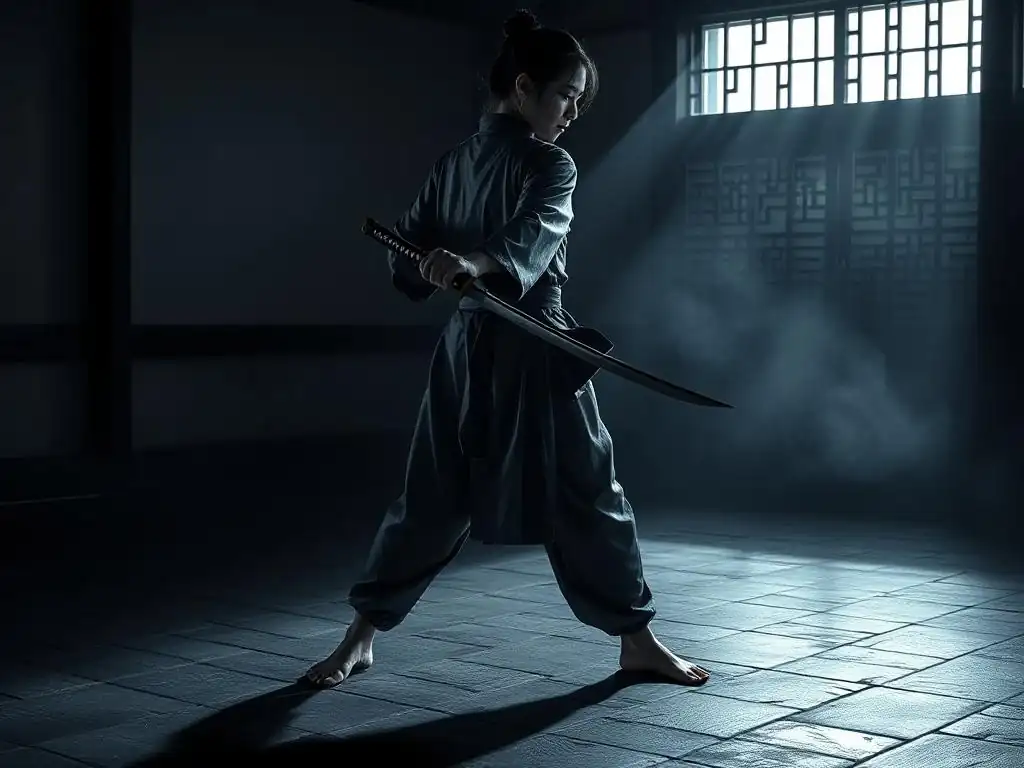
The Twisting Flower (Nian Hua) is a complex Jian maneuver characterized by the sword circling the wrist or forearm, often in a continuous, fluid motion. It requires precise control of the sword tip and sophisticated wrist flexibility. This technique is not solely for show; it can be used to change the sword's angle rapidly, deflect incoming attacks, or set up subsequent strikes. It embodies the fluidity and circularity often found in advanced Jian techniques.
Nian Hua can involve the sword tip drawing circles close to the body, either horizontally, vertically, or diagonally. The movement is initiated primarily by the wrist and forearm, with subtle support from the shoulder and body. Mastery of Nian Hua requires extensive practice to develop the necessary dexterity and control, preventing the sword from hitting the practitioner or losing control of the blade. Many hours are dedicated to isolating this movement in training drills.
Breaking Down the Nian Hua Sword Motion
The core of the Nian Hua technique is the precise rotation of the sword around a central point, usually the wrist or forearm. This rotation is achieved through subtle movements of the fingers, wrist flexion and extension, and slight adjustments of the forearm. The blade maintains a constant speed and trajectory throughout the circle, which might be as small as 10-15 cm in diameter. The ability to perform this motion smoothly in both directions (clockwise and counter-clockwise) is fundamental.
Advanced variations of Nian Hua involve performing the technique while moving or transitioning between stances. For example, a practitioner might execute a Nian Hua while stepping forward or backward, or while shifting from a Gong Bu to a Xu Bu. The challenge lies in maintaining the smooth, consistent circular motion of the sword regardless of the body's movement. This requires a high degree of dissociation between upper and lower body control.
Integrating Footwork for Seamless Transitions in Nian Hua
Seamless execution of Nian Hua within a Taolu requires perfect coordination with Jian sword footwork techniques. The footwork should support and facilitate the sword's movement, not disrupt it. For instance, as the sword circles, the practitioner's feet might be executing a Tang Ni Bu to advance, or a Qi Xing Bu to reposition. The transition from a static Nian Hua drill to performing it within a dynamic form is a significant step in advanced training.
A common integration involves using the momentum generated by a step to enhance the speed or power of the Nian Hua, or using the circling motion of the sword to cover a transition between stances. For example, a quick Qi Xing Bu might be covered by a rapid Nian Hua, ensuring the sword remains active and unpredictable even during the footwork transition. This integration of Jian sword footwork techniques and sword maneuvers is what elevates a sequence from individual movements to a flowing form.
The Winding Silk (Chan Si) Sword Method
The Winding Silk (Chan Si) concept in Jian swordplay refers to the continuous, spiraling, and often circular movements of the sword, similar to unreeling silk from a cocoon. It emphasizes fluidity, coiling power, and connection between the body and the weapon. Chan Si is not a single technique but a principle applied to various movements, including cuts, thrusts, and deflections. It is closely related to the principles found in Taijiquan and other internal martial arts.
Applying the Chan Si principle means that movements are never purely linear but contain subtle curves and spirals. Power is generated through the unwinding of coiled energy from the core, transmitted through the limbs to the sword. This results in movements that are both powerful and yielding, allowing the practitioner to adapt to an opponent's force rather than meeting it head-on. The sword feels like an extension of the body, moving with organic fluidity.
Understanding the Circular Movements of Chan Si
Chan Si movements in Jian often involve the sword tip following complex curved paths. Instead of a straight thrust, the sword might spiral forward. Instead of a linear block, the sword might circle to deflect the incoming force. These circular movements are not random; they are precise trajectories designed to control space, redirect force, and maintain continuous contact or threat. A typical Chan Si application might see the sword tip describing an 'S' curve or a figure-eight as it advances.
The power in Chan Si comes from the principle of whole-body connection. The movement originates in the feet, is guided by the waist, and expressed through the hand and sword. This allows for seemingly effortless power and the ability to change direction or technique instantly. Practicing Chan Si involves developing a keen sensitivity to the connection between the ground, the body, and the sword.
Coordinating Body Mechanics with Winding Silk
Effective Winding Silk execution is heavily dependent on coordinating the body's movement, particularly the waist and hips, with the sword. The footwork provides the base and initiates the movement, the waist guides the spiral, and the arms and sword follow. Jian sword footwork techniques like Tang Ni Bu or subtle adjustments within stances are used to support the continuous, flowing motion of the sword. There are no abrupt stops or starts; everything flows seamlessly.
For instance, a Chan Si spiral thrust might be accompanied by a subtle Tang Ni Bu forward, with the waist gently rotating to guide the sword's tip along its helical path. The coordination must be so precise that the footwork enhances the spiral, adding momentum and stability. Developing this coordination requires extensive solo practice focusing on the internal feeling of energy flow and the connection between the feet, body, and sword.
The Dragon Soaring (Long Teng) Sword Form
The Dragon Soaring (Long Teng) concept or specific forms named "Long Teng Jian" often embody the pinnacle of Jian artistry, characterized by powerful, expansive movements, leaps, and dramatic techniques that evoke the image of a dragon flying through the air. These forms showcase speed, agility, and explosive power, combining intricate footwork with dynamic sword maneuvers. Mastery of Long Teng requires not only technical skill but also significant physical conditioning and expressive intent.
Long Teng forms typically include high leaps (Tiao Bu), powerful advancing steps (Pu Bu), and rapid changes in level and direction. The sword techniques are equally dynamic, featuring sweeping cuts, powerful thrusts, and elaborate circling movements. The challenge lies in executing these powerful techniques while maintaining the control, precision, and grace characteristic of Jian. It's a demonstration of advanced command over both Jian sword footwork techniques and complex sword handling.
Achieving Power and Grace in Long Teng
Achieving both power and grace in Long Teng forms is a significant challenge. Power comes from the strong foundation provided by the footwork and the coordinated use of the entire body. Techniques like explosive leaps require powerful leg drive, while sweeping cuts utilize torque generated from the waist and hips, supported by stable stances. Grace, on the other hand, requires fluidity, smooth transitions, and precise control over the sword's trajectory, ensuring movements are clean and aesthetically pleasing.
Training for Long Teng involves developing both explosive strength and refined control. Plyometric exercises improve leaping ability, while drills focusing on smooth weight transitions enhance grace. For example, practicing a simple advance and cut sequence hundreds of times, focusing on minimizing unnecessary movements and maximizing power transfer, is essential. The goal is for the power to appear effortless and the grace to possess underlying strength.
Combining Long Teng with Leaping Footwork
Leaping footwork is a signature element of many Long Teng forms. Techniques like the "Leaping Empty Step" (Tiao Xu Bu) or "Leaping Bow Step" (Tiao Gong Bu) allow the practitioner to cover significant distance or change levels rapidly. These leaps are often combined with aerial sword techniques, such as a cut executed mid-air or a thrust upon landing. The timing between the leap and the sword maneuver is critical for both effectiveness and safety.
Integrating these leaping Jian sword footwork techniques requires extensive practice to develop body control in the air and ensure a stable landing. A poorly executed landing can disrupt the subsequent movement or lead to injury. Drills focusing on jumping and landing mechanics, often practiced without the sword initially, are crucial. Only after mastering the aerial footwork is the sword technique added, focusing on coordinating the sword's movement with the peak of the leap and the moment of landing.
Integrating Footwork and Swordplay: Advanced Combinations
Creating Fluid Transitions Between Footwork and Sword Techniques
The hallmark of an advanced Jian practitioner is the seamless integration of Jian sword footwork techniques and sword maneuvers. There is no pause or hesitation between a step and a strike; the movement flows continuously from the ground through the body to the sword. This fluidity makes the practitioner's movements unpredictable and efficient, maximizing speed and power while minimizing wasted energy. Achieving this requires countless repetitions, focusing on the connection between the lower and upper body.
Training drills often isolate footwork and sword techniques initially, but advanced practice focuses on combining them. For example, practicing a Tang Ni Bu leading directly into a thrust, or a Qi Xing Bu sequence ending precisely as a cut is completed. The timing must be exact, with the foot landing and the sword technique finishing simultaneously or with the sword technique slightly leading, powered by the momentum of the step. This synchronization is key to advanced Jian sword footwork techniques application.
Developing Sensitivity and Responsiveness in Jian Practice
Advanced Jian practice cultivates sensitivity – the ability to feel the connection between the body and the sword, and responsiveness – the ability to react instantly and appropriately to changing circumstances (real or imagined within the form). Sensitivity allows the practitioner to know exactly where the sword tip is in space without looking and to feel the flow of energy through their body. Responsiveness allows for split-second adjustments in footwork or technique.
This sensitivity is developed through dedicated solo practice, focusing on internal awareness, and through partner drills that simulate interaction. For instance, practicing "sticky sword" (Tui Shou with swords, though typically blunt) helps develop the ability to feel an opponent's force and respond with appropriate Jian sword footwork techniques and swordwork. This internal and external sensitivity is crucial for applying techniques effectively beyond the solo form.
Cloud Hands with Continuous Stepping and Thrust
An excellent example of integrated movement is the "Cloud Hands" (Yun Shou) principle applied to Jian, combined with continuous stepping and a thrust. While Yun Shou is often a circular blocking/parrying motion, integrating it with continuous Tang Ni Bu or Qi Xing Bu allows for constant defensive coverage while repositioning. Adding a sudden thrust emerging from the circular movement exemplifies dynamic integration.
Imagine executing a continuous Yun Shou, circling the sword horizontally in front of the body, while simultaneously performing a series of Tang Ni Bu steps forward. Suddenly, mid-circle, the movement changes, and the sword shoots out in a powerful thrust, powered by the forward momentum and a final body rotation. This combination requires the Jian sword footwork techniques to provide stable, continuous movement while the upper body maintains fluid control of the sword, transitioning instantly from circular defense to linear offense.
Reverse Sweep with Drop Step and Upward Cut
Another advanced combination involves a "Reverse Sweep" (Fan Sao), a "Drop Step" (Xia Bu), and an "Upward Cut" (Liao). The Reverse Sweep is a horizontal cut performed while stepping back or turning. The Drop Step involves lowering the body close to the ground, often into a Pu Bu or similar low stance. The Upward Cut is a powerful vertical or diagonal cut performed from a low position.
Executing this sequence involves performing the Reverse Sweep while initiating a retreat or turn. As the sword completes the sweep, the practitioner rapidly lowers their body into a Drop Step, using the momentum to coil potential energy. Immediately upon reaching the low stance, this coiled energy is released into a powerful Upward Cut. This combination demonstrates rapid changes in level and direction, requiring seamless coordination between the Jian sword footwork techniques and the sword actions. The Drop Step provides the low platform and power generation for the explosive upward movement.
Training Drills for Enhanced Jian Sword Footwork and Maneuvers
Footwork Conditioning Exercises for Jian Practitioners
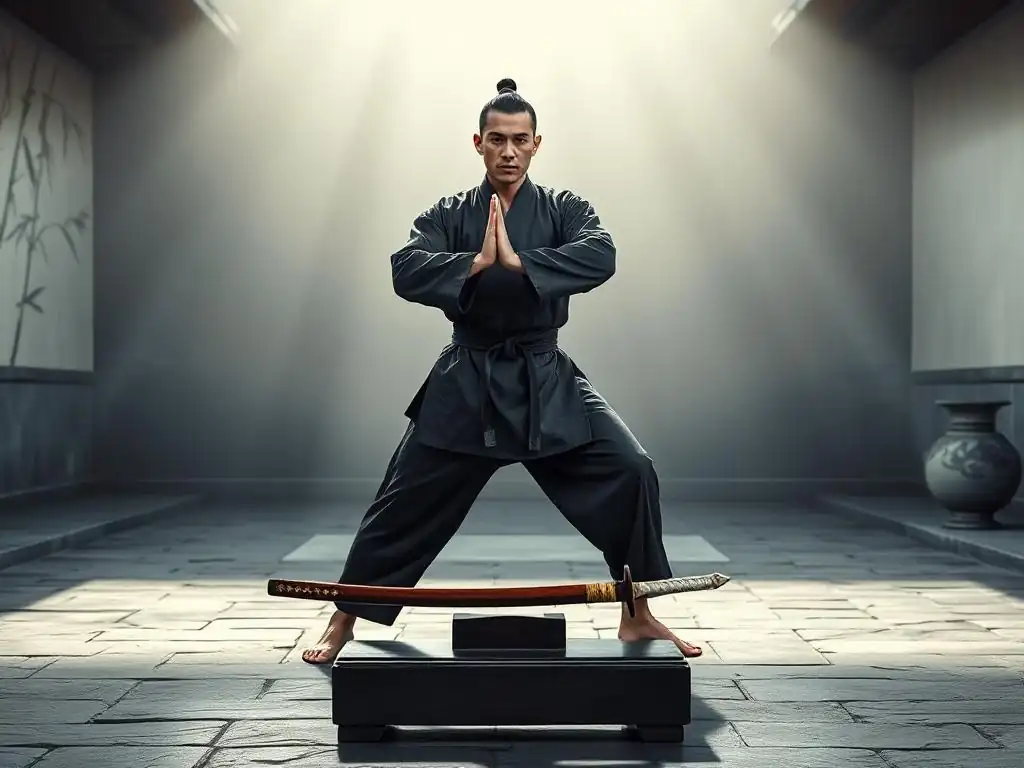
Developing advanced Jian sword footwork techniques requires specific physical conditioning focused on agility, balance, speed, and leg strength. Simply practicing the forms is often insufficient. Supplemental exercises are necessary to build the physical attributes that underpin fluid and powerful movement. These exercises should mimic the demands of Jian footwork without the sword initially.
- Cone Drills: Setting up cones in patterns (e.g., a star for Qi Xing Bu, a line for Tang Ni Bu) and practicing moving through them quickly and accurately, focusing on precise foot placement and weight transfer.
- Ladder Drills: Using an agility ladder to improve foot speed, coordination, and rhythm for quick, small steps.
- Box Jumps/Step-ups: Building explosive leg strength for leaps and powerful stance transitions.
- Single-leg Balance: Standing on one leg for extended periods, with eyes open and closed, to improve proprioception and stability.
Agility Drills for Improved Speed and Coordination
Agility is the ability to change direction quickly and efficiently while maintaining balance. For Jian sword footwork techniques, this is paramount for evasions, feints, and creating angles. Drills like shuttle runs, pro-agility drills (5-10-5), and T-drills help develop the ability to accelerate, decelerate, and change direction rapidly. Practicing these with a focus on keeping the body low and controlled, similar to Jian stances, enhances their relevance.
Another effective agility drill is mirror training with a partner. One person leads with various Jian footwork techniques (without the sword), and the other mirrors their movements precisely. This forces rapid reaction and adaptation. Aiming for drills that involve multiple changes in direction within a short period, like 10-15 seconds bursts, can significantly improve the speed and coordination required for advanced Jian movement.
Balance and Stability Training for Jian Swordplay
Balance and stability are the foundation of all Jian techniques. Without a stable base, power cannot be generated effectively, and control over the sword is compromised. Training on unstable surfaces, such as balance boards or foam pads, can improve proprioception and strengthen stabilizing muscles in the ankles, knees, and hips. Practicing basic stances and transitions on these surfaces adds a significant challenge.
Holding stances for extended periods, such as a deep Gong Bu or Ma Bu for 30-60 seconds, builds isometric strength and endurance in the legs. Incorporating dynamic balance exercises, like stepping onto and off platforms or walking on a narrow beam, further enhances stability during movement. These exercises directly support the execution of complex Jian sword footwork techniques like Qi Xing Bu and Gou Bu, which require rapid weight shifts and pivots on a small base.
Sword Technique Drills for Precision and Power
While footwork provides the foundation, the sword techniques must be executed with precision and power. Drills focusing specifically on sword handling are essential to complement footwork training. These drills isolate specific movements to refine technique and build strength and endurance in the arms, wrists, and shoulders.
- Basic Cuts/Thrusts: Practicing fundamental techniques like Pi (chop), Ci (thrust), Liao (upward cut), Sao (sweep) repeatedly, focusing on correct body alignment, power generation from the waist, and the sword tip's trajectory.
- Figure-Eight Drills: Continuously drawing horizontal or vertical figure-eights with the sword tip to improve wrist flexibility, control, and endurance.
- Target Practice: Using stationary or moving targets (like hanging paper or pool noodles) to practice hitting specific points with different techniques, focusing on accuracy and penetration.
- Weight Training: Incorporating light weights or resistance bands to build strength relevant to sword movements, being careful not to sacrifice speed or fluidity for brute force.
Targeted Drills for Specific Sword Cuts and Thrusts
Breaking down complex sword maneuvers into smaller components and drilling them specifically improves precision. For example, practicing the wrist rotation required for Nian Hua hundreds of times slowly, then increasing speed. For Chan Si, drilling the spiraling motion of the wrist and forearm in isolation before adding body movement. For thrusts, focusing on the straightness and speed of the extension, ensuring the power comes from the legs and waist, not just the arm.
Using visual aids, like drawing lines on a wall to follow with the sword tip, can help refine the trajectory of cuts and thrusts. Practicing cuts at different angles and heights ensures versatility. For thrusts, focusing on hitting a small target helps develop accuracy. These focused drills on sword mechanics are vital for translating the power and positioning gained from Jian sword footwork techniques into effective strikes.
Partner Drills for Developing Timing and Reaction
Partner drills, even with blunt training swords or wooden dowels, are crucial for developing timing, distance judgment, and reactivity – skills that cannot be fully honed solo. Simple drills like parrying incoming "attacks" help develop defensive timing. More complex drills involve one partner performing a sequence of footwork and a simple attack, and the other reacting with appropriate defensive Jian sword footwork techniques and counters.
"Pushing hands" variations adapted for sword (without contact or with very light contact using padded swords) can help develop sensitivity to an opponent's movement and force. Drills focusing on entering and exiting range, such as one partner advancing and the other retreating while maintaining a safe distance, refine the application of Jian sword footwork techniques like Tang Ni Bu and Qi Xing Bu in a dynamic context. These interactions are vital for bridging the gap between solo Taolu practice and potential self-defense application.
The Importance of Visualization and Mental Training
Beyond physical practice, mental training is a critical component of mastering advanced Jian Taolu. Visualization, focus, and mindfulness enhance body awareness, improve technique execution, and cultivate the mental fortitude required for high-level performance. The mind and body are deeply interconnected in martial arts, and training one without the other limits potential.
Mental rehearsal of forms and techniques can improve muscle memory and coordination. Visualizing successful execution helps build confidence and refine the internal feeling of the movement. For advanced Jian sword footwork techniques, visualizing the precise placement of the feet, the weight shift, and the resulting body position can improve performance even before physical practice.
Visualizing Successful Jian Sword Form Execution
Before performing a complex Jian form, mentally walking through the entire sequence, visualizing each stance, step, and sword technique in detail, can significantly improve performance. Picture the flow of energy, the timing of transitions, and the feeling of executing each movement perfectly. Focus on the Jian sword footwork techniques – see your feet moving precisely, feel the ground beneath them, and visualize the power transferring up through your body.
This visualization should be as realistic as possible, engaging all senses. Imagine the weight of the sword, the sound of the air being cut, the feeling of balance during a difficult step. Studies have shown that mental rehearsal can activate the same neural pathways as physical practice, improving coordination and reducing errors. Spending 5-10 minutes visualizing a form or a complex sequence of Jian sword footwork techniques daily can complement physical training effectively.
Cultivating Focus and Mental Clarity
Jian Taolu requires intense focus. Distractions can lead to errors, loss of balance, or even injury. Cultivating mental clarity means being fully present in the moment, focusing solely on the task at hand – the execution of the form. Techniques like single-point focus meditation, where attention is held on a specific object or sensation, can train the mind to resist distractions.
During practice, maintain focus on internal sensations – the weight shift in your Jian sword footwork techniques, the tension in your muscles, the path of your sword. When the mind wanders, gently bring it back to the present moment and the physical sensations of the movement. This trains the ability to maintain concentration during complex and physically demanding sequences.
Mindfulness Meditation for Enhanced Body Awareness
Mindfulness meditation, which involves paying attention to the present moment without judgment, can significantly enhance body awareness. By focusing on physical sensations – the feeling of your feet on the ground, the movement of your limbs, your breath – you become more attuned to your body's position and movement in space. This enhanced awareness is crucial for executing intricate Jian sword footwork techniques with precision and control.
Regular mindfulness practice can improve proprioception – the body's sense of its own position and movement. This is particularly beneficial for techniques requiring precise weight shifts and balance, like the Qi Xing Bu or Gou Bu. By becoming more aware of subtle body cues, practitioners can adjust their movements instantly, leading to more fluid and accurate execution of advanced Jian sword footwork techniques and sword maneuvers.
Conclusion: Elevating Your Jian Sword Skills
Mastering advanced Jian Taolu is a journey that demands dedication, physical conditioning, technical precision, and mental discipline. It is the intricate dance between the feet and the sword, where sophisticated Jian sword footwork techniques provide the foundation and momentum for graceful yet powerful sword maneuvers. Techniques like the Seven-Star Step, Treading Step, and Hook Step are not just movements; they are strategic tools that unlock the full potential of Jian swordplay.
Integrating complex maneuvers like Nian Hua, Chan Si, and Long Teng with precise footwork creates a seamless flow of energy and motion. This requires countless hours of dedicated practice, breaking down techniques, drilling combinations, and constantly refining the connection between the body and the weapon. The pursuit of mastery in Jian is characterized by this continuous refinement of both individual skills and their holistic integration.
The Path to Mastery Through Dedicated Practice
The path to mastery in Jian is iterative and demanding. It involves relentless repetition of fundamentals, gradual introduction of advanced techniques, and persistent effort to integrate all aspects of the art. There are no shortcuts; progress is measured in hours of sweat equity on the training floor. Advanced practitioners spend years, often decades, honing their Jian sword footwork techniques and sword handling skills.
This dedicated practice builds not just physical skill but also mental resilience and a deeper understanding of the underlying principles of Jian. It's through this consistent effort that the body and mind become harmonized, allowing the practitioner to express the true essence of the "Gentleman of Weapons." Each training session, each repetition of a challenging Jian sword footwork technique, is a step forward on this path.
Further Exploration of Advanced Jian Sword Techniques
This article has explored some key advanced Jian sword footwork techniques and complex maneuvers. However, the world of Jian is vast, with numerous styles and variations offering unique insights and techniques. Practitioners are encouraged to explore different forms, study under experienced teachers, and delve into the rich history and philosophy behind the Jian.
Continued learning might involve exploring specific stylistic variations of Jian, such as Wudang Jian with its emphasis on internal principles and flowing movement, or more external, performance-oriented Wushu Jian forms. Each style offers different approaches to Jian sword footwork techniques and sword handling, providing new challenges and deepening understanding. The journey of mastering Jian is lifelong, filled with continuous discovery and refinement.
Frequently Asked Questions
What is Jian Taolu and why is footwork important in it?
Jian Taolu refers to choreographed sword form sequences practiced in Jian (straight sword) martial arts. Footwork is crucial because it provides balance, power generation, and strategic positioning for both offense and defense.
How do Jian sword footwork techniques contribute to effective self-defense?
Proper footwork allows for rapid evasion of attacks, creating space to counter. It also helps to maintain optimal distance for striking effectively with the Jian, maximizing reach and impact.
Can you explain some basic Jian sword footwork techniques beginners should learn?
Beginners should focus on foundational steps like the bow stance, empty stance, and cat stance. Mastering these provides a solid base for movement and allows for efficient transitions between different sword maneuvers.
What makes advanced Jian Taolu footwork different from basic techniques?
Advanced footwork involves more complex movements like spinning steps, jumping maneuvers, and directional changes. These techniques require greater balance and coordination to execute effectively and create openings.
How can I improve my Jian sword footwork techniques outside of formal training?
Practice shadow footwork drills to improve muscle memory and agility. Incorporate balance exercises like single-leg stands and Tai Chi to enhance stability and coordination.
Final Reflection: The Enduring Dance of the Jian
The intricate footwork and precise sword maneuvers explored throughout this article are not merely historical relics; they represent a living art form that continues to resonate with practitioners seeking physical and mental discipline. The Jian, more than just a weapon, becomes an extension of the self, and mastering its footwork unlocks a deeper understanding of balance, coordination, and the flow of energy.
The influence of Jian sword footwork techniques extends beyond the martial arts dojo, shaping our appreciation for grace, precision, and the pursuit of perfection. The dedication required to master these techniques mirrors the dedication needed to excel in any field, reminding us that true mastery comes from consistent practice and unwavering focus. The journey of a thousand miles begins with a single step.
This ancient proverb perfectly encapsulates the spirit of Jian practice, urging us to embrace the challenges and celebrate the small victories along the way.
Now, take a moment to consider how the principles of balance, coordination, and focused intention, so central to Jian sword footwork techniques, can be applied to your own life. Whether you seek physical fitness, mental clarity, or simply a deeper connection to your inner self, embrace the spirit of the Jian and discover the power of mindful movement in every step you take.
Ignite Your Sword Journey Now!
Thanks for exploring the fascinating world of Jian Taolu with us. We hope you've gained a deeper appreciation for the artistry and precision this ancient practice demands. Now, it’s time to take your understanding to the next level.
Here are a few ways to continue your journey:
- Embark on mastering a new level with a dedicated instructor:Dedicate the next three months to mastering the first section of a Jian Taolu form under the guidance of a qualified instructor.
- Explore the historical origins of your chosen Jian Taolu form to enhance your understanding and appreciation.
- Share your insights by posting a video of you practicing one basic Jian movement on your social media using #MartialArtsMastery and invite others to join the exploration.
What specific aspect of Jian Taolu are you most eager to practice and improve upon this week?