
Oral Traditions in Arnis: Passing Down Knife and Empty Hand Secrets

Welcome to Martial Arts Mastery, your gateway to the world's fighting arts!
Delve into the fascinating realm where tradition meets technique. Ever wondered how the deadliest secrets of Arnis have been preserved through generations? Our latest exploration uncovers the captivating world of Arnis knife oral traditions, revealing how vital knowledge, particularly concerning knife techniques and empty-hand applications, is passed down through spoken word and practice. Prepare to discover the hidden layers of this Filipino martial art and unlock insights that written texts simply can't convey. What stories do these traditions hold, and how do they shape the practitioner? Read on to find out!
- Introduction to Arnis Oral Traditions and Knowledge Transfer
- The Role of the "Guro" in Preserving Arnis Techniques
- Combat Techniques Passed Down Through Generations in Arnis
- Empty Hand Combat: Arnis's Integrated Curriculum
- The Significance of "Awit" (Songs) and "Kuwento" (Stories) in Arnis Training
- Challenges and Preservation of Arnis Oral Traditions in the Modern Era
- Conclusion: The Enduring Power of Oral Transmission in Arnis
-
Frequently Asked Questions
- What is the significance of oral traditions in Arnis?
- How are knife techniques typically transmitted through oral traditions in Arnis?
- What types of "secrets" are often protected and passed down orally in Arnis?
- Why is it important to understand the historical context behind Arnis knife oral traditions?
- Beyond knife techniques, what other aspects of Arnis are preserved through oral traditions?
- Final Reflection: The Enduring Echo of Arnis
- Unleash Your Inner Arnis Master!
Introduction to Arnis Oral Traditions and Knowledge Transfer
The Importance of Oral History in Filipino Martial Arts (FMA)
Filipino Martial Arts (FMA), encompassing styles like Arnis, Eskrima, and Kali, have historically relied heavily on oral traditions for their survival and transmission. Unlike many codified martial arts with extensive written manuals and standardized curricula from their inception, FMA often developed in diverse regional contexts across the Philippine archipelago. Knowledge, particularly the intricate techniques of Arnis knife oral traditions and empty hand applications, was passed down directly from teacher to student, often within families or small, trusted groups.
This method was not merely a matter of convenience but a necessity, especially during periods of occupation where overt martial arts training might have been suppressed. The spoken word, coupled with physical demonstration and rigorous practice, became the primary vehicle for preserving complex combat systems honed over centuries.
This reliance on oral transmission meant that the depth and nuance of techniques, including critical timing, distance, and psychological aspects, were embedded within the living interaction between practitioner and master. The subtle shifts in body weight for a powerful strike, the precise angle for a disarm against an Arnis knife, or the fluid transition between weapon and empty hand combat were taught through countless repetitions and personal correction, rather than being distilled into diagrams or written descriptions.
This created a dynamic learning environment where the art evolved slightly with each generation, yet its core principles remained intact, carried forward by the dedication of those who committed themselves to memory and practice under the watchful eye of their guro.
Arnis, Eskrima, Kali: A Legacy Preserved Through Spoken Word
The terms Arnis, Eskrima, and Kali are often used interchangeably, representing a rich tapestry of Filipino martial arts, many of which share common roots and principles. The preservation of these distinct yet related systems has been overwhelmingly through oral means.
Before the widespread availability of written materials or modern recording technology, the knowledge of effective combat techniques, including sophisticated Arnis knife fighting strategies and practical empty hand defenses, resided almost exclusively in the minds and bodies of experienced practitioners. Masters would teach their disciples through demonstration, verbal instruction, and continuous drilling, ensuring that the techniques were not just understood intellectually but ingrained physically through muscle memory.
This method of transmission fostered a deep personal connection between the teacher and the student, crucial for passing down the often-dangerous knowledge safely and effectively. The specific nuances of footwork, the angle of a block against a blade, or the timing of an empty hand counter-attack were conveyed through direct interaction, making the learning process highly individualized. While variations exist between different lineages and regions, the core principles of motion, leverage, and efficiency, central to Arnis oral traditions, have been faithfully carried forward through generations of dedicated practitioners who learned by listening, watching, and doing.
The Role of the "Guro" in Preserving Arnis Techniques
The Guro as a Living Library: Transmitting Arnis Knowledge
In the context of Arnis and other Filipino Martial Arts, the "Guro" (teacher or master) serves as the central repository and transmitter of knowledge. Historically, and still significantly today, the guro embodies the accumulated wisdom and techniques of their lineage.
They are not simply instructors reading from a manual; they are the living embodiment of the art, capable of demonstrating techniques, explaining principles, and adapting instruction to the individual student's needs. The depth of their understanding encompasses not only the physical movements but also the underlying philosophy, history, and even the ethical considerations of using such potent skills, particularly in areas like Arnis knife oral traditions and empty hand applications.
A guro's training often spans decades, involving rigorous practice under their own masters and real-world application. This extensive experience allows them to explain the 'why' behind a technique, not just the 'how'. They can articulate the subtle differences between variations of a block, the optimal range for a specific strike, or the critical moment to apply an empty hand lock.
This detailed, nuanced instruction is precisely what is often lost in written materials. The guro's ability to articulate these subtleties, coupled with their physical demonstration and correction, makes them an indispensable link in the chain of oral transmission for preserving the comprehensive system of Arnis.
Lineage and the Importance of Master-Student Relationships in Arnis
The concept of lineage is paramount in Arnis, directly tied to the oral tradition. Knowledge flows through specific lines of transmission, from master to chosen disciples, and then to the next generation. This creates a strong sense of history and continuity, with practitioners often tracing their training back through several generations of guros.
The master-student relationship in Arnis is traditionally one of deep respect, trust, and dedication. The student commits to learning the art as taught by their guro, and the guro commits to passing down their knowledge faithfully, often selecting students based on character and commitment as much as skill.
This personal bond facilitates the detailed and often individualized instruction required for mastering complex Arnis techniques, including the intricacies of Arnis knife oral traditions. The guro can observe a student's progress, identify specific areas for improvement, and provide targeted feedback through verbal cues and physical adjustments.
This level of personalized instruction is crucial for developing the sensitivity, timing, and adaptability that define high-level Arnis practitioners. The lineage system, upheld by these strong master-student relationships, has been the bedrock upon which the Arnis oral traditions have survived and thrived for centuries, ensuring that the art's combat effectiveness and cultural significance are not diminished.
Combat Techniques Passed Down Through Generations in Arnis
Blocking and Striking Techniques: Oral Instructions and Practical Application
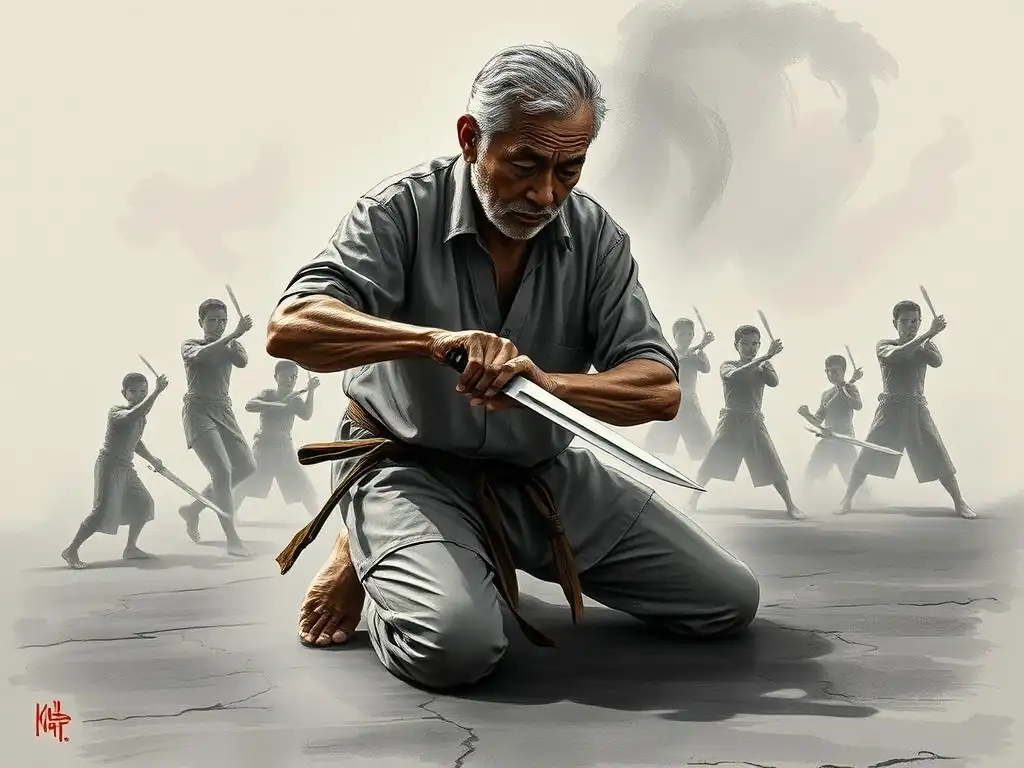
The fundamental blocking and striking techniques in Arnis, whether with weapons or empty hands, are primarily learned through direct demonstration and verbal instruction from the guro. While the basic movements might appear simple, their effective application requires precise angles, power generation, and timing, all of which are difficult to convey solely through text or static images.
A guro will demonstrate a specific block against a stick or knife attack, verbally explaining the angle of deflection, the required body mechanics, and the intended follow-up strike. Students then practice these movements repeatedly, with the guro providing constant verbal feedback and physical adjustments.
For example, the "abwecedario" (alphabet) or basic striking angles are taught through numerical or verbal cues (e.g., "angle 1," "angle 2," etc. ), accompanied by the physical movement.
Similarly, defensive techniques like the "roof block" or "umbrella block" against overhead attacks are demonstrated and named, with the guro explaining verbally when and how to apply them based on the incoming attack's trajectory. The nuances of generating power through body rotation, stepping, and hip movement are conveyed through verbal instruction and correction during practice, ensuring that students develop effective striking power and defensive structure, vital for both weapon and empty hand applications in Arnis.
Footwork and Stances: Verbal Cues and Physical Demonstrations
Effective footwork and stances are the foundation of movement and power in Arnis. These are taught extensively through demonstration and verbal cues, emphasizing balance, agility, and the ability to generate force or evade attacks. A guro will demonstrate various stances, such as the forward stance, backward stance, or ready stance, explaining verbally their purpose and the situations in which they are used. They will then guide students through footwork drills, using verbal commands like "advance," "retreat," "side step," or specific calls for triangular or circular movements.
The connection between footwork, stance, and technique is constantly reinforced through verbal instruction during drills. For instance, when practicing a specific strike, the guro will verbally remind the student to step correctly to maximize power or maintain balance. The subtle weight shifts required for quick transitions between offense and defense are taught through repetitive physical practice guided by the guro's verbal corrections. This iterative process of demonstration, practice, and verbal refinement ensures that students develop fluid and efficient movement patterns essential for executing Arnis techniques effectively in a dynamic combat situation.
The "Sinawali" Pattern and its Oral Transmission in Drills
Sinawali, meaning "to weave," refers to the fundamental double-stick striking patterns in Arnis. These patterns are not just drills; they teach coordination, timing, distance, and flow, and their transmission is a prime example of Arnis oral traditions in action. A guro typically introduces Sinawali by demonstrating the basic patterns (like the Heaven Six, Earth Six, or Reverse Sinawali) while verbally calling out the sequence or number of strikes. Students then learn to mimic the movements, first slowly and then gradually increasing speed.
The learning process is highly interactive and relies heavily on verbal cues and repetition. The guro might use specific rhythm patterns or verbal calls to guide the students through the complex weaving motions.
As students become more proficient, the guro introduces variations, transitions between patterns, and the crucial application of these movements for blocking, striking, and disarming, verbally explaining the combat context. The fluidity and timing required for effective Sinawali are absorbed through countless hours of paired practice, guided by the guro's watchful eye and continuous verbal feedback, making it a cornerstone of Arnis training passed down through the spoken word and physical drill.
Empty Hand Combat: Arnis's Integrated Curriculum
Diskarte: Improvisation and Adaptation in Arnis Techniques
"Diskarte" is a Filipino term that roughly translates to strategy, resourcefulness, or improvisation. In Arnis, particularly concerning empty hand combat, diskarte is a crucial concept passed down through oral teaching and practical application rather than rigid, codified forms. While Arnis has structured empty hand techniques derived from weapon principles (like using empty hands to block or disarm a stick or Arnis knife), the emphasis is often on adaptability. A guro teaches students principles of body mechanics, leverage, and sensitivity, then encourages them to apply these principles creatively based on the situation.
This aspect of Arnis empty hand techniques is learned through sparring and scenario-based training, where the guro provides verbal guidance and critiques. Instead of memorizing hundreds of specific responses, students learn to analyze the opponent's movements and adapt their learned principles to the immediate threat.
The guro might pose hypothetical situations or initiate unexpected attacks, prompting the student to react using their knowledge of balance, structure, and timing. This cultivates the ability to improvise effectively, a skill that is best nurtured through direct, personalized instruction and real-time feedback, making diskarte a core element of the Arnis oral traditions related to empty hand applications.
Hubud-Lubud Drills: Developing Flow and Reflexes Through Oral Instruction
Hubud-Lubud is a foundational empty hand drill in many Arnis systems, focusing on developing flow, sensitivity, and reflexive responses to trapping, striking, and joint locks. The name itself implies "to tie and untie" or "to connect and disconnect," reflecting the continuous, flowing nature of the exchange. This drill is almost exclusively taught through oral instruction and physical guidance. A guro initiates the drill with a student, verbally explaining the basic sequence of movements – how to maintain contact, how to flow from one technique to another, and how to feel for openings or pressure points.
The learning process involves significant repetition and hands-on correction from the guro. They might physically guide the student's hands and body, verbally explaining the feeling of proper connection or the timing of a transition. As the student becomes more comfortable with the basic flow, the guro introduces variations and counters, all through demonstration and verbal cues.
The goal is not just to memorize a sequence but to develop an intuitive understanding of body mechanics and pressure, allowing the practitioner to react reflexively. This deep level of sensitivity and flow, crucial for effective empty hand combat derived from Arnis principles, is a direct result of the interactive, oral transmission inherent in Hubud-Lubud training.
Tapi-Tapi: Sensitivity Training and its Verbal Guidance in Arnis
Tapi-Tapi, another key empty hand drill, emphasizes sensitivity, timing, and the ability to "feel" the opponent's intentions and movements through physical contact. It often involves exchanges of strikes, blocks, and parries, focusing on maintaining contact and control. Like Hubud-Lubud, Tapi-Tapi is primarily taught through demonstration and detailed verbal guidance from the guro. The guro will explain the principles of "live hand" usage, how to maintain contact after a block or parry, and how to use that contact to control the opponent or set up follow-up techniques.
Verbal instruction is critical during Tapi-Tapi practice to explain the subtle shifts in pressure, the angle of contact, and the timing required to counter an opponent's movement. The guro might verbally cue the student on where to apply pressure, when to yield, or how to exploit an opening felt through the connection.
This sensitivity training is highly nuanced and relies heavily on the guro's ability to articulate complex tactile sensations and strategic principles. Through continuous practice under the guro's verbal guidance, students develop the reflexive sensitivity needed to transition seamlessly between defense and offense in close-quarters empty hand combat, a skill deeply rooted in the Arnis oral traditions.
The Significance of "Awit" (Songs) and "Kuwento" (Stories) in Arnis Training
Martial Arts Ballads: Encoding Techniques in Rhyme and Rhythm
In some Filipino cultural traditions, including those related to martial arts, knowledge was occasionally encoded within songs or ballads ("Awit"). While less common as the primary mode of instruction compared to direct demonstration and verbal explanation, some historical accounts suggest that certain sequences, principles, or even historical events related to combat prowess were preserved within rhythmic narratives. These martial arts ballads might not explicitly detail every movement of an Arnis knife technique, but they could serve as mnemonic devices, helping practitioners remember sequences or the underlying philosophy of specific forms or drills.
For instance, a song might describe a legendary battle or the prowess of a historical master, implicitly referencing the techniques they employed. The rhythm and rhyme could help structure the memory of complex patterns, such as a specific Sinawali variation or a series of empty hand defenses. While direct technical instruction remained the purview of the guro through physical practice and explicit verbal commands, these songs could serve as a cultural reinforcement and a supplementary tool for preserving certain aspects of Arnis knowledge, particularly its historical context and core principles, contributing to the broader Arnis oral traditions.
Heroic Tales: Inspiring Courage and Discipline in Arnis Practitioners
Beyond technical instruction, the Arnis oral traditions also encompass the transmission of values, history, and psychological conditioning through "Kuwento" (stories). Tales of legendary Arnis masters, historical battles where FMA played a crucial role, or stories illustrating principles like courage, discipline, respect, and humility were integral to a student's training. These narratives served to inspire practitioners, instill the ethical responsibilities associated with wielding such skills (especially with weapons like the Arnis knife), and provide a cultural context for the art.
A guro might share stories of their own training, the challenges they faced, or the wisdom passed down by their masters. They might recount tales of historical figures who used Arnis effectively for self-defense or in conflict. These stories were not just entertainment; they were lessons in resilience, strategy, and character development.
They helped students understand the heritage they were inheriting and the standards of conduct expected of them. This transmission of values and inspiration through storytelling is a vital, often overlooked, component of the Arnis oral traditions, shaping not just the physical skills but the very spirit of the practitioner.
Challenges and Preservation of Arnis Oral Traditions in the Modern Era
The Impact of Modern Media and Written Materials on Arnis Training
The advent of modern media (videos, online tutorials) and the increasing availability of written materials (books, articles) present both opportunities and challenges for Arnis oral traditions. On one hand, these resources allow for wider dissemination of Arnis knowledge than ever before, reaching students globally who may not have access to a live guro. They can help preserve basic techniques and historical information in a tangible format.
However, they can also dilute the depth of understanding that comes from direct, oral transmission. Nuances of timing, distance, sensitivity, and the critical 'feel' of a technique, especially in areas like Arnis knife oral traditions and empty hand applications, are incredibly difficult to capture fully in static text or even video.
Furthermore, learning solely from media or books can lead to misunderstandings of techniques, incorrect body mechanics, and a lack of the personalized correction crucial for safe and effective practice. The absence of the guro's immediate feedback means students might reinforce bad habits. While modern resources can be valuable supplementary tools, relying on them as the primary method of learning risks losing the subtle, yet vital, elements embedded within the traditional oral teaching method, potentially leading to a superficial understanding of the art compared to the depth achieved through direct lineage training.
Efforts to Document and Preserve Traditional Arnis Knowledge
Recognizing the potential challenges posed by modernity, many individuals and organizations within the Arnis community are actively engaged in efforts to document and preserve the traditional knowledge historically passed down through oral traditions. This includes filming senior masters demonstrating techniques, recording interviews about lineage history and philosophy, and creating written curricula that attempt to capture the essence of specific styles. Some groups are establishing foundations or archives dedicated to collecting and organizing this invaluable information before it is lost as older masters pass away.
These preservation efforts are often undertaken with great care to respect the traditional nature of the art. While documenting techniques visually or in writing, many practitioners emphasize that these materials are intended to support, not replace, the role of the guro and the importance of direct instruction. They serve as a reference, a historical record, and a way to ensure that key aspects of Arnis, including specific Arnis knife oral traditions and empty hand sequences, are not forgotten. These initiatives represent a conscious effort to bridge the gap between traditional methods and modern realities, ensuring the art's continuity.
Maintaining Authenticity: Balancing Tradition and Modernity in Arnis
A significant challenge facing the Arnis community today is maintaining the authenticity of the art while adapting to the modern world. The rich diversity of Arnis styles, largely a result of regional development and oral transmission within distinct lineages, is a defining characteristic.
However, as the art globalizes and interacts with other martial arts and modern training methodologies, there's a risk of techniques becoming homogenized or losing their original context and effectiveness. Balancing the desire for wider accessibility (often facilitated by modern media) with the need to preserve the depth and integrity of traditional Arnis oral traditions is a delicate act.
This requires a conscious effort from practitioners and guros alike to understand and respect the roots of their training. It means valuing the direct teacher-student relationship, recognizing the limitations of learning solely from secondary sources, and understanding the historical and cultural context that shaped the techniques.
While incorporating modern training principles or safety practices can be beneficial, the core principles, body mechanics, and strategic thinking embedded within the oral tradition must remain paramount. The future of Arnis lies in finding ways to share its knowledge effectively without sacrificing the authenticity and depth that have allowed it to survive and evolve for centuries through the power of the spoken word and dedicated practice.
Conclusion: The Enduring Power of Oral Transmission in Arnis
Frequently Asked Questions
What is the significance of oral traditions in Arnis?
Oral traditions are crucial in Arnis because they preserve techniques and philosophies that aren't always documented in written form. It ensures the passing down of knowledge from master to student.
How are knife techniques typically transmitted through oral traditions in Arnis?
Knife techniques are often taught through demonstrations, repetition, and stories that illustrate the proper application and principles. This ensures understanding beyond just memorizing movements.
What types of "secrets" are often protected and passed down orally in Arnis?
These "secrets" often include advanced techniques, counter-measures, and insights into the psychological aspects of combat. They provide a deeper understanding of the art.
Why is it important to understand the historical context behind Arnis knife oral traditions?
Understanding the history provides context for the techniques and reveals the evolution of Arnis. It also helps appreciate the cultural significance.
Beyond knife techniques, what other aspects of Arnis are preserved through oral traditions?
Oral traditions also maintain the philosophical underpinnings, ethical codes, and cultural values associated with Arnis. These aspects ensure the holistic development of the practitioner.
Final Reflection: The Enduring Echo of Arnis
The threads of history, technique, and philosophy woven through Arnis knife oral traditions are not merely relics of the past. They are a vibrant, living force that continues to shape the practice and understanding of this martial art today. The whispers of masters, passed down through generations, resonate in every strike, every block, and every movement, reminding us that Arnis is more than just a fighting style; it's a cultural inheritance.
The power of oral tradition lies in its ability to adapt and evolve while preserving the core essence of Arnis. This intimate, person-to-person transmission fosters a deeper connection to the art, imbuing each practitioner with a sense of responsibility to safeguard and share this knowledge. Tradition is not the worship of ashes, but the preservation of fire.
- Gustav Mahler. This fire, ignited by the stories and teachings of our predecessors, continues to burn brightly, illuminating the path for future generations of Arnis practitioners.
Now, consider the weight of this legacy. How can you, as a student, instructor, or simply an admirer of Arnis, contribute to the preservation and evolution of these vital oral traditions? Embrace the stories, seek out the wisdom of experienced practitioners, and most importantly, share your knowledge with passion and dedication. Let the echo of Arnis knife oral traditions continue to resonate, ensuring that this invaluable cultural treasure endures for centuries to come.
Unleash Your Inner Arnis Master!
Thank you for exploring the rich oral traditions that keep Arnis alive! You've now glimpsed the power of ancestral knowledge and its impact on modern practice. Ready to take the next step in your Arnis journey?
Here are a few ways to connect with this incredible art form:
- Commit to sharing at least one lesson or story you learned today with a fellow martial artist, ensuring the oral tradition lives on.
- Delve deeper by researching a specific grandmaster or style mentioned within Arnis oral history and discover its unique approach.
- Join our Martial Arts Mastery community forums to discuss and exchange experiences about Arnis and its evolving traditions.
What powerful story or technique from Arnis's oral tradition will you share first to keep its legacy alive?