
Eri Seoi Nage: Unlocking the Lapel Shoulder Throw for Dominant Control

Welcome to Martial Arts Mastery!
Dive into the intricate world of grappling with our detailed exploration of the Eri Seoi Nage. Beyond a simple throw, it's a gateway to understanding leverage, control, and the subtle art of unbalancing your opponent. Curious to learn how this classic lapel shoulder throw can elevate your game? Unlock the secrets of the Eri Seoi Nage technique breakdown and discover the path to dominant control.
- Seoi Nage: Mastering the Shoulder Throw for Judo Dominance
- Introduction to Seoi Nage: A Fundamental Judo Technique
- Seoi Nage Technique Breakdown: A Step-by-Step Guide
- Seoi Nage Variations and Combinations for Judo Mastery
- Seoi Nage Training Drills for Enhanced Performance
- Common Mistakes in Seoi Nage and How to Correct Them
- The Tactical Applications of Seoi Nage in Judo Competition
- Conclusion: Elevating Your Judo Game with Seoi Nage
-
Frequently Asked Questions
- How would you describe the Eri Seoi Nage technique in simple terms?
- What are the key elements of a successful Eri Seoi Nage execution?
- How does Eri Seoi Nage differ from other shoulder throws in Judo?
- What are some common mistakes beginners make when learning Eri Seoi Nage?
- Is Eri Seoi Nage effective for self-defense, or is it primarily a competitive Judo technique?
- Final Reflection: Mastering Eri Seoi Nage for Enduring Advantage
- Conquer with Confidence: Master the Eri Seoi Nage!
Seoi Nage: Mastering the Shoulder Throw for Judo Dominance
Introduction to Seoi Nage: A Fundamental Judo Technique
What is Seoi Nage? A Definition for Judo Practitioners
Seoi Nage, often translated as "shoulder throw," is a cornerstone technique in the art of Judo. It belongs to the Te-waza (hand techniques) category of Nage-waza (throwing techniques), despite utilizing significant body movement and leverage. At its core, Seoi Nage involves turning into your opponent's space, typically pulling them forward and down onto your back or shoulder, and then rotating to throw them over your shoulder.
This technique is fundamental because it teaches essential principles of Judo movement: Tsukuri (preparation/entry), Kuzushi (breaking balance), and Kake (execution). Mastery of Seoi Nage provides a strong foundation for understanding how to use an opponent's weight and momentum against them, a central tenet of Judo's effectiveness. It is one of the first throws taught to beginners and remains a high-percentage technique even at the elite level.
The Significance of Seoi Nage in Judo Nage-waza
Seoi Nage holds immense significance within the Judo curriculum and competitive landscape. It is a versatile throw that can be applied from various grips and stances, making it adaptable to different opponents and situations. Its relative simplicity in concept, combined with the complexity of its nuanced execution, allows practitioners to continually refine it throughout their Judo journey.
Historically and currently, Seoi Nage accounts for a substantial portion of successful throws in Judo competition. While precise percentages vary by weight class and era, it consistently ranks among the top scoring techniques. For instance, analysis of major tournaments often shows Seoi Nage and its variations contributing significantly to Ippon (full point) scores, highlighting its effectiveness when applied correctly under pressure. Developing a strong Seoi Nage is often a key marker of a judoka's technical proficiency.
Seoi Nage Technique Breakdown: A Step-by-Step Guide
Step 1: Establishing the Grip for Seoi Nage Control
Securing the Initial Grip: Setting Up the Throw
Establishing a dominant and effective grip is the critical first step in setting up a Seoi Nage. The most common starting point involves controlling the opponent's lapel (typically with the right hand for a right-handed thrower) and their sleeve (with the left hand). The lapel grip, often high on the collar near the neck, provides control over the opponent's posture and upper body, allowing you to pull them forward and dictate their head position.
The sleeve grip, usually just above the elbow or at the wrist, is crucial for controlling the opponent's arm and preventing them from posting or defending effectively. This grip also allows you to generate pull and rotation, essential for breaking balance ( Kuzushi) and executing the throw. Experimenting with grip placement, such as a deeper lapel grip or a higher sleeve grip, can offer different angles of attack and control depending on your opponent's reaction and posture.
Step 2: Kuzushi - Breaking Balance for Seoi Nage Success
Forward Kuzushi: The Key to Unbalancing Your Opponent
Breaking the opponent's balance, known as Kuzushi, is paramount before attempting the throw. For Seoi Nage, the primary direction of Kuzushi is typically forward and slightly downward or to the side, pulling your opponent onto the balls of their feet or even slightly off the ground. This is achieved through a combination of pulling actions with your hands and simultaneous body movement, often a step or pivot.
Effective forward Kuzushi makes the opponent light and unstable, allowing you to enter their space and load them onto your back or shoulder with minimal resistance. Without proper Kuzushi, the opponent remains rooted and heavy, making the throw significantly harder and increasing the risk of them countering your attempt. Drills focusing on pulling power and coordinated footwork are essential for developing effective Kuzushi for Seoi Nage.
Maintaining Control During the Kuzushi Phase
Maintaining control throughout the Kuzushi phase is just as important as initiating it. As you break your opponent's balance, they will instinctively react by resisting or trying to regain their stability. Your grips and body position must be strong enough to overcome this resistance and keep them off-balance. This requires constant tension and dynamic adjustment, rather than a static pull.
For example, if your opponent steps back to counter your forward pull, you might need to adjust your angle or step further forward to maintain the Kuzushi. The strength and stability of your core and legs are vital here, providing a solid base from which to operate. Successful judoka are masters of this dynamic control, constantly feeling their opponent's weight and adjusting their actions to keep them in a vulnerable state just before the Kake (execution) phase.
Step 3: Entering the Seoi Nage Position: A Deep Dive
Footwork for Effective Entry: Positioning for the Throw
Precise and timely footwork is the foundation of a successful Seoi Nage entry. The goal is to pivot your body into your opponent's space, typically stepping deep with one foot (often the non-throwing side) and then pivoting on it or stepping through with the other. This movement allows you to turn your back towards your opponent while bringing your hips close to theirs.
A common entry involves stepping across your opponent's body with your lead foot and then pivoting on the ball of that foot while bringing your other foot around. The depth and angle of this pivot are crucial; you want to get your hips underneath or level with your opponent's center of gravity. Practicing entry footwork drills repeatedly, both solo and with a partner, is essential for developing the muscle memory required for a fast and efficient entry under pressure.
Lowering Your Center of Gravity: The Foundation of Seoi Nage
Simultaneously with your footwork, you must lower your center of gravity by bending your knees and hips. This action achieves several things: it allows you to get under your opponent's balance point, creates a strong base from which to lift, and helps you absorb their weight onto your back or shoulder. Failing to lower your center of gravity adequately is a common mistake that leads to weak throws or being easily countered.
Think of it like loading a spring; the lower you get, the more potential energy you build for the lift. Your back should remain relatively straight, avoiding bending at the waist, which can strain your back and reduce power. The depth of your squat depends on your opponent's height and posture, but the principle remains the same: get low enough to effectively load them onto your body for the subsequent rotation and lift.
Step 4: Executing the Throw: The Mechanics of Seoi Nage
Lifting and Rotating: Generating Power in the Throw
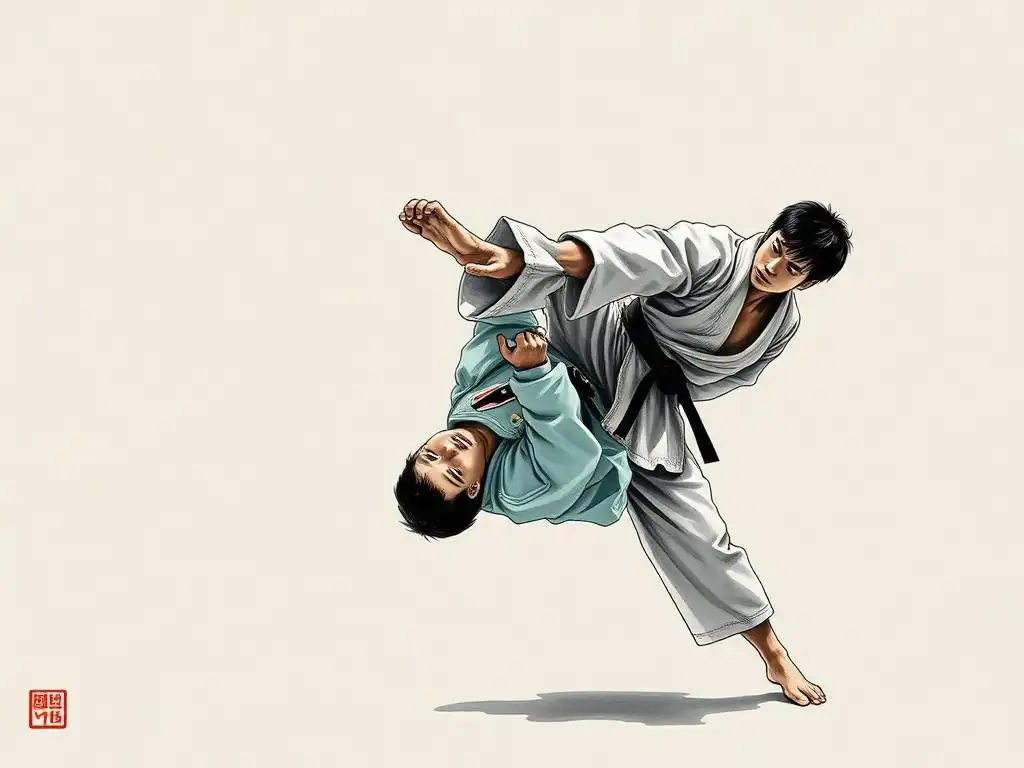
Once you have entered the position and loaded your opponent onto your back or shoulder, the Kake or execution phase begins. This involves a powerful combination of lifting with your legs and rotating your body. The lift comes primarily from extending your legs, driving upwards through the floor, while simultaneously rotating your hips and shoulders.
Your pulling arm (sleeve grip) continues to pull the opponent's arm across their body, while your lapel grip acts as a pivot point, helping to turn them over your shoulder. The power of the throw is generated by this coordinated effort – the upward drive from your legs combining with the rotational force from your hips and torso. It's not just about strength; it's about timing and applying force in the correct direction to maximize efficiency.
Maintaining a Strong Posture Throughout the Throw
Maintaining a strong, stable posture throughout the Kake phase is vital for both effectiveness and safety. Your back should remain relatively straight, and your core engaged to support the weight of your opponent. Slouching or bending excessively at the waist compromises your power and puts you at risk of injury.
Your head position is also important; typically, you keep your head up and looking in the direction of the throw. This helps maintain spinal alignment and contributes to the rotational momentum. A solid posture ensures that the force generated by your legs and hips is efficiently transferred to your opponent, resulting in a clean and powerful throw rather than a clumsy struggle.
Step 5: Follow Through and Control: Securing Ippon
Ensuring a Clean and Powerful Throw
The follow-through is the final stage of the throwing technique, ensuring that the opponent lands cleanly and forcefully, ideally resulting in an Ippon. As you complete the rotation and your opponent is falling, you continue your motion, guiding them to the mat. Do not stop your movement abruptly; let the throw finish naturally through its arc.
A common indicator of a successful follow-through is maintaining control of the opponent's sleeve or gi as they fall. This prevents them from breaking their fall effectively and ensures they land squarely on their back. The goal is to throw with sufficient power and control that the opponent lands flat, signifying a clear score.
Transitioning to Ground Control (Ne-waza) After Seoi Nage
In Judo competition, a throw that doesn't result in Ippon (e.g., Waza-ari or no score) transitions immediately into ground fighting ( Ne-waza). Therefore, it is crucial to be prepared to follow your opponent to the ground and immediately attempt to secure a hold-down ( Osae-komi), apply a submission ( Shime-waza or Kansetsu-waza), or improve your position.
Even after a clear Ippon, maintaining control as your opponent falls is good practice. If the referee doesn't call Ippon immediately, you are already in a dominant position to continue the contest on the ground. Training includes transitioning from the throwing motion directly into a ground grappling scenario, ensuring you don't lose the advantage gained from the throw attempt.
Seoi Nage Variations and Combinations for Judo Mastery
Exploring Different Grip Variations for Seoi Nage
Seoi Nage is highly adaptable and can be executed from numerous grip configurations, each offering unique advantages and challenges. The standard grip involves one hand on the lapel and the other on the sleeve, but variations abound depending on the situation and opponent's defense. Exploring these variations is key to developing a well-rounded Seoi Nage attack.
One significant variation is Eri Seoi Nage, where both hands grip the opponent's collar or lapel. This double-lapel grip provides strong control over the opponent's upper body and posture, making it difficult for them to pull away or defend with their arms. It requires a slightly different entry mechanics compared to the standard grip but can be highly effective against opponents who are skilled at breaking sleeve grips. Another common variation is the reverse grip, where the lapel hand grips the opposite side lapel.
Morote Seoi Nage: Adapting the Technique
Morote Seoi Nage, or two-hand shoulder throw, is perhaps the most standard and widely taught variation. In this version, both hands are actively involved in pulling and controlling the opponent before the entry. The grip is typically lapel and sleeve, as described in the main breakdown. The power comes from the coordinated pull of both arms combined with the body turn and leg drive.
This technique is effective because it utilizes the power of both arms to break balance and load the opponent. The lapel hand pulls forward and across, while the sleeve hand pulls upwards or outwards, depending on the specific entry and desired direction of throw. Mastery of Morote Seoi Nage provides a strong foundation before exploring more specialized variations like Ippon Seoi Nage or Eri Seoi Nage.
Ippon Seoi Nage: A Powerful Alternative
Ippon Seoi Nage, or one-arm shoulder throw, is a dynamic and often explosive variation. In this technique, the throwing arm is slipped deep under the opponent's armpit, gripping the lapel or even the back of the gi, while the other hand (the non-throwing side) releases its grip, or sometimes maintains a loose grip for balance. This allows for a very deep entry and a powerful lift.
While potentially generating significant power and Ippon, Ippon Seoi Nage can be riskier than Morote Seoi Nage as it relies heavily on the strength and control of the single arm and shoulder. It requires excellent timing and a deep, committed entry. Elite judoka often use this variation when they have secured a dominant grip with their throwing arm and can exploit a momentary lapse in the opponent's defense.
Combining Seoi Nage with Other Judo Techniques
Successful competitive Judo rarely relies on a single technique in isolation. Combining throws, known as Renraku-waza (combinations) and Kaeshi-waza (counters), is essential. Seoi Nage can be effectively combined with numerous other techniques, either as the primary attack or as a follow-up or counter.
For example, feinting a different throw can open an opportunity for Seoi Nage. Conversely, if an opponent defends against your Seoi Nage attempt by stepping back or posting, you can transition into a different throw that attacks their new position. Developing smooth transitions between techniques makes your attacks less predictable and significantly increases your chances of scoring.
Setting Up Seoi Nage with O Goshi
O Goshi (major hip throw) is a natural partner for combination attacks involving Seoi Nage. Both techniques involve turning into the opponent and utilizing hip/shoulder leverage. A common combination involves feinting an O Goshi entry, causing the opponent to stiffen their body or lean back in defense.
As they react to the feinted O Goshi, their posture and balance become vulnerable to a Seoi Nage. You can then quickly switch your entry and grip to execute the shoulder throw. This type of combination exploits the opponent's defensive reaction to one throw to open up an opportunity for another, highlighting the strategic interplay between different techniques.
Using Seoi Nage as a Counter to Uchi Mata
Seoi Nage can also be a highly effective counter-attack ( Kaeshi-waza), particularly against throws like Uchi Mata (inner thigh throw). When an opponent attempts Uchi Mata, they typically commit their weight and body to one side, lifting one leg. This often creates an opening on their opposite side and can momentarily shift their balance onto the supporting leg.
If you can maintain your balance and posture as they attempt Uchi Mata, you can use their forward momentum and off-balance position to quickly turn in for a Seoi Nage. This requires sharp timing and the ability to sense their attack early. Successfully countering a powerful throw like Uchi Mata with Seoi Nage demonstrates high-level defensive and offensive skills.
Seoi Nage Training Drills for Enhanced Performance
Solo Practice: Developing Muscle Memory for Seoi Nage
Consistent solo practice, known as Uchikomi, is fundamental for developing the muscle memory and fluidity required for an effective Seoi Nage. This involves repetitive practice of the entry and loading motion without actually throwing a partner. You can use a resistance band, a dummy, or even just practice the movement in the air.
Focus on the footwork, the lowering of your center of gravity, the coordination of your hand movements (simulating the pull and control), and the initial turn and loading. Aim for hundreds, if not thousands, of repetitions to make the entry smooth, fast, and instinctive. Solo drills build the core mechanics and physical conditioning necessary for executing the technique effectively in a live situation.
Partner Drills: Refining Timing and Coordination
Partner drills, such as Yakusoku Geiko (pre-arranged practice) and Kakari Geiko (attack practice), are crucial for refining the timing, coordination, and application of Seoi Nage against a resisting opponent. Yakusoku Geiko allows both partners to practice specific entries and reactions in a controlled environment, focusing on flow and technique rather than resistance.
Kakari Geiko involves one partner attacking with Seoi Nage while the other defends passively or semi-resistively, allowing the attacker to practice overcoming some level of opposition. These drills help you learn to read your opponent's movements, adjust your timing, and apply the Kuzushi effectively against a live body.
Resistance Training: Building Strength for Effective Throws
While technique is paramount in Judo, sufficient strength contributes significantly to the power and effectiveness of throws like Seoi Nage, especially when facing stronger opponents. Resistance training can target the specific muscle groups used in the throw: legs and hips for the lift and drive, core for stability, and back/arms for pulling and control.
Exercises like squats, deadlifts, rows, and pull-ups build the foundational strength needed. Additionally, sport-specific resistance drills using elastic bands or specialized equipment that simulate the pulling and turning motion of Seoi Nage can further enhance power output. Integrating these into your training regimen can help you generate the force required for a clean, powerful throw.
Common Mistakes in Seoi Nage and How to Correct Them
Avoiding Telegraphing: Concealing Your Intentions
A very common mistake in Seoi Nage is telegraphing the technique, making your intentions obvious to your opponent before you initiate the attack. This gives them time to react, defend, or counter. Telegraphing can manifest as a sudden change in posture, a sharp intake of breath, or a too-obvious adjustment of grips just before the entry.
To avoid telegraphing, practice initiating your entry from a relaxed, neutral stance. Integrate your grip fighting and movement leading up to the throw seamlessly, so the actual entry appears to flow naturally from the ongoing exchange. Using combination attacks also helps, as the opponent is unsure which technique is coming. Developing a fast, explosive entry with minimal preparatory tells is key.
Maintaining Proper Posture: Preventing Injury
Poor posture during Seoi Nage is not only ineffective but also significantly increases the risk of injury, particularly to the lower back. Bending over at the waist instead of bending the knees and hips to lower your center of gravity puts undue strain on the spine, especially when loading an opponent's weight.
Correcting this involves conscious effort during practice to prioritize bending the legs and keeping the back straight. Engage your core muscles to support your torso. Film yourself practicing or ask a coach to observe your entry mechanics. Strengthening your core and back muscles through specific exercises can also help maintain proper posture under load.
Generating Sufficient Power: Optimizing Throwing Mechanics
Lack of sufficient power is another frequent issue, leading to throws that are easily defended or result in low scores. This often stems from insufficient Kuzushi, a weak entry (not getting low enough or close enough), or a failure to coordinate the leg drive and rotation during the Kake phase.
Reviewing the fundamental mechanics is crucial. Ensure you are effectively breaking your opponent's balance before attempting the throw. Practice lowering your center of gravity deeply and getting your hips close to your opponent's. Focus on driving upwards powerfully with your legs while simultaneously rotating your hips and torso. Remember that power comes from the coordinated movement of the entire body, not just the arms.
The Tactical Applications of Seoi Nage in Judo Competition
Utilizing Seoi Nage in Tournament Scenarios
In the dynamic environment of a Judo tournament, utilizing Seoi Nage effectively requires tactical awareness. It is often most successful when initiated during transitions – for example, when the opponent is moving, trying to establish their own grip, or recovering from a previous exchange. Catching an opponent off guard during one of these moments is key.
Seoi Nage can be used as a primary attack against opponents who stand tall or lean forward, as their posture makes them vulnerable to forward Kuzushi. It can also be effective against opponents who are constantly pushing, as you can use their forward pressure to facilitate your entry. Observing your opponent's habits and reactions during the initial grip fighting phase can reveal opportune moments to launch your Seoi Nage attack.
Reading Your Opponent: Identifying Opportunities for Seoi Nage
Successfully applying Seoi Nage in competition heavily relies on your ability to read your opponent's posture, balance, and reactions. Does your opponent stiffen up when you pull? Do they step back when you move forward? Do they favor a particular grip? These observations provide clues for setting up your throw.
For instance, if an opponent consistently defends against a standard lapel/sleeve grip Seoi Nage, you might switch to an Eri Seoi Nage attack to exploit their reaction. If they constantly lean back, a strong forward pull combined with a deep entry can capitalize on their defensive posture. Developing this tactical eye through sparring ( Randori) against various partners is essential for applying the technique effectively under pressure.
Conclusion: Elevating Your Judo Game with Seoi Nage
The Enduring Value of Seoi Nage in Judo
Seoi Nage is more than just a single throw; it embodies core principles of Judo movement, balance, and leverage. Its enduring value lies in its versatility, effectiveness, and the fundamental lessons it teaches about using an opponent's weight and momentum. From novice to Olympic champion, mastering Seoi Nage remains a benchmark of technical skill and a potent weapon in any judoka's arsenal.
By diligently practicing the grip setups, mastering the Kuzushi, perfecting the entry mechanics, and refining the execution and follow-through, practitioners can unlock the full potential of this classic technique. Integrating variations like Eri Seoi Nage and combining it with other throws further enhances its utility. Continuously working on Seoi Nage, identifying and correcting common mistakes, and understanding its tactical applications will undoubtedly elevate your Judo game and contribute to your mastery on the mat.
Frequently Asked Questions
How would you describe the Eri Seoi Nage technique in simple terms?
Eri Seoi Nage, also known as the lapel shoulder throw, is a Judo technique where you use your opponent's lapel to help lift and throw them over your shoulder. It focuses on controlling your opponent's upper body for a decisive throw.
What are the key elements of a successful Eri Seoi Nage execution?
Successful execution relies on strong grip, proper body positioning to break your opponent's balance, and a fluid, coordinated movement to lift and throw. Timing and leverage are also crucial.
How does Eri Seoi Nage differ from other shoulder throws in Judo?
Unlike some shoulder throws, Eri Seoi Nage emphasizes grip and control of the opponent's lapel. This grip provides greater control and allows for a more direct upward lift during the throw.
What are some common mistakes beginners make when learning Eri Seoi Nage?
Common mistakes include poor posture, failing to break the opponent's balance, and not using enough leg strength to drive the throw. Also, a weak grip on the lapel can lead to failure.
Is Eri Seoi Nage effective for self-defense, or is it primarily a competitive Judo technique?
While rooted in Judo, the principles of Eri Seoi Nage – controlling the opponent's upper body and disrupting their balance – can be adapted for self-defense scenarios. However, practice is needed to adapt the technique to unpredictable situations.
Final Reflection: Mastering Eri Seoi Nage for Enduring Advantage
The detailed breakdown of Eri Seoi Nage presented here underscores its enduring relevance in modern Judo and grappling arts. The pursuit of technical mastery, particularly in a complex throw like Eri Seoi Nage, remains a cornerstone of competitive success and personal growth. Understanding the nuances of grip, footwork, and kuzushi is not merely about executing a technique; it's about cultivating a deeper understanding of leverage, balance, and control – principles that transcend the mat and apply to various aspects of life.
This technique, and the dedication required to master it, has profoundly influenced the evolution of Judo strategy and continues to inspire practitioners worldwide. The journey of learning Eri Seoi Nage is a microcosm of the larger journey of self-improvement, demanding patience, perseverance, and a willingness to learn from both successes and failures. The ultimate aim of Judo is to discipline the body and mind, leading to the perfection of the individual.
– Jigoro Kano. This quote encapsulates the spirit of continuous improvement that Eri Seoi Nage embodies.
Now, consider how you can apply the principles of Eri Seoi Nage – the meticulous attention to detail, the unwavering commitment to practice, and the pursuit of perfect execution – to your own endeavors. Whether you're a seasoned Judoka, a grappling enthusiast, or simply someone seeking to improve your skills in any field, embrace the challenge, refine your technique, and strive for mastery. The rewards, both on and off the mat, are immeasurable.
Conquer with Confidence: Master the Eri Seoi Nage!
Thank you for exploring the nuances of the Eri Seoi Nage with us. We hope this has illuminated the path towards adding this powerful technique to your arsenal. Now it's time to put knowledge into action and truly master the lapel shoulder throw.
Here are a few things you can do to further your understanding and effectiveness:
- Immediately begin practicing the drills outlined in the article, focusing on smooth transitions and maintaining a strong, stable base.
- Share this article with your training partners and start a discussion on incorporating the Eri Seoi Nage into your sparring sessions.
- Film yourself performing the Eri Seoi Nage and compare your technique with the examples shown, looking for areas of improvement.
What adjustments will you make to your grip and footwork to personalize the Eri Seoi Nage for your body type and fighting style?