
The Science Behind Agility Ladder Training for Combat Athletes


Welcome to Martial Arts Mastery, where we delve into the heart of combat excellence! Ever wondered how legendary fighters achieve lightning-fast reflexes and unparalleled footwork? Today, we unlock the secrets behind agility ladder training for combat athletes, exploring the science that transforms simple drills into a potent weapon. Dive in and discover how to elevate your game to the next level!
- Introduction to Agility Ladder Drills for Combat Sports Performance
- The Scientific Principles Underpinning Agility Ladder Training
- Agility Ladder Exercises: Specific Drills for Combat Athletes
- Designing an Effective Agility Ladder Training Program for Fighters
-
Benefits of Agility Ladder Training for Different Martial Arts Disciplines
- Agility Ladder Training for Boxing: Enhancing Footwork and Evasion
- Agility Ladder Training for Muay Thai: Improving Clinch Work and Striking Speed
- Agility Ladder Training for Brazilian Jiu-Jitsu: Developing Guard Passing Agility
- Agility Ladder Training for Wrestling: Optimizing Takedown Speed and Defense
- Agility Ladder Training for MMA: Optimizing Overall Agility and Coordination
- Preventing Injuries with Proper Agility Ladder Technique
- Measuring Progress: Tracking Agility Improvements in Combat Athletes
- Advanced Agility Ladder Techniques for Elite Combat Athletes
- Conclusion: Mastering Agility for Combat Dominance
-
Frequently Asked Questions
- What are the primary benefits of agility ladder training for combat athletes?
- How does agility ladder training translate to improved performance in combat scenarios?
- What specific agility ladder drills are most effective for combat athletes?
- How often should combat athletes incorporate agility ladder training into their routines?
- What are some common mistakes to avoid when using an agility ladder for combat sports training?
- Final Reflection: Mastering Movement, Defining Victory
- Unleash Your Inner Agility Master!
Introduction to Agility Ladder Drills for Combat Sports Performance
Why Agility Ladder Training is Essential for Fighters
In the demanding world of combat sports, success hinges on more than just strength or technique; it requires the ability to move efficiently, react instantly, and maintain balance under pressure. Agility, defined as the ability to rapidly change direction or position of the body effectively while maintaining balance, is a cornerstone of this capability. For combat athletes across disciplines like boxing, MMA, wrestling, and jiu-jitsu, superior agility translates directly into tactical advantages – evading strikes, securing takedowns, maintaining optimal distance, and controlling the fight's pace. Without finely tuned agility, even the most technically skilled fighter can be outmaneuvered.
Agility ladder training combat athletes is specifically designed to target the rapid, precise footwork and coordination necessary for these dynamic movements. Unlike linear speed, which focuses purely on forward velocity, agility is multi-directional and reactive.
A boxer needs to quickly pivot and step offline to avoid a punch; a wrestler must rapidly adjust their base to defend a shot; a BJJ practitioner requires swift footwork to pass guard or scramble effectively. Agility ladder drills provide a structured environment to practice these complex movement patterns repeatedly, engraving them into the athlete's muscle memory and nervous system, preparing them for the unpredictable chaos of competition.
Understanding the Core Benefits: Speed, Agility, and Coordination
Agility ladder training offers a synergistic bundle of benefits critical for any combat athlete. Firstly, it significantly enhances foot speed – the ability to move the feet quickly and lightly. While not the same as full sprint speed, rapid foot speed is vital for quick adjustments, feints, and closing or creating distance in fractions of a second. Drills require quick steps in and out of the ladder squares, forcing the feet to move faster than typical combat movements, thus improving the baseline speed.
Secondly, and most obviously, it develops agility itself. The varied patterns and demands of agility ladder drills challenge the athlete to change direction and body position rapidly while maintaining control. This trains the body to absorb and redirect force efficiently, a skill paramount for effective movement in the ring or on the mat.
Lastly, agility ladder training profoundly improves coordination, specifically hand-eye-foot coordination and overall body control. Performing complex patterns requires the brain to communicate effectively with the limbs, ensuring that movements are synchronized and precise, reducing stumbling or wasted motion during critical exchanges. These combined benefits make agility ladder training combat athletes a fundamental component of a well-rounded strength and conditioning program.
The Scientific Principles Underpinning Agility Ladder Training
Neuromuscular Adaptations: Enhancing Motor Control and Reaction Time
Agility ladder training for combat athletes induces significant neuromuscular adaptations. When an athlete performs rapid, precise footwork patterns on the ladder, they are repeatedly activating specific neural pathways between the brain and the muscles in their legs and feet. This repetitive, high-speed signaling leads to improved neural drive – the efficiency and speed at which the nervous system can recruit muscle fibers. Over time, this results in faster muscle contractions and a more coordinated firing sequence of different muscle groups required for quick changes in direction.
Furthermore, this type of training enhances motor unit recruitment and rate coding. Motor units, which consist of a motor neuron and the muscle fibers it innervates, become more efficient at activating simultaneously and firing at higher frequencies. This increased efficiency directly translates to a quicker first step or a more explosive reaction when needed in combat.
Studies on athletes performing agility drills have shown improvements in reaction time, sometimes by milliseconds, which can be the difference between landing a strike or getting hit, or securing a takedown versus being sprawled on. The brain becomes better at anticipating and executing complex movement sequences with minimal conscious thought.
Proprioception and Agility Ladders: Improving Body Awareness for Combat
Proprioception, often referred to as the body's sixth sense, is the awareness of the position and movement of the body and its parts in space. It relies on sensory receptors in muscles, tendons, and joints. Agility ladder training is a powerful tool for enhancing proprioception, which is vital for combat athletes who constantly operate in dynamic, often unstable environments. Navigating the small squares of the ladder requires precise foot placement without looking down, forcing the athlete to rely on their internal sense of where their limbs are relative to their body and the ground.
This heightened proprioception translates directly to improved balance and stability during combat. A fighter with good proprioception can maintain their base while absorbing a blow, recover quickly from an off-balance position, or execute complex maneuvers like pivots or sweeps with greater control. For example, a wrestler attempting a single-leg takedown needs excellent proprioception to feel their weight distribution and adjust their base instantly if their opponent counters. Agility ladder drills refine this internal body map, allowing combat athletes to move more intuitively and confidently, reducing the risk of stumbling or losing balance during crucial moments.
Cognitive Enhancement: Decision-Making Speed in the Ring/Cage
Beyond the physical benefits, agility ladder training combat athletes also offers significant cognitive advantages. Performing complex, rapid patterns requires mental focus and the ability to process information quickly. While basic ladder drills are pre-planned, the underlying mechanism trains the brain to process spatial information and sequence movements rapidly. More advanced drills can incorporate reactive elements (e.g., a partner calling out a direction or pattern), forcing the athlete to make split-second decisions based on external cues, mimicking the reactive nature of combat.
This constant processing and execution under time pressure improves cognitive processing speed and decision-making capabilities under duress. In a fight, an athlete must constantly process their opponent's movements, anticipate their actions, and decide on the appropriate counter-movement almost instantaneously. Agility ladder training helps build the neural pathways that facilitate this rapid cycle of perception, decision, and action. It trains the brain and body to work together seamlessly, allowing a fighter to react faster to a feint, recognize an opening, or adjust their strategy mid-exchange, giving them a crucial mental edge.
Agility Ladder Exercises: Specific Drills for Combat Athletes
Footwork Drills for Boxing and Kickboxing: Agility Ladder Techniques
For boxers and kickboxers, agility ladder training is fundamental to developing the intricate footwork required for offense and defense. Lateral movement is paramount for evading strikes and creating angles. Drills like the "Lateral Shuffle" (stepping side-to-side in and out of the ladder squares) build explosive lateral power and quickness. The "2-in, 2-out" drill, where you step both feet into a square then both feet out to the side, then into the next square, directly simulates the lateral shuffling often used to maintain distance or reposition.
Forward and backward movement, essential for closing distance to attack or creating space to defend, is honed by drills like the "Ickey Shuffle" (stepping in, in, out, out pattern diagonally through the ladder) or simple "In-Out" drills (stepping one foot in, then the other, then the first foot out, then the other). These drills improve the speed and coordination needed for quick forward bursts or sharp retreats.
Incorporating pivots within or at the end of ladder patterns, such as doing a 180-degree turn after a lateral movement, directly translates to setting up punches or evading attacks by changing direction instantly. Consistent practice of these agility ladder techniques builds a robust foundation for effective striking footwork.
Agility Ladder Patterns for Grappling and Wrestling: Enhancing Movement Efficiency
Grappling and wrestling demand a unique type of agility, focusing on maintaining a low center of gravity, changing levels quickly, and controlling base while moving around an opponent. Agility ladder training combat athletes in these disciplines should focus on patterns that mimic these movements. The "Ickey Shuffle" is excellent for developing the quick, controlled steps needed for circling an opponent or adjusting position during a scramble. Drills that involve stepping over the rungs, rather than just in the squares, like the "High Knees" or "Skipping" variations, improve hip mobility and explosive power needed for shots and sprawls.
Patterns that involve stepping in and out laterally while staying low, such as a low "Lateral Shuffle" or "Carioca" drill performed with bent knees, directly translate to maintaining a strong base while moving around an opponent's guard in BJJ or circling for an angle in wrestling. Incorporating drills that require quick changes in direction within a small space, like stepping forward two squares then immediately back one, helps improve the micro-adjustments needed during clinch work or ground fighting transitions. These specific agility ladder patterns build the foundational movement efficiency critical for grappling success.
Combining Agility Ladder Training with Combat-Specific Movements [Example: Slip Rope Drill with Ladder Drills]
To maximize the transfer of agility ladder skills to actual combat scenarios, it's highly effective to combine ladder drills with sport-specific movements immediately afterward. This bridges the gap between isolated footwork training and reactive fight actions. A practical example for striking athletes is integrating agility ladder work with a slip rope or focus mitts.
An athlete could perform a series of lateral agility ladder drills, such as the "2-in, 2-out" pattern down the ladder. Upon finishing the ladder, they would immediately transition to a slip rope, practicing head movement by slipping simulated punches, or move to a partner holding focus mitts to throw a quick combination.
This sequence trains the body to move rapidly and then immediately react or attack, mimicking the flow of a striking exchange where rapid footwork is followed by offensive or defensive actions. This combined training protocol enhances the neural connection between agile movement and combat technique, making the agility ladder training combat athletes perform more functional.
Designing an Effective Agility Ladder Training Program for Fighters
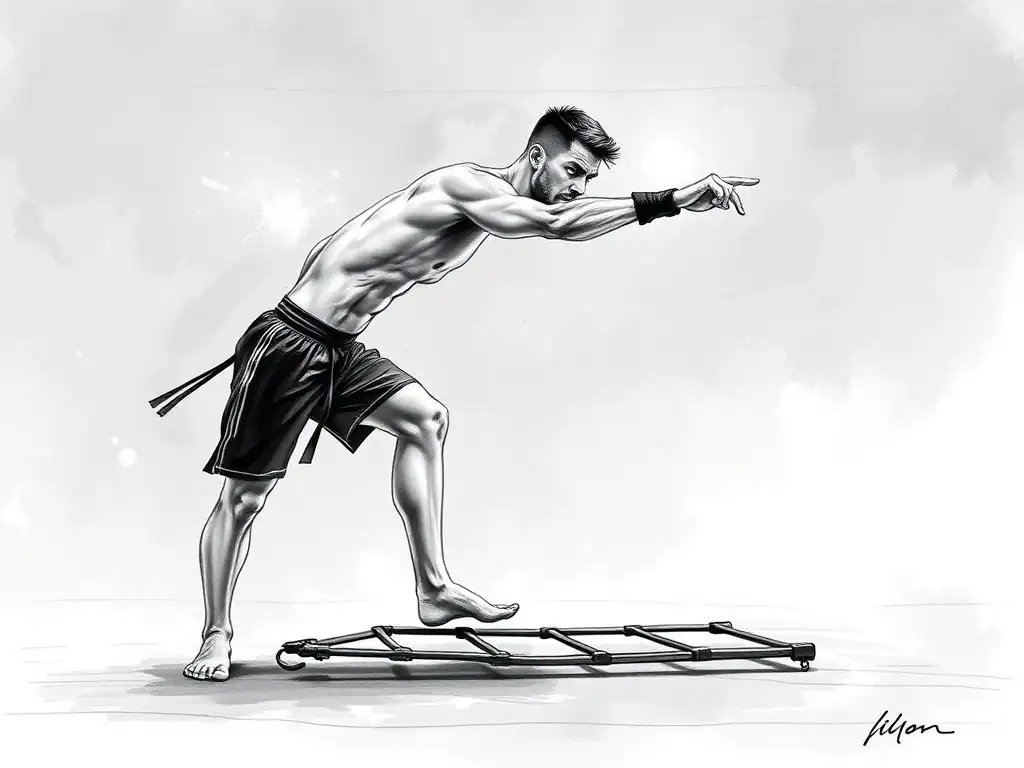
Assessing Agility Needs: Tailoring Drills to Combat Style and Weaknesses
Designing an effective agility ladder training program for combat athletes begins with a thorough assessment of their specific needs, dictated by their fighting style and identified weaknesses. A fighter who relies heavily on counter-striking and ring generalship may prioritize lateral movement and quick retreats, requiring a different emphasis on ladder drills compared to a pressure fighter who needs explosive forward bursts and the ability to cut off the ring.
Similarly, a wrestler focused on single-leg takedowns will benefit from drills that improve their lead leg speed and level changes, while a BJJ player might focus on drills that enhance hip mobility and lateral agility for guard passing.
Observing the athlete during sparring, drilling, and even previous matches can reveal specific areas for improvement. Do they get their feet tangled when changing direction? Are they slow to react to an opponent's feint? Do they lose balance easily when moving laterally?
Identifying these deficiencies allows the coach or athlete to select agility ladder drills that directly target those weaknesses. For instance, if lateral movement is slow, a program might dedicate 60-70% of ladder time to lateral-focused drills like the Lateral Shuffle or Carioca. Tailoring the selection ensures the agility ladder training combat athletes undertake is highly relevant and efficient.
Progression and Intensity: Gradually Increasing Difficulty and Speed
Progression is key to continued improvement in any training program, including agility ladder work. Simply doing the same drills at the same speed indefinitely will lead to plateaus. Progression can be implemented in several ways. The most straightforward is increasing speed: encouraging the athlete to complete the drills faster while maintaining proper form. Timing drills and setting small, incremental speed goals (e.g., improving a 10-second drill by 0.2 seconds each week) provides a measurable target.
Another method is increasing the complexity of the drills. Start with simple patterns like "In-Out" and progress to more intricate ones like the "Ickey Shuffle" or multi-directional sequences. Reducing rest time between sets also increases intensity and metabolic demand.
For advanced athletes, adding a light resistance band around the ankles (focusing on form over speed initially) or incorporating reactive elements (as discussed later) can further challenge the neuromuscular system. A typical progression might start with 3-4 sets of 15-20 seconds of work per drill with 60 seconds rest, gradually increasing work time to 25-30 seconds, decreasing rest to 45 seconds, and adding more complex patterns over a training cycle. This systematic approach ensures the agility ladder training combat athletes perform continues to stimulate adaptation.
Integrating Agility Ladder Workouts into a Comprehensive Training Regimen [Example: Agility Ladder Before Sparring]
Effective agility ladder training for combat athletes isn't a standalone activity; it must be integrated thoughtfully into the overall training regimen. The timing of agility work relative to other training components is crucial for maximizing benefits and minimizing fatigue interference. A common and effective strategy is to perform agility ladder drills early in a training session, especially before activities that require high levels of coordination and reaction, such as sparring or technical drilling.
For example, incorporating 10-15 minutes of agility ladder work before sparring serves as an excellent dynamic warm-up. It elevates heart rate, activates the nervous system, and primes the specific muscle groups and neural pathways needed for rapid, precise footwork. The athlete's neuromuscular system is fresh, allowing them to perform the drills with maximum speed and accuracy, reinforcing proper movement patterns.
Doing agility work after heavy strength training or intense conditioning might lead to sloppy form due to fatigue, reducing the quality of the neurological stimulus. Placing agility ladder workouts strategically ensures they enhance, rather than detract from, other aspects of combat preparation.
Benefits of Agility Ladder Training for Different Martial Arts Disciplines
Agility Ladder Training for Boxing: Enhancing Footwork and Evasion
In boxing, footwork is often considered the foundation of both offense and defense. Agility ladder training combat athletes who box provides direct benefits by refining the quick, precise steps needed to control distance and evade punches. Drills focusing on lateral movement, such as the "Lateral Shuffle" or "Side Straddle Hop," build the ability to rapidly shift weight and step offline to avoid incoming strikes or create angles for counter-attacks.
Forward and backward patterns like the "In-Out" or "Ickey Shuffle" improve the subtle adjustments needed to stay in range while attacking or to quickly step out of danger after delivering a combination. The rapid foot turnover demanded by the ladder drills enhances overall foot speed, making movements like pivots, lead-leg steps, and rear-leg pushes faster and more efficient. A boxer's ability to maintain balance and quickly recover footing after throwing punches or being hit is also improved through the proprioceptive demands of agility ladder work.
Agility Ladder Training for Muay Thai: Improving Clinch Work and Striking Speed
Muay Thai requires a unique blend of striking power and grappling ability within the clinch. Agility ladder training for Muay Thai fighters enhances both aspects. While power comes from the hips and core, setting up powerful kicks and punches relies on quick, deceptive footwork. Drills that emphasize quick steps and changes in rhythm, such as varied "In-Out" patterns or "Ali Shuffle" variations, improve the ability to feint, close distance explosively for attacks, or create space for powerful kicks.
Within the clinch, agility is crucial for maintaining balance while off-balancing an opponent, securing grips, and creating angles for knees and elbows. Drills that focus on lateral movement with a low center of gravity, or quick pivots and turns within a small space, directly translate to navigating the close quarters of the clinch effectively. Furthermore, the hip mobility and coordination developed through drills like high knees or skipping over the rungs can improve the snap and speed of kicks and the ability to lift the knee effectively in the clinch.
Agility Ladder Training for Brazilian Jiu-Jitsu: Developing Guard Passing Agility
Brazilian Jiu-Jitsu, though primarily ground-based, requires significant agility, particularly in transitions, scrambles, and guard passing. Agility ladder training combat athletes in BJJ can specifically target the footwork and body control needed for these scenarios. Guard passing often requires rapid lateral movements to circle around an opponent's legs, quick level changes to stuff a guard retention attempt, and the ability to maintain balance while driving forward.
Drills like the "Lateral Shuffle" or "Carioca" performed with a low base mimic the lateral pressure and movement needed to pass open guards like the spider or lasso guard. Patterns involving quick steps forward and backward, like the "Ickey Shuffle," help develop the rapid foot adjustments needed when an opponent is trying to sweep or recover guard.
The proprioceptive benefits are immense for BJJ players, helping them maintain balance during scrambles or while stacked in a guard pass attempt. Agility ladder work enhances the ability to move the feet independently of the upper body, a key skill for successful guard passing and retention.
Agility Ladder Training for Wrestling: Optimizing Takedown Speed and Defense
Wrestling is a sport defined by explosive speed, power, and relentless positional battles, making agility absolutely critical. Agility ladder training for wrestlers focuses on developing the quick first step, rapid level changes, and dynamic footwork required for takedowns and defenses. Drills emphasizing forward explosion, such as quick "In-Out" steps or "Single Leg Hops" through the ladder, build the initial burst needed for shooting takedowns like the single or double leg.
Lateral drills, like the "Lateral Shuffle" or "Side Straddle Hop," improve the ability to circle for angles, sprawl effectively by quickly stepping the feet back, and defend shots by rapidly changing direction. Drills that involve quick changes in direction within the ladder, such as stepping forward and then rapidly pivoting, translate to maneuvering for control tie-ups or adjusting position during a scramble. The emphasis on precise foot placement and rapid movement in agility ladder training helps wrestlers maintain a strong base and react instantly to their opponent's movements, improving both offensive shot efficiency and defensive readiness.
Agility Ladder Training for MMA: Optimizing Overall Agility and Coordination
Mixed Martial Arts athletes require the most comprehensive form of agility, as they must seamlessly transition between striking, wrestling, and grappling exchanges. Agility ladder training combat athletes in MMA must therefore incorporate a wide variety of drills that cover all ranges of motion and types of movement encountered in the cage. Footwork for striking evasion and angle creation, level changes for takedowns, lateral movement for grappling transitions, and maintaining balance during scrambles are all crucial.
An MMA fighter's agility ladder program should include a mix of linear, lateral, and multi-directional drills. Emphasis can be placed on drills that require quick transitions from one type of movement to another, mimicking the unpredictable nature of an MMA fight. For instance, performing a striking-focused "Ickey Shuffle" and immediately transitioning into a low "Lateral Shuffle" simulating sprawling or circling on the ground. The coordination benefits are particularly important for MMA, helping athletes integrate complex upper-body techniques (punches, clinch grips) with dynamic lower-body movements (footwork, level changes) without becoming disjointed or losing balance.
Preventing Injuries with Proper Agility Ladder Technique

Common Mistakes to Avoid During Agility Ladder Training
While agility ladder training is generally safe, improper technique can increase the risk of sprains, strains, or falls. One of the most common mistakes combat athletes make is looking down at their feet or the ladder rungs. This not only slows down reaction time and reduces the cognitive benefit but also puts the neck in an awkward position and hinders proprioception development. Athletes should be coached to keep their eyes up, looking forward, and trust their feet to find the squares.
Another frequent error is rushing the drills before mastering the pattern. Speed should only be increased once the movement pattern is smooth and accurate. Tripping on the rungs or performing sloppy, uncontrolled steps indicates the speed is too high or the focus is lacking.
Poor posture, such as hunching over or letting the core become disengaged, reduces efficiency and can strain the back. Athletes should maintain an athletic stance with a slight bend in the knees and hips, chest up, and core engaged throughout the drills. Correcting these common mistakes is vital for safe and effective agility ladder training combat athletes perform.
Warm-up and Cool-down Strategies for Agility Ladder Workouts
Proper warm-up and cool-down routines are essential components of any agility ladder training session to prepare the body for intense movement and aid recovery. A dynamic warm-up should precede agility ladder drills, lasting typically 10-15 minutes. This involves light cardio to increase heart rate and muscle temperature (e.g., jogging, skipping rope) followed by dynamic stretching that moves joints through their full range of motion (e.g., leg swings, hip circles, torso twists, ankle rotations).
Specific warm-up drills can also be performed on the ladder itself at a slower pace to prime the movement patterns, such as slow "In-Out" steps or simple lateral steps. After completing the agility ladder workout, a cool-down is recommended. This typically involves 5-10 minutes of light activity, like walking, to gradually lower heart rate, followed by static stretching.
Static stretches, held for 20-30 seconds, targeting the major muscle groups used (calves, hamstrings, quads, hip flexors, glutes), help improve flexibility and can aid in reducing post-workout stiffness. Implementing these strategies ensures the agility ladder training combat athletes perform is safer and more productive.
The Importance of Proper Footwear and Surface [Ladder Placement]
The right equipment and environment play a significant role in the safety and effectiveness of agility ladder training for combat athletes. Proper footwear is paramount. Athletes should wear training shoes that provide good lateral support and sufficient grip to prevent slipping. Running shoes, which are designed for linear motion, often lack the necessary lateral stability for the quick side-to-side movements inherent in ladder drills and can increase the risk of ankle sprains. Cross-training shoes or court shoes are often better choices.
The training surface is equally important. The agility ladder should be placed on a flat, non-slippery surface. Gymnasium floors, artificial turf, or properly maintained mats are suitable. Concrete or uneven asphalt can be too hard on the joints and increase the risk of trips or falls. Ensure the ladder itself is securely placed and not likely to slide during drills. Checking the rungs are flat and evenly spaced before starting is also a simple but crucial step. Paying attention to footwear and surface ensures that the agility ladder training combat athletes engage in is performed in a safe environment.
Measuring Progress: Tracking Agility Improvements in Combat Athletes
Agility Ladder Drill Timings: Benchmarking and Goal Setting
Quantifying progress in agility ladder training combat athletes can be highly motivating and provides objective data on improvement. Timing specific, repeatable drills is a straightforward method for benchmarking and setting goals. Popular timed drills include the "Ickey Shuffle" or "Lateral Shuffle" performed for a set distance (e.g., the length of a standard 15-foot ladder) or for a set duration (e.g., doing as many squares as possible in 15 seconds).
Record baseline times for 2-3 key drills at the beginning of a training cycle. Repeat these timed assessments every 4-6 weeks under consistent conditions (same time of day, same warm-up, same ladder). Set realistic goals for improvement, such as aiming to shave off 0.5 to 1 second from a 10-second drill time over a mesocycle (a 4-6 week training block). Consistent timing allows athletes to see tangible results from their agility ladder training, reinforcing the effort they are putting in and guiding future program adjustments.
Combat Performance Metrics: Linking Agility Training to Fight Results [Example: Reduced Time to Close Distance in Sparring]
Ultimately, the goal of agility ladder training combat athletes is to enhance performance during actual combat. While ladder times provide objective data on drill speed, observing improvements in sparring, drilling, and competition is the true measure of functional agility gains. Coaches and training partners can provide valuable feedback on perceived improvements in movement efficiency, reaction time, and balance.
For instance, a tangible metric to track during sparring sessions could be the reduced time to close distance for a specific attack or the improved ability to evade a particular offensive sequence. A boxer might notice they can step in and out of range for their jab significantly faster, or a wrestler might find they can change levels and penetrate for a shot with less hesitation.
Tracking success rates of techniques that heavily rely on agility, such as takedowns, sweeps, or evasive maneuvers, during controlled drilling or sparring can also indicate functional improvement. While harder to quantify precisely than ladder times, linking observed combat performance improvements back to the agility ladder training provides compelling evidence of its effectiveness.
Advanced Agility Ladder Techniques for Elite Combat Athletes
Reactive Agility Drills: Incorporating Visual and Auditory Cues
For elite combat athletes, moving beyond predetermined patterns to reactive agility drills is crucial for mimicking the unpredictable nature of competition. Reactive agility requires the athlete to respond to an external stimulus, such as a visual cue (like a coach pointing a direction or holding up fingers) or an auditory cue (like a coach calling out a color or direction). This adds a cognitive layer, forcing the athlete to process information and make a decision before executing the movement.
An example involves a partner standing to the side of the ladder. As the athlete performs a basic drill like the "Lateral Shuffle," the partner suddenly holds up one or two fingers. The athlete must instantly transition to a different pre-assigned pattern based on the cue (e.g., one finger means transition to a forward sprint, two fingers mean transition to a backpedal). This trains the rapid perception-decision-action cycle vital for reacting to an opponent's feints, attacks, or positional adjustments under pressure. Incorporating reactive elements makes agility ladder training combat athletes perform significantly more sport-specific.
Combining Agility Ladder Training with Plyometrics and Resistance Training
Integrating agility ladder training with other forms of speed and power development, such as plyometrics and resistance training, can create a potent stimulus for elite combat athletes. Plyometrics, like box jumps or bounds, improve explosive power, which complements the rapid foot turnover developed by the ladder. Resistance training builds foundational strength, which is necessary to generate the force for quick directional changes and powerful movements.
A common method is to pair a ladder drill with a plyometric exercise in a circuit format. For example, complete a set of "Ickey Shuffle" down the ladder, immediately followed by 3-5 box jumps. This sequence trains the body to transition quickly from rapid foot speed to explosive vertical or horizontal power.
Another approach is to perform agility ladder work on days separate from heavy resistance training but potentially before lighter, more speed-focused lifting or bodyweight exercises. Carefully combining these modalities ensures that the agility ladder training combat athletes perform contributes to a well-rounded profile of speed, power, and agility.
Periodization Strategies for Maximizing Agility Gains Throughout a Fight Camp
Periodization involves strategically planning training over time to optimize performance for key events, such as fights or tournaments. For agility ladder training combat athletes, this means adjusting the focus, volume, and intensity of ladder work throughout a fight camp. In the general preparation phase (early in the camp), the focus might be on mastering basic patterns and building a solid foundation of coordination and foot speed, with moderate volume and intensity.
As the camp progresses into the specific preparation phase, the intensity and complexity of ladder drills should increase. Incorporate more reactive drills and combine ladder work with sport-specific movements or light resistance/plyometric exercises. The volume might remain high or slightly decrease as sparring intensity increases.
In the peak phase (leading directly into the fight), agility ladder training should be maintained at a high intensity but with significantly reduced volume to ensure the athlete is sharp but not fatigued. Drills might be shorter, more reactive, and placed earlier in the week. This structured approach ensures that the benefits of agility ladder training are maximized and timed perfectly for competition.
Conclusion: Mastering Agility for Combat Dominance
Frequently Asked Questions
What are the primary benefits of agility ladder training for combat athletes?
Agility ladder training enhances footwork, coordination, and reaction time, all crucial for combat sports. It also improves speed and agility which are essential for both offense and defense.
How does agility ladder training translate to improved performance in combat scenarios?
The drills mimic the rapid footwork and directional changes required in sparring or competition. This allows athletes to react faster and move more efficiently, making them harder to hit.
What specific agility ladder drills are most effective for combat athletes?
Drills focusing on lateral movement, quick steps, and directional changes are highly beneficial. Examples include the Icky Shuffle, Lateral Shuffle, and In-Out drills, designed to enhance footwork agility.
How often should combat athletes incorporate agility ladder training into their routines?
Typically, two to three sessions per week is sufficient, focusing on proper technique over high volume initially. This allows for the development of neuromuscular pathways without overtraining.
What are some common mistakes to avoid when using an agility ladder for combat sports training?
Neglecting proper warm-up, focusing solely on speed without correct form, and failing to progress difficulty gradually are common errors. Focusing on controlled movements is crucial to avoid injury.
Final Reflection: Mastering Movement, Defining Victory
The insights into agility ladder training for combat athletes, as explored in this article, are not merely academic; they are a direct pathway to enhanced performance and reduced injury risk in the arena of competition. Understanding the science behind these drills, from neuromuscular adaptation to improved footwork, empowers athletes and coaches to move beyond rote repetition and embrace a truly strategic approach to training.
The impact of agility training extends beyond the ring or cage. It's about cultivating a deeper connection with one's body, fostering a sense of control and responsiveness that translates into confidence and resilience, both physically and mentally. The body achieves what the mind believes.
This quote, often attributed to Napoleon Hill, encapsulates the essence of agility training: it's about building not just physical prowess, but also the mental fortitude to execute under pressure.
Now, consider how you can integrate these principles into your own training regimen, or even your daily life. Embrace the challenge of mastering movement, of refining your reflexes, and of cultivating the agility that allows you to adapt and overcome any obstacle. The science is clear: agility ladder training, when approached with understanding and dedication, can unlock your full potential. The path to victory begins with a single, well-placed step.
Unleash Your Inner Agility Master!
Thanks for diving into the science of agility ladder training! We hope you now have a clearer understanding of how to boost your combat performance. Now, it's time to put that knowledge into action.
- Immediately incorporate 15-20 minutes of agility ladder drills into your next training session. Focus on proper form and gradual progression.
- Share this article with your training partners and challenge each other to a weekly agility ladder competition to keep things fun and competitive.
- Explore our Martial Arts Mastery YouTube channel for additional drills and training tips that complement your agility ladder workouts.
What's one new agility ladder drill you're excited to try this week, and how do you think it will improve your combat readiness?