
CrossPollination: The Influence of Other Martial Arts on Karate Bunkai Evolution

Welcome to Martial Arts Mastery, where we delve deep into the world's fighting arts. Are you ready to unravel the hidden layers within your kata? This article explores the fascinating Karate bunkai cross pollination influence, revealing how other martial art traditions have subtly, yet profoundly, shaped the evolution of bunkai application and understanding. Discover the secrets embedded within your forms and prepare to see your Karate training in a whole new light. Let's begin!
Karate bunkai refers to the practical application and analysis of movements found within the kata (forms) of Karate. It involves dissecting the predetermined sequences of blocks, strikes, kicks, and stances to understand their potential use in self-defense or combat situations. Bunkai goes beyond simply mimicking the movements; it seeks to uncover the underlying principles, strategies, and techniques that the kata is intended to teach. This analysis can range from simple interpretations of single movements to complex scenarios involving multiple techniques and opponents.
Understanding bunkai is crucial for any serious Karate practitioner, as it provides the 'why' behind the 'what' of kata performance. Without bunkai, kata can devolve into mere physical exercise or a choreographed dance. Traditional Okinawan Karate masters emphasized the practical application of kata movements, viewing them as repositories of combat wisdom passed down through generations. The depth of a practitioner's understanding of bunkai often reflects their grasp of Karate's combative essence.
The Importance of Cross-Pollination in Martial Arts Development
Cross-pollination in martial arts refers to the exchange and integration of techniques, principles, and training methodologies between different styles or disciplines. This process has been a driving force in the evolution of martial arts throughout history, leading to the development of new styles and the refinement of existing ones. When practitioners or systems are exposed to different approaches, they can identify gaps in their own training, discover more effective methods, or gain a deeper understanding of universal combat principles.
Historically, martial arts rarely developed in complete isolation. Trade routes, cultural exchange, and even conflict facilitated the transmission of fighting techniques across regions and cultures. This sharing of knowledge allowed styles to adapt to new threats, incorporate superior techniques, and become more robust. Modern martial arts, particularly mixed martial arts (MMA), are prime examples of deliberate cross-pollination, demonstrating the effectiveness of combining elements from various disciplines like wrestling, Brazilian Jiu-Jitsu, Muay Thai, and boxing.
Karate Bunkai Cross-Pollination: Expanding the Scope
The concept of Karate bunkai cross-pollination involves examining how techniques and principles from other martial arts can inform, deepen, and expand the interpretation and application of movements within Karate kata. While Karate has its own rich history and technical foundation, looking at kata through the lens of other systems can reveal applications that might not be immediately obvious when viewed solely within a traditional Karate framework. This approach acknowledges that effective combat principles are often universal and can be found in various martial disciplines.
Exploring Karate bunkai cross-pollination allows practitioners to uncover hidden layers of meaning in kata. For example, a movement traditionally interpreted as a block followed by a strike might, when viewed through the perspective of judo or aikido, reveal a potential joint lock or throw application. This cross-disciplinary analysis can enrich a practitioner's understanding, making their bunkai more practical and versatile. It's about recognizing shared principles and adapting effective foreign techniques to the context of Karate kata movements.
- Defining Karate Bunkai: Unlocking the Hidden Applications
- The Importance of Cross-Pollination in Martial Arts Development
- Karate Bunkai Cross-Pollination: Expanding the Scope
- How did other martial arts influence the development of Karate bunkai?
- What specific examples of cross-pollination can be found in Karate bunkai?
- Why is understanding cross-pollination important for Karate practitioners?
- Where can I find historical evidence of this bunkai evolution?
- How does MartialArtsMastery.org contribute to understanding this topic?
Historical Context: Karate's Origins and Influences
The Roots of Karate: Okinawan Te and Chinese Kung Fu
Karate's origins are deeply intertwined with the indigenous Okinawan fighting methods, collectively known as Te (meaning "hand"), and various forms of Chinese martial arts, often referred to broadly as Kung Fu or Quan Fa. Okinawa, strategically located between China and Japan, served as a significant trading hub. This geographical position facilitated cultural exchange, including the transmission of martial techniques. Okinawan sailors, traders, and officials traveling to China, particularly the Fujian province, were exposed to different fighting systems.
These Chinese influences, primarily from Southern Chinese styles known for their close-range techniques, strong stances, and emphasis on hand strikes, were gradually integrated into the local Okinawan Te. Over centuries, this fusion evolved, influenced also by the specific social and political conditions of Okinawa, such as weapons bans imposed by the ruling Satsuma samurai from Japan. This historical blend of Okinawan Te and Chinese Quan Fa laid the foundational groundwork for what would eventually become modern Karate, with many kata showing clear structural and technical similarities to Chinese forms.
Early Cross-Cultural Exchange and Martial Arts Transmission
The cross-cultural exchange that led to Karate's development was a complex process, often involving individuals who traveled and trained in different regions. Historical figures like Kanga Sakukawa (1733–1815), known as "Tōde" Sakukawa (Tōde meaning "Chinese Hand"), are documented as having studied in China. His student, Sokon Matsumura (c. 1800–1890), a key figure in Shuri-Te lineage, also reportedly traveled and trained abroad. These exchanges were not always formal; techniques were likely transmitted through trade, diplomatic missions, and even clandestine training due to restrictions on martial arts practice in Okinawa.
Specific Chinese styles that are believed to have significantly influenced early Okinawan Te include Fujian White Crane (Bai He Quan), Monk Fist (Luohan Quan), and possibly Tiger styles. The strong, rooted stances, circular hand movements, and emphasis on short-range power generation seen in many traditional Karate kata, particularly those associated with the Naha-Te lineage like Sanchin and Tensho, bear striking resemblances to techniques found in these Southern Chinese systems. This early period of cross-cultural transmission was fundamental to the initial evolution of Karate's technical repertoire and the foundation of its bunkai.
Evolution of Karate: From Combat to Sport and Art
Karate's journey from a clandestine Okinawan self-defense system to a globally recognized martial art and sport involved significant transformations, impacting how bunkai was understood and practiced. In the early 20th century, masters like Gichin Funakoshi introduced Karate to mainland Japan, where it was standardized and adapted to fit the Japanese do (way) philosophy, emphasizing character development alongside physical technique. This period saw kata often presented more as a formal exercise and less explicitly as a direct combat manual, leading to some applications becoming less emphasized or even obscured.
Further evolution occurred as Karate developed into a popular sport in the mid-20th century. Competitive sparring rules (like point sparring) favored certain techniques and strategies over others, and kata performance often became judged on aesthetic criteria and strict form rather than demonstrable bunkai effectiveness.
While this brought Karate to a global audience, it also sometimes led to a disconnect between the kata movements and their original combative purpose. However, in recent decades, there has been a resurgence of interest in the practical bunkai, with many practitioners and instructors actively researching and reconstructing the original applications, often looking to other martial arts for insights, highlighting the ongoing process of Karate bunkai cross-pollination.
The Impact of Kung Fu on Karate Bunkai
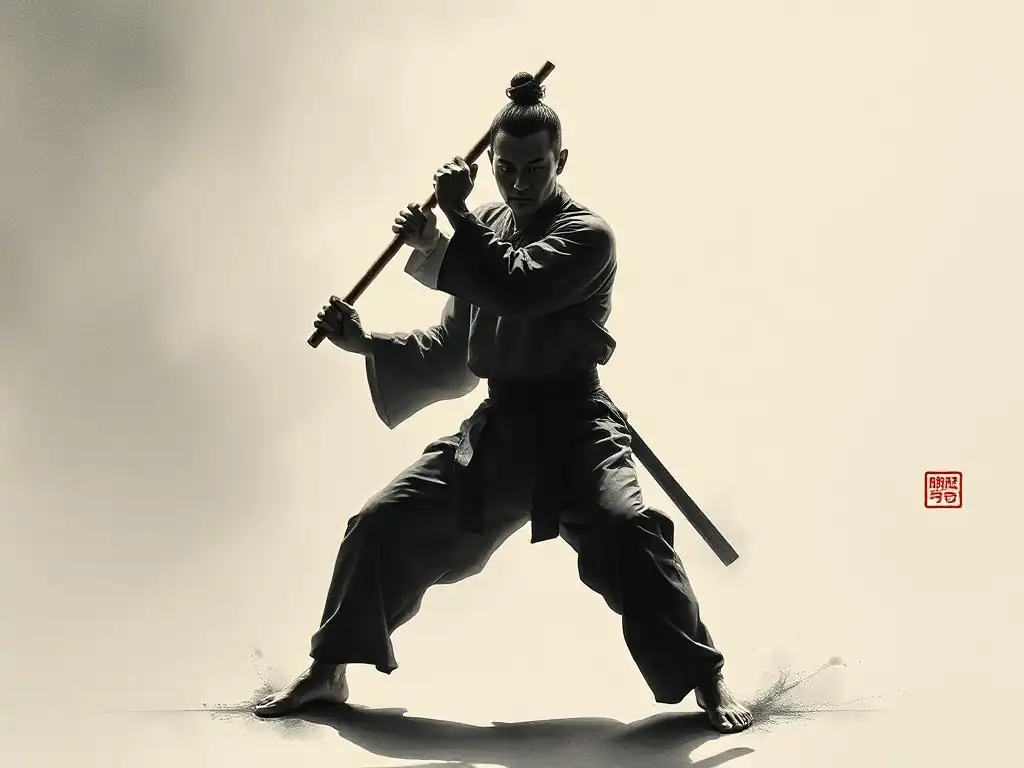
Chinese Martial Arts Techniques in Karate Forms
The influence of Chinese martial arts on Karate is undeniable, particularly in the structure and techniques of many kata. Numerous movements within Karate forms have direct counterparts or strong similarities in various Kung Fu styles, especially those originating from Southern China. Stances like Sanchin (three battles) and Shiko Dachi (square stance) are found in styles like Fujian White Crane. Hand techniques such as the crane beak, open-hand strikes, and sophisticated trapping methods also show clear lineage.
Furthermore, the underlying principles of power generation, body mechanics, and breath control found in kata like Sanchin have strong parallels in Chinese internal martial arts training. The emphasis on rootedness, coordinated body movement, and focused energy (Qi/Ki) are shared concepts. Examining Karate kata through the lens of these Chinese influences can unlock deeper bunkai interpretations, revealing applications related to seizing, controlling, and disrupting an opponent's structure, which might be less obvious if only viewed through a purely striking perspective.
Examining Specific Kung Fu Influences on Bunkai Interpretation
Several specific techniques and principles from Kung Fu styles have demonstrably influenced Karate bunkai interpretations. For instance, the prevalence of close-range techniques and infighting in many Karate kata, particularly those from the Naha-Te lineage, strongly reflects the characteristics of Southern Chinese Kung Fu. Movements that might be interpreted as simple blocks can reveal sophisticated trapping or limb control applications when analyzed with a Kung Fu mindset.
Consider the numerous open-hand techniques found in kata like Seiyunchin or Sepai. While they can be used for striking, their detailed execution often suggests applications involving seizing, tearing, or manipulating pressure points, which are common in styles like Fujian White Crane. Understanding the original context and application of similar movements in their parent Kung Fu systems provides valuable clues for unlocking the full bunkai potential of these Karate techniques. This process of Karate bunkai cross-pollination enriches the practitioner's understanding of kata.
Influence of Wing Chun's Centerline Theory on Karate's Straight-Line Attacks
While Wing Chun developed later than the primary period of Chinese influence on Okinawan Te, its core principles offer a useful lens for analyzing and applying certain Karate techniques, particularly straight-line attacks and defenses. Wing Chun places a strong emphasis on controlling the centerline – the imaginary line running vertically through the center of the body, considered the most vulnerable area. Techniques are designed to simultaneously defend one's own centerline and attack the opponent's.
Many Karate kata feature direct, linear attacks and defenses aimed towards an opponent's torso or head. Interpreting these movements with a Wing Chun-like understanding of the centerline can refine their application in bunkai. For example, a simple forward punch (oi-zuki) can be seen not just as a strike, but as an attempt to dominate the opponent's centerline while protecting one's own. Similarly, blocks are often directed to deflect an attack just enough to allow a simultaneous counter down the centerline. This perspective enhances the strategic depth of Karate bunkai application.
Influence of Southern Praying Mantis's Close-Range Combat on Karate's Trapping Techniques
Southern Praying Mantis Kung Fu is renowned for its incredibly fast, close-range hand techniques, including sophisticated trapping and seizing methods. These techniques are designed to control an opponent's limbs, disrupt their structure, and create openings for strikes at extremely close quarters. Many traditional Karate kata, particularly those with roots in Southern China, contain movements that strongly resemble Southern Praying Mantis techniques.
Movements in kata like Gojushiho (54 Steps) or Chinto (Gankaku) involve intricate hand manipulations that go beyond simple blocks or strikes. When analyzed through the lens of Southern Praying Mantis, these movements can be interpreted as trapping sequences, limb controls, or joint manipulations designed for infighting. For instance, a series of rapid hand movements might represent controlling an opponent's striking arm while simultaneously attacking. This perspective reveals a layer of close-quarters bunkai that is highly effective and adds depth to the understanding of these complex kata.
Judo and Aikido: Grappling and Joint Locking's Role in Karate Bunkai
Integrating Grappling Techniques into Karate's Striking Focus
While modern sport Karate often emphasizes striking, traditional Karate kata contain numerous movements that lend themselves to grappling applications, including throws, sweeps, and takedowns. The influence of Judo and Aikido, disciplines developed later but rooted in older Japanese Jujutsu systems that shared some common ancestry with Okinawan fighting, provides a valuable framework for interpreting these bunkai applications. Judo, with its focus on off-balancing (kuzushi), throwing (nage waza), and grappling on the ground (katame waza), offers principles directly applicable to understanding how to use a kata movement to unbalance and take down an opponent.
Many seemingly simple blocks in kata, when viewed through a Judo perspective, can be reinterpreted as methods for controlling an opponent's posture or movement to set up a throw or sweep. For example, a downward block might be used to pull an opponent off-balance, leading into a sweep. The stances themselves often provide a stable base suitable for grappling exchanges. Integrating grappling techniques from Judo into Karate bunkai expands the tactical options available to the practitioner beyond just striking, acknowledging the reality that fights often involve clinching and ground fighting.
Joint Locking Applications in Karate Bunkai: From Judo and Aikido
Both Judo (with its joint locks, kansetsu waza, primarily focused on the elbow in competition) and especially Aikido (which specializes in a wide array of joint locks and control techniques, katame waza and osae waza) offer profound insights into the joint manipulation applications hidden within Karate kata. Many kata movements involve controlling an opponent's wrist, elbow, or shoulder in ways that perfectly align with the principles of joint locking found in these arts.
A movement in kata that looks like an awkward block or strike might, when analyzed through an Aikido or Judo lens, reveal a highly effective technique for controlling an opponent's limb and applying painful pressure to a joint. The principles of leverage, body mechanics, and kuzushi used to execute joint locks in Aikido and Judo are directly applicable to understanding how to make these bunkai techniques work. This Karate bunkai cross-pollination reveals a sophisticated layer of control and submission techniques within the kata repertoire.
Adaptation of Osoto Gari (Large Outer Reaping) from a Karate Leg Sweep
Consider the leg sweeping movements found in many Karate kata, often interpreted simply as a low block or kick. When viewed through the lens of Judo's Osoto Gari (Large Outer Reaping), a highly effective throw, the bunkai application becomes much clearer and more potent. Osoto Gari involves controlling the opponent's upper body while sweeping their leg out from under them, causing them to fall backward.
A movement in kata like Heian Shodan, often shown as a low block followed by a step, can be interpreted as controlling an opponent's arm (the block) while stepping deep to execute a reaping motion against their leg. The principle is identical to Osoto Gari: disrupt balance while removing a supporting limb. This adaptation from a well-established Judo technique provides a powerful, practical bunkai for what might otherwise seem like a simple, less effective movement.
Application of Nikkyo (Wrist Joint Immobilization) from a Wrist Grab in Karate
Aikido's Nikkyo (Second Teaching), a painful wrist lock, finds direct application in the bunkai of many Karate kata movements that involve grabbing or controlling an opponent's wrist or hand. Kata often include sequences where one hand controls the opponent's wrist while the other hand performs a strike or block. Analyzing these movements with the principles of Nikkyo reveals a potential technique for controlling, unbalancing, and potentially submitting an opponent.
A common scenario in bunkai is defending against a wrist grab. A kata movement involving seizing the opponent's grabbing hand and rotating one's own wrist can be effectively interpreted as applying a Nikkyo-like lock. The leverage and pressure points targeted are the same. Understanding the mechanics of Nikkyo from Aikido provides the Karate practitioner with the specific details needed to make this bunkai application work effectively, turning a defensive reaction into a control or takedown opportunity through Karate bunkai cross-pollination.
Western Boxing and Kickboxing: Modern Striking Integration in Bunkai
Analyzing the Influence of Boxing Footwork and Angles
While Karate has its own distinct stances and movement patterns, the sophisticated footwork and understanding of angles developed in Western Boxing can offer valuable insights for refining striking bunkai. Boxing emphasizes constant movement, shifting weight, and using angles to create openings and avoid incoming strikes. This contrasts somewhat with the more rooted and linear movements often emphasized in traditional Karate.
Applying Boxing principles to Karate bunkai involves analyzing how kata movements can be used not just from a static position, but with dynamic footwork. Techniques like slipping, weaving, and pivoting, core to Boxing, can be integrated into bunkai scenarios to make defenses more evasive and attacks more difficult to predict. Understanding how to use angles to attack the opponent's vulnerable side or move out of the line of fire enhances the practicality of Karate's striking techniques in a dynamic combat situation.
Incorporating Kickboxing Techniques into Karate's Bunkai Repertoire
Kickboxing, which combines the hand techniques of Boxing with the kicking techniques of various martial arts (including Karate itself, but also Muay Thai and Taekwondo), presents a more modern combative framework that can inform Karate bunkai. While traditional Karate has kicks, Kickboxing often utilizes them in different rhythms and combinations, often integrated seamlessly with hand techniques.
Analyzing kata movements through a Kickboxing lens can reveal how Karate's kicks and strikes can be combined more fluidly and powerfully. For example, a kata sequence with a hand technique followed by a kick might be practiced as separate movements. However, understanding Kickboxing combinations can show how to deliver these as a rapid, linked sequence, using the hand technique to set up or distract for the kick. This perspective enhances the flow and effectiveness of striking bunkai, adding a modern layer to Karate bunkai cross-pollination.
Applying Boxing Slipping Techniques to Evade a Front Kick in Karate Bunkai
Consider defending against a front kick (mae geri), a common attack in Karate bunkai scenarios. A traditional defense might involve a block followed by a counter. However, applying a Boxing slipping technique provides an alternative, highly evasive defense. Slipping involves moving the head or upper body just enough to allow the attack to pass by, rather than meeting force with force.
In bunkai, this could mean interpreting a slight body shift within a kata movement not just as weight distribution for the next technique, but as a deliberate evasion. As the front kick extends, the practitioner could use a subtle twist or lean (a slip) to narrowly avoid the impact, immediately positioning themselves for a counter-attack from an advantageous angle. This application of Boxing evasion significantly improves the defensive aspect of Karate bunkai against linear attacks.
Adapting Kickboxing Roundhouse Kick Combinations for Self-Defense within Karate forms
Traditional Karate often features powerful front kicks and side kicks. While roundhouse kicks exist, they might not be emphasized in the same rapid-fire combinations seen in Kickboxing or Muay Thai. Analyzing Kickboxing combinations can show how to integrate Karate's strikes and kicks into more dynamic, layered attacks within a bunkai context.
A Kickboxing combination might involve a jab, followed by a cross, and then a roundhouse kick. While Karate kata don't typically follow this exact sequence, analyzing kata movements can reveal opportunities to adapt similar principles.
For example, a sequence of hand techniques in kata might be interpreted as setting up an opponent for a strong side kick (yoko geri) or a powerful snap kick (mae geri keage), delivered with the fluidity and follow-through seen in Kickboxing combinations. This involves seeing the kata movements not in isolation, but as potential components of a multi-layered attack strategy, enhancing the practical self-defense applications through Karate bunkai cross-pollination.
Case Studies: Kata Bunkai Examples Demonstrating Cross-Pollination
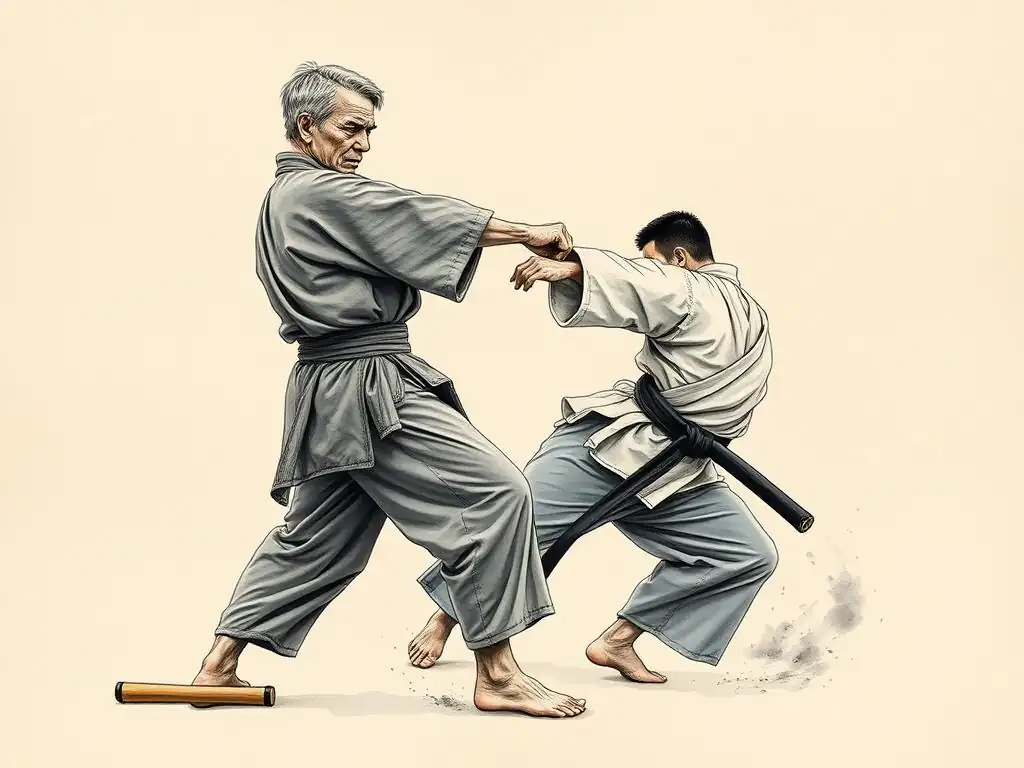
Analyzing Bassai-Dai: Tracing Influences from Southern Chinese Kung Fu
Bassai-Dai (To Storm a Fortress) is a widely practiced kata in many Karate styles, known for its robust movements, dynamic changes in direction, and numerous techniques that can be interpreted in various ways. Analyzing Bassai-Dai bunkai reveals significant potential influences from Southern Chinese Kung Fu, particularly in its close-range techniques, seizing motions, and powerful, rooted stances.
Specific movements, such as the opening sequence involving simultaneous blocks/strikes and subsequent hand manipulations, bear resemblance to techniques found in styles like Fujian White Crane or other southern systems focused on controlling the opponent's limbs and structure. The powerful downward blocks and upward strikes can be interpreted not just as simple defenses and attacks, but as methods for breaking an opponent's grip or seizing their arm to set up further techniques. The rapid changes in direction and pivots also align with strategies for navigating close-quarters combat.
Examining Gojushiho Sho: Identifying Cross-Disciplinar y Techniques
Gojushiho Sho (54 Steps, Small) is a complex, advanced kata found in Shotokan and other lineages, characterized by intricate open-hand techniques, rapid shifts, and unique movements like the "wave block" and spear hand variations. The bunkai of Gojushiho Sho demonstrates potential cross-pollination from various sources, including both Chinese Kung Fu and possibly even elements applicable to grappling or joint locks.
The numerous open-hand techniques, including seizing and manipulating gestures, strongly suggest influences from Southern Chinese styles known for such methods. For example, sequences involving controlling the opponent's arm and striking to vulnerable points align with principles found in Fujian White Crane or similar systems. Additionally, certain movements could be interpreted as setups for joint locks or controls, potentially showing a connection to principles found in older Jujutsu or even later arts like Aikido, where intricate hand controls are paramount.
Detailed Breakdown of Techniques and Influences for Bassai-Dai and Gojushiho Sho
Let's look closer at Bassai-Dai. A key sequence involves a simultaneous uchi uke (inside block) and gedan barai (downward block) while stepping. Traditional bunkai might show this as defending against a two-way attack.
A cross-pollination perspective, informed by Southern Chinese styles, could interpret the inside "block" as a seize or trap on the opponent's arm, while the downward "block" becomes a check or control against their leg or body, disrupting their balance for a follow-up strike or takedown. Another example is the repeated sukui uke (scooping block); while often shown as a defense against a low attack, it can also be interpreted as scooping or lifting an opponent's limb or even their body to off-balance them, a principle seen in various grappling arts.
In Gojushiho Sho, the intricate hand sequence often interpreted as the "wave block" could be seen, through a Kung Fu or Aikido lens, as a sophisticated method for deflecting and redirecting an opponent's force while simultaneously seizing and controlling their wrist or arm. The subsequent spear hand (nukite) thrust, delivered after controlling the limb, becomes a devastating follow-up strike to a vital point.
Another sequence involves a rapid outward-inward hand motion; this can be interpreted as a rapid trapping and striking combination akin to those found in Southern Praying Mantis, designed to overwhelm the opponent's defenses at close range. This detailed analysis, informed by Karate bunkai cross-pollination, reveals the multifaceted nature of these kata movements.
Benefits of Cross-Training for Karate Practitioners
Enhanced Understanding of Bunkai Principles
Engaging in cross-training in other martial arts can significantly enhance a Karate practitioner's understanding of bunkai principles. Exposure to disciplines like Judo, Aikido, or Kung Fu provides different perspectives on body mechanics, leverage, timing, and strategy that are directly applicable to interpreting kata movements. For instance, training in Judo helps a Karateka understand the principles of off-balancing (kuzushi), making the grappling applications in bunkai much clearer. Similarly, practicing trapping drills from Wing Chun or Southern Praying Mantis can illuminate the purpose of intricate hand movements in kata.
This broadened perspective helps unlock the deeper layers of meaning within Karate kata, moving beyond superficial interpretations. A practitioner who understands basic joint locks from Aikido will spot those applications in kata movements more readily than someone without that knowledge. Cross-training doesn't mean abandoning Karate; it means bringing external insights back to Karate, enriching the understanding and application of its core techniques and bunkai through Karate bunkai cross-pollination.
Improved Self-Defense Capabilities Through Versatility
A deeper understanding of bunkai, informed by cross-pollination, directly translates into improved self-defense capabilities. By recognizing a wider range of applications within kata – including strikes, blocks, joint locks, throws, and controls – the practitioner becomes more versatile and adaptable in a real self-defense situation. They are not limited to a purely striking response but can transition effectively between ranges and techniques as the situation demands.
For example, a practitioner who understands the grappling applications in kata, thanks to Judo insight, is better prepared if an attacker attempts to grab or wrestle. They can utilize kata movements to defend against the grab, apply a control, or execute a throw. This versatility, born from a multi-disciplinary understanding of bunkai, makes the Karate practitioner a more well-rounded and effective defender against a variety of threats.
Broadened Perspective on Martial Arts Applications
Cross-training and exploring Karate bunkai cross-pollination provide a broader perspective on the nature of martial arts themselves. It highlights the universality of certain combat principles across different styles and cultures. Recognizing similar techniques or strategies in seemingly disparate arts fosters a deeper appreciation for the shared history and evolution of fighting systems.
This broadened perspective encourages open-mindedness and a continuous learning attitude. Practitioners become less confined by the stylistic boundaries of pure Karate and more interested in the underlying functional effectiveness of techniques. This can lead to more intelligent training, better problem-solving in self-defense scenarios, and a richer, more fulfilling journey in martial arts mastery.
Considerations and Cautions: Avoiding Misinterpretation
Maintaining the Integrity of Karate Principles
While exploring Karate bunkai cross-pollination is beneficial, it is crucial to do so while maintaining the integrity of Karate's fundamental principles and body mechanics. The goal is to enrich Karate bunkai, not to turn Karate into another art entirely. Techniques borrowed or understood through another lens should be integrated in a way that aligns with Karate's core movements, stances, and power generation methods.
Simply grafting techniques from other arts onto kata movements without understanding the context or how they fit within Karate's framework can lead to ineffective or disjointed applications. The practitioner must ensure that the adapted bunkai feels natural within the body mechanics cultivated through dedicated Karate training. It's about finding how Karate's movements allow for these applications, not forcing foreign techniques awkwardly into the kata.
Avoiding Unnecessary Complexity in Bunkai Application
Another caution is to avoid making bunkai unnecessarily complex. While kata can contain multiple layers of application, the most practical bunkai is often direct, efficient, and relatively simple to execute under duress. Overly complicated interpretations, even if theoretically possible based on cross-disciplinary analysis, might not be practical in a real self-defense situation.
The exploration of Karate bunkai cross-pollination should aim to uncover practical and effective applications. It's easy to get lost in theoretical possibilities. Practitioners should test their bunkai interpretations through realistic drills and pressure testing to ensure they are functional and not just intellectual exercises. Simplicity and efficiency are key criteria for effective self-defense techniques.
The Importance of Context and Training Methodology
Finally, the context in which kata were developed and the training methodologies used to practice bunkai are paramount. Historical context helps inform the likely original intentions of the movements. Understanding that early Karate was primarily for self-defense against potentially armed opponents in close quarters provides a crucial lens for interpreting bunkai.
Furthermore, effective bunkai requires specific training methodologies that go beyond simply practicing kata solo. Partner drills, scenario training, and resistance practice are essential for developing the timing, distance, and feel necessary to apply bunkai effectively. Knowledge gained from Karate bunkai cross-pollination must be integrated into practical training to become truly useful. Without this practical application, the theoretical understanding remains just that – theory.
Conclusion: The Future of Karate Bunkai through Open-Minded Exploration
Embracing Cross-Pollination for Continued Evolution
The journey of Karate bunkai evolution is an ongoing process, and embracing cross-pollination is a vital path forward. By remaining open to the insights and techniques found in other martial arts – from the historical influences of Chinese Kung Fu to the grappling principles of Judo and Aikido, and the modern striking dynamics of Boxing and Kickboxing – practitioners can continue to deepen their understanding of Karate's kata. This open-minded exploration ensures that bunkai remains relevant, practical, and dynamic.
Karate is a living art, not a static relic. Its strength lies in its ability to adapt and absorb, as it has done throughout its history. Exploring Karate bunkai cross-pollination is not a departure from tradition but a return to the spirit of innovation and practical application that characterized its development. It allows practitioners to see familiar movements in new ways, unlocking hidden potential and ensuring the art's continued vitality.
Karate Bunkai Cross-Pollination: A Path to Deeper Understanding
Karate bunkai cross-pollination offers a rich pathway to a deeper understanding of both the individual movements within kata and the overarching principles of combat that they embody. It encourages practitioners to look beyond stylistic boundaries and recognize the universal truths of effective fighting. By comparing and contrasting techniques across different disciplines, the core mechanics and strategic intent of Karate techniques become clearer.
This process transforms kata from a set of choreographed movements into a comprehensive library of combative knowledge. It empowers practitioners to interpret kata not just as fixed sequences, but as flexible frameworks containing a multitude of potential applications, adaptable to various self-defense scenarios. This deeper understanding, facilitated by Karate bunkai cross-pollination, is invaluable for serious students of the art.
The Ongoing Journey of Martial Arts Mastery.
Ultimately, the exploration of Karate bunkai cross-pollination is part of the broader, ongoing journey toward martial arts mastery. Mastery is not about knowing one style in isolation, but about understanding the fundamental principles of combat and human movement. By drawing insights from diverse sources, the Karate practitioner hones their ability to analyze, adapt, and apply techniques effectively.
This continuous learning process, fueled by curiosity and an appreciation for the global heritage of martial arts, leads to a more profound connection with Karate's history and its practical purpose. It reinforces the idea that martial arts are not just techniques, but principles and strategies for effective action. Karate bunkai cross-pollination is a key element in this lifelong pursuit of understanding and proficiency.
Frequently Asked Questions
How did other martial arts influence the development of Karate bunkai?
Karate bunkai evolved through cross-pollination, borrowing techniques and concepts from other martial arts like Chinese kung fu and Okinawan te. This fusion of styles broadened the application and understanding of Karate techniques.
What specific examples of cross-pollination can be found in Karate bunkai?
Many bunkai interpretations show influences from grappling arts like judo and striking arts like boxing. The incorporation of throws, joint locks, and evasion strategies demonstrate this cross-pollination.
Why is understanding cross-pollination important for Karate practitioners?
Recognizing bunkai cross-pollination allows practitioners to deepen their understanding of Karate techniques. It also promotes a more adaptable and effective approach to self-defense.
Where can I find historical evidence of this bunkai evolution?
Examining historical texts and lineage records of various Karate styles reveals the exchange of techniques and philosophies. Oral traditions and the study of related martial arts offer additional insights.
How does MartialArtsMastery.org contribute to understanding this topic?
MartialArtsMastery.org provides historical overviews, training tips, and profiles of legendary practitioners. This content helps to illustrate the evolution of Karate bunkai and the influence of other martial arts.
Final Reflection: Embracing Cross-Discipline Growth
The exploration of Karate bunkai's cross-pollination influence reveals a dynamic evolution, demonstrating that no art exists in a vacuum. By acknowledging and integrating techniques and principles from other martial disciplines, Karate bunkai has not only survived but thrived, adapting to new challenges and enriching its understanding of combat application. This interconnectedness highlights the importance of open-mindedness and continuous learning in any field, not just martial arts.
The impact of this cross-pollination extends beyond the dojo, influencing how we approach problem-solving and innovation in all aspects of life. The willingness to learn from diverse perspectives and integrate seemingly disparate ideas is crucial for progress and personal growth. The meeting of two personalities is like the contact of two chemical substances: if there is any reaction, both are transformed.
- Carl Jung. This quote perfectly encapsulates the transformative power of cross-pollination, reminding us that engaging with different viewpoints can lead to profound and unexpected results.
As we conclude this exploration of Karate bunkai's evolution, I invite you to consider the lessons learned about adaptability and the power of cross-discipline thinking. How can you apply this principle of embracing diverse influences in your own life, whether in your career, your relationships, or your personal pursuits? Embrace the opportunity to learn from unexpected sources, challenge your assumptions, and allow yourself to be transformed by the richness of interconnectedness. The potential for growth is limitless when we open ourselves to the wisdom of others.
Unleash Your Bunkai Potential!
Thank you for exploring the fascinating evolution of Karate bunkai and how cross-pollination from other martial arts can enrich your understanding. Now it's time to put that knowledge into action and deepen your practice.
- Experiment with applying techniques from other martial arts (Judo throws, Aikido joint locks, etc.) to your existing Karate kata bunkai. This is your primary action!
- Share your innovative bunkai interpretations and experiences with fellow Karate practitioners online.
- Consider attending a cross-training seminar or workshop to broaden your martial arts perspective.
What unexpected bunkai application did you discover by blending styles, and how did it change your perspective?