
Richard the Lionheart: A King's Personal Prowess in Medieval Martial Combat

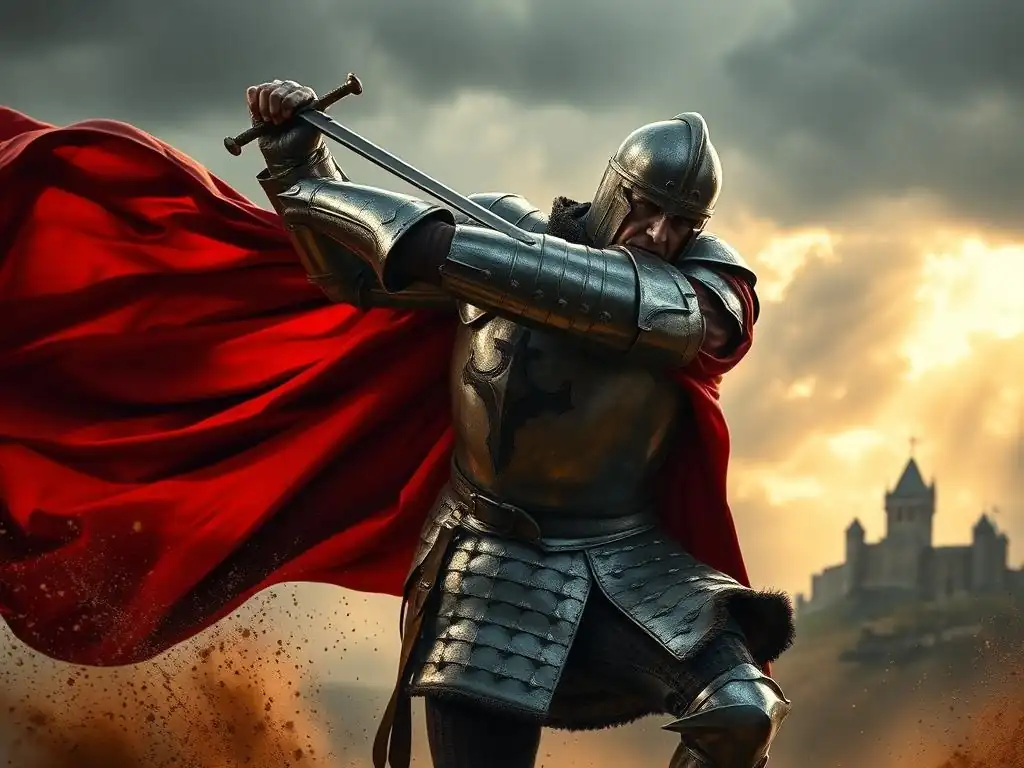
Welcome to Martial Arts Mastery, where history meets the art of combat. Ever wondered how kings of old prepared for battle? Dive into the fascinating world of medieval warfare and discover the surprising insights into the personal combat training of Richard the Lionheart. Uncover the secrets that forged a legend and see how his martial prowess shaped history. Intrigued? Read on to explore the training regimen that transformed a monarch into a formidable warrior!
- Introduction: Richard Lionheart, the Warrior King
- Early Life and Influences on Richard's Combat Prowess
- Richard Lionheart's Medieval Combat Training Regimen
-
Richard Lionheart in Battle: Examples of Personal Combat
- The Third Crusade: Showcases of Richard's Martial Skill
- The Siege of Acre: A Demonstration of Courage and Combat Effectiveness
- Encounters with Saladin's Forces: Tales of Valor and Prowess
- The Battle of Arsuf: Richard's Tactical Acumen and Personal Bravery
- The Rescue at Jaffa: A Display of Swift Action and Combat Skill
- Richard Lionheart's Martial Arts Legacy
- Richard the Lionheart: Medieval Combat Training and Modern Martial Arts
- Conclusion: Richard the Lionheart, a Paragon of Medieval Martial Combat
-
Frequently Asked Questions
- How did Richard the Lionheart's royal status influence his martial arts training?
- What specific medieval combat techniques would Richard the Lionheart have likely employed?
- What historical sources provide insight into Richard the Lionheart's martial abilities?
- How might Richard the Lionheart's training differ from modern martial arts training?
- Did Richard the Lionheart's training emphasize individual skill or battlefield tactics?
- Final Reflection: The Enduring Echo of Lionheart's Steel
- Unleash Your Inner Lionheart!
Introduction: Richard Lionheart, the Warrior King
Richard I: Beyond the Crusades, a Study in Martial Skill
Richard I, known to history as Richard the Lionheart, is often remembered primarily for his role in the Third Crusade and his legendary clashes with Saladin. Yet, reducing him solely to a crusading monarch overlooks a fundamental aspect of his identity and effectiveness: his exceptional personal martial skill.
Chroniclers of the era, such as Ambroise in his Estoire de la Guerre Sainte, frequently lauded Richard's physical strength, courage, and fighting ability. These accounts aren't merely flowery prose; they reflect the reality that a medieval king, especially one ruling vast territories and leading armies in person, was expected to be a formidable warrior.
Richard embodied this expectation, participating directly in combat, leading charges, and demonstrating proficiency with the weapons of the time. His reputation as a formidable fighter was not just propaganda; it was based on observed prowess on the battlefield, contributing significantly to his leadership authority and the morale of his troops.
His capabilities extended beyond mere brute force. Richard was recognized for his tactical acumen, particularly in leading cavalry maneuvers and coordinating forces, but his individual skill in the mêlée or personal combat was a defining trait. Medieval warfare, while involving strategy and logistics, often devolved into chaotic close-quarters fighting where individual skill, endurance, and courage were paramount.
Richard's willingness to engage directly, often in the thickest fighting, set him apart and cemented his image as the archetypal warrior-king. This personal involvement in combat was a critical component of his military leadership, proving to his knights and soldiers that he was not just a commander but a fellow combatant willing to share the risks, a trait highly valued in the feudal military structure.
The Context: Medieval Warfare and the Importance of Personal Combat
Medieval warfare was a complex interplay of strategy, siegecraft, and pitched battles, but personal combat remained a central, often decisive, element. Unlike modern conflicts fought at distance, medieval battles frequently involved hand-to-hand fighting where knights, armed with swords, lances, and axes, engaged directly with the enemy. The outcome of a skirmish or even a larger battle could hinge on the performance of key individuals, particularly the leaders.
A king's personal bravery and fighting prowess could inspire his troops to stand firm or charge, and his defeat or capture could lead to immediate collapse. For Richard Lionheart, medieval combat training was not merely a princely pastime but a fundamental preparation for the realities of leading armies in an era where the commander was often at the forefront of the fighting.
The emphasis on personal combat was also tied to the chivalric code, which, while often romanticized, did place a high value on individual skill, courage, and honor in battle, particularly among the knightly class. Tournaments, mêlées, and judicial duels, though distinct from battlefield combat, served as proving grounds for martial skill and reinforced the cultural importance of personal fighting ability.
Richard was known to have participated in tournaments in his youth, honing skills that would later be applied in real warfare. The ability to wield heavy weapons effectively while mounted or on foot, to withstand blows from formidable opponents, and to maintain composure in chaotic, high-stakes situations were all direct results of rigorous personal training, making Richard Lionheart's medieval combat training a crucial aspect of his development as a ruler and military leader.
Early Life and Influences on Richard's Combat Prowess
Royal Lineage and Expectations of Military Leadership
Born into the powerful Angevin dynasty, Richard was the son of King Henry II of England and Eleanor of Aquitaine, a lineage that placed him squarely within the highest echelons of medieval European royalty. From a young age, Richard was expected to inherit vast territories spanning England and large parts of France, including Normandy, Anjou, and Aquitaine. Governing these lands in an era of constant political maneuvering, rebellions, and external threats demanded strong military leadership.
The feudal system relied on lords, including the king, to personally lead their vassals in battle. Failure to demonstrate capability and courage in this role could undermine authority and loyalty. Richard's brothers, notably Henry the Young King, were also trained in arms, reflecting the family's emphasis on military readiness.
The Angevin court, particularly Henry II's, was known for its dynamic and often volatile nature, marked by frequent conflicts, including internal family strife. Richard spent much of his youth in his mother's court in Aquitaine, a region with its own distinct martial traditions and a history of resistance.
This environment likely exposed him to various military styles and fostered a certain independence and assertiveness from a young age. The constant need to defend or expand territories, coupled with the expectations placed upon a royal heir, provided a compelling impetus for Richard to excel in military matters and undergo rigorous Richard Lionheart medieval combat training from an early age, preparing him not just for kingship but for the fundamental role of a warrior.
Training and Education in Arms: Forging a Warrior King
Like most high-born sons of the era, Richard's education was dual-focused: administrative/political and martial. While literacy and knowledge of law and governance were important, proficiency in arms was paramount for a future ruler. Training typically began around the age of seven, when a boy might be sent to the household of a relative or powerful lord to serve as a page.
Here, he would learn basic skills, courtly etiquette, and preliminary horsemanship. By his early teens, usually around fourteen, he would become a squire, directly serving a knight. This stage involved intensive hands-on training: caring for the knight's horses and armor, accompanying him on campaigns or tournaments, and practicing weapon drills.
The squire's training was comprehensive, covering swordsmanship, lance handling, horsemanship, and tactics. Practice involved weapons like the quintain (a rotating target to practice lance strikes) and the pell (a wooden post used for practicing sword and axe blows). Squires also learned to fight in armor, understanding its limitations and advantages.
While specific details of Richard's personal training are scarce, historical accounts of knightly education provide a clear picture of the demanding process he would have undergone. By the time he was knighted, typically in his late teens or early twenties (Richard was knighted around age 16 by Louis VII of France), he would have been a seasoned warrior, his physical conditioning and martial skills honed through years of dedicated Richard Lionheart medieval combat training.
The Development of Richard's Fighting Style: Norman and Angevin Military Traditions
Richard's fighting style was deeply rooted in the Norman and Angevin military traditions, which emphasized heavy cavalry charges as the primary shock tactic on the battlefield. The Normans, renowned for their martial prowess since the 11th century, perfected the use of mounted knights, often supported by infantry and archers.
This tradition stressed the coordinated charge, the use of the lance couched under the arm, and effective use of the sword and axe in close combat after the initial impact. Richard's upbringing within this framework meant he would have trained extensively in mounted combat, mastering the complex coordination required to wield weapons effectively from horseback while wearing armor.
Beyond the standard Norman approach, the Angevin territories encompassed diverse regions, potentially exposing Richard to different military influences. His campaigns in Aquitaine, for instance, involved fighting against local lords who might employ different tactics or rely more heavily on specific types of infantry or terrain advantages.
While the core of his style remained the heavy cavalry charge, his experiences governing and campaigning across varied landscapes, from the forests of Anjou to the plains of Aquitaine and later the arid lands of the Levant, likely added layers of adaptability to his approach. The culmination of this upbringing and diverse experience resulted in Richard Lionheart's medieval combat training producing a leader equally comfortable planning grand strategy and engaging personally in the brutal realities of the medieval battlefield.
Richard Lionheart's Medieval Combat Training Regimen
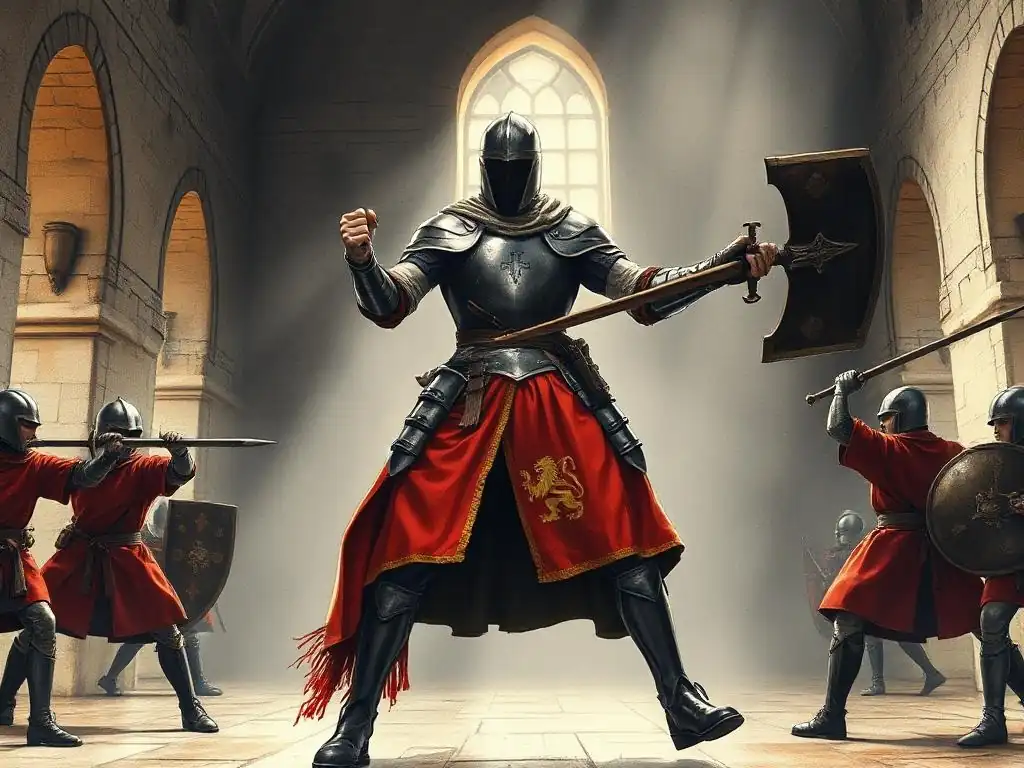
Swordsmanship: Techniques and Mastery of the Blade
Swordsmanship was arguably the most fundamental skill for a medieval knight and king. While lances were crucial for the initial cavalry charge, the sword was the primary weapon for close-quarters combat, whether mounted or dismounted. Training involved mastering various cuts, thrusts, and defensive techniques using different types of swords common at the time, such as the single-handed arming sword or the heavier great sword (though the latter was less common in Richard's earlier campaigns).
Practice on the pell allowed knights to develop power, precision, and footwork, simulating strikes against a stationary opponent. Sparring, often with blunted weapons, helped develop timing, distance management, and the ability to react to an opponent's movements.
Medieval combat manuals, such as the later I.33 manuscript (though from a slightly later period, it reflects earlier traditions), illustrate techniques involving both offense and defense, including grappling techniques incorporated into sword fighting. A knight like Richard would have trained tirelessly to develop the strength and endurance needed to wield a sword weighing perhaps 2-3 pounds for extended periods in the heat of battle while wearing armor.
Mastery involved not just hitting hard, but understanding how to target vulnerable points in armor, how to bind and control an opponent's blade, and how to transition effectively between offense and defense. This rigorous practice was a core component of Richard Lionheart's medieval combat training, making him a formidable duelist.
Horsemanship and Mounted Combat: A Knight's Essential Skill
For a medieval knight, the horse was an extension of the warrior. Horsemanship was not merely about riding but about controlling a powerful animal in chaotic conditions, using its speed and mass as part of the combat strategy. Training involved learning to ride in heavy armor, control the horse using legs and weight while the hands were occupied with weapons, and perform complex maneuvers like charges, pivots, and retreats in formation. Jousting and mêlée practice in tournaments were crucial for developing these skills, simulating the shock of impact and the close-quarters chaos of a cavalry engagement.
Mounted combat primarily utilized the lance for the initial charge, aimed at breaking enemy formations or unseating opposing knights. However, if the lance broke or the fight continued, the knight transitioned to the sword, axe, or mace from horseback. This required immense balance, coordination, and strength.
Richard's reputation suggests he excelled in this area. Descriptions of battles like Arsuf highlight his ability to lead devastating cavalry charges and remain effective even when the engagement devolved into a general mêlée. The bond between knight and warhorse, and the skill required to fight effectively as a single unit, were central tenets of Richard Lionheart's medieval combat training.
Armor and Weaponry: Understanding the Tools of War
Understanding and effectively using contemporary armor and weaponry was integral to Richard Lionheart's medieval combat training. In Richard's time, the primary form of body protection was mail armor (chainmail), often worn over a padded garment (gambeson). A mail hauberk could weigh between 25 and 40 pounds, covering the torso, arms, and sometimes legs. Head protection involved a helm, initially conical or nasal helmets, evolving towards the great helm later in his life. Wearing this protection for extended periods, fighting, and maneuvering required significant strength and stamina, which physical conditioning aimed to build.
Weapons included the lance, various types of swords (arming swords, sometimes longer two-handed swords), axes (like the Danish axe), maces, and daggers. Each weapon had its specific uses and techniques. The lance was for shock impact; the sword was versatile for cutting and thrusting; the axe and mace were effective against armored opponents due to their concussive force.
Richard would have trained with all these, learning their weight, balance, and optimal application against different targets and armor types. This practical knowledge of his gear was as important as the fighting techniques themselves in his overall Richard Lionheart medieval combat training.
Physical Conditioning: Strength, Endurance, and Agility for Battle
Medieval combat was physically grueling. Fighting in armor, wielding heavy weapons, and enduring the rigors of campaigning required exceptional physical fitness. Richard Lionheart's medieval combat training would have included extensive physical conditioning. This wasn't formalized like modern athletic training but was built into the daily activities of a squire and knight. Riding for long hours, often in armor, built endurance. Practicing weapon drills, particularly against the pell or in simulated combat, developed strength and muscular endurance.
Activities like climbing walls (simulated during training), running, and wrestling were also likely incorporated to improve agility and functional strength. Managing the weight of armor (easily 50-60 pounds including helm, shield, and weapons) while fighting required immense core strength and stamina. Chroniclers often commented on Richard's physical strength, which would have been a direct result of years of demanding physical training. His ability to endure long campaigns and fight effectively in multiple battles during the Third Crusade is testament to the effectiveness of his physical conditioning as part of his comprehensive Richard Lionheart medieval combat training.
Richard Lionheart in Battle: Examples of Personal Combat
The Third Crusade: Showcases of Richard's Martial Skill
The Third Crusade (1189-1192) provided numerous opportunities for Richard to demonstrate the culmination of his Richard Lionheart medieval combat training on a grand stage. From the siege of Acre to the march south and the battles against Saladin's forces, Richard was consistently at the forefront.
His personal involvement in combat was not limited to leading charges; he was known to engage in individual or small-group skirmishes and defend positions directly. This visible courage and martial prowess were crucial for maintaining the morale and cohesion of the diverse crusader army, which comprised forces from various European kingdoms with their own leaders and agendas.
His reputation preceded him, even among his enemies. Saladin's own chroniclers and soldiers expressed respect, and sometimes fear, for the English king's ferocity and effectiveness in battle. Richard's actions throughout the crusade served as practical lessons in medieval warfare, demonstrating how a combination of strategic planning, tactical flexibility, and personal martial skill could achieve victories against a formidable and often numerically superior foe. His performance in the Holy Land solidified his image as a warrior king, an image forged through years of dedicated training and proven in the crucible of major military campaigns.
The Siege of Acre: A Demonstration of Courage and Combat Effectiveness
The Siege of Acre (1189-1191) was a protracted affair that tested the endurance of both the crusaders and the Muslim defenders. Richard's arrival in June 1191 significantly boosted the besiegers' efforts. While much of the siege involved siege engines, mining, and assaults on the walls, personal combat was frequent in skirmishes outside the city and during attempts to breach defenses. Richard, despite falling ill with "Arsuf fever" (likely a form of dysentery), reportedly directed operations from a stretcher and even used a crossbow to personally shoot at the defenders on the walls, demonstrating his determination and adaptability.
His leadership during the final stages of the siege, including organizing assaults and defending against Salladin's relief attempts, showcased his tactical command alongside his personal willingness to engage. While not a battle defined by a single grand cavalry charge led by Richard, Acre demonstrated his broader military effectiveness, combining strategic oversight with direct, personal involvement where needed. His presence and active participation, even when unwell, underlined the importance of a leader's personal courage and combat effectiveness, reinforcing the value of his extensive Richard Lionheart medieval combat training.
Encounters with Saladin's Forces: Tales of Valor and Prowess
Throughout the Third Crusade, Richard's forces frequently clashed with those of Saladin, particularly during the march from Acre to Jaffa. These encounters, often sharp skirmishes or probing attacks by Saladin's light cavalry and archers, required constant vigilance and readiness for combat. Richard often rode among his knights, participating in repelling these attacks and leading counter-charges. Accounts describe his ability to fight effectively against the fast-moving, harassing tactics of Saladin's Turcopoles and Mamluks.
One notable, though possibly embellished, account describes Richard personally cutting down numerous foes in a single engagement, showcasing his strength and swordsmanship. While the exact numbers may be exaggerated by chroniclers eager to glorify their patron, the consistent theme across different sources is Richard's active participation in the fighting and his recognized skill as a combatant. These skirmishes, though smaller than pitched battles, were vital for maintaining the crusader army's discipline and morale during the challenging march, and Richard's personal example was a key factor.
The Battle of Arsuf: Richard's Tactical Acumen and Personal Bravery
The Battle of Arsuf (September 7, 1191) is perhaps the most famous example of Richard's military genius and personal combat prowess. Marching south along the coast, Richard's army was subjected to relentless harassment from Saladin's larger force (estimated figures suggest Richard had perhaps 10,000-12,000 men against Saladin's 20,000-30,000). Despite the provocation and the suffering of his infantry from arrows and javelins, Richard maintained strict marching order, absorbing the attacks until the opportune moment.
When the Knights Hospitaller finally broke ranks and charged, Richard seized the initiative, ordering a full-scale cavalry charge. He personally led the charge of the main body of knights, smashing into Saladin's lines. Chroniclers describe Richard fighting with incredible ferocity, carving a path through the enemy.
His combination of strategic patience, decisive tactical response, and personal bravery in leading the charge was instrumental in the crusader victory, which inflicted heavy casualties on Saladin's army (estimated in the thousands) and secured the vital port of Jaffa. Arsuf stands as a testament to the effectiveness of Richard Lionheart's medieval combat training when combined with strategic leadership.
The Rescue at Jaffa: A Display of Swift Action and Combat Skill
In 1192, while peace negotiations were underway, Saladin launched a surprise attack on Jaffa, which was held by a small crusader garrison. Richard, who was nearby, responded with remarkable speed, sailing with a small force by ship. Upon arrival, he reportedly leaped into the water and waded ashore, leading his men directly into the besieged town. The fighting was desperate and hand-to-hand as they pushed back Saladin's troops who had already breached the walls.
During the subsequent defense of Jaffa, Saladin launched a major assault. Richard, with only a fraction of Saladin's numbers (perhaps 2,000 men, including dismounted knights, against Saladin's estimated 10,000-20,000), organized a defense centered around dismounted knights fighting shoulder-to-shoulder. Richard himself fought on foot, armed with a sword and axe, in the thickest of the fighting.
Accounts describe him as a whirlwind, personally engaging and defeating numerous attackers. His extraordinary courage and skill in this close-quarters battle galvanized his small force and repelled Saladin's much larger army, a stunning display of personal combat effectiveness honed by years of Richard Lionheart medieval combat training.
Richard Lionheart's Martial Arts Legacy
The Impact of Richard's Fighting Style on Medieval Warfare Tactics
While Richard did not fundamentally invent new military tactics, his effective application of established Norman/Angevin methods, combined with his personal leadership, left a significant mark. His mastery of the heavy cavalry charge, executed with discipline and timed for maximum impact, demonstrated its continued viability against mobile, archer-heavy forces like Saladin's. Arsuf, in particular, became a case study in how a disciplined force could absorb harassment and deliver a decisive counter-blow led by its commander.
Furthermore, Richard's willingness to adapt, fighting effectively on foot at Jaffa when mounted combat was not feasible, highlighted the importance of versatility. While the era was dominated by the mounted knight, the ability to dismount and fight effectively as heavy infantry was a crucial skill, especially in sieges or defensive actions. His personal example reinforced the tactical value of the knightly class not just as shock cavalry but as highly trained, adaptable heavy fighters, a lesson that influenced military thinking in subsequent campaigns.
Richard as a Symbol of Chivalry and Martial Excellence
Richard the Lionheart quickly became an iconic figure in medieval literature and legend, symbolizing the ideal Christian knight and warrior-king. His courage, strength, and prowess in battle were celebrated in chansons de geste, chronicles, and later romantic literature. While the historical Richard was a complex figure with political flaws and moments of ruthlessness (such as the controversial execution of prisoners at Acre), his martial image was overwhelmingly positive.
This image contributed to the evolving concept of chivalry, which, beyond courtly love, emphasized bravery, skill in arms, honor in battle, and the protection of the weak (though this ideal was often aspirational). Richard's deeds in the Holy Land, particularly his perceived honorable interactions and mutual respect with Saladin (despite being enemies), further cemented his reputation as a paragon of medieval martial excellence. His legend inspired generations of knights and nobles, serving as a benchmark for personal valor and military leadership, a legacy built upon the foundation of his rigorous Richard Lionheart medieval combat training and battlefield performance.
Analyzing Richard's Strengths and Weaknesses as a Combatant
Richard's strengths as a combatant were numerous and well-documented. His physical strength was legendary, enabling him to wield heavy weapons effectively and endure the physical strain of battle in armor. His skill with the sword and lance was repeatedly demonstrated in leading charges and engaging in personal combat. His courage was unquestioned; he consistently placed himself in positions of extreme danger at the forefront of his troops. His tactical intelligence allowed him to make decisive actions, like the charge at Arsuf or the swift relief of Jaffa.
However, his greatest strength could also be a weakness. His eagerness for personal combat and tendency to lead from the very front, while inspiring, also exposed him to significant risk. His death in 1199 was not in a grand battle against a worthy foe, but from a crossbow bolt during the siege of a minor castle (Chalus-Chabrol), sustained while reportedly inspecting the siege works without full armor.
This illustrates the inherent danger of his hands-on approach. While his Richard Lionheart medieval combat training made him a formidable fighter, the unpredictable nature of medieval warfare meant even the greatest warrior was vulnerable. His focus on personal prowess sometimes overshadowed strategic prudence in less glamorous situations.
Richard the Lionheart: Medieval Combat Training and Modern Martial Arts
Lessons from History: Applying Medieval Combat Principles Today
While modern martial arts differ vastly from medieval combat, the principles underlying Richard Lionheart's medieval combat training still hold relevance. The emphasis on rigorous physical conditioning for strength, endurance, and agility is universal across all demanding martial disciplines. The dedication required to master complex weapon systems, whether a medieval sword or a modern sport weapon, remains a core tenet of high-level martial skill.
Furthermore, the historical accounts highlight the importance of understanding distance, timing, and leverage – fundamental principles applicable to any form of combat, armed or unarmed. Richard's ability to transition between mounted and dismounted fighting, or adapt his tactics in different scenarios (like the defense of Jaffa), underscores the value of versatility and adaptability in martial arts. Studying the historical accounts of figures like Richard provides insights into the warrior mindset, the importance of discipline under pressure, and the critical link between training and performance in life-or-death situations.
The Enduring Appeal of Richard Lionheart's Warrior Image
Richard the Lionheart continues to capture the imagination centuries after his death, largely due to his powerful image as a warrior king. This enduring appeal stems from the romantic ideal of the knight errant and the leader who fights alongside his men. In a world where leadership is often perceived as detached, the image of a king like Richard, personally engaging in the brutal reality of medieval combat, resonates deeply.
His story, particularly his clashes in the Holy Land, has been retold in countless books, films, and games, solidifying his place as a legendary figure. This fascination reflects a timeless admiration for courage, skill, and leadership demonstrated in the face of adversity. The historical accounts of his prowess, born from dedicated Richard Lionheart medieval combat training and proven on the battlefield, ensure his legacy as one of history's most iconic warrior monarchs persists.
Conclusion: Richard the Lionheart, a Paragon of Medieval Martial Combat
Frequently Asked Questions
How did Richard the Lionheart's royal status influence his martial arts training?
His royal status provided him with access to the best instructors and resources, allowing for a more comprehensive and intensive training regime than most. This afforded him a significant advantage in mastering combat skills. He was able to dedicate time and resources to developing his personal prowess.
What specific medieval combat techniques would Richard the Lionheart have likely employed?
He would have likely focused on techniques involving sword fighting, lance combat, and hand-to-hand combat, common in medieval warfare. Proficiency with mounted combat would also have been essential for a king leading armies. He would have trained in weaponry and armor usage.
What historical sources provide insight into Richard the Lionheart's martial abilities?
Primary sources like chronicles and accounts of battles offer glimpses into his battlefield performance and reputation. Secondary sources, such as biographies and historical analyses, interpret these accounts and shed further light on his combat effectiveness. These sources provide context and evidence.
How might Richard the Lionheart's training differ from modern martial arts training?
Medieval combat training emphasized practical application for warfare, focusing on lethal techniques and battlefield endurance. Modern martial arts often incorporate elements of sport, fitness, and self-discipline, which are secondary in comparison. The focus was on survival.
Did Richard the Lionheart's training emphasize individual skill or battlefield tactics?
While individual skill was crucial, Richard's training would have also heavily emphasized battlefield tactics and leadership. A king needed to command armies effectively, understanding strategy and coordinating troops, along with personal combat skills. Both were essential.
Okay, here's a final reflection tailored to your article about Richard the Lionheart and his martial prowess, designed to resonate with readers and encourage further thought:
Final Reflection: The Enduring Echo of Lionheart's Steel
Richard the Lionheart's legend, forged in the crucible of medieval combat, continues to resonate today, not just as a historical footnote, but as a testament to the power of dedication and martial excellence. The strategies and training he employed, though centuries old, offer valuable insights into the development of skill and the application of leadership under pressure, making his story perpetually relevant to anyone striving for mastery in any field.
The impact of Richard's martial prowess extends beyond the battlefield; it has shaped our romanticized vision of medieval kingship and chivalry. His image, a blend of warrior and leader, continues to inspire and influence our understanding of courage and determination. A king without learning is but a crowned ass.
- Frederick the Great. This quote, while not directly about Richard, underscores the importance of a ruler's capabilities, and Richard's martial skills were undeniably a crucial part of his power and appeal.
As we close this exploration of Richard the Lionheart's martial training, I invite you to consider the lessons he embodies. What aspects of his dedication and strategic thinking can you apply to your own challenges? Let Richard's unwavering commitment to excellence inspire you to hone your skills, embrace challenges, and strive for greatness in your own personal battles, whatever they may be.
Unleash Your Inner Lionheart!
Thank you for exploring the martial prowess of Richard the Lionheart. We hope you've gained a new appreciation for the personal combat skills that defined kingship in the medieval era. Now, take that inspiration and translate it into action:
- Boldly explore a historical European martial art (HEMA) style like longsword or sword and buckler. Discover the techniques that knights like Richard may have used.
- Share this article with fellow history buffs and martial arts enthusiasts. Help spread awareness of the king's true fighting abilities.
- Research the armor and weaponry of the 12th century to appreciate the challenges Richard faced on the battlefield.
Ready to start your own martial arts journey inspired by history?