
Sambo Gripping Masterclass: How to Control the Kurtka and Your Opponent

Welcome to Martial Arts Mastery, your definitive resource for unlocking the secrets of combat. Beyond punches and kicks, lies a world of intricate techniques and profound philosophies. Are you ready to delve into the art of domination? This masterclass unveils the power of Sambo grip control techniques, exploring how to command the Kurtka and your opponent with precision and force. Prepare to elevate your grappling game – the secrets to mastering Sambo are just a scroll away...
- Introduction to Sambo Grip Fighting and Kurtka Control
- Mastering Fundamental Sambo Grip Techniques
- Advanced Sambo Grip Control Strategies
- Sambo Grip Variations for Takedowns and Throws
- Implementing Leg Locks from Grip Control in Sambo
- Drills to Improve Your Sambo Grip Strength and Control
- Troubleshooting Common Sambo Grip Fighting Problems
- The Importance of Hand Placement in Sambo Grip Control
- Integrating Sambo Grip Control into Your Overall Game
- Conclusion: The Path to Sambo Grip Mastery
-
Frequently Asked Questions
- What is the Kurtka and why is it important in Sambo grip control?
- What are some basic Sambo grip control techniques a beginner should learn first?
- How does Sambo grip control differ from grip fighting in other grappling arts like Judo or Wrestling?
- What are some strategies for breaking an opponent's strong grips in Sambo?
- How can I improve my Sambo grip strength and endurance for better grip control?
- Final Reflection: Mastering the Art of Control
- Unleash Your Sambo Grip Mastery!
Introduction to Sambo Grip Fighting and Kurtka Control
Understanding the Importance of Grips in Sambo
In Sambo, the ability to control your opponent's grips and establish your own dominant hold is arguably the most critical factor determining success. Unlike striking arts, Sambo grappling relies heavily on manipulating your opponent's balance and structure through physical connection. This connection is primarily established and maintained through grips on the kurtka, the specialized Sambo jacket.
Mastering Sambo grip control techniques allows a practitioner to dictate the distance, control posture, set up throws and takedowns, and prevent the opponent from doing the same. Without effective grip fighting, executing any Sambo technique, from a basic hip throw to a complex leg lock entry, becomes significantly more difficult, if not impossible.
The initial exchange of grips is often referred to as the "grip fight" or obkhvat in Russian. This phase is a strategic battle where each competitor attempts to gain a superior position. A dominant grip can immediately put an opponent on the defensive, limiting their movement options and opening opportunities for attack.
Conversely, losing the grip fight can lead to being thrown or taken down quickly. For instance, securing a strong high collar grip combined with a sleeve grip gives immense control over the opponent's upper body posture, making them vulnerable to forward throws. Studies in competitive Sambo have shown that athletes who win the initial grip exchange have a significantly higher probability of scoring within the first 30 seconds of a match, highlighting the direct correlation between superior Sambo grip control techniques and offensive success.
The Sambo Kurtka: A Key Element in Grip-Based Control
The Sambo kurtka, a sturdy jacket typically made of cotton, is not merely protective clothing; it is a fundamental tool in Sambo grip control and manipulation. Its durable construction, reinforced seams, and specific design (including shoulder straps and belt loops) provide numerous points of purchase for gripping.
Unlike judo gis, Sambo kurtkas often feature shoulder straps extending down the chest, offering unique grip opportunities that allow for powerful control over the opponent's upper body and posture. The material's texture and thickness also play a role, providing a solid, non-slippery surface for hands to latch onto and maintain holds even under significant pressure.
Effective use of the kurtka involves understanding where to grip for maximum leverage and control. Grips on the lapels allow control over posture and rotation. Sleeve grips provide control over arm movement and distance. Grips on the belt offer powerful leverage for throws and takedowns, particularly hip throws and sweeps.
Shoulder grips (on the straps or fabric) enable control over forward and backward movement and are excellent for setting up throws like Osoto Gari. The ability to fluidly transition between these various grips on the kurtka, constantly seeking a superior angle and breaking the opponent's holds, is the essence of advanced Sambo grip control techniques. A common tactic involves using a sleeve grip to pull the opponent off-balance while simultaneously securing a strong lapel grip with the other hand, creating a powerful combination for offensive action.
Mastering Fundamental Sambo Grip Techniques
The Orthodox Grip: A Foundation for Control
The orthodox grip, often referred to as the "standard" or "pistol" grip on the sleeve and a lapel grip, is a foundational element in Sambo grip control techniques. Typically, this involves taking a grip on the opponent's lead sleeve with one hand (often the same side as your lead leg) and a grip on the opposite lapel with the other hand.
For a right-handed stance, this might be a grip on the opponent's left sleeve and their right lapel. This configuration provides a balanced control over both the opponent's arm (limiting attacks and controlling distance) and their upper body (controlling posture and setting up throws).
Mastering the orthodox grip involves understanding how to use it to break posture and create angles. By pulling down on the lapel and slightly forward on the sleeve, you can force your opponent to bend at the waist, making them unstable and vulnerable. This grip setup is a prerequisite for countless Sambo techniques, including basic throws like O Goshi (Major Hip Throw) and Tai Otoshi (Body Drop).
Effective Sambo grip control techniques starting from the orthodox stance require constant pressure and subtle adjustments, using pushes and pulls to keep the opponent off-balance while defending against their attempts to establish their own dominant grips. Practicing maintaining this grip while moving is crucial; a drill often involves circling with a partner, each maintaining a strong orthodox grip while resisting being pulled off-balance.
The Cross Grip: Disrupting Your Opponent's Balance
The cross grip involves taking a grip on the opponent's lapel or sleeve with the hand that crosses your centerline – for example, gripping their right lapel with your left hand or their left sleeve with your right hand. While potentially exposing you initially, the cross grip is a powerful tool for disrupting your opponent's balance and posture in unexpected ways.
A common cross grip involves securing a high grip on the opponent's far collar or lapel. This grip allows you to pull them strongly forward or diagonally, breaking their base and setting up throws like Tomoe Nage (Circle Throw) or certain leg attacks.
Utilizing the cross grip effectively requires timing and follow-through. Because it often involves reaching across your body, it can leave you open to attacks if not executed decisively. However, once secured, it provides unique leverage points.
For instance, a strong cross-collar grip can be used to pull the opponent's head down and forward, making them susceptible to throws over the leg or shoulder. Another effective cross grip is on the far sleeve, which can be used to pull the opponent's arm across their body, disrupting their structure and creating opportunities for throws like Osoto Gari or entries into leg attacks. Competitive Sambo athletes frequently use opportunistic cross grips during transitions or when an opponent overextends, demonstrating the value of these less conventional Sambo grip control techniques for creating sudden openings.
The Belt Grip: Essential for Throws and Takedowns
The belt grip is one of the most powerful grips in Sambo, offering significant leverage for throws and takedowns, particularly hip throws and sweeps. This involves securing a grip directly on the opponent's belt, typically with one hand, while often maintaining another grip (like a sleeve or lapel grip) with the other hand. The belt grip provides a direct connection to the opponent's center of gravity, allowing for powerful rotational and lifting forces. A deep belt grip, where you can get your fingers well under the belt, offers even greater control.
Mastering the belt grip is essential for many classic Sambo techniques. For example, executing a powerful O Goshi often requires a strong belt grip to lift and rotate the opponent onto your hip. Similarly, for throws like Uchi Mata (Inner Thigh Throw) or Harai Goshi (Sweeping Hip Throw), a belt grip provides the necessary control over the opponent's hip and core to generate power and off-balance them effectively.
Because the belt is a stable point of contact, maintaining a strong belt grip is a key component of many effective Sambo grip control techniques for keeping an opponent close and preventing them from creating distance or establishing their own powerful grips. However, obtaining a belt grip can be challenging against a defensive opponent, often requiring setups using other grips or movement.
Advanced Sambo Grip Control Strategies
Breaking Your Opponent's Grips: Countering Common Defenses
Effective Sambo grip control techniques are not just about establishing your own holds but also about preventing and breaking your opponent's. A skilled Sambo practitioner must constantly work to strip their opponent's power grips. Common methods include using two-on-one control on the gripping hand, upward or downward jerks, or applying pressure at the wrist or elbow joint. For example, if an opponent secures a strong cross-collar grip, you can use both of your hands to grip their wrist or sleeve near the gripping hand and yank upwards or outwards sharply to break their hold.
Another common grip break involves using your forearm or shoulder to apply pressure against the opponent's gripping arm while simultaneously pulling your body away or rotating. If an opponent has a deep sleeve grip, you might trap their arm against your body with your elbow and then rotate your shoulder or pull your sleeve free with your other hand. Timing and explosiveness are key to successful grip breaks. Hesitation allows the opponent to solidify their hold.
Practicing various grip breaks against resisting partners is vital. Consider a drill where partners establish dominant grips (e.g., strong lapel or sleeve), and the goal is solely to break the grip without allowing them to re-establish it quickly. This focuses specifically on the defensive aspect of Sambo grip control techniques.
Maintaining Dominant Grips: Preventing Escapes
Once a dominant grip is established, the next challenge is maintaining it against an opponent actively trying to break free. This requires constant pressure, awareness, and subtle adjustments. A strong lapel grip, for example, needs continuous downward or inward pressure to keep the opponent's posture broken. A sleeve grip requires tension to control their arm movement. Simply holding the fabric is not enough; the grip must be active, using body weight and structure.
Maintaining Sambo grip control techniques involves using your entire body, not just your hands. Your posture, balance, and footwork all contribute to keeping the grip secure. For instance, leaning slightly into a lapel grip can make it harder for the opponent to pull away.
Using your legs to drive forward or step laterally can help maintain a belt grip during a throw attempt. If an opponent starts to posture up to break a grip, you need to immediately adjust your angle and pressure to counter their movement. Drills focusing on maintaining specific grips while the partner actively tries to break them (e.g., 30-second rounds dedicated to holding a cross-collar grip) are excellent for developing this crucial skill.
Combining Grips for Maximum Control
True mastery of Sambo grip control techniques lies in the ability to combine different grips synergistically to maximize control and create attack opportunities. While single dominant grips are powerful, combinations often provide superior leverage and multiple lines of attack. The classic orthodox grip (sleeve and opposite lapel) is a prime example of a fundamental combination. Other powerful combinations include a high collar grip combined with a belt grip, which offers immense control over the opponent's upper body and core for powerful throws.
Another effective combination is a two-on-one grip on one of the opponent's arms (controlling their wrist and elbow/sleeve) combined with a lapel or collar grip with your free hand. This gives you overwhelming control over one of their limbs, severely limiting their ability to grip or defend on that side, while your free hand maintains control over their posture.
Combining a deep lapel grip with a same-side sleeve grip (often called a Russian tie or underhook-like grip depending on execution) can also provide strong control for throws like Morote Gari (Two-Hand Reaping) or entries into leg attacks. Experimenting with different grip combinations and understanding the specific advantages each offers against various opponent reactions is key to developing sophisticated Sambo grip control techniques.
Sambo Grip Variations for Takedowns and Throws
Using Grips for Harai Goshi (Sweeping Hip Throw)
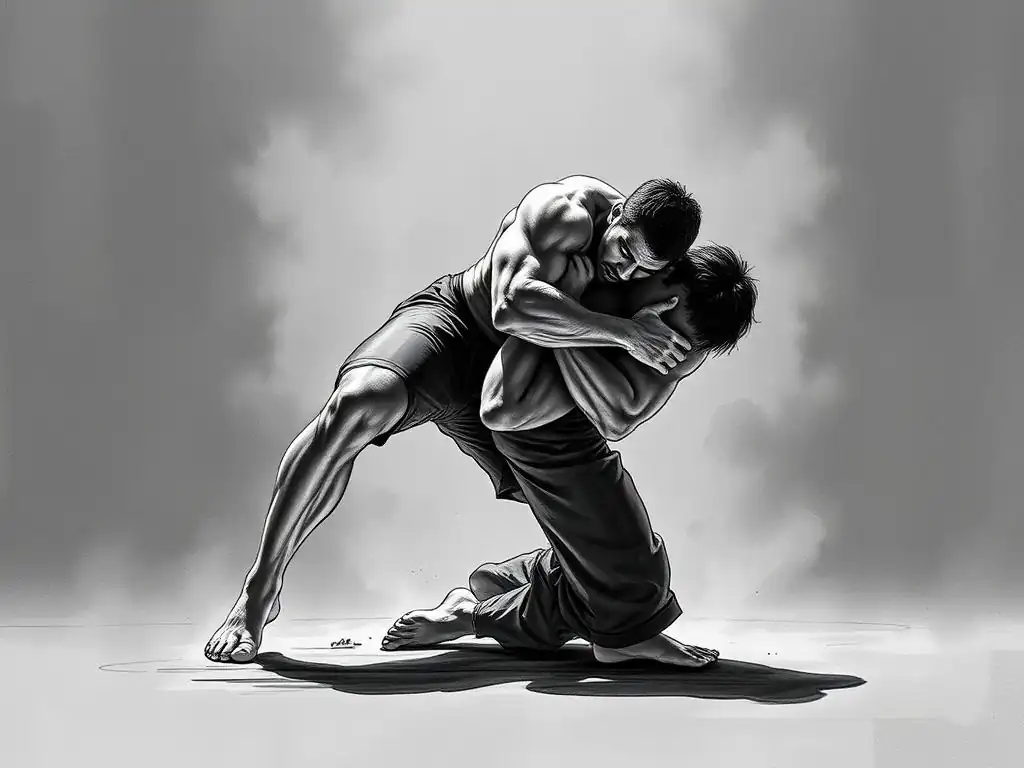
Harai Goshi, a fundamental sweeping hip throw, relies heavily on precise Sambo grip control techniques to generate the necessary off-balance and leverage. The most common grip setup involves an orthodox grip: a strong grip on the opponent's opposite lapel (e.g., right hand on their left lapel) and a grip on their sleeve (e.g., left hand on their left sleeve). The lapel grip is used to pull the opponent forward and across your body, breaking their balance onto their lead foot. The sleeve grip controls their arm, preventing them from posting out and helping to pull them onto you.
For a powerful Harai Goshi, the lapel grip should be high on the collar to maximize control over their upper body posture. As you turn in for the throw, the lapel grip pulls them tightly against your back, while the sleeve grip maintains tension and helps rotate their body.
A variation involves using a belt grip instead of or in addition to the lapel grip, providing even greater control over the opponent's hips for a stronger sweep. The ability to transition from a standard grip fight into this specific grip configuration seamlessly is a crucial element of successful Harai Goshi execution and demonstrates the application of Sambo grip control techniques in offensive transitions.
Grip Fighting for Osoto Gari (Major Outer Reaping)
Osoto Gari, a major outer reaping throw, is another technique where specific Sambo grip control techniques are paramount. While various grips can set up Osoto Gari, a common and effective approach uses a high grip on the opponent's lapel or shoulder with one hand and a sleeve grip with the other.
The high grip (e.g., right hand high on their left lapel or shoulder) is used to pull the opponent towards you and slightly backward, shifting their weight onto the leg you intend to reap. The sleeve grip (e.g., left hand on their left sleeve) prevents them from stepping back and helps control their balance sideways.
Some Sambo practitioners prefer a dominant same-side grip (e.g., right hand on right lapel, left hand on left sleeve) or even a cross grip for Osoto Gari. A cross grip on the far lapel (e.g., right hand on their right lapel) can be used to pull them strongly forward and across, forcing them onto their heels and making the reaping action more effective.
Regardless of the specific grip combination, the core principle remains: use your grips to disrupt the opponent's balance onto the leg you are targeting for the reap. Effective Sambo grip control techniques for Osoto Gari involve not just holding the fabric but actively pulling and pushing to create the desired off-balance before executing the leg action.
Grip Strategies for Tomoe Nage (Circle Throw)
Tomoe Nage, a dynamic sacrifice throw, often originates from specific Sambo grip control techniques that pull the opponent forward onto you. A classic setup involves a high cross-collar grip (e.g., left hand high on their right lapel or collar) combined with a sleeve grip on the opposite arm (e.g., right hand on their left sleeve). The high cross-collar grip is crucial as it allows you to pull the opponent's weight directly over your center as you fall backward.
Another effective grip strategy for Tomoe Nage is using a two-on-one grip on one of the opponent's sleeves or wrists, pulling that arm across their body, and then securing a high grip on their back or far shoulder with your free hand before dropping back. The key across all variations is using the grips to force the opponent's weight forward, making them susceptible to being pulled over your extended leg.
The power of Tomoe Nage comes from the combination of grip tension and body movement; the grips are the conduits through which you transfer your energy and off-balance the opponent. Mastering the timing of pulling with the grips as you fall is paramount for successful execution of this Sambo grip control technique application.
Implementing Leg Locks from Grip Control in Sambo
Setting Up Leg Locks with Specific Grips
Sambo's emphasis on leg locks makes the transition from upper-body grip control to lower-body attacks a crucial skill. Specific Sambo grip control techniques can be powerful tools for setting up leg lock entries.
For example, a strong belt grip, while often used for throws, can also be used to pull the opponent close and control their hips, making it easier to transition to a leg entanglement like an Achilles lock or a kneebar. As you pull them in for a throw that they defend by widening their base, the belt grip keeps them connected, allowing you to drop underneath and secure a leg.
Another common setup involves using sleeve and lapel grips to break the opponent's posture and force them to step forward heavily on one leg. As they commit their weight to that leg, you can use the grips to control their upper body while simultaneously dropping down to attack the exposed leg. A strong cross-collar grip can pull the opponent off-balance, creating a scramble where leg attacks become available.
The key is to use the upper-body grips to control the opponent's balance and reaction, creating the necessary opening to safely and effectively enter a leg entanglement. This fluid transition from standing Sambo grip control techniques to ground-based leg attacks is a hallmark of advanced Sambo.
Common Leg Lock Attacks from Kurtka Control
Once an opponent's leg is isolated or exposed through effective Sambo grip control techniques, the kurtka offers additional points of control for executing leg locks. For instance, after securing a leg entanglement like an outside leg reap (similar to a Heel Hook entry in BJJ, though Sambo focuses on Achilles/kneebar), you can use your free hand to grip the opponent's kurtka near their hip or belt. This grip provides crucial control over their body, preventing them from turning out of the entanglement or posturing up to relieve pressure on the leg.
Another application involves using kurtka grips while attacking an Achilles lock. As you secure the opponent's foot and ankle, using your free hand to grip their lapel or sleeve can help maintain control over their balance and prevent them from rolling to escape the pressure.
Similarly, when attacking a kneebar from a standing or transitional position, maintaining a grip on the opponent's kurtka (e.g., their pants or jacket near the knee or hip) helps stabilize their body and prevent them from straightening their leg or escaping the position. These Sambo grip control techniques on the kurtka provide secondary control points that complement the primary leg lock mechanics, increasing the likelihood of submission.
Defending Against Leg Locks While Maintaining Grips
Defending against leg locks in Sambo often involves breaking the opponent's grips on your leg and controlling their body. However, maintaining your own grips on the opponent's kurtka during a leg lock defense can be a highly effective counter-strategy. If an opponent is attempting a leg lock entry, maintaining a strong grip on their lapel, sleeve, or belt can allow you to control their posture and balance, potentially disrupting their ability to secure the leg lock entanglement effectively.
For example, if an opponent drops down for an Achilles lock entry, maintaining a strong high collar grip can allow you to pull them upwards, preventing them from fully committing their weight and body position to the attack. Similarly, if they are attempting a kneebar, using a grip on their kurtka near their hip can help you rotate your body or drive into them to relieve pressure on your knee.
By keeping a connection through your grips on their kurtka, you can influence their movement and posture even while defending your leg, complicating their attack and providing opportunities for escape or counter-attack. This highlights the multi-faceted nature of Sambo grip control techniques – they are vital for offense, defense, and transitions.
Drills to Improve Your Sambo Grip Strength and Control
Grip Strengthening Exercises for Sambo Practitioners
Developing formidable grip strength is foundational to effective Sambo grip control techniques. While specific Sambo drills help, incorporating targeted grip exercises is crucial. These don't require specialized Sambo equipment initially. Simple exercises like deadlifts, pull-ups, and rows build overall pulling strength, directly benefiting gripping power. More specific exercises include farmer's walks (carrying heavy weights for distance), plate pinches (holding weight plates together with just finger strength), and towel pull-ups (using towels draped over a bar to simulate gripping fabric).
Using a kurtka or gi during training adds sport-specific resistance. Practicing pull-ups or rows while gripping the fabric of a suspended kurtka or gi mimics real Sambo grip demands. Grip trainers, hand grippers, and rice buckets (submerging hands in rice and performing various movements) are also effective tools for improving finger and forearm strength, endurance, and dexterity. Consistency is key; incorporating 10-15 minutes of dedicated grip training several times a week can significantly enhance your ability to establish and maintain dominant Sambo grip control techniques in sparring and competition.
Partner Drills for Realistic Grip Fighting Scenarios
Partner drills are essential for translating raw grip strength into practical Sambo grip control techniques. These drills simulate the dynamic, unpredictable nature of real grip fighting. A basic drill involves two partners starting in a neutral stance, with the goal being simply to establish a dominant grip (e.g., high collar and sleeve) and prevent the opponent from doing the same for a set time (e.g., 30-60 seconds). This forces constant movement, grip attempts, and grip breaks.
More advanced partner drills can focus on specific scenarios:
- Grip Break & Establish: One partner establishes a strong grip, and the other's sole goal is to break it and establish their own dominant grip within a time limit.
- Positional Grip Fighting: Start from a specific position (e.g., collar-and-elbow tie) and fight for Sambo grip control techniques that allow for a specific throw entry.
- Continuous Grip Fighting: Partners continuously fight for grips, flowing from one grip attempt to another, without attempting throws. This builds endurance and reactive grip fighting skills.
These drills should be performed with increasing intensity, simulating the pressure of a real match and refining decision-making in the grip fight.
Solo Drills to Refine Grip Transitions and Maintenance
While partner work is crucial, solo drills can also improve specific aspects of Sambo grip control techniques, particularly transitions and maintenance. Using a suspended kurtka or a grappling dummy, practitioners can practice transitioning between different grip combinations (e.g., from an orthodox grip to a cross grip, or from a lapel grip to a belt grip). This helps build muscle memory for fluid hand movements and body positioning.
Solo drills can also focus on maintaining tension and applying pressure through the grips. Holding a specific grip combination on a suspended kurtka or dummy and practicing generating pulling or pushing forces while maintaining balance and posture helps reinforce proper body mechanics. Tasks might include:
- Hold a high collar grip and practice generating downward pulling force for 30 seconds.
- Transition from a sleeve grip to a belt grip on a dummy, repeating 10 times per side.
- Practice breaking an imaginary grip by yanking or rotating, simulating the body movement needed.
These solo exercises, though not replacing partner work, allow for high-repetition practice of specific Sambo grip control techniques mechanics, improving efficiency and speed in dynamic situations.
Troubleshooting Common Sambo Grip Fighting Problems
Dealing with a Stronger Opponent
Facing an opponent with significantly greater physical strength is a common challenge in Sambo grip fighting. Relying solely on brute force to maintain or break grips against a stronger opponent is often ineffective and exhausting. Instead, focus on technique, leverage, and timing. Against a stronger opponent, precision in Sambo grip control techniques becomes paramount. Aim for high-percentage grips that offer mechanical advantage, such as deep lapel grips high on the collar or grips that control the opponent's sleeve close to their body, limiting their ability to extend and generate force.
Use movement and angles to your advantage. Instead of trying to muscle a grip break, use footwork and body rotation to create angles that compromise the opponent's base and make their grip weaker. For example, if they have a strong grip on your lapel, step away and turn your shoulder sharply to apply leverage against their hold.
Focus on breaking their grips quickly and explosively before they can solidify them. If they establish a dominant grip, don't panic; use systematic grip breaks rather than just pulling away. Against a stronger opponent, conserving energy by fighting smart, not hard, is key to effective Sambo grip control techniques.
Overcoming Defensive Grip Strategies
Some opponents employ highly defensive grip strategies, such as constantly gripping low on your sleeves or pants, avoiding deep grips, or immediately stripping your grips as you establish them. Overcoming these tactics requires patience and adaptability in your Sambo grip control techniques. Against an opponent who avoids deep grips, focus on establishing strong, controlling grips wherever available – even shallow sleeve grips can be used to control distance and set up attacks if used correctly.
If an opponent is constantly stripping your grips, you need to become highly efficient at re-establishing them or transitioning immediately to an attack as they break your hold. Use fakes and feints with your grip attempts to draw reactions. Sometimes, offering a shallow grip deliberately can bait the opponent into reaching, creating an opening for you to secure a deeper, more dominant grip elsewhere.
Persistence is crucial; keep attempting to establish your preferred Sambo grip control techniques while being ready to adapt and attack from less ideal grips if necessary. Consider using grips like the collar tie or shoulder grip, which are harder for opponents to strip quickly compared to lapel or sleeve grips.
Adapting Your Grips to Different Body Types
Opponent body type significantly influences effective Sambo grip control techniques. Taller, lankier opponents may offer easier access to high collar grips but can use their reach to keep you at bay or establish strong grips from a distance. Shorter, stockier opponents might be harder to reach for high grips but offer easier access to belt or low sleeve grips and can generate immense power in close. Adapting your grip strategy based on your opponent's build is essential.
Against a taller opponent, focus on closing the distance and securing grips that limit their reach, such as sleeve grips that pin their arm to their body or grips that force them to bend at the waist (e.g., low lapel grips combined with pulling). Don't allow them to establish their long-range Sambo grip control techniques like outstretched sleeve grips. Against a shorter opponent, capitalize on opportunities for belt grips or grips that allow you to leverage your height, such as high shoulder grips if you can get them.
Be mindful of their lower center of gravity and power in close quarters. Practice grip fighting against partners of varying body types to develop the intuition needed to adapt your Sambo grip control techniques on the fly.
The Importance of Hand Placement in Sambo Grip Control
Optimizing Hand Position for Leverage and Power
Precise hand placement is fundamental to maximizing the effectiveness of Sambo grip control techniques. Simply grabbing the fabric is not enough; the way you position your fingers, palm, and wrist relative to the opponent's kurtka dictates the leverage and power you can generate. For a lapel grip, a deep grip with your fingers wrapped around the fabric and your thumb inside provides much more control than a shallow grip with just your fingertips. The knuckles should be pressed against the opponent's chest or shoulder to provide solid connection and leverage.
On a sleeve grip, gripping close to the opponent's elbow gives more control over their arm extension and movement than gripping near the wrist. A "pistol grip" (rolling the fabric into a tight bundle) offers a very secure hold. For a belt grip, getting your fingers underneath the belt itself provides a much stronger connection to their core than just gripping the fabric of the jacket near the belt line.
Understanding these nuances of hand position allows you to apply pressure more effectively, break the opponent's balance with less effort, and maintain your Sambo grip control techniques against resistance. Even a slight adjustment in hand position can significantly impact the power of your throw or the security of your hold.
Avoiding Common Hand Placement Mistakes
Several common mistakes in hand placement can undermine effective Sambo grip control techniques. One is gripping too loosely or shallowly, which allows the opponent to easily strip the grip or simply pull away. Another is placing the hand in a position that compromises your own structure or balance, such as reaching too far or crossing your arms awkwardly. Gripping too tightly with excessive forearm tension without engaging the rest of the body can also lead to quick fatigue without providing significant control.
Placing your thumb on the outside of the lapel or sleeve (instead of inside or reinforcing the grip) is another common error that results in a weaker, less secure hold. Furthermore, allowing your wrist to be bent or weak in the grip compromises your ability to transfer force.
Effective Sambo grip control techniques require a strong, stable wrist and forearm connected to a solid core and base. Avoid letting your hands become isolated from the rest of your body's structure; the power of the grip comes from your entire body working in unison, channeled through the precise hand placement on the kurtka.
Hand Placement for Collar Tie, Sleeve Control, and Lapel Grip
Specific hand placements are optimized for different types of grips in Sambo. For a collar tie (often a precursor to other grips or techniques), the hand is placed high on the back of the opponent's neck or collar, with fingers providing downward pressure to control posture. The palm might press against their neck, or the fingers wrap around the fabric depending on the desired control. This hand placement is designed for breaking posture and setting up head-and-arm control or throws.
For sleeve control, gripping near the elbow provides maximum control over the opponent's ability to extend their arm and maintain distance. The hand should wrap around the fabric firmly, with fingers curled and thumb reinforcing the grip. The goal is to effectively "shorten" their arm. For a lapel grip, particularly a high collar grip, the hand should reach deep into the collar, with fingers wrapping around the thick seam or fabric.
The thumb can be placed inside the lapel for reinforcement (a "pistol grip") or outside, depending on preference and the specific technique being set up. The deeper the grip and the higher on the collar, the more control you have over the opponent's upper body and ability to breathe comfortably, adding pressure. Mastering these specific hand placements is fundamental to executing effective Sambo grip control techniques.
Integrating Sambo Grip Control into Your Overall Game
Combining Grips with Footwork and Movement
Sambo grip control techniques are not static; they are dynamic tools that must be integrated with footwork and movement. Simply holding a grip without moving is ineffective. Your grips should guide your movement and disrupt your opponent's, while your footwork should constantly seek better angles and maintain your balance. For example, using a sleeve grip to pull the opponent forward can be combined with a lateral step to circle them off-balance. A lapel grip used to break posture can be combined with a forward step to drive them back.
Effective Sambo grip control involves using your grips to initiate reactions from your opponent and using your footwork to capitalize on those reactions. If you pull with a sleeve grip and they pull back, step into that backward momentum for a throw. If you push with a lapel grip and they step back, follow them with your footwork to maintain pressure.
Drills that combine grip fighting with specific footwork patterns (e.g., circling while maintaining grips, stepping and pulling simultaneously) are crucial for developing this integration. Think of your hands and feet working together: the grips control the opponent's upper body and arms, while the feet control distance, angles, and your own base.
Using Grips to Set Up Other Attacks and Submissions
Sambo grip control techniques are rarely ends in themselves; they are primarily means to set up throws, takedowns, and submissions. A dominant grip creates opportunities. A strong collar grip can set up a variety of throws like O Goshi or Tai Otoshi. A deep sleeve grip can be used to control an arm for an armbar entry or to set up throws like Kouchi Gari (Minor Inner Reaping). The grip dictates the available options.
Furthermore, combining grip control with feints or pressure can create openings. Applying strong pressure with a lapel grip can cause the opponent to resist by posturing up, creating an opportunity to transition to a leg attack as they shift their weight. Using a strong two-on-one grip on an arm can lead directly into an armbar or a sweep. The art lies in recognizing the opportunities created by your Sambo grip control techniques and transitioning seamlessly into an attack. This requires not just strong grips but also a deep understanding of Sambo techniques and transitions.
Using Grip Fighting to Control Distance and Tempo
The grip fight is the primary mechanism for controlling distance and tempo in Sambo. By establishing and maintaining grips, you dictate how close or far you are from your opponent and the pace of the match. Maintaining close-range grips like collar ties or belt grips forces a close-quarters fight, suitable for powerful hip throws or close-in leg attacks. Keeping grips at a slightly longer range, like sleeve and lapel grips with extension, allows for throws that require more space, like Osoto Gari or Tai Otoshi.
An opponent who excels at Sambo grip control techniques can slow down a fast-paced match by establishing heavy, controlling grips, preventing dynamic movement. Conversely, they can accelerate a slow match by using explosive grip breaks and rapid grip changes to create openings. The grip fight is a strategic battle over space and time. By mastering grip control, you gain the ability to impose your preferred distance and tempo on the match, forcing your opponent to fight on your terms, which is a significant tactical advantage.
Conclusion: The Path to Sambo Grip Mastery
Mastering Sambo grip control techniques is a lifelong pursuit, fundamental to success in this dynamic martial art. It involves not just developing physical strength but also cultivating strategic understanding, technical precision in hand placement, and the ability to adapt to different opponents and situations. From the foundational orthodox grip to advanced combinations and transitions, effective grip fighting is the engine that drives Sambo's throws, takedowns, and submissions.
The journey to grip mastery requires dedicated training, incorporating specific strength exercises, realistic partner drills, and focused solo practice. It demands constant refinement of grip breaks, maintenance strategies, and the seamless integration of grips with movement and attack. By prioritizing Sambo grip control techniques, practitioners unlock the full potential of the kurtka as a tool for manipulation and leverage, transforming the simple act of holding fabric into a sophisticated art form that dictates the flow and outcome of the fight.
Frequently Asked Questions
What is the Kurtka and why is it important in Sambo grip control?
The Kurtka is the traditional jacket worn in Sambo. It's crucial because most Sambo grip control techniques rely on manipulating the Kurtka to control your opponent's movements and posture.
What are some basic Sambo grip control techniques a beginner should learn first?
Beginners should focus on mastering fundamental grips like the sleeve grip, lapel grip, and belt grip. These form the foundation for more advanced throws and submissions.
How does Sambo grip control differ from grip fighting in other grappling arts like Judo or Wrestling?
While there's overlap, Sambo grip control emphasizes controlling the Kurtka for takedowns and submissions. Judo also uses a jacket, but wrestling focuses more on direct body control.
What are some strategies for breaking an opponent's strong grips in Sambo?
Employ techniques like wrist rotations, pulling the Kurtka away from the body, and using footwork to create space and disrupt their balance. Grip fighting is key to controlling the match.
How can I improve my Sambo grip strength and endurance for better grip control?
Incorporate exercises like pull-ups, deadlifts, and grip-specific training using tools like grip strengtheners and thick bars. Consistent practice and drilling grip fighting scenarios are vital.
Final Reflection: Mastering the Art of Control
The techniques explored in this article, detailing the intricacies of Sambo grip control, are more than just a collection of maneuvers; they represent a profound understanding of leverage, balance, and the subtle art of imposing one's will. In a world increasingly defined by chaos and uncertainty, the ability to establish and maintain control, both physically and mentally, resonates deeply. The principles of Sambo grip control, therefore, extend far beyond the mat, offering valuable lessons in strategy, adaptability, and the pursuit of mastery in any domain.
The influence of Sambo, and its emphasis on gripping and control, continues to shape the landscape of grappling arts. The relentless pursuit of superior grip control not only enhances competitive performance but also cultivates a deeper connection to the art itself, fostering a sense of discipline and respect. The essence of strategy is to create a situation where your opponent has no choice but to submit.
This quote, though applicable to combat sports, speaks to a universal truth: understanding and controlling the dynamics of any situation is paramount to achieving success.
As you reflect on the techniques and principles outlined in this article, consider how you can apply them not only to your Sambo practice but also to the challenges you face in your daily life. Embrace the pursuit of mastery, cultivate your ability to control your environment, and remember that true strength lies not just in physical power, but in the unwavering control of your mind and body. Let the lessons of Sambo grip control empower you to navigate the complexities of life with confidence, resilience, and unwavering determination.
Unleash Your Sambo Grip Mastery!
Thank you for exploring the art of Sambo grips! Now that you've unlocked these powerful techniques, it's time to put them into action and elevate your grappling game. Ready to dominate the kurtka?
- Start drilling! Focus on perfecting the fundamental grips detailed in this article with a training partner. Consistency is key to building muscle memory and mastering control.
- Explore variations. Experiment with different grip combinations on the kurtka to discover what works best for your style and body type. Share your findings with your training partners!
- Join the community. Connect with fellow Sambo enthusiasts on our forum to discuss techniques, share training tips, and learn from each other's experiences.
What innovative grip combination are you most excited to try in your next training session?