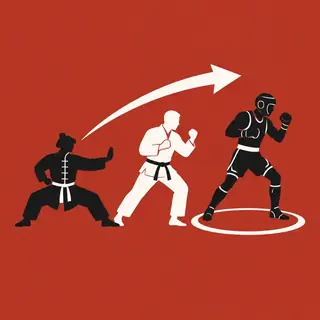
The Fear Factor: Understanding and Overcoming CompetitionInduced Anxiety
Fear of competition in martial arts can cripple performance. This article delves into the psychological roots of competition anxiety in martial arts,…
Read article

Unlock your full potential with expert guidance on training for competition, where strategy, peaking, and mindset converge to forge champions. Master tactical fight planning, periodize your training to hit peak performance at the exact right moment, and cultivate the unshakable mental resilience that separates victors from the rest. Whether you’re stepping into your first local tournament or chasing a national title, these proven methods will sharpen your edge, optimize recovery, and build the warrior’s focus needed to dominate under pressure. Elevate your fight IQ and transform preparation into victory.

Fear of competition in martial arts can cripple performance. This article delves into the psychological roots of competition anxiety in martial arts,…
Read article
🏆 Conquer your nerves and dominate the competition. This essential guide unlocks the secrets of martial arts confidence building, empowering you with…
Read article
🥋 Silence that nagging "inner critic martial arts" voice before training. Discover how to conquer self-doubt, unlock your potential, and master your…
Read article
deception in competitive martial arts is a crucial skill. Master deceptive feints to outmaneuver opponents and achieve victory on the mats.
Read article
🛡️ Master the art of "Deceptive Defense" on MartialArtsMastery.org. Learn strategic trap defense techniques to outwit and neutralize opponents, turning their aggression…
Read article
🔥 Conquer grueling fights with peak performance. This guide unveils essential martial arts energy management techniques, crucial for sustained power and strategic…
Read article
🏆 Unlock peak performance on fight day. Discover how a meticulously crafted pre-competition ritual, tailored for martial arts, can be your ultimate…
Read articleCompeting in martial arts is a transformative journey that demands more than just physical skill. This subcategory dives deep into the tactical, physiological, and psychological pillars that separate podium finishers from the rest. Whether you’re preparing for a local grappling tournament, a kickboxing bout, or a national forms championship, you’ll discover proven frameworks for strategic game planning, periodized peaking, and mental resilience. Here, we transform raw talent into championship-level performance, ensuring you step onto the mat with clarity, confidence, and a winning edge.
Competitive success begins long before the first bell. A robust strategy involves studying your opponent’s tendencies—their stance, favorite combinations, and glaring weaknesses—while also auditing your own strengths under pressure. Learn to create a flexible game plan that adapts to live exchanges, integrating predictive counters, distance management, and rhythm-breaking tactics. Specific scouting templates help you categorize rivals into archetypes (pressure fighters, counter-strikers, grapplers), allowing you to drill targeted responses that exploit predictable patterns.
Beyond reading opponents, strategy is about controlling the narrative of the match. You’ll explore how to dictate pace, choose the battleground (clinch, outside, ground), and use feints to force reactions. Decision-tree training is introduced, where you practice branch scenarios—what to do if your takedown is stuffed, or your jab is constantly parried. By internalizing these contingency plans, you reduce in-fight hesitation, turning every exchange into a calculated move rather than a hopeful guess. This section ensures your head is as sharp as your hands and feet.
Physical peak performance is an art of timing, not just effort. This facet explains how to manipulate training volume, intensity, and frequency to arrive at competition day feeling explosive, fresh, and powerful. You’ll learn the science of tapering—reducing workload by 40-60% in the final 7-14 days while maintaining skill mastery and neural activation. Emphasis is placed on the difference between overreaching and overtraining, helping you avoid the dreaded staleness that ruins many contenders.
Equally critical is smart weight management. Instead of dangerous crash dieting, we cover gradual cutting, water-loading protocols, and nutrient timing to make weight safely while preserving muscle glycogen and cognitive function. Energy system periodization ensures you have the right fuel for your sport’s demands—whether you need explosive ATP for 3-minute rounds or sustained aerobic output for 10-minute bouts. Recovery strategies, including sleep optimization and active recovery days, are detailed to maximize your body’s adaptive response, so you hit peak force and speed exactly when it matters.
The mental battlefield is often where championships are won or lost. Here, we decode the psychological toolkit used by elite athletes, starting with imagery and visualization techniques— rehearsing successful techniques, overcoming adversity, and seeing victory vividly. You’ll learn to program your subconscious for confidence by pairing mental rehearsal with physiological relaxation, creating a neural blueprint that fires faster than your opponent can react.
Pressure handling is another cornerstone. This section introduces reframing anxiety as excitement, using controlled breathing to lower heart rate variability, and developing a pre-fight ritual that signals “ready” to your nervous system. We also cover how to manage mid-fight setbacks: what to do when you’re losing, hit with a surprise, or feeling fatigue. Self-talk strategies replace destructive thoughts with process-oriented affirmations, keeping your focus on the next action rather than the scoreboard. By mastering your internal dialogue, you turn adversity into a rallying point, demonstrating that calm composure under fire is a trainable skill.
Peak performance is impossible without deliberate recovery. This subcategory dissects the post-training and post-competition protocols that accelerate muscle repair, reduce soreness, and mitigate injury risk. You’ll explore contrast baths, compression therapy, and mobility routines that target high-impact joints—knees, shoulders, and hips—common in martial arts. Active rest weeks are scheduled intentionally to prevent chronic overuse injuries while maintaining a base level of conditioning.
Injury prevention goes beyond stretching; it’s about load management and technique refinement. We cover how to identify early warning signs of tendonitis, stress fractures, and ligament strain, plus how to modify training to avoid setbacks without losing progress. Return-to-play protocols are explained, ensuring that any minor issue does not become a major layoff. Also, we emphasize the importance of sleep as the ultimate recovery tool—prescribing 8-10 hours and nap strategies that directly correlate with reaction time and immune function, keeping you injury-free and ready for your next camp.
Nothing replicates the chaos of a real match like high-quality simulation. This section teaches you how to structure competition-style sparring sessions that mimic rounds, scoring, and the psychological intensity of the event. You’ll learn to design live drills with specific rules—e.g., no leg kicks for a week, or starting with 30 seconds of explosive output—to force adaptability. Video analysis of your sparring becomes a powerful tool, helping you identify leaks in your guard, footwork errors, and missed counters.
Beyond physical simulation, we address the “unknown” variables: different venues, judges’ biases, and rule set nuances. Visualizing the environment—the smell of the mats, the roar of the crowd—reduces first-time distraction. You’ll also practice “open” sparring where techniques are unpredictable, building improvisation skills. By treating every practice spar as a mini-final, you condition your nervous system to remain cool under chaotic exchanges, ensuring that when the bell rings for real, your body and mind have already been there countless times.
Success isn’t just the final week; it’s the entire macrocycle leading up to it. This facet outlines how to build a 12-16 week competition camp, breaking it into distinct phases: foundational volume, strength-power development, skill sharpening, and peaking. Each phase has specific goals, training “density,” and testing checkpoints—such as regular sparring assessments or power output tests—to confirm progress. Load management ensures you don’t peak too early, with deliberate deload weeks woven into the calendar.
We also discuss how to integrate multiple competitions into a season, using a periodization pyramid that prioritizes “A” (target) events over “B” or “C” qualifiers. Recovery weeks after each bout are non-negotiable, and we provide templates for adjusting your plan if you’re forced to miss training days due to illness or injury. Team communication and coach-athlete feedback loops are stressed, so your plan stays dynamic. By the end, you’ll have a clear roadmap that turns your raw material into a polished, ring-ready competitor.
Typically, begin tapering 10-14 days before your event. Reduce training volume by 40-50% while keeping intensity high, meaning fewer repetitions but at competition speed. Use the first three days for heavy technical rehearsal, then drop to 30 minutes of light sparring and drills. Aim for your final two days to be very light, focusing on mobility, visualization, and short explosive bursts. This preserves neural sharpness while allowing muscles to fully recover.
Avoid dropping more than 1-2% of body weight per week. Start by reducing carbohydrate intake gradually and increasing water consumption to about 1.5 gallons daily, then in the final 48 hours, reduce water to 1 gallon, then half, and cut sodium. Use a “water-loading” phase followed by a dry-out, but eat high-protein meals and complex carbs early. On weigh-in day, replenish with electrolytes and simple sugars to restore muscle glycogen, not fat.
Reframe nerves as excitement—that adrenaline is fuel. Practice box breathing (4-4-4-4) for five minutes in the locker room, then perform a dynamic warm-up (jumping jacks, shadowboxing) to burn off excess energy. Create a ritual: listen to a specific song, tie your belt a certain way, or say a confident phrase. Visualize yourself executing your first attack successfully, which shifts mental focus from fear to action.
Immediately shorten your output—focus on footwork and defense, not powerful strikes. Use your breath: exhale sharply on every technique, inhale deeply during clinching or standing still. Make your opponent chase you to reset the pace, then explode with three quick, sharp shots. Train “high-energy burst” drills in sparring that simulate fatigue, so your body knows how to push through the wall with technique, not panic.
Only 1-2 hard sparring sessions per week, spaced at least 48 hours apart. The rest of your sparring should be “technical” at 50-60% intensity to reinforce skills without CNS fatigue. In the final two weeks, reduce hard sparring to none—replace with light touch, shadowboxing, and focus mitts to sharpen timing. The goal is to arrive neurologically fresh, so excessive hard sparring close to the event can blunt your reflexes.