
Precision Strikes: The Importance of Targeting in Martial Arts Forms


Welcome to Martial Arts Mastery, your ultimate resource for unlocking the secrets of combat traditions worldwide. Delve into the heart of precision and power as we explore the critical role of targeting techniques in martial arts. Are you ready to elevate your forms and unlock a deeper understanding of striking mastery? Let's begin.
- Introduction: Unveiling the Power of Precise Targeting in Martial Arts Forms
- Understanding Targeting Techniques in Martial Arts
- Precision Striking in Different Martial Arts Styles: A Comparative Analysis
- Refining Your Targeting Skills Through Form Practice
- Common Mistakes in Targeting and How to Avoid Them
- The Benefits of Mastering Targeting Techniques in Martial Arts Forms
- Conclusion: Mastering the Art of Precision Striking
-
Frequently Asked Questions
- How crucial is precise targeting in martial arts training?
- What are some common targeting points emphasized in martial arts?
- How does understanding anatomy contribute to better targeting in martial arts?
- How can I improve my targeting accuracy during martial arts practice?
- Does the martial art style I practice influence the targeting techniques I learn?
- Final Reflection: The Art of Focused Power
- Unleash Your Inner Accuracy!
Introduction: Unveiling the Power of Precise Targeting in Martial Arts Forms
The Role of Forms (Kata/Poomsae/Taolu) in Developing Targeting Skills
Martial arts forms, known by various names such as Kata in Karate, Poomsae in Taekwondo, or Taolu in Kung Fu, are structured sequences of movements that simulate combat scenarios against imaginary opponents. While often viewed as mere performance or tradition, their primary purpose is deeply rooted in practical application.
Forms serve as a vital training tool for developing fundamental skills, and among the most critical is the mastery of targeting techniques martial arts practitioners rely upon in real-world situations. Through repetitive execution of strikes, blocks, and movements within a predefined sequence, students internalize the correct angles, distances, and points of impact.
The intricate choreography of a form is designed to engrain muscle memory, allowing techniques to be performed instinctively and powerfully. Consider a specific strike within a Kata; its trajectory, the chambering of the hand or foot, and the final point of extension are all meticulously prescribed. This precision isn't arbitrary; it guides the practitioner to aim for specific, vulnerable areas on an opponent.
By practicing these sequences repeatedly, the body learns the optimal path and force application for hitting a designated target, even without a physical opponent present. This consistent practice of targeting techniques martial arts forms facilitate builds a foundational understanding of anatomy and leverage points critical for effective self-defense.
Why Accurate Targeting Matters in Martial Arts Applications
In any combative scenario, whether sparring or self-defense, the difference between a technique that merely connects and one that is truly effective often lies in accurate targeting. A powerful punch or kick directed at a non-vital area may have little impact, whereas even a less forceful strike delivered precisely to a vulnerable point can incapacitate an attacker or create a crucial opening. Mastering targeting techniques martial arts emphasize allows practitioners to maximize the efficiency of their movements, conserving energy while delivering maximum effect. This is paramount in situations where survival may depend on ending a confrontation quickly and decisively.
Moreover, accurate targeting is not solely about inflicting damage; it is also about control and disruption. Techniques aimed at joints, balance points, or nerve clusters can neutralize a threat without necessarily causing severe injury, aligning with the self-defense principle of using appropriate force. For instance, a precise strike to the knee can disrupt an attacker's mobility, or pressure on a nerve point can temporarily stun. The study of targeting techniques martial arts forms teach provides a blueprint for understanding these applications, ensuring that the skills developed in the dojo, dojang, or kwoon translate effectively to practical self-protection scenarios.
Understanding Targeting Techniques in Martial Arts
Anatomical Vulnerabilities: Key Target Areas for Effective Strikes
Understanding human anatomy is fundamental to effective targeting techniques martial arts teach. The body is not uniformly resilient; certain areas are inherently more vulnerable to strikes, pressure, or manipulation due to the presence of vital organs, nerve clusters, major blood vessels, or delicate bone structures. Martial arts systems have, over centuries, identified and categorized these points to optimize the impact of their techniques. Focusing strikes on these areas increases the likelihood of achieving desired outcomes, such as disorientation, pain compliance, temporary paralysis, or even incapacitation.
A comprehensive study of martial arts targeting techniques involves learning the location and effect of striking or applying pressure to these specific points. While the ethical application of such knowledge is paramount, the technical understanding is crucial for effectiveness. For example, a strike to the jaw can cause a knockout due to its connection to the brain and potential to disrupt balance.
A kick to the knee joint can compromise stability and mobility. Forms often implicitly or explicitly guide practitioners to aim for these areas through the height and angle of their techniques, reinforcing the importance of anatomical awareness in martial arts targeting.
Vital Points and Pressure Points (Kyusho-Jutsu)
Vital points, often referred to as Kyusho in Japanese martial arts, are specific locations on the body where nerves, blood vessels, or organs are close to the surface or particularly vulnerable to impact or pressure. Targeting these points can produce effects ranging from intense pain and muscle spasm to temporary paralysis, loss of consciousness, or even fatality if extreme force is applied. While the study of Kyusho-Jutsu is a specialized field, basic knowledge of common vital points is integrated into many traditional martial arts forms and techniques.
- Solar Plexus: A large network of nerves located below the rib cage. A strike here can cause difficulty breathing, nausea, and temporary incapacitation.
- Temple: The side of the head, where the skull is relatively thin and major blood vessels are close to the surface. A strike can cause concussion or loss of consciousness.
- Groin: Contains sensitive nerves and organs. A strike here causes intense pain and often immediate collapse.
- Nerve Points: Specific locations like the side of the neck (carotid sinus), behind the ear (mastoid process), or along the limbs where pressure or striking can cause pain or temporary motor dysfunction.
The precise angle and depth of application are critical when targeting vital or pressure points. Forms practice helps develop the necessary control and accuracy. For example, a downward strike in a form might be aimed at the collarbone (clavicle), a relatively fragile bone that, if fractured, can severely limit arm movement. Understanding why a technique is performed at a specific height and angle within a form reveals its intended target and potential effect.
Targeting Nerve Clusters and Bone Structures
Beyond vital organs and classic pressure points, martial arts targeting techniques also focus on nerve clusters and specific bone structures. Nerves are highly sensitive to impact or compression. Striking areas where major nerves run close to the bone surface, such as the ulnar nerve at the elbow (the "funny bone") or nerves along the shin bone, can cause intense, debilitating pain and temporary loss of function in the affected limb.
Bone structures themselves are also prime targets. Joints like the knee, elbow, ankle, and wrist are particularly vulnerable to strikes, locks, and hyperextension. A strike to the side of the knee can damage ligaments and tendons, severely impairing mobility. A strike to the bridge of the nose can cause disorientation and pain.
Targeting the collarbone or ribs can result in fractures that hinder an opponent's ability to defend or attack. Forms often contain techniques specifically designed to attack these structures, such as downward hammer fists aimed at the collarbone or side kicks directed at the knee. Practicing these movements within the structured environment of a form helps students internalize the correct trajectory and impact point for these specific targeting techniques martial arts deem effective.
Targeting Distances and Range Control
Effective targeting techniques in martial arts are not solely about where to hit, but also from what distance. Understanding and controlling the distance between you and your opponent, known as range control, is paramount. Each technique has an optimal range for maximum power and effectiveness. A punch thrown from too far away will lack power and might overextend the practitioner, while one thrown from too close might be jammed. Similarly, a kick requires space to generate power and reach its target effectively.
Forms practice implicitly teaches range control by requiring techniques to be executed with specific extensions and footwork. The distance covered in a stance transition or the reach of a specific strike within a form corresponds to the intended engagement range. For instance, a long-range fighting stance might transition into a short-range technique, simulating closing distance to attack a specific target. Mastering these movements within forms helps students develop an intuitive sense of distance, enabling them to select and apply the appropriate targeting techniques martial arts offer based on their proximity to an opponent.
Mastering the Correct Distance for Optimal Impact
The power generated in a martial arts technique comes not just from muscle force but from body mechanics, including weight transfer, hip rotation, and kinetic chain alignment. All these elements converge most effectively when the technique lands at its optimal range.
For a straight punch (like a reverse punch in Karate or a straight lead in Boxing-influenced styles), the optimal range is typically where the arm is extended but not locked out, allowing for snap and recoil. For a front kick (Ap Chagi in Taekwondo), the ideal distance allows the hip to drive forward fully as the leg extends, impacting with the ball of the foot or heel on the target.
Practicing forms helps students refine their internal sense of distance. The precise footwork and body movements associated with each technique in a form dictate the range at which it is meant to be applied. By repeating these sequences, the practitioner develops muscle memory that instinctively recognizes and adjusts to the correct distance for executing specific targeting techniques martial arts forms emphasize. This internal calibration is invaluable when transitioning from static form practice to dynamic sparring or self-defense, allowing for rapid assessment and execution of techniques at the appropriate range.
Adjusting Techniques for Different Opponent Sizes and Stances
Real-world opponents come in various sizes and adopt different stances, which affects the effective target areas and the distance required to reach them. A technique aimed at the midsection of a taller opponent might need to be adjusted downwards for a shorter one. An opponent with a bladed stance presents different open targets than one in a square stance. Skilled martial artists must be able to adapt their targeting techniques martial arts training provides to these variables.
Forms, while often performed against an imaginary opponent of a fixed size, lay the groundwork for this adaptability. By understanding the principle behind a technique and its intended target within the form, practitioners can learn to modify the execution slightly to suit different situations.
For example, a standard punch height in a form might be aimed at a typical solar plexus level, but a skilled practitioner understands the punch can be angled up for the jaw or down for the sternum depending on the opponent. This ability to apply targeting techniques martial arts forms teach with flexibility is a hallmark of advanced skill.
Precision Striking in Different Martial Arts Styles: A Comparative Analysis
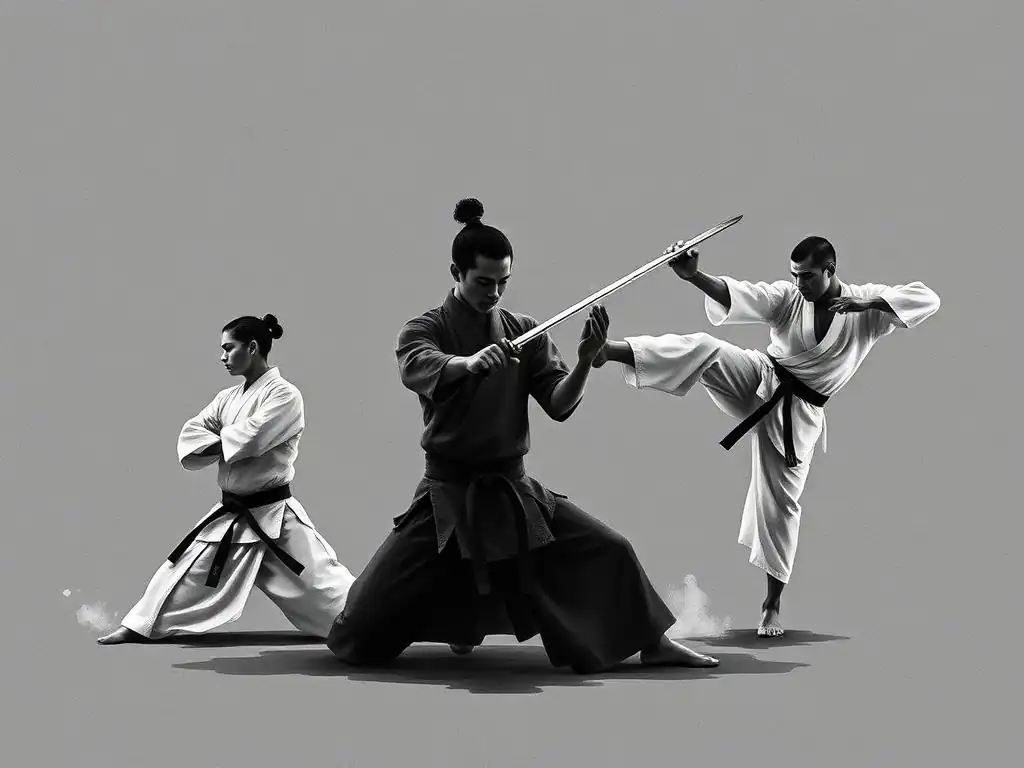
Targeting techniques martial arts styles employ vary significantly based on their primary focus, typical range of engagement, and favored body weapons (hands, feet, elbows, knees, grappling). While the underlying anatomical vulnerabilities remain constant, how different styles exploit them through their forms and techniques provides a fascinating comparison. Examining specific examples within the forms of different styles highlights the diverse approaches to precision striking.
Karate: Focusing Power Through Precise Targeting
Karate, particularly traditional Okinawan and Japanese styles, emphasizes powerful, linear strikes delivered with maximum force often through hip rotation and rooted stances. Precision targeting is crucial because many techniques are designed to end an encounter with a single decisive blow (ikken hissatsu - "one strike, certain kill"). Forms (Kata) are central to Karate training, meticulously detailing the angle, height, and focus point for each technique, inherently teaching specific targeting techniques martial arts Karateka practice.
Empi Uchi in Heian Godan: Targeting the Solar Plexus
Consider the Empi Uchi (elbow strike) found in the Kata Heian Godan (Peaceful Mind, Level 5), a common form in Shotokan and other Karate styles. Towards the end of the Kata, after stepping forward into a straddle stance (Kiba Dachi), a practitioner executes a sharp, downward elbow strike. This movement is typically aimed at the solar plexus or potentially the spine of an opponent who is close and perhaps bent over.
The execution in the Kata is precise: the elbow travels downwards with force generated from the core and gravity, the other hand often chambered tightly or protecting the face. The downward trajectory and the power focused into the small point of the elbow make this an extremely effective strike for disrupting breathing and causing significant pain when delivered to the solar plexus. Practicing this Empi Uchi in the Kata repeatedly ingrains the correct body mechanics, angle, and the specific downward targeting techniques martial arts Karate forms like Heian Godan emphasize for close-range vital point strikes.
Taekwondo: Utilizing Leg Techniques for Accurate Strikes
Taekwondo is renowned for its dynamic kicking techniques, often involving high and fast strikes. While impressive aesthetically, these techniques are also formidable weapons when applied with precision targeting. Taekwondo forms (Poomsae) guide practitioners in executing these complex kicks and hand techniques with accuracy, illustrating various targeting techniques martial arts Taekwondo favors for different ranges and situations, particularly focusing on the torso and head.
Ap Chagi in Taegeuk Il Jang: Targeting the Midsection
The Ap Chagi (front kick) is a foundational technique appearing early in the Taekwondo Poomsae sequence, such as in Taegeuk Il Jang (Great Extremes, Level 1). This simple yet effective kick is typically aimed at the opponent's midsection – the sternum, solar plexus, or abdomen. The Poomsae requires lifting the knee high, extending the leg sharply, and impacting with the ball of the foot or instep, retracting quickly.
Practicing the Ap Chagi within Taegeuk Il Jang emphasizes kicking straight forward and level, maintaining balance, and focusing power through the core. This consistent practice teaches the correct trajectory and height for targeting the central mass of an opponent, a common target area in Taekwondo sparring. The Poomsae drills the fundamental motion and targeting techniques martial arts like Taekwondo utilize for effective linear kicks to the torso, setting the stage for more complex variations.
Kung Fu: Diverse Targeting Strategies for Varied Opponents
Kung Fu encompasses a vast array of styles, each with its own forms (Taolu) and unique approach to combat. This diversity translates into a wide range of targeting techniques martial arts practitioners of Kung Fu employ, often incorporating strikes to multiple levels, joint locks, throws, and pressure point attacks within flowing, dynamic movements. Kung Fu forms often simulate engagements with multiple attackers or opponents of different sizes and fighting styles.
Quan Tui in Changquan: Targeting the Groin
Changquan (Long Fist), a prominent Northern Chinese Kung Fu style, is known for its expansive, long-range movements, agile footwork, and powerful kicks. A common technique is the Quan Tui (circular kick or hook kick), which can be adapted to target various areas. However, a fundamental low-line kick found in many basic Changquan sequences involves a quick, deceptive kick often aimed at the groin or inner thigh.
In some Changquan Taolu, a low, fast kick is executed, often sweeping or hooking inwards. This technique, while seemingly simple, requires precise timing and trajectory to bypass an opponent's guard and strike a vulnerable low-line target like the groin. The form practice emphasizes speed and the ability to deliver the kick with minimal telegraphing. This specific application highlights how Kung Fu targeting techniques martial arts practitioners learn can involve deceptive angles and focus on immediately debilitating targets to disrupt an opponent's base and defense.
Aikido: Targeting Joint Locks and Off-Balancing Techniques
Aikido, founded by Morihei Ueshiba, is primarily a defensive martial art focused on blending with an attacker's movement and redirecting their energy to control them through joint locks, throws, and pins. While not focused on striking vital points in the same way as striking arts, Aikido employs precise targeting techniques martial arts practitioners use to disrupt an attacker's balance and structure, specifically targeting joints to apply leverage and control. Aikido does have forms (often practiced with a partner, known as Kata) and solo exercises that build the body mechanics for these techniques.
Shiho Nage in Suwariwaza: Targeting the Elbow Joint
Shiho Nage (Four Corner Throw) is a fundamental Aikido technique performed from various positions, including Suwariwaza (seated techniques). In Suwariwaza practice, Tori (the defender) receives a grab or attack from Uke (the attacker) and applies Shiho Nage to control and throw Uke. The core of this technique involves precisely targeting and controlling the attacker's elbow joint and wrist to break their balance and execute the throw.
The Aikido Kata or practice drill for Shiho Nage in Suwariwaza involves specific movements to gain control of Uke's arm, apply pressure and leverage to the elbow joint in a specific direction (often upwards and outwards), and turn the body to complete the throw. This requires acute awareness of the opponent's structure and precise targeting of the elbow joint to apply the technique effectively without relying on brute force. The solo movements and partner drills in Aikido forms practice develop the sensitivity and precision needed for these joint-focused targeting techniques martial arts like Aikido utilize for control and throws.
Refining Your Targeting Skills Through Form Practice
Forms are not just sequences to be memorized; they are dynamic blueprints for combat application. Refining targeting techniques martial arts forms teach requires dedicated, intelligent practice that goes beyond simply moving through the steps. It involves deep understanding, visualization, and specific training methods to bridge the gap between the solo performance of a form and its practical use.
Visualization and Mental Imagery for Enhanced Precision
One of the most powerful tools for improving targeting techniques martial arts forms offer is visualization. As you perform a form, actively imagine an opponent standing before you. See their size, their stance, and specifically, visualize the target area you are aiming for with each technique. If the form calls for a punch to the midsection, picture the solar plexus; if it's a kick, visualize the knee joint or the ribs.
This mental rehearsal enhances focus and intent. It turns abstract movements into purposeful actions directed at specific points. By consistently visualizing the target during form practice, you train your mind to connect the movement with its intended application, improving accuracy and commitment when performing the technique in a real scenario. This type of focused mental imagery is a critical step in mastering targeting techniques martial arts practitioners rely on for effectiveness.
Slow Motion Practice and Repetition for Muscle Memory
Practicing forms in slow motion allows for meticulous attention to detail – the angle of a strike, the exact trajectory of a block, the precise point of extension. This method helps identify and correct subtle errors in body mechanics that can affect targeting accuracy. By slowing down, you can ensure your hand or foot is aligned correctly, your body weight is properly transferred, and your technique is aimed precisely at the intended target area as dictated by the form.
High-speed repetition is also essential for building muscle memory. Once the correct mechanics are understood through slow practice, repeating the form or specific sequences at increasing speeds helps to engrain the movements so deeply that they become automatic. This allows for rapid, accurate execution of targeting techniques martial arts require in dynamic situations. The combination of slow, deliberate practice for precision and fast repetition for speed and ingrained response is key to mastering targeting techniques through forms.
Partner Drills: Bridging the Gap Between Forms and Sparring
While solo form practice is fundamental, working with a partner is crucial for developing practical targeting skills. Partner drills allow practitioners to apply the targeting techniques martial arts forms teach against a moving, resisting opponent (or at least a partner providing realistic resistance). This helps adapt the movements learned in the abstract form to the dynamic reality of interaction.
Drills can involve one partner providing a target area (like a hand or padded limb) for the other to strike or lock, or more complex scenarios simulating attacks found within forms. This immediate feedback helps refine distance, timing, and accuracy. It highlights whether the angle and height practiced in the form are effective against a real person and allows for adjustments. Partner drills are indispensable for translating the theoretical targeting techniques martial arts forms represent into practical, applicable skills.
Pad Work and Heavy Bag Training for Power and Accuracy
Pad work (working with a partner holding focus mitts, Thai pads, or a body shield) and heavy bag training are excellent ways to develop both power and accurate targeting. These tools provide physical targets that simulate the resistance and impact points of an opponent. Unlike air techniques in forms, hitting a pad or bag gives tactile feedback, confirming whether the strike landed correctly and with sufficient force.
When practicing targeting techniques martial arts forms contain, use pad or bag work to specifically drill those techniques. If a form has a specific punch aimed at the head level, practice that exact punch on focus mitts held at head height. If it has a kick aimed at the midsection, practice it on a body shield. This reinforces the targeting learned in the form with real impact training, developing power, accuracy, and the ability to hit a specific point under pressure.
Common Mistakes in Targeting and How to Avoid Them
Even with dedicated form practice, practitioners can fall into common pitfalls that undermine targeting accuracy and effectiveness. Recognizing these mistakes is the first step to correcting them and refining one's targeting techniques martial arts training aims to perfect.
Overextending and Losing Balance
A frequent error is overextending a strike in an attempt to reach a target, especially when distance is misjudged. This not only reduces the power of the technique but also leaves the practitioner off-balance, vulnerable to counter-attack. Overextension often occurs when trying to hit a target that is just out of reach or when failing to step in properly.
To avoid this, focus on maintaining proper structure and balance during form practice. Ensure that techniques finish with the body in a stable position, ready for the next movement or to defend. Pay close attention to the footwork within the form, as it dictates the correct distance for each technique. If a technique in the form ends with a specific stance, ensure your live application ends with the same stability. Practicing forms with correct range control ingrained helps prevent overextension in application, thus improving targeting techniques martial arts require for stability.
Telegraphing Strikes and Losing the Element of Surprise
Telegraphing means giving away your intention to strike before the technique is executed, often through unnecessary movements like drawing the hand back excessively or tensing the shoulders. This allows an opponent to anticipate and evade or block the attack, rendering the targeting ineffective, regardless of how precise the aim was.
Forms practice, when done correctly, emphasizes efficient, direct movement. Techniques should be executed with minimal wasted motion. Focus on launching strikes directly from their chambered or ready positions as shown in the form, without unnecessary preparatory movements. Pay attention to keeping the body relaxed until the moment of impact. Analyzing and eliminating telegraphing during form practice directly translates to more deceptive and effective targeting techniques martial arts practitioners can employ in sparring or self-defense.
Ignoring Distance and Range Management
As discussed earlier, failing to manage distance is a major impediment to effective targeting. Attempting a long-range kick when too close, or a short-range elbow when too far away, results in ineffective techniques and missed opportunities. This often stems from insufficient attention to footwork and spatial awareness during training.
Forms inherently teach range management through their footwork and technique combinations. Practice forms with a conscious awareness of how each step and movement alters the distance to the imaginary opponent. Understand the optimal range for each technique within the form. Supplementing form practice with partner drills focused on distance control helps bridge the gap to live application, reinforcing the crucial link between range management and successful targeting techniques martial arts emphasize.
The Benefits of Mastering Targeting Techniques in Martial Arts Forms
Mastering targeting techniques martial arts forms help develop yields numerous benefits, enhancing not only combative effectiveness but also overall understanding and appreciation of the art.
Increased Striking Power and Effectiveness
When a strike lands precisely on a vulnerable or intended target area, its impact is significantly amplified. Even a technique performed with moderate force can be highly effective if delivered to a weak point. By focusing power onto a small, specific area, practitioners maximize the potential damage or disruptive effect of their strikes.
Forms practice, which emphasizes precise angles and points of focus, directly contributes to this. The repetitive motion trains the body to deliver force along the correct trajectory to hit the intended target accurately. This results in targeting techniques martial arts practitioners execute becoming far more potent and efficient.
Improved Reaction Time and Reflexes
Consistent practice of forms, especially when incorporating visualization of an opponent, trains the mind and body to react quickly and appropriately. By internalizing the sequences and intended targets, practitioners develop faster recognition of opportunities and a more immediate response.
When faced with a real-world situation, the ingrained movements and targeting awareness developed through forms allow for quicker assessment of the situation and rapid execution of the appropriate targeting techniques martial arts provide. This reduction in reaction time is critical in self-defense scenarios.
Enhanced Self-Defense Capabilities
Ultimately, the goal of many martial arts practitioners is effective self-defense. Mastering targeting techniques is perhaps the most critical skill for achieving this. Knowing where to strike to disable or deter an attacker quickly and efficiently is paramount for survival.
Forms provide a safe and structured environment to learn these vital applications. By practicing techniques aimed at specific vulnerable points, practitioners build the knowledge and muscle memory necessary to apply these targeting techniques martial arts forms teach under pressure, significantly enhancing their ability to protect themselves.
Deeper Understanding of Martial Arts Principles
Beyond the physical benefits, focusing on targeting techniques within forms deepens a practitioner's understanding of the underlying principles of their martial art. It reveals the practical reason behind specific movements, stances, and transitions.
Understanding why a particular technique in a form is performed at a certain height or angle unlocks its combative application. This insight transforms form practice from rote memorization into a study of applied physics, anatomy, and strategy, leading to a richer and more meaningful engagement with the martial art. Mastering targeting techniques martial arts forms embody is key to unlocking this deeper knowledge.
Conclusion: Mastering the Art of Precision Striking
Precision striking, guided by effective targeting techniques martial arts forms instill, is a cornerstone of practical martial arts application. It elevates techniques from mere movements to purposeful actions designed to achieve a specific effect on an opponent. Forms serve as the foundational training ground, embedding the correct body mechanics, angles, and awareness necessary for accurate and powerful strikes and joint manipulations.
From the vital points targeted in Karate Kata to the joint control emphasized in Aikido forms, each style's approach to targeting is woven into the fabric of its traditional sequences. Understanding and actively practicing the targeting techniques martial arts forms present transforms abstract movements into applicable self-defense skills, maximizing effectiveness while conserving energy.
Integrating Targeting Techniques into Your Overall Martial Arts Training
To truly master targeting techniques, they must be a conscious focus throughout all aspects of your martial arts training.
- Forms: Practice forms with intent, visualizing the target for each technique. Analyze why the technique is performed in a specific way and what its intended effect is.
- Basic Techniques: When practicing individual strikes or blocks, always aim for a specific point, even if it's just an imaginary one.
- Partner Drills: Use partner drills and pad work to practice hitting specific targets on a person or equipment, bridging the gap from solo forms.
- Sparring: While sparring is dynamic, try to apply the targeting principles learned, aiming for open areas rather than just making contact anywhere.
By making targeting a central theme, you enhance the practical value of every training session.
The Ongoing Journey of Skill Refinement and Mastery
Mastering targeting techniques martial arts offer is not a destination but a continuous journey. It requires ongoing study, practice, and refinement. As you progress, your understanding of anatomy, body mechanics, and strategy will deepen, allowing for ever-increasing precision and effectiveness.
Embrace the study of targeting within your forms practice. Seek guidance from instructors on the specific applications and intended targets of techniques in your style's forms. Through diligent practice and a focused approach, you will unlock the full potential of your martial arts training, transforming your techniques into truly precise and powerful strikes. The pursuit of mastering targeting techniques martial arts teach is a rewarding path leading to greater skill, confidence, and a deeper connection to your art.
Frequently Asked Questions
How crucial is precise targeting in martial arts training?
Targeting is absolutely crucial in martial arts. It allows for maximum impact and efficiency, turning basic techniques into highly effective self-defense maneuvers. Without proper targeting, power is wasted.
What are some common targeting points emphasized in martial arts?
Common targets include vital areas like the solar plexus, temples, and groin. These points are vulnerable areas where strikes can quickly incapacitate an opponent, regardless of their size.
How does understanding anatomy contribute to better targeting in martial arts?
Knowing the underlying anatomy allows martial artists to exploit weak points in the body. Understanding bone structure, nerve clusters, and muscle weaknesses leads to more effective and precise strikes.
How can I improve my targeting accuracy during martial arts practice?
Focus on slow, deliberate movements during training. Use targets like pads or dummies to practice striking specific areas. Regular drills and visualization exercises will enhance accuracy over time.
Does the martial art style I practice influence the targeting techniques I learn?
Yes, different martial arts styles prioritize different targets and techniques. Some focus on pressure points, while others emphasize large muscle groups. Understanding your style's core principles is key.
Final Reflection: The Art of Focused Power
The journey through the intricacies of targeting techniques in martial arts forms reveals a truth that resonates far beyond the dojo: precision is paramount. What begins as a study of anatomical vulnerabilities and strategic strikes culminates in an understanding of focused intent and the efficient application of power, principles that hold profound relevance in our daily lives.
The discipline cultivated through mastering targeting in martial arts extends into all facets of existence. It teaches us to identify our goals, to analyze the obstacles, and to apply our efforts with unwavering focus. This is not merely about physical prowess; it's about cultivating a mindset of clarity and purpose. Knowing yourself and knowing your opponent, you need not fear the result of a hundred battles.
- Sun Tzu. This ancient wisdom underscores the enduring importance of understanding both the target and the self in achieving any objective.
As you step away from this exploration of targeting techniques, consider how you can apply these principles to your own endeavors. Where can you refine your focus? Where can you eliminate wasted energy? Embrace the art of precision, and you will find that the power to achieve your goals lies within your ability to target them with unwavering intent.
Unleash Your Inner Accuracy!
Thank you for exploring the nuances of targeting in martial arts forms with us. We hope you've gained a deeper appreciation for the precision and focus required. Now, it's time to put that knowledge into action!
Here are a few ways to continue your journey:
- Refine your focus: Dedicate 15 minutes in your next training session to meticulously practicing the targeting of each strike in your primary form. Feel the connection between your intention and the point of impact.
- Share your insights: Discuss the importance of precise targeting with your training partners, and compare techniques to refine your approach.
- Explore historical accuracy: Research the historical context of your form's targeting, uncovering the real-world applications behind each movement.
What specific targeting challenge are you most eager to overcome in your training?